MIXING AND HOMOGENIZATION
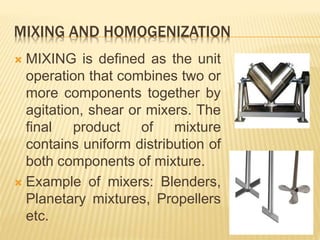
 MIXING is defined as the unit
operation that combines two or
more components together by
agitation, shear or mixers. The
final product of mixture
contains uniform distribution of
both components of mixture.
 Example of mixers: Blenders,
Planetary mixtures, Propellers
etc.
ADVANTAGES/APPLICATIONS OF MIXING
 To obtain uniform composition of the mixed
components.
 To enhance physical & chemical reaction of
mixed components.
 To improve dissolution & diffusion of mixture.
 To get true solution after mixing two miscible
liquids.
 Mixing is essential to produce emulsion when
two immiscible liquids are mixed together with
emulsifying agent.
 To produce a solution after mixing a solid with
liquid.
 To produce semisolid products like ointments,
suppository after mixing a solid or liquid with
semisolid base.
 Mixing is essential in manufacturing of tablets &
capsules to get proper mixture of solid powders.
TYPES OF MIXTURES
 Positive mixtures
Mixtures formed from two or more miscible liquids
or gases through diffusion process are positive
mixtures. Such mixtures requires no energy &
creates no problem. e.g: solution, syrup, etc
 Negative mixtures
Mixtures formed from immiscible components like
solid & liquid to form suspension or emulsion are
negative mixtures. Such mixtures require more
energy & may separate out. e.g: suspension,
emulsion, etc
 Neutral mixtures
Mixtures formed from different components
like solid & liquid to form static mixtures are
neutral mixtures. Such mixtures do not easily
mix but once mixed they do not separate
easily. e.g: paste, ointments, etc
LIQUID MIXING
Liquid mixing is divided into following
subgroup:
1. Mixing of liquid and liquid
i. Mixing of two or more miscible liquids
ii. Mixing of two or more immiscible liquids
2. Mixing of liquid & solid
i. Mixing of liquids & soluble solids
ii. Mixing of liquids & insoluble solids
MECHANISM OF MIXING
 Bulk Transport
 Laminar Mixing
 Turbulent Mixing
 Molecular Diffusion
LIQUID MIXERS
 Shaker Mixers
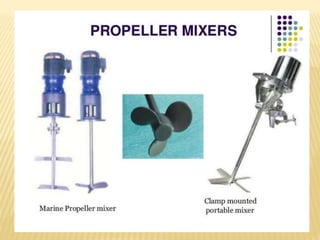
 Propeller Mixers
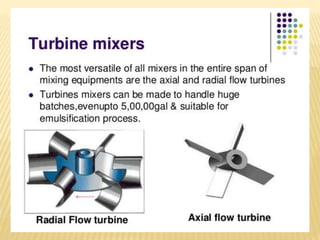
 Turbine Mixers
 Paddle Mixers
SHAKER MIXER
PADDLE MIXER
SOLID MIXING
MECHANISM OF SOLID MIXING:
 Convective Mixing: Mixing of the bulk
particles as a whole from one container to
another. Also known as bulk transport.
 Shear Mixing: Mixing of particles using
shear forces by agitator or stream of air.
 Diffusive Mixing: Mixing of materials by
random movement of particles along its
different layers through diffusion process.
PROCESS OF MIXING
1. Expansion of solid bed occurs so the mixing
equipment should be filled about 60% of its
volume.
2. Application of 3-Dimensional shear forces.
3. Mixing time should be optimum to prevent
aggregation & separation of particles.
4. Avoid demixing due to particle breakdown.
FACTORS AFFECTING MIXING OF SOLID
PARTICLES:
1. Particle size
2. Particle shape
3. Density
4. Porosity
5. Volume
6. Flow properties & charge
7. Mixing mechanism
8. Mixing time
9. Surface area
SEMISOLID MIXING
 Mixing of liquid with semi-solid
 Mixing of solid with semi-solid
 Semisolid mixing involves dispersion of liquid or
solid materials in the semi-solid base. They are
neutral mixtures that do not separate out easily.
Miscible liquid & soluble solid are easily mixed with
low force & short time. However, immiscible liquids
& insoluble solids are mixed with help of
emulsifying agent or wetting agent.
 Semisolid mixing equipments: Ribbon blender,
Triple roller mill, Planetary mixture, Colloid mill, etc.
MIXING EQUIPMENTS
1. TRIPLE ROLLER MILL
Triple roller mill consists of 3 horizontal
rollers which moves at different speeds.
There is very small gap between rollers
which can be adjusted according to the
need. Materials coming between rollers is
crushed, depending upon the gap & also
sheared by the difference in rate of
movement between two surfaces. The size
reduction is due to attrition & this method is
effective for dispersions of solid in semi-
HOPPER
ROLLERS
SCRAPPER
A B C
The material is fed through the hopper into
roller A & B where they are crushed or
dispersed. Then they are passed to roller B &
C where they are further crushed & smooth
mixture is formed. Finally the mixture is
removed by the scrapper from the rollers.
Uses: Semi-solid mixing, solid mixing
2. PLANETARY MIXER
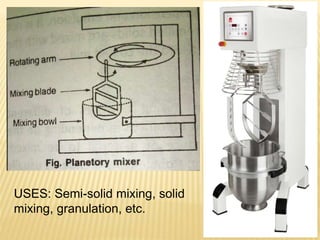
Planetary mixer consists of rotating arm &
mixing arm attached to a stationery wall.
Mixing arm consists of mixing blades
attached to it which moves around its own
axis & also moves around central axis. This
makes mixing of material in every part of the
mixing vessel. The rotation of mixer is similar
to rotation of planets in its own axis & also
around the sun as central axis. It is used in
mixing of solids & semisolids
USES: Semi-solid mixing, solid
mixing, granulation, etc.
3. DOUBLE CONE MIXER/ BLENDER
 It consists of large double cone shaped tank used
for mixing solid powders with different densities.
Mixing occurs by the rotation of blender usually at
30 to 100 rpm. The solid powders are fed &
discharged from same opening/port. Mixing is very
efficient in blenders because of optimum rotation of
powders with different densities.
 Some blender consists of cylindrical tank with
mixing blades attached to a shaft along the axis of
the tank. These blades helps to split powders & mix
efficiently.
Double cone blender
Octagonal blender
V blender
USES: SOLID MIXING,POWDER MIXING
4. COLLOID MILL
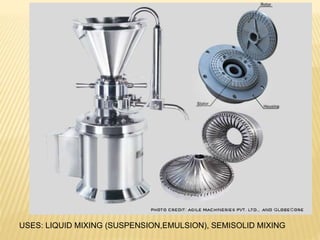
 Colloid mill consists of a conical rotor and
stator. The distance between rotor and stator
is adjusted between 0.005 to 0.075 cm. The
rotor is connected to a high speed motor
which can revolve at a speed of 3000 to
20000 rpm.
 The fine material (premilled) is feed to
hopper and size of material is reduced as it
passes through moving rotor and stator. It
works on the principle of shearing.
 It is used in the dispersion of suspension &
USES: LIQUID MIXING (SUSPENSION,EMULSION), SEMISOLID MIXING
HOMOGENIZATION
 Homogenization is the process of converting
non-uniform mixture to a colloidal state or a
uniform mixture. It is done by reducing
particle size of mixtures or uniform dispersion
of the mixtures making the product
homogenous.
 e.g: converting coarse emulsion to colloidal
emulsion
 Homogenizers are used for the preparation
of biphasic systems like suspensions,
HOMOGENIZERS
 Modified Turbines: It consists of turbine &
stator at a certain distance in the mixer. The
rotation of turbines at very high speed
creates a pressure difference & reduces the
particle size. The particles & fluids pass
through the stator & turbines which produces
mechanical forces to obtain uniform or
homogenized mixture.
 Pressure Homogenizer: It consists of high
pressure pump fitted to stainless steel fluid
tank. The high pressure is responsible for
homogenization of solid dispersed in the
liquid.
 Ultrasonic Homogenizer is an example of
pressure homogenizer where ultrasonic
waves (frequency above 20000 Hz) are
generated for mixing or uniform dispersion of
the mixtures. The ultrasonic waves produces
shear effect responsible for size reduction &
homogenization. It is used primarily for

Pharmaceutical Mixing & Homogenization

  • 1.
    MIXING AND HOMOGENIZATION MIXING is defined as the unit operation that combines two or more components together by agitation, shear or mixers. The final product of mixture contains uniform distribution of both components of mixture.  Example of mixers: Blenders, Planetary mixtures, Propellers etc.
  • 2.
    ADVANTAGES/APPLICATIONS OF MIXING To obtain uniform composition of the mixed components.  To enhance physical & chemical reaction of mixed components.  To improve dissolution & diffusion of mixture.  To get true solution after mixing two miscible liquids.
  • 3.
     Mixing isessential to produce emulsion when two immiscible liquids are mixed together with emulsifying agent.  To produce a solution after mixing a solid with liquid.  To produce semisolid products like ointments, suppository after mixing a solid or liquid with semisolid base.  Mixing is essential in manufacturing of tablets & capsules to get proper mixture of solid powders.
  • 4.
    TYPES OF MIXTURES Positive mixtures Mixtures formed from two or more miscible liquids or gases through diffusion process are positive mixtures. Such mixtures requires no energy & creates no problem. e.g: solution, syrup, etc  Negative mixtures Mixtures formed from immiscible components like solid & liquid to form suspension or emulsion are negative mixtures. Such mixtures require more energy & may separate out. e.g: suspension, emulsion, etc
  • 5.
     Neutral mixtures Mixturesformed from different components like solid & liquid to form static mixtures are neutral mixtures. Such mixtures do not easily mix but once mixed they do not separate easily. e.g: paste, ointments, etc
  • 6.
    LIQUID MIXING Liquid mixingis divided into following subgroup: 1. Mixing of liquid and liquid i. Mixing of two or more miscible liquids ii. Mixing of two or more immiscible liquids 2. Mixing of liquid & solid i. Mixing of liquids & soluble solids ii. Mixing of liquids & insoluble solids
  • 7.
    MECHANISM OF MIXING Bulk Transport  Laminar Mixing  Turbulent Mixing  Molecular Diffusion
  • 8.
    LIQUID MIXERS  ShakerMixers  Propeller Mixers  Turbine Mixers  Paddle Mixers
  • 9.
  • 12.
  • 13.
    SOLID MIXING MECHANISM OFSOLID MIXING:  Convective Mixing: Mixing of the bulk particles as a whole from one container to another. Also known as bulk transport.  Shear Mixing: Mixing of particles using shear forces by agitator or stream of air.  Diffusive Mixing: Mixing of materials by random movement of particles along its different layers through diffusion process.
  • 14.
    PROCESS OF MIXING 1.Expansion of solid bed occurs so the mixing equipment should be filled about 60% of its volume. 2. Application of 3-Dimensional shear forces. 3. Mixing time should be optimum to prevent aggregation & separation of particles. 4. Avoid demixing due to particle breakdown.
  • 15.
    FACTORS AFFECTING MIXINGOF SOLID PARTICLES: 1. Particle size 2. Particle shape 3. Density 4. Porosity 5. Volume 6. Flow properties & charge 7. Mixing mechanism 8. Mixing time 9. Surface area
  • 16.
    SEMISOLID MIXING  Mixingof liquid with semi-solid  Mixing of solid with semi-solid  Semisolid mixing involves dispersion of liquid or solid materials in the semi-solid base. They are neutral mixtures that do not separate out easily. Miscible liquid & soluble solid are easily mixed with low force & short time. However, immiscible liquids & insoluble solids are mixed with help of emulsifying agent or wetting agent.  Semisolid mixing equipments: Ribbon blender, Triple roller mill, Planetary mixture, Colloid mill, etc.
  • 17.
    MIXING EQUIPMENTS 1. TRIPLEROLLER MILL Triple roller mill consists of 3 horizontal rollers which moves at different speeds. There is very small gap between rollers which can be adjusted according to the need. Materials coming between rollers is crushed, depending upon the gap & also sheared by the difference in rate of movement between two surfaces. The size reduction is due to attrition & this method is effective for dispersions of solid in semi-
  • 18.
  • 19.
    The material isfed through the hopper into roller A & B where they are crushed or dispersed. Then they are passed to roller B & C where they are further crushed & smooth mixture is formed. Finally the mixture is removed by the scrapper from the rollers. Uses: Semi-solid mixing, solid mixing
  • 20.
    2. PLANETARY MIXER Planetarymixer consists of rotating arm & mixing arm attached to a stationery wall. Mixing arm consists of mixing blades attached to it which moves around its own axis & also moves around central axis. This makes mixing of material in every part of the mixing vessel. The rotation of mixer is similar to rotation of planets in its own axis & also around the sun as central axis. It is used in mixing of solids & semisolids
  • 21.
    USES: Semi-solid mixing,solid mixing, granulation, etc.
  • 22.
    3. DOUBLE CONEMIXER/ BLENDER  It consists of large double cone shaped tank used for mixing solid powders with different densities. Mixing occurs by the rotation of blender usually at 30 to 100 rpm. The solid powders are fed & discharged from same opening/port. Mixing is very efficient in blenders because of optimum rotation of powders with different densities.  Some blender consists of cylindrical tank with mixing blades attached to a shaft along the axis of the tank. These blades helps to split powders & mix efficiently.
  • 23.
    Double cone blender Octagonalblender V blender USES: SOLID MIXING,POWDER MIXING
  • 24.
    4. COLLOID MILL Colloid mill consists of a conical rotor and stator. The distance between rotor and stator is adjusted between 0.005 to 0.075 cm. The rotor is connected to a high speed motor which can revolve at a speed of 3000 to 20000 rpm.  The fine material (premilled) is feed to hopper and size of material is reduced as it passes through moving rotor and stator. It works on the principle of shearing.  It is used in the dispersion of suspension &
  • 25.
    USES: LIQUID MIXING(SUSPENSION,EMULSION), SEMISOLID MIXING
  • 26.
    HOMOGENIZATION  Homogenization isthe process of converting non-uniform mixture to a colloidal state or a uniform mixture. It is done by reducing particle size of mixtures or uniform dispersion of the mixtures making the product homogenous.  e.g: converting coarse emulsion to colloidal emulsion  Homogenizers are used for the preparation of biphasic systems like suspensions,
  • 27.
    HOMOGENIZERS  Modified Turbines:It consists of turbine & stator at a certain distance in the mixer. The rotation of turbines at very high speed creates a pressure difference & reduces the particle size. The particles & fluids pass through the stator & turbines which produces mechanical forces to obtain uniform or homogenized mixture.
  • 28.
     Pressure Homogenizer:It consists of high pressure pump fitted to stainless steel fluid tank. The high pressure is responsible for homogenization of solid dispersed in the liquid.  Ultrasonic Homogenizer is an example of pressure homogenizer where ultrasonic waves (frequency above 20000 Hz) are generated for mixing or uniform dispersion of the mixtures. The ultrasonic waves produces shear effect responsible for size reduction & homogenization. It is used primarily for