Gout It is a metabolic disorder characterized by
hyperuricaemia (normal plasma urate 2–6 mg/dl).
Uric acid, a product of purine metabolism, has low
water solubility, especially at low pH.
When blood levels are high, it precipitates and
deposits in joints, kidney and subcutaneous tissue.
DRUGS FOR GOUT
ACUTE GOUT
• NSAIDS
• Colchicine
• Corticosteroids
CHRONIC GOUT
Uricosurics
• Probenecid
• Sulfinpyrazone
Synthesis Inhibitors
• Allopurinol
• Febuxostat
NSAIDS
Strong antiinflammatory drugs like Naproxen,
Piroxicam, Diclofenac, Indomethacin or Etoricoxib
have beneficial effects on acute Gout.
They inhibit the synthesis of Prostaglandins and
inhibit chemotactic migration of leucocytes into the
inflamed joint.
Thus they reduce inflammation in gout.
COLCHICINE
It is a plant alkaloid obtained from Colchicum
autumnale which specifically suppresses gouty
inflammation.
MOA: Colchicine binds to protein tubulin and inhibits
microtubule formation, arresting granulocyte motility
and decreasing inflammation.
Colchicine also inhibits leukocyte chemotaxis,
formation of glycoprotein and phagocytosis.
Indication:
• Antiinflammatory in Gout (NSAIDs alternative)
• Chondritis
• Prophylaxis of Gout
Dose: 1mg starting and then 0.5mg 2-3 hourly until
pain reduces (total 3 doses/day)
Adverse effects
• Nausea, Vomiting, Abdominal Pain, Diarrhoea
• Myopathy, Neutropenia, Aplastic anaemia,
Alopecia (prolong use)
Contraindications
• Pregnancy
• Liver disease
• Renal disease
• Cardiovascular disease
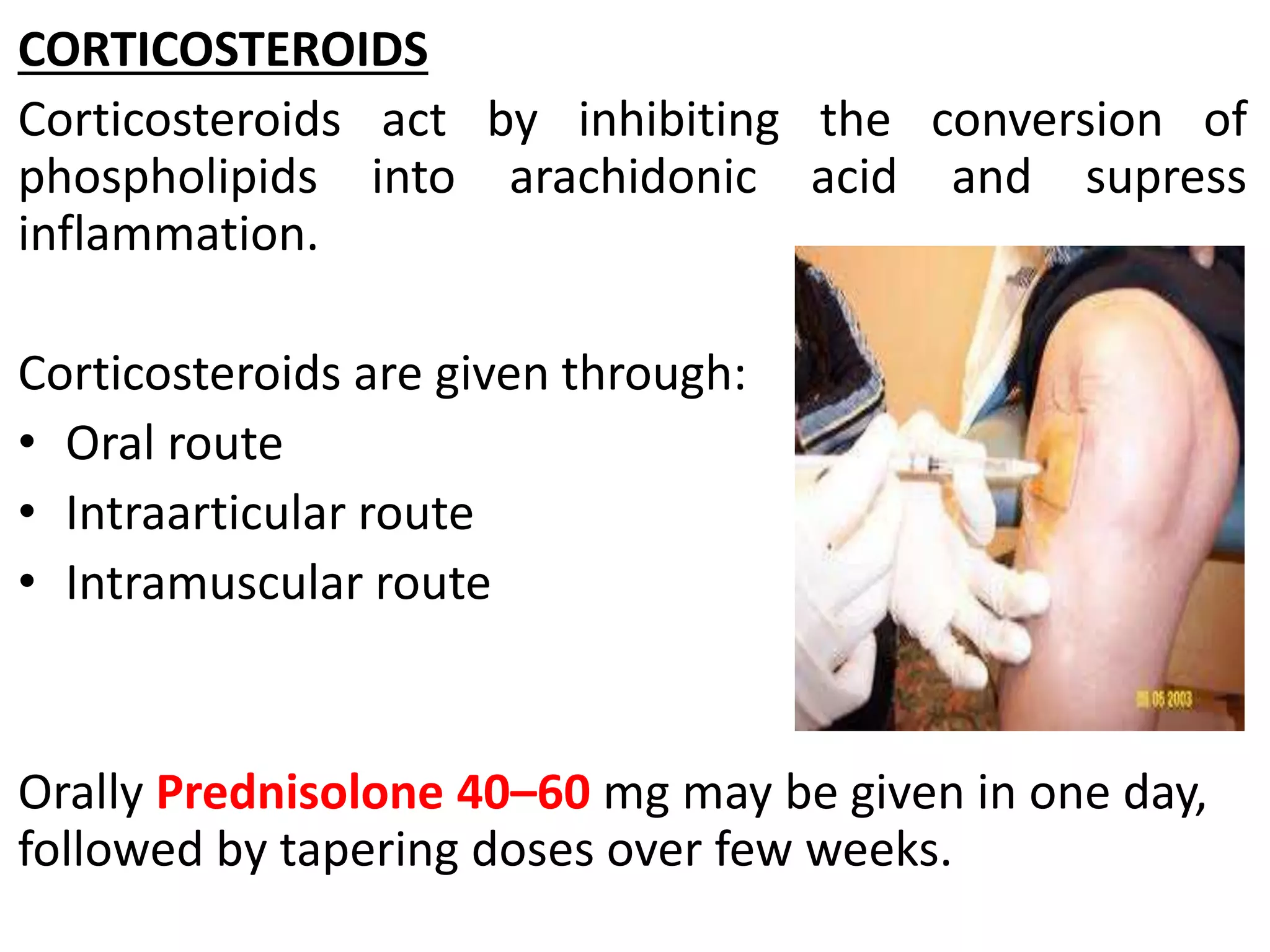
CORTICOSTEROIDS
Corticosteroids act by inhibiting the conversion of
phospholipids into arachidonic acid and supress
inflammation.
Corticosteroids are given through:
• Oral route
• Intraarticular route
• Intramuscular route
Orally Prednisolone 40–60 mg may be given in one day,
followed by tapering doses over few weeks.
URICOSURICS: The drugs that promote renal clearance
of uric acid by inhibiting urate reabsorption.
PROBENECID
MOA: It Inhibits the tubular reabsorbtion of urate, thus
increasing the urinary excretion of uric acid & decreasing
serum urate level.
Indications:
• Chronic Gout & Hyperuricemia
• Prolong the action of Penicillin
Dose: 250-500mg BD
Adverse effects:
• Dyspepsia
• Hypersensitivity (Rashes)
• Gastric distress (Peptic ulcer)
Contraindications: Probenecid should be avoided if the
patient’s creatinine clearance is less than 50 ml/min.
ALLOPURINOL
MOA: Allopurinol is a purine analog which inhibits the enzyme
xanthine oxidase and reduces blood levels of uric acid.
Indications:
• Hyperuricemia in Gout
• Hyperuricemia in Cancer or Renal diseases
• Kala-azar
Dose:Start with 100 mg OD, gradually increase as needed to
300 mg/day; maximum 600 mg/day
Adverse effects
• Hypersensitivity (rashes)
• Fever
• Muscle pain
Contraindications
• Pregnancy
• Lactation
• Hypersensiitivity
FEBUXOSTAT
MOA: Febuxostat is a nonpurine xanthine oxidase inhibitor
which reduces uric acid formation and decreases uric acid
levels in blood.
Indications:
• Chronic Gout
• Hyperuricemia
Dose: 40-80mg OD
Adverse effects
• Liver damage
• Diarrhoea
• Nausea
• headache
Contraindications
Same as Allopurinol
RHEUMATOID ARTHRITIS (RA) is an autoimmune
disease in which there is joint inflammation, synovial
proliferation and destruction of articular cartilage.
Immune complexes
composed of IgM activate
complement and release
cytokines (mainly TNFα and
IL-1) which are chemotactic
for neutrophils.
The inflammatory cells secrete lysosomal enzymes which
damage cartilage and erode bone, while PGs produced in
the process cause vasodilatation and pain.
The goals of drug therapy in RA are:
• Ameliorate(reduce) pain, swelling and joint
stiffness.
• Prevent articular cartilage damage and bony
erosions.
• Prevent deformity and preserve joint function.
Drugs for Rheumatoid Arthritis
NSAIDS
CORTICOSTEROIDS
Disease Modifying Antirheumatoid Drugs (DMARDS)
1.Immunosupressants: Methotrexate
Azathioprene
Cyclosporine
2.Sulphasalazine
3.Hydroxychloroquine
4.Leflunomide
5.TNFα inhibitors: Etanercept
Infliximab
Adalimumab
6.IL-1 antagonist: Anakinra
Gold & Penicillamine are no longer used!
Disease Modifying Antirheumatoid Drugs (DMARDS)
METHOTREXATE
Folic acid analog, Antimetabolite
MOA: Methotrexate inhibits dihydrofolate reductase
(DHFR), the enzyme that converts dihydrofolic
acid(FH2) into tetrahydrofolic acid (FH4) and hence
inhibits biosynthesis and proliferation of DNA and
immune cells (T cell & B cell).
In Rheumatoid Arthritis, methotrexate also inhibits
cytokine production, chemotaxis and cell-mediated
immune reaction.
Note:- Conversion of folic acid into its active form,
Tetrahydrofolic acid (FH4) is essential for the
synthesis of DNA and cell proliferation.
METHOTREXATEχ
Indications:
• First Choice DMARDs alone and in combination
• Psoriasis, Ankylosing spondylitis
• Immunosuppression and anti-inflammatory
• Anticancer (Leukaemia, Breast cancer, Carcinomas)
Dose For Rheumatoid Arthritis: 7.5-15 mg weekly
Adverse Effects:
• Bone marrow depression
• Leukopenia (Decrease WBC)
• Thrombocytopenia (↓ Platelets)
• Anaemia (Decrease RBC)
• Liver damage
• Renal failure
• Skin reactions
• Alopecia
• Ocular irritation
Contraindications:
• Pregnancy
• Bone marrow, Liver And Renal Impairment
• Ulcerative disorders
SULPHASALAZINE
MOA: Sulphasalzine splits in colon by bacteria into
sulfapyridine (antibacterial) and 5-amino salicylic
acid (anti-inflammatory). It decreases IgA & IgM
factors, suppresses T cell response and has anti-
inflammatory & immunosuppressive actions.
Indications:
• Rheumatoid Arthritis
• Inflammatory Bowel Disease
Dose: 1-3g/day in divided doses
Adverse Effects:
• Anaemia
• Hepatitis
• Male infertility
HYDROXYCHLOROQUINE
MOA: Hydroxychloroquine supress lysosomal
enzymes, reduce monocyte IL–1, inhibit B
lymphocytes and interfere antigen processing. It
also has free radical scavenging activity. Thus it has
beneficial effects on Rheumatoid Arthritis when
given for long periods of 3-6 months.
Indications:
• Rheumatoid Arthritis
• Anti-malarial
Dose: 400 mg/day for 4–6 weeks, followed by 200
mg/day for maintenance
Adverse effects:
• Retinal damage
• IBS
• Graying of Hair
LEFLUNOMIDE
MOA: Leflunomide is an immunomodulator which
inhibits proliferation of stimulated lymphocytes in
patients with active RA. Active metabolite of
leflunomide inhibits dihydroorotate dehydrogenase
and pyrimidine synthesis in actively dividing cells &
antibody production by B-cells is depressed.
Indications:
• Rheumatoid Arthritis
• Immunosuppression
Dose: loading dose of 100 mg daily for 3 days
followed by 20 mg OD.
Adverse effects:
• Loss of hair
• Thrombocytopenia
• Leukopenia
BIOLOGICALS
TNFα inhibitors: Etanercept
Infliximab
Adalimumab
MOA: TNFα inhibitors & IL-1 antagonist bind and
inhibit cytokines, especially TNFα or IL-1 and are
reserve drugs for severe refractory disease. These
drugs mainly suppress macrophage and T-cell
function. Thus inflammation in the joint regress and
new erosions are slowed.
Indications: (given s.c.)
Autoimmune diseases like RA, inflammatory bowel
diseases, psoriasis, scleroderma, etc.
IL-1 antagonist: Anakinra
Abatacept

Gout and Rheumatoid arthritis (RA)

  • 2.
    Gout It isa metabolic disorder characterized by hyperuricaemia (normal plasma urate 2–6 mg/dl). Uric acid, a product of purine metabolism, has low water solubility, especially at low pH. When blood levels are high, it precipitates and deposits in joints, kidney and subcutaneous tissue.
  • 3.
    DRUGS FOR GOUT ACUTEGOUT • NSAIDS • Colchicine • Corticosteroids CHRONIC GOUT Uricosurics • Probenecid • Sulfinpyrazone Synthesis Inhibitors • Allopurinol • Febuxostat
  • 4.
    NSAIDS Strong antiinflammatory drugslike Naproxen, Piroxicam, Diclofenac, Indomethacin or Etoricoxib have beneficial effects on acute Gout. They inhibit the synthesis of Prostaglandins and inhibit chemotactic migration of leucocytes into the inflamed joint. Thus they reduce inflammation in gout.
  • 5.
    COLCHICINE It is aplant alkaloid obtained from Colchicum autumnale which specifically suppresses gouty inflammation. MOA: Colchicine binds to protein tubulin and inhibits microtubule formation, arresting granulocyte motility and decreasing inflammation. Colchicine also inhibits leukocyte chemotaxis, formation of glycoprotein and phagocytosis. Indication: • Antiinflammatory in Gout (NSAIDs alternative) • Chondritis • Prophylaxis of Gout Dose: 1mg starting and then 0.5mg 2-3 hourly until pain reduces (total 3 doses/day)
  • 6.
    Adverse effects • Nausea,Vomiting, Abdominal Pain, Diarrhoea • Myopathy, Neutropenia, Aplastic anaemia, Alopecia (prolong use) Contraindications • Pregnancy • Liver disease • Renal disease • Cardiovascular disease
  • 7.
    CORTICOSTEROIDS Corticosteroids act byinhibiting the conversion of phospholipids into arachidonic acid and supress inflammation. Corticosteroids are given through: • Oral route • Intraarticular route • Intramuscular route Orally Prednisolone 40–60 mg may be given in one day, followed by tapering doses over few weeks.
  • 8.
    URICOSURICS: The drugsthat promote renal clearance of uric acid by inhibiting urate reabsorption. PROBENECID MOA: It Inhibits the tubular reabsorbtion of urate, thus increasing the urinary excretion of uric acid & decreasing serum urate level. Indications: • Chronic Gout & Hyperuricemia • Prolong the action of Penicillin Dose: 250-500mg BD Adverse effects: • Dyspepsia • Hypersensitivity (Rashes) • Gastric distress (Peptic ulcer) Contraindications: Probenecid should be avoided if the patient’s creatinine clearance is less than 50 ml/min.
  • 9.
    ALLOPURINOL MOA: Allopurinol isa purine analog which inhibits the enzyme xanthine oxidase and reduces blood levels of uric acid. Indications: • Hyperuricemia in Gout • Hyperuricemia in Cancer or Renal diseases • Kala-azar Dose:Start with 100 mg OD, gradually increase as needed to 300 mg/day; maximum 600 mg/day
  • 10.
    Adverse effects • Hypersensitivity(rashes) • Fever • Muscle pain Contraindications • Pregnancy • Lactation • Hypersensiitivity
  • 11.
    FEBUXOSTAT MOA: Febuxostat isa nonpurine xanthine oxidase inhibitor which reduces uric acid formation and decreases uric acid levels in blood. Indications: • Chronic Gout • Hyperuricemia Dose: 40-80mg OD Adverse effects • Liver damage • Diarrhoea • Nausea • headache Contraindications Same as Allopurinol
  • 12.
    RHEUMATOID ARTHRITIS (RA)is an autoimmune disease in which there is joint inflammation, synovial proliferation and destruction of articular cartilage. Immune complexes composed of IgM activate complement and release cytokines (mainly TNFα and IL-1) which are chemotactic for neutrophils.
  • 13.
    The inflammatory cellssecrete lysosomal enzymes which damage cartilage and erode bone, while PGs produced in the process cause vasodilatation and pain.
  • 14.
    The goals ofdrug therapy in RA are: • Ameliorate(reduce) pain, swelling and joint stiffness. • Prevent articular cartilage damage and bony erosions. • Prevent deformity and preserve joint function.
  • 15.
    Drugs for RheumatoidArthritis NSAIDS CORTICOSTEROIDS Disease Modifying Antirheumatoid Drugs (DMARDS) 1.Immunosupressants: Methotrexate Azathioprene Cyclosporine 2.Sulphasalazine 3.Hydroxychloroquine 4.Leflunomide 5.TNFα inhibitors: Etanercept Infliximab Adalimumab 6.IL-1 antagonist: Anakinra Gold & Penicillamine are no longer used!
  • 16.
    Disease Modifying AntirheumatoidDrugs (DMARDS) METHOTREXATE Folic acid analog, Antimetabolite MOA: Methotrexate inhibits dihydrofolate reductase (DHFR), the enzyme that converts dihydrofolic acid(FH2) into tetrahydrofolic acid (FH4) and hence inhibits biosynthesis and proliferation of DNA and immune cells (T cell & B cell). In Rheumatoid Arthritis, methotrexate also inhibits cytokine production, chemotaxis and cell-mediated immune reaction. Note:- Conversion of folic acid into its active form, Tetrahydrofolic acid (FH4) is essential for the synthesis of DNA and cell proliferation.
  • 17.
    METHOTREXATEχ Indications: • First ChoiceDMARDs alone and in combination • Psoriasis, Ankylosing spondylitis • Immunosuppression and anti-inflammatory • Anticancer (Leukaemia, Breast cancer, Carcinomas) Dose For Rheumatoid Arthritis: 7.5-15 mg weekly
  • 19.
    Adverse Effects: • Bonemarrow depression • Leukopenia (Decrease WBC) • Thrombocytopenia (↓ Platelets) • Anaemia (Decrease RBC) • Liver damage • Renal failure • Skin reactions • Alopecia • Ocular irritation Contraindications: • Pregnancy • Bone marrow, Liver And Renal Impairment • Ulcerative disorders
  • 20.
    SULPHASALAZINE MOA: Sulphasalzine splitsin colon by bacteria into sulfapyridine (antibacterial) and 5-amino salicylic acid (anti-inflammatory). It decreases IgA & IgM factors, suppresses T cell response and has anti- inflammatory & immunosuppressive actions. Indications: • Rheumatoid Arthritis • Inflammatory Bowel Disease Dose: 1-3g/day in divided doses Adverse Effects: • Anaemia • Hepatitis • Male infertility
  • 21.
    HYDROXYCHLOROQUINE MOA: Hydroxychloroquine supresslysosomal enzymes, reduce monocyte IL–1, inhibit B lymphocytes and interfere antigen processing. It also has free radical scavenging activity. Thus it has beneficial effects on Rheumatoid Arthritis when given for long periods of 3-6 months. Indications: • Rheumatoid Arthritis • Anti-malarial Dose: 400 mg/day for 4–6 weeks, followed by 200 mg/day for maintenance Adverse effects: • Retinal damage • IBS • Graying of Hair
  • 22.
    LEFLUNOMIDE MOA: Leflunomide isan immunomodulator which inhibits proliferation of stimulated lymphocytes in patients with active RA. Active metabolite of leflunomide inhibits dihydroorotate dehydrogenase and pyrimidine synthesis in actively dividing cells & antibody production by B-cells is depressed. Indications: • Rheumatoid Arthritis • Immunosuppression Dose: loading dose of 100 mg daily for 3 days followed by 20 mg OD. Adverse effects: • Loss of hair • Thrombocytopenia • Leukopenia
  • 23.
    BIOLOGICALS TNFα inhibitors: Etanercept Infliximab Adalimumab MOA:TNFα inhibitors & IL-1 antagonist bind and inhibit cytokines, especially TNFα or IL-1 and are reserve drugs for severe refractory disease. These drugs mainly suppress macrophage and T-cell function. Thus inflammation in the joint regress and new erosions are slowed. Indications: (given s.c.) Autoimmune diseases like RA, inflammatory bowel diseases, psoriasis, scleroderma, etc. IL-1 antagonist: Anakinra Abatacept

Editor's Notes