DISTILLATION
 Distillation is a physical separation process used to
separate components of a mixture based on differences
in their boiling points.
 It is commonly used in industries, laboratories and
everyday application to purify liquids, recover solvents
or separate components of a mixture.
2
PRINCIPLE OF DISTILLATION
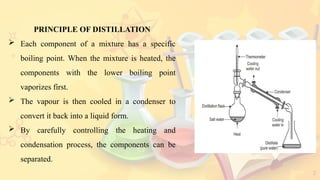
 Each component of a mixture has a specific
boiling point. When the mixture is heated, the
components with the lower boiling point
vaporizes first.
 The vapour is then cooled in a condenser to
convert it back into a liquid form.
 By carefully controlling the heating and
condensation process, the components can be
separated.
3
APPLICATION OF DISTILLATION
 Purification of chemicals
 Alcohol Production
 Isolating active ingredients
 Extraction of aromatic compounds.
 Separation of crude oils
4
TYPES OF DISTILLATION
1. Simple Distillation
2. Flash Distillation
3. Fractional Distillation
4. Distillation Under Reduced Pressure
5. Steam Distillation
6. Molecular Distillation
5
SIMPLE DISTILLATION
Principle
 The process is based on the differences in boiling points of components in a
mixture.
 The liquid with lower boiling point vaporizes first when the mixture is
heated, leaving behind other components.
 The vapour is then condensed back into liquid e collected separately.
 The effectiveness of simple distillation is optimal when boiling points of
components differs by at least 25°C.
6
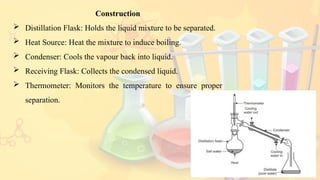
Construction
 Distillation Flask: Holds the liquid mixture to be separated.
 Heat Source: Heat the mixture to induce boiling.
 Condenser: Cools the vapour back into liquid.
 Receiving Flask: Collects the condensed liquid.
 Thermometer: Monitors the temperature to ensure proper
separation.
7
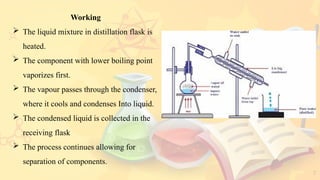
Working
 The liquid mixture in distillation flask is
heated.
 The component with lower boiling point
vaporizes first.
 The vapour passes through the condenser,
where it cools and condenses Into liquid.
 The condensed liquid is collected in the
receiving flask
 The process continues allowing for
separation of components.
8
Advantages
 Simple setup
 Cost effective
 Minimum Energy Utilization
Disadvantages
 Inefficient for mixtures with close boiling point.
 Not suitable for heat- sensitive substances
Application
 Water purification
 Purification of organic solvents
 Alcohol Distillation.
9
FLASH DISTILLATION
PRINCIPLE
 The process operates on the principle that when a heated liquid a sudden reduction
in pressure, it partially mixture undergoes Vaporizes.
 This rapid vaporization occurs because the reduced pressure lowers the boiling point
of mixture's components.
10
CONSTRUCTION
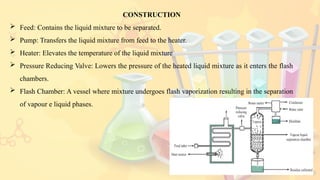
 Feed: Contains the liquid mixture to be separated.
 Pump: Transfers the liquid mixture from feed to the heater.
 Heater: Elevates the temperature of the liquid mixture
 Pressure Reducing Valve: Lowers the pressure of the heated liquid mixture as it enters the flash
chambers.
 Flash Chamber: A vessel where mixture undergoes flash vaporization resulting in the separation
of vapour e liquid phases.
11
WORKING
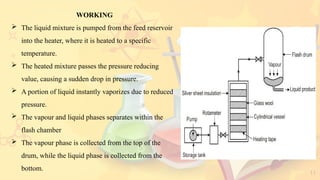
 The liquid mixture is pumped from the feed reservoir
into the heater, where it is heated to a specific
temperature.
 The heated mixture passes the pressure reducing
value, causing a sudden drop in pressure.
 A portion of liquid instantly vaporizes due to reduced
pressure.
 The vapour and liquid phases separates within the
flash chamber
 The vapour phase is collected from the top of the
drum, while the liquid phase is collected from the
bottom.
12
Advantages
 Simple Design
 Low Operating Cost
 Fast Separation
Application
 Petroleum Refining
 Chemical Processing
 Food Processing
Disadvantages
 Limited Separation
 Not suitable for Heat-Sensitive Materials.
13
FRACTIONAL DISTILLATION
Principle
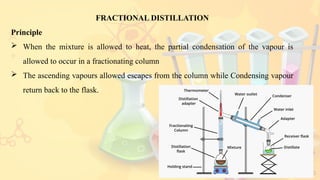
 When the mixture is allowed to heat, the partial condensation of the vapour is
allowed to occur in a fractionating column
 The ascending vapours allowed escapes from the column while Condensing vapour
return back to the flask.
14
CONSTRUCTION
 Distillation flask: A round bottom flask that hold the liquid mixture
 Fractionating Column: A vertical column that separates the vapour phase from liquid phase.
 Condenser: A coil or tube that condenses the vapour back Into a liquid
 Collection Vessel: A vessel that collects the distilled fractions
WORKING
 The mixture is heated in the distillation flask.
 The component with low boiling vaporizes frost and escaped from fractionating column e collected
in the receiver.
 The component with high boiling point condensed back into distillation flask through Fractionating
column.
15
Advantages
 Efficient separation
 High Purity
 Suitable for both laboratory & industrial process.
Disadvantages
 Complex Setup
 Time Consuming
Applications
 Petroleum Industry
 Pharmaceutical Industry
 Food Industry
16
DISTILLATION UNDER REDUCED PRESSURE
PRINGPLE
 Distillation under reduced pressure, also known as vacuum distillation is based on
the principle that the boiling point Of a liquid decreases as surrounding pressure
decreases.
 By reducing the pressure, the liquid can be vaporized at a lower temperature, which
helps to prevent thermal degredation and preserve the quality of the product.
17
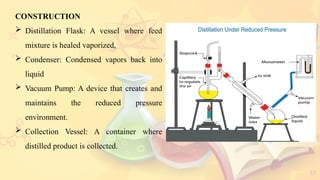
CONSTRUCTION
 Distillation Flask: A vessel where feed
mixture is healed vaporized,
 Condenser: Condensed vapors back into
liquid
 Vacuum Pump: A device that creates and
maintains the reduced pressure
environment.
 Collection Vessel: A container where
distilled product is collected.
18
WORKING
 The feed mixture is introduced into the distillation flask.
 The feed mixture is heated, causing the liquid to vaporize.
 The vacuum pump creates a reduced pressure environment, which facilitates
vaporization at low temperature
 The vapour rises into condenser, where it condensed back into liquid.
 The distilled product is collected into the collection vessel.
19
Advantages
 Lower Temperature
 Increased Efficiency
 Reduced Energy Consumption
Application
 Chemical Processing
 Food Processing
 Pharmaceutical Manufacturing
Disadvantages
 Higher Equipment cost
 Increased complexity
20
STEAM DISTILLATION
PRINCIPLE
 Steam distillation is a technique used to purify or isolate heat-sensitive compounds.
 It utilizes steam to separate a mixture of two or more liquids based on their differences
in boiling points
CONSTRUCTION
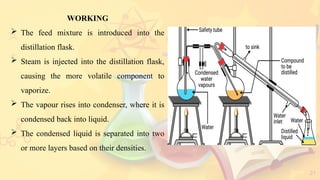
 Distillation Flask: A Vessel where feed mixture is heated & vaporized.
 Steam Generator: A device that produces steam.
 Condenser: Device that condensed vapour back into liquid.
 Collection Vessel: Container where distilled product is received.
21
WORKING
 The feed mixture is introduced into the
distillation flask.
 Steam is injected into the distillation flask,
causing the more volatile component to
vaporize.
 The vapour rises into condenser, where it is
condensed back into liquid.
 The condensed liquid is separated into two
or more layers based on their densities.
22
Advantages
 Low temperature requirement
 Increased Efficiency
 Reduced Energy consumption
Disadvantages
 Higher equipment cost
 Complexity.
Application
 Food Processing
 Chemical Processing
 Pharmaceutical Processing.
23
24
25
26

Pharmaceutical engineering (sem-3)unit 2-3.pptx

  • 1.
    DISTILLATION  Distillation isa physical separation process used to separate components of a mixture based on differences in their boiling points.  It is commonly used in industries, laboratories and everyday application to purify liquids, recover solvents or separate components of a mixture.
  • 2.
    2 PRINCIPLE OF DISTILLATION Each component of a mixture has a specific boiling point. When the mixture is heated, the components with the lower boiling point vaporizes first.  The vapour is then cooled in a condenser to convert it back into a liquid form.  By carefully controlling the heating and condensation process, the components can be separated.
  • 3.
    3 APPLICATION OF DISTILLATION Purification of chemicals  Alcohol Production  Isolating active ingredients  Extraction of aromatic compounds.  Separation of crude oils
  • 4.
    4 TYPES OF DISTILLATION 1.Simple Distillation 2. Flash Distillation 3. Fractional Distillation 4. Distillation Under Reduced Pressure 5. Steam Distillation 6. Molecular Distillation
  • 5.
    5 SIMPLE DISTILLATION Principle  Theprocess is based on the differences in boiling points of components in a mixture.  The liquid with lower boiling point vaporizes first when the mixture is heated, leaving behind other components.  The vapour is then condensed back into liquid e collected separately.  The effectiveness of simple distillation is optimal when boiling points of components differs by at least 25°C.
  • 6.
    6 Construction  Distillation Flask:Holds the liquid mixture to be separated.  Heat Source: Heat the mixture to induce boiling.  Condenser: Cools the vapour back into liquid.  Receiving Flask: Collects the condensed liquid.  Thermometer: Monitors the temperature to ensure proper separation.
  • 7.
    7 Working  The liquidmixture in distillation flask is heated.  The component with lower boiling point vaporizes first.  The vapour passes through the condenser, where it cools and condenses Into liquid.  The condensed liquid is collected in the receiving flask  The process continues allowing for separation of components.
  • 8.
    8 Advantages  Simple setup Cost effective  Minimum Energy Utilization Disadvantages  Inefficient for mixtures with close boiling point.  Not suitable for heat- sensitive substances Application  Water purification  Purification of organic solvents  Alcohol Distillation.
  • 9.
    9 FLASH DISTILLATION PRINCIPLE  Theprocess operates on the principle that when a heated liquid a sudden reduction in pressure, it partially mixture undergoes Vaporizes.  This rapid vaporization occurs because the reduced pressure lowers the boiling point of mixture's components.
  • 10.
    10 CONSTRUCTION  Feed: Containsthe liquid mixture to be separated.  Pump: Transfers the liquid mixture from feed to the heater.  Heater: Elevates the temperature of the liquid mixture  Pressure Reducing Valve: Lowers the pressure of the heated liquid mixture as it enters the flash chambers.  Flash Chamber: A vessel where mixture undergoes flash vaporization resulting in the separation of vapour e liquid phases.
  • 11.
    11 WORKING  The liquidmixture is pumped from the feed reservoir into the heater, where it is heated to a specific temperature.  The heated mixture passes the pressure reducing value, causing a sudden drop in pressure.  A portion of liquid instantly vaporizes due to reduced pressure.  The vapour and liquid phases separates within the flash chamber  The vapour phase is collected from the top of the drum, while the liquid phase is collected from the bottom.
  • 12.
    12 Advantages  Simple Design Low Operating Cost  Fast Separation Application  Petroleum Refining  Chemical Processing  Food Processing Disadvantages  Limited Separation  Not suitable for Heat-Sensitive Materials.
  • 13.
    13 FRACTIONAL DISTILLATION Principle  Whenthe mixture is allowed to heat, the partial condensation of the vapour is allowed to occur in a fractionating column  The ascending vapours allowed escapes from the column while Condensing vapour return back to the flask.
  • 14.
    14 CONSTRUCTION  Distillation flask:A round bottom flask that hold the liquid mixture  Fractionating Column: A vertical column that separates the vapour phase from liquid phase.  Condenser: A coil or tube that condenses the vapour back Into a liquid  Collection Vessel: A vessel that collects the distilled fractions WORKING  The mixture is heated in the distillation flask.  The component with low boiling vaporizes frost and escaped from fractionating column e collected in the receiver.  The component with high boiling point condensed back into distillation flask through Fractionating column.
  • 15.
    15 Advantages  Efficient separation High Purity  Suitable for both laboratory & industrial process. Disadvantages  Complex Setup  Time Consuming Applications  Petroleum Industry  Pharmaceutical Industry  Food Industry
  • 16.
    16 DISTILLATION UNDER REDUCEDPRESSURE PRINGPLE  Distillation under reduced pressure, also known as vacuum distillation is based on the principle that the boiling point Of a liquid decreases as surrounding pressure decreases.  By reducing the pressure, the liquid can be vaporized at a lower temperature, which helps to prevent thermal degredation and preserve the quality of the product.
  • 17.
    17 CONSTRUCTION  Distillation Flask:A vessel where feed mixture is healed vaporized,  Condenser: Condensed vapors back into liquid  Vacuum Pump: A device that creates and maintains the reduced pressure environment.  Collection Vessel: A container where distilled product is collected.
  • 18.
    18 WORKING  The feedmixture is introduced into the distillation flask.  The feed mixture is heated, causing the liquid to vaporize.  The vacuum pump creates a reduced pressure environment, which facilitates vaporization at low temperature  The vapour rises into condenser, where it condensed back into liquid.  The distilled product is collected into the collection vessel.
  • 19.
    19 Advantages  Lower Temperature Increased Efficiency  Reduced Energy Consumption Application  Chemical Processing  Food Processing  Pharmaceutical Manufacturing Disadvantages  Higher Equipment cost  Increased complexity
  • 20.
    20 STEAM DISTILLATION PRINCIPLE  Steamdistillation is a technique used to purify or isolate heat-sensitive compounds.  It utilizes steam to separate a mixture of two or more liquids based on their differences in boiling points CONSTRUCTION  Distillation Flask: A Vessel where feed mixture is heated & vaporized.  Steam Generator: A device that produces steam.  Condenser: Device that condensed vapour back into liquid.  Collection Vessel: Container where distilled product is received.
  • 21.
    21 WORKING  The feedmixture is introduced into the distillation flask.  Steam is injected into the distillation flask, causing the more volatile component to vaporize.  The vapour rises into condenser, where it is condensed back into liquid.  The condensed liquid is separated into two or more layers based on their densities.
  • 22.
    22 Advantages  Low temperaturerequirement  Increased Efficiency  Reduced Energy consumption Disadvantages  Higher equipment cost  Complexity. Application  Food Processing  Chemical Processing  Pharmaceutical Processing.
  • 23.
  • 24.
  • 25.
  • 26.

Editor's Notes

  • #2 Please visit our website: www.freepptbackgrounds.net
  • #3 Please visit our website: www.freepptbackgrounds.net
  • #4 Please visit our website: www.freepptbackgrounds.net
  • #5 Please visit our website: www.freepptbackgrounds.net
  • #6 Please visit our website: www.freepptbackgrounds.net
  • #7 Please visit our website: www.freepptbackgrounds.net
  • #8 Please visit our website: www.freepptbackgrounds.net
  • #9 Please visit our website: www.freepptbackgrounds.net
  • #10 Please visit our website: www.freepptbackgrounds.net
  • #11 Please visit our website: www.freepptbackgrounds.net
  • #12 Please visit our website: www.freepptbackgrounds.net
  • #13 Please visit our website: www.freepptbackgrounds.net
  • #14 Please visit our website: www.freepptbackgrounds.net
  • #15 Please visit our website: www.freepptbackgrounds.net
  • #16 Please visit our website: www.freepptbackgrounds.net
  • #17 Please visit our website: www.freepptbackgrounds.net
  • #18 Please visit our website: www.freepptbackgrounds.net
  • #19 Please visit our website: www.freepptbackgrounds.net
  • #20 Please visit our website: www.freepptbackgrounds.net
  • #21 Please visit our website: www.freepptbackgrounds.net
  • #22 Please visit our website: www.freepptbackgrounds.net
  • #23 Please visit our website: www.freepptbackgrounds.net
  • #24 Please visit our website: www.freepptbackgrounds.net
  • #25 Please visit our website: www.freepptbackgrounds.net
  • #26 Please visit our website: www.freepptbackgrounds.net