EVAPORATION
By- SANCHIT DHANKHAR
CONTENTS
 Classification of evaporation equipment
 Horizontal tube evaporation
 Vertical evaporator: short tubes (standard and basket)-long
tubes (climbing film)
 Forced circular evaporators
 Evaporator accessories (problems encountered)
 References
2
Definition of Evaporation
• Evaporation is the process of removal of solvent from
the solution by boiling the liquid in a suitable vessel
and withdrawing the vapour, leaving a concentrated
product.
• Applications of Evaporation
1. Evaporation process is used in the manufacture of
bulk drugs, particularly in pharmaceutical industries.
2. Evaporation is used in the manufacture of biological
products. e.g. Insulin, enzymes and hormones.
3. In demineralization of water.
3
Factors Effecting on Evaporation
1. Temperature
2. Temperature and time of evaporation
3. Temperature and moisture content
4. Types of product required
5. Effect of concentration
6. Surface area
7. Vapour pressure of the liquid to be evaporated
4
Classification of evaporation
equipment
I. Natural circulation evaporators
1. Evaporating pans
2. Evaporating still
3. Short tube evaporators
II. Forced circulation evaporators
III. Film evaporators
1. Climbing film evaporators
2. Horizontal film evaporators
5
Evaporating pans
6
Evaporating pans
 Evaporating pan consists of a hemispherical
pan made from copper or stainless steel and
surrounded by steam jacket.
 The hemispherical shape provides a large
surface area for evaporation.
 The evaporators are mounted in such a way
that they can be tilted to remove the product.
 The evaporating pans are heated by steam
which passes through a steam jacket.
7
Evaporating still
8
Evaporating still
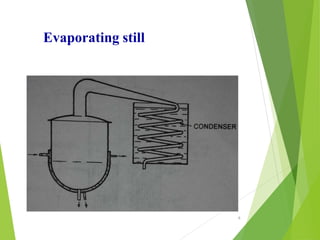
 This type of evaporator is commonly
known as a “Still” because the evaporating
pan is covered and is connected to a
condenser so that the vapours are
condensed into the liquid.
 There is a vessel similar to the evaporating
pan with a cover that connects it to the
condenser, so that the liquid is distilled off.
9
Horizontal tube evaporation
10
Horizontal tube evaporation
 In this type of evaporator, several parallel 8
feet long tubes are joined together in series.
 Each tube is enclosed in the opposite direction
to the feed liquid in the inner tube.
 The liquid passes through the tubes, gets
evaporated as it moves along the tube and
finally passes to a separator.
 The concentrated liquid is collected at the
bottom while the vapour is led off to the
atmosphere or used for some heating purpose.
11
Vertical evaporator: short tubes
(standard and basket)
12
Vertical evaporator: short tubes
(standard and basket)
 Short tube evaporator consists of a number
of tubes which are from 1 to 2 meters in
length and from 40-80 mm in diameter.
 The tubes are filled with liquid and
surrounded by steam.
 The level of the liquid is maintained
slightly above the top of the tubes so that
the space which is left in the evaporator can
be used for the purpose of separation of
vapour from the boiling liquid.
13
Vertical evaporator: long tubes
(climbing film evaporators)
14
Vertical evaporator: long tubes
(climbing film evaporators)
 Long tube evaporators a large number of vertical
tubes about 7 meters in length and 50 mm in
diameter are enclosed in an outer jacket to which
steam is supplied.
 The pre-heated feed liquid is admitted at the base.
 Here it boils and the vapours formed take the liquid
up the tube at a velocity of about 6-7
meters/second.
 The liquid takes only a few seconds to travels the
length of the tube, so the evaporator is very suitable
for heat-sensitive substances.
15
Forced circular evaporators
16
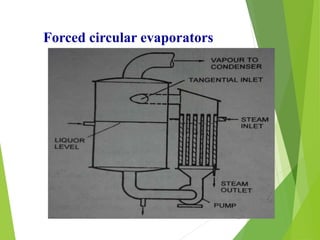
Forced circular evaporators
 In this types of evaporators, some mechanical device
is fitted to circulate the contents heating in it. e.g. an
evaporating pan in which the material is agitated by a
stirring rod or by mechanical propeller.
 The liquid is circulated by means of a pump and as it
is under pressure in the tubes the boiling point is
raised and no boiling takes places.
 As the liquid leaves the tubes and enters the body of
the evaporator, there is a drop in pressure and vapour
gets removed from the supper heated liquid.
17
Multiple Effect Evaporation
18
Multiple Effect Evaporation
 Two evaporators are connected together with a
piping arrangement so that the vapour from the
calandria of first effect (which is heated by
steam) is used to heat the calandria of the
second effect.
 This means that the calandria of the second
effect is used as condenser for the first effect,
so that latent heat of vaporisation is used to
evaporate more quantity of the liquid instead of
its going as waste.
 The vapour from the second effect then taken
to a condenser and converted into liquid.
19
Evaporator accessories
(problems encountered)
 The heating surface is limited and decreases
proportionally to increase in size of the pan.
 The evaporating pan cannot be used for the
evaporation of thermolabile pharmaceutical
materials which are dissolved in an organic
solvent, such as, ethyl alcohol, as there is no
provision to recollect the costly organic
solvent.
 The evaporating still is not suitable for the
thermolabile materials as the liquor is heatead
all the time in it.
20
THANK YOU
21

Evaporation- Pharmaceutical Engineering

  • 1.
  • 2.
    CONTENTS  Classification ofevaporation equipment  Horizontal tube evaporation  Vertical evaporator: short tubes (standard and basket)-long tubes (climbing film)  Forced circular evaporators  Evaporator accessories (problems encountered)  References 2
  • 3.
    Definition of Evaporation •Evaporation is the process of removal of solvent from the solution by boiling the liquid in a suitable vessel and withdrawing the vapour, leaving a concentrated product. • Applications of Evaporation 1. Evaporation process is used in the manufacture of bulk drugs, particularly in pharmaceutical industries. 2. Evaporation is used in the manufacture of biological products. e.g. Insulin, enzymes and hormones. 3. In demineralization of water. 3
  • 4.
    Factors Effecting onEvaporation 1. Temperature 2. Temperature and time of evaporation 3. Temperature and moisture content 4. Types of product required 5. Effect of concentration 6. Surface area 7. Vapour pressure of the liquid to be evaporated 4
  • 5.
    Classification of evaporation equipment I.Natural circulation evaporators 1. Evaporating pans 2. Evaporating still 3. Short tube evaporators II. Forced circulation evaporators III. Film evaporators 1. Climbing film evaporators 2. Horizontal film evaporators 5
  • 6.
  • 7.
    Evaporating pans  Evaporatingpan consists of a hemispherical pan made from copper or stainless steel and surrounded by steam jacket.  The hemispherical shape provides a large surface area for evaporation.  The evaporators are mounted in such a way that they can be tilted to remove the product.  The evaporating pans are heated by steam which passes through a steam jacket. 7
  • 8.
  • 9.
    Evaporating still  Thistype of evaporator is commonly known as a “Still” because the evaporating pan is covered and is connected to a condenser so that the vapours are condensed into the liquid.  There is a vessel similar to the evaporating pan with a cover that connects it to the condenser, so that the liquid is distilled off. 9
  • 10.
  • 11.
    Horizontal tube evaporation In this type of evaporator, several parallel 8 feet long tubes are joined together in series.  Each tube is enclosed in the opposite direction to the feed liquid in the inner tube.  The liquid passes through the tubes, gets evaporated as it moves along the tube and finally passes to a separator.  The concentrated liquid is collected at the bottom while the vapour is led off to the atmosphere or used for some heating purpose. 11
  • 12.
    Vertical evaporator: shorttubes (standard and basket) 12
  • 13.
    Vertical evaporator: shorttubes (standard and basket)  Short tube evaporator consists of a number of tubes which are from 1 to 2 meters in length and from 40-80 mm in diameter.  The tubes are filled with liquid and surrounded by steam.  The level of the liquid is maintained slightly above the top of the tubes so that the space which is left in the evaporator can be used for the purpose of separation of vapour from the boiling liquid. 13
  • 14.
    Vertical evaporator: longtubes (climbing film evaporators) 14
  • 15.
    Vertical evaporator: longtubes (climbing film evaporators)  Long tube evaporators a large number of vertical tubes about 7 meters in length and 50 mm in diameter are enclosed in an outer jacket to which steam is supplied.  The pre-heated feed liquid is admitted at the base.  Here it boils and the vapours formed take the liquid up the tube at a velocity of about 6-7 meters/second.  The liquid takes only a few seconds to travels the length of the tube, so the evaporator is very suitable for heat-sensitive substances. 15
  • 16.
  • 17.
    Forced circular evaporators In this types of evaporators, some mechanical device is fitted to circulate the contents heating in it. e.g. an evaporating pan in which the material is agitated by a stirring rod or by mechanical propeller.  The liquid is circulated by means of a pump and as it is under pressure in the tubes the boiling point is raised and no boiling takes places.  As the liquid leaves the tubes and enters the body of the evaporator, there is a drop in pressure and vapour gets removed from the supper heated liquid. 17
  • 18.
  • 19.
    Multiple Effect Evaporation Two evaporators are connected together with a piping arrangement so that the vapour from the calandria of first effect (which is heated by steam) is used to heat the calandria of the second effect.  This means that the calandria of the second effect is used as condenser for the first effect, so that latent heat of vaporisation is used to evaporate more quantity of the liquid instead of its going as waste.  The vapour from the second effect then taken to a condenser and converted into liquid. 19
  • 20.
    Evaporator accessories (problems encountered) The heating surface is limited and decreases proportionally to increase in size of the pan.  The evaporating pan cannot be used for the evaporation of thermolabile pharmaceutical materials which are dissolved in an organic solvent, such as, ethyl alcohol, as there is no provision to recollect the costly organic solvent.  The evaporating still is not suitable for the thermolabile materials as the liquor is heatead all the time in it. 20
  • 21.