Dissolution Method Development
by
Bhanu Prakash . N
Analytical R&D(Formulations)
Email. Id: bhanu.analytical@gmail.com
Overview of Presentation
• Definition of dissolution
• Process of Dissolution for Solid Dosage Forms
• Theory of dissolution
• Various influencing parameters
• Regularotary Guidance
• Method Development(Chromatography and analysis)
• Key insights to investigations during sample Analysis.
Dissolution Definition
Dissolution is a process by which
solid substance enters in the solvent
yield a solution.
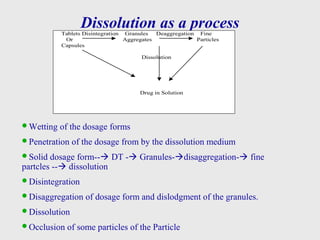
Dissolution as a processTablets Disintegration Granules Deaggregation Fine
Or Aggregates Particles
Capsules
Dissolution
Drug in Solution
Wetting of the dosage forms
Penetration of the dosage from by the dissolution medium
Solid dosage form-- DT - Granules-disaggregation- fine
partcles -- dissolution
Disintegration
Disaggregation of dosage form and dislodgment of the granules.
Dissolution
Occlusion of some particles of the Particle
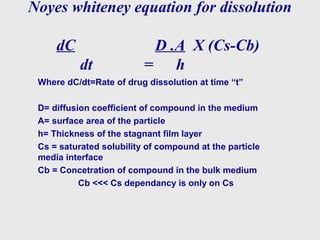
Noyes whiteney equation for dissolution
dC D .A X (Cs-Cb)
dt = h
Where dC/dt=Rate of drug dissolution at time “t”
D= diffusion coefficient of compound in the medium
A= surface area of the particle
h= Thickness of the stagnant film layer
Cs = saturated solubility of compound at the particle
media interface
Cb = Concetration of compound in the bulk medium
Cb <<< Cs dependancy is only on Cs
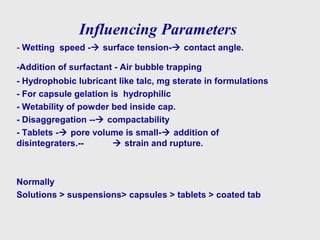
Influencing Parameters
- Wetting speed - surface tension- contact angle.
-Addition of surfactant - Air bubble trapping
- Hydrophobic lubricant like talc, mg sterate in formulations
- For capsule gelation is hydrophilic
- Wetability of powder bed inside cap.
- Disaggregation -- compactability
- Tablets - pore volume is small- addition of
disintegraters.--  strain and rupture.
Normally
Solutions > suspensions> capsules > tablets > coated tab
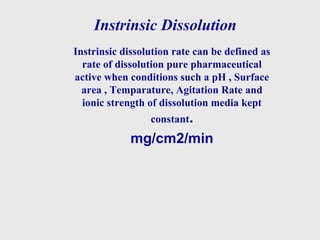
Instrinsic Dissolution
Instrinsic dissolution rate can be defined as
rate of dissolution pure pharmaceutical
active when conditions such a pH , Surface
area , Temparature, Agitation Rate and
ionic strength of dissolution media kept
constant.
mg/cm2/min
Systematic Approach to Dissolution
Method Developement
Litterature information
SBOA, PDR, PIL, pK data
Study the Drug Absorption characteristics.
• RLD’s.
•Classification.
•Tmax.
•Absolute bioavailability and
relative bioavailability.
•Food affect.
Solubility Study
What do we Get From Solubility
Study ?
Rate Determining Step
Selection of Media For Dissolution
Study
Type of Solubility
1) BCS-Highest Unit Dose in 250
ml of Dissolution media .
2) Saturated Solubility –Shake
Flask method
BCS Guidance Summary
BCS takes into account three major factors that govern
the rate and extent of drug absorption from IR solid
oral dosage forms: solubility, intestinal permeability,
and dissolution.
4 BCS classes are: 1 = HS, HP; 2 = LS, HP; 3 = HS,
LP; 4 = LS, LP
Different formulations of rapidly dissolving BCS class 1
product can be given biowaiver if they show rapid and
similar dissolution profiles over the physiological pH
range.
BCS defines rapid dissolution, i.e., 85% in 30 minutes.
If dissolution is this rapid across the pH range,
absorption not dissolution rate limited.
Solubility Study
Media Selection :
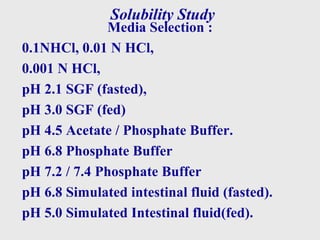
0.1NHCl, 0.01 N HCl,
0.001 N HCl,
pH 2.1 SGF (fasted),
pH 3.0 SGF (fed)
pH 4.5 Acetate / Phosphate Buffer.
pH 6.8 Phosphate Buffer
pH 7.2 / 7.4 Phosphate Buffer
pH 6.8 Simulated intestinal fluid (fasted).
pH 5.0 Simulated Intestinal fluid(fed).
Solubility Study
Media Selection :
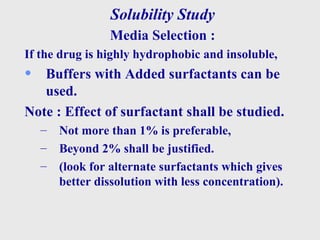
If the drug is highly hydrophobic and insoluble,
• Buffers with Added surfactants can be
used.
Note : Effect of surfactant shall be studied.
– Not more than 1% is preferable,
– Beyond 2% shall be justified.
– (look for alternate surfactants which gives
better dissolution with less concentration).
Solubility Study
Media Selection :
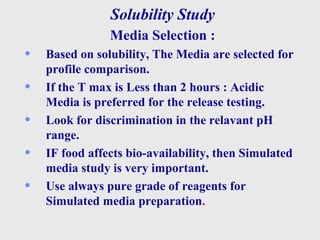
• Based on solubility, The Media are selected for
profile comparison.
• If the T max is Less than 2 hours : Acidic
Media is preferred for the release testing.
• Look for discrimination in the relavant pH
range.
• IF food affects bio-availability, then Simulated
media study is very important.
• Use always pure grade of reagents for
Simulated media preparation.
Sink condition
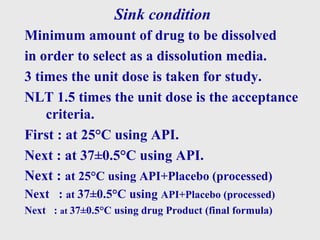
Minimum amount of drug to be dissolved
in order to select as a dissolution media.
3 times the unit dose is taken for study.
NLT 1.5 times the unit dose is the acceptance
criteria.
First : at 25°C using API.
Next : at 37±0.5°C using API.
Next : at 25°C using API+Placebo (processed)
Next : at 37±0.5°C using API+Placebo (processed)
Next : at 37±0.5°C using drug Product (final formula)
Seven Steps to Become a Expert for
Dissolution Method Development
Step-1
Single Peak Chromatographic Method/UV scan
Successful Method Development
-No blank Inteferance
-No placebo Inteferance
-Peak Shape/ Tailing
-Shortest Run Time
-Major Degradant Seperation
Step-2
Standard Preparation optimization
(Knowledge of Solubility to be Used)
Step-3
Solution Stability in Dissolution Media
Step-4
Choice of Appratus-
Paddle/Basket/Rpm/Volume/Time
Points for Profile
1) Appratus.
2) RPM-50/75/100
3) Volume –500/900/1000/2000/4000ml
4) Time points to get Discrimination
Step-4(conti.,)
Selection of Apparatus
Widely used :
Apparatus 1 (basket)
Apparatus 2 (paddle)
Apparatus 3 (reciprocating cylinder)
Apparatus 4 (Flow through Apparatus)
Step-5
-Media Preparation
-Dissolved Oxygen/ Degassing of Media
-Temperature of Media
-Volume of media
-pH of Media
-Setting of Right Parameters for Auto
Samplers.
-Use suitable sinkers or no sinkers.
Step-6
-Disintegration Pattern
-Floating Particle of Drug or excipients
-Heap Formation
-Cone Effect
-Type of Filters
-Sampling Errors
-Media Volume Measurements for ER
Step-7
Analysis of Samples
Successful Dissolution method
Development and analysis Completes
Investigations– During Analysis of
Samples
Possible errors :
•Media preparation.
•Standard preparation.
•Filters.
•Stability of solutions (std/test).
•Sampling / replacement.
•Interference
(Chromatography/UV).
Investigations– During Analysis of
Samples
•Always take additional sample at higher
RPM ,10 minutes after the last time interval.
•Alternatively, Perform the assay of the
residue
•Always record the physical observation and
tablet to tablet variation.Involve Formulation
scientist for physical observation.
•Verify and establish the role of sinkers.
•Measure the Volume of media at the end of
the run for ER samples.
Investigations– During Analysis of
Samples
• Clean the filters and lines thoroughly
before starting the run.
•Verify the filters (compare with Manual
sampling and centrifuge).
•Standard May absorb moisture. Preserve
Properly. Check the validity dates and
storage condition.
•Extra / additional peaks shall be
investigated and the root cause shall be
known.
•Observe peak distortions between standard
and test.
Investigations– During Analysis of
Samples
• If the drug is degrading, we shall also know
what type of degradation it undergoes.
•Inject dissolution sample in RS method and
find out if possible what is the degradant.
•Assess whether method is specific to the
extent that it avoids interference.
•Are we stabilizing the solution or degrading
further and stabilizing.
•Timing of stabilization is also very
important.
Investigations– During Analysis of
Samples
•Dissolution General chapter is harmonized Now.
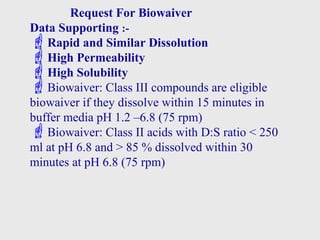
Request For Biowaiver
Data Supporting :-
Rapid and Similar Dissolution
High Permeability
High Solubility
Biowaiver: Class III compounds are eligible
biowaiver if they dissolve within 15 minutes in
buffer media pH 1.2 –6.8 (75 rpm)
Biowaiver: Class II acids with D:S ratio < 250
ml at pH 6.8 and > 85 % dissolved within 30
minutes at pH 6.8 (75 rpm)
Thanks

Dissolution-method Development-PPT

  • 1.
    Dissolution Method Development by BhanuPrakash . N Analytical R&D(Formulations) Email. Id: bhanu.analytical@gmail.com
  • 2.
    Overview of Presentation •Definition of dissolution • Process of Dissolution for Solid Dosage Forms • Theory of dissolution • Various influencing parameters • Regularotary Guidance • Method Development(Chromatography and analysis) • Key insights to investigations during sample Analysis.
  • 3.
    Dissolution Definition Dissolution isa process by which solid substance enters in the solvent yield a solution.
  • 4.
    Dissolution as aprocessTablets Disintegration Granules Deaggregation Fine Or Aggregates Particles Capsules Dissolution Drug in Solution Wetting of the dosage forms Penetration of the dosage from by the dissolution medium Solid dosage form-- DT - Granules-disaggregation- fine partcles -- dissolution Disintegration Disaggregation of dosage form and dislodgment of the granules. Dissolution Occlusion of some particles of the Particle
  • 5.
    Noyes whiteney equationfor dissolution dC D .A X (Cs-Cb) dt = h Where dC/dt=Rate of drug dissolution at time “t” D= diffusion coefficient of compound in the medium A= surface area of the particle h= Thickness of the stagnant film layer Cs = saturated solubility of compound at the particle media interface Cb = Concetration of compound in the bulk medium Cb <<< Cs dependancy is only on Cs
  • 6.
    Influencing Parameters - Wettingspeed - surface tension- contact angle. -Addition of surfactant - Air bubble trapping - Hydrophobic lubricant like talc, mg sterate in formulations - For capsule gelation is hydrophilic - Wetability of powder bed inside cap. - Disaggregation -- compactability - Tablets - pore volume is small- addition of disintegraters.--  strain and rupture. Normally Solutions > suspensions> capsules > tablets > coated tab
  • 7.
    Instrinsic Dissolution Instrinsic dissolutionrate can be defined as rate of dissolution pure pharmaceutical active when conditions such a pH , Surface area , Temparature, Agitation Rate and ionic strength of dissolution media kept constant. mg/cm2/min
  • 8.
    Systematic Approach toDissolution Method Developement
  • 9.
    Litterature information SBOA, PDR,PIL, pK data Study the Drug Absorption characteristics. • RLD’s. •Classification. •Tmax. •Absolute bioavailability and relative bioavailability. •Food affect.
  • 10.
    Solubility Study What dowe Get From Solubility Study ? Rate Determining Step Selection of Media For Dissolution Study Type of Solubility 1) BCS-Highest Unit Dose in 250 ml of Dissolution media . 2) Saturated Solubility –Shake Flask method
  • 11.
    BCS Guidance Summary BCStakes into account three major factors that govern the rate and extent of drug absorption from IR solid oral dosage forms: solubility, intestinal permeability, and dissolution. 4 BCS classes are: 1 = HS, HP; 2 = LS, HP; 3 = HS, LP; 4 = LS, LP Different formulations of rapidly dissolving BCS class 1 product can be given biowaiver if they show rapid and similar dissolution profiles over the physiological pH range. BCS defines rapid dissolution, i.e., 85% in 30 minutes. If dissolution is this rapid across the pH range, absorption not dissolution rate limited.
  • 12.
    Solubility Study Media Selection: 0.1NHCl, 0.01 N HCl, 0.001 N HCl, pH 2.1 SGF (fasted), pH 3.0 SGF (fed) pH 4.5 Acetate / Phosphate Buffer. pH 6.8 Phosphate Buffer pH 7.2 / 7.4 Phosphate Buffer pH 6.8 Simulated intestinal fluid (fasted). pH 5.0 Simulated Intestinal fluid(fed).
  • 13.
    Solubility Study Media Selection: If the drug is highly hydrophobic and insoluble, • Buffers with Added surfactants can be used. Note : Effect of surfactant shall be studied. – Not more than 1% is preferable, – Beyond 2% shall be justified. – (look for alternate surfactants which gives better dissolution with less concentration).
  • 14.
    Solubility Study Media Selection: • Based on solubility, The Media are selected for profile comparison. • If the T max is Less than 2 hours : Acidic Media is preferred for the release testing. • Look for discrimination in the relavant pH range. • IF food affects bio-availability, then Simulated media study is very important. • Use always pure grade of reagents for Simulated media preparation.
  • 15.
    Sink condition Minimum amountof drug to be dissolved in order to select as a dissolution media. 3 times the unit dose is taken for study. NLT 1.5 times the unit dose is the acceptance criteria. First : at 25°C using API. Next : at 37±0.5°C using API. Next : at 25°C using API+Placebo (processed) Next : at 37±0.5°C using API+Placebo (processed) Next : at 37±0.5°C using drug Product (final formula)
  • 16.
    Seven Steps toBecome a Expert for Dissolution Method Development Step-1 Single Peak Chromatographic Method/UV scan Successful Method Development -No blank Inteferance -No placebo Inteferance -Peak Shape/ Tailing -Shortest Run Time -Major Degradant Seperation
  • 17.
  • 18.
  • 19.
    Step-4 Choice of Appratus- Paddle/Basket/Rpm/Volume/Time Pointsfor Profile 1) Appratus. 2) RPM-50/75/100 3) Volume –500/900/1000/2000/4000ml 4) Time points to get Discrimination
  • 20.
    Step-4(conti.,) Selection of Apparatus Widelyused : Apparatus 1 (basket) Apparatus 2 (paddle) Apparatus 3 (reciprocating cylinder) Apparatus 4 (Flow through Apparatus)
  • 21.
    Step-5 -Media Preparation -Dissolved Oxygen/Degassing of Media -Temperature of Media -Volume of media -pH of Media -Setting of Right Parameters for Auto Samplers. -Use suitable sinkers or no sinkers.
  • 22.
    Step-6 -Disintegration Pattern -Floating Particleof Drug or excipients -Heap Formation -Cone Effect -Type of Filters -Sampling Errors -Media Volume Measurements for ER
  • 23.
    Step-7 Analysis of Samples SuccessfulDissolution method Development and analysis Completes
  • 24.
    Investigations– During Analysisof Samples Possible errors : •Media preparation. •Standard preparation. •Filters. •Stability of solutions (std/test). •Sampling / replacement. •Interference (Chromatography/UV).
  • 25.
    Investigations– During Analysisof Samples •Always take additional sample at higher RPM ,10 minutes after the last time interval. •Alternatively, Perform the assay of the residue •Always record the physical observation and tablet to tablet variation.Involve Formulation scientist for physical observation. •Verify and establish the role of sinkers. •Measure the Volume of media at the end of the run for ER samples.
  • 26.
    Investigations– During Analysisof Samples • Clean the filters and lines thoroughly before starting the run. •Verify the filters (compare with Manual sampling and centrifuge). •Standard May absorb moisture. Preserve Properly. Check the validity dates and storage condition. •Extra / additional peaks shall be investigated and the root cause shall be known. •Observe peak distortions between standard and test.
  • 27.
    Investigations– During Analysisof Samples • If the drug is degrading, we shall also know what type of degradation it undergoes. •Inject dissolution sample in RS method and find out if possible what is the degradant. •Assess whether method is specific to the extent that it avoids interference. •Are we stabilizing the solution or degrading further and stabilizing. •Timing of stabilization is also very important.
  • 28.
    Investigations– During Analysisof Samples •Dissolution General chapter is harmonized Now.
  • 29.
    Request For Biowaiver DataSupporting :- Rapid and Similar Dissolution High Permeability High Solubility Biowaiver: Class III compounds are eligible biowaiver if they dissolve within 15 minutes in buffer media pH 1.2 –6.8 (75 rpm) Biowaiver: Class II acids with D:S ratio < 250 ml at pH 6.8 and > 85 % dissolved within 30 minutes at pH 6.8 (75 rpm)
  • 30.