Biorelevant dissolution media
Suhaib
Jamia hamdard
BIO = Biological system RELEVANCE= appropriate chacteristic composition , Simulation
In vitro surrogate for in vivo performance.
When compendial dissolution medium was unable to simulate the dissolution as that of
in vivo so the development of Biorelevant dissolution medium came into existence .
It is desirable to have a global medium reflecting the changes in the GIT before & after
meal intake , to estimate food effects on drug dissolution and release.
In vitro testing of orally administered dosage forms under conditions simulating the
intralumenal environment.
It aims to forecast the intralumenal fate of the dosage form and of the API after oral
administration .
Current issues in biorelevant performance testing include the validation of in-vitro
conditions for evaluation of lumenal dispersion/digestion of lipid dosage forms,
technicalities relating to the quantification also.
The development of Biorelevant dissolution medium mainly used as:-
Why modifications of previous Biorelevant Dissolution Media !
The previous versions of the biorelevant media do not reflect the
lipolysis products of meal digestion that were known to enhance the
solubility and dissolution of poorly soluble lipophilic drugs .
The biorelevant dissolution media have been updated recently to bring
the composition and characteristics closer to those of aspirates
collected from the human GIT.
Can be used to assess the performance of different formulations
for poorly water soluble compounds.
Have been successfully applied over the past decade to obtain
IVIVCs.
Used to predict the oral absorption of drug .
In forecasting formulation and food effects on dissolution of, or
release from, the dosage form, disintegration of tablets or
capsules.
USE OF BIORELEVANT MEDIA
Why biorelevant media simulating the environment of stomach need to be
studied ??
The stomach is the port of entry into the GI tract for orally administered drug
products.
It is here that immediate-release (IR) dosage forms should disintegrate, enabling the
active pharmaceutical ingredient (API) to dissolve in a timely manner before it
reaches the absorptive sites in the small intestine.
For poorly soluble weak bases, the pH conditions for dissolution are the most
favourable in a fasted, healthy stomach.
Why biorelevant media simulating the environment of intestine need to
be studied ?
The small intestine represents the region where drugs are best absorbed.
Extended release, Modified release ( Enteric coated) dosage form release in
intestine.
Additionally, for poorly soluble, weakly acidic compounds and lipophilic
compounds, dissolution is favoured in this segment.
Why biorelevant media simulating the environment of colon need to be studied ?
Those drugs having low permeability in the small intestine but can also be absorbed to some
extent through the colonic mucosa .
An extended release dosage form is administered in colon .
Some dosage form targets the drug to the colonic mucosa for local action, conditions in the lower
GI lumen will influence drug/dosage form performance pH 5.8 acetate buffer .
Crohn’s disease or chronic inflammatory disease , inflammatory bowel disease (IBD) colitis may
be more effectively treated by direct drug delivery to the colon.
Protein drugs are generally unstable in the acidic environment of the stomach and are also
degraded by proteolytic enzymes present in the stomach and small intestine.
Researchers are investigating the oral delivery of protein and peptide drugs by protecting them
against enzymatic degradation for later release in the colon.
Drugs such as the beta-blockers (metoprolol) and isosorbide-5-mononitrate, (NSAIDs), steroids,
peptides, and vaccines are well absorbed in the colon, similar to absorption in the small
intestine .
• Attributes for development of biorelevant media
depends on:-
1) Fluid composition in the GIT
2) Hydrodynamics in the GIT
3) API/formulation properties
4) Prediction of plasma profile
5) Development of IVIVCs
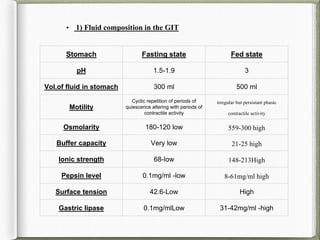
• 1) Fluid composition in the GIT
Stomach Fasting state Fed state
pH 1.5-1.9 3
Vol.of fluid in stomach 300 ml 500 ml
Motility
Cyclic repetition of periods of
quiescence altering with periods of
contractile activity
irregular but persistant phasic
contractile activity
Osmolarity 180-120 low 559-300 high
Buffer capacity Very low 21-25 high
Ionic strength 68-low 148-213High
Pepsin level 0.1mg/ml -low 8-61mg/ml high
Surface tension 42.6-Low High
Gastric lipase 0.1mg/mlLow 31-42mg/ml -high
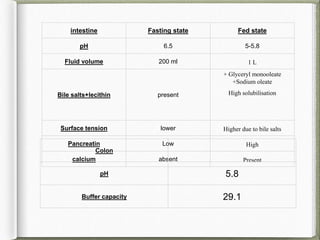
intestine Fasting state Fed state
pH 6.5 5-5.8
Fluid volume 200 ml 1 L
Bile salts+lecithin present
+ Glyceryl monooleate
+Sodium oleate
High solubilisation
Surface tension lower Higher due to bile salts
Pancreatin Low High
calcium absent Present
Colon
pH 5.8
Buffer capacity 29.1
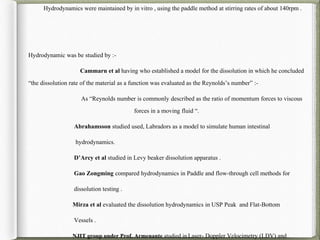
Hydrodynamics were maintained by in vitro , using the paddle method at stirring rates of about 140rpm .
Hydrodynamic was be studied by :-
Cammarn et al having who established a model for the dissolution in which he concluded
“the dissolution rate of the material as a function was evaluated as the Reynolds’s number” :-
As “Reynolds number is commonly described as the ratio of momentum forces to viscous
forces in a moving fluid “.
Abrahamsson studied used, Labradors as a model to simulate human intestinal
hydrodynamics.
D’Arcy et al studied in Levy beaker dissolution apparatus .
Gao Zongming compared hydrodynamics in Paddle and flow-through cell methods for
dissolution testing .
Mirza et al evaluated the dissolution hydrodynamics in USP Peak and Flat-Bottom
Vessels .
NJIT group under Prof. Armenante studied in Laser- Doppler Velocimetry (LDV) and
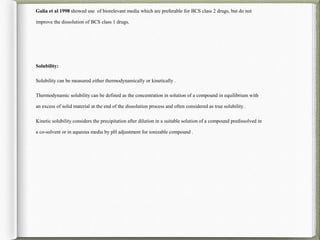
Galia et al 1998 showed use of biorelevant media which are preferable for BCS class 2 drugs, but do not
improve the dissolution of BCS class 1 drugs.
Solubility:
Solubility can be measured either thermodynamically or kinetically .
Thermodynamic solubility can be defined as the concentration in solution of a compound in equilibrium with
an excess of solid material at the end of the dissolution process and often considered as true solubility .
Kinetic solubility considers the precipitation after dilution in a suitable solution of a compound predissolved in
a co-solvent or in aqueous media by pH adjustment for ionizable compound .
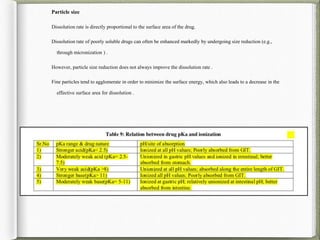
Particle size
Dissolution rate is directly proportional to the surface area of the drug.
Dissolution rate of poorly soluble drugs can often be enhanced markedly by undergoing size reduction (e.g.,
through micronization ) .
However, particle size reduction does not always improve the dissolution rate .
Fine particles tend to agglomerate in order to minimize the surface energy, which also leads to a decrease in the
effective surface area for dissolution .
Drug pKa and gastrointestinal pH:
4) Prediction of plasma profile
Wagner-Nelson and Loo-Riegelman are both model dependent methods in which is used for a one-compartment
model methods
Numerical deconvolution is model dependent method for multi-compartment system
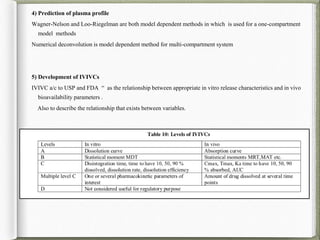
5) Development of IVIVCs
IVIVC a/c to USP and FDA “ as the relationship between appropriate in vitro release characteristics and in vivo
bioavailability parameters .
Also to describe the relationship that exists between variables.
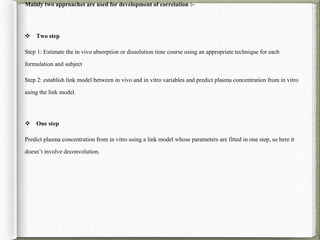
Mainly two approaches are used for development of correlation :-
 Two step
Step 1: Estimate the in vivo absorption or dissolution time course using an appropriate technique for each
formulation and subject
Step 2: establish link model between in vivo and in vitro variables and predict plasma concentration from in vitro
using the link model.
 One step
Predict plasma concentration from in vitro using a link model whose parameters are fitted in one step, so here it
doesn’t involve deconvolution.
To establish a predictive mathematical model describing the relationship between an in vitro property and a
relevant in vivo response.
The proposed evaluation approaches focus on the estimation of predictive performance or, conversely,
prediction error.
Internal predictability is applied to IVIVC established using formulations with three or more release rates for
non-narrow therapeutic index drugs exhibiting conclusive prediction error :-
% PE = [(Observed parameter – Predicted parameter)/ (Predicted parameter)]*100
According to the IVIVC guidance, the average prediction error across formulations cannot be greater than
10% and a formulation cannot have a prediction error greater than 15%.
Based on these criteria, each of the IVIVC models is valid in terms of the rate and extent of drug absorption
External predictability evaluation is not necessary unless the drug is a narrow therapeutic index, or only two
release rates were used to develop the IVIVC, or, if the internal predictability criteria are not met i.e.
prediction error internally is inconclusive.
The prediction error for external validation should not exceed 10% where as % PE between 10 - 20% indicates
inconclusive predictability and the need for further study using additional data sets.
Softwares have been developed such as Simcyp, GastroPlusTM
, PK-SimTM
, MEDICI-PKTM
, Cloe PKTM
etc. for
physiological based pharmacokinetic model (PBPK ).
Parameter such as metabolic factors, drug loss in GIT and stereochemistry are to be considered while
developing IVIVC .
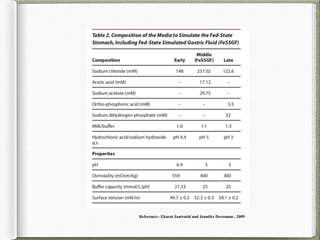
The concept of FaSSGF was proposed by
Vertzoni et al. in 2005 :-
Media to simulate the environment in the
fasted stomach
Simple AQUEOUS BUFFER
SGFsp
Biorelevant Dissolution Media
FaSSGF (with pepsin)
Milk (full-fat [3.5%],
long-life, UHT-treated)
Artificial liquid meals e.g. Ensure and
Ensure Plus
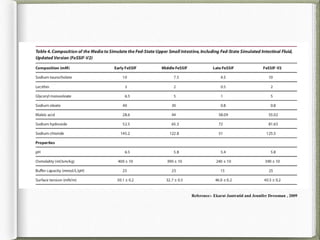
Reference:- Ekarat Jantratid and Jennifer Dressman , 2009
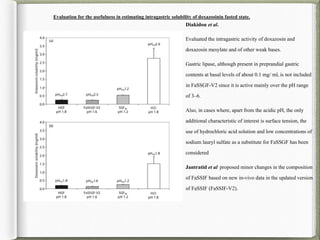
Diakidou et al.
Evaluated the intragastric activity of doxazosin and
doxazosin mesylate and of other weak bases.
Gastric lipase, although present in preprandial gastric
contents at basal levels of about 0.1 mg/ ml, is not included
in FaSSGF-V2 since it is active mainly over the pH range
of 3–6.
Also, in cases where, apart from the acidic pH, the only
additional characteristic of interest is surface tension, the
use of hydrochloric acid solution and low concentrations of
sodium lauryl sulfate as a substitute for FaSSGF has been
considered
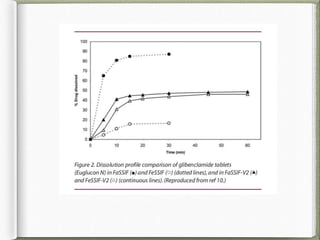
Jantratid et al proposed minor changes in the composition
of FaSSIF based on new in-vivo data in the updated version
of FaSSIF (FaSSIF-V2).
Evaluation for the usefulness in estimating intragastric solubility of doxazosinin fasted state.
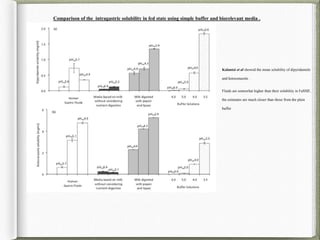
Kalantzi et al showed the mean solubility of dipyridamole
and ketoconazole .
Fluids are somewhat higher than their solubility in FaSSIF,
the estimates are much closer than those from the plain
buffer
Comparison of the intragastric solubility in fed state using simple buffer and biorelevant media .
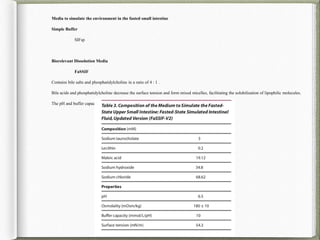
Media to simulate the environment in the fasted small intestine
Simple Buffer
SIFsp
Biorelevant Dissolution Media
FaSSIF
Contains bile salts and phosphatidylcholine in a ratio of 4 : 1 .
Bile acids and phosphatidylcholine decrease the surface tension and form mixed micelles, facilitating the solubilisation of lipophilic molecules.
The pH and buffer capacity of the medium is adjusted by using maleate buffer .
The composition of the updated FaSSIF, so-called FaSSIF-V2, was changed slightly to more closely reflect the in vivo data,
while the buffer has been changed from phosphate to maleate for practical reasons.
The small intestine is the main site of digestion of food components and generation of free fatty acids and monoglycerides leads
to the formation of vesicles and other colloidal structures that, in addition to the mixed bile salt micelles, provide a better
simulation of intralumenal solubilising species.
In addition to bile salts and lecithin, these media contain lipolytic products such as glyceryl monooleate and sodium oleate to
simulate the presence of monoglycerides and fatty acids in the intestinal contents .
Bile salts and lecithin can also increase the wetting process for the lipophilic drugs and solubilize the drug into the micelles
formed by bile salts and lecithin .
Pancreatin of porcine origin is used because due to its natural origin it contains all relevant enzymes including pancreatic lipase,
phopsholipase A2 and cholesterol esterase.
Calcium is also added to the medium in order to control the lipolysis rate by removing the produced free fatty acids which can
inhibit lipase activity .
The pH and free calcium concentration of the reaction mixture is maintained by the addition of sodium hydroxide and calcium
chloride solutions, respectively.
Reference:- Ekarat Jantratid and Jennifer Dressman , 2009
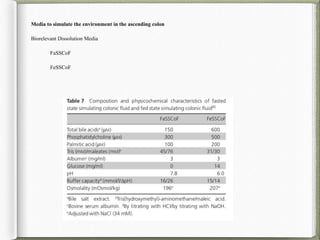
Media to simulate the environment in the ascending colon
Biorelevant Dissolution Media
FaSSCoF
FeSSCoF
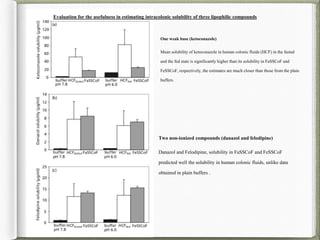
One weak base (ketoconazole)
Mean solubility of ketoconazole in human colonic fluids (HCF) in the fasted
and the fed state is significantly higher than its solubility in FaSSCoF and
FeSSCoF, respectively, the estimates are much closer than those from the plain
buffers.
Two non-ionized compounds (danazol and felodipine)
Danazol and Felodipine, solubility in FaSSCoF and FeSSCoF
predicted well the solubility in human colonic fluids, unlike data
obtained in plain buffers .
Evaluation for the usefulness in estimating intracolonic solubility of three lipophilic compounds
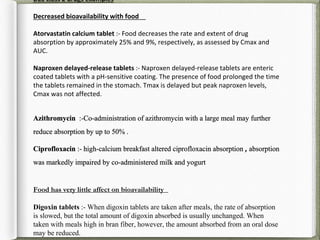
BCS class 2 drugs examples
Decreased bioavailability with food
Atorvastatin calcium tablet :- Food decreases the rate and extent of drug
absorption by approximately 25% and 9%, respectively, as assessed by Cmax and
AUC.
Naproxen delayed-release tablets :- Naproxen delayed-release tablets are enteric
coated tablets with a pH-sensitive coating. The presence of food prolonged the time
the tablets remained in the stomach. Tmax is delayed but peak naproxen levels,
Cmax was not affected.
Food has very little affect on bioavailability
Digoxin tablets :- When digoxin tablets are taken after meals, the rate of absorption
is slowed, but the total amount of digoxin absorbed is usually unchanged. When
taken with meals high in bran fiber, however, the amount absorbed from an oral dose
may be reduced.
Thank you

Biorelevant ppt

  • 1.
  • 2.
    BIO = Biologicalsystem RELEVANCE= appropriate chacteristic composition , Simulation In vitro surrogate for in vivo performance. When compendial dissolution medium was unable to simulate the dissolution as that of in vivo so the development of Biorelevant dissolution medium came into existence . It is desirable to have a global medium reflecting the changes in the GIT before & after meal intake , to estimate food effects on drug dissolution and release. In vitro testing of orally administered dosage forms under conditions simulating the intralumenal environment. It aims to forecast the intralumenal fate of the dosage form and of the API after oral administration . Current issues in biorelevant performance testing include the validation of in-vitro conditions for evaluation of lumenal dispersion/digestion of lipid dosage forms, technicalities relating to the quantification also. The development of Biorelevant dissolution medium mainly used as:-
  • 3.
    Why modifications ofprevious Biorelevant Dissolution Media ! The previous versions of the biorelevant media do not reflect the lipolysis products of meal digestion that were known to enhance the solubility and dissolution of poorly soluble lipophilic drugs . The biorelevant dissolution media have been updated recently to bring the composition and characteristics closer to those of aspirates collected from the human GIT.
  • 4.
    Can be usedto assess the performance of different formulations for poorly water soluble compounds. Have been successfully applied over the past decade to obtain IVIVCs. Used to predict the oral absorption of drug . In forecasting formulation and food effects on dissolution of, or release from, the dosage form, disintegration of tablets or capsules. USE OF BIORELEVANT MEDIA
  • 5.
    Why biorelevant mediasimulating the environment of stomach need to be studied ?? The stomach is the port of entry into the GI tract for orally administered drug products. It is here that immediate-release (IR) dosage forms should disintegrate, enabling the active pharmaceutical ingredient (API) to dissolve in a timely manner before it reaches the absorptive sites in the small intestine. For poorly soluble weak bases, the pH conditions for dissolution are the most favourable in a fasted, healthy stomach.
  • 6.
    Why biorelevant mediasimulating the environment of intestine need to be studied ? The small intestine represents the region where drugs are best absorbed. Extended release, Modified release ( Enteric coated) dosage form release in intestine. Additionally, for poorly soluble, weakly acidic compounds and lipophilic compounds, dissolution is favoured in this segment.
  • 7.
    Why biorelevant mediasimulating the environment of colon need to be studied ? Those drugs having low permeability in the small intestine but can also be absorbed to some extent through the colonic mucosa . An extended release dosage form is administered in colon . Some dosage form targets the drug to the colonic mucosa for local action, conditions in the lower GI lumen will influence drug/dosage form performance pH 5.8 acetate buffer . Crohn’s disease or chronic inflammatory disease , inflammatory bowel disease (IBD) colitis may be more effectively treated by direct drug delivery to the colon. Protein drugs are generally unstable in the acidic environment of the stomach and are also degraded by proteolytic enzymes present in the stomach and small intestine. Researchers are investigating the oral delivery of protein and peptide drugs by protecting them against enzymatic degradation for later release in the colon. Drugs such as the beta-blockers (metoprolol) and isosorbide-5-mononitrate, (NSAIDs), steroids, peptides, and vaccines are well absorbed in the colon, similar to absorption in the small intestine .
  • 8.
    • Attributes fordevelopment of biorelevant media depends on:- 1) Fluid composition in the GIT 2) Hydrodynamics in the GIT 3) API/formulation properties 4) Prediction of plasma profile 5) Development of IVIVCs
  • 9.
    • 1) Fluidcomposition in the GIT Stomach Fasting state Fed state pH 1.5-1.9 3 Vol.of fluid in stomach 300 ml 500 ml Motility Cyclic repetition of periods of quiescence altering with periods of contractile activity irregular but persistant phasic contractile activity Osmolarity 180-120 low 559-300 high Buffer capacity Very low 21-25 high Ionic strength 68-low 148-213High Pepsin level 0.1mg/ml -low 8-61mg/ml high Surface tension 42.6-Low High Gastric lipase 0.1mg/mlLow 31-42mg/ml -high
  • 10.
    intestine Fasting stateFed state pH 6.5 5-5.8 Fluid volume 200 ml 1 L Bile salts+lecithin present + Glyceryl monooleate +Sodium oleate High solubilisation Surface tension lower Higher due to bile salts Pancreatin Low High calcium absent Present Colon pH 5.8 Buffer capacity 29.1
  • 11.
    Hydrodynamics were maintainedby in vitro , using the paddle method at stirring rates of about 140rpm . Hydrodynamic was be studied by :- Cammarn et al having who established a model for the dissolution in which he concluded “the dissolution rate of the material as a function was evaluated as the Reynolds’s number” :- As “Reynolds number is commonly described as the ratio of momentum forces to viscous forces in a moving fluid “. Abrahamsson studied used, Labradors as a model to simulate human intestinal hydrodynamics. D’Arcy et al studied in Levy beaker dissolution apparatus . Gao Zongming compared hydrodynamics in Paddle and flow-through cell methods for dissolution testing . Mirza et al evaluated the dissolution hydrodynamics in USP Peak and Flat-Bottom Vessels . NJIT group under Prof. Armenante studied in Laser- Doppler Velocimetry (LDV) and
  • 12.
    Galia et al1998 showed use of biorelevant media which are preferable for BCS class 2 drugs, but do not improve the dissolution of BCS class 1 drugs. Solubility: Solubility can be measured either thermodynamically or kinetically . Thermodynamic solubility can be defined as the concentration in solution of a compound in equilibrium with an excess of solid material at the end of the dissolution process and often considered as true solubility . Kinetic solubility considers the precipitation after dilution in a suitable solution of a compound predissolved in a co-solvent or in aqueous media by pH adjustment for ionizable compound .
  • 13.
    Particle size Dissolution rateis directly proportional to the surface area of the drug. Dissolution rate of poorly soluble drugs can often be enhanced markedly by undergoing size reduction (e.g., through micronization ) . However, particle size reduction does not always improve the dissolution rate . Fine particles tend to agglomerate in order to minimize the surface energy, which also leads to a decrease in the effective surface area for dissolution . Drug pKa and gastrointestinal pH:
  • 14.
    4) Prediction ofplasma profile Wagner-Nelson and Loo-Riegelman are both model dependent methods in which is used for a one-compartment model methods Numerical deconvolution is model dependent method for multi-compartment system 5) Development of IVIVCs IVIVC a/c to USP and FDA “ as the relationship between appropriate in vitro release characteristics and in vivo bioavailability parameters . Also to describe the relationship that exists between variables.
  • 15.
    Mainly two approachesare used for development of correlation :-  Two step Step 1: Estimate the in vivo absorption or dissolution time course using an appropriate technique for each formulation and subject Step 2: establish link model between in vivo and in vitro variables and predict plasma concentration from in vitro using the link model.  One step Predict plasma concentration from in vitro using a link model whose parameters are fitted in one step, so here it doesn’t involve deconvolution.
  • 16.
    To establish apredictive mathematical model describing the relationship between an in vitro property and a relevant in vivo response. The proposed evaluation approaches focus on the estimation of predictive performance or, conversely, prediction error. Internal predictability is applied to IVIVC established using formulations with three or more release rates for non-narrow therapeutic index drugs exhibiting conclusive prediction error :- % PE = [(Observed parameter – Predicted parameter)/ (Predicted parameter)]*100 According to the IVIVC guidance, the average prediction error across formulations cannot be greater than 10% and a formulation cannot have a prediction error greater than 15%. Based on these criteria, each of the IVIVC models is valid in terms of the rate and extent of drug absorption External predictability evaluation is not necessary unless the drug is a narrow therapeutic index, or only two release rates were used to develop the IVIVC, or, if the internal predictability criteria are not met i.e. prediction error internally is inconclusive. The prediction error for external validation should not exceed 10% where as % PE between 10 - 20% indicates inconclusive predictability and the need for further study using additional data sets. Softwares have been developed such as Simcyp, GastroPlusTM , PK-SimTM , MEDICI-PKTM , Cloe PKTM etc. for physiological based pharmacokinetic model (PBPK ). Parameter such as metabolic factors, drug loss in GIT and stereochemistry are to be considered while developing IVIVC .
  • 17.
    The concept ofFaSSGF was proposed by Vertzoni et al. in 2005 :- Media to simulate the environment in the fasted stomach Simple AQUEOUS BUFFER SGFsp Biorelevant Dissolution Media FaSSGF (with pepsin) Milk (full-fat [3.5%], long-life, UHT-treated) Artificial liquid meals e.g. Ensure and Ensure Plus Reference:- Ekarat Jantratid and Jennifer Dressman , 2009
  • 18.
    Reference:- Ekarat Jantratidand Jennifer Dressman , 2009
  • 19.
    Diakidou et al. Evaluatedthe intragastric activity of doxazosin and doxazosin mesylate and of other weak bases. Gastric lipase, although present in preprandial gastric contents at basal levels of about 0.1 mg/ ml, is not included in FaSSGF-V2 since it is active mainly over the pH range of 3–6. Also, in cases where, apart from the acidic pH, the only additional characteristic of interest is surface tension, the use of hydrochloric acid solution and low concentrations of sodium lauryl sulfate as a substitute for FaSSGF has been considered Jantratid et al proposed minor changes in the composition of FaSSIF based on new in-vivo data in the updated version of FaSSIF (FaSSIF-V2). Evaluation for the usefulness in estimating intragastric solubility of doxazosinin fasted state.
  • 20.
    Kalantzi et alshowed the mean solubility of dipyridamole and ketoconazole . Fluids are somewhat higher than their solubility in FaSSIF, the estimates are much closer than those from the plain buffer Comparison of the intragastric solubility in fed state using simple buffer and biorelevant media .
  • 21.
    Media to simulatethe environment in the fasted small intestine Simple Buffer SIFsp Biorelevant Dissolution Media FaSSIF Contains bile salts and phosphatidylcholine in a ratio of 4 : 1 . Bile acids and phosphatidylcholine decrease the surface tension and form mixed micelles, facilitating the solubilisation of lipophilic molecules. The pH and buffer capacity of the medium is adjusted by using maleate buffer .
  • 22.
    The composition ofthe updated FaSSIF, so-called FaSSIF-V2, was changed slightly to more closely reflect the in vivo data, while the buffer has been changed from phosphate to maleate for practical reasons. The small intestine is the main site of digestion of food components and generation of free fatty acids and monoglycerides leads to the formation of vesicles and other colloidal structures that, in addition to the mixed bile salt micelles, provide a better simulation of intralumenal solubilising species. In addition to bile salts and lecithin, these media contain lipolytic products such as glyceryl monooleate and sodium oleate to simulate the presence of monoglycerides and fatty acids in the intestinal contents . Bile salts and lecithin can also increase the wetting process for the lipophilic drugs and solubilize the drug into the micelles formed by bile salts and lecithin . Pancreatin of porcine origin is used because due to its natural origin it contains all relevant enzymes including pancreatic lipase, phopsholipase A2 and cholesterol esterase. Calcium is also added to the medium in order to control the lipolysis rate by removing the produced free fatty acids which can inhibit lipase activity . The pH and free calcium concentration of the reaction mixture is maintained by the addition of sodium hydroxide and calcium chloride solutions, respectively.
  • 23.
    Reference:- Ekarat Jantratidand Jennifer Dressman , 2009
  • 25.
    Media to simulatethe environment in the ascending colon Biorelevant Dissolution Media FaSSCoF FeSSCoF
  • 26.
    One weak base(ketoconazole) Mean solubility of ketoconazole in human colonic fluids (HCF) in the fasted and the fed state is significantly higher than its solubility in FaSSCoF and FeSSCoF, respectively, the estimates are much closer than those from the plain buffers. Two non-ionized compounds (danazol and felodipine) Danazol and Felodipine, solubility in FaSSCoF and FeSSCoF predicted well the solubility in human colonic fluids, unlike data obtained in plain buffers . Evaluation for the usefulness in estimating intracolonic solubility of three lipophilic compounds
  • 27.
    BCS class 2drugs examples Decreased bioavailability with food Atorvastatin calcium tablet :- Food decreases the rate and extent of drug absorption by approximately 25% and 9%, respectively, as assessed by Cmax and AUC. Naproxen delayed-release tablets :- Naproxen delayed-release tablets are enteric coated tablets with a pH-sensitive coating. The presence of food prolonged the time the tablets remained in the stomach. Tmax is delayed but peak naproxen levels, Cmax was not affected. Food has very little affect on bioavailability Digoxin tablets :- When digoxin tablets are taken after meals, the rate of absorption is slowed, but the total amount of digoxin absorbed is usually unchanged. When taken with meals high in bran fiber, however, the amount absorbed from an oral dose may be reduced.
  • 28.