 HISTORY
 INTRODUCTION
 NEED OF DISSOLUTION TESTING
 BIOPHARMACEUTICS CLASSIFICATION SCHEME
 SETTING DISSOLUTION TESTING PROCEDURE
 SETTING DISSOLUTION SPECIFICATION
 FACTORS INFLUENCING DISSOLUTION TESTING
 APPARATUS
Definition:
Dissolution is defined as a process by which a solid substance
enters in the solvent to yield a solution.
Fundamentally it is controlled by the affinity between the
solid substances and the solvent.
HISTORY:
19th Century- Bernard.S.Proctor
 Pill Dissolution is necessary for Drug Absorption
1897-Noyes&Whitney
 Dissolution-related to rate of diffusion of saturated
layer around the solid
1930- Attempt to relate invitro testing and Invivo availability
1950’s – focus shifted from physicochemcial aspects to
effect on biological activity
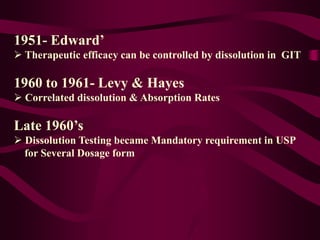
1951- Edward’
 Therapeutic efficacy can be controlled by dissolution in GIT
1960 to 1961- Levy & Hayes
 Correlated dissolution & Absorption Rates
Late 1960’s
 Dissolution Testing became Mandatory requirement in USP
for Several Dosage form
INTRODUCTION -Dissolution
 Far from being understood perfectly
 Not a predictor of therapeutic efficacy
 qualitative tool in design, fabrication and evaluation of
dosage form
 Most sensitive predictor of bioavailability
 Important Quality Control Test
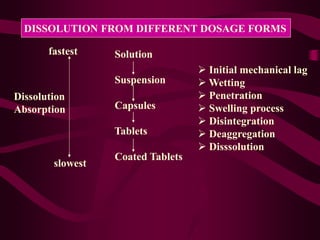
DISSOLUTION FROM DIFFERENT DOSAGE FORMS
Solution
Suspension
Capsules
Tablets
Coated Tablets
Dissolution
Absorption
fastest
slowest
 Initial mechanical lag
 Wetting
 Penetration
 Swelling process
 Disintegration
 Deaggregation
 Disssolution
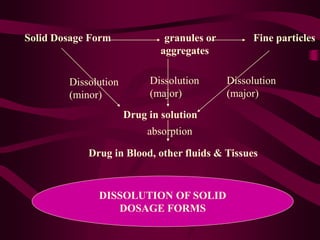
Solid Dosage Form granules or Fine particles
aggregates
Drug in solution
Drug in Blood, other fluids & Tissues
DISSOLUTION OF SOLID
DOSAGE FORMS
Dissolution
(minor)
Dissolution
(major)
Dissolution
(major)
absorption
NEED OF DISSOLUTION TESTING:
 Rate Limiting Step
 Rate of Dissolution controls rate of absorption
 Bioavailability can be correlated with invitro
Dissolution Results
 Minimizing use of Human Volunteers as Test
subjects
 Ensure Batch-Batch Quality Equivalence
 Invitro models can be used to screen potential drugs and its
formulations
 Post approval changes-effect of modification in Formula Structre
on bioavailability can be addressed.
 Minimize cost, Labour etc.
 Convenient
 STILL…….. The best model also may not be able to mimic the
fate of dosage form in biological system
STEPS FOR DEVELOPMENT OF A DISSOLUTION TEST
 Reconstructions of conditions in GIT in invitro system
 Physico chemical properties of an Invitro dissolution model
may be of significance in the Invivo process once a success-
ful model that adequately mimics the invivo situation is
developed
 Rate Limiting Factors of drug absorption
 Bio pharmaceutics classification scheme
RATE LIMITING FACTORS OF DRUG ABSORPTION
 Drug is not delivered from its formulation over an appropriate
time frame in solution form at the site of absorption in GIT
 Decomposition of drug in GIT
 Lack of effective transport of drug across Gut Wall
 First pass Metabolism
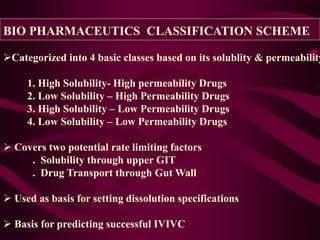
BIO PHARMACEUTICS CLASSIFICATION SCHEME
Categorized into 4 basic classes based on its solublity & permeability
1. High Solubility- High permeability Drugs
2. Low Solubility – High Permeability Drugs
3. High Solubility – Low Permeability Drugs
4. Low Solubility – Low Permeability Drugs
 Covers two potential rate limiting factors
. Solubility through upper GIT
. Drug Transport through Gut Wall
 Used as basis for setting dissolution specifications
 Basis for predicting successful IVIVC
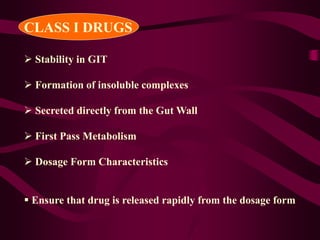
CLASS I DRUGS
 Stability in GIT
 Formation of insoluble complexes
 Secreted directly from the Gut Wall
 First Pass Metabolism
 Dosage Form Characteristics
 Ensure that drug is released rapidly from the dosage form
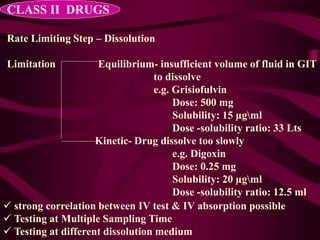
CLASS II DRUGS
Rate Limiting Step – Dissolution
Limitation Equilibrium- insufficient volume of fluid in GIT
to dissolve
e.g. Grisiofulvin
Dose: 500 mg
Solubility: 15 µgml
Dose -solubility ratio: 33 Lts
Kinetic- Drug dissolve too slowly
e.g. Digoxin
Dose: 0.25 mg
Solubility: 20 µgml
Dose -solubility ratio: 12.5 ml
 strong correlation between IV test & IV absorption possible
 Testing at Multiple Sampling Time
 Testing at different dissolution medium
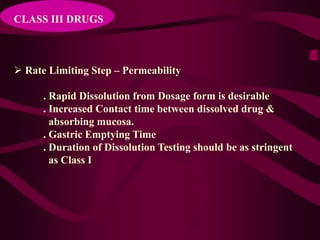
CLASS III DRUGS
 Rate Limiting Step – Permeability
. Rapid Dissolution from Dosage form is desirable
. Increased Contact time between dissolved drug &
absorbing mucosa.
. Gastric Emptying Time
. Duration of Dissolution Testing should be as stringent
as Class I
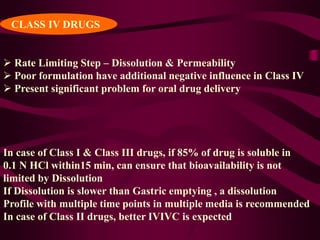
CLASS IV DRUGS
 Rate Limiting Step – Dissolution & Permeability
 Poor formulation have additional negative influence in Class IV
 Present significant problem for oral drug delivery
In case of Class I & Class III drugs, if 85% of drug is soluble in
0.1 N HCl within15 min, can ensure that bioavailability is not
limited by Dissolution
If Dissolution is slower than Gastric emptying , a dissolution
Profile with multiple time points in multiple media is recommended
In case of Class II drugs, better IVIVC is expected
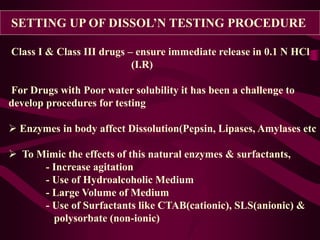
SETTING UP OF DISSOL’N TESTING PROCEDURE
Class I & Class III drugs – ensure immediate release in 0.1 N HCl
(I.R)
For Drugs with Poor water solubility it has been a challenge to
develop procedures for testing
 Enzymes in body affect Dissolution(Pepsin, Lipases, Amylases etc
 To Mimic the effects of this natural enzymes & surfactants,
- Increase agitation
- Use of Hydroalcoholic Medium
- Large Volume of Medium
- Use of Surfactants like CTAB(cationic), SLS(anionic) &
polysorbate (non-ionic)
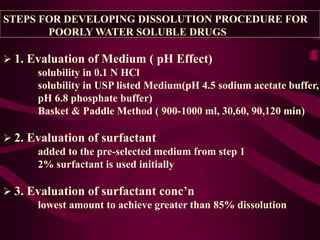
STEPS FOR DEVELOPING DISSOLUTION PROCEDURE FOR
POORLY WATER SOLUBLE DRUGS
 1. Evaluation of Medium ( pH Effect)
solubility in 0.1 N HCl
solubility in USP listed Medium(pH 4.5 sodium acetate buffer,
pH 6.8 phosphate buffer)
Basket & Paddle Method ( 900-1000 ml, 30,60, 90,120 min)
 2. Evaluation of surfactant
added to the pre-selected medium from step 1
2% surfactant is used initially
 3. Evaluation of surfactant conc’n
lowest amount to achieve greater than 85% dissolution
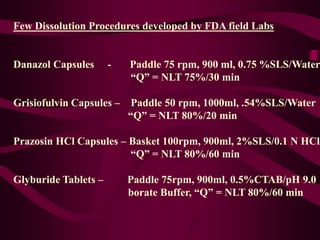
Few Dissolution Procedures developed by FDA field Labs
Danazol Capsules - Paddle 75 rpm, 900 ml, 0.75 %SLS/Water
“Q” = NLT 75%/30 min
Grisiofulvin Capsules – Paddle 50 rpm, 1000ml, .54%SLS/Water
“Q” = NLT 80%/20 min
Prazosin HCl Capsules – Basket 100rpm, 900ml, 2%SLS/0.1 N HCl
“Q” = NLT 80%/60 min
Glyburide Tablets – Paddle 75rpm, 900ml, 0.5%CTAB/pH 9.0
borate Buffer, “Q” = NLT 80%/60 min
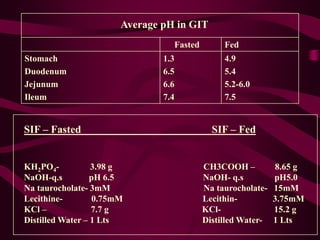
Fasted Fed
Stomach
Duodenum
Jejunum
Ileum
1.3
6.5
6.6
7.4
4.9
5.4
5.2-6.0
7.5
Average pH in GIT
SIF – Fasted SIF – Fed
KH2PO4- 3.98 g CH3COOH – 8.65 g
NaOH-q.s pH 6.5 NaOH- q.s pH5.0
Na taurocholate- 3mM Na taurocholate- 15mM
Lecithine- 0.75mM Lecithin- 3.75mM
KCl – 7.7 g KCl- 15.2 g
Distilled Water – 1 Lts Distilled Water- 1 Lts
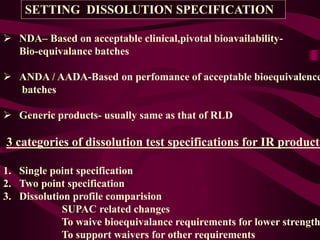
SETTING DISSOLUTION SPECIFICATION
 NDA– Based on acceptable clinical,pivotal bioavailability-
Bio-equivalance batches
 ANDA / AADA-Based on perfomance of acceptable bioequivalence
batches
 Generic products- usually same as that of RLD
3 categories of dissolution test specifications for IR products
1. Single point specification
2. Two point specification
3. Dissolution profile comparision
SUPAC related changes
To waive bioequivalance requirements for lower strength
To support waivers for other requirements
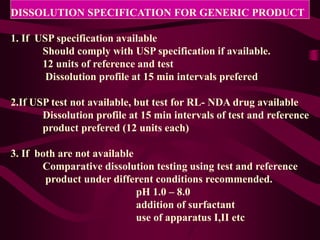
DISSOLUTION SPECIFICATION FOR GENERIC PRODUCT
1. If USP specification available
Should comply with USP specification if available.
12 units of reference and test
Dissolution profile at 15 min intervals prefered
2.If USP test not available, but test for RL- NDA drug available
Dissolution profile at 15 min intervals of test and reference
product prefered (12 units each)
3. If both are not available
Comparative dissolution testing using test and reference
product under different conditions recommended.
pH 1.0 – 8.0
addition of surfactant
use of apparatus I,II etc
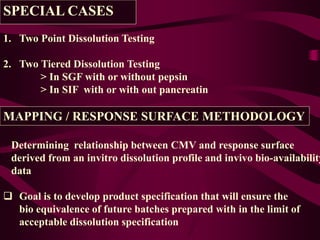
SPECIAL CASES
1. Two Point Dissolution Testing
2. Two Tiered Dissolution Testing
> In SGF with or without pepsin
> In SIF with or with out pancreatin
MAPPING / RESPONSE SURFACE METHODOLOGY
Determining relationship between CMV and response surface
derived from an invitro dissolution profile and invivo bio-availability
data
 Goal is to develop product specification that will ensure the
bio equivalence of future batches prepared with in the limit of
acceptable dissolution specification
DISSOLUTION PROFILE COMPARISION
F1 Factor (Difference factor)
% difference between the two curves at each time point
12 units to be used
For curves to be considered similar, value should close to zero.
F2 Factor (Similarity factor)
Measurement of the similarity in % dissolution between two curves
12 units to be used
For curves to be considered similar, value should close to 100
FACTORS TO BE CONSIDERED IN COMPARISION
 Dissolution time points for both curves should be same
 The Reference batch should be most recently manufactured
pre change product
 Only one measurement should be considered after 85%
dissolution of both the product
SETTING OF DISSOLUTION SPECIFICATION IN
MODIFIED RELEASE DOSAGE FORM
 Without IVIVC
1. Should be established from clinical/bioavailability lots.
2. 10% deviation at any time point permitted
3. Above 10% variation can be permitted provided that
range at anytime point doesnot exceed 25% with the
evidence that they are bio-equivalent
4. Above 25% can be acceptable with proven bioequivalence
5. Minimum of 3 time points recommended to set specification
6. The last time point should be at the point where atleast 80%
of drug is dissolved/plateau of dissolution profile reached
7. USP acceptance criteria for dissolution testing recommended
unless alternate acceptance criteria is specified in ANDA/NDA
 Where IVIVC has been Established:
Specification should be established in such that all lots that
have dissolution profiles within the upper & lower limits of
the specifications or bio equivalent to clinical lot/reference std
 Level A correlation Established:
. Specification should be established based on avg data.
. Minimum of 3 time points recommended to set specification
. The last time point should be at the point where atleast 80%
of drug is dissolved/plateau of dissolution profile reached.
. In lots at lowest & highest specification limits should have a
maximal difference of 20% in the predicted Cmax & AUC
 Multiple Level C correlation Established:
SAME as previous
 Level C correlation based on single time point established
. There is NMT a 20% difference in predicted AUC & Cmax
. % dissolved at any time point should be +/- 10% from mean
dissolution profile obtained from clinical/bioavailability lots.
FACTORS INFLUENCING DISSOLUTION TESTING
Dissolution Test should give reproducible results even when it is
performed in two different laboratories or with different personel.
To achieve high reproducibility all variables that influence the
test should be controlled
1) Factors related to physicochemical properties of the drug
2) Factors related to drug product formulation
3) Factors related to dosage form
4) Factors related to Dissolution testing Device
5) Factors related to Test parameters
6) Miscellaneous Factors
 Factors related to physicochemical properties of the drug
a) Solid Phase Characteristics
. Amorphicity, Crystallinity
b) Polymorphism
c) Co-precipitation and /or Complexation
. Hydroflumethiazide-PVP-co-precipitates
d) Particle Characterisitics
. Effective surface area, wetting properties of media,
hydrophilic nature of the drug
 Factors related to drug product formulation
a) Excipients & Additives
b) Particle Size
c) Granulating agents & Binders
d) Disintegrating agents
e) Lubricant
f) Interfacial tension between drug&media
g) Surfactants
 Factors related to dosage form
a) Manufacturing Procedure
b) Granule Size
c) Drug – Excipient interaction
d) Compression force
e) De – aggregation
f) Storage of dosage form
 Factors related to Dissolution testing Device
a) Eccentricity of agitating element
b) Vibration
c) Agitation intencity
d) Stirring element alignment
e) Flow pattern disturbances
f) Sampling probes, position & filters
g) Dosage form design
h) Type of device
 Factors related to Test parameters
a) Temperature
b) Dissolution medium
. Dissolved gas / air
. Composition of media
. pH
. Viscosity
. Other factors
 Miscellaneous Factors
a) Adsorption
b) Sorption
Apparatus
USP Compendial Dissolution Testing
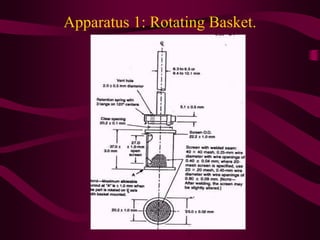
Apparatus 1: Rotating Basket.
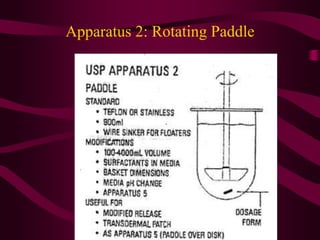
Apparatus 2: Rotating Paddle
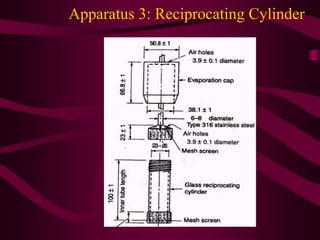
Apparatus 3: Reciprocating Cylinder
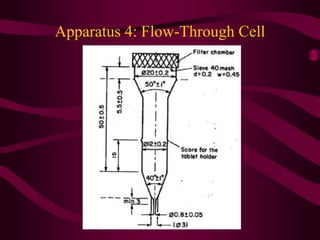
Apparatus 4: Flow-Through Cell
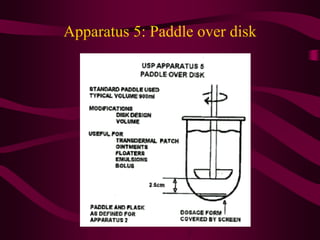
Apparatus 5: Paddle over disk
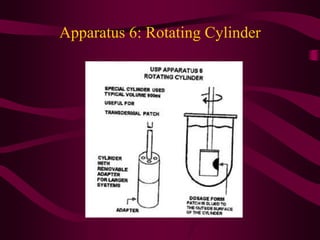
Apparatus 6: Rotating Cylinder
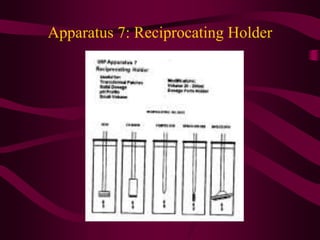
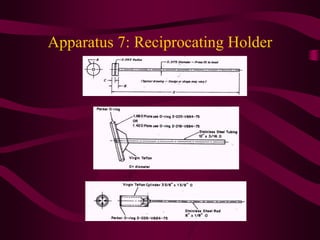
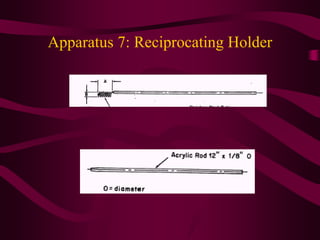
Apparatus 7: Reciprocating Holder
Apparatus 1: Rotating Basket.
Apparatus 2: Rotating Paddle
Apparatus 3: Reciprocating Cylinder
Apparatus 4: Flow-Through Cell
Apparatus 5: Paddle over disk
Apparatus 6: Rotating Cylinder
Apparatus 7: Reciprocating Holder
Dissolution_Technique.ppt

Dissolution_Technique.ppt

  • 1.
     HISTORY  INTRODUCTION NEED OF DISSOLUTION TESTING  BIOPHARMACEUTICS CLASSIFICATION SCHEME  SETTING DISSOLUTION TESTING PROCEDURE  SETTING DISSOLUTION SPECIFICATION  FACTORS INFLUENCING DISSOLUTION TESTING  APPARATUS
  • 2.
    Definition: Dissolution is definedas a process by which a solid substance enters in the solvent to yield a solution. Fundamentally it is controlled by the affinity between the solid substances and the solvent.
  • 3.
    HISTORY: 19th Century- Bernard.S.Proctor Pill Dissolution is necessary for Drug Absorption 1897-Noyes&Whitney  Dissolution-related to rate of diffusion of saturated layer around the solid 1930- Attempt to relate invitro testing and Invivo availability 1950’s – focus shifted from physicochemcial aspects to effect on biological activity
  • 4.
    1951- Edward’  Therapeuticefficacy can be controlled by dissolution in GIT 1960 to 1961- Levy & Hayes  Correlated dissolution & Absorption Rates Late 1960’s  Dissolution Testing became Mandatory requirement in USP for Several Dosage form
  • 5.
    INTRODUCTION -Dissolution  Farfrom being understood perfectly  Not a predictor of therapeutic efficacy  qualitative tool in design, fabrication and evaluation of dosage form  Most sensitive predictor of bioavailability  Important Quality Control Test
  • 6.
    DISSOLUTION FROM DIFFERENTDOSAGE FORMS Solution Suspension Capsules Tablets Coated Tablets Dissolution Absorption fastest slowest  Initial mechanical lag  Wetting  Penetration  Swelling process  Disintegration  Deaggregation  Disssolution
  • 7.
    Solid Dosage Formgranules or Fine particles aggregates Drug in solution Drug in Blood, other fluids & Tissues DISSOLUTION OF SOLID DOSAGE FORMS Dissolution (minor) Dissolution (major) Dissolution (major) absorption
  • 8.
    NEED OF DISSOLUTIONTESTING:  Rate Limiting Step  Rate of Dissolution controls rate of absorption  Bioavailability can be correlated with invitro Dissolution Results  Minimizing use of Human Volunteers as Test subjects  Ensure Batch-Batch Quality Equivalence
  • 9.
     Invitro modelscan be used to screen potential drugs and its formulations  Post approval changes-effect of modification in Formula Structre on bioavailability can be addressed.  Minimize cost, Labour etc.  Convenient  STILL…….. The best model also may not be able to mimic the fate of dosage form in biological system
  • 10.
    STEPS FOR DEVELOPMENTOF A DISSOLUTION TEST  Reconstructions of conditions in GIT in invitro system  Physico chemical properties of an Invitro dissolution model may be of significance in the Invivo process once a success- ful model that adequately mimics the invivo situation is developed  Rate Limiting Factors of drug absorption  Bio pharmaceutics classification scheme
  • 11.
    RATE LIMITING FACTORSOF DRUG ABSORPTION  Drug is not delivered from its formulation over an appropriate time frame in solution form at the site of absorption in GIT  Decomposition of drug in GIT  Lack of effective transport of drug across Gut Wall  First pass Metabolism
  • 12.
    BIO PHARMACEUTICS CLASSIFICATIONSCHEME Categorized into 4 basic classes based on its solublity & permeability 1. High Solubility- High permeability Drugs 2. Low Solubility – High Permeability Drugs 3. High Solubility – Low Permeability Drugs 4. Low Solubility – Low Permeability Drugs  Covers two potential rate limiting factors . Solubility through upper GIT . Drug Transport through Gut Wall  Used as basis for setting dissolution specifications  Basis for predicting successful IVIVC
  • 13.
    CLASS I DRUGS Stability in GIT  Formation of insoluble complexes  Secreted directly from the Gut Wall  First Pass Metabolism  Dosage Form Characteristics  Ensure that drug is released rapidly from the dosage form
  • 14.
    CLASS II DRUGS RateLimiting Step – Dissolution Limitation Equilibrium- insufficient volume of fluid in GIT to dissolve e.g. Grisiofulvin Dose: 500 mg Solubility: 15 µgml Dose -solubility ratio: 33 Lts Kinetic- Drug dissolve too slowly e.g. Digoxin Dose: 0.25 mg Solubility: 20 µgml Dose -solubility ratio: 12.5 ml  strong correlation between IV test & IV absorption possible  Testing at Multiple Sampling Time  Testing at different dissolution medium
  • 15.
    CLASS III DRUGS Rate Limiting Step – Permeability . Rapid Dissolution from Dosage form is desirable . Increased Contact time between dissolved drug & absorbing mucosa. . Gastric Emptying Time . Duration of Dissolution Testing should be as stringent as Class I
  • 16.
    CLASS IV DRUGS Rate Limiting Step – Dissolution & Permeability  Poor formulation have additional negative influence in Class IV  Present significant problem for oral drug delivery In case of Class I & Class III drugs, if 85% of drug is soluble in 0.1 N HCl within15 min, can ensure that bioavailability is not limited by Dissolution If Dissolution is slower than Gastric emptying , a dissolution Profile with multiple time points in multiple media is recommended In case of Class II drugs, better IVIVC is expected
  • 17.
    SETTING UP OFDISSOL’N TESTING PROCEDURE Class I & Class III drugs – ensure immediate release in 0.1 N HCl (I.R) For Drugs with Poor water solubility it has been a challenge to develop procedures for testing  Enzymes in body affect Dissolution(Pepsin, Lipases, Amylases etc  To Mimic the effects of this natural enzymes & surfactants, - Increase agitation - Use of Hydroalcoholic Medium - Large Volume of Medium - Use of Surfactants like CTAB(cationic), SLS(anionic) & polysorbate (non-ionic)
  • 18.
    STEPS FOR DEVELOPINGDISSOLUTION PROCEDURE FOR POORLY WATER SOLUBLE DRUGS  1. Evaluation of Medium ( pH Effect) solubility in 0.1 N HCl solubility in USP listed Medium(pH 4.5 sodium acetate buffer, pH 6.8 phosphate buffer) Basket & Paddle Method ( 900-1000 ml, 30,60, 90,120 min)  2. Evaluation of surfactant added to the pre-selected medium from step 1 2% surfactant is used initially  3. Evaluation of surfactant conc’n lowest amount to achieve greater than 85% dissolution
  • 19.
    Few Dissolution Proceduresdeveloped by FDA field Labs Danazol Capsules - Paddle 75 rpm, 900 ml, 0.75 %SLS/Water “Q” = NLT 75%/30 min Grisiofulvin Capsules – Paddle 50 rpm, 1000ml, .54%SLS/Water “Q” = NLT 80%/20 min Prazosin HCl Capsules – Basket 100rpm, 900ml, 2%SLS/0.1 N HCl “Q” = NLT 80%/60 min Glyburide Tablets – Paddle 75rpm, 900ml, 0.5%CTAB/pH 9.0 borate Buffer, “Q” = NLT 80%/60 min
  • 20.
    Fasted Fed Stomach Duodenum Jejunum Ileum 1.3 6.5 6.6 7.4 4.9 5.4 5.2-6.0 7.5 Average pHin GIT SIF – Fasted SIF – Fed KH2PO4- 3.98 g CH3COOH – 8.65 g NaOH-q.s pH 6.5 NaOH- q.s pH5.0 Na taurocholate- 3mM Na taurocholate- 15mM Lecithine- 0.75mM Lecithin- 3.75mM KCl – 7.7 g KCl- 15.2 g Distilled Water – 1 Lts Distilled Water- 1 Lts
  • 21.
    SETTING DISSOLUTION SPECIFICATION NDA– Based on acceptable clinical,pivotal bioavailability- Bio-equivalance batches  ANDA / AADA-Based on perfomance of acceptable bioequivalence batches  Generic products- usually same as that of RLD 3 categories of dissolution test specifications for IR products 1. Single point specification 2. Two point specification 3. Dissolution profile comparision SUPAC related changes To waive bioequivalance requirements for lower strength To support waivers for other requirements
  • 22.
    DISSOLUTION SPECIFICATION FORGENERIC PRODUCT 1. If USP specification available Should comply with USP specification if available. 12 units of reference and test Dissolution profile at 15 min intervals prefered 2.If USP test not available, but test for RL- NDA drug available Dissolution profile at 15 min intervals of test and reference product prefered (12 units each) 3. If both are not available Comparative dissolution testing using test and reference product under different conditions recommended. pH 1.0 – 8.0 addition of surfactant use of apparatus I,II etc
  • 23.
    SPECIAL CASES 1. TwoPoint Dissolution Testing 2. Two Tiered Dissolution Testing > In SGF with or without pepsin > In SIF with or with out pancreatin MAPPING / RESPONSE SURFACE METHODOLOGY Determining relationship between CMV and response surface derived from an invitro dissolution profile and invivo bio-availability data  Goal is to develop product specification that will ensure the bio equivalence of future batches prepared with in the limit of acceptable dissolution specification
  • 24.
    DISSOLUTION PROFILE COMPARISION F1Factor (Difference factor) % difference between the two curves at each time point 12 units to be used For curves to be considered similar, value should close to zero. F2 Factor (Similarity factor) Measurement of the similarity in % dissolution between two curves 12 units to be used For curves to be considered similar, value should close to 100
  • 25.
    FACTORS TO BECONSIDERED IN COMPARISION  Dissolution time points for both curves should be same  The Reference batch should be most recently manufactured pre change product  Only one measurement should be considered after 85% dissolution of both the product
  • 26.
    SETTING OF DISSOLUTIONSPECIFICATION IN MODIFIED RELEASE DOSAGE FORM  Without IVIVC 1. Should be established from clinical/bioavailability lots. 2. 10% deviation at any time point permitted 3. Above 10% variation can be permitted provided that range at anytime point doesnot exceed 25% with the evidence that they are bio-equivalent 4. Above 25% can be acceptable with proven bioequivalence 5. Minimum of 3 time points recommended to set specification 6. The last time point should be at the point where atleast 80% of drug is dissolved/plateau of dissolution profile reached 7. USP acceptance criteria for dissolution testing recommended unless alternate acceptance criteria is specified in ANDA/NDA
  • 27.
     Where IVIVChas been Established: Specification should be established in such that all lots that have dissolution profiles within the upper & lower limits of the specifications or bio equivalent to clinical lot/reference std  Level A correlation Established: . Specification should be established based on avg data. . Minimum of 3 time points recommended to set specification . The last time point should be at the point where atleast 80% of drug is dissolved/plateau of dissolution profile reached. . In lots at lowest & highest specification limits should have a maximal difference of 20% in the predicted Cmax & AUC
  • 28.
     Multiple LevelC correlation Established: SAME as previous  Level C correlation based on single time point established . There is NMT a 20% difference in predicted AUC & Cmax . % dissolved at any time point should be +/- 10% from mean dissolution profile obtained from clinical/bioavailability lots.
  • 29.
    FACTORS INFLUENCING DISSOLUTIONTESTING Dissolution Test should give reproducible results even when it is performed in two different laboratories or with different personel. To achieve high reproducibility all variables that influence the test should be controlled 1) Factors related to physicochemical properties of the drug 2) Factors related to drug product formulation 3) Factors related to dosage form 4) Factors related to Dissolution testing Device 5) Factors related to Test parameters 6) Miscellaneous Factors
  • 30.
     Factors relatedto physicochemical properties of the drug a) Solid Phase Characteristics . Amorphicity, Crystallinity b) Polymorphism c) Co-precipitation and /or Complexation . Hydroflumethiazide-PVP-co-precipitates d) Particle Characterisitics . Effective surface area, wetting properties of media, hydrophilic nature of the drug
  • 31.
     Factors relatedto drug product formulation a) Excipients & Additives b) Particle Size c) Granulating agents & Binders d) Disintegrating agents e) Lubricant f) Interfacial tension between drug&media g) Surfactants
  • 32.
     Factors relatedto dosage form a) Manufacturing Procedure b) Granule Size c) Drug – Excipient interaction d) Compression force e) De – aggregation f) Storage of dosage form
  • 33.
     Factors relatedto Dissolution testing Device a) Eccentricity of agitating element b) Vibration c) Agitation intencity d) Stirring element alignment e) Flow pattern disturbances f) Sampling probes, position & filters g) Dosage form design h) Type of device
  • 34.
     Factors relatedto Test parameters a) Temperature b) Dissolution medium . Dissolved gas / air . Composition of media . pH . Viscosity . Other factors  Miscellaneous Factors a) Adsorption b) Sorption
  • 35.
    Apparatus USP Compendial DissolutionTesting Apparatus 1: Rotating Basket. Apparatus 2: Rotating Paddle Apparatus 3: Reciprocating Cylinder Apparatus 4: Flow-Through Cell Apparatus 5: Paddle over disk Apparatus 6: Rotating Cylinder Apparatus 7: Reciprocating Holder
  • 36.
  • 37.
  • 38.
  • 39.
  • 40.
  • 41.
  • 42.
  • 43.
  • 44.