IN VITRO DISSOLUTION
AND DRUG RELEASE TESTING
Submitted By: Prachi Pandey Submitted To: Dr. Tejpal Yadav
M. Pharm (Pharmaceutics), IInd Sem.
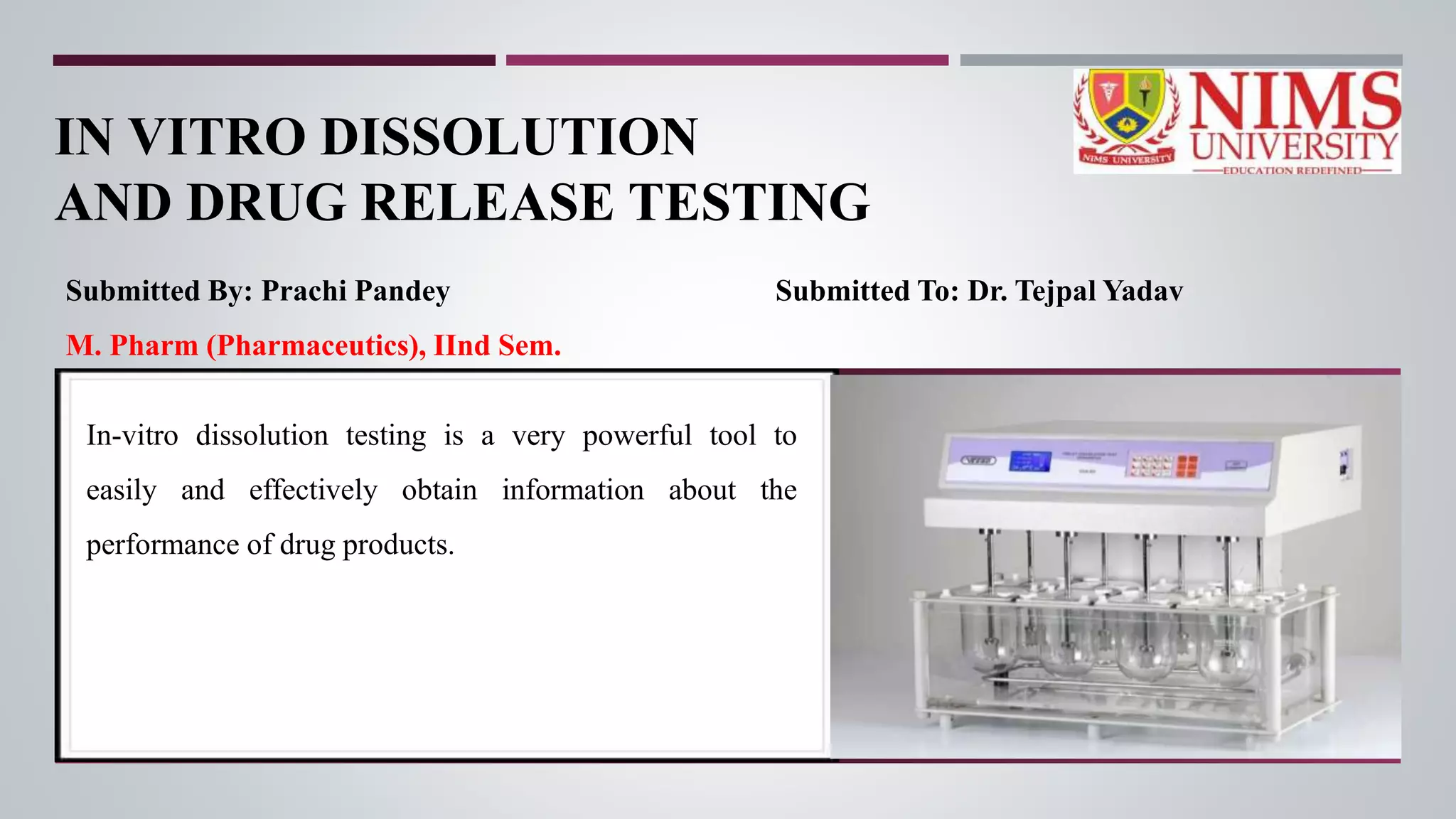
In-vitro dissolution testing is a very powerful tool to
easily and effectively obtain information about the
performance of drug products.
DEFINATION
• Dissolution is a process in which a solid substance solubilizes in a given solvent (mass
transfer from the solid surface to the liquid phase.)
• Dissolution testing measures the extent and rate of solution formation from a dosage form,
such as tablet, capsule, ointment, etc.
• The dissolution of a drug is important for its bioavailability and therapeutic effectiveness
 DISSOLUTION RATE :
 Dissolution rate is defined as the amount of solid substance goes into solution per unit time under
standard conditions of temperature, pH and solvent composition and constant surface area.
 ABSOLUTE OR INTRINSIC SOLUBILITY:
 It is defined as the maximum amount of solute dissolved in a given solvent under standard conditions of
temperature, pressure and pH.
DISSOLUTION
When a immediate release tablet or other solid drug form is introduced into a beaker of water or into the
gastrointestinal tract, the following steps take place.
 Disintegration: breaking of tablet into granules.
 Deaggregation: breaking of these granules into individual particles.
 Dissolution: finally, particles dissolve, releasing the active drug into solution. Dissolution is a time
dependant process that represents the final step of drug release, which is ultimately required before a
drug can be absorbed or exert a pharmacologic effect
DISSOLUTION OF TABLETS AND CAPSULES
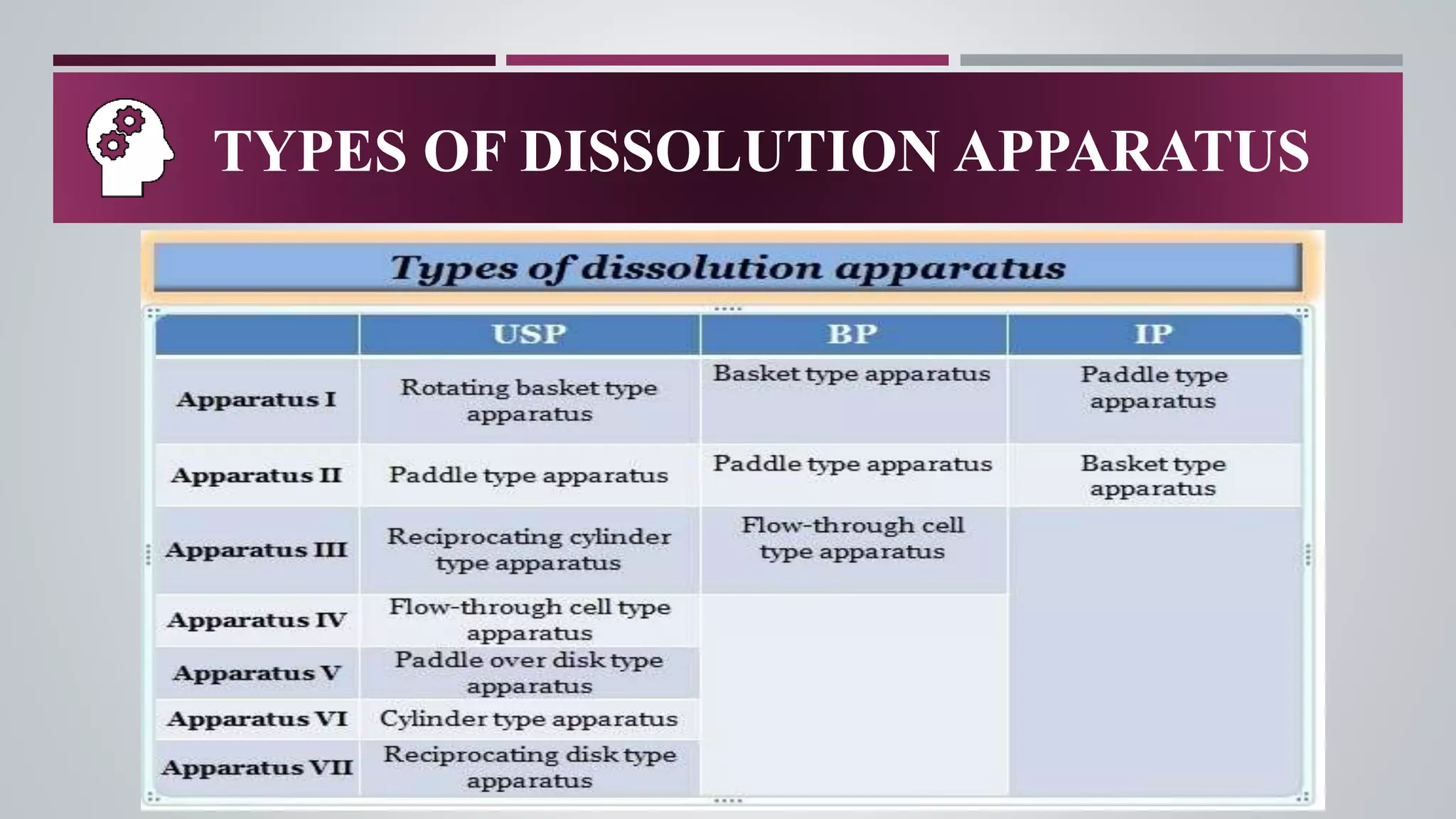
TYPES OF DISSOLUTION APPARATUS
USP DISSOLUTION APPARATUS
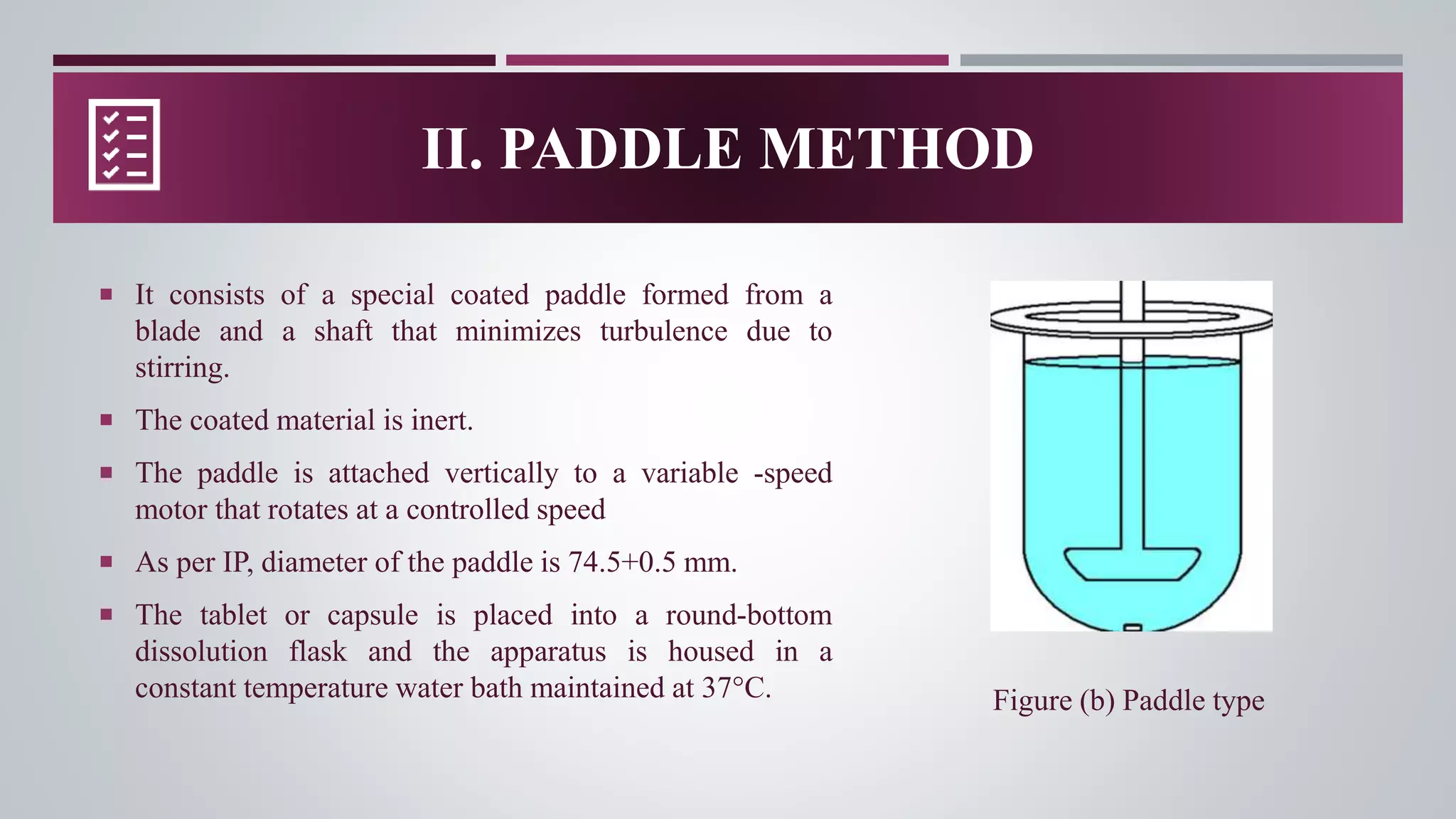
• Cylindrical basket of 22mesh.
• Rotating speed-100 rpm.
• As per IP, height of dissolution jar is 168+8 mm and internal diameter
is102+4 mm and height of basket36.8+3 mm and diameter is 25.4+3
mm.
• Temp. maintained at 37°C
• Calibration tablets of Prednisone-for disintegrating tablets.
• Salicylic acid calibration tablets-for non disintegrating tablets.
• For capsules & dosage forms that tend to float.
I. ROTATING BASKET APPARATUS
Figure (a) Basket type
II. PADDLE METHOD
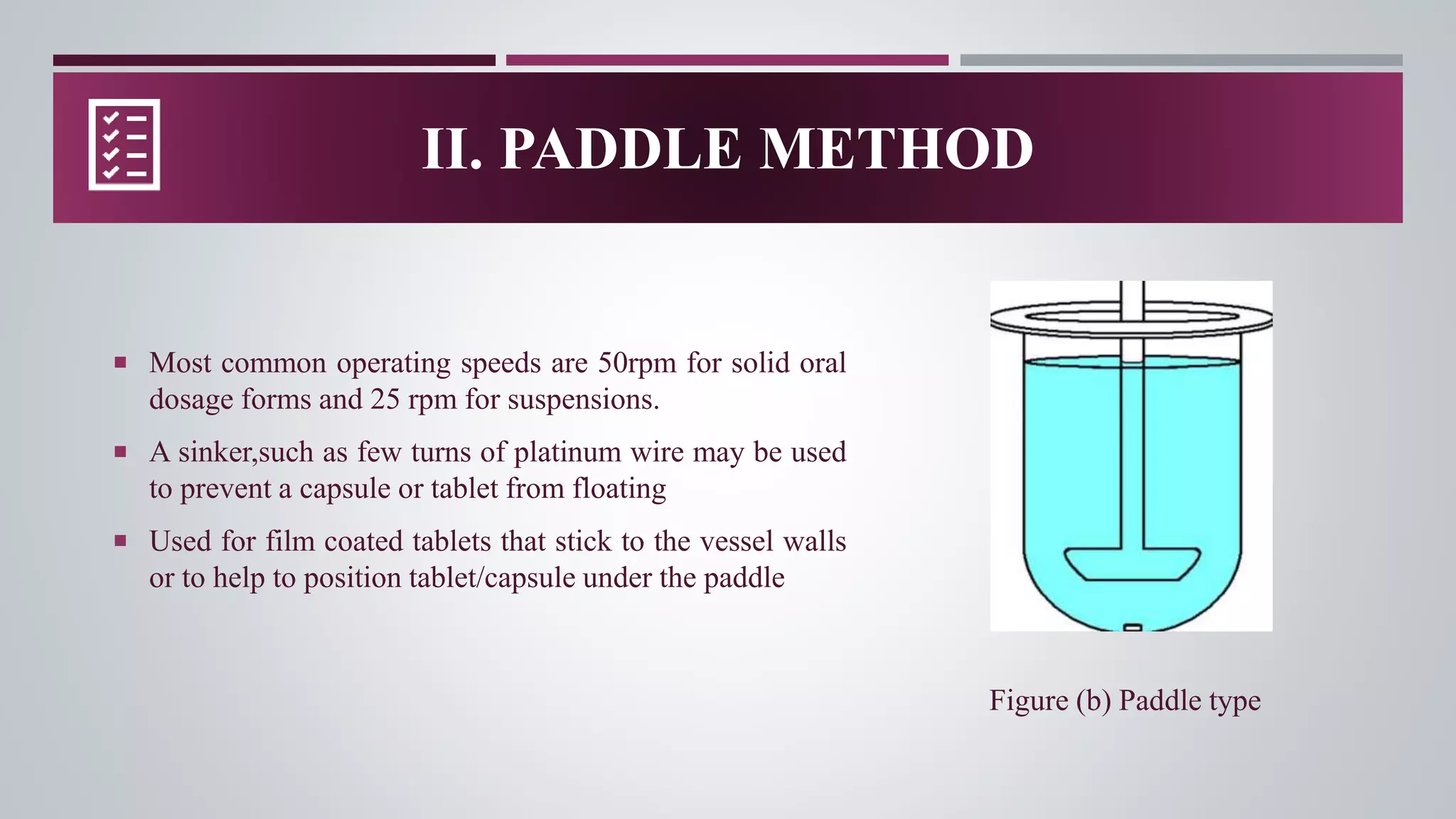
 It consists of a special coated paddle formed from a
blade and a shaft that minimizes turbulence due to
stirring.
 The coated material is inert.
 The paddle is attached vertically to a variable -speed
motor that rotates at a controlled speed
 As per IP, diameter of the paddle is 74.5+0.5 mm.
 The tablet or capsule is placed into a round-bottom
dissolution flask and the apparatus is housed in a
constant temperature water bath maintained at 37°C. Figure (b) Paddle type
II. PADDLE METHOD
 Most common operating speeds are 50rpm for solid oral
dosage forms and 25 rpm for suspensions.
 A sinker,such as few turns of platinum wire may be used
to prevent a capsule or tablet from floating
 Used for film coated tablets that stick to the vessel walls
or to help to position tablet/capsule under the paddle
Figure (b) Paddle type
• Set of cylindrical, flat-bottomed glass vessels equipped
with reciprocating cylinders.
• temp. 37°C
• Place the stated volume of dissolution medium in each
vessel of the apparatus, assemble the apparatus,
equilibrate the dissolution medium to 37±0.5°C and
remove the thermometer
• Place one dosage form unit in each of the cylinders
taking care to exclude the air bubbles from the surface
of each dosage unit and immediately operate the
apparatus as specified in the monograph.
III. RECEPROCATING CYLINDER TYPE
Figure (c) Receprocating cylinder type
• During the upward and downward stroke, the
reciprocating cylinder moves through a total
distance of 9.9 to 10.1cm.
• Within the time interval specified raise the
cylinders and withdraw a portion of the
solution under test from a zone midway
between the surface of the dissolution medium
and bottom of each vessel.
III. RECEPROCATING CYLINDER TYPE
Figure (c) Receprocating cylinder type
VI. FLOW THROUGH CELL METHOD
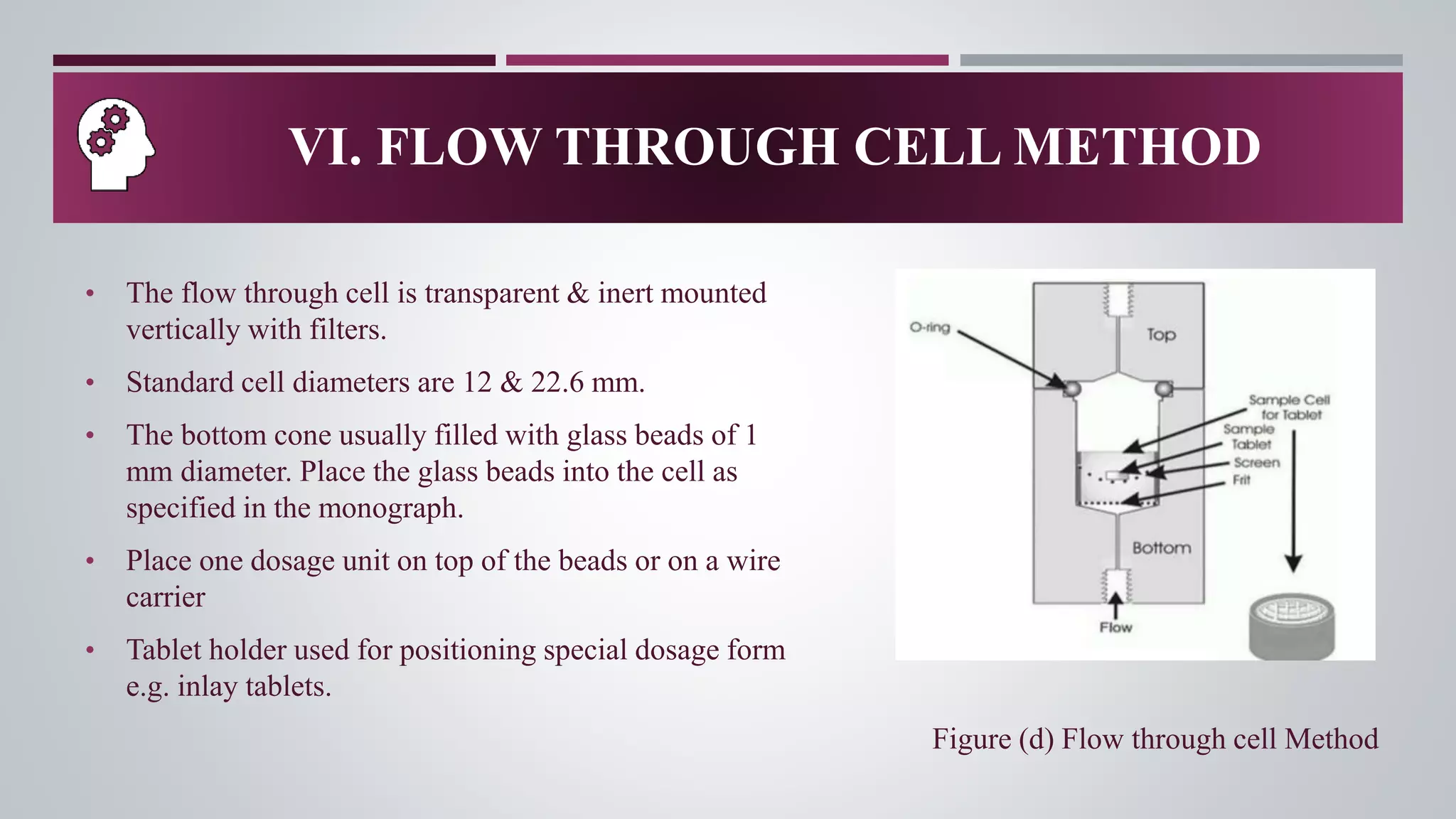
• The flow through cell is transparent & inert mounted
vertically with filters.
• Standard cell diameters are 12 & 22.6 mm.
• The bottom cone usually filled with glass beads of 1
mm diameter. Place the glass beads into the cell as
specified in the monograph.
• Place one dosage unit on top of the beads or on a wire
carrier
• Tablet holder used for positioning special dosage form
e.g. inlay tablets.
Figure (d) Flow through cell Method
VI. FLOW THROUGH CELL METHOD
• Assemble the filter head and fix the parts together by means
of a suitable clamping device.
• Introduce by the pump of the dissolution medium warmed to
37±0.5°C through the bottom of the cell to obtain the flow
rate specified and measured with an accuracy of 5%.
• Flow rate is maintained from 4 to 16 mL/min.
• Collect the eluate by fractions at each of the times stated
• For modified release dosage forms, containing active
ingredients with limited solubility
Figure (d) Flow through cell Method
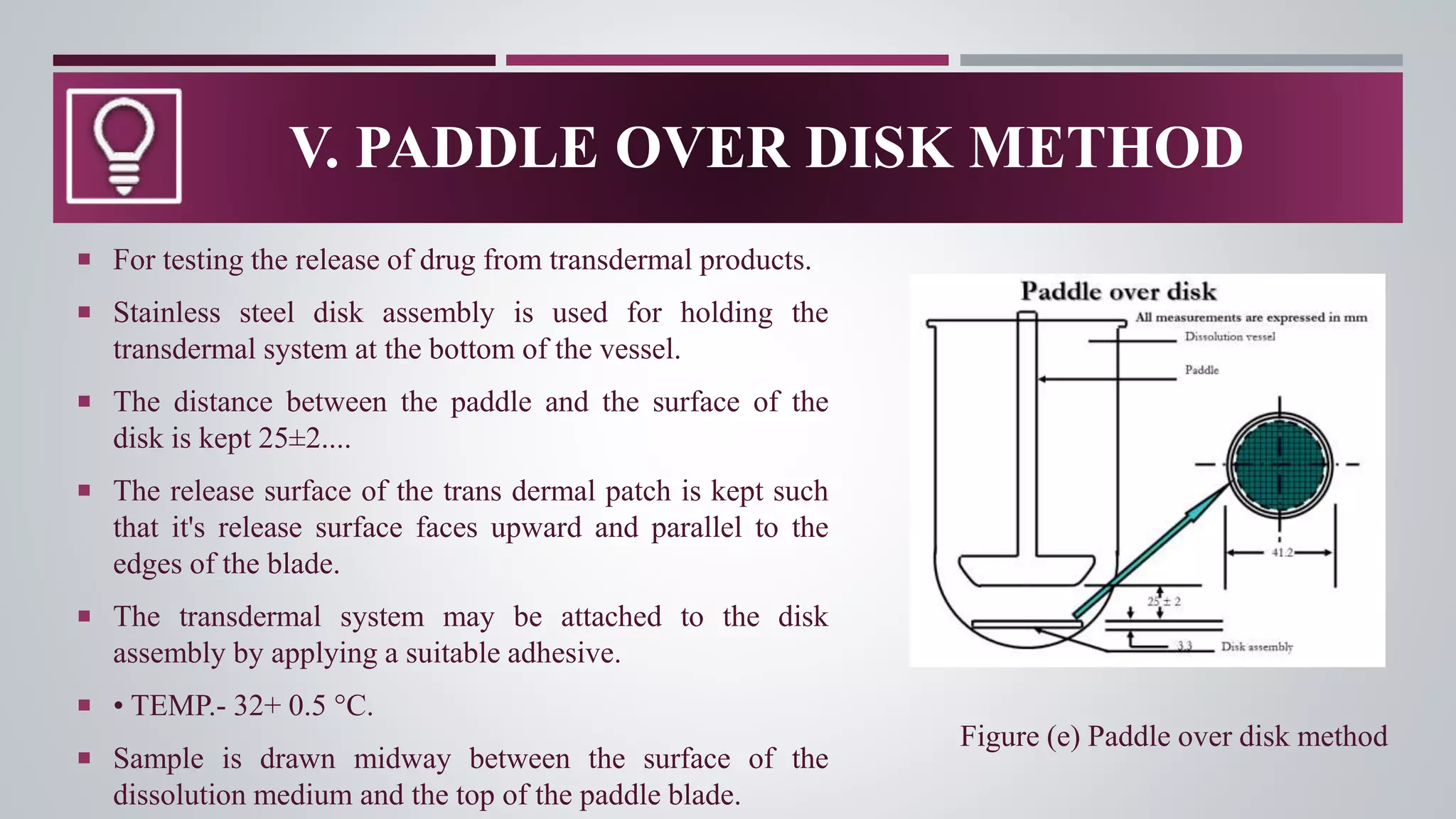
V. PADDLE OVER DISK METHOD
 For testing the release of drug from transdermal products.
 Stainless steel disk assembly is used for holding the
transdermal system at the bottom of the vessel.
 The distance between the paddle and the surface of the
disk is kept 25±2....
 The release surface of the trans dermal patch is kept such
that it's release surface faces upward and parallel to the
edges of the blade.
 The transdermal system may be attached to the disk
assembly by applying a suitable adhesive.
 • TEMP.- 32+ 0.5 °C.
 Sample is drawn midway between the surface of the
dissolution medium and the top of the paddle blade.
Figure (e) Paddle over disk method
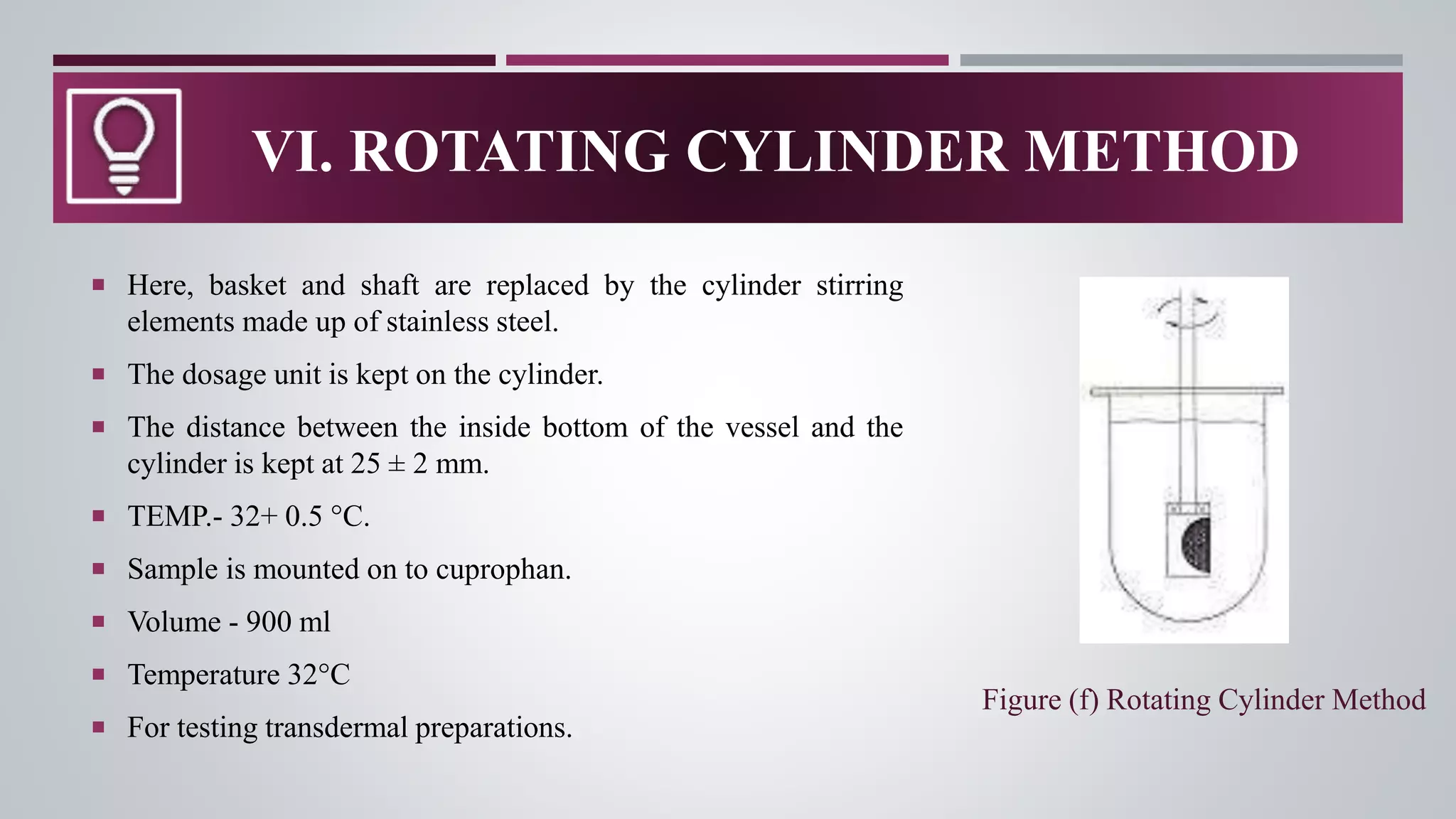
VI. ROTATING CYLINDER METHOD
 Here, basket and shaft are replaced by the cylinder stirring
elements made up of stainless steel.
 The dosage unit is kept on the cylinder.
 The distance between the inside bottom of the vessel and the
cylinder is kept at 25 ± 2 mm.
 TEMP.- 32+ 0.5 °C.
 Sample is mounted on to cuprophan.
 Volume - 900 ml
 Temperature 32°C
 For testing transdermal preparations.
Figure (f) Rotating Cylinder Method
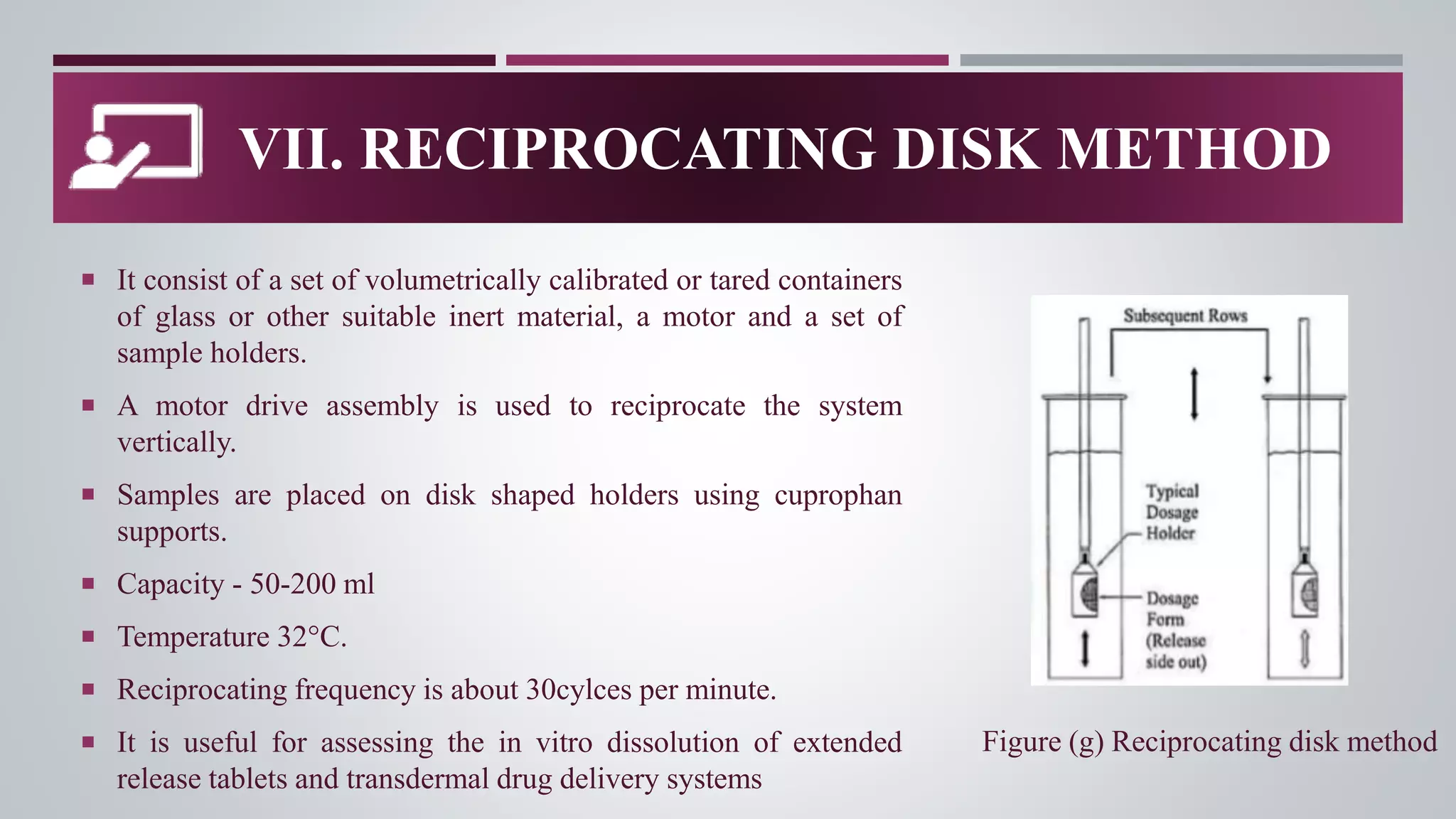
VII. RECIPROCATING DISK METHOD
 It consist of a set of volumetrically calibrated or tared containers
of glass or other suitable inert material, a motor and a set of
sample holders.
 A motor drive assembly is used to reciprocate the system
vertically.
 Samples are placed on disk shaped holders using cuprophan
supports.
 Capacity - 50-200 ml
 Temperature 32°C.
 Reciprocating frequency is about 30cylces per minute.
 It is useful for assessing the in vitro dissolution of extended
release tablets and transdermal drug delivery systems
Figure (g) Reciprocating disk method
In vitro dissolution apparatus USP.pptx

In vitro dissolution apparatus USP.pptx

  • 1.
    IN VITRO DISSOLUTION ANDDRUG RELEASE TESTING Submitted By: Prachi Pandey Submitted To: Dr. Tejpal Yadav M. Pharm (Pharmaceutics), IInd Sem. In-vitro dissolution testing is a very powerful tool to easily and effectively obtain information about the performance of drug products.
  • 2.
    DEFINATION • Dissolution isa process in which a solid substance solubilizes in a given solvent (mass transfer from the solid surface to the liquid phase.) • Dissolution testing measures the extent and rate of solution formation from a dosage form, such as tablet, capsule, ointment, etc. • The dissolution of a drug is important for its bioavailability and therapeutic effectiveness
  • 3.
     DISSOLUTION RATE:  Dissolution rate is defined as the amount of solid substance goes into solution per unit time under standard conditions of temperature, pH and solvent composition and constant surface area.  ABSOLUTE OR INTRINSIC SOLUBILITY:  It is defined as the maximum amount of solute dissolved in a given solvent under standard conditions of temperature, pressure and pH. DISSOLUTION
  • 4.
    When a immediaterelease tablet or other solid drug form is introduced into a beaker of water or into the gastrointestinal tract, the following steps take place.  Disintegration: breaking of tablet into granules.  Deaggregation: breaking of these granules into individual particles.  Dissolution: finally, particles dissolve, releasing the active drug into solution. Dissolution is a time dependant process that represents the final step of drug release, which is ultimately required before a drug can be absorbed or exert a pharmacologic effect DISSOLUTION OF TABLETS AND CAPSULES
  • 6.
  • 7.
  • 8.
    • Cylindrical basketof 22mesh. • Rotating speed-100 rpm. • As per IP, height of dissolution jar is 168+8 mm and internal diameter is102+4 mm and height of basket36.8+3 mm and diameter is 25.4+3 mm. • Temp. maintained at 37°C • Calibration tablets of Prednisone-for disintegrating tablets. • Salicylic acid calibration tablets-for non disintegrating tablets. • For capsules & dosage forms that tend to float. I. ROTATING BASKET APPARATUS Figure (a) Basket type
  • 9.
    II. PADDLE METHOD It consists of a special coated paddle formed from a blade and a shaft that minimizes turbulence due to stirring.  The coated material is inert.  The paddle is attached vertically to a variable -speed motor that rotates at a controlled speed  As per IP, diameter of the paddle is 74.5+0.5 mm.  The tablet or capsule is placed into a round-bottom dissolution flask and the apparatus is housed in a constant temperature water bath maintained at 37°C. Figure (b) Paddle type
  • 10.
    II. PADDLE METHOD Most common operating speeds are 50rpm for solid oral dosage forms and 25 rpm for suspensions.  A sinker,such as few turns of platinum wire may be used to prevent a capsule or tablet from floating  Used for film coated tablets that stick to the vessel walls or to help to position tablet/capsule under the paddle Figure (b) Paddle type
  • 11.
    • Set ofcylindrical, flat-bottomed glass vessels equipped with reciprocating cylinders. • temp. 37°C • Place the stated volume of dissolution medium in each vessel of the apparatus, assemble the apparatus, equilibrate the dissolution medium to 37±0.5°C and remove the thermometer • Place one dosage form unit in each of the cylinders taking care to exclude the air bubbles from the surface of each dosage unit and immediately operate the apparatus as specified in the monograph. III. RECEPROCATING CYLINDER TYPE Figure (c) Receprocating cylinder type
  • 12.
    • During theupward and downward stroke, the reciprocating cylinder moves through a total distance of 9.9 to 10.1cm. • Within the time interval specified raise the cylinders and withdraw a portion of the solution under test from a zone midway between the surface of the dissolution medium and bottom of each vessel. III. RECEPROCATING CYLINDER TYPE Figure (c) Receprocating cylinder type
  • 13.
    VI. FLOW THROUGHCELL METHOD • The flow through cell is transparent & inert mounted vertically with filters. • Standard cell diameters are 12 & 22.6 mm. • The bottom cone usually filled with glass beads of 1 mm diameter. Place the glass beads into the cell as specified in the monograph. • Place one dosage unit on top of the beads or on a wire carrier • Tablet holder used for positioning special dosage form e.g. inlay tablets. Figure (d) Flow through cell Method
  • 14.
    VI. FLOW THROUGHCELL METHOD • Assemble the filter head and fix the parts together by means of a suitable clamping device. • Introduce by the pump of the dissolution medium warmed to 37±0.5°C through the bottom of the cell to obtain the flow rate specified and measured with an accuracy of 5%. • Flow rate is maintained from 4 to 16 mL/min. • Collect the eluate by fractions at each of the times stated • For modified release dosage forms, containing active ingredients with limited solubility Figure (d) Flow through cell Method
  • 15.
    V. PADDLE OVERDISK METHOD  For testing the release of drug from transdermal products.  Stainless steel disk assembly is used for holding the transdermal system at the bottom of the vessel.  The distance between the paddle and the surface of the disk is kept 25±2....  The release surface of the trans dermal patch is kept such that it's release surface faces upward and parallel to the edges of the blade.  The transdermal system may be attached to the disk assembly by applying a suitable adhesive.  • TEMP.- 32+ 0.5 °C.  Sample is drawn midway between the surface of the dissolution medium and the top of the paddle blade. Figure (e) Paddle over disk method
  • 16.
    VI. ROTATING CYLINDERMETHOD  Here, basket and shaft are replaced by the cylinder stirring elements made up of stainless steel.  The dosage unit is kept on the cylinder.  The distance between the inside bottom of the vessel and the cylinder is kept at 25 ± 2 mm.  TEMP.- 32+ 0.5 °C.  Sample is mounted on to cuprophan.  Volume - 900 ml  Temperature 32°C  For testing transdermal preparations. Figure (f) Rotating Cylinder Method
  • 17.
    VII. RECIPROCATING DISKMETHOD  It consist of a set of volumetrically calibrated or tared containers of glass or other suitable inert material, a motor and a set of sample holders.  A motor drive assembly is used to reciprocate the system vertically.  Samples are placed on disk shaped holders using cuprophan supports.  Capacity - 50-200 ml  Temperature 32°C.  Reciprocating frequency is about 30cylces per minute.  It is useful for assessing the in vitro dissolution of extended release tablets and transdermal drug delivery systems Figure (g) Reciprocating disk method

Editor's Notes

  • #2 Delete this slide when you finish preparing the other slides.