SEMINAR ON INVITRO DISSOLUTION
AND INVITRO INVIVO CORRELATION
PRESENTED BY-ROSHAN M JAIN
(M.PHARM 1ST YEAR)
SUBMITTED TO-
Dr . A . GEETHALAKSHMI
(HOD and Professor of department of
pharmaceutics)
RR COLLEGE OF PHARMACY
CONTENT
• Definition
• Dissolution testing
• Ivivc definition
• Significance of ivivc
• Parameters for correlation
• Levels of correlation
• References
Definition
• Dissolution is a process in which a solid substance solubilizes
in a given solvent i.e. Mass transfer from the solid surface to
the liquid phase.
• Dissolution is the rate determining step for hydrophobic,
poorly aqueous soluble drugs.
Dissolution testing
• Dissolution and drug release tests are in-vitro tests that measure
the rate and extent of dissolution or release of the drug substance
from a drug product, usually aq. Medium under specified
conditions.
• It is important QC procedure for the drug product and linked to
product performance in-vivo.
 Need for dissolution testing:
• Evaluation of bio availability.
• Batch to batch drug release uniformity.
• Development of more efficacious and therapeutically optical dosage
forms.
• Ensure quality and stability of the product.
• Product development, quality control, research and application.
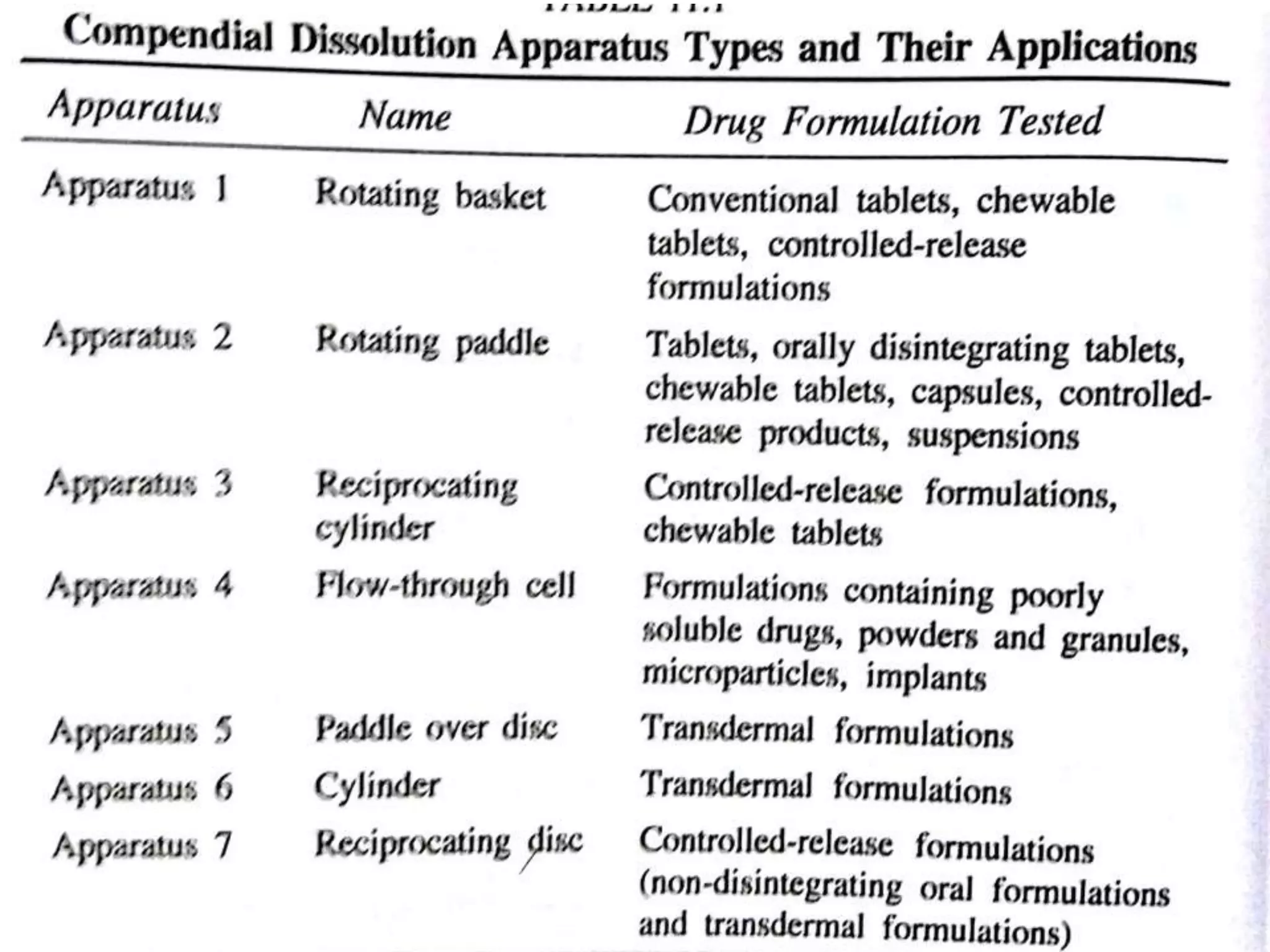
APPARATUS-1(ROTATING BASKET)
DESIGN:
 Vessel: -Made of borosilicate glass.
-Semi hemispherical bottom
-Capacity 1000ml
 Shaft : -Stainless steel 316
-Rotates smoothly without
significance wobble(100 rpm)
-Speed regulator
 Water bath:-Maintained at 37±0.5ºC
USE:
Tablets, capsules, delayed release
suppositories, floating dosage forms.
 METHOD(Rotating basket):
 Place the stated volume of the dissolution medium(±1 %) inthe
vessel and equilibrate dissolution medium to37±0.5°C.
 Place 1 tablet or capsule in the apparatus ,taking care to excludeair
bubbles from the surface of the dosage form unit and immediately
operate the apparatus at the rate specified(100rpm).
 Withdraw a specimen from a zone midway between the surface ofthe
dissolution medium and the top of the rotating basket,not less than
1cm from the vessel wall at each times stated.
 Replace the aliquots withdrawn for analysis with equal volumesof
fresh dissolution medium at 37°C.
 Keep the vessel covered for the duration of the test and verifythe
temperature of the mixture under test at suitabletimes.
 Perform the analysis as directed in individual monograph andrepeat
the test with additional dosage form units.
Apparatus 1 - Basket
Advantages:
 Full pH change during the test
 Can be easily automated
which is important for routine
investigations.
Disadvantages:
 Basket screen is clogged with
gummy particles.
 Hydrodynamic „dead zone“
under the basket
 Degassing is particularly
important
 Mesh gets corroded by HCl solution.
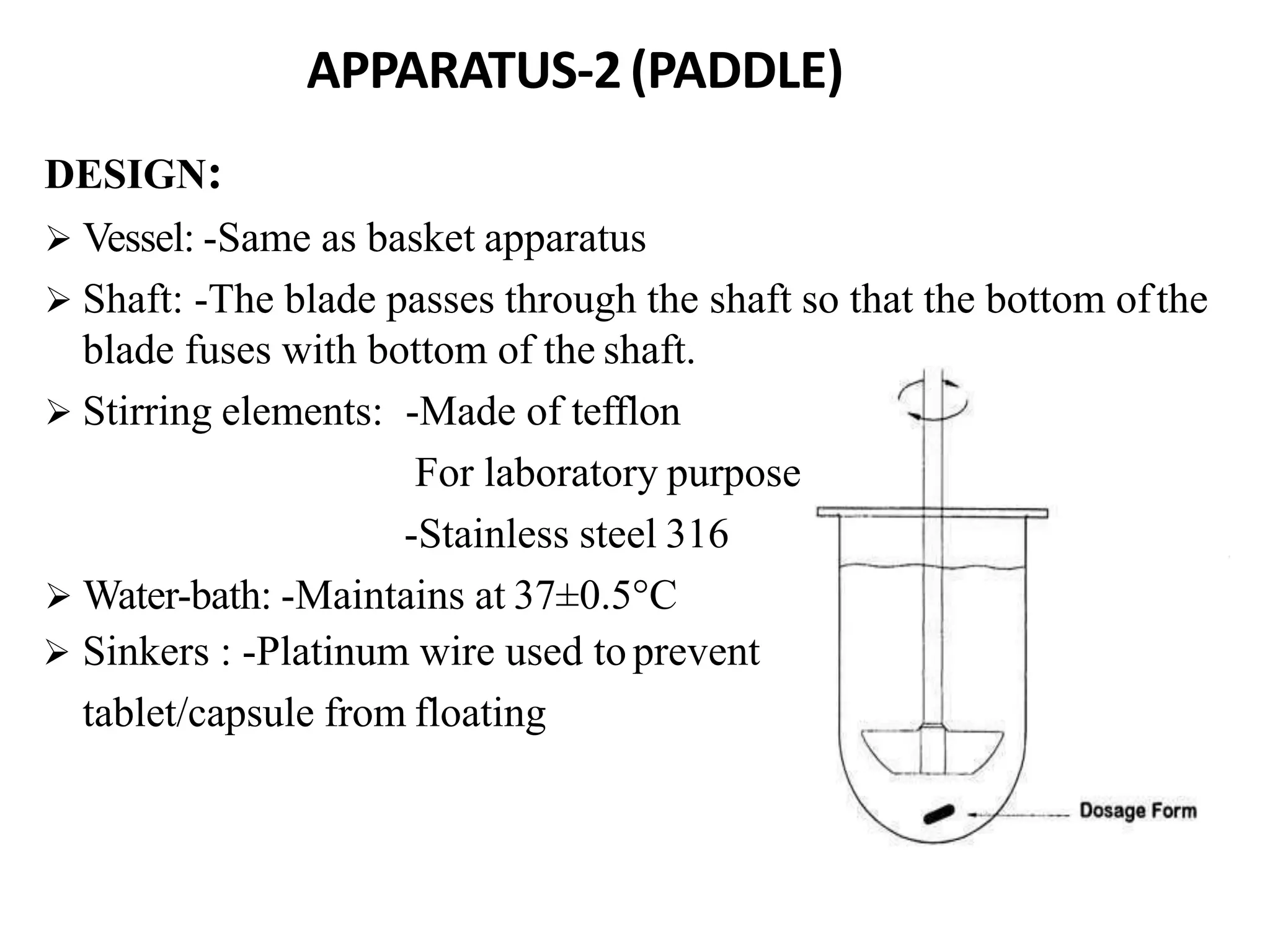
APPARATUS-2(PADDLE)
DESIGN:
 Vessel: -Same as basket apparatus
 Shaft: -The blade passes through the shaft so that the bottom ofthe
blade fuses with bottom of the shaft.
 Stirring elements: -Made of tefflon
For laboratory purpose
-Stainless steel 316
 Water-bath: -Maintains at 37±0.5°C
 Sinkers : -Platinum wire used to prevent
tablet/capsule from floating
METHOD
 It consists of a special coated paddle formed from a blade anda
shaft that minimizes turbulence due to stirring.
 The coated material is inert.
 The paddle is attached vertically to a variable -speed motorthat
rotates at a controlled speed.
 The tablet or capsule is placed into a round-bottom dissolution
flask and the apparatus is housed in a constant temperaturewater
bath maintained at 37°C.
 Most common operating speeds are 50rpm for solid oral dosage
forms and 25 rpm for suspensions.
 A sinker ,such as few turns of platinum wire may be usedto
prevent a capsule or tablet from floating
 Used for film coated tablets that stick to the vessel walls orto
help to position tablet/capsule under thepaddle.
Advantages
 Easy to use
 Robust
 pH change possible
 Can be easily automated which is important for
routine investigations
Disadvantages
 pH/media change is often difficult
 Hydrodynamics are complex, they vary with site of the dosage
form in the vessel (sticking,floating) and therefore may
significantly affect drug dissolution
 Sinkers for floating dosage forms
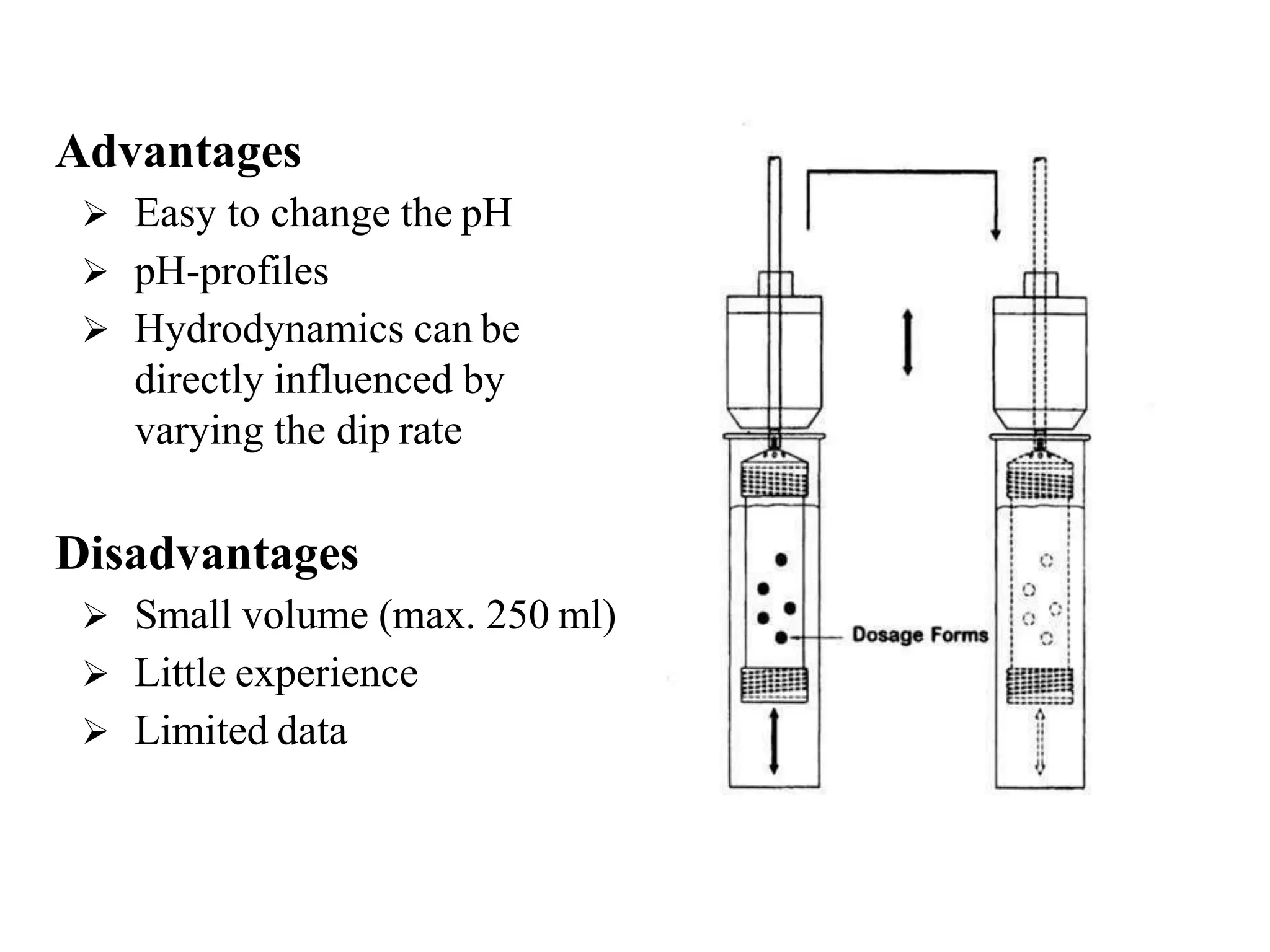
APPARATUS-3(RECIPROCATING CYLINDER)
DESIGN:
 Vessel: -Set of cylindrical flat bottom glassvessels
-Set of reciprocating cylinders
-stainless steel fittings(type 316)and
screens made of nonsorbing or
non-reactive materials.
 Agitation type: -Reciprocating
-5-35 rpm
 Volume of dissolution medium:-200-250ml
 Water bath:- Maintain at 37±0.5°C
USE:
Tablets, beads, controlledand
extended release formulations
METHOD(Reciprocating cylinder):
 Place the stated volume of dissolution medium in each vessel ofthe
apparatus, assemble the apparatus, equilibrate the dissolution
medium to 37±0.5 and remove the thermometer
 Place one dosage form unit in each of the cylinders taking careto
exclude the air bubbles from the surface of each dosage unit and
immediately operate the apparatus as specified in themonograph.
 During the upward and downward stroke, the reciprocatingcylinder
moves through a total distance of 9.9 to 10.1cm.
 Within the time interval specified raise the cylinders and withdrawa
portion of the solution under test from a zone midway between the
surface of the dissolution medium and bottom of eachvessel.
Advantages
 Easy to change the pH
 pH-profiles
 Hydrodynamics can be
directly influenced by
varying the dip rate
Disadvantages
 Small volume (max. 250 ml)
 Little experience
 Limited data
APPARATUS-4 (FLOW THROUGHCELL)
DESIGN:
 Reservoir : -For dissolution medium
 Pump : -Forces dissolution medium through cell
-Holding a sample
-Flow rate 10-100ml/min
-Laminar flow is maintained
-Peristaltic/centrifugal pumps are not recommended
 Water bath:- Maintain at 37±0.5°C
USE:
Low solubility drugs ,micro particulates ,implants, suppositories
controlled release formulations
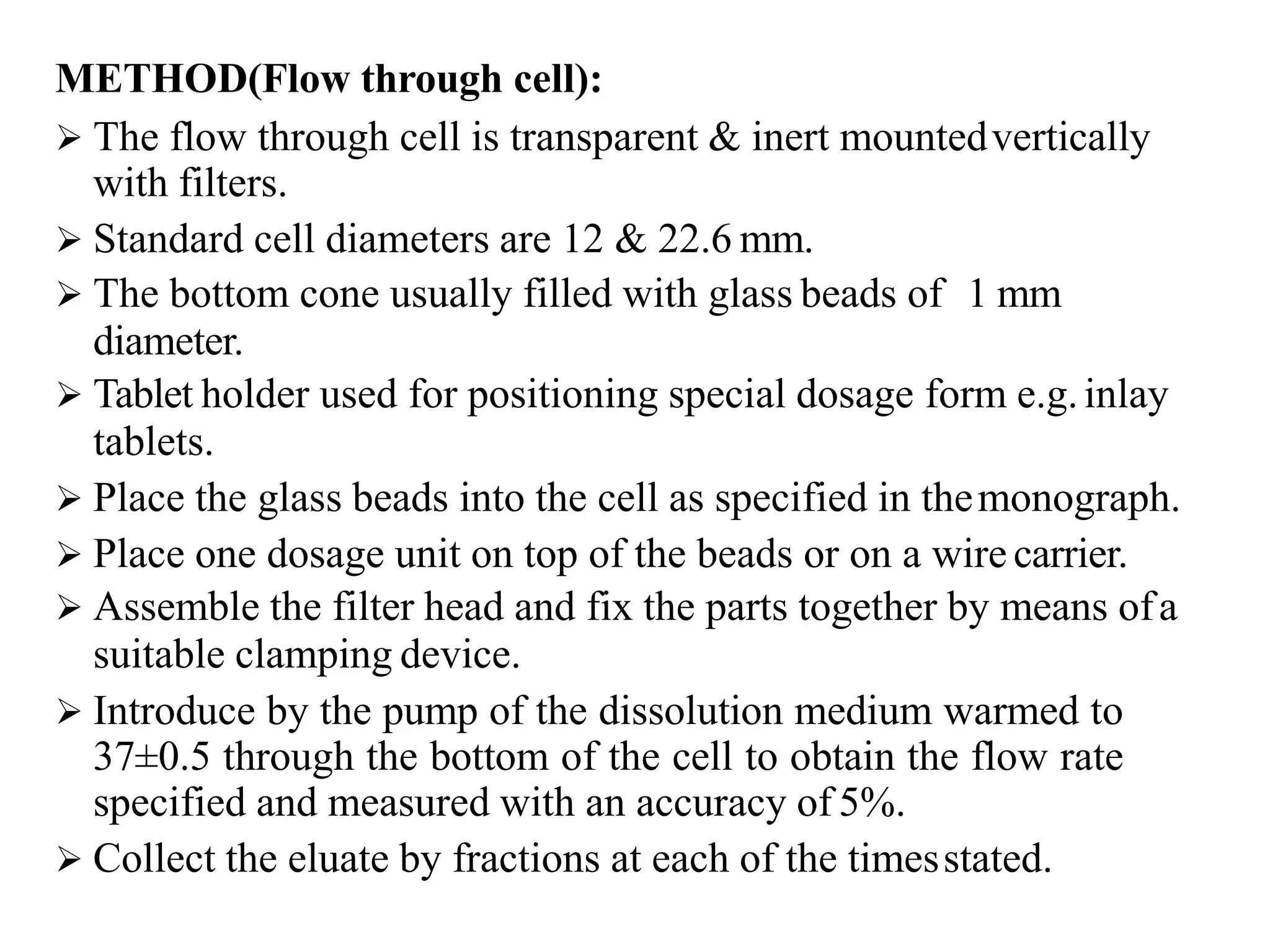
METHOD(Flow through cell):
 The flow through cell is transparent & inert mountedvertically
with filters.
 Standard cell diameters are 12 & 22.6 mm.
 The bottom cone usually filled with glass beads of 1 mm
diameter.
 Tablet holder used for positioning special dosage form e.g.inlay
tablets.
 Place the glass beads into the cell as specified in themonograph.
 Place one dosage unit on top of the beads or on a wire carrier.
 Assemble the filter head and fix the parts together by means ofa
suitable clamping device.
 Introduce by the pump of the dissolution medium warmed to
37±0.5 through the bottom of the cell to obtain the flow rate
specified and measured with an accuracy of 5%.
 Collect the eluate by fractions at each of the timesstated.
.
Advantages
 easy to change media pH
 pH-profile possible
 Sink conditions maintained
 different modes
a) open system
b) closed system
Disadvantages
 Deaeration necessary
 high volumes of media
 labor intensive
Cell types:
Tablets 22.6 mm Powders / Granules ImplantsTablets 12 mm
Suppositories /
Soft
gelatincapsules
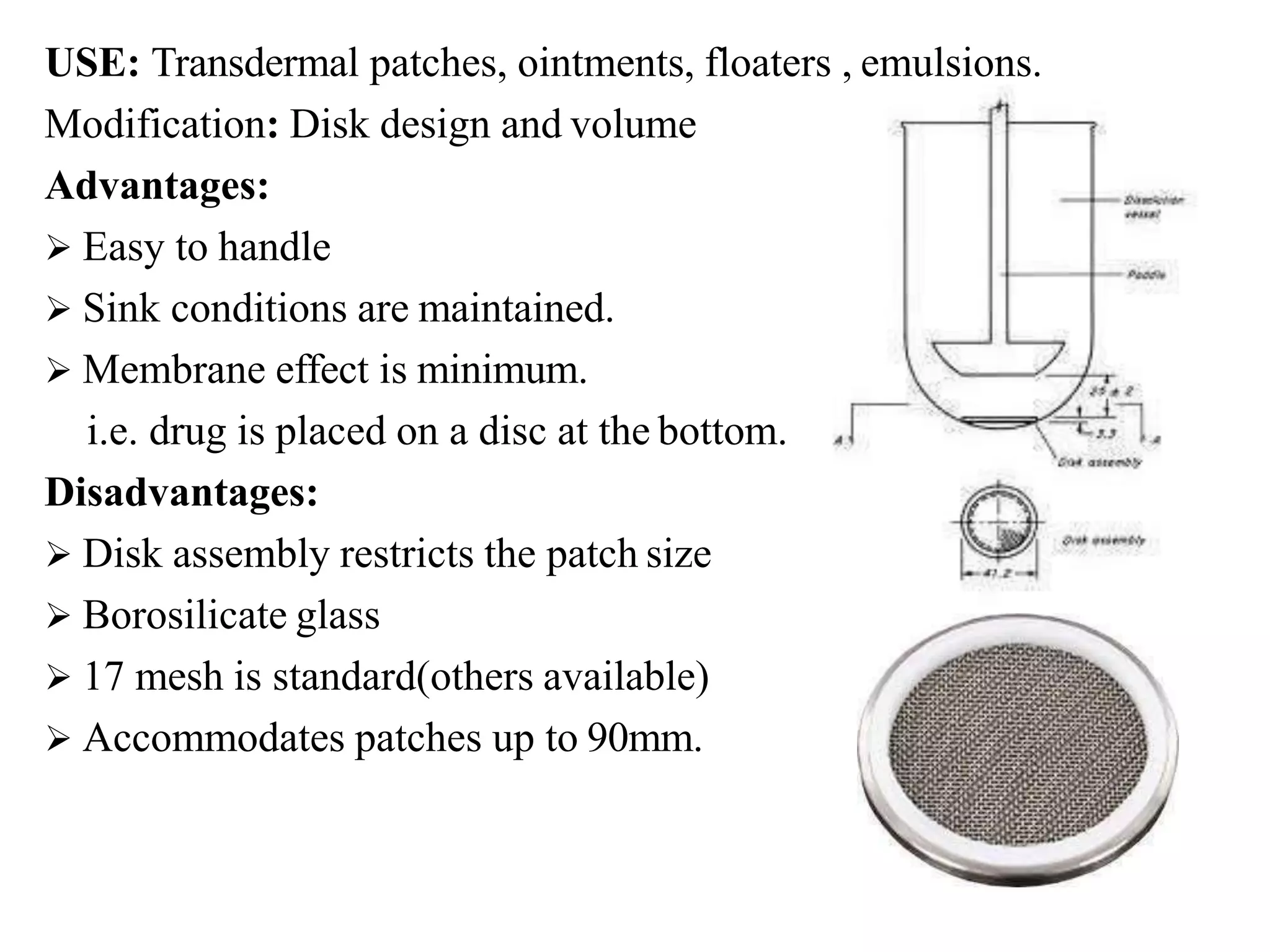
APPARATUS-5(PADDLE-OVER-DISK)
DESIGN:
 Vessel
 Shaft
 Stirring elements- rotating speed 25-50rpm
 Sample holder:-disk assembly that hold a product in such away
that release surface is parallel withpaddle
-Paddle is directly attached over disk assembly
-Samples are drawn between surface off the medium
and top of the paddle blade
 Volume:900ml
 Temperature:32°C
USE: Transdermal patches, ointments, floaters , emulsions.
Modification: Disk design and volume
Advantages:
 Easy to handle
 Sink conditions are maintained.
 Membrane effect is minimum.
i.e. drug is placed on a disc at the bottom.
Disadvantages:
 Disk assembly restricts the patch size
 Borosilicate glass
 17 mesh is standard(others available)
 Accommodates patches up to 90mm.
METHOD(Paddle over disk)
 This method is used for testing the release of drugsfrom
transdermal products.
 The apparatus consists of a sample holder or disc assemblythat
holds the product.
 The entire preparation is placed in a dissolution flask filledwith
specified medium maintained at 32ºC.
 The paddle is placed directly over the discassembly.
 The disk assembly holds the system flat and is positioned suchthat
release surface is placed parallel with the bottom of the paddle
blade. Vessel is covered to minimize evaporation duringtest.
 Samples are drawn midway between the surface of dissolution
medium and the top of the paddle blade at specifiedtimes.
APPARATUS-6(ROTATING CYLINDER)
DESIGN:
 Vessel:- In place of basket, cylinder is used.
 Shaft :-Stainless steel 316
 Sample :- Mounted to cuprophan (inner porous cellulosicmaterial)
an entire system adheres to cylinder.
- Dosage unit is placed in cylinder and release from sideout.
 Water-bath: maintained at 32±0.5°C
USE:
 Transdermal patches cannot be cut into small size.
 Solid dosage forms, pH profile , small volumes
METHOD( Rotating cylinder):
 Use the assembly from apparatus 1 except to replace the basketand
shaft with a stainless steel cylinder stirringelement.
 The temperature is maintained at 32±0.5°C.
 The dosage unit is placed on the cylinder with side out.
 The dosage unit is placed to the exterior of the cylinder such that
long axis of the system fits around the circumference of thecylinder
and removes trapped air bubbles.
 Place the cylinder in the apparatus and immediately rotate at therate
specified in the individual monograph.
 Samples are drawn midway between the surface of thedissolution
medium and the top of the rotating cylinder foranalysis.
Rotating cylinder:
Advantages: -Equipment (apparatus 1)available with the
manufacturers can be used with modification as apparatus6.
Disadvantages:-Large volume of medium is required.
-Drug gets diluted & causes difficulties inanalysis
-Difficult to clean the cylinder.
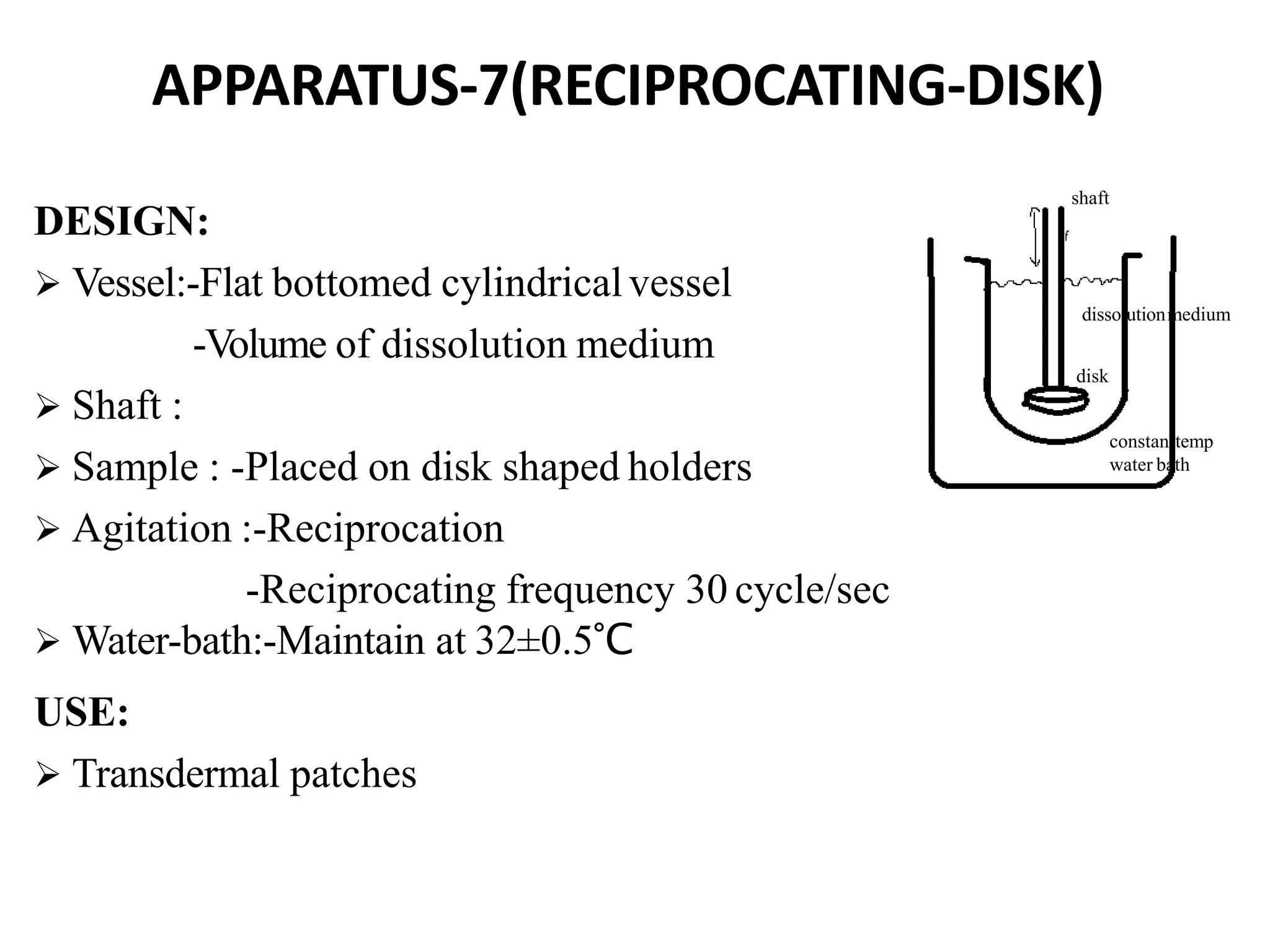
APPARATUS-7(RECIPROCATING-DISK)
DESIGN:
 Vessel:-Flat bottomed cylindricalvessel
-Volume of dissolution medium
 Shaft :
 Sample : -Placed on disk shaped holders
 Agitation :-Reciprocation
-Reciprocating frequency 30 cycle/sec
 Water-bath:-Maintain at 32±0.5°C
USE:
 Transdermal patches
shaft
disk
dissolutionmedium
constanttemp
water bath
METHOD(Reciprocating disk):
 The assembly consists of a set of volumetrically calibrated solution
containers made of glass or suitable inert material, a motor , a drive
assembly used to reciprocate the systemvertically.
 The samples are placed on the disk shaped holders using cuprophan
supports
 The test is carried out at 32°C.
 The reciprocating frequency is 30cycles/min.
Advantages:-Convenient method for selecting the volume of the
medium.
-sink conditions can be maintained.
-more sensitivity
Disadvantages: -Investment is high because the design is totally
different from standard equipment already available inindustry.
Definition
• In vitro dissolution: it’s a process of release of drug from
dosage form as measured in an in vitro dissolution apparatus.
• In vivo dissolution: process of dissolution of drugs in the GI
tract.
• Correlation: relationship between in vitro dissolution rate and
in vivo absorption rate as used in bio-equivalence guidance
• IVIVC: has been defined as ‘‘ a predictive mathematical model
describing the relationship between an in-vitro property of a
dosage form and an in-vivo response’’
Significance of ivivc
• The main objective of developing and evaluating an IVIVC is to
enable the dissolution test to serve as a surrogate. It reduces
the number of bio-equivalence required for approval as well
as during scale up and post approval changes (SUPAC).
• IVIVC shortens the drug development period, economizes the
resources and leads to improved product quality.
• A mean of assuring the bioavailability of active ingredients
from a dosage form.
• Supports and or validates the use of dissolution methods and
specifications
• IVIVC assists in supporting biowaivers.
Parameters for correlations
SL. NO. IN VITRO IN VIVO
1. Dissolution rate Absorption rate (or
absorption time )
2. Percent drug
dissolved
Percent of drug
absorbed
3. Percent drug
dissolved
Maximum plasma
concentration, Cmax
4. Percent drug
dissolved
Serum drug
concentration, Cp
Dissolution rate versus absorption rate
• If dissolution of drug is rate limiting step, the faster the
dissolution rate, the faster is the rate of appearance of drug in
the plasma. Therefore, absorption time and dissolution time
may be considered for correlation
Percent of drug dissolved versus percent of
drug absorbed:
• Appropriate dissolution medium and a slow stirring rate
during dissolution should be considered to mimic in vivo
dissolution.
• If the drug is absorbed completely after dissolution, a linear
correlation may be obtained by comparing the percent drug
absorbed to the percent drug dissolved.
Percent of drug dissolved versus maximum
plasma concentration:
• A poorly formulated drug may not be completely dissolved
and released, resulting in lower plasma drug concentration.
• The percentage of drug released at any time interval will be
greater for more bio available drug product, the peak serum
concentration will be higher for the drug that shows highest
percent of drug dissolved.
Serum drug concentration versus percent of
drug dissolved
• In a study on aspirin absorption, serum concentration of
aspirin was correlated to percent of drug dissolved using an in
vitro dissolution method
• Dissolution of drug is rate limiting step, and various
formulation with different dissolution rates has difference in
serum concentration of aspirin
Levels of correlation
• Levels A correlation
• Levels B correlation
• Levels C correlation
• Multiple levels C correlation
Levels A correlation
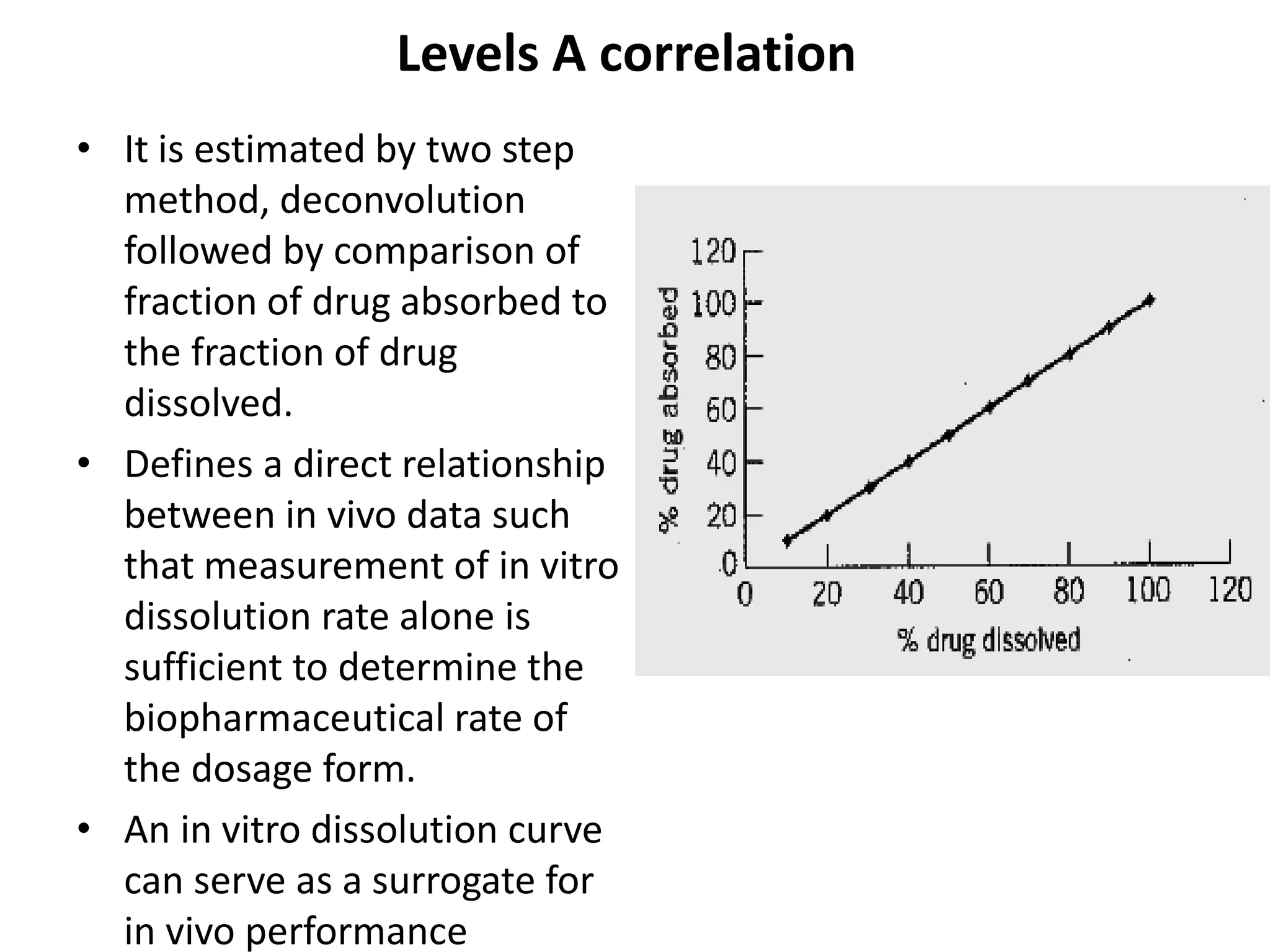
• It is estimated by two step
method, deconvolution
followed by comparison of
fraction of drug absorbed to
the fraction of drug
dissolved.
• Defines a direct relationship
between in vivo data such
that measurement of in vitro
dissolution rate alone is
sufficient to determine the
biopharmaceutical rate of
the dosage form.
• An in vitro dissolution curve
can serve as a surrogate for
in vivo performance
Levels B correlation
• Levels B correlation utilizes the
principles of statistical moment
analysis.
• Mean in vitro dissolution time
(MDTvitro) of the product is
compared to mean in vivo residence
time (MRT).
• MRT may be calculated as the ratio of
the area under the first moment
curve (AUMC)to the AUC, where
AUMC is the area under the curve
observed for the product of time and
concentration versus time.
Level C correlation
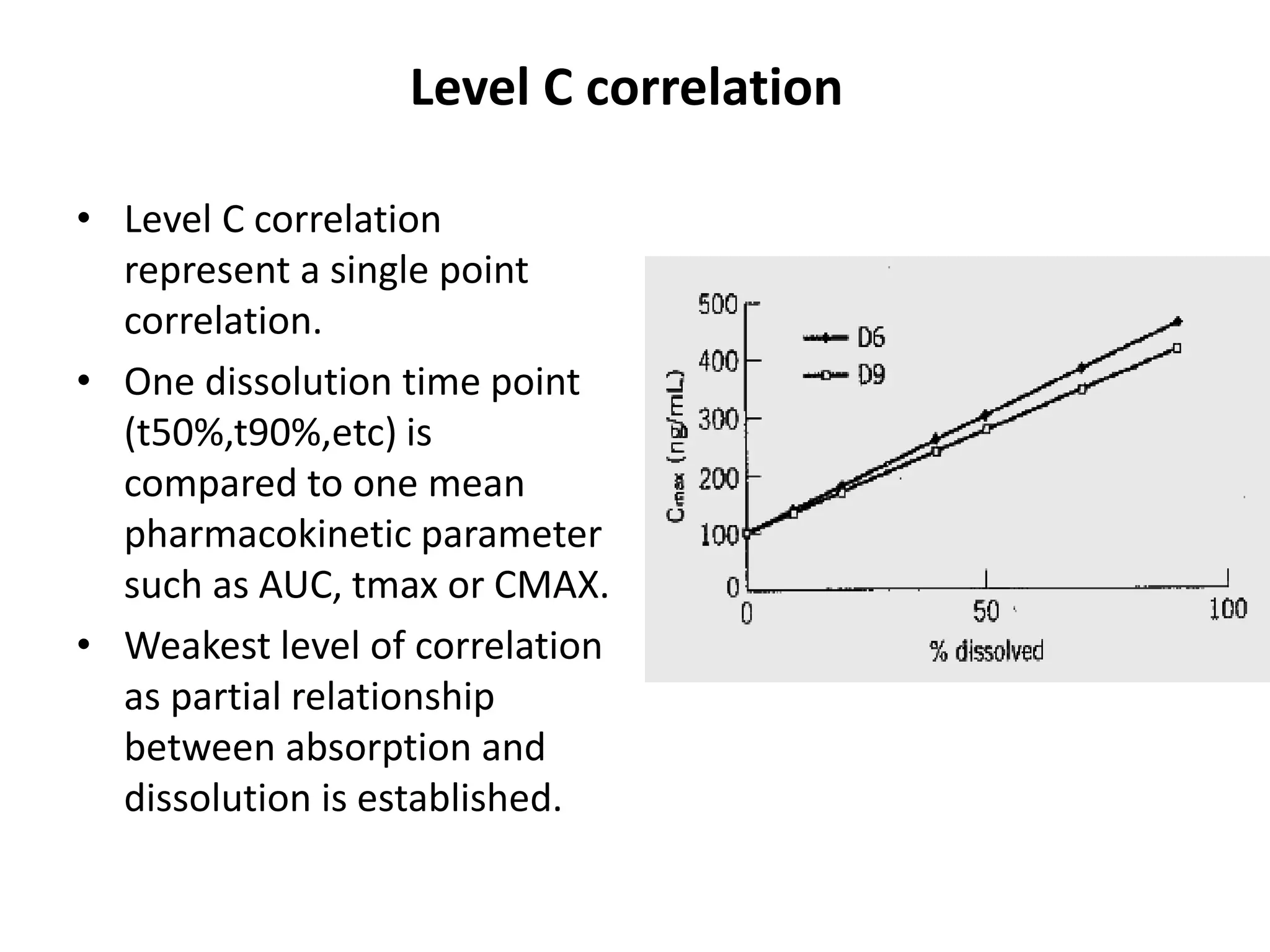
• Level C correlation
represent a single point
correlation.
• One dissolution time point
(t50%,t90%,etc) is
compared to one mean
pharmacokinetic parameter
such as AUC, tmax or CMAX.
• Weakest level of correlation
as partial relationship
between absorption and
dissolution is established.
Multiple level correlations
• Multiple Level C correlation relates one or several
pharmacokinetic parameters of interest (Cmax, AUC, or any
other suitable parameters) to amount of drug dissolved at
several time points of the dissolution profile.
• Its correlation is more meaningful than that of Level C as
several time points are considered.
REFERENCE
• WWW.WIKIPEDIA.COM.
• WWW.SLIDESHARE.COM.
 in vitro dissolution and iviv correlation

in vitro dissolution and iviv correlation

  • 1.
    SEMINAR ON INVITRODISSOLUTION AND INVITRO INVIVO CORRELATION PRESENTED BY-ROSHAN M JAIN (M.PHARM 1ST YEAR) SUBMITTED TO- Dr . A . GEETHALAKSHMI (HOD and Professor of department of pharmaceutics) RR COLLEGE OF PHARMACY
  • 2.
    CONTENT • Definition • Dissolutiontesting • Ivivc definition • Significance of ivivc • Parameters for correlation • Levels of correlation • References
  • 3.
    Definition • Dissolution isa process in which a solid substance solubilizes in a given solvent i.e. Mass transfer from the solid surface to the liquid phase. • Dissolution is the rate determining step for hydrophobic, poorly aqueous soluble drugs.
  • 4.
    Dissolution testing • Dissolutionand drug release tests are in-vitro tests that measure the rate and extent of dissolution or release of the drug substance from a drug product, usually aq. Medium under specified conditions. • It is important QC procedure for the drug product and linked to product performance in-vivo.  Need for dissolution testing: • Evaluation of bio availability. • Batch to batch drug release uniformity. • Development of more efficacious and therapeutically optical dosage forms. • Ensure quality and stability of the product. • Product development, quality control, research and application.
  • 6.
    APPARATUS-1(ROTATING BASKET) DESIGN:  Vessel:-Made of borosilicate glass. -Semi hemispherical bottom -Capacity 1000ml  Shaft : -Stainless steel 316 -Rotates smoothly without significance wobble(100 rpm) -Speed regulator  Water bath:-Maintained at 37±0.5ºC USE: Tablets, capsules, delayed release suppositories, floating dosage forms.
  • 7.
     METHOD(Rotating basket): Place the stated volume of the dissolution medium(±1 %) inthe vessel and equilibrate dissolution medium to37±0.5°C.  Place 1 tablet or capsule in the apparatus ,taking care to excludeair bubbles from the surface of the dosage form unit and immediately operate the apparatus at the rate specified(100rpm).  Withdraw a specimen from a zone midway between the surface ofthe dissolution medium and the top of the rotating basket,not less than 1cm from the vessel wall at each times stated.  Replace the aliquots withdrawn for analysis with equal volumesof fresh dissolution medium at 37°C.  Keep the vessel covered for the duration of the test and verifythe temperature of the mixture under test at suitabletimes.  Perform the analysis as directed in individual monograph andrepeat the test with additional dosage form units.
  • 8.
  • 9.
    Advantages:  Full pHchange during the test  Can be easily automated which is important for routine investigations. Disadvantages:  Basket screen is clogged with gummy particles.  Hydrodynamic „dead zone“ under the basket  Degassing is particularly important  Mesh gets corroded by HCl solution.
  • 10.
    APPARATUS-2(PADDLE) DESIGN:  Vessel: -Sameas basket apparatus  Shaft: -The blade passes through the shaft so that the bottom ofthe blade fuses with bottom of the shaft.  Stirring elements: -Made of tefflon For laboratory purpose -Stainless steel 316  Water-bath: -Maintains at 37±0.5°C  Sinkers : -Platinum wire used to prevent tablet/capsule from floating
  • 11.
    METHOD  It consistsof a special coated paddle formed from a blade anda shaft that minimizes turbulence due to stirring.  The coated material is inert.  The paddle is attached vertically to a variable -speed motorthat rotates at a controlled speed.  The tablet or capsule is placed into a round-bottom dissolution flask and the apparatus is housed in a constant temperaturewater bath maintained at 37°C.  Most common operating speeds are 50rpm for solid oral dosage forms and 25 rpm for suspensions.  A sinker ,such as few turns of platinum wire may be usedto prevent a capsule or tablet from floating  Used for film coated tablets that stick to the vessel walls orto help to position tablet/capsule under thepaddle.
  • 12.
    Advantages  Easy touse  Robust  pH change possible  Can be easily automated which is important for routine investigations Disadvantages  pH/media change is often difficult  Hydrodynamics are complex, they vary with site of the dosage form in the vessel (sticking,floating) and therefore may significantly affect drug dissolution  Sinkers for floating dosage forms
  • 13.
    APPARATUS-3(RECIPROCATING CYLINDER) DESIGN:  Vessel:-Set of cylindrical flat bottom glassvessels -Set of reciprocating cylinders -stainless steel fittings(type 316)and screens made of nonsorbing or non-reactive materials.  Agitation type: -Reciprocating -5-35 rpm  Volume of dissolution medium:-200-250ml  Water bath:- Maintain at 37±0.5°C USE: Tablets, beads, controlledand extended release formulations
  • 14.
    METHOD(Reciprocating cylinder):  Placethe stated volume of dissolution medium in each vessel ofthe apparatus, assemble the apparatus, equilibrate the dissolution medium to 37±0.5 and remove the thermometer  Place one dosage form unit in each of the cylinders taking careto exclude the air bubbles from the surface of each dosage unit and immediately operate the apparatus as specified in themonograph.  During the upward and downward stroke, the reciprocatingcylinder moves through a total distance of 9.9 to 10.1cm.  Within the time interval specified raise the cylinders and withdrawa portion of the solution under test from a zone midway between the surface of the dissolution medium and bottom of eachvessel.
  • 15.
    Advantages  Easy tochange the pH  pH-profiles  Hydrodynamics can be directly influenced by varying the dip rate Disadvantages  Small volume (max. 250 ml)  Little experience  Limited data
  • 16.
    APPARATUS-4 (FLOW THROUGHCELL) DESIGN: Reservoir : -For dissolution medium  Pump : -Forces dissolution medium through cell -Holding a sample -Flow rate 10-100ml/min -Laminar flow is maintained -Peristaltic/centrifugal pumps are not recommended  Water bath:- Maintain at 37±0.5°C USE: Low solubility drugs ,micro particulates ,implants, suppositories controlled release formulations
  • 17.
    METHOD(Flow through cell): The flow through cell is transparent & inert mountedvertically with filters.  Standard cell diameters are 12 & 22.6 mm.  The bottom cone usually filled with glass beads of 1 mm diameter.  Tablet holder used for positioning special dosage form e.g.inlay tablets.  Place the glass beads into the cell as specified in themonograph.  Place one dosage unit on top of the beads or on a wire carrier.  Assemble the filter head and fix the parts together by means ofa suitable clamping device.  Introduce by the pump of the dissolution medium warmed to 37±0.5 through the bottom of the cell to obtain the flow rate specified and measured with an accuracy of 5%.  Collect the eluate by fractions at each of the timesstated.
  • 18.
    . Advantages  easy tochange media pH  pH-profile possible  Sink conditions maintained  different modes a) open system b) closed system Disadvantages  Deaeration necessary  high volumes of media  labor intensive
  • 19.
    Cell types: Tablets 22.6mm Powders / Granules ImplantsTablets 12 mm Suppositories / Soft gelatincapsules
  • 20.
    APPARATUS-5(PADDLE-OVER-DISK) DESIGN:  Vessel  Shaft Stirring elements- rotating speed 25-50rpm  Sample holder:-disk assembly that hold a product in such away that release surface is parallel withpaddle -Paddle is directly attached over disk assembly -Samples are drawn between surface off the medium and top of the paddle blade  Volume:900ml  Temperature:32°C
  • 21.
    USE: Transdermal patches,ointments, floaters , emulsions. Modification: Disk design and volume Advantages:  Easy to handle  Sink conditions are maintained.  Membrane effect is minimum. i.e. drug is placed on a disc at the bottom. Disadvantages:  Disk assembly restricts the patch size  Borosilicate glass  17 mesh is standard(others available)  Accommodates patches up to 90mm.
  • 22.
    METHOD(Paddle over disk) This method is used for testing the release of drugsfrom transdermal products.  The apparatus consists of a sample holder or disc assemblythat holds the product.  The entire preparation is placed in a dissolution flask filledwith specified medium maintained at 32ºC.  The paddle is placed directly over the discassembly.  The disk assembly holds the system flat and is positioned suchthat release surface is placed parallel with the bottom of the paddle blade. Vessel is covered to minimize evaporation duringtest.  Samples are drawn midway between the surface of dissolution medium and the top of the paddle blade at specifiedtimes.
  • 23.
    APPARATUS-6(ROTATING CYLINDER) DESIGN:  Vessel:-In place of basket, cylinder is used.  Shaft :-Stainless steel 316  Sample :- Mounted to cuprophan (inner porous cellulosicmaterial) an entire system adheres to cylinder. - Dosage unit is placed in cylinder and release from sideout.  Water-bath: maintained at 32±0.5°C USE:  Transdermal patches cannot be cut into small size.  Solid dosage forms, pH profile , small volumes
  • 24.
    METHOD( Rotating cylinder): Use the assembly from apparatus 1 except to replace the basketand shaft with a stainless steel cylinder stirringelement.  The temperature is maintained at 32±0.5°C.  The dosage unit is placed on the cylinder with side out.  The dosage unit is placed to the exterior of the cylinder such that long axis of the system fits around the circumference of thecylinder and removes trapped air bubbles.  Place the cylinder in the apparatus and immediately rotate at therate specified in the individual monograph.  Samples are drawn midway between the surface of thedissolution medium and the top of the rotating cylinder foranalysis.
  • 25.
    Rotating cylinder: Advantages: -Equipment(apparatus 1)available with the manufacturers can be used with modification as apparatus6. Disadvantages:-Large volume of medium is required. -Drug gets diluted & causes difficulties inanalysis -Difficult to clean the cylinder.
  • 26.
    APPARATUS-7(RECIPROCATING-DISK) DESIGN:  Vessel:-Flat bottomedcylindricalvessel -Volume of dissolution medium  Shaft :  Sample : -Placed on disk shaped holders  Agitation :-Reciprocation -Reciprocating frequency 30 cycle/sec  Water-bath:-Maintain at 32±0.5°C USE:  Transdermal patches shaft disk dissolutionmedium constanttemp water bath
  • 27.
    METHOD(Reciprocating disk):  Theassembly consists of a set of volumetrically calibrated solution containers made of glass or suitable inert material, a motor , a drive assembly used to reciprocate the systemvertically.  The samples are placed on the disk shaped holders using cuprophan supports  The test is carried out at 32°C.  The reciprocating frequency is 30cycles/min. Advantages:-Convenient method for selecting the volume of the medium. -sink conditions can be maintained. -more sensitivity Disadvantages: -Investment is high because the design is totally different from standard equipment already available inindustry.
  • 28.
    Definition • In vitrodissolution: it’s a process of release of drug from dosage form as measured in an in vitro dissolution apparatus. • In vivo dissolution: process of dissolution of drugs in the GI tract. • Correlation: relationship between in vitro dissolution rate and in vivo absorption rate as used in bio-equivalence guidance • IVIVC: has been defined as ‘‘ a predictive mathematical model describing the relationship between an in-vitro property of a dosage form and an in-vivo response’’
  • 29.
    Significance of ivivc •The main objective of developing and evaluating an IVIVC is to enable the dissolution test to serve as a surrogate. It reduces the number of bio-equivalence required for approval as well as during scale up and post approval changes (SUPAC). • IVIVC shortens the drug development period, economizes the resources and leads to improved product quality. • A mean of assuring the bioavailability of active ingredients from a dosage form. • Supports and or validates the use of dissolution methods and specifications • IVIVC assists in supporting biowaivers.
  • 30.
    Parameters for correlations SL.NO. IN VITRO IN VIVO 1. Dissolution rate Absorption rate (or absorption time ) 2. Percent drug dissolved Percent of drug absorbed 3. Percent drug dissolved Maximum plasma concentration, Cmax 4. Percent drug dissolved Serum drug concentration, Cp
  • 31.
    Dissolution rate versusabsorption rate • If dissolution of drug is rate limiting step, the faster the dissolution rate, the faster is the rate of appearance of drug in the plasma. Therefore, absorption time and dissolution time may be considered for correlation
  • 32.
    Percent of drugdissolved versus percent of drug absorbed: • Appropriate dissolution medium and a slow stirring rate during dissolution should be considered to mimic in vivo dissolution. • If the drug is absorbed completely after dissolution, a linear correlation may be obtained by comparing the percent drug absorbed to the percent drug dissolved.
  • 33.
    Percent of drugdissolved versus maximum plasma concentration: • A poorly formulated drug may not be completely dissolved and released, resulting in lower plasma drug concentration. • The percentage of drug released at any time interval will be greater for more bio available drug product, the peak serum concentration will be higher for the drug that shows highest percent of drug dissolved.
  • 34.
    Serum drug concentrationversus percent of drug dissolved • In a study on aspirin absorption, serum concentration of aspirin was correlated to percent of drug dissolved using an in vitro dissolution method • Dissolution of drug is rate limiting step, and various formulation with different dissolution rates has difference in serum concentration of aspirin
  • 35.
    Levels of correlation •Levels A correlation • Levels B correlation • Levels C correlation • Multiple levels C correlation
  • 36.
    Levels A correlation •It is estimated by two step method, deconvolution followed by comparison of fraction of drug absorbed to the fraction of drug dissolved. • Defines a direct relationship between in vivo data such that measurement of in vitro dissolution rate alone is sufficient to determine the biopharmaceutical rate of the dosage form. • An in vitro dissolution curve can serve as a surrogate for in vivo performance
  • 37.
    Levels B correlation •Levels B correlation utilizes the principles of statistical moment analysis. • Mean in vitro dissolution time (MDTvitro) of the product is compared to mean in vivo residence time (MRT). • MRT may be calculated as the ratio of the area under the first moment curve (AUMC)to the AUC, where AUMC is the area under the curve observed for the product of time and concentration versus time.
  • 38.
    Level C correlation •Level C correlation represent a single point correlation. • One dissolution time point (t50%,t90%,etc) is compared to one mean pharmacokinetic parameter such as AUC, tmax or CMAX. • Weakest level of correlation as partial relationship between absorption and dissolution is established.
  • 39.
    Multiple level correlations •Multiple Level C correlation relates one or several pharmacokinetic parameters of interest (Cmax, AUC, or any other suitable parameters) to amount of drug dissolved at several time points of the dissolution profile. • Its correlation is more meaningful than that of Level C as several time points are considered.
  • 40.