DAYANANDA SAGAR UNIVERSITY
DEPARTMENT OF PHARMACEUTICS
DISSOLUTION METHOD
Rajdulari
M. Pharma 2nd sem
NEED FOR DISSOLUTION TESTING DEVICE
 Solid drugs absorbed only from the solution .
 In vitro test – estimate amount of drug released per unit time.
 In vitro disintegration test not sufficient .
 In vitro dissolution test most reliable predictors of in vivo
performance.
 Dissolution - rate limiting factor.
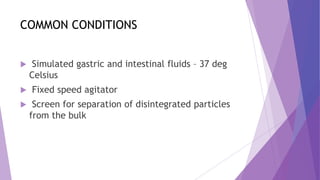
COMMON CONDITIONS
 Simulated gastric and intestinal fluids – 37 deg
Celsius
 Fixed speed agitator
 Screen for separation of disintegrated particles
from the bulk
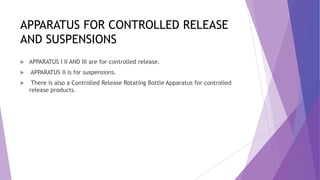
APPARATUS FOR CONTROLLED RELEASE
AND SUSPENSIONS
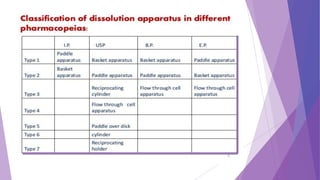
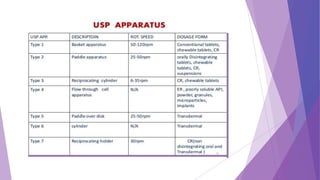
 APPARATUS I II AND III are for controlled release.
 APPARATUS II is for suspensions.
 There is also a Controlled Release Rotating Bottle Apparatus for controlled
release products.
Apparatus 1- Basket apparatus
The assembly consists of the following :
 A covered vessel
 Transparent material
 A motor
 A metallic drive shaft,
 A cylindrical basket,
 The water bath permits the holding of temp inside vessel at 37±0.5 ̊C
 The vessel is a cylindrical with hemispherical bottom .
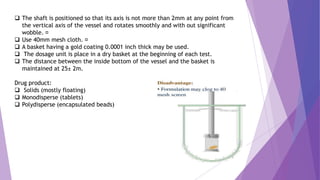
 The shaft is positioned so that its axis is not more than 2mm at any point from
the vertical axis of the vessel and rotates smoothly and with out significant
wobble.
 Use 40mm mesh cloth.
 A basket having a gold coating 0.0001 inch thick may be used.
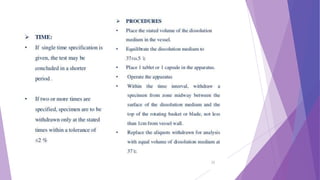
 The dosage unit is place in a dry basket at the beginning of each test.
 The distance between the inside bottom of the vessel and the basket is
maintained at 25± 2m.
Drug product:
 Solids (mostly floating)
 Monodisperse (tablets)
 Polydisperse (encapsulated beads)
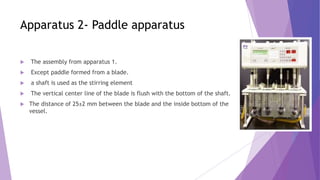
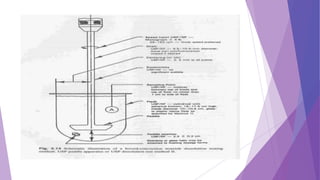
Apparatus 2- Paddle apparatus
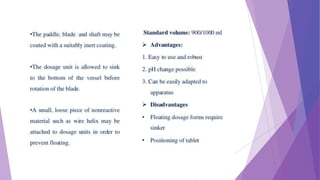
 The assembly from apparatus 1.
 Except paddle formed from a blade.
 a shaft is used as the stirring element
 The vertical center line of the blade is flush with the bottom of the shaft.
 The distance of 25±2 mm between the blade and the inside bottom of the
vessel.
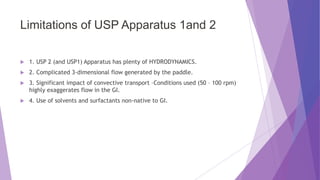
Limitations of USP Apparatus 1and 2
 1. USP 2 (and USP1) Apparatus has plenty of HYDRODYNAMICS.
 2. Complicated 3-dimensional flow generated by the paddle.
 3. Significant impact of convective transport –Conditions used (50 – 100 rpm)
highly exaggerates flow in the GI.
 4. Use of solvents and surfactants non-native to GI.
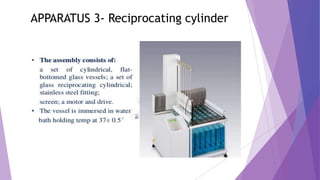
APPARATUS 3- Reciprocating cylinder
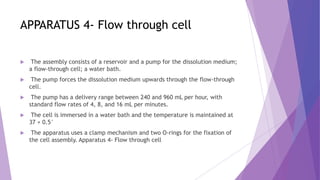
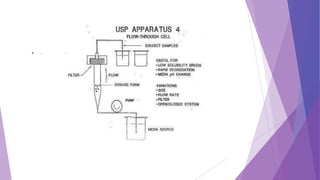
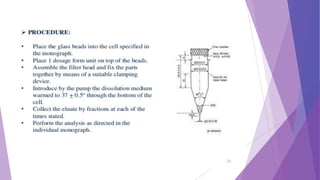
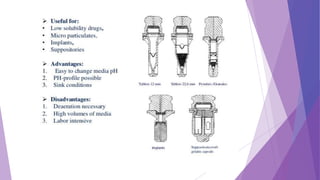
APPARATUS 4- Flow through cell
 The assembly consists of a reservoir and a pump for the dissolution medium;
a flow-through cell; a water bath.
 The pump forces the dissolution medium upwards through the flow-through
cell.
 The pump has a delivery range between 240 and 960 mL per hour, with
standard flow rates of 4, 8, and 16 mL per minutes.
 The cell is immersed in a water bath and the temperature is maintained at
37 + 0.5°
 The apparatus uses a clamp mechanism and two O-rings for the fixation of
the cell assembly. Apparatus 4- Flow through cell
APPARATUS FOR TRANSDERMAL AND
TOPICAL DOSAGE FORM
 APPARATUS V VI AND VII are used for transdermal products.
 APPARATUS V AND VI are used for topical dosage forms.
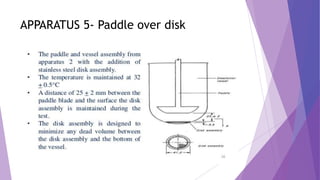
APPARATUS 5- Paddle over disk
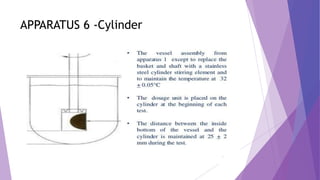
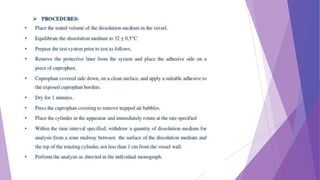
APPARATUS 6 -Cylinder
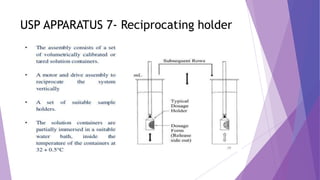
USP APPARATUS 7- Reciprocating holder
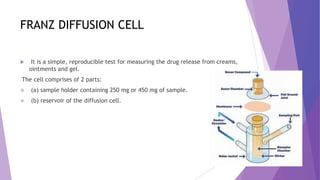
FRANZ DIFFUSION CELL
 It is a simple, reproducible test for measuring the drug release from creams,
ointments and gel.
The cell comprises of 2 parts:
 (a) sample holder containing 250 mg or 450 mg of sample.
 (b) reservoir of the diffusion cell.
REFERENCE
 1. Banakar V. U. and et. al. , pharmaceutical dissolution testing, markcel
deken, pg 4,16,57,136-137
 2. Remington, the science and practice of pharmacy, Mack pub. Co. , 19th
edition pg 594,601,602
 3. Brahmankar D.M. , Jaiswal S. , biopharmaceutics and pharmacokinetics a
treatise, Vallabh parashan, 2nd edition, pg 29-34
 4. www.dissolutiontech.com
 5. U.S. Pharmacopia,2008

Dissolution method

  • 1.
    DAYANANDA SAGAR UNIVERSITY DEPARTMENTOF PHARMACEUTICS DISSOLUTION METHOD Rajdulari M. Pharma 2nd sem
  • 3.
    NEED FOR DISSOLUTIONTESTING DEVICE  Solid drugs absorbed only from the solution .  In vitro test – estimate amount of drug released per unit time.  In vitro disintegration test not sufficient .  In vitro dissolution test most reliable predictors of in vivo performance.  Dissolution - rate limiting factor.
  • 4.
    COMMON CONDITIONS  Simulatedgastric and intestinal fluids – 37 deg Celsius  Fixed speed agitator  Screen for separation of disintegrated particles from the bulk
  • 7.
    APPARATUS FOR CONTROLLEDRELEASE AND SUSPENSIONS  APPARATUS I II AND III are for controlled release.  APPARATUS II is for suspensions.  There is also a Controlled Release Rotating Bottle Apparatus for controlled release products.
  • 8.
    Apparatus 1- Basketapparatus The assembly consists of the following :  A covered vessel  Transparent material  A motor  A metallic drive shaft,  A cylindrical basket,  The water bath permits the holding of temp inside vessel at 37±0.5 ̊C  The vessel is a cylindrical with hemispherical bottom .
  • 9.
     The shaftis positioned so that its axis is not more than 2mm at any point from the vertical axis of the vessel and rotates smoothly and with out significant wobble.  Use 40mm mesh cloth.  A basket having a gold coating 0.0001 inch thick may be used.  The dosage unit is place in a dry basket at the beginning of each test.  The distance between the inside bottom of the vessel and the basket is maintained at 25± 2m. Drug product:  Solids (mostly floating)  Monodisperse (tablets)  Polydisperse (encapsulated beads)
  • 10.
    Apparatus 2- Paddleapparatus  The assembly from apparatus 1.  Except paddle formed from a blade.  a shaft is used as the stirring element  The vertical center line of the blade is flush with the bottom of the shaft.  The distance of 25±2 mm between the blade and the inside bottom of the vessel.
  • 14.
    Limitations of USPApparatus 1and 2  1. USP 2 (and USP1) Apparatus has plenty of HYDRODYNAMICS.  2. Complicated 3-dimensional flow generated by the paddle.  3. Significant impact of convective transport –Conditions used (50 – 100 rpm) highly exaggerates flow in the GI.  4. Use of solvents and surfactants non-native to GI.
  • 15.
  • 18.
    APPARATUS 4- Flowthrough cell  The assembly consists of a reservoir and a pump for the dissolution medium; a flow-through cell; a water bath.  The pump forces the dissolution medium upwards through the flow-through cell.  The pump has a delivery range between 240 and 960 mL per hour, with standard flow rates of 4, 8, and 16 mL per minutes.  The cell is immersed in a water bath and the temperature is maintained at 37 + 0.5°  The apparatus uses a clamp mechanism and two O-rings for the fixation of the cell assembly. Apparatus 4- Flow through cell
  • 22.
    APPARATUS FOR TRANSDERMALAND TOPICAL DOSAGE FORM  APPARATUS V VI AND VII are used for transdermal products.  APPARATUS V AND VI are used for topical dosage forms.
  • 23.
  • 25.
  • 27.
    USP APPARATUS 7-Reciprocating holder
  • 28.
    FRANZ DIFFUSION CELL It is a simple, reproducible test for measuring the drug release from creams, ointments and gel. The cell comprises of 2 parts:  (a) sample holder containing 250 mg or 450 mg of sample.  (b) reservoir of the diffusion cell.
  • 29.
    REFERENCE  1. BanakarV. U. and et. al. , pharmaceutical dissolution testing, markcel deken, pg 4,16,57,136-137  2. Remington, the science and practice of pharmacy, Mack pub. Co. , 19th edition pg 594,601,602  3. Brahmankar D.M. , Jaiswal S. , biopharmaceutics and pharmacokinetics a treatise, Vallabh parashan, 2nd edition, pg 29-34  4. www.dissolutiontech.com  5. U.S. Pharmacopia,2008