1
 Introduction
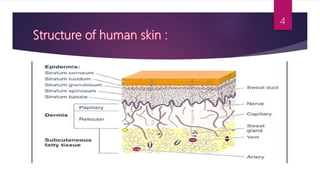
 Structure of human skin
 Components of NFIT
 Mechanism of operation
 Classification of NFIT
 Need of needle free injections
 Advantages
 Limitations
 Brands in market
2
3
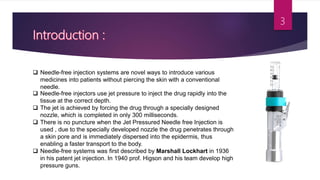
 Needle-free injection systems are novel ways to introduce various
medicines into patients without piercing the skin with a conventional
needle.
 Needle-free injectors use jet pressure to inject the drug rapidly into the
tissue at the correct depth.
 The jet is achieved by forcing the drug through a specially designed
nozzle, which is completed in only 300 milliseconds.
 There is no puncture when the Jet Pressured Needle free Injection is
used , due to the specially developed nozzle the drug penetrates through
a skin pore and is immediately dispersed into the epidermis, thus
enabling a faster transport to the body.
 Needle-free systems was first described by Marshall Lockhart in 1936
in his patent jet injection. In 1940 prof. Higson and his team develop high
pressure guns.
4
5
Ampoule
Transporter &
Trigger.
Adaptar
Injector body
Silitop - Component
of NFIT, used for
dental application
6
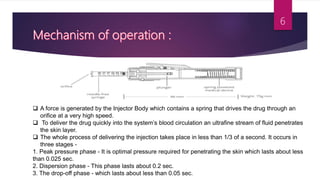
 A force is generated by the Injector Body which contains a spring that drives the drug through an
orifice at a very high speed.
 To deliver the drug quickly into the system’s blood circulation an ultrafine stream of fluid penetrates
the skin layer.
 The whole process of delivering the injection takes place in less than 1/3 of a second. It occurs in
three stages -
1. Peak pressure phase - It is optimal pressure required for penetrating the skin which lasts about less
than 0.025 sec.
2. Dispersion phase - This phase lasts about 0.2 sec.
3. The drop-off phase - which lasts about less than 0.05 sec.
7
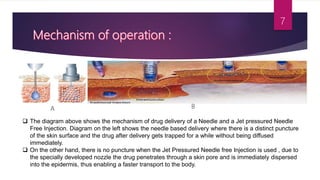
 The diagram above shows the mechanism of drug delivery of a Needle and a Jet pressured Needle
Free Injection. Diagram on the left shows the needle based delivery where there is a distinct puncture
of the skin surface and the drug after delivery gets trapped for a while without being diffused
immediately.
 On the other hand, there is no puncture when the Jet Pressured Needle free Injection is used , due to
the specially developed nozzle the drug penetrates through a skin pore and is immediately dispersed
into the epidermis, thus enabling a faster transport to the body.
A B
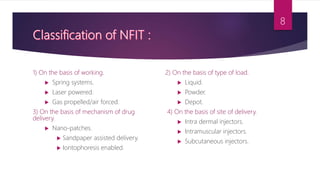
1) On the basis of working.
 Spring systems.
 Laser powered.
 Gas propelled/air forced.
3) On the basis of mechanism of drug
delivery.
 Nano-patches.
 Sandpaper assisted delivery.
 Iontophoresis enabled.
2) On the basis of type of load.
 Liquid.
 Powder.
 Depot.
4) On the basis of site of delivery.
 Intra dermal injectors.
 Intramuscular injectors.
 Subcutaneous injectors.
8
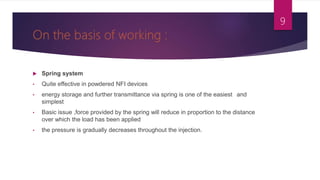
 Spring system
• Quite effective in powdered NFI devices
• energy storage and further transmittance via spring is one of the easiest and
simplest
• Basic issue ,force provided by the spring will reduce in proportion to the distance
over which the load has been applied
• the pressure is gradually decreases throughout the injection.
9
On the basis of working :
 Laser powered
• Developed by Prof Jack Yoh and his team (Department of Mechanical and
Aerospace Engineering, Seol National University, South Korea)
• system that blasts microscopic jets of drugs into the skin
• uses an erbium-doped yttrium garnet laser
• laser pulse of a wavelength of about 2940 nm is emitted
• which has a life span of about 250 millionth of a second
10
On the basis of working :
 Gas propelled/air forced.
• Sustained force of generation,
• greater flexibility,
• and the ability to deliver larger volumes
• Gases like carbon dioxide, nitrogen & helium are used
11
 1. Powder Injections
Drugs delivered reach the circulatory system at a faster rate as compared to those
administered by subcutaneous injection.
The principle of all the devices is the same; i.e. the energy generated by a transient gas jet is
used to accelerate a premeasured dose of particulate drug
 2. Liquid injections
The basic principle of this injection is, if a high enough pressure is generated by a fluid, then
the liquid will punch a hole into the skin and will be delivered into the tissues in and under the
skin
 3. Depot injections
Depot injections are given in the muscle, where they create a depot of a drug that is released
continuously over a specified period of time
12
13
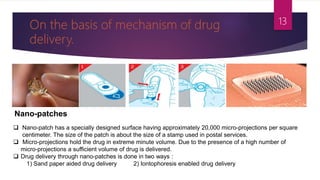
 Nano-patch has a specially designed surface having approximately 20,000 micro-projections per square
centimeter. The size of the patch is about the size of a stamp used in postal services.
 Micro-projections hold the drug in extreme minute volume. Due to the presence of a high number of
micro-projections a sufficient volume of drug is delivered.
 Drug delivery through nano-patches is done in two ways :
1) Sand paper aided drug delivery 2) Iontophoresis enabled drug delivery
Nano-patches
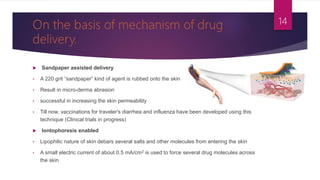
 Sandpaper assisted delivery
• A 220 grit “sandpaper” kind of agent is rubbed onto the skin
• Result in micro-derma abrasion
• successful in increasing the skin permeability
• Till now, vaccinations for traveler's diarrhea and influenza have been developed using this
technique (Clinical trials in progress)
 Iontophoresis enabled
• Lipophilic nature of skin debars several salts and other molecules from entering the skin
• A small electric current of about 0.5 mA/cm2 is used to force several drug molecules across
the skin
14
 Intra dermal injectors
• Employed to deliver comparatively newer, DNA-based vaccines
• Delivers the drug at a very shallow depth
 Intramuscular injectors
• Drug delivery via this system is the deepest among all
• Most successful for vaccination
 Subcutaneous injectors
• Proteins including the human GH have been administered by this system
• Medicament is delivered to the adipose layer just below the skin
15
 Needle Phobia- 10-15% of the population has a fear of Needles, Which causes
avoidance of treatment which leads to serious issues.
 Needlestick injury exposes healthcare workers to over 20 different bloodborne
pathogens.
 Insulin- A survey in 2014 revealed that 422 millions (42.2 Crore) people had Type
II Diabetes. Such patients have to be administered with insulin at regular intervals
to keep a check on their blood sugar levels. Needle free Injection Technology thus
comes as a blessing to such people. HIV, Hepatits B, Hepatitis C.
16
 Painless procedure
 Relief to patients who have to be inoculated many times in a day
 Efficient use of Vaccine
 Pandemic effective
 Zero contamination
 Better drug diffusion
 Zero disposal Hazard
 Ideal for developing countries
17
 High pressure delivery of drugs by the Jet pressured needle free Injection can damage fragile
molecules beneath our skin surface, especially Monoclonal antibodies.
 This can be resolved if a specialized device is employed to control the exact pressure of drug
delivery.
 Though this problem is faced only by patients who undergo multiple inoculations within a short
period of time thus is not of a major concern for the generally ill patients or patients for vaccination.
18
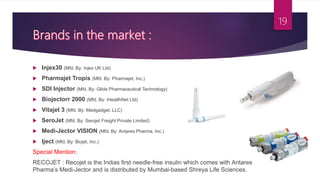
 Injex30 (Mfd. By: Injex UK Ltd)
 Pharmajet Tropis (Mfd. By: Pharmajet, Inc.)
 SDI Injector (Mfd. By: Glide Pharmaceutical Technology)
 Biojectorr 2000 (Mfd. By: iHealthNet Ltd)
 Vitajet 3 (Mfd. By: Medgadget, LLC)
 SeroJet (Mfd. By: Serojet Freight Private Limited)
 Medi-Jector VISION (Mfd. By: Antares Pharma, Inc.)
 Iject (Mfd. By: Biojet, Inc.)
Special Mention:
RECOJET : Recojet is the Indias first needle-free insulin which comes with Antares
Pharma’s Medi-Jector and is distributed by Mumbai-based Shreya Life Sciences.
19
20
THANK YOU

The needle free injection technology

  • 1.
  • 2.
     Introduction  Structureof human skin  Components of NFIT  Mechanism of operation  Classification of NFIT  Need of needle free injections  Advantages  Limitations  Brands in market 2
  • 3.
    3  Needle-free injectionsystems are novel ways to introduce various medicines into patients without piercing the skin with a conventional needle.  Needle-free injectors use jet pressure to inject the drug rapidly into the tissue at the correct depth.  The jet is achieved by forcing the drug through a specially designed nozzle, which is completed in only 300 milliseconds.  There is no puncture when the Jet Pressured Needle free Injection is used , due to the specially developed nozzle the drug penetrates through a skin pore and is immediately dispersed into the epidermis, thus enabling a faster transport to the body.  Needle-free systems was first described by Marshall Lockhart in 1936 in his patent jet injection. In 1940 prof. Higson and his team develop high pressure guns.
  • 4.
  • 5.
    5 Ampoule Transporter & Trigger. Adaptar Injector body Silitop- Component of NFIT, used for dental application
  • 6.
    6  A forceis generated by the Injector Body which contains a spring that drives the drug through an orifice at a very high speed.  To deliver the drug quickly into the system’s blood circulation an ultrafine stream of fluid penetrates the skin layer.  The whole process of delivering the injection takes place in less than 1/3 of a second. It occurs in three stages - 1. Peak pressure phase - It is optimal pressure required for penetrating the skin which lasts about less than 0.025 sec. 2. Dispersion phase - This phase lasts about 0.2 sec. 3. The drop-off phase - which lasts about less than 0.05 sec.
  • 7.
    7  The diagramabove shows the mechanism of drug delivery of a Needle and a Jet pressured Needle Free Injection. Diagram on the left shows the needle based delivery where there is a distinct puncture of the skin surface and the drug after delivery gets trapped for a while without being diffused immediately.  On the other hand, there is no puncture when the Jet Pressured Needle free Injection is used , due to the specially developed nozzle the drug penetrates through a skin pore and is immediately dispersed into the epidermis, thus enabling a faster transport to the body. A B
  • 8.
    1) On thebasis of working.  Spring systems.  Laser powered.  Gas propelled/air forced. 3) On the basis of mechanism of drug delivery.  Nano-patches.  Sandpaper assisted delivery.  Iontophoresis enabled. 2) On the basis of type of load.  Liquid.  Powder.  Depot. 4) On the basis of site of delivery.  Intra dermal injectors.  Intramuscular injectors.  Subcutaneous injectors. 8
  • 9.
     Spring system •Quite effective in powdered NFI devices • energy storage and further transmittance via spring is one of the easiest and simplest • Basic issue ,force provided by the spring will reduce in proportion to the distance over which the load has been applied • the pressure is gradually decreases throughout the injection. 9
  • 10.
    On the basisof working :  Laser powered • Developed by Prof Jack Yoh and his team (Department of Mechanical and Aerospace Engineering, Seol National University, South Korea) • system that blasts microscopic jets of drugs into the skin • uses an erbium-doped yttrium garnet laser • laser pulse of a wavelength of about 2940 nm is emitted • which has a life span of about 250 millionth of a second 10
  • 11.
    On the basisof working :  Gas propelled/air forced. • Sustained force of generation, • greater flexibility, • and the ability to deliver larger volumes • Gases like carbon dioxide, nitrogen & helium are used 11
  • 12.
     1. PowderInjections Drugs delivered reach the circulatory system at a faster rate as compared to those administered by subcutaneous injection. The principle of all the devices is the same; i.e. the energy generated by a transient gas jet is used to accelerate a premeasured dose of particulate drug  2. Liquid injections The basic principle of this injection is, if a high enough pressure is generated by a fluid, then the liquid will punch a hole into the skin and will be delivered into the tissues in and under the skin  3. Depot injections Depot injections are given in the muscle, where they create a depot of a drug that is released continuously over a specified period of time 12
  • 13.
    13  Nano-patch hasa specially designed surface having approximately 20,000 micro-projections per square centimeter. The size of the patch is about the size of a stamp used in postal services.  Micro-projections hold the drug in extreme minute volume. Due to the presence of a high number of micro-projections a sufficient volume of drug is delivered.  Drug delivery through nano-patches is done in two ways : 1) Sand paper aided drug delivery 2) Iontophoresis enabled drug delivery Nano-patches
  • 14.
     Sandpaper assisteddelivery • A 220 grit “sandpaper” kind of agent is rubbed onto the skin • Result in micro-derma abrasion • successful in increasing the skin permeability • Till now, vaccinations for traveler's diarrhea and influenza have been developed using this technique (Clinical trials in progress)  Iontophoresis enabled • Lipophilic nature of skin debars several salts and other molecules from entering the skin • A small electric current of about 0.5 mA/cm2 is used to force several drug molecules across the skin 14
  • 15.
     Intra dermalinjectors • Employed to deliver comparatively newer, DNA-based vaccines • Delivers the drug at a very shallow depth  Intramuscular injectors • Drug delivery via this system is the deepest among all • Most successful for vaccination  Subcutaneous injectors • Proteins including the human GH have been administered by this system • Medicament is delivered to the adipose layer just below the skin 15
  • 16.
     Needle Phobia-10-15% of the population has a fear of Needles, Which causes avoidance of treatment which leads to serious issues.  Needlestick injury exposes healthcare workers to over 20 different bloodborne pathogens.  Insulin- A survey in 2014 revealed that 422 millions (42.2 Crore) people had Type II Diabetes. Such patients have to be administered with insulin at regular intervals to keep a check on their blood sugar levels. Needle free Injection Technology thus comes as a blessing to such people. HIV, Hepatits B, Hepatitis C. 16
  • 17.
     Painless procedure Relief to patients who have to be inoculated many times in a day  Efficient use of Vaccine  Pandemic effective  Zero contamination  Better drug diffusion  Zero disposal Hazard  Ideal for developing countries 17
  • 18.
     High pressuredelivery of drugs by the Jet pressured needle free Injection can damage fragile molecules beneath our skin surface, especially Monoclonal antibodies.  This can be resolved if a specialized device is employed to control the exact pressure of drug delivery.  Though this problem is faced only by patients who undergo multiple inoculations within a short period of time thus is not of a major concern for the generally ill patients or patients for vaccination. 18
  • 19.
     Injex30 (Mfd.By: Injex UK Ltd)  Pharmajet Tropis (Mfd. By: Pharmajet, Inc.)  SDI Injector (Mfd. By: Glide Pharmaceutical Technology)  Biojectorr 2000 (Mfd. By: iHealthNet Ltd)  Vitajet 3 (Mfd. By: Medgadget, LLC)  SeroJet (Mfd. By: Serojet Freight Private Limited)  Medi-Jector VISION (Mfd. By: Antares Pharma, Inc.)  Iject (Mfd. By: Biojet, Inc.) Special Mention: RECOJET : Recojet is the Indias first needle-free insulin which comes with Antares Pharma’s Medi-Jector and is distributed by Mumbai-based Shreya Life Sciences. 19
  • 20.