Submitted by:Puttamreddy Kavyasri
M.pharmacy (pharmaceutics)
MBSchool of pharmaceutical sciences(MBU)
submitted to: Dr.S.Prasanthi
Associate professor
CONTENTS:
• Definition
• Dissolution
• Alternative methods of dissolution
• Meeting dissolution requirements
Dissolution of a drug is imporatant for its
and
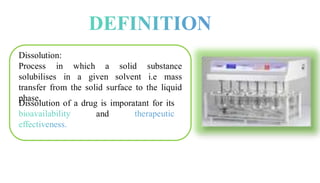
Dissolution:
Process in which a solid substance
solubilises in a given solvent i.e mass
transfer from the solid surface to the liquid
phase.
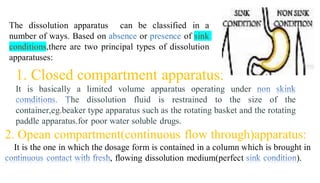
The dissolution apparatus can be classified in a
number of ways. Based on absence or presence of sink
conditions,there are two principal types of dissolution
apparatuses:
1. Closed compartment apparatus:
It is basically a limited volume apparatus operating under
he dissolution fluid is restrained to the size of the
container,eg.beaker type apparatus such as the rotating basket and the rotating
paddle apparatus.for poor water soluble drugs.
2. Opean compartment(continuous flow through)apparatus:
It is the one in which the dosage form is contained in a column which is brought in
, flowing dissolution medium(perfect ).
 NATURAL CONVECTION NON SINK METHODS:
a) klein solvmeter method
b) nelson hanging pellet method
c) levy static disc method
 FORCED CONVENTION NON SINK METHODS:
a) Tumbling method
b) levy or beaker method
c) rotating disk method
d) particle size method
e) USP rotating basket apparatus
f) USP paddle apparatu
 FORCED CONVECTION SINK DEVICES:
a) Wurster polis adsorption method
b) partition method
c) Dialysis methods
d) Rotating disk apparatus
 CONTINOUS FLOW/FLOW THROUGH METHODS:
a) Pernarowski method
b) Langenbucher method
c) Baun and walker
d) Tingastad and Reigelman
e) Modified column apparatus
f) Takenaka method
NATURAL CONVECTION NON SINK METHODS:
a. klein solvmeter method:
 The carrier device is surrounded by floats and
immersed in the dissolution medium.
 The measuring bar links the float to the calibration
scale above.
 When the dose form is placed in the boat, the bar moves
downward, and as it dissolves, it moves upward.
 The difference in bar movement height reveals the
amount of dissolved dose.
 The disintegrated dosage form cannot be examined, and
the effects of concentration on the dissolution rate and
measuring system are not accountable.
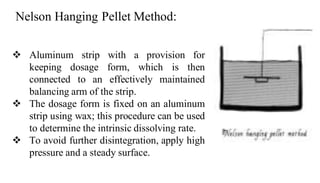
Nelson Hanging Pellet Method:
 Aluminum strip with a provision for
keeping dosage form, which is then
connected to an effectively maintained
balancing arm of the strip.
 The dosage form is fixed on an aluminum
strip using wax; this procedure can be used
to determine the intrinsic dissolving rate.
 To avoid further disintegration, apply high
pressure and a steady surface.
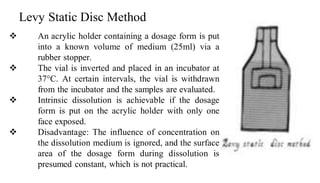
Levy Static Disc Method
 An acrylic holder containing a dosage form is put
into a known volume of medium (25ml) via a
rubber stopper.
 The vial is inverted and placed in an incubator at
37°C. At certain intervals, the vial is withdrawn
from the incubator and the samples are evaluated.
 Intrinsic dissolution is achievable if the dosage
form is put on the acrylic holder with only one
face exposed.
 Disadvantage: The influence of concentration on
the dissolution medium is ignored, and the surface
area of the dosage form during dissolution is
presumed constant, which is not practical.
FORCED CONVECTION NON SINK METHODS:
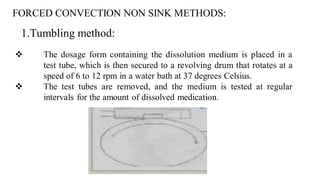
1.Tumbling method:
 The dosage form containing the dissolution medium is placed in a
test tube, which is then secured to a revolving drum that rotates at a
speed of 6 to 12 rpm in a water bath at 37 degrees Celsius.
 The test tubes are removed, and the medium is tested at regular
intervals for the amount of dissolved medication.
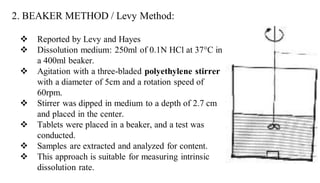
2. BEAKER METHOD / Levy Method:
 Reported by Levy and Hayes
 Dissolution medium: 250ml of 0.1N HCl at 37°C in
a 400ml beaker.
 Agitation with a three-bladed polyethylene stirrer
with a diameter of 5cm and a rotation speed of
60rpm.
 Stirrer was dipped in medium to a depth of 2.7 cm
and placed in the center.
 Tablets were placed in a beaker, and a test was
conducted.
 Samples are extracted and analyzed for content.
 This approach is suitable for measuring intrinsic
dissolution rate.
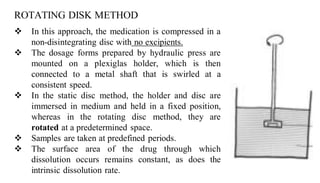
ROTATING DISK METHOD
 In this approach, the medication is compressed in a
non-disintegrating disc with no excipients.
 The dosage forms prepared by hydraulic press are
mounted on a plexiglas holder, which is then
connected to a metal shaft that is swirled at a
consistent speed.
 In the static disc method, the holder and disc are
immersed in medium and held in a fixed position,
whereas in the rotating disc method, they are
rotated at a predetermined space.
 Samples are taken at predefined periods.
 The surface area of the drug through which
dissolution occurs remains constant, as does the
intrinsic dissolution rate.
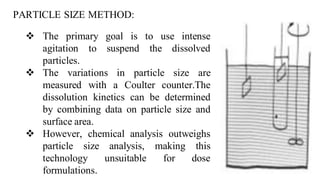
PARTICLE SIZE METHOD:
 The primary goal is to use intense
agitation to suspend the dissolved
particles.
 The variations in particle size are
measured with a Coulter counter.The
dissolution kinetics can be determined
by combining data on particle size and
surface area.
 However, chemical analysis outweighs
particle size analysis, making this
technology unsuitable for dose
formulations.
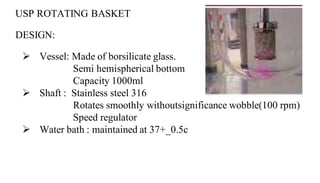
USP ROTATING BASKET
DESIGN:
 Vessel: Made of borsilicate glass.
Semi hemispherical bottom
Capacity 1000ml
 Shaft : Stainless steel 316
Rotates smoothly withoutsignificance wobble(100 rpm)
Speed regulator
 Water bath : maintained at 37+_0.5c
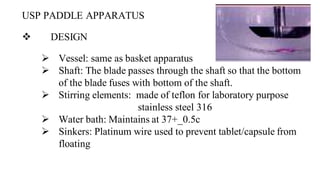
USP PADDLE APPARATUS
 DESIGN
 Vessel: same as basket apparatus
 Shaft: The blade passes through the shaft so that the bottom
of the blade fuses with bottom of the shaft.
 Stirring elements: made of teflon for laboratory purpose
stainless steel 316
 Water bath: Maintains at 37+_0.5c
 Sinkers: Platinum wire used to prevent tablet/capsule from
floating
FORCED CONVECTION SINK DEVICES
An ideal dissolution process is one which will mimic the invivo
conditions by mintaing perfect sink conditions.These perfect
sink conditions can be maintained by either of the following
systems:
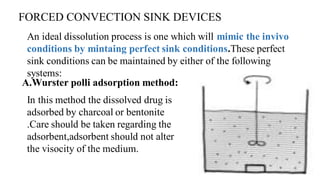
A.Wurster polli adsorption method:
In this method the dissolved drug is
adsorbed by charcoal or bentonite
.Care should be taken regarding the
adsorbent,adsorbent should not alter
the visocity of the medium.
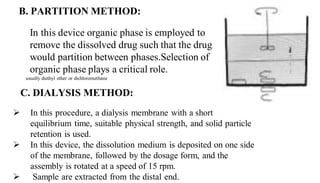
B. PARTITION METHOD:
In this device organic phase is employed to
remove the dissolved drug such that the drug
would partition between phases.Selection of
organic phase plays a critical role.
C. DIALYSIS METHOD:
 In this procedure, a dialysis membrane with a short
equilibrium time, suitable physical strength, and solid particle
retention is used.
 In this device, the dissolution medium is deposited on one side
of the membrane, followed by the dosage form, and the
assembly is rotated at a speed of 15 rpm.
 Sample are extracted from the distal end.
usually diethyl ether or dichloromethane
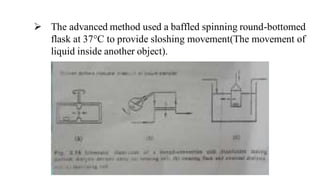
 The advanced method used a baffled spinning round-bottomed
flask at 37°C to provide sloshing movement(The movement of
liquid inside another object).
CONTINUOUS FLOW APPARATUS
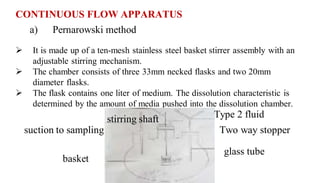
a) Pernarowski method
 It is made up of a ten-mesh stainless steel basket stirrer assembly with an
adjustable stirring mechanism.
 The chamber consists of three 33mm necked flasks and two 20mm
diameter flasks.
 The flask contains one liter of medium. The dissolution characteristic is
determined by the amount of media pushed into the dissolution chamber.
Type 2 fluid
Two way stopper
glass tube
basket
suction to sampling
stirring shaft
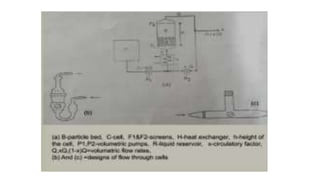
Langenbucher column method
 This device adheres to the dissolution basic design.
 The screen is designed such that the medium flows
uniformly throughout the entire cross section in a
laminar pattern.
 This is again closed by a secondary screen, a filter
that prevents the undissolved medication from
eluting.
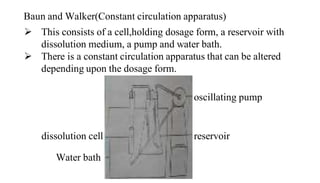
Baun and Walker(Constant circulation apparatus)
 This consists of a cell,holding dosage form, a reservoir with
dissolution medium, a pump and water bath.
 There is a constant circulation apparatus that can be altered
depending upon the dosage form.
oscillating pump
reservoir
dissolution cell
Water bath
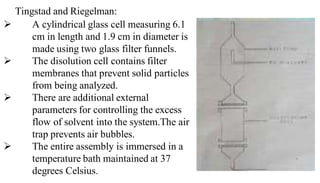
Tingstad and Riegelman:
 A cylindrical glass cell measuring 6.1
cm in length and 1.9 cm in diameter is
made using two glass filter funnels.
 The disolution cell contains filter
membranes that prevent solid particles
from being analyzed.
 There are additional external
parameters for controlling the excess
flow of solvent into the system.The air
trap prevents air bubbles.
 The entire assembly is immersed in a
temperature bath maintained at 37
degrees Celsius.
Flow Through Modified Column Apparatus:
 The gadget comprises of a 14M nylon
filter.
 The pipe from the pump is connected
to the dissolving cell.
 The screen, which rests on the bottom
half of the filter holder, is supported
by teflon-faced stainless steel.
 The flow direction ensures that the
paraticles do not fall through the
screen.The remainder of the steps are
the same.
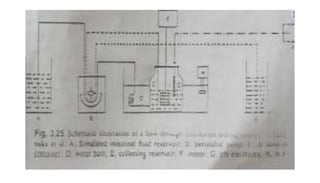
Continous flow apparatus by Takenaka method
 The drug's release is assessed using an in vitro simulator
equipment that includes a flow-type dissolving container.
 The dosage form is inserted in the basket, which rotates at 94
rpm and contains 300 mL of medium.
 The medium is then evacuated from the reservoir using a
peristatic pump.
 Aliquots are extracted using a syringe and then filtered through
Whatan filter paper before being promptly refilled with fresh
medium.
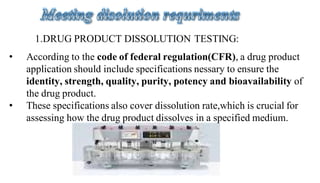
1.DRUG PRODUCT DISSOLUTION TESTING:
• According to the code of federal regulation(CFR), a drug product
application should include specifications nessary to ensure the
identity, strength, quality, purity, potency and bioavailability of
the drug product.
• These specifications also cover dissolution rate,which is crucial for
assessing how the drug product dissolves in a specified medium.
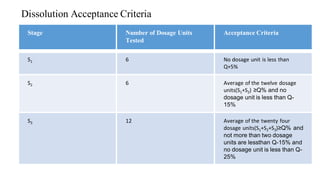
On the basis of dissolution profile data, criteria for acceptance/passing
of test results are based on Q values as given in table below. The value
of Q is defined as percentage of drug content dissolved in a given
time period. This value is generally specified in USP monograph of a
given drug product. Three stages viz. S1, S2 and S3 of dissolution
testing are allowed as given in
Dissolution Acceptance Criteria
Stage Number of Dosage Units
Tested
Acceptance Criteria
S1 6 No dosage unit is less than
Q+5%
S2 6 Average of the twelve dosage
units(S1+S2) ≥Q% and no
dosage unit is less than Q-
15%
S3 12 Average of the twenty four
dosage units(S1+S2+S3)≥Q% and
not more than two dosage
units are lessthan Q-15% and
no dosage unit is less than Q-
25%
NATURAL CONVENTION:
Driving force is natural buoyancy forces
FORCED CONVENTION:
Driving force is external force pump
INTRINSIC DISSOLUTION:
The rate of dissolution of a pure pharmaceutical active ingredient when the
surfacearea stirring ,spped, pH and ionic strength of the dissolution medium
is kept constant.
Alternative methods of dissolution testing and meeting dissolution requriments

Alternative methods of dissolution testing and meeting dissolution requriments

  • 1.
    Submitted by:Puttamreddy Kavyasri M.pharmacy(pharmaceutics) MBSchool of pharmaceutical sciences(MBU) submitted to: Dr.S.Prasanthi Associate professor
  • 2.
    CONTENTS: • Definition • Dissolution •Alternative methods of dissolution • Meeting dissolution requirements
  • 3.
    Dissolution of adrug is imporatant for its and Dissolution: Process in which a solid substance solubilises in a given solvent i.e mass transfer from the solid surface to the liquid phase.
  • 4.
    The dissolution apparatuscan be classified in a number of ways. Based on absence or presence of sink conditions,there are two principal types of dissolution apparatuses: 1. Closed compartment apparatus: It is basically a limited volume apparatus operating under he dissolution fluid is restrained to the size of the container,eg.beaker type apparatus such as the rotating basket and the rotating paddle apparatus.for poor water soluble drugs. 2. Opean compartment(continuous flow through)apparatus: It is the one in which the dosage form is contained in a column which is brought in , flowing dissolution medium(perfect ).
  • 5.
     NATURAL CONVECTIONNON SINK METHODS: a) klein solvmeter method b) nelson hanging pellet method c) levy static disc method  FORCED CONVENTION NON SINK METHODS: a) Tumbling method b) levy or beaker method c) rotating disk method d) particle size method e) USP rotating basket apparatus f) USP paddle apparatu
  • 6.
     FORCED CONVECTIONSINK DEVICES: a) Wurster polis adsorption method b) partition method c) Dialysis methods d) Rotating disk apparatus  CONTINOUS FLOW/FLOW THROUGH METHODS: a) Pernarowski method b) Langenbucher method c) Baun and walker d) Tingastad and Reigelman e) Modified column apparatus f) Takenaka method
  • 7.
    NATURAL CONVECTION NONSINK METHODS: a. klein solvmeter method:  The carrier device is surrounded by floats and immersed in the dissolution medium.  The measuring bar links the float to the calibration scale above.  When the dose form is placed in the boat, the bar moves downward, and as it dissolves, it moves upward.  The difference in bar movement height reveals the amount of dissolved dose.  The disintegrated dosage form cannot be examined, and the effects of concentration on the dissolution rate and measuring system are not accountable.
  • 8.
    Nelson Hanging PelletMethod:  Aluminum strip with a provision for keeping dosage form, which is then connected to an effectively maintained balancing arm of the strip.  The dosage form is fixed on an aluminum strip using wax; this procedure can be used to determine the intrinsic dissolving rate.  To avoid further disintegration, apply high pressure and a steady surface.
  • 9.
    Levy Static DiscMethod  An acrylic holder containing a dosage form is put into a known volume of medium (25ml) via a rubber stopper.  The vial is inverted and placed in an incubator at 37°C. At certain intervals, the vial is withdrawn from the incubator and the samples are evaluated.  Intrinsic dissolution is achievable if the dosage form is put on the acrylic holder with only one face exposed.  Disadvantage: The influence of concentration on the dissolution medium is ignored, and the surface area of the dosage form during dissolution is presumed constant, which is not practical.
  • 10.
    FORCED CONVECTION NONSINK METHODS: 1.Tumbling method:  The dosage form containing the dissolution medium is placed in a test tube, which is then secured to a revolving drum that rotates at a speed of 6 to 12 rpm in a water bath at 37 degrees Celsius.  The test tubes are removed, and the medium is tested at regular intervals for the amount of dissolved medication.
  • 11.
    2. BEAKER METHOD/ Levy Method:  Reported by Levy and Hayes  Dissolution medium: 250ml of 0.1N HCl at 37°C in a 400ml beaker.  Agitation with a three-bladed polyethylene stirrer with a diameter of 5cm and a rotation speed of 60rpm.  Stirrer was dipped in medium to a depth of 2.7 cm and placed in the center.  Tablets were placed in a beaker, and a test was conducted.  Samples are extracted and analyzed for content.  This approach is suitable for measuring intrinsic dissolution rate.
  • 12.
    ROTATING DISK METHOD In this approach, the medication is compressed in a non-disintegrating disc with no excipients.  The dosage forms prepared by hydraulic press are mounted on a plexiglas holder, which is then connected to a metal shaft that is swirled at a consistent speed.  In the static disc method, the holder and disc are immersed in medium and held in a fixed position, whereas in the rotating disc method, they are rotated at a predetermined space.  Samples are taken at predefined periods.  The surface area of the drug through which dissolution occurs remains constant, as does the intrinsic dissolution rate.
  • 13.
    PARTICLE SIZE METHOD: The primary goal is to use intense agitation to suspend the dissolved particles.  The variations in particle size are measured with a Coulter counter.The dissolution kinetics can be determined by combining data on particle size and surface area.  However, chemical analysis outweighs particle size analysis, making this technology unsuitable for dose formulations.
  • 14.
    USP ROTATING BASKET DESIGN: Vessel: Made of borsilicate glass. Semi hemispherical bottom Capacity 1000ml  Shaft : Stainless steel 316 Rotates smoothly withoutsignificance wobble(100 rpm) Speed regulator  Water bath : maintained at 37+_0.5c
  • 15.
    USP PADDLE APPARATUS DESIGN  Vessel: same as basket apparatus  Shaft: The blade passes through the shaft so that the bottom of the blade fuses with bottom of the shaft.  Stirring elements: made of teflon for laboratory purpose stainless steel 316  Water bath: Maintains at 37+_0.5c  Sinkers: Platinum wire used to prevent tablet/capsule from floating
  • 16.
    FORCED CONVECTION SINKDEVICES An ideal dissolution process is one which will mimic the invivo conditions by mintaing perfect sink conditions.These perfect sink conditions can be maintained by either of the following systems: A.Wurster polli adsorption method: In this method the dissolved drug is adsorbed by charcoal or bentonite .Care should be taken regarding the adsorbent,adsorbent should not alter the visocity of the medium.
  • 17.
    B. PARTITION METHOD: Inthis device organic phase is employed to remove the dissolved drug such that the drug would partition between phases.Selection of organic phase plays a critical role. C. DIALYSIS METHOD:  In this procedure, a dialysis membrane with a short equilibrium time, suitable physical strength, and solid particle retention is used.  In this device, the dissolution medium is deposited on one side of the membrane, followed by the dosage form, and the assembly is rotated at a speed of 15 rpm.  Sample are extracted from the distal end. usually diethyl ether or dichloromethane
  • 18.
     The advancedmethod used a baffled spinning round-bottomed flask at 37°C to provide sloshing movement(The movement of liquid inside another object).
  • 19.
    CONTINUOUS FLOW APPARATUS a)Pernarowski method  It is made up of a ten-mesh stainless steel basket stirrer assembly with an adjustable stirring mechanism.  The chamber consists of three 33mm necked flasks and two 20mm diameter flasks.  The flask contains one liter of medium. The dissolution characteristic is determined by the amount of media pushed into the dissolution chamber. Type 2 fluid Two way stopper glass tube basket suction to sampling stirring shaft
  • 20.
    Langenbucher column method This device adheres to the dissolution basic design.  The screen is designed such that the medium flows uniformly throughout the entire cross section in a laminar pattern.  This is again closed by a secondary screen, a filter that prevents the undissolved medication from eluting.
  • 22.
    Baun and Walker(Constantcirculation apparatus)  This consists of a cell,holding dosage form, a reservoir with dissolution medium, a pump and water bath.  There is a constant circulation apparatus that can be altered depending upon the dosage form. oscillating pump reservoir dissolution cell Water bath
  • 23.
    Tingstad and Riegelman: A cylindrical glass cell measuring 6.1 cm in length and 1.9 cm in diameter is made using two glass filter funnels.  The disolution cell contains filter membranes that prevent solid particles from being analyzed.  There are additional external parameters for controlling the excess flow of solvent into the system.The air trap prevents air bubbles.  The entire assembly is immersed in a temperature bath maintained at 37 degrees Celsius.
  • 24.
    Flow Through ModifiedColumn Apparatus:  The gadget comprises of a 14M nylon filter.  The pipe from the pump is connected to the dissolving cell.  The screen, which rests on the bottom half of the filter holder, is supported by teflon-faced stainless steel.  The flow direction ensures that the paraticles do not fall through the screen.The remainder of the steps are the same.
  • 25.
    Continous flow apparatusby Takenaka method  The drug's release is assessed using an in vitro simulator equipment that includes a flow-type dissolving container.  The dosage form is inserted in the basket, which rotates at 94 rpm and contains 300 mL of medium.  The medium is then evacuated from the reservoir using a peristatic pump.  Aliquots are extracted using a syringe and then filtered through Whatan filter paper before being promptly refilled with fresh medium.
  • 27.
    1.DRUG PRODUCT DISSOLUTIONTESTING: • According to the code of federal regulation(CFR), a drug product application should include specifications nessary to ensure the identity, strength, quality, purity, potency and bioavailability of the drug product. • These specifications also cover dissolution rate,which is crucial for assessing how the drug product dissolves in a specified medium.
  • 28.
    On the basisof dissolution profile data, criteria for acceptance/passing of test results are based on Q values as given in table below. The value of Q is defined as percentage of drug content dissolved in a given time period. This value is generally specified in USP monograph of a given drug product. Three stages viz. S1, S2 and S3 of dissolution testing are allowed as given in
  • 29.
    Dissolution Acceptance Criteria StageNumber of Dosage Units Tested Acceptance Criteria S1 6 No dosage unit is less than Q+5% S2 6 Average of the twelve dosage units(S1+S2) ≥Q% and no dosage unit is less than Q- 15% S3 12 Average of the twenty four dosage units(S1+S2+S3)≥Q% and not more than two dosage units are lessthan Q-15% and no dosage unit is less than Q- 25%
  • 30.
    NATURAL CONVENTION: Driving forceis natural buoyancy forces FORCED CONVENTION: Driving force is external force pump INTRINSIC DISSOLUTION: The rate of dissolution of a pure pharmaceutical active ingredient when the surfacearea stirring ,spped, pH and ionic strength of the dissolution medium is kept constant.