Md. Abdul Karim Mia
Analyst
National Control Laboratory (NCL), DGDA, Dhaka, Bangladesh
Dissolution
Dissolution?
Academic Definition
Dissolution is the process by which a solid substance
enters into a solvent to form a solution.
Pharmaceutical Definition
Dissolution is a test used throughout the life cycle of a
pharmaceutical product to evaluate the rate of release of a
drug substance from the dosage form.
National Control Laboratory (NCL), DGDA, Dhaka, Bangladesh
History of Dissolution
 The first dissolution studies were reported in the literature in 1897 by Noyes and
Whitney where they studied the dissolution of two sparingly soluble compounds,
namely benzoic acid and lead chloride.
 Edwards in 1951 postulated that the rate-limiting step in the absorption of aspirin in
the bloodstream was its dissolution.
 In 1957 Nelson was the first scientist to explicitly relate the blood levels of orally
administered theophylline to its dissolution.
 However, in the mid 1960s realization of the impact of dissolution on the therapeutic
effect of orally administered drugs began.
National Control Laboratory (NCL), DGDA, Dhaka, Bangladesh
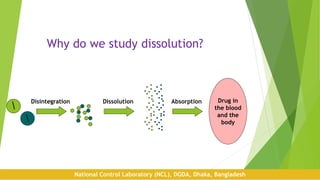
Why do we study dissolution?
Disintegration Dissolution Absorption Drug in
the blood
and the
body
National Control Laboratory (NCL), DGDA, Dhaka, Bangladesh
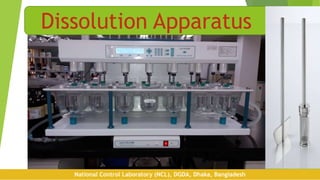
Dissolution Apparatus
National Control Laboratory (NCL), DGDA, Dhaka, Bangladesh
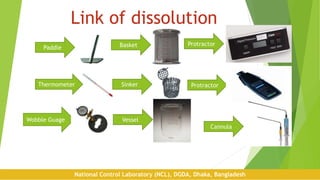
Link of dissolution
Protractor
Thermometer
Paddle Basket
Sinker Protractor
Wobble Guage Vessel
National Control Laboratory (NCL), DGDA, Dhaka, Bangladesh
Cannula
Goal of the dissolution
 It asses the performance of drug products
 To be effective the test should be predictive, comparative,
disseminatory and reproducible.
 Predict the bioavailability- surrogate the parameter of the therapeutic
efficacy
 Indicate the robustness of the dosage form of drug product related
safety
 Sensitivity variation of the manufacturing process which have a critical
influence on the dosage form performance.
National Control Laboratory (NCL), DGDA, Dhaka, Bangladesh
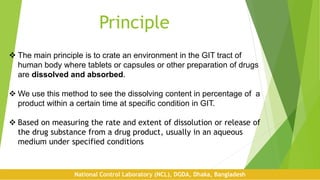
Principle
 The main principle is to crate an environment in the GIT tract of
human body where tablets or capsules or other preparation of drugs
are dissolved and absorbed.
 We use this method to see the dissolving content in percentage of a
product within a certain time at specific condition in GIT.
 Based on measuring the rate and extent of dissolution or release of
the drug substance from a drug product, usually in an aqueous
medium under specified conditions
National Control Laboratory (NCL), DGDA, Dhaka, Bangladesh
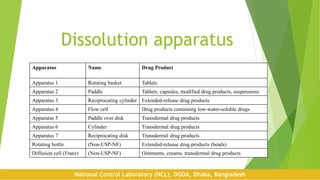
Dissolution apparatus
Apparatus Name Drug Product
Apparatus 1 Rotating basket Tablets
Apparatus 2 Paddle Tablets, capsules, modified drug products, suspensions
Apparatus 3 Reciprocating cylinder Extended-release drug products
Apparatus 4 Flow cell Drug products containing low-water-soluble drugs
Apparatus 5 Paddle over disk Transdermal drug products
Apparatus 6 Cylinder Transdermal drug products
Apparatus 7 Reciprocating disk Transdermal drug products
Rotating bottle (Non-USP-NF) Extended-release drug products (beads)
Diffusion cell (Franz) (Non-USP-NF) Ointments, creams, transdermal drug products
National Control Laboratory (NCL), DGDA, Dhaka, Bangladesh
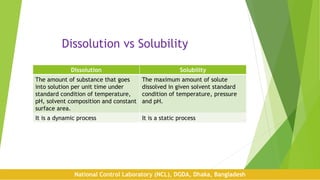
Dissolution vs Solubility
Dissolution Solubility
The amount of substance that goes
into solution per unit time under
standard condition of temperature,
pH, solvent composition and constant
surface area.
The maximum amount of solute
dissolved in given solvent standard
condition of temperature, pressure
and pH.
It is a dynamic process It is a static process
National Control Laboratory (NCL), DGDA, Dhaka, Bangladesh
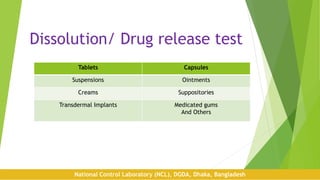
Dissolution/ Drug release test
Tablets Capsules
Suspensions Ointments
Creams Suppositories
Transdermal Implants Medicated gums
And Others
National Control Laboratory (NCL), DGDA, Dhaka, Bangladesh
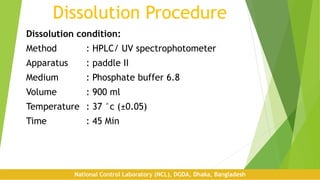
Dissolution Procedure
Dissolution condition:
Method : HPLC/ UV spectrophotometer
Apparatus : paddle II
Medium : Phosphate buffer 6.8
Volume : 900 ml
Temperature : 37 °c (±0.05)
Time : 45 Min
National Control Laboratory (NCL), DGDA, Dhaka, Bangladesh
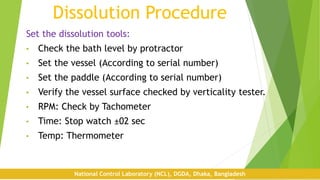
Dissolution Procedure
Set the dissolution tools:
• Check the bath level by protractor
• Set the vessel (According to serial number)
• Set the paddle (According to serial number)
• Verify the vessel surface checked by verticality tester.
• RPM: Check by Tachometer
• Time: Stop watch ±02 sec
• Temp: Thermometer
National Control Laboratory (NCL), DGDA, Dhaka, Bangladesh
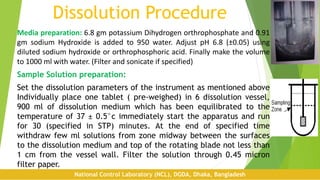
Dissolution Procedure
Media preparation: 6.8 gm potassium Dihydrogen orthrophosphate and 0.91
gm sodium Hydroxide is added to 950 water. Adjust pH 6.8 (±0.05) using
diluted sodium hydroxide or orthrophosphoric acid. Finally make the volume
to 1000 ml with water. (Filter and sonicate if specified)
Sample Solution preparation:
Set the dissolution parameters of the instrument as mentioned above
Individually place one tablet ( pre-weighed) in 6 dissolution vessel,
900 ml of dissolution medium which has been equilibrated to the
temperature of 37 ± 0.5°c immediately start the apparatus and run
for 30 (specified in STP) minutes. At the end of specified time
withdraw few ml solutions from zone midway between the surfaces
to the dissolution medium and top of the rotating blade not less than
1 cm from the vessel wall. Filter the solution through 0.45 micron
filter paper.
National Control Laboratory (NCL), DGDA, Dhaka, Bangladesh
Dissolution Procedure
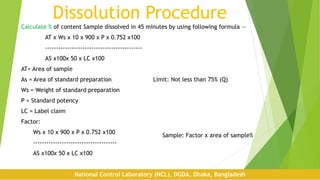
Calculate % of content Sample dissolved in 45 minutes by using following formula —
AT x Ws x 10 x 900 x P x 0.752 x100
--------------------------------------------
AS x100x 50 x LC x100
AT= Area of sample
As = Area of standard preparation Limit: Not less than 75% (Q)
Ws = Weight of standard preparation
P = Standard potency
LC = Label claim
Factor:
Ws x 10 x 900 x P x 0.752 x100
--------------------------------------
AS x100x 50 x LC x100
National Control Laboratory (NCL), DGDA, Dhaka, Bangladesh
Sample: Factor x area of sample%
Dissolution Procedure
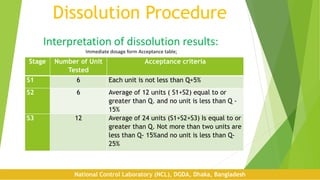
Stage Number of Unit
Tested
Acceptance criteria
S1 6 Each unit is not less than Q+5%
S2 6 Average of 12 units ( S1+S2) equal to or
greater than Q. and no unit is less than Q -
15%
S3 12 Average of 24 units (S1+S2+S3) Is equal to or
greater than Q. Not more than two units are
less than Q- 15%and no unit is less than Q-
25%
Interpretation of dissolution results:
Immediate dosage form Acceptance table;
National Control Laboratory (NCL), DGDA, Dhaka, Bangladesh
Dissolution Procedure
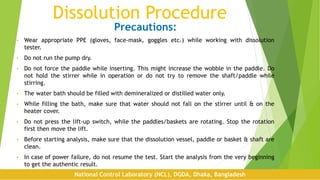
Precautions:
• Wear appropriate PPE (gloves, face-mask, goggles etc.) while working with dissolution
tester.
• Do not run the pump dry.
• Do not force the paddle while inserting. This might increase the wobble in the paddle. Do
not hold the stirrer while in operation or do not try to remove the shaft/paddle while
stirring.
• The water bath should be filled with demineralized or distilled water only.
• While filling the bath, make sure that water should not fall on the stirrer until & on the
heater cover.
• Do not press the lift-up switch, while the paddles/baskets are rotating. Stop the rotation
first then move the lift.
• Before starting analysis, make sure that the dissolution vessel, paddle or basket & shaft are
clean.
• In case of power failure, do not resume the test. Start the analysis from the very beginning
to get the authentic result.
National Control Laboratory (NCL), DGDA, Dhaka, Bangladesh
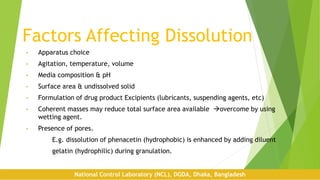
Factors Affecting Dissolution
• Apparatus choice
• Agitation, temperature, volume
• Media composition & pH
• Surface area & undissolved solid
• Formulation of drug product Excipients (lubricants, suspending agents, etc)
• Coherent masses may reduce total surface area available overcome by using
wetting agent.
• Presence of pores.
E.g. dissolution of phenacetin (hydrophobic) is enhanced by adding diluent
gelatin (hydrophilic) during granulation.
National Control Laboratory (NCL), DGDA, Dhaka, Bangladesh
For Your patience
National Control Laboratory (NCL), DGDA, Dhaka, Bangladesh
Thank You

Dissolution

  • 1.
    Md. Abdul KarimMia Analyst National Control Laboratory (NCL), DGDA, Dhaka, Bangladesh Dissolution
  • 2.
    Dissolution? Academic Definition Dissolution isthe process by which a solid substance enters into a solvent to form a solution. Pharmaceutical Definition Dissolution is a test used throughout the life cycle of a pharmaceutical product to evaluate the rate of release of a drug substance from the dosage form. National Control Laboratory (NCL), DGDA, Dhaka, Bangladesh
  • 3.
    History of Dissolution The first dissolution studies were reported in the literature in 1897 by Noyes and Whitney where they studied the dissolution of two sparingly soluble compounds, namely benzoic acid and lead chloride.  Edwards in 1951 postulated that the rate-limiting step in the absorption of aspirin in the bloodstream was its dissolution.  In 1957 Nelson was the first scientist to explicitly relate the blood levels of orally administered theophylline to its dissolution.  However, in the mid 1960s realization of the impact of dissolution on the therapeutic effect of orally administered drugs began. National Control Laboratory (NCL), DGDA, Dhaka, Bangladesh
  • 4.
    Why do westudy dissolution? Disintegration Dissolution Absorption Drug in the blood and the body National Control Laboratory (NCL), DGDA, Dhaka, Bangladesh
  • 5.
    Dissolution Apparatus National ControlLaboratory (NCL), DGDA, Dhaka, Bangladesh
  • 6.
    Link of dissolution Protractor Thermometer PaddleBasket Sinker Protractor Wobble Guage Vessel National Control Laboratory (NCL), DGDA, Dhaka, Bangladesh Cannula
  • 7.
    Goal of thedissolution  It asses the performance of drug products  To be effective the test should be predictive, comparative, disseminatory and reproducible.  Predict the bioavailability- surrogate the parameter of the therapeutic efficacy  Indicate the robustness of the dosage form of drug product related safety  Sensitivity variation of the manufacturing process which have a critical influence on the dosage form performance. National Control Laboratory (NCL), DGDA, Dhaka, Bangladesh
  • 8.
    Principle  The mainprinciple is to crate an environment in the GIT tract of human body where tablets or capsules or other preparation of drugs are dissolved and absorbed.  We use this method to see the dissolving content in percentage of a product within a certain time at specific condition in GIT.  Based on measuring the rate and extent of dissolution or release of the drug substance from a drug product, usually in an aqueous medium under specified conditions National Control Laboratory (NCL), DGDA, Dhaka, Bangladesh
  • 9.
    Dissolution apparatus Apparatus NameDrug Product Apparatus 1 Rotating basket Tablets Apparatus 2 Paddle Tablets, capsules, modified drug products, suspensions Apparatus 3 Reciprocating cylinder Extended-release drug products Apparatus 4 Flow cell Drug products containing low-water-soluble drugs Apparatus 5 Paddle over disk Transdermal drug products Apparatus 6 Cylinder Transdermal drug products Apparatus 7 Reciprocating disk Transdermal drug products Rotating bottle (Non-USP-NF) Extended-release drug products (beads) Diffusion cell (Franz) (Non-USP-NF) Ointments, creams, transdermal drug products National Control Laboratory (NCL), DGDA, Dhaka, Bangladesh
  • 10.
    Dissolution vs Solubility DissolutionSolubility The amount of substance that goes into solution per unit time under standard condition of temperature, pH, solvent composition and constant surface area. The maximum amount of solute dissolved in given solvent standard condition of temperature, pressure and pH. It is a dynamic process It is a static process National Control Laboratory (NCL), DGDA, Dhaka, Bangladesh
  • 11.
    Dissolution/ Drug releasetest Tablets Capsules Suspensions Ointments Creams Suppositories Transdermal Implants Medicated gums And Others National Control Laboratory (NCL), DGDA, Dhaka, Bangladesh
  • 12.
    Dissolution Procedure Dissolution condition: Method: HPLC/ UV spectrophotometer Apparatus : paddle II Medium : Phosphate buffer 6.8 Volume : 900 ml Temperature : 37 °c (±0.05) Time : 45 Min National Control Laboratory (NCL), DGDA, Dhaka, Bangladesh
  • 13.
    Dissolution Procedure Set thedissolution tools: • Check the bath level by protractor • Set the vessel (According to serial number) • Set the paddle (According to serial number) • Verify the vessel surface checked by verticality tester. • RPM: Check by Tachometer • Time: Stop watch ±02 sec • Temp: Thermometer National Control Laboratory (NCL), DGDA, Dhaka, Bangladesh
  • 14.
    Dissolution Procedure Media preparation:6.8 gm potassium Dihydrogen orthrophosphate and 0.91 gm sodium Hydroxide is added to 950 water. Adjust pH 6.8 (±0.05) using diluted sodium hydroxide or orthrophosphoric acid. Finally make the volume to 1000 ml with water. (Filter and sonicate if specified) Sample Solution preparation: Set the dissolution parameters of the instrument as mentioned above Individually place one tablet ( pre-weighed) in 6 dissolution vessel, 900 ml of dissolution medium which has been equilibrated to the temperature of 37 ± 0.5°c immediately start the apparatus and run for 30 (specified in STP) minutes. At the end of specified time withdraw few ml solutions from zone midway between the surfaces to the dissolution medium and top of the rotating blade not less than 1 cm from the vessel wall. Filter the solution through 0.45 micron filter paper. National Control Laboratory (NCL), DGDA, Dhaka, Bangladesh
  • 15.
    Dissolution Procedure Calculate %of content Sample dissolved in 45 minutes by using following formula — AT x Ws x 10 x 900 x P x 0.752 x100 -------------------------------------------- AS x100x 50 x LC x100 AT= Area of sample As = Area of standard preparation Limit: Not less than 75% (Q) Ws = Weight of standard preparation P = Standard potency LC = Label claim Factor: Ws x 10 x 900 x P x 0.752 x100 -------------------------------------- AS x100x 50 x LC x100 National Control Laboratory (NCL), DGDA, Dhaka, Bangladesh Sample: Factor x area of sample%
  • 16.
    Dissolution Procedure Stage Numberof Unit Tested Acceptance criteria S1 6 Each unit is not less than Q+5% S2 6 Average of 12 units ( S1+S2) equal to or greater than Q. and no unit is less than Q - 15% S3 12 Average of 24 units (S1+S2+S3) Is equal to or greater than Q. Not more than two units are less than Q- 15%and no unit is less than Q- 25% Interpretation of dissolution results: Immediate dosage form Acceptance table; National Control Laboratory (NCL), DGDA, Dhaka, Bangladesh
  • 17.
    Dissolution Procedure Precautions: • Wearappropriate PPE (gloves, face-mask, goggles etc.) while working with dissolution tester. • Do not run the pump dry. • Do not force the paddle while inserting. This might increase the wobble in the paddle. Do not hold the stirrer while in operation or do not try to remove the shaft/paddle while stirring. • The water bath should be filled with demineralized or distilled water only. • While filling the bath, make sure that water should not fall on the stirrer until & on the heater cover. • Do not press the lift-up switch, while the paddles/baskets are rotating. Stop the rotation first then move the lift. • Before starting analysis, make sure that the dissolution vessel, paddle or basket & shaft are clean. • In case of power failure, do not resume the test. Start the analysis from the very beginning to get the authentic result. National Control Laboratory (NCL), DGDA, Dhaka, Bangladesh
  • 18.
    Factors Affecting Dissolution •Apparatus choice • Agitation, temperature, volume • Media composition & pH • Surface area & undissolved solid • Formulation of drug product Excipients (lubricants, suspending agents, etc) • Coherent masses may reduce total surface area available overcome by using wetting agent. • Presence of pores. E.g. dissolution of phenacetin (hydrophobic) is enhanced by adding diluent gelatin (hydrophilic) during granulation. National Control Laboratory (NCL), DGDA, Dhaka, Bangladesh
  • 19.
    For Your patience NationalControl Laboratory (NCL), DGDA, Dhaka, Bangladesh Thank You