Generative
Models &
ChatGPT
Loic Merckel
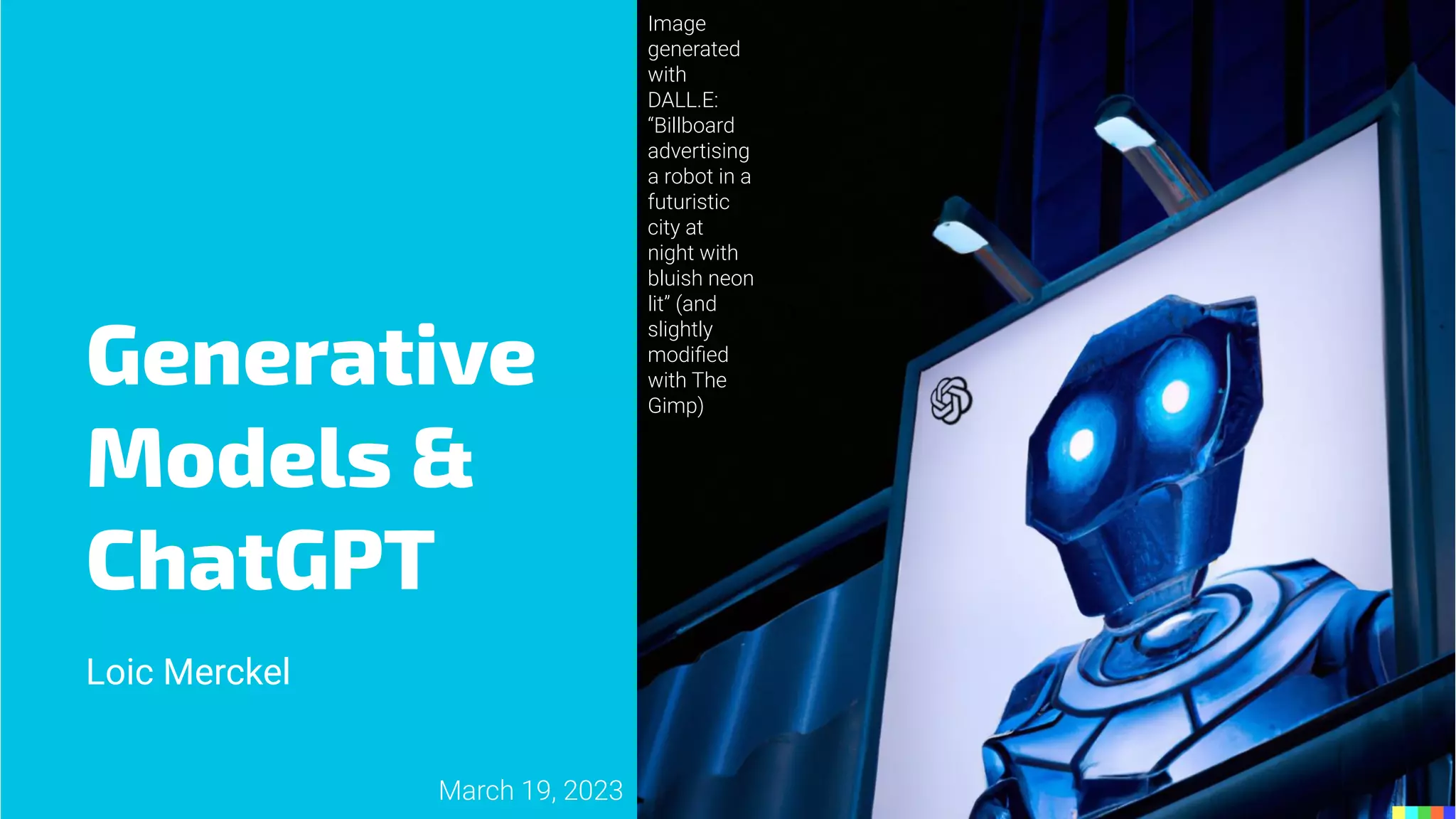
Image
generated
with
DALL.E:
“Billboard
advertising
a robot in a
futuristic
city at
night with
bluish neon
lit” (and
slightly
modified
with The
Gimp)
March 19, 2023
Generative Models
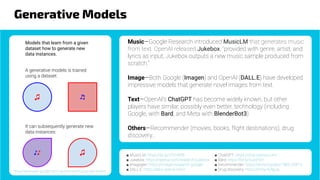
Models that learn from a given
dataset how to generate new
data instances.
https://developers.google.com/machine-learning/gan/generative
♫ ♬
♪♪
A generative models is trained
using a dataset:
It can subsequently generate new
data instances:
♫
Music—Google Research introduced MusicLM that generates music
from text. OpenAI released Jukebox, “provided with genre, artist, and
lyrics as input, Jukebox outputs a new music sample produced from
scratch.”
Image—Both Google (Imagen) and OpenAI (DALL.E) have developed
impressive models that generate novel images from text.
Text—OpenAI’s ChatGPT has become widely known, but other
players have similar, possibly even better, technology (including
Google, with Bard, and Meta with BlenderBot3).
Others—Recommender (movies, books, flight destinations), drug
discovery…
■ ChatGPT: https://chat.openai.com/
■ Bard: https://bit.ly/3JpiFkH
■ Recommender: https://arxiv.org/abs/1802.05814
■ Drug discovery: https://bit.ly/42lguaj
■ MusicLM: https://bit.ly/3Tm4Rfk
■ Jukebox: https://openai.com/research/jukebox
■ Imagegen: https://imagen.research.google/
■ DALL.E: https://labs.openai.com/
Discriminative vs. Generative Models
GLM, GBM, SVM, RF, Feedforward ANN, … GMM, VAE, GAN, Transformers …
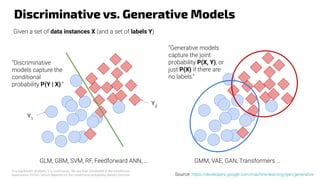
Given a set of data instances X (and a set of labels Y)
“Discriminative
models capture the
conditional
probability P(Y | X).”
“Generative models
capture the joint
probability P(X, Y), or
just P(X) if there are
no labels.”
Source: https://developers.google.com/machine-learning/gan/generative
Y1
Y2
In a regression analysis, Y is continuous. We are then interested in the conditional
expectation E(Y|X)—which depends on the conditional probability density function.
Discriminative Model: 2016 Olympics Athletes
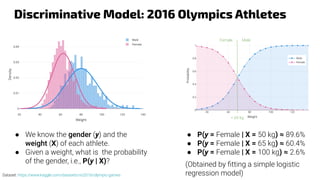
● We know the gender (y) and the
weight (X) of each athlete.
● Given a weight, what is the probability
of the gender, i.e., P(y | X)?
● P(y = Female | X = 50 kg) ≈ 89.6%
● P(y = Female | X = 65 kg) ≈ 60.4%
● P(y = Female | X = 100 kg) ≈ 2.6%
(Obtained by fitting a simple logistic
regression model)
Dataset: https://www.kaggle.com/datasets/rio2016/olympic-games
≈ 69 kg
Female Male
Generative Model: 2016 Olympics Athletes
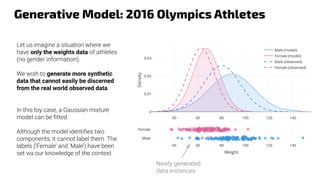
Let us imagine a situation where we
have only the weights data of athletes
(no gender information).
We wish to generate more synthetic
data that cannot easily be discerned
from the real world observed data.
In this toy case, a Gaussian mixture
model can be fitted.
Although the model identifies two
components, it cannot label them. The
labels (‘Female’ and ‘Male’) have been
set via our knowledge of the context.
Newly generated
data instances
Text Generation
Models
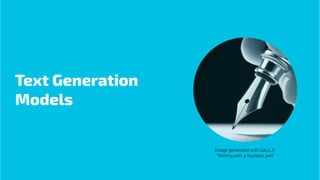
Image generated with DALL.E:
“Writing with a fountain pen”
1966: ELIZA
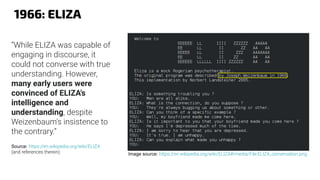
Image source: https://en.wikipedia.org/wiki/ELIZA#/media/File:ELIZA_conversation.png
“While ELIZA was capable of
engaging in discourse, it
could not converse with true
understanding. However,
many early users were
convinced of ELIZA's
intelligence and
understanding, despite
Weizenbaum's insistence to
the contrary.”
Source: https://en.wikipedia.org/wiki/ELIZA
(and references therein).
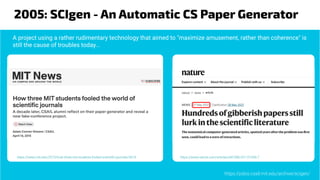
2005: SCIgen - An Automatic CS Paper Generator
https://www.nature.com/articles/d41586-021-01436-7
https://news.mit.edu/2015/how-three-mit-students-fooled-scientific-journals-0414
A project using a rather rudimentary technology that aimed to "maximize amusement, rather than coherence" is
still the cause of troubles today...
https://pdos.csail.mit.edu/archive/scigen/
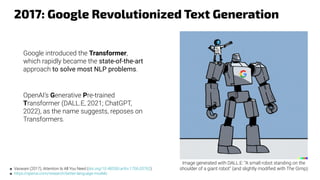
2017: Google Revolutionized Text Generation
■ Vaswani (2017), Attention Is All You Need (doi.org/10.48550/arXiv.1706.03762)
■ https://openai.com/research/better-language-models
Image generated with DALL.E: “A small robot standing on the
shoulder of a giant robot” (and slightly modified with The Gimp)
OpenAI’s Generative Pre-trained
Transformer (DALL.E, 2021; ChatGPT,
2022), as the name suggests, reposes on
Transformers.
Google introduced the Transformer,
which rapidly became the state-of-the-art
approach to solve most NLP problems.
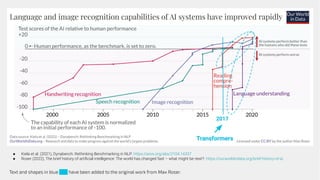
● Kiela et al. (2021), Dynabench: Rethinking Benchmarking in NLP: https://arxiv.org/abs/2104.14337
● Roser (2022), The brief history of artificial intelligence: The world has changed fast – what might be next?: https://ourworldindata.org/brief-history-of-ai
Transformers
2017
Text and shapes in blue have been added to the original work from Max Roser.
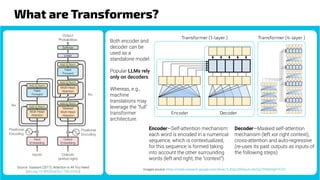
What are Transformers?
Images source: https://colab.research.google.com/drive/1L42pL04PbauS-nNzVg7IYNtrK0pFYCGY
Encoder Decoder
Encoder—Self-attention mechanism:
each word is encoded in a numerical
sequence, which is contextualized,
for this sequence is formed taking
into account the other surrounding
words (left and right, the “context”).
Decoder—Masked self-attention
mechanism (left xor right context),
cross-attention and auto-regressive
(re-uses its past outputs as inputs of
the following steps)
Transformer (1-layer ) Transformer (4-layer )
Both encoder and
decoder can be
used as a
standalone model.
Popular LLMs rely
only on decoders.
Whereas, e.g.,
machine
translations may
leverage the “full”
transformer
architecture.
Source: Vaswani (2017), Attention Is All You Need
(doi.org/10.48550/arXiv.1706.03762)
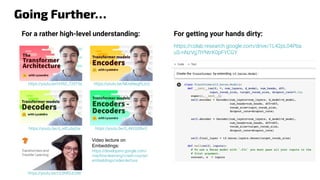
Going Further…
https://youtu.be/LE3NfEULV6k
For a rather high-level understanding: For getting your hands dirty:
https://colab.research.google.com/drive/1L42pL04Pba
uS-nNzVg7IYNtrK0pFYCGY
https://youtu.be/H39Z_720T5s https://youtu.be/MUqNwgPjJvQ
https://youtu.be/d_ixlCubqQw https://youtu.be/0_4KEb08xrE
Video lecture on
Embeddings:
https://developers.google.com/
machine-learning/crash-course/
embeddings/video-lecture
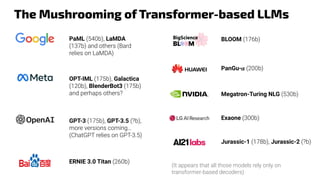
The Mushrooming of Transformer-based LLMs
PaML (540b), LaMDA
(137b) and others (Bard
relies on LaMDA)
OPT-IML (175b), Galactica
(120b), BlenderBot3 (175b)
and perhaps others?
ERNIE 3.0 Titan (260b)
GPT-3 (175b), GPT-3.5 (?b),
more versions coming…
(ChatGPT relies on GPT-3.5)
BLOOM (176b)
PanGu-𝛼 (200b)
Jurassic-1 (178b), Jurassic-2 (?b)
Exaone (300b)
Megatron-Turing NLG (530b)
(It appears that all those models rely only on
transformer-based decoders)
ChatGPT
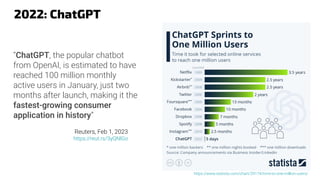
2022: ChatGPT
“ChatGPT, the popular chatbot
from OpenAI, is estimated to have
reached 100 million monthly
active users in January, just two
months after launch, making it the
fastest-growing consumer
application in history”
https://www.statista.com/chart/29174/time-to-one-million-users/
Reuters, Feb 1, 2023
https://reut.rs/3yQNlGo
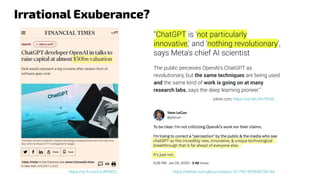
“ChatGPT is 'not particularly
innovative,' and 'nothing revolutionary',
says Meta's chief AI scientist
The public perceives OpenAI's ChatGPT as
revolutionary, but the same techniques are being used
and the same kind of work is going on at many
research labs, says the deep learning pioneer.”
Irrational Exuberance?
https://twitter.com/ylecun/status/1617921903934726144
https://on.ft.com/3JRPM22
zdnet.com, https://zd.net/3mTlOS0
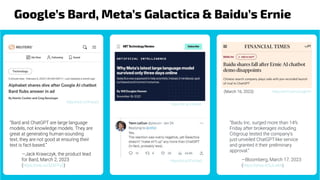
Google’s Bard, Meta’s Galactica & Baidu’s Ernie
https://bit.ly/3Jnt404
https://bit.ly/3TnLRwS
https://reut.rs/3FvarpQ
“Bard and ChatGPT are large language
models, not knowledge models. They are
great at generating human-sounding
text, they are not good at ensuring their
text is fact-based.”
—Jack Krawczyk, the product lead
for Bard, March 2, 2023
(https://cnb.cx/3ZXFFy3)
https://on.ft.com/3JogEVH
(March 16, 2023)
“Baidu Inc. surged more than 14%
Friday after brokerages including
Citigroup tested the company’s
just-unveiled ChatGPT-like service
and granted it their preliminary
approval.”
—Bloomberg, March 17, 2023
(https://yhoo.it/3JLxAXI)
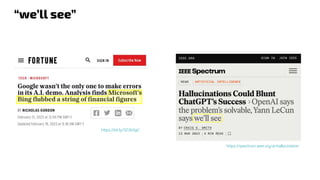
“we’ll see”
https://bit.ly/3Z365gC
https://spectrum.ieee.org/ai-hallucination
Except where otherwise noted, this work is licensed under
https://creativecommons.org/licenses/by/4.0/
619.io

Generative Models and ChatGPT

  • 1.
    Generative Models & ChatGPT Loic Merckel Image generated with DALL.E: “Billboard advertising arobot in a futuristic city at night with bluish neon lit” (and slightly modified with The Gimp) March 19, 2023
  • 2.
    Generative Models Models thatlearn from a given dataset how to generate new data instances. https://developers.google.com/machine-learning/gan/generative ♫ ♬ ♪♪ A generative models is trained using a dataset: It can subsequently generate new data instances: ♫ Music—Google Research introduced MusicLM that generates music from text. OpenAI released Jukebox, “provided with genre, artist, and lyrics as input, Jukebox outputs a new music sample produced from scratch.” Image—Both Google (Imagen) and OpenAI (DALL.E) have developed impressive models that generate novel images from text. Text—OpenAI’s ChatGPT has become widely known, but other players have similar, possibly even better, technology (including Google, with Bard, and Meta with BlenderBot3). Others—Recommender (movies, books, flight destinations), drug discovery… ■ ChatGPT: https://chat.openai.com/ ■ Bard: https://bit.ly/3JpiFkH ■ Recommender: https://arxiv.org/abs/1802.05814 ■ Drug discovery: https://bit.ly/42lguaj ■ MusicLM: https://bit.ly/3Tm4Rfk ■ Jukebox: https://openai.com/research/jukebox ■ Imagegen: https://imagen.research.google/ ■ DALL.E: https://labs.openai.com/
  • 3.
    Discriminative vs. GenerativeModels GLM, GBM, SVM, RF, Feedforward ANN, … GMM, VAE, GAN, Transformers … Given a set of data instances X (and a set of labels Y) “Discriminative models capture the conditional probability P(Y | X).” “Generative models capture the joint probability P(X, Y), or just P(X) if there are no labels.” Source: https://developers.google.com/machine-learning/gan/generative Y1 Y2 In a regression analysis, Y is continuous. We are then interested in the conditional expectation E(Y|X)—which depends on the conditional probability density function.
  • 4.
    Discriminative Model: 2016Olympics Athletes ● We know the gender (y) and the weight (X) of each athlete. ● Given a weight, what is the probability of the gender, i.e., P(y | X)? ● P(y = Female | X = 50 kg) ≈ 89.6% ● P(y = Female | X = 65 kg) ≈ 60.4% ● P(y = Female | X = 100 kg) ≈ 2.6% (Obtained by fitting a simple logistic regression model) Dataset: https://www.kaggle.com/datasets/rio2016/olympic-games ≈ 69 kg Female Male
  • 5.
    Generative Model: 2016Olympics Athletes Let us imagine a situation where we have only the weights data of athletes (no gender information). We wish to generate more synthetic data that cannot easily be discerned from the real world observed data. In this toy case, a Gaussian mixture model can be fitted. Although the model identifies two components, it cannot label them. The labels (‘Female’ and ‘Male’) have been set via our knowledge of the context. Newly generated data instances
  • 6.
    Text Generation Models Image generatedwith DALL.E: “Writing with a fountain pen”
  • 7.
    1966: ELIZA Image source:https://en.wikipedia.org/wiki/ELIZA#/media/File:ELIZA_conversation.png “While ELIZA was capable of engaging in discourse, it could not converse with true understanding. However, many early users were convinced of ELIZA's intelligence and understanding, despite Weizenbaum's insistence to the contrary.” Source: https://en.wikipedia.org/wiki/ELIZA (and references therein).
  • 8.
    2005: SCIgen -An Automatic CS Paper Generator https://www.nature.com/articles/d41586-021-01436-7 https://news.mit.edu/2015/how-three-mit-students-fooled-scientific-journals-0414 A project using a rather rudimentary technology that aimed to "maximize amusement, rather than coherence" is still the cause of troubles today... https://pdos.csail.mit.edu/archive/scigen/
  • 9.
    2017: Google RevolutionizedText Generation ■ Vaswani (2017), Attention Is All You Need (doi.org/10.48550/arXiv.1706.03762) ■ https://openai.com/research/better-language-models Image generated with DALL.E: “A small robot standing on the shoulder of a giant robot” (and slightly modified with The Gimp) OpenAI’s Generative Pre-trained Transformer (DALL.E, 2021; ChatGPT, 2022), as the name suggests, reposes on Transformers. Google introduced the Transformer, which rapidly became the state-of-the-art approach to solve most NLP problems.
  • 10.
    ● Kiela etal. (2021), Dynabench: Rethinking Benchmarking in NLP: https://arxiv.org/abs/2104.14337 ● Roser (2022), The brief history of artificial intelligence: The world has changed fast – what might be next?: https://ourworldindata.org/brief-history-of-ai Transformers 2017 Text and shapes in blue have been added to the original work from Max Roser.
  • 11.
    What are Transformers? Imagessource: https://colab.research.google.com/drive/1L42pL04PbauS-nNzVg7IYNtrK0pFYCGY Encoder Decoder Encoder—Self-attention mechanism: each word is encoded in a numerical sequence, which is contextualized, for this sequence is formed taking into account the other surrounding words (left and right, the “context”). Decoder—Masked self-attention mechanism (left xor right context), cross-attention and auto-regressive (re-uses its past outputs as inputs of the following steps) Transformer (1-layer ) Transformer (4-layer ) Both encoder and decoder can be used as a standalone model. Popular LLMs rely only on decoders. Whereas, e.g., machine translations may leverage the “full” transformer architecture. Source: Vaswani (2017), Attention Is All You Need (doi.org/10.48550/arXiv.1706.03762)
  • 12.
    Going Further… https://youtu.be/LE3NfEULV6k For arather high-level understanding: For getting your hands dirty: https://colab.research.google.com/drive/1L42pL04Pba uS-nNzVg7IYNtrK0pFYCGY https://youtu.be/H39Z_720T5s https://youtu.be/MUqNwgPjJvQ https://youtu.be/d_ixlCubqQw https://youtu.be/0_4KEb08xrE Video lecture on Embeddings: https://developers.google.com/ machine-learning/crash-course/ embeddings/video-lecture
  • 13.
    The Mushrooming ofTransformer-based LLMs PaML (540b), LaMDA (137b) and others (Bard relies on LaMDA) OPT-IML (175b), Galactica (120b), BlenderBot3 (175b) and perhaps others? ERNIE 3.0 Titan (260b) GPT-3 (175b), GPT-3.5 (?b), more versions coming… (ChatGPT relies on GPT-3.5) BLOOM (176b) PanGu-𝛼 (200b) Jurassic-1 (178b), Jurassic-2 (?b) Exaone (300b) Megatron-Turing NLG (530b) (It appears that all those models rely only on transformer-based decoders)
  • 14.
  • 15.
    2022: ChatGPT “ChatGPT, thepopular chatbot from OpenAI, is estimated to have reached 100 million monthly active users in January, just two months after launch, making it the fastest-growing consumer application in history” https://www.statista.com/chart/29174/time-to-one-million-users/ Reuters, Feb 1, 2023 https://reut.rs/3yQNlGo
  • 16.
    “ChatGPT is 'notparticularly innovative,' and 'nothing revolutionary', says Meta's chief AI scientist The public perceives OpenAI's ChatGPT as revolutionary, but the same techniques are being used and the same kind of work is going on at many research labs, says the deep learning pioneer.” Irrational Exuberance? https://twitter.com/ylecun/status/1617921903934726144 https://on.ft.com/3JRPM22 zdnet.com, https://zd.net/3mTlOS0
  • 17.
    Google’s Bard, Meta’sGalactica & Baidu’s Ernie https://bit.ly/3Jnt404 https://bit.ly/3TnLRwS https://reut.rs/3FvarpQ “Bard and ChatGPT are large language models, not knowledge models. They are great at generating human-sounding text, they are not good at ensuring their text is fact-based.” —Jack Krawczyk, the product lead for Bard, March 2, 2023 (https://cnb.cx/3ZXFFy3) https://on.ft.com/3JogEVH (March 16, 2023) “Baidu Inc. surged more than 14% Friday after brokerages including Citigroup tested the company’s just-unveiled ChatGPT-like service and granted it their preliminary approval.” —Bloomberg, March 17, 2023 (https://yhoo.it/3JLxAXI)
  • 18.
  • 19.
    Except where otherwisenoted, this work is licensed under https://creativecommons.org/licenses/by/4.0/ 619.io