DR. JUAN CARLOS BECERRA MARTÍNEZ
CÁTEDRA DE MEDICINA INTERNA-MC3087
Tecnológico de Monterrey
Campus Guadalajara
The Platelet
 Platelets are released from the megakaryocyte
 Normal blood platelet count is 150,000–450,000/L.
 The major regulator of platelet production is the hormone
thrombopoietin (TPO), which is synthesized in the liver.
 Synthesis is increased with inflammation and specifically
by interleukin 6.
 Thus a reduction in platelet and megakaryocyte mass
increases the level of TPO, which then stimulates platelet
production.
Harrison's Principles of Internal Medicine. 18th Ed.
The Platelet
 Platelets circulate with an average life span of 7 to
10 days.
 Approximately one-third of the platelets reside in
the spleen, and this number increases in proportion
to splenic size, although the platelet count rarely
decreases to <40,000/L as the spleen enlarges.
 Platelets are physiologically very active, but are
anucleate, and thus have limited capacity to
synthesize new proteins.
Harrison's Principles of Internal Medicine. 18th Ed.
The Platelet
 Normal vascular endothelium contributes to preventing
thrombosis
 When vascular endothelium is injured, these inhibitory
effects are overcome, and platelets adhere to the
exposed intimal surface primarily through VWF, a protein
present in:
 Plasma
 The extracellular matrix of the subendothelial vessel wall.
 Platelet adhesion results in the generation of intracellular
signals that lead to activation of the platelet glycoprotein
(Gp) IIb/IIIa receptor and resultant platelet aggregation.
Harrison's Principles of Internal Medicine. 18th Ed.
The Platelet
 Activated platelets undergo release of their granule
contents:
 Nucleotides,
 Adhesive proteins,
 Growth factors,
 Procoagulants
 …that serve to promote platelet aggregation and blood
clot formation and influence the environment of the
forming clot. During platelet aggregation, additional
platelets are recruited to the site of injury, leading to the
formation of an occlusive platelet thrombus. The platelet
plug is stabilized by the fibrin mesh that develops
simultaneously as the product of the coagulation
cascade.
Harrison's Principles of Internal Medicine. 18th Ed.
The Vessel Wall
 The endothelium normally presents an
antithrombotic surface but rapidly becomes
prothrombotic when stimulated, which promotes:
 Coagulation
 Inhibits fibrinolysis
 Activates platelets.
 In many cases, endothelium-derived vasodilators
are also platelet inhibitors (e.g., nitric oxide) and,
conversely, endothelium-derived vasoconstrictors
(e.g., endothelin) can also be platelet activators.
Harrison's Principles of Internal Medicine. 18th Ed.
Thrombocytopenia
 Thrombocytopenia results from one or more of three processes:
 (1) decreased bone marrow production:
○ Inherited
○ Acquired
 (2) sequestration, usually in an enlarged spleen;
 (3) increased platelet destruction.
 A key step is rule out "pseudothrombocytopenia”
 Is an in vitro artifact resulting from platelet agglutination via antibodies
(usually IgG, but also IgM and IgA) when the calcium content is
decreased by blood collection in ethylenediamine tetraacetic (EDTA)
[the anticoagulant present in tubes (purple top)
 A blood smear should be evaluated and a platelet count determined in
blood collected into sodium citrate (blue top tube) or heparin (green top
tube)
Harrison's Principles of Internal Medicine. 18th Ed.
Thrombocytopenia
Normal peripheral blood
Harrison's Principles of Internal Medicine. 18th Ed.
Thrombocytopenia
Platelet clumping in pseudothrombocytopenia
Harrison's Principles of Internal Medicine. 18th Ed.
Approach to the Patient:
Thrombocytopenia
Harrison's Principles of Internal Medicine. 18th Ed.
Infection-Induced
Thrombocytopenia
 Many viral and bacterial infections result in
thrombocytopenia and are the most common
noniatrogenic cause of thrombocytopenia.
 This may or may not be associated with
disseminated intravascular coagulation (DIC),
which is most commonly seen in patients with
systemic infections.
 Infections can affect both platelet production
and platelet survival.
Harrison's Principles of Internal Medicine. 18th Ed.
Drug-Induced
Thrombocytopenia
 Many drugs have been associated with
thrombocytopenia
 A helpful website, Platelets on the Internet
(http://www.ouhsc.edu/platelets/index.html)
 Classic drug-dependent antibodies are antibodies
that react with specific platelet surface antigens,
and result in thrombocytopenia only when the
drug is present (more common with quinine and
sulfonamides).
Harrison's Principles of Internal Medicine. 18th Ed.
Drug-Induced
Thrombocytopenia
 Drug-dependent antibody binding can be
demonstrated by laboratory assays,
showing antibody binding in the presence
of, but not without, the drug present in the
assay.
 The thrombocytopenia typically occurs after
a period of initial exposure (median length
21 days), or upon reexposure, and usually
resolves in 7–10 days after drug withdrawal.
Harrison's Principles of Internal Medicine. 18th Ed.
Drug-Induced
Thrombocytopenia
Harrison's Principles of Internal Medicine. 18th Ed.
Heparin-Induced Thrombocytopenia
 Drug-induced thrombocytopenia due to heparin differs
from that seen with other drugs in two major ways.
 (1) The thrombocytopenia is not usually severe, with nadir
counts rarely <20,000/L.
 (2) Heparin-induced thrombocytopenia (HIT) is not associated
with bleeding and, in fact, markedly increases the risk of
thrombosis.
 HIT results from antibody formation to a complex of the
platelet-specific protein platelet factor 4 (PF4) and heparin. The
antiheparin/PF4 antibody can activate platelets.
○ A fraction of those who develop antibodies will develop HIT,
and a portion of those (up to 50%) will develop thrombosis
(HITT).
Harrison's Principles of Internal Medicine. 18th Ed.
Heparin-Induced Thrombocytopenia
 HIT can occur after exposure to low-molecular-weight
heparin (LMWH) as well as unfractionated heparin
(UFH), although it is about 10 times more common with
the latter.
 Most patients develop HIT after exposure to heparin for
5–14 days.
 It occurs before 5 days in those who were exposed to
heparin in the prior few weeks or months (<~100 days)
and have circulating antiheparin/PF4 antibodies. Rarely,
thrombocytopenia and thrombosis begin several days
after all heparin has been stopped (termed delayed-
onset HIT).
Harrison's Principles of Internal Medicine. 18th Ed.
Heparin-Induced Thrombocytopenia
Harrison's Principles of Internal Medicine. 18th Ed.
Heparin-Induced Thrombocytopenia
 HIT (anti-heparin/PF4) antibodies can be
detected using two types of assays.
 (ELISA) with PF4/polyanion complex as the
antigen.
 Platelet activation assay
Harrison's Principles of Internal Medicine. 18th Ed.
Heparin-Induced Thrombocytopenia
 Treatment:
 Prompt discontinuation of heparin and use of
alternative anticoagulants (at least 1 month).
○ The direct thrombin inhibitors (DTIs): argatroban,
lepirudin, bivalirudin
○ Antithrombin drugs: fondaparinux
○ HIT antibodies cross-react with LMWH, and these
preparations should not be used in the treatment
of HIT.
Harrison's Principles of Internal Medicine. 18th Ed.
Immune Thrombocytopenic Purpura
(ITP)
 ITP: also termed idiopathic thrombocytopenic purpura
 Is an acquired disorder in which there is immune-
mediated destruction of platelets
 In children, it is usually an acute disease, most
commonly following an infection, and with a self-limited
course.
 In adults, it usually runs a more chronic course.
 ITP is termed secondary if it is associated with an
underlying disorder; autoimmune disorders, particularly
systemic lupus erythematosus (SLE), and infections,
such as HIV and hepatitis C, are common causes.
Harrison's Principles of Internal Medicine. 18th Ed.
Immune Thrombocytopenic Purpura
(ITP)
 ITP is characterized by:
 Mucocutaneous bleeding
 A low, often very low, platelet count
 Normal peripheral blood cells and smear.
 Ecchymoses and petechiae
Harrison's Principles of Internal Medicine. 18th Ed.
Immune Thrombocytopenic Purpura
(ITP)
 Antibodies (serologic testing) is usually not
helpful due to the low sensitivity and
specificity of the current tests.
 Evaluate for secondary causes of ITP:
 HIV, hepatitis C
 SLE
 Autoinmmune diseases
Harrison's Principles of Internal Medicine. 18th Ed.
Immune Thrombocytopenic Purpura
(ITP)
 Treatment:
 Prednisone at 1 mg/kg
 Rh0(D) immune globulin therapy (WinRho SDF), at 50–75 g/kg (only
in Rh-positive patients!)
 Intravenous gamma globulin (IVIgG), is dosed at 2 g/kg total, given in
divided doses over 2–5 days.
 Rituximab, an anti-CD20 (B cell) antibody, in refractory ITP.
 Splenectomy has been used for treatment of patients who relapse
after glucocorticoids are tapered
 Thrombopoietin receptor agonists are now available:
○ Romiplostim and eltrombopag
Harrison's Principles of Internal Medicine. 18th Ed.
Inherited Thrombocytopenia
 Thrombocytopenia is rarely inherited
 May be inherited in an autosomal dominant,
autosomal recessive, or X-linked pattern.
 Autosomal dominant thrombocytopenia:
○ May-Hegglin anomaly, and Sebastian,
Epstein's, and Fechtner syndromes,
○ A common feature of these disorders is large
platelets (Fig. 115-1C).
Harrison's Principles of Internal Medicine. 18th Ed.
Inherited Thrombocytopenia
Abnormal large platelet in autosomal dominant macrothrombocytopenia.
Harrison's Principles of Internal Medicine. 18th Ed.
Inherited Thrombocytopenia
 Autosomal recessive disorders:
 Congenital amegakaryocytic thrombocytopenia
 Thrombocytopenia with absent radii
 Bernard Soulier syndrome: due to absence of
GPIb-IX-V, the VWF adhesion receptor.
 X-linked disorders
 Include Wiskott-Aldrich syndrome and a
dyshematopoietic syndrome
Harrison's Principles of Internal Medicine. 18th Ed.
Thrombotic Thrombocytopenic
Purpura and Hemolytic Uremic
Syndrome
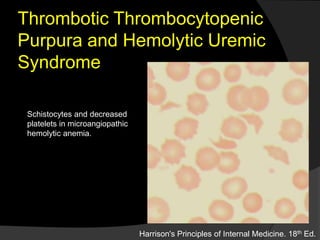
 Thrombotic thrombocytopenic microangiopathies:
 Are a group of disorders characterized by
thrombocytopenia, a microangiopathic hemolytic anemia
evident by fragmented RBCs and laboratory evidence of
hemolysis, and microvascular thrombosis.
 They include thrombotic thrombocytopenic purpura
(TTP) and hemolytic uremic syndrome (HUS).
Harrison's Principles of Internal Medicine. 18th Ed.
Thrombotic Thrombocytopenic
Purpura and Hemolytic Uremic
Syndrome
Schistocytes and decreased
platelets in microangiopathic
hemolytic anemia.
Harrison's Principles of Internal Medicine. 18th Ed.
Thrombotic Thrombocytopenic
Purpura (TTP)
 TTP has a pentad of findings:
 Microangiopathic hemolytic anemia
 Thrombocytopenia
 Renal failure
 Neurologic findings,
 Fever.
Harrison's Principles of Internal Medicine. 18th Ed.
Thrombotic Thrombocytopenic
Purpura (TTP)
 Antibodies to the metalloprotease
ADAMTS13, that cleaves VWF.
 The persistence of ultra-large VWF molecules
contribute to pathogenic platelet adhesion and
aggregation
 The level of ADAMTS13 activity, as well as
antibodies, can now be detected by
laboratory assays.
Harrison's Principles of Internal Medicine. 18th Ed.
Thrombotic Thrombocytopenic
Purpura (TTP)
Harrison's Principles of Internal Medicine. 18th Ed.
Thrombotic Thrombocytopenic
Purpura (TTP)
 Antibodies to the metalloprotease
ADAMTS13, that cleaves VWF.
 The persistence of ultra-large VWF molecules
contribute to pathogenic platelet adhesion and
aggregation
 The level of ADAMTS13 activity, as well as
antibodies, can now be detected by
laboratory assays.
Harrison's Principles of Internal Medicine. 18th Ed.
Thrombotic Thrombocytopenic
Purpura (TTP)
 Inherited TTP: Upshaw-Schulman syndrome
 Secondary TTP:
 HIV infection
 Pregnant women.
 Medication-related: ticlopidine, clopidogrel,
cyclosporine, mitomycin C, tacrolimus, quinine)
Harrison's Principles of Internal Medicine. 18th Ed.
Thrombotic Thrombocytopenic
Purpura (TTP)
 Treatment:
 TTP is a devastating disease if not diagnosed and
treated promptly.
 Plasma exchange remains the mainstay of
treatment of TTP.
 Glucocorticoids as an adjunct therapy
 Rituximab: under investigation
Harrison's Principles of Internal Medicine. 18th Ed.
Hemolytic Uremic
Syndrome
 HUS is a syndrome characterized by:
 Acute renal failure
 Microangiopathic hemolytic anemia
 Thrombocytopenia.
 It is seen predominantly in children and in
most cases is preceded by an episode of
diarrhea, often hemorrhagic in nature.
Escherichia coli O157:H7 is the most
frequent, although not only, etiologic serotype.
Harrison's Principles of Internal Medicine. 18th Ed.
Hemolytic Uremic
Syndrome
 Treatment of HUS is primarily supportive.
 Dialysis
 Plasma exchange has not been shown to alter the
overall course.
Harrison's Principles of Internal Medicine. 18th Ed.
Thromobcytosis
 Thrombocytosis is almost always due either
to
 (1) Iron deficiency;
 (2) Inflammation, cancer, or infection (reactive
thrombocytosis);
 (3) An underlying myeloproliferative process
[essential thrombocythemia or polycythemia vera)
 >1.5 million = myeloproliferative disorder
Harrison's Principles of Internal Medicine. 18th Ed.
Qualitative Disorders of Platelet
Function
 Inherited:
 Relatively rare,
 Autosomal recessive disorders:
○ Glanzmann's thrombasthenia (absence of the platelet
GpIIbIIIa receptor)
○ Bernard Soulier syndrome (absence of the platelet GpIb-
IX-V receptor).
 Autosomal dominant disorders:
○ Platelet storage pool disorder (SPD): abnormalities of
platelet granule formation.
 Bleeding symptoms are usually mild in nature.
Harrison's Principles of Internal Medicine. 18th Ed.
Qualitative Disorders of Platelet
Function
 Inherited:
 Platelet transfusion if severe
 Milder bleeding symptoms frequently respond to
desmopressin (increases plasma VWF and FVIII
levels; it may also have a direct effect on platelet
function).
Harrison's Principles of Internal Medicine. 18th Ed.
Qualitative Disorders of Platelet
Function
 Acquired:
 Medications (antiplatelet therapy, penicillins).
 Uremia.
 Cardiopulmonary bypass due to the effect of the
artificial circuit on platelets
Harrison's Principles of Internal Medicine. 18th Ed.
von Willebrand Disease
 VWD is the most common inherited bleeding
disorder.
 Prevalence of 1%,
 VWF serves two roles:
○ (1) as the major adhesion molecule to subendothelium
○ (2) as the binding protein for FVIII, resulting in significant
prolongation of the FVIII half-life in circulation.
○ The platelet-adhesive function of VWF is critically dependent on
the presence of large VWF multimers, while FVIII binding is not.
○ Most of the symptoms of VWD are "platelet-like" except in more
severe VWD when the FVIII is low enough to produce
symptoms similar to those found in Factor VIII deficiency
(hemophilia A).
Harrison's Principles of Internal Medicine. 18th Ed.
von Willebrand Disease
 VWD has been classified into three major types,
with four subtypes of type 2
 The most common type of VWD is type 1
disease (80% of cases).
 Patients have predominantly mucosal bleeding
symptoms
 Menorrhagia is a common manifestation of VWD.
Menstrual bleeding resulting in anemia should warrant
an evaluation for VWD and, if negative, functional
platelet disorders.
Harrison's Principles of Internal Medicine. 18th Ed.
von Willebrand Disease
Harrison's Principles of Internal Medicine. 18th Ed.
von Willebrand Disease
Sabatine, MS. Pocket Medicine. 4th Ed.
Disorders of Platelets

Disorders of Platelets

  • 1.
    DR. JUAN CARLOSBECERRA MARTÍNEZ CÁTEDRA DE MEDICINA INTERNA-MC3087 Tecnológico de Monterrey Campus Guadalajara
  • 2.
    The Platelet  Plateletsare released from the megakaryocyte  Normal blood platelet count is 150,000–450,000/L.  The major regulator of platelet production is the hormone thrombopoietin (TPO), which is synthesized in the liver.  Synthesis is increased with inflammation and specifically by interleukin 6.  Thus a reduction in platelet and megakaryocyte mass increases the level of TPO, which then stimulates platelet production. Harrison's Principles of Internal Medicine. 18th Ed.
  • 3.
    The Platelet  Plateletscirculate with an average life span of 7 to 10 days.  Approximately one-third of the platelets reside in the spleen, and this number increases in proportion to splenic size, although the platelet count rarely decreases to <40,000/L as the spleen enlarges.  Platelets are physiologically very active, but are anucleate, and thus have limited capacity to synthesize new proteins. Harrison's Principles of Internal Medicine. 18th Ed.
  • 4.
    The Platelet  Normalvascular endothelium contributes to preventing thrombosis  When vascular endothelium is injured, these inhibitory effects are overcome, and platelets adhere to the exposed intimal surface primarily through VWF, a protein present in:  Plasma  The extracellular matrix of the subendothelial vessel wall.  Platelet adhesion results in the generation of intracellular signals that lead to activation of the platelet glycoprotein (Gp) IIb/IIIa receptor and resultant platelet aggregation. Harrison's Principles of Internal Medicine. 18th Ed.
  • 5.
    The Platelet  Activatedplatelets undergo release of their granule contents:  Nucleotides,  Adhesive proteins,  Growth factors,  Procoagulants  …that serve to promote platelet aggregation and blood clot formation and influence the environment of the forming clot. During platelet aggregation, additional platelets are recruited to the site of injury, leading to the formation of an occlusive platelet thrombus. The platelet plug is stabilized by the fibrin mesh that develops simultaneously as the product of the coagulation cascade. Harrison's Principles of Internal Medicine. 18th Ed.
  • 6.
    The Vessel Wall The endothelium normally presents an antithrombotic surface but rapidly becomes prothrombotic when stimulated, which promotes:  Coagulation  Inhibits fibrinolysis  Activates platelets.  In many cases, endothelium-derived vasodilators are also platelet inhibitors (e.g., nitric oxide) and, conversely, endothelium-derived vasoconstrictors (e.g., endothelin) can also be platelet activators. Harrison's Principles of Internal Medicine. 18th Ed.
  • 7.
    Thrombocytopenia  Thrombocytopenia resultsfrom one or more of three processes:  (1) decreased bone marrow production: ○ Inherited ○ Acquired  (2) sequestration, usually in an enlarged spleen;  (3) increased platelet destruction.  A key step is rule out "pseudothrombocytopenia”  Is an in vitro artifact resulting from platelet agglutination via antibodies (usually IgG, but also IgM and IgA) when the calcium content is decreased by blood collection in ethylenediamine tetraacetic (EDTA) [the anticoagulant present in tubes (purple top)  A blood smear should be evaluated and a platelet count determined in blood collected into sodium citrate (blue top tube) or heparin (green top tube) Harrison's Principles of Internal Medicine. 18th Ed.
  • 8.
    Thrombocytopenia Normal peripheral blood Harrison'sPrinciples of Internal Medicine. 18th Ed.
  • 9.
    Thrombocytopenia Platelet clumping inpseudothrombocytopenia Harrison's Principles of Internal Medicine. 18th Ed.
  • 10.
    Approach to thePatient: Thrombocytopenia Harrison's Principles of Internal Medicine. 18th Ed.
  • 11.
    Infection-Induced Thrombocytopenia  Many viraland bacterial infections result in thrombocytopenia and are the most common noniatrogenic cause of thrombocytopenia.  This may or may not be associated with disseminated intravascular coagulation (DIC), which is most commonly seen in patients with systemic infections.  Infections can affect both platelet production and platelet survival. Harrison's Principles of Internal Medicine. 18th Ed.
  • 12.
    Drug-Induced Thrombocytopenia  Many drugshave been associated with thrombocytopenia  A helpful website, Platelets on the Internet (http://www.ouhsc.edu/platelets/index.html)  Classic drug-dependent antibodies are antibodies that react with specific platelet surface antigens, and result in thrombocytopenia only when the drug is present (more common with quinine and sulfonamides). Harrison's Principles of Internal Medicine. 18th Ed.
  • 13.
    Drug-Induced Thrombocytopenia  Drug-dependent antibodybinding can be demonstrated by laboratory assays, showing antibody binding in the presence of, but not without, the drug present in the assay.  The thrombocytopenia typically occurs after a period of initial exposure (median length 21 days), or upon reexposure, and usually resolves in 7–10 days after drug withdrawal. Harrison's Principles of Internal Medicine. 18th Ed.
  • 14.
  • 15.
    Heparin-Induced Thrombocytopenia  Drug-inducedthrombocytopenia due to heparin differs from that seen with other drugs in two major ways.  (1) The thrombocytopenia is not usually severe, with nadir counts rarely <20,000/L.  (2) Heparin-induced thrombocytopenia (HIT) is not associated with bleeding and, in fact, markedly increases the risk of thrombosis.  HIT results from antibody formation to a complex of the platelet-specific protein platelet factor 4 (PF4) and heparin. The antiheparin/PF4 antibody can activate platelets. ○ A fraction of those who develop antibodies will develop HIT, and a portion of those (up to 50%) will develop thrombosis (HITT). Harrison's Principles of Internal Medicine. 18th Ed.
  • 16.
    Heparin-Induced Thrombocytopenia  HITcan occur after exposure to low-molecular-weight heparin (LMWH) as well as unfractionated heparin (UFH), although it is about 10 times more common with the latter.  Most patients develop HIT after exposure to heparin for 5–14 days.  It occurs before 5 days in those who were exposed to heparin in the prior few weeks or months (<~100 days) and have circulating antiheparin/PF4 antibodies. Rarely, thrombocytopenia and thrombosis begin several days after all heparin has been stopped (termed delayed- onset HIT). Harrison's Principles of Internal Medicine. 18th Ed.
  • 17.
  • 18.
    Heparin-Induced Thrombocytopenia  HIT(anti-heparin/PF4) antibodies can be detected using two types of assays.  (ELISA) with PF4/polyanion complex as the antigen.  Platelet activation assay Harrison's Principles of Internal Medicine. 18th Ed.
  • 19.
    Heparin-Induced Thrombocytopenia  Treatment: Prompt discontinuation of heparin and use of alternative anticoagulants (at least 1 month). ○ The direct thrombin inhibitors (DTIs): argatroban, lepirudin, bivalirudin ○ Antithrombin drugs: fondaparinux ○ HIT antibodies cross-react with LMWH, and these preparations should not be used in the treatment of HIT. Harrison's Principles of Internal Medicine. 18th Ed.
  • 20.
    Immune Thrombocytopenic Purpura (ITP) ITP: also termed idiopathic thrombocytopenic purpura  Is an acquired disorder in which there is immune- mediated destruction of platelets  In children, it is usually an acute disease, most commonly following an infection, and with a self-limited course.  In adults, it usually runs a more chronic course.  ITP is termed secondary if it is associated with an underlying disorder; autoimmune disorders, particularly systemic lupus erythematosus (SLE), and infections, such as HIV and hepatitis C, are common causes. Harrison's Principles of Internal Medicine. 18th Ed.
  • 21.
    Immune Thrombocytopenic Purpura (ITP) ITP is characterized by:  Mucocutaneous bleeding  A low, often very low, platelet count  Normal peripheral blood cells and smear.  Ecchymoses and petechiae Harrison's Principles of Internal Medicine. 18th Ed.
  • 22.
    Immune Thrombocytopenic Purpura (ITP) Antibodies (serologic testing) is usually not helpful due to the low sensitivity and specificity of the current tests.  Evaluate for secondary causes of ITP:  HIV, hepatitis C  SLE  Autoinmmune diseases Harrison's Principles of Internal Medicine. 18th Ed.
  • 23.
    Immune Thrombocytopenic Purpura (ITP) Treatment:  Prednisone at 1 mg/kg  Rh0(D) immune globulin therapy (WinRho SDF), at 50–75 g/kg (only in Rh-positive patients!)  Intravenous gamma globulin (IVIgG), is dosed at 2 g/kg total, given in divided doses over 2–5 days.  Rituximab, an anti-CD20 (B cell) antibody, in refractory ITP.  Splenectomy has been used for treatment of patients who relapse after glucocorticoids are tapered  Thrombopoietin receptor agonists are now available: ○ Romiplostim and eltrombopag Harrison's Principles of Internal Medicine. 18th Ed.
  • 24.
    Inherited Thrombocytopenia  Thrombocytopeniais rarely inherited  May be inherited in an autosomal dominant, autosomal recessive, or X-linked pattern.  Autosomal dominant thrombocytopenia: ○ May-Hegglin anomaly, and Sebastian, Epstein's, and Fechtner syndromes, ○ A common feature of these disorders is large platelets (Fig. 115-1C). Harrison's Principles of Internal Medicine. 18th Ed.
  • 25.
    Inherited Thrombocytopenia Abnormal largeplatelet in autosomal dominant macrothrombocytopenia. Harrison's Principles of Internal Medicine. 18th Ed.
  • 26.
    Inherited Thrombocytopenia  Autosomalrecessive disorders:  Congenital amegakaryocytic thrombocytopenia  Thrombocytopenia with absent radii  Bernard Soulier syndrome: due to absence of GPIb-IX-V, the VWF adhesion receptor.  X-linked disorders  Include Wiskott-Aldrich syndrome and a dyshematopoietic syndrome Harrison's Principles of Internal Medicine. 18th Ed.
  • 27.
    Thrombotic Thrombocytopenic Purpura andHemolytic Uremic Syndrome  Thrombotic thrombocytopenic microangiopathies:  Are a group of disorders characterized by thrombocytopenia, a microangiopathic hemolytic anemia evident by fragmented RBCs and laboratory evidence of hemolysis, and microvascular thrombosis.  They include thrombotic thrombocytopenic purpura (TTP) and hemolytic uremic syndrome (HUS). Harrison's Principles of Internal Medicine. 18th Ed.
  • 28.
    Thrombotic Thrombocytopenic Purpura andHemolytic Uremic Syndrome Schistocytes and decreased platelets in microangiopathic hemolytic anemia. Harrison's Principles of Internal Medicine. 18th Ed.
  • 29.
    Thrombotic Thrombocytopenic Purpura (TTP) TTP has a pentad of findings:  Microangiopathic hemolytic anemia  Thrombocytopenia  Renal failure  Neurologic findings,  Fever. Harrison's Principles of Internal Medicine. 18th Ed.
  • 30.
    Thrombotic Thrombocytopenic Purpura (TTP) Antibodies to the metalloprotease ADAMTS13, that cleaves VWF.  The persistence of ultra-large VWF molecules contribute to pathogenic platelet adhesion and aggregation  The level of ADAMTS13 activity, as well as antibodies, can now be detected by laboratory assays. Harrison's Principles of Internal Medicine. 18th Ed.
  • 31.
    Thrombotic Thrombocytopenic Purpura (TTP) Harrison'sPrinciples of Internal Medicine. 18th Ed.
  • 32.
    Thrombotic Thrombocytopenic Purpura (TTP) Antibodies to the metalloprotease ADAMTS13, that cleaves VWF.  The persistence of ultra-large VWF molecules contribute to pathogenic platelet adhesion and aggregation  The level of ADAMTS13 activity, as well as antibodies, can now be detected by laboratory assays. Harrison's Principles of Internal Medicine. 18th Ed.
  • 33.
    Thrombotic Thrombocytopenic Purpura (TTP) Inherited TTP: Upshaw-Schulman syndrome  Secondary TTP:  HIV infection  Pregnant women.  Medication-related: ticlopidine, clopidogrel, cyclosporine, mitomycin C, tacrolimus, quinine) Harrison's Principles of Internal Medicine. 18th Ed.
  • 34.
    Thrombotic Thrombocytopenic Purpura (TTP) Treatment:  TTP is a devastating disease if not diagnosed and treated promptly.  Plasma exchange remains the mainstay of treatment of TTP.  Glucocorticoids as an adjunct therapy  Rituximab: under investigation Harrison's Principles of Internal Medicine. 18th Ed.
  • 35.
    Hemolytic Uremic Syndrome  HUSis a syndrome characterized by:  Acute renal failure  Microangiopathic hemolytic anemia  Thrombocytopenia.  It is seen predominantly in children and in most cases is preceded by an episode of diarrhea, often hemorrhagic in nature. Escherichia coli O157:H7 is the most frequent, although not only, etiologic serotype. Harrison's Principles of Internal Medicine. 18th Ed.
  • 36.
    Hemolytic Uremic Syndrome  Treatmentof HUS is primarily supportive.  Dialysis  Plasma exchange has not been shown to alter the overall course. Harrison's Principles of Internal Medicine. 18th Ed.
  • 37.
    Thromobcytosis  Thrombocytosis isalmost always due either to  (1) Iron deficiency;  (2) Inflammation, cancer, or infection (reactive thrombocytosis);  (3) An underlying myeloproliferative process [essential thrombocythemia or polycythemia vera)  >1.5 million = myeloproliferative disorder Harrison's Principles of Internal Medicine. 18th Ed.
  • 38.
    Qualitative Disorders ofPlatelet Function  Inherited:  Relatively rare,  Autosomal recessive disorders: ○ Glanzmann's thrombasthenia (absence of the platelet GpIIbIIIa receptor) ○ Bernard Soulier syndrome (absence of the platelet GpIb- IX-V receptor).  Autosomal dominant disorders: ○ Platelet storage pool disorder (SPD): abnormalities of platelet granule formation.  Bleeding symptoms are usually mild in nature. Harrison's Principles of Internal Medicine. 18th Ed.
  • 39.
    Qualitative Disorders ofPlatelet Function  Inherited:  Platelet transfusion if severe  Milder bleeding symptoms frequently respond to desmopressin (increases plasma VWF and FVIII levels; it may also have a direct effect on platelet function). Harrison's Principles of Internal Medicine. 18th Ed.
  • 40.
    Qualitative Disorders ofPlatelet Function  Acquired:  Medications (antiplatelet therapy, penicillins).  Uremia.  Cardiopulmonary bypass due to the effect of the artificial circuit on platelets Harrison's Principles of Internal Medicine. 18th Ed.
  • 41.
    von Willebrand Disease VWD is the most common inherited bleeding disorder.  Prevalence of 1%,  VWF serves two roles: ○ (1) as the major adhesion molecule to subendothelium ○ (2) as the binding protein for FVIII, resulting in significant prolongation of the FVIII half-life in circulation. ○ The platelet-adhesive function of VWF is critically dependent on the presence of large VWF multimers, while FVIII binding is not. ○ Most of the symptoms of VWD are "platelet-like" except in more severe VWD when the FVIII is low enough to produce symptoms similar to those found in Factor VIII deficiency (hemophilia A). Harrison's Principles of Internal Medicine. 18th Ed.
  • 42.
    von Willebrand Disease VWD has been classified into three major types, with four subtypes of type 2  The most common type of VWD is type 1 disease (80% of cases).  Patients have predominantly mucosal bleeding symptoms  Menorrhagia is a common manifestation of VWD. Menstrual bleeding resulting in anemia should warrant an evaluation for VWD and, if negative, functional platelet disorders. Harrison's Principles of Internal Medicine. 18th Ed.
  • 43.
    von Willebrand Disease Harrison'sPrinciples of Internal Medicine. 18th Ed.
  • 44.
    von Willebrand Disease Sabatine,MS. Pocket Medicine. 4th Ed.