Platelet Disorders
Matthew Fabiszak, D.O.
Primary vs Secondary Hemostasis
Primary Hemostasis
• Formation of weak platelet plug
Secondary Hemostasis
• Stabilization and strengthening of
platelet plug
Primary Hemostasis
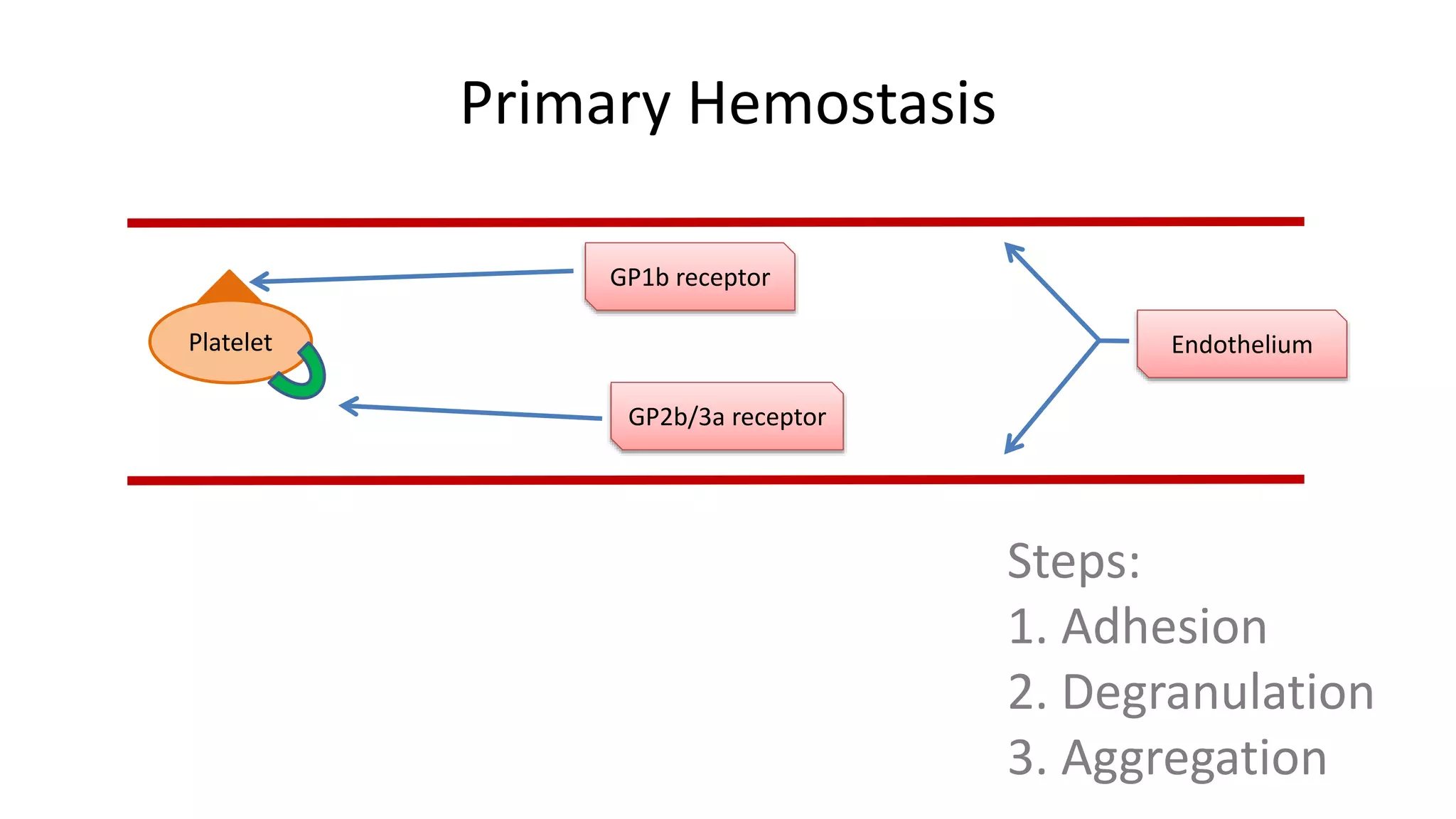
Platelet
GP1b receptor
GP2b/3a receptor
Endothelium
Steps:
1. Adhesion
2. Degranulation
3. Aggregation
Primary Hemostasis
Adhesion:
• Platelets bind vWF using GP1b receptor
ADP ADP
ADP
A2
A2
A2
Primary Hemostasis
Degranulation:
• Adhesion leads to change in shape of platelet
• Degranulation of ADP and Thromboxane A2 occurs
o ADP release leads to change in configuration of GP2b/3a
Primary Hemostasis
Aggregation:
• GP2b/3a receptor binding via fibrinogen bridge forms weak plug
How to stop aow to stop a
• Irreversible blockade of
ADP receptors
– Clopidogrel
– Prasugrel
– Ticagrelor
– Ticlopidine
• G2b/3a binders
– Abciximab
– Eptifibatide
– Tirofiban
https://cdn.shopify.com/s/files/1/0347/6329/products/Platelet_Party_grande.png?v=1486494493
Issues with Primary
Hemostasis
Clinical presentation:
– Epistaxis
– Gingival bleeding
– GI bleeding
– Hemoptysis
– Petechiae
– Purpura
– Hematuria
– Menorrhagia
Issues with Secondary
Hemostasis
Clinical presentation:
• Deep tissue bleeding
o Hemarthrosis
o Hematoma
https://1.bp.blogspot.com/-7pD5t3jZzi0/TYf5OwvwyaI/AAAAAAAAAxo/LfrfM-QurkM/s1600/platelets.jpg
APPROACH TO
THROMBOCYTOPENIA
Definition
• Thrombocytopenia is defined as platelets < 150,000 microL
– Mild 100,000 – 150,000/microL
– Moderate 50,000 – 100,000/microL
– Severe < 50,000/microL
True thrombocytopenia?
• Recheck platelet count, check peripheral smear for clumping
– EDTA decreases calcium content  platelet clumping
– Use Sodium citrate (blue top) or Heparin (green top) tube instead
• If truly thrombocytopenic, assessment of:
– Hep C, HIV, and TSH are helpful
• Both hyper and hypothyroidism can cause thrombocytopenia
Partial list of medications known to cause
thrombocytopenia
• Abciximab
• Beta-Lactams
• Carbamazipine
• Eptifibatide
• Gold compounds
• Heparin
• Linozolid
• MMR vaccine
• Phenytoin
• Pipercillin
• Quinidine
• Quinine
• Rifampin
• Sulfonamides
• Tirofiban
• Bactrim
• Valproic acid
• Vancomycin
https://www.cfhi-fcass.ca/sf-images/default-source/cartoons-copyright/DrugSafe-EN.jpg?sfvrsn=0
Idiopathic Thrombocytopenia Purpura
Pathology:
• IgG against platelet antigens (i.e. GPIIb/IIIa)
• Splenic macrophages consume antibody bound
platelets
– Association with CLL and non Hodgkins lymphoma
Presentation:
• Typically female
• Purpura and thrombocytopenia.
– Usually isolated thrombocytopenia without other causes
• Diagnosis of exclusion
Diagnosis:
• Lab tests show low platelets usually <50,000K
• Normal PT/PTT, smear normal
Treatment:
• Steroids +/- IVIG
• Rhogam for Rh+
• Rituximab
• Splenectomy
Microangiopathic hemolytic anemia
(TTP, DIC, etc.)
Thrombotic Thrombocytopenic Purpura
Pathology:
• ADAMSTS-13 deficiency 
accumulation of clumps of large vWF
multimers  bind to masses of
platelets  microvascular occlusion
and thrombocytopenia
Presentation:
• Febrile
• Anemia
• Thrombocytopenia
• Renal dysfunction
• Neurological findings
Diagnosis:
• MAHA on peripheral smear
• Normal fibrinogen, d-dimer, and factor
levels
• ADAMSTS-13 has poor sensitivity –
Treat when you have high suspicion
Treatment:
• Plasmapheresis
Hemolytic Uremic Syndrome
Atypical HUS
• Antibodies to Complement Factor H
– Atypical HUS is complement mediated and
usually NOT proceeded by diarrhea.
• Eculizumab is treatment of choice
Secondary
• Infection related
– Classical version associated with diarrheal
illness elaborating Shiga Toxin (Escherichia
Coli O157:H7 in the USA)
– O118:H2, O111:H or O104:H4 in Europe
and other regions around the world
– Strep Pneumo
– HIV in children
• Drug toxicity particularly those with cancer or
solid organ transplants
• Treat with plasmapheresis
Disseminated Intravascular Coagulation
Pathology:
• Severe underlying disease
– Pancreatitis, sepsis, malignancy (especially
APML), cirrhosis, TRALI, obstetrical
complications like preeclampsia or
retained dead fetus
Presentation:
• Bleeding/oozing
Diagnosis:
• MAHA on peripheral smear and low
platelets
• Low fibrinogen, increased d-dimer,
increased PT/PTT, INR
Treatment:
• Treat the underlying condition
• Transfuse
– Thrombocytopenia
– Low fibrinogen (Cryoprecipitate)
– Prolonged PT/PTT (FFP)
– Anemic
Heparin Induced Thrombocytopenia
Pathology:
• Drug-induced thrombocytopenia in which
the antigen is a complex between platelet
factor 4 (PF4) and heparin
• Antibodies directed against the
heparin/PF4 complex can activate platelets
via Fc receptors on platelets, leading to
thrombocytopenia and, paradoxically in
some patients, thrombosis
Presentation:
• Drop in platelets 5-10 days after heparin
initiation
• Thrombosis
Diagnosis:
• 4Ts Score
• Elisa for anti-PF4 antibodies (Sensitive – in house – high
number of False Positives). Checking for optical density
<0.4 or >2.0
• Serotonin Release Assay (Specific – send out test)
Treatment:
• Stop heparin
• Agatroban for renal dysfunction and normal hepatic
function
• Fondaparinux for hepatic dysfunction and normal renal
function
• Agatroban or Bivalirudin at reduced dosage if both
renal and hepatic dysfunction
• Warfarin should not be started until platlet count
normalizes due to risk of warfarin skin necrosis
Qualitative Platelet Disorders
Citations
• https://www.uptodate.com/contents/management-of-heparin-induced-
thrombocytopenia?source=see_link
• https://www.uptodate.com/contents/clinical-presentation-and-diagnosis-of-heparin-
induced-thrombocytopenia?source=search_result&search=HIT&selectedTitle=1~150
• https://en.wikipedia.org/wiki/Megakaryocyte
• Fauci, A. S., & Harrison, T. R. (2008). Harrisons principles of internal medicine. New York:
McGraw-Hill, Medical Publishing Division.
• Le, T., & Bhushan, V. (2013). First aid for the USMLE step 1 2013: a student to student guide.
New York: McGraw-Hill Medical.
• https://onlinemeded.org/hematology-oncology/bleeding
• Sattar, H. A. (2017). Fundamentals of pathology: medical course and Step 1 review. Chicago,
IL: Pathoma.com.
• Master the Boards Step 2 CK
• MKSAP 17

Platelet disorders

  • 1.
  • 2.
    Primary vs SecondaryHemostasis Primary Hemostasis • Formation of weak platelet plug Secondary Hemostasis • Stabilization and strengthening of platelet plug
  • 3.
    Primary Hemostasis Platelet GP1b receptor GP2b/3areceptor Endothelium Steps: 1. Adhesion 2. Degranulation 3. Aggregation
  • 4.
    Primary Hemostasis Adhesion: • Plateletsbind vWF using GP1b receptor
  • 5.
    ADP ADP ADP A2 A2 A2 Primary Hemostasis Degranulation: •Adhesion leads to change in shape of platelet • Degranulation of ADP and Thromboxane A2 occurs o ADP release leads to change in configuration of GP2b/3a
  • 6.
    Primary Hemostasis Aggregation: • GP2b/3areceptor binding via fibrinogen bridge forms weak plug
  • 7.
    How to stopaow to stop a
  • 8.
    • Irreversible blockadeof ADP receptors – Clopidogrel – Prasugrel – Ticagrelor – Ticlopidine • G2b/3a binders – Abciximab – Eptifibatide – Tirofiban
  • 9.
  • 10.
    Issues with Primary Hemostasis Clinicalpresentation: – Epistaxis – Gingival bleeding – GI bleeding – Hemoptysis – Petechiae – Purpura – Hematuria – Menorrhagia
  • 11.
    Issues with Secondary Hemostasis Clinicalpresentation: • Deep tissue bleeding o Hemarthrosis o Hematoma
  • 12.
  • 13.
  • 14.
    Definition • Thrombocytopenia isdefined as platelets < 150,000 microL – Mild 100,000 – 150,000/microL – Moderate 50,000 – 100,000/microL – Severe < 50,000/microL
  • 17.
    True thrombocytopenia? • Recheckplatelet count, check peripheral smear for clumping – EDTA decreases calcium content  platelet clumping – Use Sodium citrate (blue top) or Heparin (green top) tube instead • If truly thrombocytopenic, assessment of: – Hep C, HIV, and TSH are helpful • Both hyper and hypothyroidism can cause thrombocytopenia
  • 18.
    Partial list ofmedications known to cause thrombocytopenia • Abciximab • Beta-Lactams • Carbamazipine • Eptifibatide • Gold compounds • Heparin • Linozolid • MMR vaccine • Phenytoin • Pipercillin • Quinidine • Quinine • Rifampin • Sulfonamides • Tirofiban • Bactrim • Valproic acid • Vancomycin https://www.cfhi-fcass.ca/sf-images/default-source/cartoons-copyright/DrugSafe-EN.jpg?sfvrsn=0
  • 20.
    Idiopathic Thrombocytopenia Purpura Pathology: •IgG against platelet antigens (i.e. GPIIb/IIIa) • Splenic macrophages consume antibody bound platelets – Association with CLL and non Hodgkins lymphoma Presentation: • Typically female • Purpura and thrombocytopenia. – Usually isolated thrombocytopenia without other causes • Diagnosis of exclusion Diagnosis: • Lab tests show low platelets usually <50,000K • Normal PT/PTT, smear normal Treatment: • Steroids +/- IVIG • Rhogam for Rh+ • Rituximab • Splenectomy
  • 22.
  • 23.
    Thrombotic Thrombocytopenic Purpura Pathology: •ADAMSTS-13 deficiency  accumulation of clumps of large vWF multimers  bind to masses of platelets  microvascular occlusion and thrombocytopenia Presentation: • Febrile • Anemia • Thrombocytopenia • Renal dysfunction • Neurological findings Diagnosis: • MAHA on peripheral smear • Normal fibrinogen, d-dimer, and factor levels • ADAMSTS-13 has poor sensitivity – Treat when you have high suspicion Treatment: • Plasmapheresis
  • 24.
    Hemolytic Uremic Syndrome AtypicalHUS • Antibodies to Complement Factor H – Atypical HUS is complement mediated and usually NOT proceeded by diarrhea. • Eculizumab is treatment of choice Secondary • Infection related – Classical version associated with diarrheal illness elaborating Shiga Toxin (Escherichia Coli O157:H7 in the USA) – O118:H2, O111:H or O104:H4 in Europe and other regions around the world – Strep Pneumo – HIV in children • Drug toxicity particularly those with cancer or solid organ transplants • Treat with plasmapheresis
  • 25.
    Disseminated Intravascular Coagulation Pathology: •Severe underlying disease – Pancreatitis, sepsis, malignancy (especially APML), cirrhosis, TRALI, obstetrical complications like preeclampsia or retained dead fetus Presentation: • Bleeding/oozing Diagnosis: • MAHA on peripheral smear and low platelets • Low fibrinogen, increased d-dimer, increased PT/PTT, INR Treatment: • Treat the underlying condition • Transfuse – Thrombocytopenia – Low fibrinogen (Cryoprecipitate) – Prolonged PT/PTT (FFP) – Anemic
  • 29.
    Heparin Induced Thrombocytopenia Pathology: •Drug-induced thrombocytopenia in which the antigen is a complex between platelet factor 4 (PF4) and heparin • Antibodies directed against the heparin/PF4 complex can activate platelets via Fc receptors on platelets, leading to thrombocytopenia and, paradoxically in some patients, thrombosis Presentation: • Drop in platelets 5-10 days after heparin initiation • Thrombosis Diagnosis: • 4Ts Score • Elisa for anti-PF4 antibodies (Sensitive – in house – high number of False Positives). Checking for optical density <0.4 or >2.0 • Serotonin Release Assay (Specific – send out test) Treatment: • Stop heparin • Agatroban for renal dysfunction and normal hepatic function • Fondaparinux for hepatic dysfunction and normal renal function • Agatroban or Bivalirudin at reduced dosage if both renal and hepatic dysfunction • Warfarin should not be started until platlet count normalizes due to risk of warfarin skin necrosis
  • 30.
  • 33.
    Citations • https://www.uptodate.com/contents/management-of-heparin-induced- thrombocytopenia?source=see_link • https://www.uptodate.com/contents/clinical-presentation-and-diagnosis-of-heparin- induced-thrombocytopenia?source=search_result&search=HIT&selectedTitle=1~150 •https://en.wikipedia.org/wiki/Megakaryocyte • Fauci, A. S., & Harrison, T. R. (2008). Harrisons principles of internal medicine. New York: McGraw-Hill, Medical Publishing Division. • Le, T., & Bhushan, V. (2013). First aid for the USMLE step 1 2013: a student to student guide. New York: McGraw-Hill Medical. • https://onlinemeded.org/hematology-oncology/bleeding • Sattar, H. A. (2017). Fundamentals of pathology: medical course and Step 1 review. Chicago, IL: Pathoma.com. • Master the Boards Step 2 CK • MKSAP 17

Editor's Notes

  • #4 Adhesion: at sites of endovascular injury vWF adheres to subendothial collagen. Platelets bind vWF using GP1b receptor Degranulation: adhesion changes shape of platelets leading to degranulation of ADP and ThromboxaneA2 which promote aggregation Aggregation: Aggregation via GP2b/3a receptor via fibrinogen bridge forms weak platelet plug Endothelin – vasoconstriction Nitric oxide and prostaglandins – vasodilation and inhibition of GP1b function
  • #5 Adhesion: at sites of endovascular injury vWF adheres to subendothial collagen. Platelets bind vWF using GP1b receptor Degranulation: adhesion changes shape of platelets leading to degranulation of ADP and ThromboxaneA2 which promote aggregation Aggregation: Aggregation via GP2b/3a receptor via fibrinogen bridge forms weak platelet plug
  • #6 Adhesion: at sites of endovascular injury vWF adheres to subendothial collagen. Platelets bind vWF using GP1b receptor Degranulation: adhesion changes shape of platelets leading to degranulation of ADP and ThromboxaneA2 which promote aggregation Aggregation: Aggregation via GP2b/3a receptor via fibrinogen bridge forms weak platelet plug
  • #7 Adhesion: at sites of endovascular injury vWF adheres to subendothial collagen. Platelets bind vWF using GP1b receptor Degranulation: adhesion changes shape of platelets leading to degranulation of ADP and ThromboxaneA2 which promote aggregation Aggregation: Aggregation via GP2b/3a receptor via fibrinogen bridge forms weak platelet plug
  • #16 Platelet clumping signifies pseudothrombocytopenia, which will resolve if blood is redrawn using a citrated or heparinized tube. EDTA issues – decreased calcium.
  • #20 Thrombotic thrombocytopenic purpura is a clinical diagnosis that requires the presence of thrombocytopenia and microangiopathic hemolytic anemia, which is confirmed by schistocytes on the peripheral blood smear.
  • #22 Thrombotic thrombocytopenic purpura is a clinical diagnosis that requires the presence of thrombocytopenia and microangiopathic hemolytic anemia, which is confirmed by schistocytes on the peripheral blood smear.
  • #25 https://iowagenetics.files.wordpress.com/2008/09/slide5.jpg
  • #26 Cryo – made from FFP which is frozen and repeatedly thawed to produce a concentrated source of clotting factors including Factor VIII, vWF, Fibrinogen (Factor I) FFP – Just plain old plasma
  • #28 Assessing the pretest probability of heparin-induced thrombocytopenia by using a risk scoring system, such as the 4T score, is helpful in guiding therapy in patients at low risk for it. This patient gets 0 points. <30% drop, <4 days, no thrombosis
  • #29 Heparin cessation and immediate treatment with a nonheparin alternative anticoagulant (lepirudin, argatroban, danaparoid) are mandatory when a high pretest probability of heparin-induced thrombocytopenia is present.
  • #30 ≤3 points: low probability for HIT (≤5% in original study, <1% in meta-analysis). 4-5 points: intermediate probability (~14% probability of HIT). 6-8 points: high probability (~64% probability of HIT).
  • #31 Bernard Soulier – BS – BIG SUCKERS
  • #32 https://www.pinterest.co.uk/pin/115967759132892978/