Diana Girnita, MD, PhD
The Christ Hospital
December 2011
Definition
 Platelets < 150,000/ml
 2.5% of normal people < 150,000/ml
 Recent drop ≥ 50%, even if normal platelets
count
Increased risk of bleeding
if < 60,000 -with minor trauma
if < 12,000 –spontaneous
If < 6,000 - severe, life threatening
Initial approach of the patient
 Clinical:
1. epistaxis
2. gingival bleeding
3. meno/ metrorrhagia
4. tend to bleed immediately after minor trauma
5. cerebral bleeding
 Cutaneous: petechiae, purpura, ecchymoses
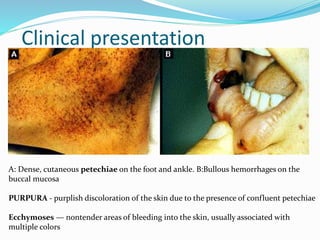
Clinical presentation
A: Dense, cutaneous petechiae on the foot and ankle. B:Bullous hemorrhages on the
buccal mucosa
PURPURA - purplish discoloration of the skin due to the presence of confluent petechiae
Ecchymoses — nontender areas of bleeding into the skin, usually associated with
multiple colors
PMH
?Bleeding history
?Hematologic disease (acute /chronic leukemias,
MDS)
?Recent new drugs or drugs that are only taken
intermittently (ASA, NSAID, herbal, plavix, heparin)
?Recent live virus vaccination
?Recent infection (viral, bacterial, rickettsial) /sepsis
?Recent travel — malaria /dengue virus,
leptospirosis, meningococcemia, hantavirus,
hemorrhagic fevers (eg, Ebola, Lassa ).
PMH- cont
?Recent massive transfusion (PRBCs /platelets)
in an allo-sensitized recipient
? Recent organ transplantation by sensitization to
platelet allo-antigens /GVHD
?Pregnancy especially late in the 3rd trimester or at
onset of labor , +/- ITP or TTP-HUS, or
preeclampsia/ eclampsia
FH: ++ for bleeding and/or thrombocytopenia
The physical examination
 Examination in critical areas
1. Ocular fundus -CNS bleeding
2. Lymphadenopathy
3. Hepatosplenomegaly
4. Stool for occult blood
5. Skin -feet and ankles , presacral area, areas of
previous trauma
 Outline areas of bleeding with a marking pen (changes
in the number/pattern of petechiae)
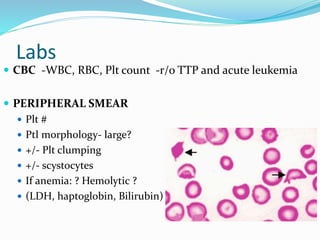
Labs
 CBC -WBC, RBC, Plt count -r/o TTP and acute leukemia
 PERIPHERAL SMEAR
 Plt #
 Ptl morphology- large?
 +/- Plt clumping
 +/- scystocytes
 If anemia: ? Hemolytic ?
 (LDH, haptoglobin, Bilirubin)
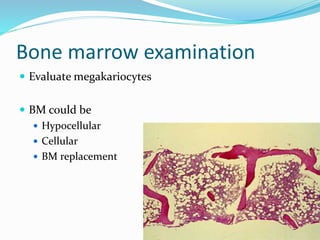
Bone marrow examination
 Evaluate megakariocytes
 BM could be
 Hypocellular
 Cellular
 BM replacement
Mechanisms of thrombocytopenia
1. Pseudothrombocytopenia
2. Decreased platelet production
3. Increased platelet destruction
4. Dilutional thrombocytopenia
5. Distributional thrombocytopenia
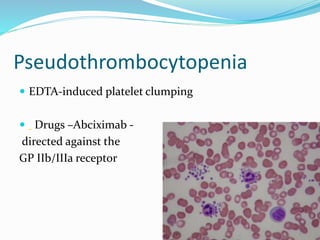
Pseudothrombocytopenia
 EDTA-induced platelet clumping
 Drugs –Abciximab -
directed against the
GP IIb/IIIa receptor
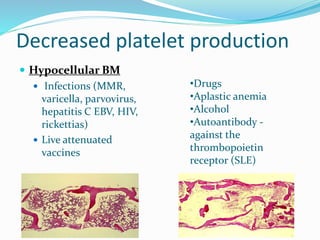
Decreased platelet production
 Hypocellular BM
 Infections (MMR,
varicella, parvovirus,
hepatitis C EBV, HIV,
rickettias)
 Live attenuated
vaccines
•Drugs
•Aplastic anemia
•Alcohol
•Autoantibody -
against the
thrombopoietin
receptor (SLE)
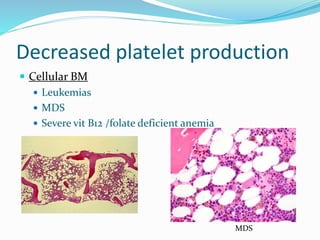
Decreased platelet production
 Cellular BM
 Leukemias
 MDS
 Severe vit B12 /folate deficient anemia
MDS
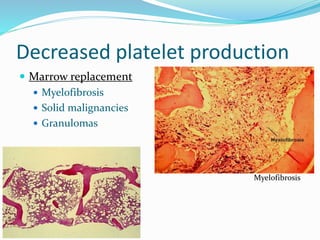
Decreased platelet production
 Marrow replacement
 Myelofibrosis
 Solid malignancies
 Granulomas
Myelofibrosis
Increased platelet destruction
1.Immune –mediated
 Primary ITP
 Secondary: infectious, CLL, drugs (heparin), APL sdr,
lymphoma
 Allo-immunization (post-transfusion)
2. Non-immune mediated
 MAHA (TTP-HUS, DIC)
 Evan Sdr: thrombocytopenia + hemolytic anemia
 Vascular prostheses/ bypass; trauma
 Drugs: ticlopidine/clopidogrel,
 Cavernous hemangioma
 HELLP syndrome -in pregnant women
Other causes:
 Dilutional thrombocytopenia — massive blood transfusion
with PRBC (> 20 units of PRBCs /24H)
 Distributional thrombocytopenia caused by splenic
sequestration
Portal hypertension
Cirrhosis
Splenomegaly
Hypothermia
Thrombocytopenia in the ICU patient
 Sepsis/septic shock - one-half of the cases
 Use of heparin
 DIC
 Massive blood transfusion
 Post-transfusion purpura
 Cardiopulmonary resuscitation
 Cardiopulmonary bypass
 ARDS
 PE
 Use of intravascular catheters
 Solid organ allograft rejection
 Drugs (antibiotics, chemotherapy, antiplatelet agents -
abciximab)
Heparin induced thrombocytopenia
(HIT)
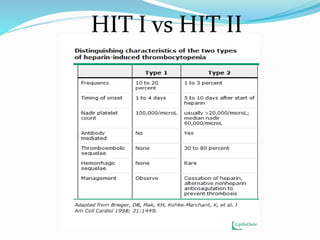
HIT I
HIT II
HIT II
 an immune-mediated disorder characterized by the
formation of antibodies against the heparin-platelet
factor 4 complex.
 UFH/LMWH
 5-10 days after the heparin is started
 Heparin –PF4 complex- Ab induce platelet aggregation
and activation, endothelial cell activation (IL-6, vWF)
 Thrombosis (arterial and venous) + thrombocytopenia
(>50% fall in Plt)
 DVT, PE (25%)
 Skin necrosis at injection site
Dg of HIT II
 Serotonin release assay
 Heparin-induced platelet aggregation
 The solid phase ELISA immunoassay- heparin-PF4-
IgG antibodies
Treatment HIT II
 Stop the heparin UFH/LMWH
 Lepirudin — Refludan®
 Is a recombinant hirudin (anticoagulant action, similar to
antithrombin III - the thrombin inhibitor)
 For HIT complicated by thrombosis, preventing new thromboses
 Not for renal failure patients
 Argatroban
 Is a direct thrombin inhibitor
 Metabolized in the liver
 Activity monitored by APTT
 Good for renal failure patients
 Warfarin — when
1) patient stably anticoagulated with a thrombin-specific inhibitor
2) Plt > 150,000/microL
Challenges in bridging to long term
anticoagulation
 The combination of argatroban and warfarin may raise
the INR > 5.0 without a significant increased risk of
bleeding complications.
 Measure the chromogenic factor X level
 A level < 40-45% typically indicates that the INR will
be therapeutic (2-3) when the argatroban is
discontinued.
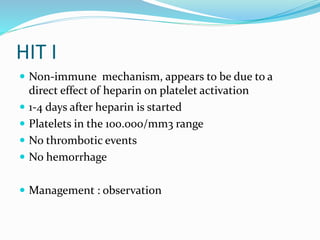
HIT I
 Non-immune mechanism, appears to be due to a
direct effect of heparin on platelet activation
 1-4 days after heparin is started
 Platelets in the 100.000/mm3 range
 No thrombotic events
 No hemorrhage
 Management : observation
HIT I vs HIT II
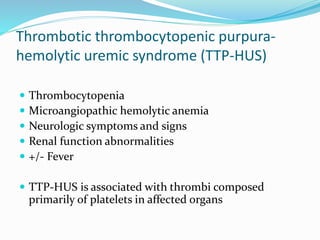
Thrombotic thrombocytopenic purpura-
hemolytic uremic syndrome (TTP-HUS)
 Thrombocytopenia
 Microangiopathic hemolytic anemia
 Neurologic symptoms and signs
 Renal function abnormalities
 +/- Fever
 TTP-HUS is associated with thrombi composed
primarily of platelets in affected organs
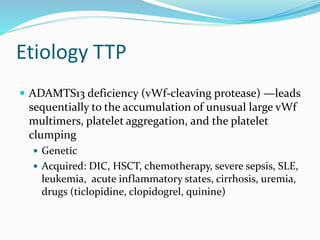
Etiology TTP
 ADAMTS13 deficiency (vWf-cleaving protease) —leads
sequentially to the accumulation of unusual large vWf
multimers, platelet aggregation, and the platelet
clumping
 Genetic
 Acquired: DIC, HSCT, chemotherapy, severe sepsis, SLE,
leukemia, acute inflammatory states, cirrhosis, uremia,
drugs (ticlopidine, clopidogrel, quinine)
Etiology HUS
 Enterohemorrhagic E coli
 Shiga toxin binds and activates endothelial cells and
platelets and induces formation of intra-renal thrombi
Clinic:
 Children
 Bloody diarrhea
 Fever
Diagnosis TTP-HUS
 Peripheral smear: ++ Schystocytes
 Negative Coombs test
 Normal PT, PTT, fibrinogen
 Hemolysis : LDH increased (tissue ischemia +
hemolysis), indirect bilirubin increased, decreased
haptoglobin
 Increased creatinine
 Biopsy: arterioles filled with hyaline thrombi (DDx:
vasculitis, DIC, HELLP, malignant HTN)
Treatment TTP-HUS
1. Plasma exchange
Exceptions:
 Postdiarrheal HUS in children
 Cancer chemotherapy or transplantation
 Severe acute renal failure- cause fluid overload
2. Glucocorticoids: severe deficiency of ADAMTS13
Platelet transfusions are contraindicated
Immune thrombocytopenic
purpura (ITP)
 Dg of exclusion
 ITP is related to a combination of
 increased platelet destruction along with
 inhibition of megakaryocyte platelet production via the
production of specific IgG autoantibodies directed
against platelet membrane GP (GPIIb/IIIa)
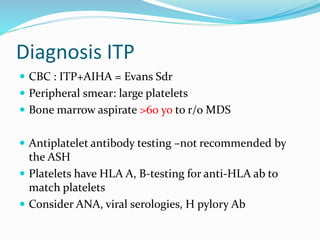
Diagnosis ITP
 CBC : ITP+AIHA = Evans Sdr
 Peripheral smear: large platelets
 Bone marrow aspirate >60 yo to r/o MDS
 Antiplatelet antibody testing –not recommended by
the ASH
 Platelets have HLA A, B-testing for anti-HLA ab to
match platelets
 Consider ANA, viral serologies, H pylory Ab
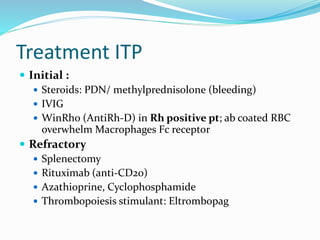
Treatment ITP
 Initial :
 Steroids: PDN/ methylprednisolone (bleeding)
 IVIG
 WinRho (AntiRh-D) in Rh positive pt; ab coated RBC
overwhelm Macrophages Fc receptor
 Refractory
 Splenectomy
 Rituximab (anti-CD20)
 Azathioprine, Cyclophosphamide
 Thrombopoiesis stimulant: Eltrombopag
References
 www.uptodate.com
 John Hopkins IM board review
 PG MGH handbook
Thank you!
ALYSA & ANA

Thrombocytopenia

  • 1.
    Diana Girnita, MD,PhD The Christ Hospital December 2011
  • 2.
    Definition  Platelets <150,000/ml  2.5% of normal people < 150,000/ml  Recent drop ≥ 50%, even if normal platelets count
  • 3.
    Increased risk ofbleeding if < 60,000 -with minor trauma if < 12,000 –spontaneous If < 6,000 - severe, life threatening
  • 4.
    Initial approach ofthe patient  Clinical: 1. epistaxis 2. gingival bleeding 3. meno/ metrorrhagia 4. tend to bleed immediately after minor trauma 5. cerebral bleeding  Cutaneous: petechiae, purpura, ecchymoses
  • 5.
    Clinical presentation A: Dense,cutaneous petechiae on the foot and ankle. B:Bullous hemorrhages on the buccal mucosa PURPURA - purplish discoloration of the skin due to the presence of confluent petechiae Ecchymoses — nontender areas of bleeding into the skin, usually associated with multiple colors
  • 6.
    PMH ?Bleeding history ?Hematologic disease(acute /chronic leukemias, MDS) ?Recent new drugs or drugs that are only taken intermittently (ASA, NSAID, herbal, plavix, heparin) ?Recent live virus vaccination ?Recent infection (viral, bacterial, rickettsial) /sepsis ?Recent travel — malaria /dengue virus, leptospirosis, meningococcemia, hantavirus, hemorrhagic fevers (eg, Ebola, Lassa ).
  • 7.
    PMH- cont ?Recent massivetransfusion (PRBCs /platelets) in an allo-sensitized recipient ? Recent organ transplantation by sensitization to platelet allo-antigens /GVHD ?Pregnancy especially late in the 3rd trimester or at onset of labor , +/- ITP or TTP-HUS, or preeclampsia/ eclampsia FH: ++ for bleeding and/or thrombocytopenia
  • 8.
    The physical examination Examination in critical areas 1. Ocular fundus -CNS bleeding 2. Lymphadenopathy 3. Hepatosplenomegaly 4. Stool for occult blood 5. Skin -feet and ankles , presacral area, areas of previous trauma  Outline areas of bleeding with a marking pen (changes in the number/pattern of petechiae)
  • 9.
    Labs  CBC -WBC,RBC, Plt count -r/o TTP and acute leukemia  PERIPHERAL SMEAR  Plt #  Ptl morphology- large?  +/- Plt clumping  +/- scystocytes  If anemia: ? Hemolytic ?  (LDH, haptoglobin, Bilirubin)
  • 10.
    Bone marrow examination Evaluate megakariocytes  BM could be  Hypocellular  Cellular  BM replacement
  • 11.
    Mechanisms of thrombocytopenia 1.Pseudothrombocytopenia 2. Decreased platelet production 3. Increased platelet destruction 4. Dilutional thrombocytopenia 5. Distributional thrombocytopenia
  • 12.
    Pseudothrombocytopenia  EDTA-induced plateletclumping  Drugs –Abciximab - directed against the GP IIb/IIIa receptor
  • 13.
    Decreased platelet production Hypocellular BM  Infections (MMR, varicella, parvovirus, hepatitis C EBV, HIV, rickettias)  Live attenuated vaccines •Drugs •Aplastic anemia •Alcohol •Autoantibody - against the thrombopoietin receptor (SLE)
  • 14.
    Decreased platelet production Cellular BM  Leukemias  MDS  Severe vit B12 /folate deficient anemia MDS
  • 15.
    Decreased platelet production Marrow replacement  Myelofibrosis  Solid malignancies  Granulomas Myelofibrosis
  • 16.
    Increased platelet destruction 1.Immune–mediated  Primary ITP  Secondary: infectious, CLL, drugs (heparin), APL sdr, lymphoma  Allo-immunization (post-transfusion) 2. Non-immune mediated  MAHA (TTP-HUS, DIC)  Evan Sdr: thrombocytopenia + hemolytic anemia  Vascular prostheses/ bypass; trauma  Drugs: ticlopidine/clopidogrel,  Cavernous hemangioma  HELLP syndrome -in pregnant women
  • 17.
    Other causes:  Dilutionalthrombocytopenia — massive blood transfusion with PRBC (> 20 units of PRBCs /24H)  Distributional thrombocytopenia caused by splenic sequestration Portal hypertension Cirrhosis Splenomegaly Hypothermia
  • 18.
    Thrombocytopenia in theICU patient  Sepsis/septic shock - one-half of the cases  Use of heparin  DIC  Massive blood transfusion  Post-transfusion purpura  Cardiopulmonary resuscitation  Cardiopulmonary bypass  ARDS  PE  Use of intravascular catheters  Solid organ allograft rejection  Drugs (antibiotics, chemotherapy, antiplatelet agents - abciximab)
  • 19.
  • 20.
    HIT II  animmune-mediated disorder characterized by the formation of antibodies against the heparin-platelet factor 4 complex.  UFH/LMWH  5-10 days after the heparin is started  Heparin –PF4 complex- Ab induce platelet aggregation and activation, endothelial cell activation (IL-6, vWF)  Thrombosis (arterial and venous) + thrombocytopenia (>50% fall in Plt)  DVT, PE (25%)  Skin necrosis at injection site
  • 21.
    Dg of HITII  Serotonin release assay  Heparin-induced platelet aggregation  The solid phase ELISA immunoassay- heparin-PF4- IgG antibodies
  • 22.
    Treatment HIT II Stop the heparin UFH/LMWH  Lepirudin — Refludan®  Is a recombinant hirudin (anticoagulant action, similar to antithrombin III - the thrombin inhibitor)  For HIT complicated by thrombosis, preventing new thromboses  Not for renal failure patients  Argatroban  Is a direct thrombin inhibitor  Metabolized in the liver  Activity monitored by APTT  Good for renal failure patients  Warfarin — when 1) patient stably anticoagulated with a thrombin-specific inhibitor 2) Plt > 150,000/microL
  • 23.
    Challenges in bridgingto long term anticoagulation  The combination of argatroban and warfarin may raise the INR > 5.0 without a significant increased risk of bleeding complications.  Measure the chromogenic factor X level  A level < 40-45% typically indicates that the INR will be therapeutic (2-3) when the argatroban is discontinued.
  • 24.
    HIT I  Non-immunemechanism, appears to be due to a direct effect of heparin on platelet activation  1-4 days after heparin is started  Platelets in the 100.000/mm3 range  No thrombotic events  No hemorrhage  Management : observation
  • 25.
    HIT I vsHIT II
  • 26.
    Thrombotic thrombocytopenic purpura- hemolyticuremic syndrome (TTP-HUS)  Thrombocytopenia  Microangiopathic hemolytic anemia  Neurologic symptoms and signs  Renal function abnormalities  +/- Fever  TTP-HUS is associated with thrombi composed primarily of platelets in affected organs
  • 27.
    Etiology TTP  ADAMTS13deficiency (vWf-cleaving protease) —leads sequentially to the accumulation of unusual large vWf multimers, platelet aggregation, and the platelet clumping  Genetic  Acquired: DIC, HSCT, chemotherapy, severe sepsis, SLE, leukemia, acute inflammatory states, cirrhosis, uremia, drugs (ticlopidine, clopidogrel, quinine)
  • 28.
    Etiology HUS  EnterohemorrhagicE coli  Shiga toxin binds and activates endothelial cells and platelets and induces formation of intra-renal thrombi Clinic:  Children  Bloody diarrhea  Fever
  • 29.
    Diagnosis TTP-HUS  Peripheralsmear: ++ Schystocytes  Negative Coombs test  Normal PT, PTT, fibrinogen  Hemolysis : LDH increased (tissue ischemia + hemolysis), indirect bilirubin increased, decreased haptoglobin  Increased creatinine  Biopsy: arterioles filled with hyaline thrombi (DDx: vasculitis, DIC, HELLP, malignant HTN)
  • 30.
    Treatment TTP-HUS 1. Plasmaexchange Exceptions:  Postdiarrheal HUS in children  Cancer chemotherapy or transplantation  Severe acute renal failure- cause fluid overload 2. Glucocorticoids: severe deficiency of ADAMTS13 Platelet transfusions are contraindicated
  • 31.
    Immune thrombocytopenic purpura (ITP) Dg of exclusion  ITP is related to a combination of  increased platelet destruction along with  inhibition of megakaryocyte platelet production via the production of specific IgG autoantibodies directed against platelet membrane GP (GPIIb/IIIa)
  • 32.
    Diagnosis ITP  CBC: ITP+AIHA = Evans Sdr  Peripheral smear: large platelets  Bone marrow aspirate >60 yo to r/o MDS  Antiplatelet antibody testing –not recommended by the ASH  Platelets have HLA A, B-testing for anti-HLA ab to match platelets  Consider ANA, viral serologies, H pylory Ab
  • 33.
    Treatment ITP  Initial:  Steroids: PDN/ methylprednisolone (bleeding)  IVIG  WinRho (AntiRh-D) in Rh positive pt; ab coated RBC overwhelm Macrophages Fc receptor  Refractory  Splenectomy  Rituximab (anti-CD20)  Azathioprine, Cyclophosphamide  Thrombopoiesis stimulant: Eltrombopag
  • 34.
    References  www.uptodate.com  JohnHopkins IM board review  PG MGH handbook
  • 35.