Platelet; Functions, Disorders
and its Assessment
Platelet function
• Responsible for primary hemostasis via 5 mechanisms-
• Adhesion
• Secretion
• Aggregation
• Coagulation (provide coagulant surface)
• Clot retraction
• Physiologically contribute to hemostasis and pathologically leads to thrombotic
occlusion of vessel with obstruction to blood flow and subsequent tissue damage
Additional role of platelets
• Inflammation
• Antimicrobial host defense
• Mitogenesis
• Wound healing
Primary hemostasis
Adhesion
• Upon damage to vessel vWF will bind to the exposed subendothelial collagen via its A3 domain, after
which it adopts its platelet-binding conformation.
• VWF binds to platelets via GPIb–V–IX complex
• The interaction of GPVI with collagen will result in further platelet activation
Platelet activation
• Once platelets have adhered
they degranulate, releasing
stored secondary agents such
as ADP, ATP, and synthesize
thromboxane A2
• ADP activates P2Y1 and P2Y12
which further degranulates
platelets
Platelet Aggregation
• Agonists
• ADP
• Collagen
• Epinephrine
• AA
• Thrombin
• Serotonin
Platelet function
Platelets: procoagulant surface for activation of coagulation cascade as explained by cell
model of coagulation
Platelet function
Platelet disorders
• Common bleeding disorders: congenital or acquired.
• Any abnormality in platelet count and function or both can result in bleeding
Platelet disorders
Quantitative disorders Qualitative disorders
Inherited AcquiredThrombocytosis Thrombocytopenia
Platelet count
> 4 lac/µ L
Platelet count
<1.5 lac/µ L
Rare Common
Quantitative disorders: THROMBOCYTOSIS
(>450000/cumm)
• Reactive thrombocytosis
• Iron deficiency
• Inflammatory disorders
• Tissue injury/trauma,
• Sepsis or infection
• Malignancy
• Post splenectomy
• Rebound thrombocytosis
following hemorrhage
• Primary thrombocytosis
• Bone marrow disorders
• Essential thrombocytosis
• Polycythemia vera
• Chronic myelogenous leukemia
• Myeloid metaplasia
Increased destruction Decreased
production
Sequestration
Dilutional
• Congenital
• B12 and folate deficiency
• Medications (valproic acid,
chemotherapy)
• Radiation
• Toxins (alcohol)
• Infections (parvovirus, CMV,
ehrlichiosis)
• Liver disease (TPO deficiency)
• Primary marrow disorders
myelodysplasia, myelofibrosis,
• Acute & chronic leukemias,
lymphoproliferative disorders
• Marrow replaced by solid tumors
• Granulomatous diseases of the
marrow
Non immuneImmune
• ITP
• Infections (HIV, HCV,
H.pylori)
• Lymphoproliferative
disorders
• Medications (e.g.
quinine, quinidine,
gold, heparin,
glycoprotein IIb/IIIa
inhibitors)
• Posttransfusion
thrombocytopenia
• DIC
• Thrombotic
microangiopathies (TTP,
HUS, eclampsia, HELLP
syndrome)
• Cardiopulmonary
bypass, intra-aortic
balloon pump,
ventricular assist devices
• Abnormal vascular
surfaces (aneurysms,
heart valves, Merritt-
Kasabach syndrome)
• Hemophagocytosis
splenomegaly
• Massive
transfusion
• Crystalloid
infusion
Quantitative disorders: Thrombocytopenia (<150000/cumm)
Platelet Function Disorders
• An abnormality in platelet function can result in bleeding even when the platelet
count is normal
• Most platelet function disorders are associated with a relatively mild bleeding
tendency
• Can be aquired which is more common
• Can be inherited/congenital which is more rare
Inherited Disorders of Platelet Function
Inherited causes of Platelet Function Disorders
Characteristics of Congenital Platelet Function Disorders
Platelet function disorders: Acquired
• Uraemia
• Dysproteinemias
• Extracorporeal perfusion
• Acquired von Willebrand disease
• Acquired storage pool deficiency
• Antiplatelet antibodies
• Liver disease
• Drugs and other agents
• Acute leukemias & myelodysplastic
syndromes
• Myeloproliferative disorders
• Essential thrombocythemia
• Polycythemia vera
• Chronic myeloid leukemia
• Primary myelofibrosis
Acquired platelet function disorders:
Site of platelet
dysfunction
Systemic
illness
Potential mechanisms Platelet
aggregation
Studies
Treatment
Intrinsic
disorders of
platelet function
Chronic
Myeloproli.
Disorders
Defect at level of
c. megakaryocyte:
1) Abnormal lipid
peroxidation &
responses to Tx A2
2) Abnormal expression of
FcγR.
3) Combined defect in
memb.expression
& activation of GPIIb/IIIa
complexes
4) Acquired storage pool
disorder
Defective
aggregation
Treatment of
underlying
disorders
Site of platelet
dysfunction
Systemic
illness
Potential mechanisms Platelet
aggregation
Studies
Treatment
Intrinsic
disorders of
platelet function
MDS/
Leukemias
Defective
megakaryopoiesis:
1) Dilated canalicular
system and abnormal
microtubule formation
2) Reduced or giant
granules may form by
fusion of several single
granules
3) Acquired membrane
defect with abnormal Gp
expression
Multiple aggre.
defects
Treatment of
underlying
disorders
Acquired platelet function disorders:
Site of platelet
dysfunction
Systemic
illness
Potential mechanisms Platelet
aggregation
Studies
Treatment
Extrinsic
disorders of
platelet function
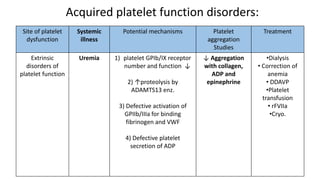
Uremia 1) platelet GPIb/IX receptor
number and function ↓
2) ↑proteolysis by
ADAMTS13 enz.
3) Defective activation of
GPIIb/IIIa for binding
fibrinogen and VWF
4) Defective platelet
secretion of ADP
↓ Aggregation
with collagen,
ADP and
epinephrine
•Dialysis
• Correction of
anemia
• DDAVP
•Platelet
transfusion
• rFVIIa
•Cryo.
Acquired platelet function disorders:
Site of platelet
dysfunction
Systemic illness Potential mechanism Platelet
aggregation
Studies
Treatment
Extrinsic
disorders of
platelet
function
Liver dysfunction Altered platelet mem.
palmate and stearate
meta.
Defective
aggregation
•Correction of
underlying ds.
• DDAVP
•Platelet Tx.
Paraprotenemia Nonspecific binding of
Igs to platelet surface
Defective
aggregation
•Plasmaphresis
•Tt of underlying ds
• Platelet tx
only during life
threatening
bleeding
Hypothermia 1) ↓ plasma soluble
P-selectin
expression
2) ↓ levels of TX-A2
↓ Platelet
activation
Correction of
hypothermia
Acquired platelet function disorders:
Site of platelet
dysfunction
Systemic
illness
Potential mechanism Platelet
aggregation
Studies
Treatment
Extrinsic
disorders of
platelet function
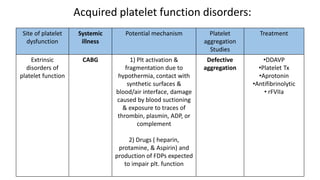
CABG 1) Plt activation &
fragmentation due to
hypothermia, contact with
synthetic surfaces &
blood/air interface, damage
caused by blood suctioning
& exposure to traces of
thrombin, plasmin, ADP, or
complement
2) Drugs ( heparin,
protamine, & Aspirin) and
production of FDPs expected
to impair plt. function
Defective
aggregation
•DDAVP
•Platelet Tx
•Aprotonin
•Antifibrinolytic
• rFVIIa
Acquired platelet function disorders:
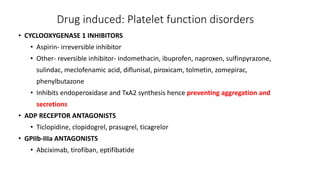
Drug induced: Platelet function disorders
• CYCLOOXYGENASE 1 INHIBITORS
• Aspirin- irreversible inhibitor
• Other- reversible inhibitor- indomethacin, ibuprofen, naproxen, sulfinpyrazone,
sulindac, meclofenamic acid, diflunisal, piroxicam, tolmetin, zomepirac,
phenylbutazone
• Inhibits endoperoxidase and TxA2 synthesis hence preventing aggregation and
secretions
• ADP RECEPTOR ANTAGONISTS
• Ticlopidine, clopidogrel, prasugrel, ticagrelor
• GPIIb-IIIa ANTAGONISTS
• Abciximab, tirofiban, eptifibatide
Drug induced: Platelet function disorders
• DRUGS THAT INCREASE PLATELET CYCLIC AMP OR CYCLIC GMP
• Inhibiting the cyclic nucleotide phosphodiesterases, or increasing adenyl cyclase activity
• Prostaglandin I2 and analogues
• Results in inhibition of platelet responses- adhesion, aggregation and secretion
• Phosphodiesterase inhibitors (dipyridamole, cilostazol, caffeine, theophylline,
aminophylline)
• Nitric oxide and nitric oxide donors
Acquired causes of platelet function disorders
• ANTIMICROBIALS
• Penicillins, Cephalosporins, Nitrofurantoin, Hydroxychloroquine, Miconazole
• Inhibit platelet aggregation & adherence to subendothelial structures
• Effect is dose-dependent, taking approx. 2-3 days to manifest and 3-10 days to
abate
• ANTICOAGULANTS
• Heparin
• THROMBOLYTIC AGENTS
• Streptokinase, tissue plasminogen activator, urokinase
Acquired causes of platelet function disorders
• CARDIOVASCULAR DRUGS
• β- blockers (propranolol), Vasodilators (nitroprusside, nitroglycerin), Diuretics
(furosemide), CCB, Quinidine, ACE inhibitors
• Act through inhibition of aggregation or modification of platelet surface
• PSYCHOTROPICS AND ANESTHETICS
• TCA (e.g imipramine) inhibit platelet aggregation and secretion responses to ADP,
epinephrine, and collagen
• Phenothiazines (e.g chlorpromazine, promethazine),
• SSRI (e.g fluoxetine)- reversible serotonin deficiency in dense- granules
• General anesthesia (halothane)
Acquired causes of platelet function disorders
• CHEMOTHERAPEUTIC AGENTS
• Mithramycin, BCNU (1,3-bis(2-chloroethyl)-1-nitrosurea), Daunorubicin, Dasatinib
• MISCELLANEOUS AGENTS
• Dextrans and hydroxyethyl starch
• Lipid-lowering agents-clofibrate, halofenate
• e-Aminocaproic acid, Antihistamines, Ethanol, Vitamin E
• Radiographic contrast agents
• Food items and food supplements - omega-3 fatty acids, vitamin E, onions, garlic,
ginger, cumin, turmeric, clove, black tree fungus, Ginkgo
Assessment of suspected platelet disorder
• History & Examination
• Petechiae
• Ecchymosis
• Bleeding on cut and easy bruising
Clinical assessment
EcchymosisPetechiae
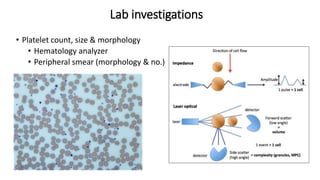
• Platelet count, size & morphology
• Hematology analyzer
• Peripheral smear (morphology & no.)
Lab investigations
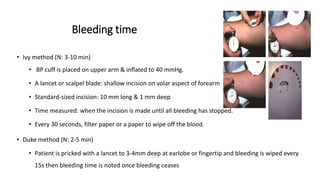
• Ivy method (N: 3-10 min)
• BP cuff is placed on upper arm & inflated to 40 mmHg.
• A lancet or scalpel blade: shallow incision on volar aspect of forearm
• Standard-sized incision: 10 mm long & 1 mm deep
• Time measured: when the incision is made until all bleeding has stopped.
• Every 30 seconds, filter paper or a paper to wipe off the blood.
• Duke method (N: 2-5 min)
• Patient is pricked with a lancet to 3-4mm deep at earlobe or fingertip and bleeding is wiped every
15s then bleeding time is noted once bleeding ceases
Bleeding time
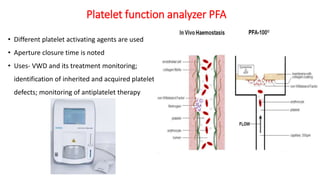
Platelet function analyzer PFA 100/200
• Rapid, simple, & reproducible
• Measures primary platelet-related hemostasis under conditions of high shear, with
platelet plug formation
• Asses adhesion function (dependent on VWF rather than fibrinogen)
• Very sensitive to vWF levels but test results can also be prolonged in cases with
thrombocytopenia & anemia itself.
Screening for suspected platelet disorder
• Different platelet activating agents are used
• Aperture closure time is noted
• Uses- VWD and its treatment monitoring;
identification of inherited and acquired platelet
defects; monitoring of antiplatelet therapy
Platelet function analyzer PFA
• Lab evaluation of aggregation
• Gold standard for platelet function
test
• It by passes the test of adhesion
• Light transmission aggregometry
(LTA):most common method
Platelet aggregation studies
Platelet Aggregation: LTA
• Light focused on sample cuvette
contained PRP
• PRP stirred and recorder identified
baseline – 0% transmittance
• Agonist added
• Transmitted light changes in response to
degree of PLT shape changes
• Change in light transmission
continuously monitored and recorded
• As PLT aggregates form, recorder moves
towards 100% transmittance
• Abnormalities
• Decreased or absent aggregation Platelet-rich plasma in an optical aggregometer.
Platelet count is approximately 200 × 109/L, and
platelets are maintained in suspension by a
magnetic stir bar turning at 1000 rpm.
PLT Aggregation: WB
• Parallel electrodes (DC) immersed in
saline-diluted whole blood
• Add agonist
• PLTs aggregate on electrodes, reducing
current
• Change is current directly proportional
to level of PLT aggregation
The aggregating platelets form a layer on the
electrodes, and current is impeded by the platelet
layer. Resistance (Ω) is proportional to aggregation,
providing a tracing that resembles optical
aggregometry.
Platelet Aggregation Curve
• Primary wave
• Reversible
• Measures ability of platelets to respond to
an external agonist
• Without enough stimulus or without an
intact prostaglandin pathway (to TxA2),
platelets disaggregate
• Secondary wave
• Irreversible
• Results in complete release of primarily
dense granules contents, most
importantly ADP, after stimulation.
Common aggregation agonists
ADP (P2Ya/P2Y12)
• Biphasic curve: 1o & 2o waves (requires
intact PG pathway)
• No biphasic response: if ADP is added
at too low/too high conc.
Epinephrine (a2-andrenergic receptor)
• Biphasic curve; requires intact PG
pathway
Collagen (GPIa/IIa/GPVI)
• Lag phase followed by 2o wave only
Thrombin (PAR1/PAR4/GPIba/GPV)
• Independent of PG or ADP pathways
• Irreversible aggregation only
Arachadonic acid ( TPa/TPb)
• 2o wave only; assesses COX pathway
Ristocetin (GPIb/V/IX/vWF)
• Binds to vWF/GPIb/IX complex & results
in agglutination
• Evaluates adhesion reaction
41
Lumiaggregometry: luminescence technology
• Measure platelet aggregation and secretion of ATP.
• This modification is sensitive to ATP release & marker of platelet activation.
• ATP is measured by its reaction with firefly luciferin to give chemiluminescence
• Resulting light emission is detected, amplified, & recorded by instrument.
• Performed by using whole blood or PRP.
• USES
• Quantitative analysis of Dense Granule Release
• Secretion Study and Aggregation performed simultaneously in same sample
• Diagnose Storage Pool Disease and Secretion Defect
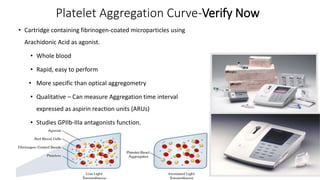
Platelet Aggregation Curve-Verify Now
• Cartridge containing fibrinogen-coated microparticles using
Arachidonic Acid as agonist.
• Whole blood
• Rapid, easy to perform
• More specific than optical aggregometry
• Qualitative – Can measure Aggregation time interval
expressed as aspirin reaction units (ARUs)
• Studies GPIIb-IIIa antagonists function.
• This two-step -uses a cell counter to measure total platelet count in a whole blood
sample and then to re-determine the platelet count on a second sample that has been
exposed to a known platelet agonist
• The Plateletworks tubes can be run on any hematology analyzer utilizing impedance
methodology
Platelet Aggregation Curve-plateletworks
• lumi-aggregometer
• Secretion of radio-labelled serotonin used to study dense granules
• α-granule secretion
• most commonly assayed by flow cytometry- studying P-selectin expression on
platelet surface after activation
• ELISA and Multiplex assay are also employed- to study PF4 and β-TG
Assessment of secretion of platelet granule contents
Flow cytometry
• Fluorochrome tagged monoclonal antibodies(Mabs) against a platelet-specific
antigen
• Most common platelet activation markers assessed
• P-selectin, glycoproteins are studied
• Can be used to study platelet anomaly of number and function of platelet
receptors
Assessment of suspected platelet disorder:
Transmission electron microscopy
• For the quantitation of dense granules
• Ultrastructural evaluation
Thromboxane A2 formation
• Investigation of patients with suspected abnormalities of arachidonic acid
metabolism.
• Released by activated platelets and rapidly metabolised
• Studied by immunoassay or mass spectrometry
Assessment of suspected platelet disorder:
Molecular genetic testing
• genetic testing can aid in accurate diagnosis of the inherited disorders
• Next generation sequencing (NGS) panels, now available, offer an efficient
approach to molecular diagnosis
• Can help in genetic counselling and prenatal diagnosis
Assessment of suspected platelet disorder:
Other tests available
• Platelet adhesion
• Impact; Cone and Plate(let) Analyzer
• Global thrombosis test GTT
• Viscoelastic test- TEG/ROTEM/platelet
Assessment of suspected platelet disorder:
Assessment of suspected platelet disorder

platelet function, disorders and its assesment

  • 1.
  • 2.
    Platelet function • Responsiblefor primary hemostasis via 5 mechanisms- • Adhesion • Secretion • Aggregation • Coagulation (provide coagulant surface) • Clot retraction • Physiologically contribute to hemostasis and pathologically leads to thrombotic occlusion of vessel with obstruction to blood flow and subsequent tissue damage
  • 3.
    Additional role ofplatelets • Inflammation • Antimicrobial host defense • Mitogenesis • Wound healing
  • 4.
    Primary hemostasis Adhesion • Upondamage to vessel vWF will bind to the exposed subendothelial collagen via its A3 domain, after which it adopts its platelet-binding conformation. • VWF binds to platelets via GPIb–V–IX complex • The interaction of GPVI with collagen will result in further platelet activation
  • 5.
    Platelet activation • Onceplatelets have adhered they degranulate, releasing stored secondary agents such as ADP, ATP, and synthesize thromboxane A2 • ADP activates P2Y1 and P2Y12 which further degranulates platelets
  • 6.
    Platelet Aggregation • Agonists •ADP • Collagen • Epinephrine • AA • Thrombin • Serotonin
  • 7.
    Platelet function Platelets: procoagulantsurface for activation of coagulation cascade as explained by cell model of coagulation
  • 8.
  • 9.
    Platelet disorders • Commonbleeding disorders: congenital or acquired. • Any abnormality in platelet count and function or both can result in bleeding Platelet disorders Quantitative disorders Qualitative disorders Inherited AcquiredThrombocytosis Thrombocytopenia Platelet count > 4 lac/µ L Platelet count <1.5 lac/µ L Rare Common
  • 10.
    Quantitative disorders: THROMBOCYTOSIS (>450000/cumm) •Reactive thrombocytosis • Iron deficiency • Inflammatory disorders • Tissue injury/trauma, • Sepsis or infection • Malignancy • Post splenectomy • Rebound thrombocytosis following hemorrhage • Primary thrombocytosis • Bone marrow disorders • Essential thrombocytosis • Polycythemia vera • Chronic myelogenous leukemia • Myeloid metaplasia
  • 11.
    Increased destruction Decreased production Sequestration Dilutional •Congenital • B12 and folate deficiency • Medications (valproic acid, chemotherapy) • Radiation • Toxins (alcohol) • Infections (parvovirus, CMV, ehrlichiosis) • Liver disease (TPO deficiency) • Primary marrow disorders myelodysplasia, myelofibrosis, • Acute & chronic leukemias, lymphoproliferative disorders • Marrow replaced by solid tumors • Granulomatous diseases of the marrow Non immuneImmune • ITP • Infections (HIV, HCV, H.pylori) • Lymphoproliferative disorders • Medications (e.g. quinine, quinidine, gold, heparin, glycoprotein IIb/IIIa inhibitors) • Posttransfusion thrombocytopenia • DIC • Thrombotic microangiopathies (TTP, HUS, eclampsia, HELLP syndrome) • Cardiopulmonary bypass, intra-aortic balloon pump, ventricular assist devices • Abnormal vascular surfaces (aneurysms, heart valves, Merritt- Kasabach syndrome) • Hemophagocytosis splenomegaly • Massive transfusion • Crystalloid infusion Quantitative disorders: Thrombocytopenia (<150000/cumm)
  • 12.
    Platelet Function Disorders •An abnormality in platelet function can result in bleeding even when the platelet count is normal • Most platelet function disorders are associated with a relatively mild bleeding tendency • Can be aquired which is more common • Can be inherited/congenital which is more rare
  • 13.
    Inherited Disorders ofPlatelet Function
  • 14.
    Inherited Disorders ofPlatelet Function
  • 15.
    Inherited causes ofPlatelet Function Disorders
  • 16.
    Characteristics of CongenitalPlatelet Function Disorders
  • 20.
    Platelet function disorders:Acquired • Uraemia • Dysproteinemias • Extracorporeal perfusion • Acquired von Willebrand disease • Acquired storage pool deficiency • Antiplatelet antibodies • Liver disease • Drugs and other agents • Acute leukemias & myelodysplastic syndromes • Myeloproliferative disorders • Essential thrombocythemia • Polycythemia vera • Chronic myeloid leukemia • Primary myelofibrosis
  • 21.
    Acquired platelet functiondisorders: Site of platelet dysfunction Systemic illness Potential mechanisms Platelet aggregation Studies Treatment Intrinsic disorders of platelet function Chronic Myeloproli. Disorders Defect at level of c. megakaryocyte: 1) Abnormal lipid peroxidation & responses to Tx A2 2) Abnormal expression of FcγR. 3) Combined defect in memb.expression & activation of GPIIb/IIIa complexes 4) Acquired storage pool disorder Defective aggregation Treatment of underlying disorders
  • 22.
    Site of platelet dysfunction Systemic illness Potentialmechanisms Platelet aggregation Studies Treatment Intrinsic disorders of platelet function MDS/ Leukemias Defective megakaryopoiesis: 1) Dilated canalicular system and abnormal microtubule formation 2) Reduced or giant granules may form by fusion of several single granules 3) Acquired membrane defect with abnormal Gp expression Multiple aggre. defects Treatment of underlying disorders Acquired platelet function disorders:
  • 23.
    Site of platelet dysfunction Systemic illness Potentialmechanisms Platelet aggregation Studies Treatment Extrinsic disorders of platelet function Uremia 1) platelet GPIb/IX receptor number and function ↓ 2) ↑proteolysis by ADAMTS13 enz. 3) Defective activation of GPIIb/IIIa for binding fibrinogen and VWF 4) Defective platelet secretion of ADP ↓ Aggregation with collagen, ADP and epinephrine •Dialysis • Correction of anemia • DDAVP •Platelet transfusion • rFVIIa •Cryo. Acquired platelet function disorders:
  • 24.
    Site of platelet dysfunction Systemicillness Potential mechanism Platelet aggregation Studies Treatment Extrinsic disorders of platelet function Liver dysfunction Altered platelet mem. palmate and stearate meta. Defective aggregation •Correction of underlying ds. • DDAVP •Platelet Tx. Paraprotenemia Nonspecific binding of Igs to platelet surface Defective aggregation •Plasmaphresis •Tt of underlying ds • Platelet tx only during life threatening bleeding Hypothermia 1) ↓ plasma soluble P-selectin expression 2) ↓ levels of TX-A2 ↓ Platelet activation Correction of hypothermia Acquired platelet function disorders:
  • 25.
    Site of platelet dysfunction Systemic illness Potentialmechanism Platelet aggregation Studies Treatment Extrinsic disorders of platelet function CABG 1) Plt activation & fragmentation due to hypothermia, contact with synthetic surfaces & blood/air interface, damage caused by blood suctioning & exposure to traces of thrombin, plasmin, ADP, or complement 2) Drugs ( heparin, protamine, & Aspirin) and production of FDPs expected to impair plt. function Defective aggregation •DDAVP •Platelet Tx •Aprotonin •Antifibrinolytic • rFVIIa Acquired platelet function disorders:
  • 26.
    Drug induced: Plateletfunction disorders • CYCLOOXYGENASE 1 INHIBITORS • Aspirin- irreversible inhibitor • Other- reversible inhibitor- indomethacin, ibuprofen, naproxen, sulfinpyrazone, sulindac, meclofenamic acid, diflunisal, piroxicam, tolmetin, zomepirac, phenylbutazone • Inhibits endoperoxidase and TxA2 synthesis hence preventing aggregation and secretions • ADP RECEPTOR ANTAGONISTS • Ticlopidine, clopidogrel, prasugrel, ticagrelor • GPIIb-IIIa ANTAGONISTS • Abciximab, tirofiban, eptifibatide
  • 27.
    Drug induced: Plateletfunction disorders • DRUGS THAT INCREASE PLATELET CYCLIC AMP OR CYCLIC GMP • Inhibiting the cyclic nucleotide phosphodiesterases, or increasing adenyl cyclase activity • Prostaglandin I2 and analogues • Results in inhibition of platelet responses- adhesion, aggregation and secretion • Phosphodiesterase inhibitors (dipyridamole, cilostazol, caffeine, theophylline, aminophylline) • Nitric oxide and nitric oxide donors
  • 28.
    Acquired causes ofplatelet function disorders • ANTIMICROBIALS • Penicillins, Cephalosporins, Nitrofurantoin, Hydroxychloroquine, Miconazole • Inhibit platelet aggregation & adherence to subendothelial structures • Effect is dose-dependent, taking approx. 2-3 days to manifest and 3-10 days to abate • ANTICOAGULANTS • Heparin • THROMBOLYTIC AGENTS • Streptokinase, tissue plasminogen activator, urokinase
  • 29.
    Acquired causes ofplatelet function disorders • CARDIOVASCULAR DRUGS • β- blockers (propranolol), Vasodilators (nitroprusside, nitroglycerin), Diuretics (furosemide), CCB, Quinidine, ACE inhibitors • Act through inhibition of aggregation or modification of platelet surface • PSYCHOTROPICS AND ANESTHETICS • TCA (e.g imipramine) inhibit platelet aggregation and secretion responses to ADP, epinephrine, and collagen • Phenothiazines (e.g chlorpromazine, promethazine), • SSRI (e.g fluoxetine)- reversible serotonin deficiency in dense- granules • General anesthesia (halothane)
  • 30.
    Acquired causes ofplatelet function disorders • CHEMOTHERAPEUTIC AGENTS • Mithramycin, BCNU (1,3-bis(2-chloroethyl)-1-nitrosurea), Daunorubicin, Dasatinib • MISCELLANEOUS AGENTS • Dextrans and hydroxyethyl starch • Lipid-lowering agents-clofibrate, halofenate • e-Aminocaproic acid, Antihistamines, Ethanol, Vitamin E • Radiographic contrast agents • Food items and food supplements - omega-3 fatty acids, vitamin E, onions, garlic, ginger, cumin, turmeric, clove, black tree fungus, Ginkgo
  • 31.
    Assessment of suspectedplatelet disorder
  • 32.
    • History &Examination • Petechiae • Ecchymosis • Bleeding on cut and easy bruising Clinical assessment EcchymosisPetechiae
  • 33.
    • Platelet count,size & morphology • Hematology analyzer • Peripheral smear (morphology & no.) Lab investigations
  • 34.
    • Ivy method(N: 3-10 min) • BP cuff is placed on upper arm & inflated to 40 mmHg. • A lancet or scalpel blade: shallow incision on volar aspect of forearm • Standard-sized incision: 10 mm long & 1 mm deep • Time measured: when the incision is made until all bleeding has stopped. • Every 30 seconds, filter paper or a paper to wipe off the blood. • Duke method (N: 2-5 min) • Patient is pricked with a lancet to 3-4mm deep at earlobe or fingertip and bleeding is wiped every 15s then bleeding time is noted once bleeding ceases Bleeding time
  • 35.
    Platelet function analyzerPFA 100/200 • Rapid, simple, & reproducible • Measures primary platelet-related hemostasis under conditions of high shear, with platelet plug formation • Asses adhesion function (dependent on VWF rather than fibrinogen) • Very sensitive to vWF levels but test results can also be prolonged in cases with thrombocytopenia & anemia itself. Screening for suspected platelet disorder
  • 36.
    • Different plateletactivating agents are used • Aperture closure time is noted • Uses- VWD and its treatment monitoring; identification of inherited and acquired platelet defects; monitoring of antiplatelet therapy Platelet function analyzer PFA
  • 37.
    • Lab evaluationof aggregation • Gold standard for platelet function test • It by passes the test of adhesion • Light transmission aggregometry (LTA):most common method Platelet aggregation studies
  • 38.
    Platelet Aggregation: LTA •Light focused on sample cuvette contained PRP • PRP stirred and recorder identified baseline – 0% transmittance • Agonist added • Transmitted light changes in response to degree of PLT shape changes • Change in light transmission continuously monitored and recorded • As PLT aggregates form, recorder moves towards 100% transmittance • Abnormalities • Decreased or absent aggregation Platelet-rich plasma in an optical aggregometer. Platelet count is approximately 200 × 109/L, and platelets are maintained in suspension by a magnetic stir bar turning at 1000 rpm.
  • 39.
    PLT Aggregation: WB •Parallel electrodes (DC) immersed in saline-diluted whole blood • Add agonist • PLTs aggregate on electrodes, reducing current • Change is current directly proportional to level of PLT aggregation The aggregating platelets form a layer on the electrodes, and current is impeded by the platelet layer. Resistance (Ω) is proportional to aggregation, providing a tracing that resembles optical aggregometry.
  • 40.
    Platelet Aggregation Curve •Primary wave • Reversible • Measures ability of platelets to respond to an external agonist • Without enough stimulus or without an intact prostaglandin pathway (to TxA2), platelets disaggregate • Secondary wave • Irreversible • Results in complete release of primarily dense granules contents, most importantly ADP, after stimulation.
  • 41.
    Common aggregation agonists ADP(P2Ya/P2Y12) • Biphasic curve: 1o & 2o waves (requires intact PG pathway) • No biphasic response: if ADP is added at too low/too high conc. Epinephrine (a2-andrenergic receptor) • Biphasic curve; requires intact PG pathway Collagen (GPIa/IIa/GPVI) • Lag phase followed by 2o wave only Thrombin (PAR1/PAR4/GPIba/GPV) • Independent of PG or ADP pathways • Irreversible aggregation only Arachadonic acid ( TPa/TPb) • 2o wave only; assesses COX pathway Ristocetin (GPIb/V/IX/vWF) • Binds to vWF/GPIb/IX complex & results in agglutination • Evaluates adhesion reaction 41
  • 42.
    Lumiaggregometry: luminescence technology •Measure platelet aggregation and secretion of ATP. • This modification is sensitive to ATP release & marker of platelet activation. • ATP is measured by its reaction with firefly luciferin to give chemiluminescence • Resulting light emission is detected, amplified, & recorded by instrument. • Performed by using whole blood or PRP. • USES • Quantitative analysis of Dense Granule Release • Secretion Study and Aggregation performed simultaneously in same sample • Diagnose Storage Pool Disease and Secretion Defect
  • 43.
    Platelet Aggregation Curve-VerifyNow • Cartridge containing fibrinogen-coated microparticles using Arachidonic Acid as agonist. • Whole blood • Rapid, easy to perform • More specific than optical aggregometry • Qualitative – Can measure Aggregation time interval expressed as aspirin reaction units (ARUs) • Studies GPIIb-IIIa antagonists function.
  • 44.
    • This two-step-uses a cell counter to measure total platelet count in a whole blood sample and then to re-determine the platelet count on a second sample that has been exposed to a known platelet agonist • The Plateletworks tubes can be run on any hematology analyzer utilizing impedance methodology Platelet Aggregation Curve-plateletworks
  • 46.
    • lumi-aggregometer • Secretionof radio-labelled serotonin used to study dense granules • α-granule secretion • most commonly assayed by flow cytometry- studying P-selectin expression on platelet surface after activation • ELISA and Multiplex assay are also employed- to study PF4 and β-TG Assessment of secretion of platelet granule contents
  • 47.
    Flow cytometry • Fluorochrometagged monoclonal antibodies(Mabs) against a platelet-specific antigen • Most common platelet activation markers assessed • P-selectin, glycoproteins are studied • Can be used to study platelet anomaly of number and function of platelet receptors Assessment of suspected platelet disorder:
  • 48.
    Transmission electron microscopy •For the quantitation of dense granules • Ultrastructural evaluation Thromboxane A2 formation • Investigation of patients with suspected abnormalities of arachidonic acid metabolism. • Released by activated platelets and rapidly metabolised • Studied by immunoassay or mass spectrometry Assessment of suspected platelet disorder:
  • 49.
    Molecular genetic testing •genetic testing can aid in accurate diagnosis of the inherited disorders • Next generation sequencing (NGS) panels, now available, offer an efficient approach to molecular diagnosis • Can help in genetic counselling and prenatal diagnosis Assessment of suspected platelet disorder:
  • 50.
    Other tests available •Platelet adhesion • Impact; Cone and Plate(let) Analyzer • Global thrombosis test GTT • Viscoelastic test- TEG/ROTEM/platelet Assessment of suspected platelet disorder:
  • 51.
    Assessment of suspectedplatelet disorder

Editor's Notes

  • #6 This recruits more platelet which promote platelet aggregation
  • #11  e.g. connective tissue disorders, IBD
  • #39 Proportionally