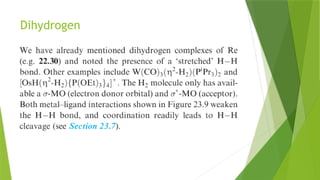
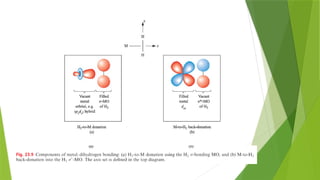
Part A:TOPICS:
Introduction
Ligands: bonding and spectroscopy
18-electron rule
Metalcarbonyls
Isolobal principle
Electron counting schemes
Types of organometallic reactions
3.
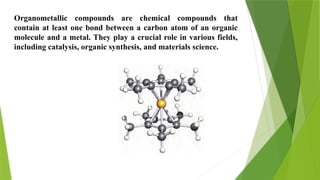
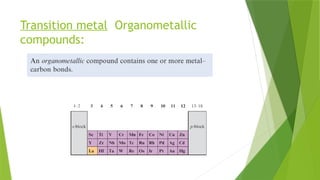
Organometallic compounds arechemical compounds that
contain at least one bond between a carbon atom of an organic
molecule and a metal. They play a crucial role in various fields,
including catalysis, organic synthesis, and materials science.
4.
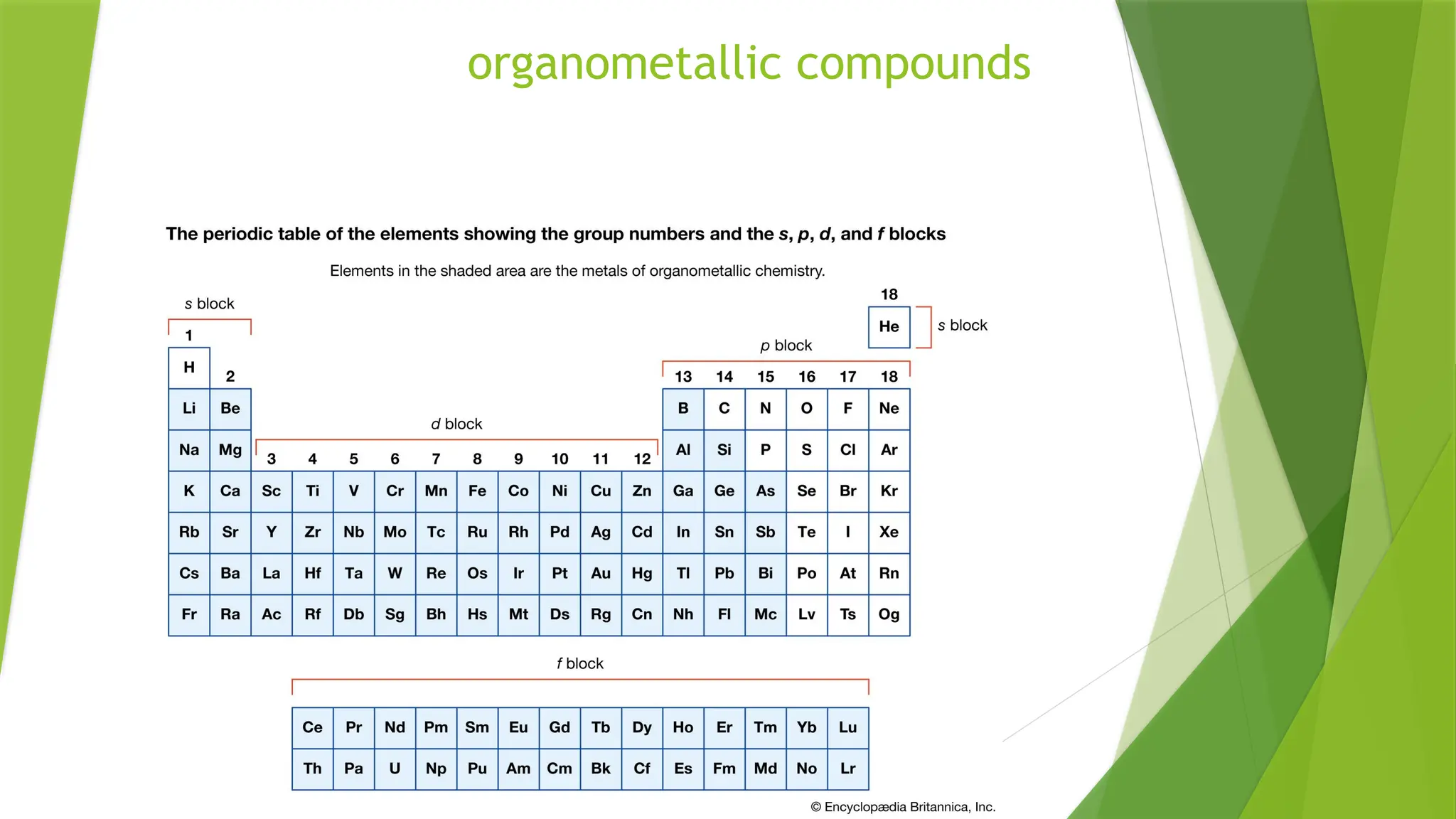
Organometallic compounds aretypically discussed in
terms of the metal as either:
main-group compounds: The main-group metals of organometallic
compounds are typically considered to be those of the S-block (groups 1
and 2) and the heavier elements of the p-block (groups 13–15) in the
periodic table of elements.
transition metal compounds. The transition metals include those
elements in the d- and f-blocks (groups 3–12).
5.
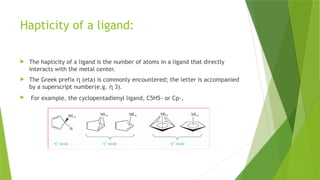
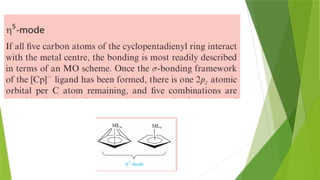
Hapticity of aligand:
The hapticity of a ligand is the number of atoms in a ligand that directly
interacts with the metal center.
The Greek prefix ղ (eta) is commonly encountered; the letter is accompanied
by a superscript number(e.g. ղ 3).
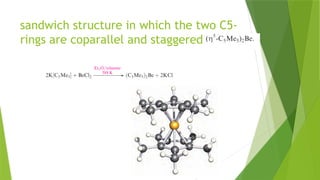
For example, the cyclopentadienyl ligand, C5H5- or Cp-,
6.
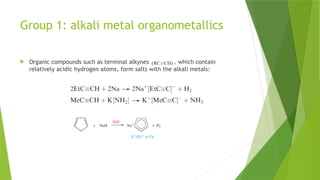
Group 1: alkalimetal organometallics
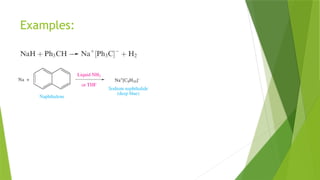
Organic compounds such as terminal alkynes , which contain
relatively acidic hydrogen atoms, form salts with the alkali metals:
7.
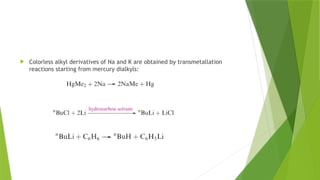
Colorless alkylderivatives of Na and K are obtained by transmetallation
reactions starting from mercury dialkyls:
Organolithium compounds importance
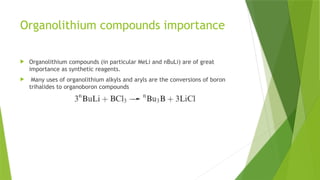
Organolithium compounds (in particular MeLi and nBuLi) are of great
importance as synthetic reagents.
Many uses of organolithium alkyls and aryls are the conversions of boron
trihalides to organoboron compounds
10.
Group 2organometallics
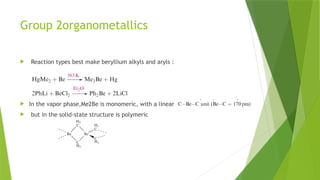
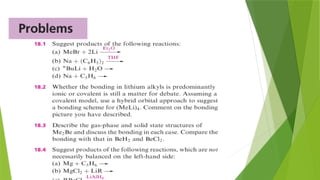
Reactiontypes best make beryllium alkyls and aryls :
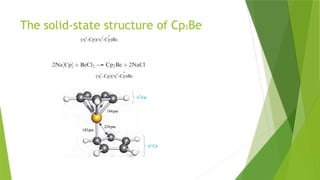
In the vapor phase,Me2Be is monomeric, with a linear
but in the solid-state structure is polymeric
Magnesium
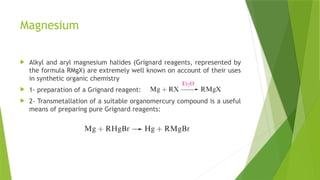
Alkyl andaryl magnesium halides (Grignard reagents, represented by
the formula RMgX) are extremely well known on account of their uses
in synthetic organic chemistry
1- preparation of a Grignard reagent:
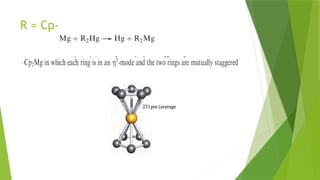
2- Transmetallation of a suitable organomercury compound is a useful
means of preparing pure Grignard reagents:
Common types ofligand: bonding and spectroscopy
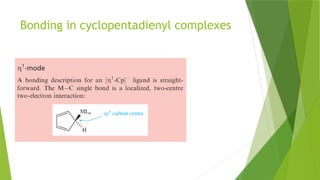
1-σ -Bonded alkyl, aryl, and related ligands
In complexes such as WMe6, [MoMe7] , TiMe4, and MeMn(CO)5,
the M-C-Me bond can be described as a localized 2c-2e interaction,
i.e., it parallels that for the [ղ1-Cp ligand], the Fe -CPh, Fe- CCHO
bond.
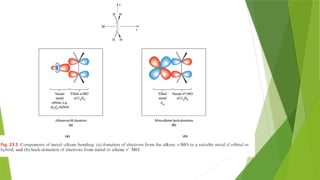
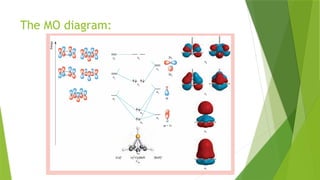
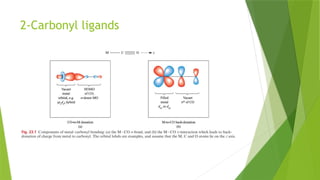
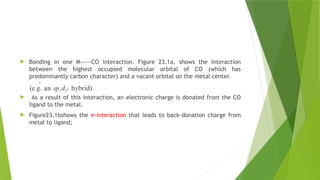
Bonding inone M-----CO interaction. Figure 23.1a, shows the interaction
between the highest occupied molecular orbital of CO (which has
predominantly carbon character) and a vacant orbital on the metal center.
As a result of this interaction, an electronic charge is donated from the CO
ligand to the metal.
Figure23.1bshows the π-interaction that leads to back-donation charge from
metal to ligand;
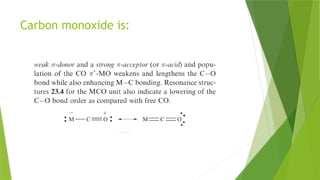
The traditionalbonding model for an MCO
interaction emphasizes OC M-donation
and significant M CO- back-donation
leading to C –O bond weakening and a
concomitant lowering of CO.H
25.
synergic effect
“Theinterplay of donation and back-donation of electronic charge
between a metal and an acceptor ligand is an example .”
Evidence for alowering of the C-O bond
The IR spectrum of free CO, an absorption at 2143 cm-1 is assigned to the C-
O stretching mode
The lower the value of CO, the weaker the C-O bond, and this indicates
greater back-donation of charge from metal to CO
29.
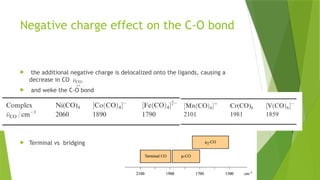
Negative charge effecton the C-O bond
the additional negative charge is delocalized onto the ligands, causing a
decrease in CO
and weke the C-O bond
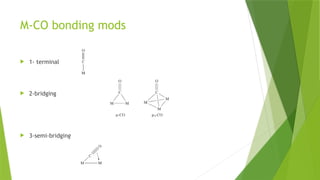
Terminal vs bridging
30.
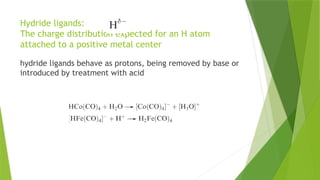
Hydride ligands:
The chargedistribution expected for an H atom
attached to a positive metal center
hydride ligands behave as protons, being removed by base or
introduced by treatment with acid
31.
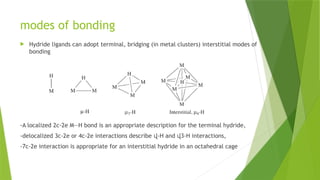
modes of bonding
Hydride ligands can adopt terminal, bridging (in metal clusters) interstitial modes of
bonding
-A localized 2c-2e M—H bond is an appropriate description for the terminal hydride,
-delocalized 3c-2e or 4c-2e interactions describe վ-H and վ3-H interactions,
-7c-2e interaction is appropriate for an interstitial hydride in an octahedral cage
32.
Phosphine and relatedligands: are σ-donor and π-acceptor
ligands
Monodentate organa phosphines may be tertiary (PR3),
secondary (PR2H) or primary (PRH2) and are terminally bound;
PF3 behaves similarly. Bridging modes can be adopted by [PR2]-
or [PR]-2 ligands.
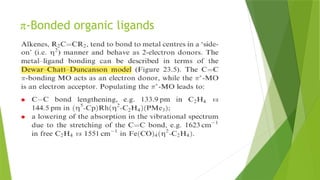
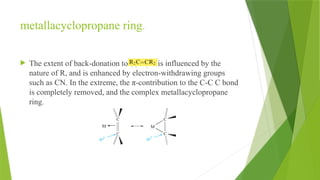
metallacyclopropane ring.
Theextent of back-donation to is influenced by the
nature of R, and is enhanced by electron-withdrawing groups
such as CN. In the extreme, the π-contribution to the C-C C bond
is completely removed, and the complex metallacyclopropane
ring.
37.
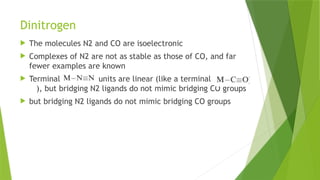
Dinitrogen
The moleculesN2 and CO are isoelectronic
Complexes of N2 are not as stable as those of CO, and far
fewer examples are known
Terminal units are linear (like a terminal
), but bridging N2 ligands do not mimic bridging CO groups
but bridging N2 ligands do not mimic bridging CO groups
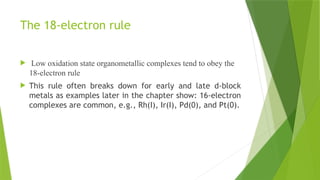
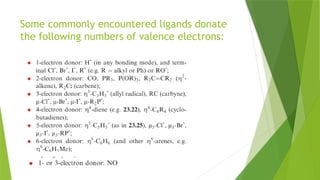
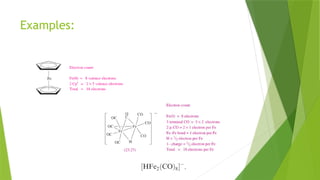
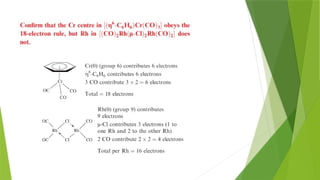
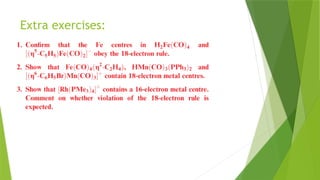
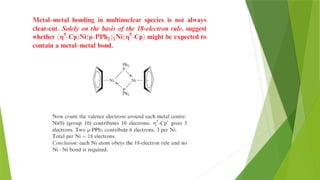
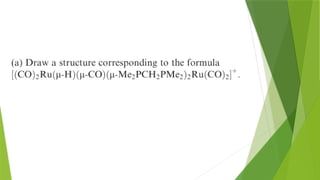
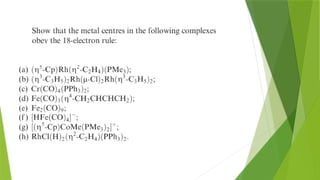
The 18-electron rule
Low oxidation state organometallic complexes tend to obey the
18-electron rule
This rule often breaks down for early and late d-block
metals as examples later in the chapter show: 16-electron
complexes are common, e.g., Rh(I), Ir(I), Pd(0), and Pt(0).
Naming organometallic compoundsfollows specific
conventions based on IUPAC guidelines.
Basic Principles:
Identify the metal and the organic groups attached.
Use the metal's name as a prefix or suffix, depending on its position in the compound.
Number the carbon atoms in the organic ligand to indicate their attachment to the metal.
Common Naming Conventions:
Simple Organometallics: Name the organic ligand first, followed by the metal. For example,
in methyl lithium (CH3Li), "methyl" is the organic part, and "lithium" is the metal.
Complex Ligands: Use prefixes (di-, tri-, etc.) for multiple identical ligands. For example, in
(C2H5)2Zn, it is named diethylzinc.
Anionic Ligands: If the organic group is an anion, use the suffix "-ide" or "-ate" as
appropriate. For example, in sodium methoxide (NaOCH3), "methoxide" indicates the
anionic form of methanol.
52.
Special Cases:
Bidentate and Polydentate Ligands: Name the ligand with its full name,
indicating its binding sites. For example, ethylenediamine is a bidentate
ligand.
Metal Oxidation States: Indicate the oxidation state of the metal in Roman
numerals in parentheses. For example, in iron(III) acetylacetonate, the iron is
in the +3 oxidation state.

![Common types of ligand: bonding and spectroscopy
1-σ -Bonded alkyl, aryl, and related ligands
In complexes such as WMe6, [MoMe7] , TiMe4, and MeMn(CO)5,
the M-C-Me bond can be described as a localized 2c-2e interaction,
i.e., it parallels that for the [ղ1-Cp ligand], the Fe -CPh, Fe- CCHO
bond.](https://image.slidesharecdn.com/introductiontoorganometalliccompound-251226123152-5400ac0f/85/Introduction-to-organometallic-compound-pptx-20-320.jpg)

![Phosphine and related ligands: are σ-donor and π-acceptor
ligands
Monodentate organa phosphines may be tertiary (PR3),
secondary (PR2H) or primary (PRH2) and are terminally bound;
PF3 behaves similarly. Bridging modes can be adopted by [PR2]-
or [PR]-2 ligands.](https://image.slidesharecdn.com/introductiontoorganometalliccompound-251226123152-5400ac0f/85/Introduction-to-organometallic-compound-pptx-32-320.jpg)