- 1 -
These Notes are copyright Alex Moss 2003. They may be reproduced without need for permission.
www.alchemyst.f2o.org
GENERAL ORGANOMETALLICS NOTES
The 18 Electron Rule
The 18 electron rule comes about in a similar way to the octet rule encountered for p
block compounds, where a model of filling all bonding orbitals gives a stable compound.
It states that “Stable organometallic complexes are formed when the sum of the neutral
metal valence electrons plus the sum of the electrons considered to be donated by the
ligand (and taking into account any net charge) equals eighteen”.
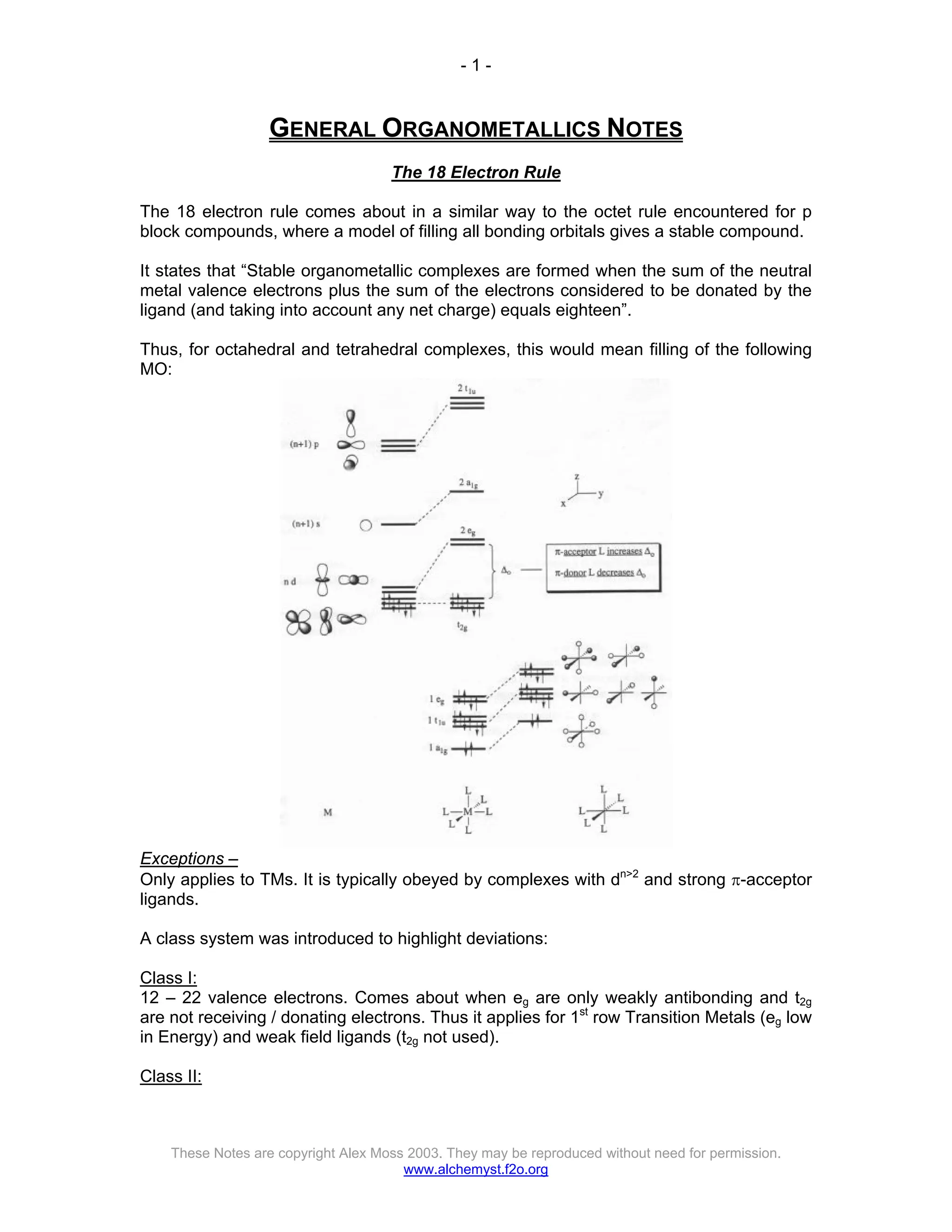
Thus, for octahedral and tetrahedral complexes, this would mean filling of the following
MO:
Exceptions –
Only applies to TMs. It is typically obeyed by complexes with dn>2
and strong π-acceptor
ligands.
A class system was introduced to highlight deviations:
Class I:
12 – 22 valence electrons. Comes about when eg are only weakly antibonding and t2g
are not receiving / donating electrons. Thus it applies for 1st
row Transition Metals (eg low
in Energy) and weak field ligands (t2g not used).
Class II:
- 2 -
These Notes are copyright Alex Moss 2003. They may be reproduced without need for permission.
www.alchemyst.f2o.org
Up to 18 valence electrons. eg now too high in energy to be used, so common for 2nd
/3rd
row TM’s and strong field ligands (good σ-donors).
Class III:
Obey 18 electron rule. t2g are π-bonding (occupied) with eg strongly antibonding. This is
the vast majority for Organometallic TM’s.
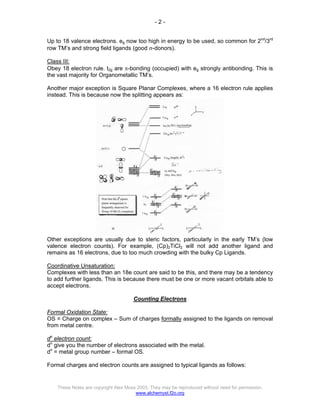
Another major exception is Square Planar Complexes, where a 16 electron rule applies
instead. This is because now the splitting appears as:
Other exceptions are usually due to steric factors, particularly in the early TM’s (low
valence electron counts). For example, (Cp)2TiCl2 will not add another ligand and
remains as 16 electrons, due to too much crowding with the bulky Cp Ligands.
Coordinative Unsaturation:
Complexes with less than an 18e count are said to be this, and there may be a tendency
to add further ligands. This is because there must be one or more vacant orbitals able to
accept electrons.
Counting Electrons
Formal Oxidation State:
OS = Charge on complex – Sum of charges formally assigned to the ligands on removal
from metal centre.
dn
electron count:
dn
give you the number of electrons associated with the metal.
dn
= metal group number – formal OS.
Formal charges and electron counts are assigned to typical ligands as follows:
- 3 -
These Notes are copyright Alex Moss 2003. They may be reproduced without need for permission.
www.alchemyst.f2o.org
LIGAND ELECTRONS CHARGE
Alkyl 1 -1
Aryl 1 -1
Hydride 1 -1
Alkene 2 0
Alkyne 2 or 4 0 or -2
Allyl 1 or 3 -1
Cyclo CnHn Depends on η
n = 5 => -1
n = 6 => 0
n = 7 => +1 or -3
n = 8 => -2
Carbene 2 0 (Fischer) or -2 (Schrock)
Carbyne 3 0 or -3
Carbonyl 2 0
Nitrosyl* 1 (bent) or 3 (linear) -1 (bent) or +1 (linear)
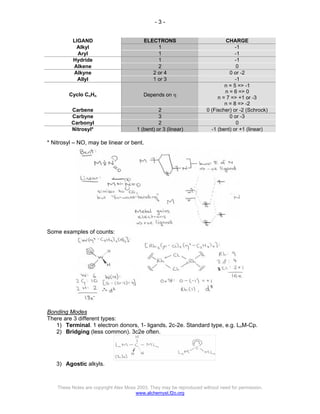
* Nitrosyl – NO, may be linear or bent.
Some examples of counts:
Bonding Modes
There are 3 different types:
1) Terminal. 1 electron donors, 1- ligands, 2c-2e. Standard type, e.g. LnM-Cp.
2) Bridging (less common). 3c2e often.
3) Agostic alkyls.
- 4 -
These Notes are copyright Alex Moss 2003. They may be reproduced without need for permission.
www.alchemyst.f2o.org
Alkyls
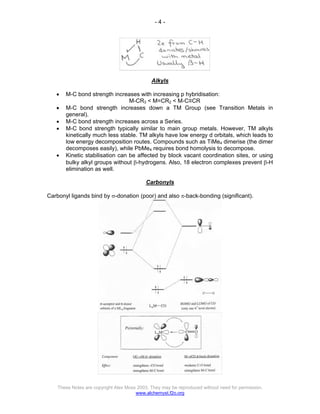
• M-C bond strength increases with increasing p hybridisation:
M-CR3 < M=CR2 < M-C≡CR
• M-C bond strength increases down a TM Group (see Transition Metals in
general).
• M-C bond strength increases across a Series.
• M-C bond strength typically similar to main group metals. However, TM alkyls
kinetically much less stable. TM alkyls have low energy d orbitals, which leads to
low energy decomposition routes. Compounds such as TiMe4 dimerise (the dimer
decomposes easily), while PbMe4 requires bond homolysis to decompose.
• Kinetic stabilisation can be affected by block vacant coordination sites, or using
bulky alkyl groups without β-hydrogens. Also, 18 electron complexes prevent β-H
elimination as well.
Carbonyls
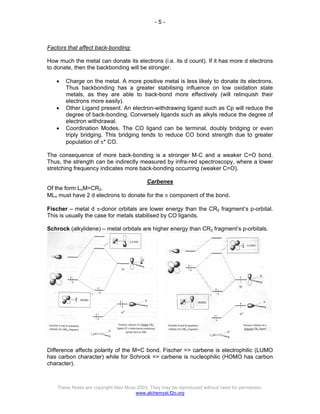
Carbonyl ligands bind by σ-donation (poor) and also π-back-bonding (significant).
- 5 -
These Notes are copyright Alex Moss 2003. They may be reproduced without need for permission.
www.alchemyst.f2o.org
Factors that affect back-bonding:
How much the metal can donate its electrons (i.e. its d count). If it has more d electrons
to donate, then the backbonding will be stronger.
• Charge on the metal. A more positive metal is less likely to donate its electrons.
Thus backbonding has a greater stabilising influence on low oxidation state
metals, as they are able to back-bond more effectively (will relinquish their
electrons more easily).
• Other Ligand present. An electron-withdrawing ligand such as Cp will reduce the
degree of back-bonding. Conversely ligands such as alkyls reduce the degree of
electron withdrawal.
• Coordination Modes. The CO ligand can be terminal, doubly bridging or even
triply bridging. This bridging tends to reduce CO bond strength due to greater
population of π* CO.
The consequence of more back-bonding is a stronger M-C and a weaker C=O bond.
Thus, the strength can be indirectly measured by infra-red spectroscopy, where a lower
stretching frequency indicates more back-bonding occurring (weaker C=O).
Carbenes
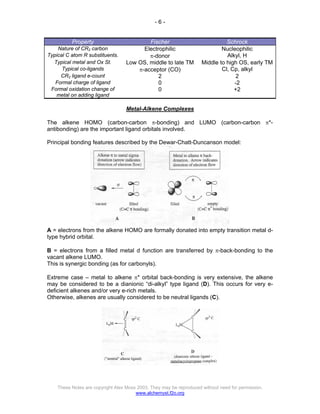
Of the form LnM=CR2.
MLn must have 2 d electrons to donate for the π component of the bond.
Fischer – metal d π-donor orbitals are lower energy than the CR2 fragment’s p-orbital.
This is usually the case for metals stabilised by CO ligands.
Schrock (alkylidene) – metal orbitals are higher energy than CR2 fragment’s p-orbitals.
Difference affects polarity of the M=C bond. Fischer => carbene is electrophilic (LUMO
has carbon character) while for Schrock => carbene is nucleophilic (HOMO has carbon
character).
- 6 -
These Notes are copyright Alex Moss 2003. They may be reproduced without need for permission.
www.alchemyst.f2o.org
Property Fischer Schrock
Nature of CR2 carbon Electrophilic Nucleophilic
Typical C atom R substituents. π-donor Alkyl, H
Typical metal and Ox St. Low OS, middle to late TM Middle to high OS, early TM
Typical co-ligands π-acceptor (CO) Cl, Cp, alkyl
CR2 ligand e-count 2 2
Formal charge of ligand 0 -2
Formal oxidation change of
metal on adding ligand
0 +2
Metal-Alkene Complexes
The alkene HOMO (carbon-carbon π-bonding) and LUMO (carbon-carbon π*-
antibonding) are the important ligand orbitals involved.
Principal bonding features described by the Dewar-Chatt-Duncanson model:
A = electrons from the alkene HOMO are formally donated into empty transition metal d-
type hybrid orbital.
B = electrons from a filled metal d function are transferred by π-back-bonding to the
vacant alkene LUMO.
This is synergic bonding (as for carbonyls).
Extreme case – metal to alkene π* orbital back-bonding is very extensive, the alkene
may be considered to be a dianionic “di-alkyl” type ligand (D). This occurs for very e-
deficient alkenes and/or very e-rich metals.
Otherwise, alkenes are usually considered to be neutral ligands (C).
- 7 -
These Notes are copyright Alex Moss 2003. They may be reproduced without need for permission.
www.alchemyst.f2o.org
Sandwich Compounds
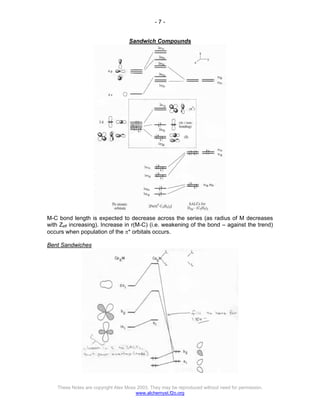
M-C bond length is expected to decrease across the series (as radius of M decreases
with Zeff increasing). Increase in r(M-C) (i.e. weakening of the bond – against the trend)
occurs when population of the π* orbitals occurs.
Bent Sandwiches
- 8 -
These Notes are copyright Alex Moss 2003. They may be reproduced without need for permission.
www.alchemyst.f2o.org
The consequence of this is that all bonding interactions are in the equatorial plane.
Mechanisms and Reaction Types
Association and Dissociation:
[M] + L Æ [M]-L
Typically results in the valence electron count increasing by 2, but Oxidation State and
d-count remain the same.
Substitution:
[M]-L + L’ Æ [M]-L’ + L
Net no change in valence electrons, d-count or Oxidation State. Typically proceeds via
first Dissociation, since a 20e intermediate would be highly unstable (occupation of σ*
orbitals required).
Oxidation and Reduction:
Gain or loss of electrons. For oxidation, leads to change in valence electron count (-1),
oxidation state (+1) and d-count (-1).
Migratory Insertion
[M]-A + B Æ [M]-B-A
No net change in electron counts or oxidation states. Classic Example: Me insertion into
Mn carbonyl compound. Proceeds via migration of ligand, then insertion of B.
Formal Definition:
Insertion of an unsaturated ligand (Y) into an adjacent M-X bond.
Mn+
dn
[dn-2
] Mn+
dn
Y = CO, C2H4, C2H2, Benzene, Cyclopentadienyl
X = H, R, Ar, C(O)R
L = Lewis Base, Solvent, PR3, NR3, R2O
- 9 -
These Notes are copyright Alex Moss 2003. They may be reproduced without need for permission.
www.alchemyst.f2o.org
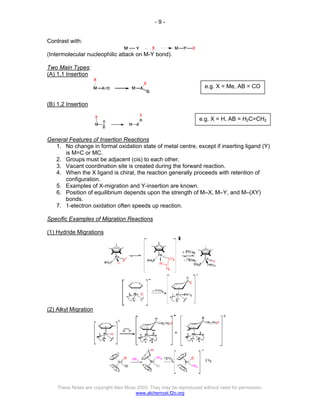
Contrast with:
(Intermolecular nucleophilic attack on M-Y bond).
Two Main Types:
(A) 1,1 Insertion
(B) 1,2 Insertion
General Features of Insertion Reactions
1. No change in formal oxidation state of metal centre, except if inserting ligand (Y)
is M=C or MC.
2. Groups must be adjacent (cis) to each other.
3. Vacant coordination site is created during the forward reaction.
4. When the X ligand is chiral, the reaction generally proceeds with retention of
configuration.
5. Examples of X-migration and Y-insertion are known.
6. Position of equilibrium depends upon the strength of M–X, M–Y, and M–(XY)
bonds.
7. 1-electron oxidation often speeds up reaction.
Specific Examples of Migration Reactions
(1) Hydride Migrations
(2) Alkyl Migration
e.g. X = Me, AB = CO
e.g. X = H, AB = H2C=CH2
- 10 -
These Notes are copyright Alex Moss 2003. They may be reproduced without need for permission.
www.alchemyst.f2o.org
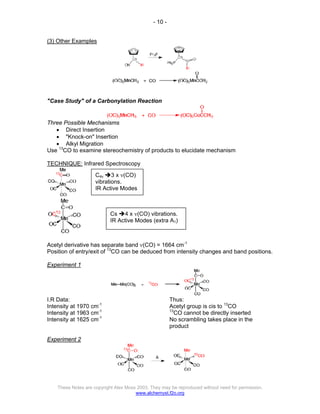
(3) Other Examples
"Case Study" of a Carbonylation Reaction
Three Possible Mechanisms
• Direct Insertion
• "Knock-on" Insertion
• Alkyl Migration
Use 13
CO to examine stereochemistry of products to elucidate mechanism
TECHNIQUE: Infrared Spectroscopy
Acetyl derivative has separate band ν(CO) = 1664 cm-1
Position of entry/exit of 13
CO can be deduced from intensity changes and band positions.
Experiment 1
I.R Data:
Intensity at 1970 cm-1
Intensity at 1963 cm-1
Intensity at 1625 cm-1
Thus:
Acetyl group is cis to 13
CO
13
CO cannot be directly inserted
No scrambling takes place in the
product
Experiment 2
C4v Î3 x ν(CO)
vibrations.
IR Active Modes
Cs Î4 x ν(CO) vibrations.
IR Active Modes (extra A1)
- 11 -
These Notes are copyright Alex Moss 2003. They may be reproduced without need for permission.
www.alchemyst.f2o.org
Result 100% cis product
Does not prove either carbonyl insertion or methyl migration.
Experiment 3
Result: Trans
1
Cis
2
Proved using intensities of 1976 cm-1
(cis) and 1949 cm-1
(trans) in I.R. spectrum
• Only migration can give correct product distribution.
• Cannot get trans isomer by de-insertion of CO.
Rate Law for Carbonylation Reaction
Under Normal conditions the following rates are observed
k1 is rate determining, i.e. 1st Order in alkyl–Mn
0th
Order in L (incoming ligand)
if k2 is >>> k-2, then,
High [L]: First order in starting material
Low [L]: Mixed order kinetics
Rate constants are found to be identical for the substitution of CO in Me-CO-Mn(CO)5
and for the decarbonylation of the acetyl compound, i.e. they have the same rate
determining step.
Rate accelerated by Lewis Acid catalysis, e.g. H+
, AlCl3, BF3.
Lewis acids are presumed to stabilise Transition state as shown:
- 12 -
These Notes are copyright Alex Moss 2003. They may be reproduced without need for permission.
www.alchemyst.f2o.org
General Observations of Stereospecificity
Metal Centre
Carbon Centre
Oxidative Addition
[M] + A-B Æ [M](A)(B)
Valence electron count increases by 2, as does Oxidation State. d-count reduces by 2.
Requirements for the Metal Complex
• Metal centre must be d2
or greater.
• Metal centre must be coordinatively unsaturated.
• Metal must have appropriate both empty and vacant orbitals.
Transition Metal Example:
Non-transition Metal Examples:
• Me—Br + Mg Æ Me—Mg—Br
• PF3 + F2 Æ PF5
• SnCl2 + Cl2 Æ SnCl4
- 13 -
These Notes are copyright Alex Moss 2003. They may be reproduced without need for permission.
www.alchemyst.f2o.org
Carbon-Hydrogen Bond Activation
Note: Reaction proceeds faster for C6H6 versus CH4 but Ph—H bond stronger then
CH3—H bond
Kinetic Rate Laws for Oxidative Addition Reactions
(1) d8
Square planar Complexes
e.g. Oxidative addition of XY to IrCl(CO)(PPh3)2 (Vaska's complex)
we observe:
Rate = k2[Ir(I)][XY]
• Simple 2nd Order Kinetics
• Characteristic of Coordinatively Unsaturated systems
(2) d8
Trigonal Bipyramidal Complexes
e.g. Oxidative addition of XY to IrH(CO)(PPh3)3
we observe:
• Characteristic of Coordinatively Saturated complexes
• consistent with the following scheme:
- 14 -
These Notes are copyright Alex Moss 2003. They may be reproduced without need for permission.
www.alchemyst.f2o.org
Note: Reaction is retarded by extra phosphine.
Mechanisms of Oxidative Addition Reactions
• No single mechanism holds for all oxidative-addition reactions.
• 3 main mechanism have been observed depending on the reactants, and conditions.
Types:
(a) Concerted.
(b) (i) Nucleophillic Attack (SN2).
(ii) Ionic Mechanism.
(c) Radical Reaction.
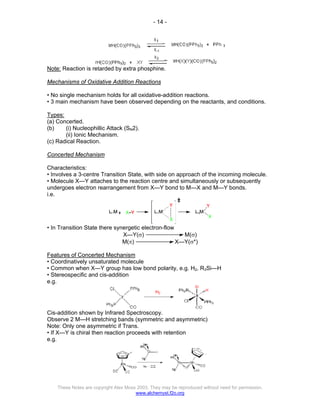
Concerted Mechanism
Characteristics:
• Involves a 3-centre Transition State, with side on approach of the incoming molecule.
• Molecule X—Y attaches to the reaction centre and simultaneously or subsequently
undergoes electron rearrangement from X—Y bond to M—X and M—Y bonds.
i.e.
• In Transition State there synergetic electron-flow
X—Y(σ) M(σ)
M(π) X—Y(σ*)
Features of Concerted Mechanism
• Coordinatively unsaturated molecule
• Common when X—Y group has low bond polarity, e.g. H2, R3Si—H
• Stereospecific and cis-addition
e.g.
Cis-addition shown by Infrared Spectroscopy.
Observe 2 M—H stretching bands (symmetric and asymmetric)
Note: Only one asymmetric if Trans.
• If X—Y is chiral then reaction proceeds with retention
e.g.
- 15 -
These Notes are copyright Alex Moss 2003. They may be reproduced without need for permission.
www.alchemyst.f2o.org
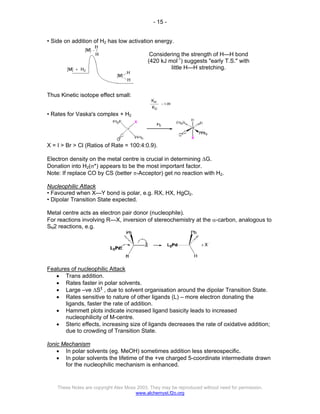
• Side on addition of H2 has low activation energy.
Considering the strength of H—H bond
(420 kJ mol-1
) suggests "early T.S." with
little H—H stretching.
Thus Kinetic isotope effect small:
• Rates for Vaska's complex + H2
X = I > Br > Cl (Ratios of Rate = 100:4:0.9).
Electron density on the metal centre is crucial in determining ∆G.
Donation into H2(σ*) appears to be the most important factor.
Note: If replace CO by CS (better π-Acceptor) get no reaction with H2.
Nucleophilic Attack
• Favoured when X—Y bond is polar, e.g. RX, HX, HgCl2.
• Dipolar Transition State expected.
Metal centre acts as electron pair donor (nucleophile).
For reactions involving R—X, inversion of stereochemistry at the α-carbon, analogous to
SN2 reactions, e.g.
Features of nucleophilic Attack
• Trans addition.
• Rates faster in polar solvents.
• Large –ve ∆S‡
, due to solvent organisation around the dipolar Transition State.
• Rates sensitive to nature of other ligands (L) – more electron donating the
ligands, faster the rate of addition.
• Hammett plots indicate increased ligand basicity leads to increased
nucleophilicity of M-centre.
• Steric effects, increasing size of ligands decreases the rate of oxidative addition;
due to crowding of Transition State.
Ionic Mechanism
• In polar solvents (eg. MeOH) sometimes addition less stereospecific.
• In polar solvents the lifetime of the +ve charged 5-coordinate intermediate drawn
for the nucleophilic mechanism is enhanced.
- 16 -
These Notes are copyright Alex Moss 2003. They may be reproduced without need for permission.
www.alchemyst.f2o.org
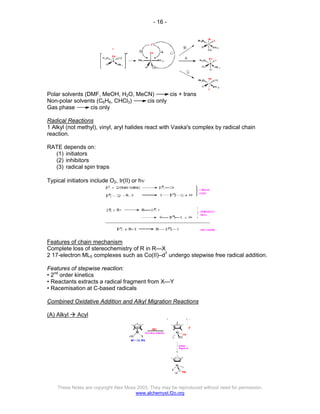
Polar solvents (DMF, MeOH, H2O, MeCN) cis + trans
Non-polar solvents (C6H6, CHCl3) cis only
Gas phase cis only
Radical Reactions
1 Alkyl (not methyl), vinyl, aryl halides react with Vaska's complex by radical chain
reaction.
RATE depends on:
(1) initiators
(2) inhibitors
(3) radical spin traps
Typical initiators include O2, Ir(II) or hν
Features of chain mechanism
Complete loss of stereochemistry of R in R—X
2 17-electron ML5 complexes such as Co(II)–d7
undergo stepwise free radical addition.
Features of stepwise reaction:
• 2nd
order kinetics
• Reactants extracts a radical fragment from X—Y
• Racemisation at C-based radicals
Combined Oxidative Addition and Alkyl Migration Reactions
(A) Alkyl Æ Acyl
- 17 -
These Notes are copyright Alex Moss 2003. They may be reproduced without need for permission.
www.alchemyst.f2o.org
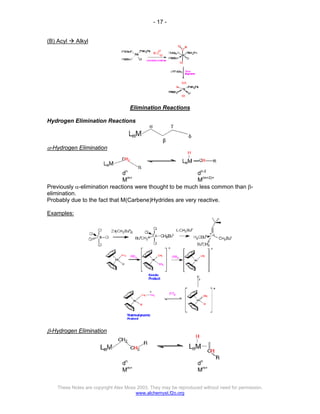
(B) Acyl Æ Alkyl
Elimination Reactions
Hydrogen Elimination Reactions
α-Hydrogen Elimination
dn
dn-2
Mm+
M(m+2)+
Previously α-elimination reactions were thought to be much less common than β-
elimination.
Probably due to the fact that M(Carbene)Hydrides are very reactive.
Examples:
β-Hydrogen Elimination
dn
dn
Mm+
Mm+
- 18 -
These Notes are copyright Alex Moss 2003. They may be reproduced without need for permission.
www.alchemyst.f2o.org
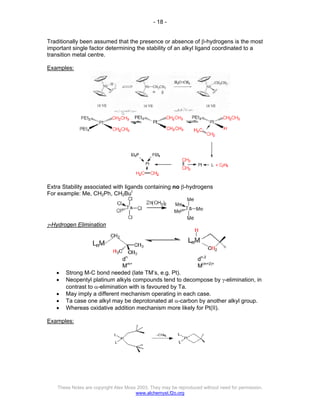
Traditionally been assumed that the presence or absence of β-hydrogens is the most
important single factor determining the stability of an alkyl ligand coordinated to a
transition metal centre.
Examples:
Extra Stability associated with ligands containing no β-hydrogens
For example: Me, CH2Ph, CH2But
γ-Hydrogen Elimination
dn
dn-2
Mm+
M(m+2)+
• Strong M-C bond needed (late TM’s, e.g. Pt).
• Neopentyl platinum alkyls compounds tend to decompose by γ-elimination, in
contrast to α-elimination with is favoured by Ta.
• May imply a different mechanism operating in each case.
• Ta case one alkyl may be deprotonated at α-carbon by another alkyl group.
• Whereas oxidative addition mechanism more likely for Pt(II).
Examples:
- 19 -
These Notes are copyright Alex Moss 2003. They may be reproduced without need for permission.
www.alchemyst.f2o.org
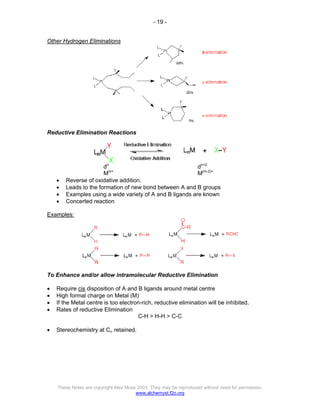
Other Hydrogen Eliminations
Reductive Elimination Reactions
dn
dn+2
Mm+
M(m-2)+
• Reverse of oxidative addition.
• Leads to the formation of new bond between A and B groups
• Examples using a wide variety of A and B ligands are known
• Concerted reaction
Examples:
To Enhance and/or allow intramolecular Reductive Elimination
• Require cis disposition of A and B ligands around metal centre
• High formal charge on Metal (M)
• If the Metal centre is too electron-rich, reductive elimination will be inhibited.
• Rates of reductive Elimination
C-H > H-H > C-C
• Stereochemistry at Cα retained.
- 20 -
These Notes are copyright Alex Moss 2003. They may be reproduced without need for permission.
www.alchemyst.f2o.org
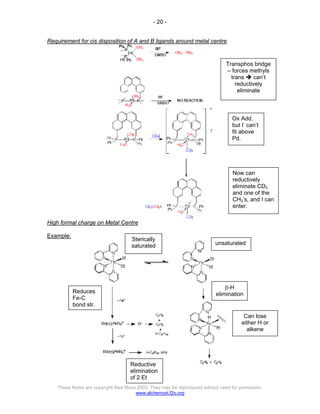
Requirement for cis disposition of A and B ligands around metal centre
High formal charge on Metal Centre
Example:
Transphos bridge
– forces methyls
trans Î can’t
reductively
eliminate
Ox Add,
but I-
can’t
fit above
Pd.
Now can
reductively
eliminate CD3
and one of the
CH3’s, and I can
enter.
Sterically
saturated unsaturated
β-H
elimination
Can lose
either H or
alkene
Reductive
elimination
of 2 Et
Reduces
Fe-C
bond str.
- 21 -
These Notes are copyright Alex Moss 2003. They may be reproduced without need for permission.
www.alchemyst.f2o.org
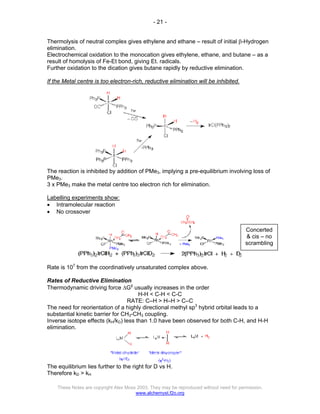
Thermolysis of neutral complex gives ethylene and ethane – result of initial β-Hydrogen
elimination.
Electrochemical oxidation to the monocation gives ethylene, ethane, and butane – as a
result of homolysis of Fe-Et bond, giving Et. radicals.
Further oxidation to the dication gives butane rapidly by reductive elimination.
If the Metal centre is too electron-rich, reductive elimination will be inhibited.
The reaction is inhibited by addition of PMe3, implying a pre-equilibrium involving loss of
PMe3.
3 x PMe3 make the metal centre too electron rich for elimination.
Labelling experiments show:
• Intramolecular reaction
• No crossover
Rate is 107
from the coordinatively unsaturated complex above.
Rates of Reductive Elimination
Thermodynamic driving force ∆G‡
usually increases in the order
H-H < C-H < C-C
RATE: C–H > H–H > C–C
The need for reorientation of a highly directional methyl sp3
hybrid orbital leads to a
substantial kinetic barrier for CH3-CH3 coupling.
Inverse isotope effects (kH/kD) less than 1.0 have been observed for both C-H, and H-H
elimination.
The equilibrium lies further to the right for D vs H.
Therefore kD > kH
Concerted
& cis – no
scrambling
- 22 -
These Notes are copyright Alex Moss 2003. They may be reproduced without need for permission.
www.alchemyst.f2o.org
Molecular Dihydrogen Complexes
Experimental Evidence:
Neutron Diffraction
(time-consuming method)
Solution NMR
(modern method)
d(H—H) = 0.84 Å
JHD ca. 30 Hz
JHH ca. 30 x 6.66
compare d(H2) = 0.74 Å compare J(H2) ca. 300 Hz
Other examples
Dihydrogen-Dihydride Exchange:
Nucleophilic Attack on Ligand
[M]-A + B Æ [M]-A-B
An example would be attack on Cp (complex net charged) by MeLi, or attack on an
alkene (complex net charged) by H-
.
Syntheses
Alkyls –
a) Transmetallation. Use Mg / Li reagents.
b) Carbonylate anions, [LnM(CO)x]n-
act as nucleophiles to attack e.g. MeI.
c) Form metal hydrides (then use these to attack alkenes and β-eliminate).
d) Oxidative Addition – using e.g. MeI and 16e compound.
Carbonyls –
a) metal + CO – needs low enthalpy of atomisation. Works only for Ni and Fe.
b) Metal halide/salt + reducing agent + CO, e.g. CrCl3 + Al + 6CO gives Cr(CO)6 +
AlCl3.
Sandwich –
Arenes:
a) Fischer-Hafner. Ring + MCl3 + Al + NO2S2O4. Works for 1st
row TMs only.
b) Metal atom / vapour. M(s) + electron gun, then add rings to M (atoms). Works for
M = Ti, Nb, W, Mo + some lanthanides. Helps if R substituents on ring.
Cyclopentadienes:
Easier to make since Cp(-) has degree of ionic interaction. Use salt-elimination routes
from NaCp / LiCp* + metal halide.

Organometallics Lecture Notes by Chemistry

  • 1.
    - 1 - TheseNotes are copyright Alex Moss 2003. They may be reproduced without need for permission. www.alchemyst.f2o.org GENERAL ORGANOMETALLICS NOTES The 18 Electron Rule The 18 electron rule comes about in a similar way to the octet rule encountered for p block compounds, where a model of filling all bonding orbitals gives a stable compound. It states that “Stable organometallic complexes are formed when the sum of the neutral metal valence electrons plus the sum of the electrons considered to be donated by the ligand (and taking into account any net charge) equals eighteen”. Thus, for octahedral and tetrahedral complexes, this would mean filling of the following MO: Exceptions – Only applies to TMs. It is typically obeyed by complexes with dn>2 and strong π-acceptor ligands. A class system was introduced to highlight deviations: Class I: 12 – 22 valence electrons. Comes about when eg are only weakly antibonding and t2g are not receiving / donating electrons. Thus it applies for 1st row Transition Metals (eg low in Energy) and weak field ligands (t2g not used). Class II:
  • 2.
    - 2 - TheseNotes are copyright Alex Moss 2003. They may be reproduced without need for permission. www.alchemyst.f2o.org Up to 18 valence electrons. eg now too high in energy to be used, so common for 2nd /3rd row TM’s and strong field ligands (good σ-donors). Class III: Obey 18 electron rule. t2g are π-bonding (occupied) with eg strongly antibonding. This is the vast majority for Organometallic TM’s. Another major exception is Square Planar Complexes, where a 16 electron rule applies instead. This is because now the splitting appears as: Other exceptions are usually due to steric factors, particularly in the early TM’s (low valence electron counts). For example, (Cp)2TiCl2 will not add another ligand and remains as 16 electrons, due to too much crowding with the bulky Cp Ligands. Coordinative Unsaturation: Complexes with less than an 18e count are said to be this, and there may be a tendency to add further ligands. This is because there must be one or more vacant orbitals able to accept electrons. Counting Electrons Formal Oxidation State: OS = Charge on complex – Sum of charges formally assigned to the ligands on removal from metal centre. dn electron count: dn give you the number of electrons associated with the metal. dn = metal group number – formal OS. Formal charges and electron counts are assigned to typical ligands as follows:
  • 3.
    - 3 - TheseNotes are copyright Alex Moss 2003. They may be reproduced without need for permission. www.alchemyst.f2o.org LIGAND ELECTRONS CHARGE Alkyl 1 -1 Aryl 1 -1 Hydride 1 -1 Alkene 2 0 Alkyne 2 or 4 0 or -2 Allyl 1 or 3 -1 Cyclo CnHn Depends on η n = 5 => -1 n = 6 => 0 n = 7 => +1 or -3 n = 8 => -2 Carbene 2 0 (Fischer) or -2 (Schrock) Carbyne 3 0 or -3 Carbonyl 2 0 Nitrosyl* 1 (bent) or 3 (linear) -1 (bent) or +1 (linear) * Nitrosyl – NO, may be linear or bent. Some examples of counts: Bonding Modes There are 3 different types: 1) Terminal. 1 electron donors, 1- ligands, 2c-2e. Standard type, e.g. LnM-Cp. 2) Bridging (less common). 3c2e often. 3) Agostic alkyls.
  • 4.
    - 4 - TheseNotes are copyright Alex Moss 2003. They may be reproduced without need for permission. www.alchemyst.f2o.org Alkyls • M-C bond strength increases with increasing p hybridisation: M-CR3 < M=CR2 < M-C≡CR • M-C bond strength increases down a TM Group (see Transition Metals in general). • M-C bond strength increases across a Series. • M-C bond strength typically similar to main group metals. However, TM alkyls kinetically much less stable. TM alkyls have low energy d orbitals, which leads to low energy decomposition routes. Compounds such as TiMe4 dimerise (the dimer decomposes easily), while PbMe4 requires bond homolysis to decompose. • Kinetic stabilisation can be affected by block vacant coordination sites, or using bulky alkyl groups without β-hydrogens. Also, 18 electron complexes prevent β-H elimination as well. Carbonyls Carbonyl ligands bind by σ-donation (poor) and also π-back-bonding (significant).
  • 5.
    - 5 - TheseNotes are copyright Alex Moss 2003. They may be reproduced without need for permission. www.alchemyst.f2o.org Factors that affect back-bonding: How much the metal can donate its electrons (i.e. its d count). If it has more d electrons to donate, then the backbonding will be stronger. • Charge on the metal. A more positive metal is less likely to donate its electrons. Thus backbonding has a greater stabilising influence on low oxidation state metals, as they are able to back-bond more effectively (will relinquish their electrons more easily). • Other Ligand present. An electron-withdrawing ligand such as Cp will reduce the degree of back-bonding. Conversely ligands such as alkyls reduce the degree of electron withdrawal. • Coordination Modes. The CO ligand can be terminal, doubly bridging or even triply bridging. This bridging tends to reduce CO bond strength due to greater population of π* CO. The consequence of more back-bonding is a stronger M-C and a weaker C=O bond. Thus, the strength can be indirectly measured by infra-red spectroscopy, where a lower stretching frequency indicates more back-bonding occurring (weaker C=O). Carbenes Of the form LnM=CR2. MLn must have 2 d electrons to donate for the π component of the bond. Fischer – metal d π-donor orbitals are lower energy than the CR2 fragment’s p-orbital. This is usually the case for metals stabilised by CO ligands. Schrock (alkylidene) – metal orbitals are higher energy than CR2 fragment’s p-orbitals. Difference affects polarity of the M=C bond. Fischer => carbene is electrophilic (LUMO has carbon character) while for Schrock => carbene is nucleophilic (HOMO has carbon character).
  • 6.
    - 6 - TheseNotes are copyright Alex Moss 2003. They may be reproduced without need for permission. www.alchemyst.f2o.org Property Fischer Schrock Nature of CR2 carbon Electrophilic Nucleophilic Typical C atom R substituents. π-donor Alkyl, H Typical metal and Ox St. Low OS, middle to late TM Middle to high OS, early TM Typical co-ligands π-acceptor (CO) Cl, Cp, alkyl CR2 ligand e-count 2 2 Formal charge of ligand 0 -2 Formal oxidation change of metal on adding ligand 0 +2 Metal-Alkene Complexes The alkene HOMO (carbon-carbon π-bonding) and LUMO (carbon-carbon π*- antibonding) are the important ligand orbitals involved. Principal bonding features described by the Dewar-Chatt-Duncanson model: A = electrons from the alkene HOMO are formally donated into empty transition metal d- type hybrid orbital. B = electrons from a filled metal d function are transferred by π-back-bonding to the vacant alkene LUMO. This is synergic bonding (as for carbonyls). Extreme case – metal to alkene π* orbital back-bonding is very extensive, the alkene may be considered to be a dianionic “di-alkyl” type ligand (D). This occurs for very e- deficient alkenes and/or very e-rich metals. Otherwise, alkenes are usually considered to be neutral ligands (C).
  • 7.
    - 7 - TheseNotes are copyright Alex Moss 2003. They may be reproduced without need for permission. www.alchemyst.f2o.org Sandwich Compounds M-C bond length is expected to decrease across the series (as radius of M decreases with Zeff increasing). Increase in r(M-C) (i.e. weakening of the bond – against the trend) occurs when population of the π* orbitals occurs. Bent Sandwiches
  • 8.
    - 8 - TheseNotes are copyright Alex Moss 2003. They may be reproduced without need for permission. www.alchemyst.f2o.org The consequence of this is that all bonding interactions are in the equatorial plane. Mechanisms and Reaction Types Association and Dissociation: [M] + L Æ [M]-L Typically results in the valence electron count increasing by 2, but Oxidation State and d-count remain the same. Substitution: [M]-L + L’ Æ [M]-L’ + L Net no change in valence electrons, d-count or Oxidation State. Typically proceeds via first Dissociation, since a 20e intermediate would be highly unstable (occupation of σ* orbitals required). Oxidation and Reduction: Gain or loss of electrons. For oxidation, leads to change in valence electron count (-1), oxidation state (+1) and d-count (-1). Migratory Insertion [M]-A + B Æ [M]-B-A No net change in electron counts or oxidation states. Classic Example: Me insertion into Mn carbonyl compound. Proceeds via migration of ligand, then insertion of B. Formal Definition: Insertion of an unsaturated ligand (Y) into an adjacent M-X bond. Mn+ dn [dn-2 ] Mn+ dn Y = CO, C2H4, C2H2, Benzene, Cyclopentadienyl X = H, R, Ar, C(O)R L = Lewis Base, Solvent, PR3, NR3, R2O
  • 9.
    - 9 - TheseNotes are copyright Alex Moss 2003. They may be reproduced without need for permission. www.alchemyst.f2o.org Contrast with: (Intermolecular nucleophilic attack on M-Y bond). Two Main Types: (A) 1,1 Insertion (B) 1,2 Insertion General Features of Insertion Reactions 1. No change in formal oxidation state of metal centre, except if inserting ligand (Y) is M=C or MC. 2. Groups must be adjacent (cis) to each other. 3. Vacant coordination site is created during the forward reaction. 4. When the X ligand is chiral, the reaction generally proceeds with retention of configuration. 5. Examples of X-migration and Y-insertion are known. 6. Position of equilibrium depends upon the strength of M–X, M–Y, and M–(XY) bonds. 7. 1-electron oxidation often speeds up reaction. Specific Examples of Migration Reactions (1) Hydride Migrations (2) Alkyl Migration e.g. X = Me, AB = CO e.g. X = H, AB = H2C=CH2
  • 10.
    - 10 - TheseNotes are copyright Alex Moss 2003. They may be reproduced without need for permission. www.alchemyst.f2o.org (3) Other Examples "Case Study" of a Carbonylation Reaction Three Possible Mechanisms • Direct Insertion • "Knock-on" Insertion • Alkyl Migration Use 13 CO to examine stereochemistry of products to elucidate mechanism TECHNIQUE: Infrared Spectroscopy Acetyl derivative has separate band ν(CO) = 1664 cm-1 Position of entry/exit of 13 CO can be deduced from intensity changes and band positions. Experiment 1 I.R Data: Intensity at 1970 cm-1 Intensity at 1963 cm-1 Intensity at 1625 cm-1 Thus: Acetyl group is cis to 13 CO 13 CO cannot be directly inserted No scrambling takes place in the product Experiment 2 C4v Î3 x ν(CO) vibrations. IR Active Modes Cs Î4 x ν(CO) vibrations. IR Active Modes (extra A1)
  • 11.
    - 11 - TheseNotes are copyright Alex Moss 2003. They may be reproduced without need for permission. www.alchemyst.f2o.org Result 100% cis product Does not prove either carbonyl insertion or methyl migration. Experiment 3 Result: Trans 1 Cis 2 Proved using intensities of 1976 cm-1 (cis) and 1949 cm-1 (trans) in I.R. spectrum • Only migration can give correct product distribution. • Cannot get trans isomer by de-insertion of CO. Rate Law for Carbonylation Reaction Under Normal conditions the following rates are observed k1 is rate determining, i.e. 1st Order in alkyl–Mn 0th Order in L (incoming ligand) if k2 is >>> k-2, then, High [L]: First order in starting material Low [L]: Mixed order kinetics Rate constants are found to be identical for the substitution of CO in Me-CO-Mn(CO)5 and for the decarbonylation of the acetyl compound, i.e. they have the same rate determining step. Rate accelerated by Lewis Acid catalysis, e.g. H+ , AlCl3, BF3. Lewis acids are presumed to stabilise Transition state as shown:
  • 12.
    - 12 - TheseNotes are copyright Alex Moss 2003. They may be reproduced without need for permission. www.alchemyst.f2o.org General Observations of Stereospecificity Metal Centre Carbon Centre Oxidative Addition [M] + A-B Æ [M](A)(B) Valence electron count increases by 2, as does Oxidation State. d-count reduces by 2. Requirements for the Metal Complex • Metal centre must be d2 or greater. • Metal centre must be coordinatively unsaturated. • Metal must have appropriate both empty and vacant orbitals. Transition Metal Example: Non-transition Metal Examples: • Me—Br + Mg Æ Me—Mg—Br • PF3 + F2 Æ PF5 • SnCl2 + Cl2 Æ SnCl4
  • 13.
    - 13 - TheseNotes are copyright Alex Moss 2003. They may be reproduced without need for permission. www.alchemyst.f2o.org Carbon-Hydrogen Bond Activation Note: Reaction proceeds faster for C6H6 versus CH4 but Ph—H bond stronger then CH3—H bond Kinetic Rate Laws for Oxidative Addition Reactions (1) d8 Square planar Complexes e.g. Oxidative addition of XY to IrCl(CO)(PPh3)2 (Vaska's complex) we observe: Rate = k2[Ir(I)][XY] • Simple 2nd Order Kinetics • Characteristic of Coordinatively Unsaturated systems (2) d8 Trigonal Bipyramidal Complexes e.g. Oxidative addition of XY to IrH(CO)(PPh3)3 we observe: • Characteristic of Coordinatively Saturated complexes • consistent with the following scheme:
  • 14.
    - 14 - TheseNotes are copyright Alex Moss 2003. They may be reproduced without need for permission. www.alchemyst.f2o.org Note: Reaction is retarded by extra phosphine. Mechanisms of Oxidative Addition Reactions • No single mechanism holds for all oxidative-addition reactions. • 3 main mechanism have been observed depending on the reactants, and conditions. Types: (a) Concerted. (b) (i) Nucleophillic Attack (SN2). (ii) Ionic Mechanism. (c) Radical Reaction. Concerted Mechanism Characteristics: • Involves a 3-centre Transition State, with side on approach of the incoming molecule. • Molecule X—Y attaches to the reaction centre and simultaneously or subsequently undergoes electron rearrangement from X—Y bond to M—X and M—Y bonds. i.e. • In Transition State there synergetic electron-flow X—Y(σ) M(σ) M(π) X—Y(σ*) Features of Concerted Mechanism • Coordinatively unsaturated molecule • Common when X—Y group has low bond polarity, e.g. H2, R3Si—H • Stereospecific and cis-addition e.g. Cis-addition shown by Infrared Spectroscopy. Observe 2 M—H stretching bands (symmetric and asymmetric) Note: Only one asymmetric if Trans. • If X—Y is chiral then reaction proceeds with retention e.g.
  • 15.
    - 15 - TheseNotes are copyright Alex Moss 2003. They may be reproduced without need for permission. www.alchemyst.f2o.org • Side on addition of H2 has low activation energy. Considering the strength of H—H bond (420 kJ mol-1 ) suggests "early T.S." with little H—H stretching. Thus Kinetic isotope effect small: • Rates for Vaska's complex + H2 X = I > Br > Cl (Ratios of Rate = 100:4:0.9). Electron density on the metal centre is crucial in determining ∆G. Donation into H2(σ*) appears to be the most important factor. Note: If replace CO by CS (better π-Acceptor) get no reaction with H2. Nucleophilic Attack • Favoured when X—Y bond is polar, e.g. RX, HX, HgCl2. • Dipolar Transition State expected. Metal centre acts as electron pair donor (nucleophile). For reactions involving R—X, inversion of stereochemistry at the α-carbon, analogous to SN2 reactions, e.g. Features of nucleophilic Attack • Trans addition. • Rates faster in polar solvents. • Large –ve ∆S‡ , due to solvent organisation around the dipolar Transition State. • Rates sensitive to nature of other ligands (L) – more electron donating the ligands, faster the rate of addition. • Hammett plots indicate increased ligand basicity leads to increased nucleophilicity of M-centre. • Steric effects, increasing size of ligands decreases the rate of oxidative addition; due to crowding of Transition State. Ionic Mechanism • In polar solvents (eg. MeOH) sometimes addition less stereospecific. • In polar solvents the lifetime of the +ve charged 5-coordinate intermediate drawn for the nucleophilic mechanism is enhanced.
  • 16.
    - 16 - TheseNotes are copyright Alex Moss 2003. They may be reproduced without need for permission. www.alchemyst.f2o.org Polar solvents (DMF, MeOH, H2O, MeCN) cis + trans Non-polar solvents (C6H6, CHCl3) cis only Gas phase cis only Radical Reactions 1 Alkyl (not methyl), vinyl, aryl halides react with Vaska's complex by radical chain reaction. RATE depends on: (1) initiators (2) inhibitors (3) radical spin traps Typical initiators include O2, Ir(II) or hν Features of chain mechanism Complete loss of stereochemistry of R in R—X 2 17-electron ML5 complexes such as Co(II)–d7 undergo stepwise free radical addition. Features of stepwise reaction: • 2nd order kinetics • Reactants extracts a radical fragment from X—Y • Racemisation at C-based radicals Combined Oxidative Addition and Alkyl Migration Reactions (A) Alkyl Æ Acyl
  • 17.
    - 17 - TheseNotes are copyright Alex Moss 2003. They may be reproduced without need for permission. www.alchemyst.f2o.org (B) Acyl Æ Alkyl Elimination Reactions Hydrogen Elimination Reactions α-Hydrogen Elimination dn dn-2 Mm+ M(m+2)+ Previously α-elimination reactions were thought to be much less common than β- elimination. Probably due to the fact that M(Carbene)Hydrides are very reactive. Examples: β-Hydrogen Elimination dn dn Mm+ Mm+
  • 18.
    - 18 - TheseNotes are copyright Alex Moss 2003. They may be reproduced without need for permission. www.alchemyst.f2o.org Traditionally been assumed that the presence or absence of β-hydrogens is the most important single factor determining the stability of an alkyl ligand coordinated to a transition metal centre. Examples: Extra Stability associated with ligands containing no β-hydrogens For example: Me, CH2Ph, CH2But γ-Hydrogen Elimination dn dn-2 Mm+ M(m+2)+ • Strong M-C bond needed (late TM’s, e.g. Pt). • Neopentyl platinum alkyls compounds tend to decompose by γ-elimination, in contrast to α-elimination with is favoured by Ta. • May imply a different mechanism operating in each case. • Ta case one alkyl may be deprotonated at α-carbon by another alkyl group. • Whereas oxidative addition mechanism more likely for Pt(II). Examples:
  • 19.
    - 19 - TheseNotes are copyright Alex Moss 2003. They may be reproduced without need for permission. www.alchemyst.f2o.org Other Hydrogen Eliminations Reductive Elimination Reactions dn dn+2 Mm+ M(m-2)+ • Reverse of oxidative addition. • Leads to the formation of new bond between A and B groups • Examples using a wide variety of A and B ligands are known • Concerted reaction Examples: To Enhance and/or allow intramolecular Reductive Elimination • Require cis disposition of A and B ligands around metal centre • High formal charge on Metal (M) • If the Metal centre is too electron-rich, reductive elimination will be inhibited. • Rates of reductive Elimination C-H > H-H > C-C • Stereochemistry at Cα retained.
  • 20.
    - 20 - TheseNotes are copyright Alex Moss 2003. They may be reproduced without need for permission. www.alchemyst.f2o.org Requirement for cis disposition of A and B ligands around metal centre High formal charge on Metal Centre Example: Transphos bridge – forces methyls trans Î can’t reductively eliminate Ox Add, but I- can’t fit above Pd. Now can reductively eliminate CD3 and one of the CH3’s, and I can enter. Sterically saturated unsaturated β-H elimination Can lose either H or alkene Reductive elimination of 2 Et Reduces Fe-C bond str.
  • 21.
    - 21 - TheseNotes are copyright Alex Moss 2003. They may be reproduced without need for permission. www.alchemyst.f2o.org Thermolysis of neutral complex gives ethylene and ethane – result of initial β-Hydrogen elimination. Electrochemical oxidation to the monocation gives ethylene, ethane, and butane – as a result of homolysis of Fe-Et bond, giving Et. radicals. Further oxidation to the dication gives butane rapidly by reductive elimination. If the Metal centre is too electron-rich, reductive elimination will be inhibited. The reaction is inhibited by addition of PMe3, implying a pre-equilibrium involving loss of PMe3. 3 x PMe3 make the metal centre too electron rich for elimination. Labelling experiments show: • Intramolecular reaction • No crossover Rate is 107 from the coordinatively unsaturated complex above. Rates of Reductive Elimination Thermodynamic driving force ∆G‡ usually increases in the order H-H < C-H < C-C RATE: C–H > H–H > C–C The need for reorientation of a highly directional methyl sp3 hybrid orbital leads to a substantial kinetic barrier for CH3-CH3 coupling. Inverse isotope effects (kH/kD) less than 1.0 have been observed for both C-H, and H-H elimination. The equilibrium lies further to the right for D vs H. Therefore kD > kH Concerted & cis – no scrambling
  • 22.
    - 22 - TheseNotes are copyright Alex Moss 2003. They may be reproduced without need for permission. www.alchemyst.f2o.org Molecular Dihydrogen Complexes Experimental Evidence: Neutron Diffraction (time-consuming method) Solution NMR (modern method) d(H—H) = 0.84 Å JHD ca. 30 Hz JHH ca. 30 x 6.66 compare d(H2) = 0.74 Å compare J(H2) ca. 300 Hz Other examples Dihydrogen-Dihydride Exchange: Nucleophilic Attack on Ligand [M]-A + B Æ [M]-A-B An example would be attack on Cp (complex net charged) by MeLi, or attack on an alkene (complex net charged) by H- . Syntheses Alkyls – a) Transmetallation. Use Mg / Li reagents. b) Carbonylate anions, [LnM(CO)x]n- act as nucleophiles to attack e.g. MeI. c) Form metal hydrides (then use these to attack alkenes and β-eliminate). d) Oxidative Addition – using e.g. MeI and 16e compound. Carbonyls – a) metal + CO – needs low enthalpy of atomisation. Works only for Ni and Fe. b) Metal halide/salt + reducing agent + CO, e.g. CrCl3 + Al + 6CO gives Cr(CO)6 + AlCl3. Sandwich – Arenes: a) Fischer-Hafner. Ring + MCl3 + Al + NO2S2O4. Works for 1st row TMs only. b) Metal atom / vapour. M(s) + electron gun, then add rings to M (atoms). Works for M = Ti, Nb, W, Mo + some lanthanides. Helps if R substituents on ring. Cyclopentadienes: Easier to make since Cp(-) has degree of ionic interaction. Use salt-elimination routes from NaCp / LiCp* + metal halide.