Digital Preservation…
  a wicked problem


                 Ronald Surette
                 DG Digital Preservation and CIO
                 Library and Archives Canada
                 Ronald.surette@lac-bac.gc.ca
Outline
   Digital Preservation
   Key Questions
   Integrity and Authenticity
   LAC Strategy
   Whole of Society Model
   State of the DP world
   Conclusion

                        2
Wicked problem
•   Originally coined by Professors Rittel and Webber in a seminal paper in 1973.
•   From Wikipedia
     –   A problem that is difficult or impossible to solve because of incomplete, contradictory, and changing requirements that
         are often difficult to recognize. Moreover, because of complex interdependencies, the effort to solve one aspect of a
         wicked problem may reveal or create other problems.
•   They are complex, ever changing problems that you haven’t been able to treat with much
    success (or “solve” in the traditional sense of the word), because they won’t keep still. They
    are “messy”.
•   They cannot be solved in a traditional linear fashion (as you would a “tame” problem) as the
    problem definition itself evolves as new possible solutions are considered and/or
    implemented.
•   We just have to learn to live with them and manage them. There is no “SOLUTION”
•   Digital preservation fits that description and, importantly, some of the approaches to “wicked
    problems” become useful as strategies for Digital Preservation as I hope you will see later in
    the presentation.


                                                             3
There is no solution to a
            wicked problem


We just have to learn to live with them and
manage them.
Evolve with time…

But you can’t SOLVE them

                        4
Digital is different than analog
 LAC has three core business functions
       Acquisition
       Preservation
       Access
 Across three primary sources:
       Government records via Records Disposition Authorities (RDAs)
       Published material via legal deposit/purchases
       Private records via donations/purchases

 IN ALL BUSINESS LINES AND ACROSS ALL
  SOURCES, DIGITAL IS DIFFERENT

Digital is different               5
A Word from Daniel Caron,
          Librarian and Archivist of Canada
“. . . the face of information has changed
substantially in the last decade: superabundance;
rapid creation, sharing and remixing by individuals;
multiple formats; unprecedented access; ever-
present and expanding user influence, points of
view, skills and engagement. This picture is in direct
contrast to that of the past, which was characterised
by limited creation and quantity; mediated access
and decisions; authoritative sources; specialist
interventions; limited number of fixed formats; limited
sharing; and fewer players.”
      – Daniel J. Caron, Shaping our Continuing Memory Collectively: A
        Representative Documentary Heritage


Digital is different                   6
A “Wicked Problem”:
                       Attributes of the challenge
 Profound
       Digital objects are now the dominant way of creating, managing,
        exchanging and accessing information
       Changing architecture of social and business processes
       Shifting institutional structures, boundaries and relational
        configurations
 Complex
       Content: distributed network-based digital objects, the
        emergence of shared digital stewardship
       Technical: a shape-shifting, ever-changing landscape dominated
        by persistent uncertainty
       Social: emergence of new actors, new and more complex social
        and economic dynamics
Digital is different                 7
A “Wicked Problem”:
   Attributes of the challenge . . . Cont’d
 Distributed
       Increasingly distributed, network-based organization of digital
        information and its life-cycle management
       Shared among a broad range of societal actors in all sectors of
        society; global, trans-national in scope
       Requires national and trans-national frameworks and
        governance
 “Wicked”
       Continuous uncertainty and shifting solution domains
       Traditional assumptions and approaches to problem resolution
        do not work
       Requires new thinking, innovation, continuous experimentation;
        new skills and governance
Digital is different                 8
Digital Preservation: 4 Key Questions
1. In what ways is digital preservation NOT the same as
   analog preservation?
       Digital objects are less fixed (photograph vs website; book vs
        blog)
       Digital objects will be acquired based on analysis of value not
        evidence of value: more chaff with the wheat: continual re-
        appraisal?
       Total cost of ownership shifts: digital costs more to preserve
        than to get – more interventions required
       All of the above are true in both migration and emulation
        scenarios
    IF THE PROBLEMS ARE NOT THE SAME, WHY WOULD WE
    EXPECT THE SOLUTIONS TO BE?
Key Questions                       9
Digital Preservation: 4 Key Questions

2. Should we take a “generational”
   approach to digital preservation?
      Continual refresh of tools and practices: a
       long-term solution = short-term solution +
       next short-term solution + next short-term
       solution . . . . 10 years at a time?
      Requires new approach to services (not
       systems) development


Key Questions              10
Digital Preservation: 4 Key Questions
3. Should we develop and use TDR models that support
    “levels” of preservation, accountability, and metadata
    requirements?
    Specialized preservation; common access
    Shift metadata focus to information “about-what-the-
       item-is-about” not “about-the-item”
    Store and access metadata in structures that
       support digital discovery


Key Questions               11
Digital Preservation: 4 Key Questions

4. How could we implement and manage a
   networked operationalization of the first
   three concepts?
         Appraisal decisions before-or-at the point of
          creation
         Sharing information on what’s being collected
          and why
         Transfer ownership and control over bits and
          bytes rather than transfer the digital objects
          themselves

Key Questions                 12
Integrity and Authenticity
Analogue meanings:                   Digital meanings:
       Tied to concept of            Original no longer exists
        “original”: unique             – email/tweet
        version of an item            Reduced risk to alteration
       Risk of alteration or          of “initial” version; access
        alternate versions             is to copies
       Demonstrated via              Multiple copies allows
        provenance and “chain          validation
        of control”                   Demonstrated via
                                       provenance and chain of
                                       control
Integrity and Authenticity      13
Integrity and Authenticity
 Thoughts, insights, issues, actions
       Chain of control requires documenting
        changes . . . Same as analogue
       Demonstrate this chain of control for digital
        items at three levels: “l’objet physique, l’objet
        logique, et l’objet conceptuel” (Frey)
       Reformatting/migrating the object versus
        emulating the device


Integrity and Authenticity    14
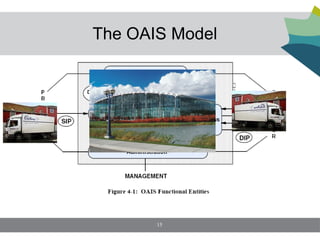
The OAIS Model


       15
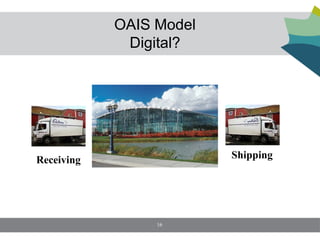
OAIS Model
             Digital?


Receiving                Shipping


                 16
Digital Preservation Tenants: A Re-cap
1. Digital archives are significantly different from physical archives
   with respect to acquisition, preservation and discovery.
2. Digital archives are assets held in trust for use by our citizens: they
   have measurable values and costs that change with time. The
   efforts associated to preserving digital assets should be
   proportional to their value.
3. Digital archives need to be preserved for an extended period but
   the preservation technology and strategy will be achieved one
   generation at a time.
4. Because of their unstable nature, digital assets must be captured
   close to creation and should be disposed of later if their value is not
   sustained during reviews.
5. Digital archives need to be federated using a shared data model.

LAC Strategy                        17
LAC Strategy
 Describes our current, emergent approach
 Consider it one way not the only way
 Expect continual change and refinement
 Open to challenge, confirmation and
  change
 Welcome dialogue and discussion on all of
  these issues
      What is missing? Alternative approaches?
LAC Strategy              18
LAC Strategy
 One solution does not fit . . . (. . . Any/All)
 The only durable solutions are those that can be
  changed/replaced easily, quickly, cheaply.
      Build small. Build fast. Build often.
 Change is the only constant so be good at it


LAC Strategy                    19
LAC Strategy . . . More details

 Use different repositories for different kinds of
  digital objects
      Have built a repository to meet our most stringent
       requirements.
      Examining commercial products to hold specialized
       records with different requirements
 With a common integration layer to support
  control, discovery and access


Social Data Model             20
LAC Strategy . . . More details

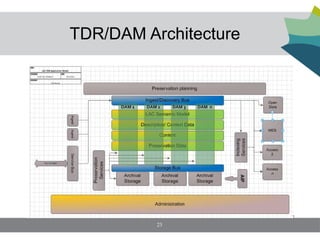
 All objects, including access versions, held in the
  TDRs (DAMs)
 Moving to digital service delivery model where
  access to LAC holdings is via digital version
  regardless of original format
 Digital objects served from TDRs to the user via
  common search layer and according to the
  applicable rights management regime (access is
  legislation/policy driven not technology-driven)

LAC Strategy             21
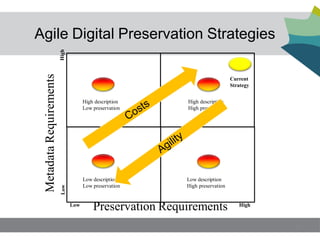
Agile Digital Preservation Strategies
                         High
 Metadata Requirements

                                                                               Current
                                                                               Strategy


                                      High description     High description
                                      Low preservation     High preservation


                                      Low description      Low description
                                      Low preservation     High preservation
                         Low


                                Low
                                          Preservation Requirements               High


                                                                                          22
TDR/DAM Architecture


          23
Whole of Society Model: “About-ness”
 LAC is using a whole of society approach for the selection
  of items to be acquired.
 This approach uses a domains social model to focus our
  attention on areas of importance within Canadian society,
  using the concept of fundamental discourses. (More at:
  http)
 The Whole of Society Data Model is a semantic
  representation the domains social model and is used for
  the management of the metadata. This data model can
  also be shared with other documentary heritage
  organizations (DHOs), thereby significantly enhancing the
  “findability” experience across DHOs.
  Whole of Society Model      24
Whole of Society Model: Facets
The model uses several dimensions of facets:

 People: Relevant people and their attributes including
  biographies
          Artists, Authors, Politicians, Celebrities
 Terms: Roles that link people to organizations for a time
  period
          Prime Minister, President, CEO, Owner, Member
 Organizations
          Political, Economic, Government, Social entities
 Events
          Wars, celebrations, natural disasters, political,
  Whole of Society Model             25
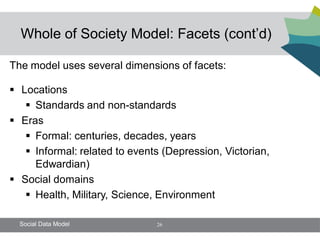
Whole of Society Model: Facets (cont’d)

The model uses several dimensions of facets:

 Locations
    Standards and non-standards
 Eras
    Formal: centuries, decades, years
    Informal: related to events (Depression, Victorian,
     Edwardian)
 Social domains
    Health, Military, Science, Environment

  Social Data Model            26
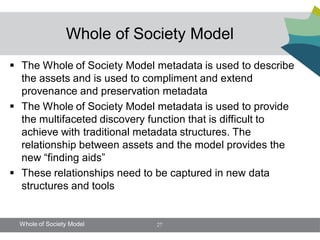
Whole of Society Model
 The Whole of Society Model metadata is used to describe
  the assets and is used to compliment and extend
  provenance and preservation metadata
 The Whole of Society Model metadata is used to provide
  the multifaceted discovery function that is difficult to
  achieve with traditional metadata structures. The
  relationship between assets and the model provides the
  new “finding aids”
 These relationships need to be captured in new data
  structures and tools


  Whole of Society Model      27
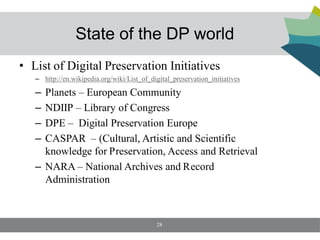
State of the DP world
• List of Digital Preservation Initiatives
   – http://en.wikipedia.org/wiki/List_of_digital_preservation_initiatives

   – Planets – European Community
   – NDIIP – Library of Congress
   – DPE – Digital Preservation Europe
   – CASPAR – (Cultural, Artistic and Scientific
     knowledge for Preservation, Access and Retrieval
   – NARA – National Archives and Record
     Administration


                                             28
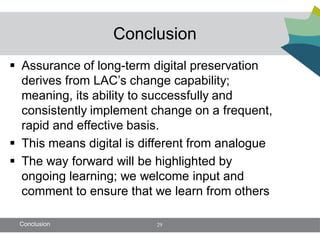
Conclusion
 Assurance of long-term digital preservation
  derives from LAC’s change capability;
  meaning, its ability to successfully and
  consistently implement change on a frequent,
  rapid and effective basis.
 This means digital is different from analogue
 The way forward will be highlighted by
  ongoing learning; we welcome input and
  comment to ensure that we learn from others

 Conclusion               29
The preceding pages describe Library and Archives Canada’s current
understanding of, and strategies and plans for, digital preservation, a rapidly
changing field. LAC expects its way forward to continually evolve and welcomes
perspectives, challenges, and comments that will help it identify and implement
necessary revisions to its approach.

AIIM Ottawa Presentation Digital Preservation A Wicked Problem

  • 1.
    Digital Preservation… a wicked problem Ronald Surette DG Digital Preservation and CIO Library and Archives Canada Ronald.surette@lac-bac.gc.ca
  • 2.
    Outline  Digital Preservation  Key Questions  Integrity and Authenticity  LAC Strategy  Whole of Society Model  State of the DP world  Conclusion 2
  • 3.
    Wicked problem • Originally coined by Professors Rittel and Webber in a seminal paper in 1973. • From Wikipedia – A problem that is difficult or impossible to solve because of incomplete, contradictory, and changing requirements that are often difficult to recognize. Moreover, because of complex interdependencies, the effort to solve one aspect of a wicked problem may reveal or create other problems. • They are complex, ever changing problems that you haven’t been able to treat with much success (or “solve” in the traditional sense of the word), because they won’t keep still. They are “messy”. • They cannot be solved in a traditional linear fashion (as you would a “tame” problem) as the problem definition itself evolves as new possible solutions are considered and/or implemented. • We just have to learn to live with them and manage them. There is no “SOLUTION” • Digital preservation fits that description and, importantly, some of the approaches to “wicked problems” become useful as strategies for Digital Preservation as I hope you will see later in the presentation. 3
  • 4.
    There is nosolution to a wicked problem We just have to learn to live with them and manage them. Evolve with time… But you can’t SOLVE them 4
  • 5.
    Digital is differentthan analog  LAC has three core business functions  Acquisition  Preservation  Access  Across three primary sources:  Government records via Records Disposition Authorities (RDAs)  Published material via legal deposit/purchases  Private records via donations/purchases  IN ALL BUSINESS LINES AND ACROSS ALL SOURCES, DIGITAL IS DIFFERENT Digital is different 5
  • 6.
    A Word fromDaniel Caron, Librarian and Archivist of Canada “. . . the face of information has changed substantially in the last decade: superabundance; rapid creation, sharing and remixing by individuals; multiple formats; unprecedented access; ever- present and expanding user influence, points of view, skills and engagement. This picture is in direct contrast to that of the past, which was characterised by limited creation and quantity; mediated access and decisions; authoritative sources; specialist interventions; limited number of fixed formats; limited sharing; and fewer players.” – Daniel J. Caron, Shaping our Continuing Memory Collectively: A Representative Documentary Heritage Digital is different 6
  • 7.
    A “Wicked Problem”: Attributes of the challenge  Profound  Digital objects are now the dominant way of creating, managing, exchanging and accessing information  Changing architecture of social and business processes  Shifting institutional structures, boundaries and relational configurations  Complex  Content: distributed network-based digital objects, the emergence of shared digital stewardship  Technical: a shape-shifting, ever-changing landscape dominated by persistent uncertainty  Social: emergence of new actors, new and more complex social and economic dynamics Digital is different 7
  • 8.
    A “Wicked Problem”: Attributes of the challenge . . . Cont’d  Distributed  Increasingly distributed, network-based organization of digital information and its life-cycle management  Shared among a broad range of societal actors in all sectors of society; global, trans-national in scope  Requires national and trans-national frameworks and governance  “Wicked”  Continuous uncertainty and shifting solution domains  Traditional assumptions and approaches to problem resolution do not work  Requires new thinking, innovation, continuous experimentation; new skills and governance Digital is different 8
  • 9.
    Digital Preservation: 4Key Questions 1. In what ways is digital preservation NOT the same as analog preservation?  Digital objects are less fixed (photograph vs website; book vs blog)  Digital objects will be acquired based on analysis of value not evidence of value: more chaff with the wheat: continual re- appraisal?  Total cost of ownership shifts: digital costs more to preserve than to get – more interventions required  All of the above are true in both migration and emulation scenarios IF THE PROBLEMS ARE NOT THE SAME, WHY WOULD WE EXPECT THE SOLUTIONS TO BE? Key Questions 9
  • 10.
    Digital Preservation: 4Key Questions 2. Should we take a “generational” approach to digital preservation?  Continual refresh of tools and practices: a long-term solution = short-term solution + next short-term solution + next short-term solution . . . . 10 years at a time?  Requires new approach to services (not systems) development Key Questions 10
  • 11.
    Digital Preservation: 4Key Questions 3. Should we develop and use TDR models that support “levels” of preservation, accountability, and metadata requirements?  Specialized preservation; common access  Shift metadata focus to information “about-what-the- item-is-about” not “about-the-item”  Store and access metadata in structures that support digital discovery Key Questions 11
  • 12.
    Digital Preservation: 4Key Questions 4. How could we implement and manage a networked operationalization of the first three concepts?  Appraisal decisions before-or-at the point of creation  Sharing information on what’s being collected and why  Transfer ownership and control over bits and bytes rather than transfer the digital objects themselves Key Questions 12
  • 13.
    Integrity and Authenticity Analoguemeanings: Digital meanings:  Tied to concept of  Original no longer exists “original”: unique – email/tweet version of an item  Reduced risk to alteration  Risk of alteration or of “initial” version; access alternate versions is to copies  Demonstrated via  Multiple copies allows provenance and “chain validation of control”  Demonstrated via provenance and chain of control Integrity and Authenticity 13
  • 14.
    Integrity and Authenticity Thoughts, insights, issues, actions  Chain of control requires documenting changes . . . Same as analogue  Demonstrate this chain of control for digital items at three levels: “l’objet physique, l’objet logique, et l’objet conceptuel” (Frey)  Reformatting/migrating the object versus emulating the device Integrity and Authenticity 14
  • 15.
  • 16.
    OAIS Model Digital? Receiving Shipping 16
  • 17.
    Digital Preservation Tenants:A Re-cap 1. Digital archives are significantly different from physical archives with respect to acquisition, preservation and discovery. 2. Digital archives are assets held in trust for use by our citizens: they have measurable values and costs that change with time. The efforts associated to preserving digital assets should be proportional to their value. 3. Digital archives need to be preserved for an extended period but the preservation technology and strategy will be achieved one generation at a time. 4. Because of their unstable nature, digital assets must be captured close to creation and should be disposed of later if their value is not sustained during reviews. 5. Digital archives need to be federated using a shared data model. LAC Strategy 17
  • 18.
    LAC Strategy  Describesour current, emergent approach  Consider it one way not the only way  Expect continual change and refinement  Open to challenge, confirmation and change  Welcome dialogue and discussion on all of these issues  What is missing? Alternative approaches? LAC Strategy 18
  • 19.
    LAC Strategy  Onesolution does not fit . . . (. . . Any/All)  The only durable solutions are those that can be changed/replaced easily, quickly, cheaply.  Build small. Build fast. Build often.  Change is the only constant so be good at it LAC Strategy 19
  • 20.
    LAC Strategy .. . More details  Use different repositories for different kinds of digital objects  Have built a repository to meet our most stringent requirements.  Examining commercial products to hold specialized records with different requirements  With a common integration layer to support control, discovery and access Social Data Model 20
  • 21.
    LAC Strategy .. . More details  All objects, including access versions, held in the TDRs (DAMs)  Moving to digital service delivery model where access to LAC holdings is via digital version regardless of original format  Digital objects served from TDRs to the user via common search layer and according to the applicable rights management regime (access is legislation/policy driven not technology-driven) LAC Strategy 21
  • 22.
    Agile Digital PreservationStrategies High Metadata Requirements Current Strategy High description High description Low preservation High preservation Low description Low description Low preservation High preservation Low Low Preservation Requirements High 22
  • 23.
  • 24.
    Whole of SocietyModel: “About-ness”  LAC is using a whole of society approach for the selection of items to be acquired.  This approach uses a domains social model to focus our attention on areas of importance within Canadian society, using the concept of fundamental discourses. (More at: http)  The Whole of Society Data Model is a semantic representation the domains social model and is used for the management of the metadata. This data model can also be shared with other documentary heritage organizations (DHOs), thereby significantly enhancing the “findability” experience across DHOs. Whole of Society Model 24
  • 25.
    Whole of SocietyModel: Facets The model uses several dimensions of facets:  People: Relevant people and their attributes including biographies  Artists, Authors, Politicians, Celebrities  Terms: Roles that link people to organizations for a time period  Prime Minister, President, CEO, Owner, Member  Organizations  Political, Economic, Government, Social entities  Events  Wars, celebrations, natural disasters, political, Whole of Society Model 25
  • 26.
    Whole of SocietyModel: Facets (cont’d) The model uses several dimensions of facets:  Locations  Standards and non-standards  Eras  Formal: centuries, decades, years  Informal: related to events (Depression, Victorian, Edwardian)  Social domains  Health, Military, Science, Environment Social Data Model 26
  • 27.
    Whole of SocietyModel  The Whole of Society Model metadata is used to describe the assets and is used to compliment and extend provenance and preservation metadata  The Whole of Society Model metadata is used to provide the multifaceted discovery function that is difficult to achieve with traditional metadata structures. The relationship between assets and the model provides the new “finding aids”  These relationships need to be captured in new data structures and tools Whole of Society Model 27
  • 28.
    State of theDP world • List of Digital Preservation Initiatives – http://en.wikipedia.org/wiki/List_of_digital_preservation_initiatives – Planets – European Community – NDIIP – Library of Congress – DPE – Digital Preservation Europe – CASPAR – (Cultural, Artistic and Scientific knowledge for Preservation, Access and Retrieval – NARA – National Archives and Record Administration 28
  • 29.
    Conclusion  Assurance oflong-term digital preservation derives from LAC’s change capability; meaning, its ability to successfully and consistently implement change on a frequent, rapid and effective basis.  This means digital is different from analogue  The way forward will be highlighted by ongoing learning; we welcome input and comment to ensure that we learn from others Conclusion 29
  • 30.
    The preceding pagesdescribe Library and Archives Canada’s current understanding of, and strategies and plans for, digital preservation, a rapidly changing field. LAC expects its way forward to continually evolve and welcomes perspectives, challenges, and comments that will help it identify and implement necessary revisions to its approach.