Digital Library Software
RupeshKumarA
Email:a.rupeshkumar@gmail.com
Software
• Software is a collection of instructions that enable the user to
interactwitha computer, its hardware, or perform tasks.
• A digital library software is a software which provides
functionalities for systematic selection, acquisition,
deposition, processing, search and discovery of digital
documents.
DL Software
• CommercialSoftware
• Free and Open Source Software
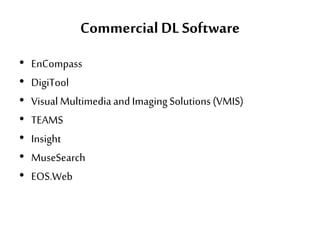
Commercial DLSoftware
• EnCompass
• DigiTool
• Visual Multimediaand ImagingSolutions(VMIS)
• TEAMS
• Insight
• MuseSearch
• EOS.Web
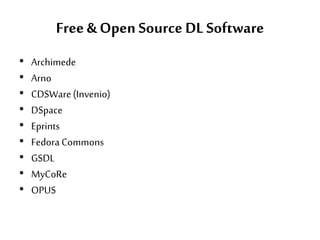
Free & Open Source DL Software
• Archimede
• Arno
• CDSWare(Invenio)
• DSpace
• Eprints
• Fedora Commons
• GSDL
• MyCoRe
• OPUS
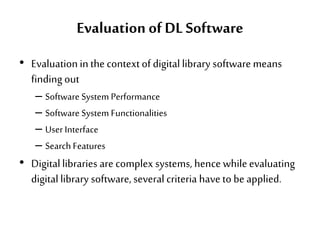
Evaluation of DL Software
• Evaluationin the context of digital library software means
finding out
– Software System Performance
– Software System Functionalities
– User Interface
– Search Features
• Digitallibraries are complex systems, hence whileevaluating
digital library software, several criteria have to be applied.
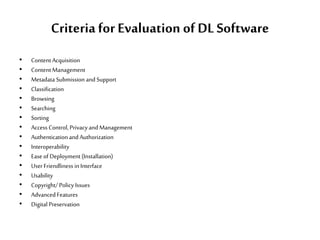
Criteria forEvaluation of DL Software
• Content Acquisition
• Content Management
• Metadata Submission and Support
• Classification
• Browsing
• Searching
• Sorting
• Access Control, Privacyand Management
• Authentication and Authorization
• Interoperability
• Ease of Deployment (Installation)
• UserFriendliness in Interface
• Usability
• Copyright/Policy Issues
• AdvancedFeatures
• Digital Preservation
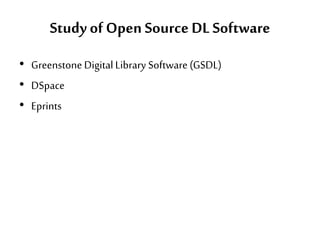
Study of Open Source DL Software
• Greenstone DigitalLibrary Software (GSDL)
• DSpace
• Eprints
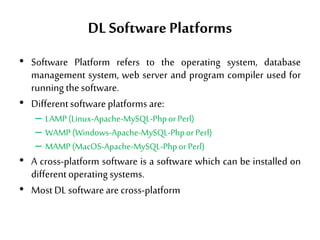
DL SoftwarePlatforms
• Software Platform refers to the operating system, database
management system, web server and program compiler used for
running thesoftware.
• Differentsoftwareplatformsare:
– LAMP(Linux-Apache-MySQL-PhporPerl)
– WAMP(Windows-Apache-MySQL-PhporPerl)
– MAMP(MacOS-Apache-MySQL-PhporPerl)
• A cross-platform software is a software which can be installed on
differentoperatingsystems.
• MostDLsoftwarearecross-platform
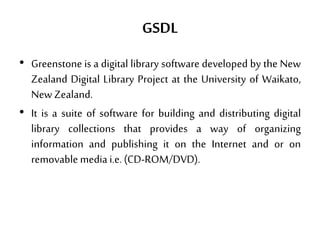
GSDL
• Greenstone is a digital library software developed by the New
Zealand Digital Library Project at the University of Waikato,
NewZealand.
• It is a suite of software for building and distributing digital
library collections that provides a way of organizing
information and publishing it on the Internet and or on
removable media i.e. (CD-ROM/DVD).
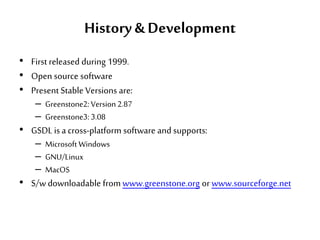
History & Development
• First released during 1999.
• Open source software
• Present Stable Versions are:
– Greenstone2: Version 2.87
– Greenstone3: 3.08
• GSDL is a cross-platform software and supports:
– Microsoft Windows
– GNU/Linux
– MacOS
• S/w downloadable fromwww.greenstone.org or www.sourceforge.net
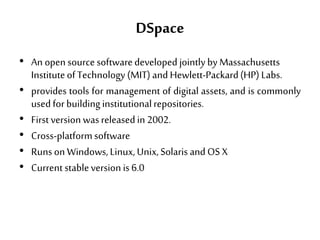
DSpace
• An open source softwaredeveloped jointly by Massachusetts
InstituteofTechnology (MIT) and Hewlett-Packard(HP) Labs.
• provides tools for management of digital assets, and is commonly
usedforbuildinginstitutionalrepositories.
• First version wasreleasedin 2002.
• Cross-platformsoftware
• Runson Windows,Linux,Unix,Solaris andOS X
• Current stableversion is6.0
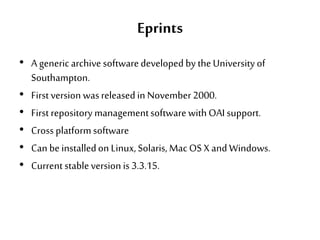
Eprints
• A genericarchive softwaredeveloped by theUniversity of
Southampton.
• First version wasreleasedin November2000.
• First repository managementsoftwarewithOAI support.
• Cross platformsoftware
• Can be installedon Linux,Solaris, Mac OS X and Windows.
• Current stableversion is 3.3.15.
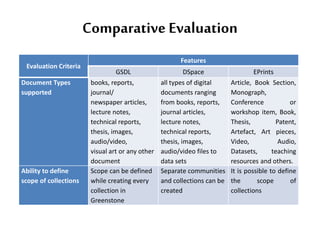
Comparative Evaluation
Evaluation Criteria
Features
GSDL DSpace EPrints
Document Types
supported
books, reports,
journal/
newspaper articles,
lecture notes,
technical reports,
thesis, images,
audio/video,
visual art or any other
document
all types of digital
documents ranging
from books, reports,
journal articles,
lecture notes,
technical reports,
thesis, images,
audio/video files to
data sets
Article, Book Section,
Monograph,
Conference or
workshop item, Book,
Thesis, Patent,
Artefact, Art pieces,
Video, Audio,
Datasets, teaching
resources and others.
Ability to define
scope of collections
Scope can be defined
while creating every
collection in
Greenstone
Separate communities
and collections can be
created
It is possible to define
the scope of
collections
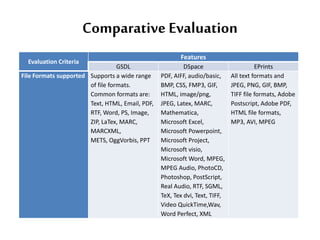
Comparative Evaluation
Evaluation Criteria
Features
GSDL DSpace EPrints
File Formats supported Supports a wide range
of file formats.
Common formats are:
Text, HTML, Email, PDF,
RTF, Word, PS, Image,
ZIP, LaTex, MARC,
MARCXML,
METS, OggVorbis, PPT
PDF, AIFF, audio/basic,
BMP, CSS, FMP3, GIF,
HTML, image/png,
JPEG, Latex, MARC,
Mathematica,
Microsoft Excel,
Microsoft Powerpoint,
Microsoft Project,
Microsoft visio,
Microsoft Word, MPEG,
MPEG Audio, PhotoCD,
Photoshop, PostScript,
Real Audio, RTF, SGML,
TeX, Tex dvi, Text, TIFF,
Video QuickTime,Wav,
Word Perfect, XML
All text formats and
JPEG, PNG, GIF, BMP,
TIFF file formats, Adobe
Postscript, Adobe PDF,
HTML file formats,
MP3, AVI, MPEG
Comparative Evaluation
Evaluation Criteria
Features
GSDL DSpace EPrints
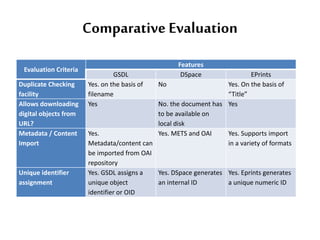
Duplicate Checking
facility
Yes. on the basis of
filename
No Yes. On the basis of
“Title”
Allows downloading
digital objects from
URL?
Yes No. the document has
to be available on
local disk
Yes
Metadata / Content
Import
Yes.
Metadata/content can
be imported from OAI
repository
Yes. METS and OAI Yes. Supports import
in a variety of formats
Unique identifier
assignment
Yes. GSDL assigns a
unique object
identifier or OID
Yes. DSpace generates
an internal ID
Yes. Eprints generates
a unique numeric ID
Comparative Evaluation
Evaluation Criteria
Features
GSDL DSpace EPrints
Deleting and moving of
objects
GSDL supports deletion
of objects, but does not
support moving of
objects from one
collection to another
DSpace supports
deletion and moving of
objects from one
collection to another
Eprints supports
deletion of objects, but
does not support
moving of objects from
one collection to
another
Submission Workflow
management
No. GSDL does not
support different
submission processes
Yes. Supports
submission,
accept/reject and edit
metadata processes
Yes. Supports
submission,
accept/reject and edit
processes
Email notification
system
No Yes Yes
Web Interface for users Yes Yes Yes
Automatic Metadata
Extraction
Yes No No
Comparative Evaluation
Evaluation Criteria
Features
GSDL DSpace EPrints
Customization of
Metadata Sets
Yes Yes Yes
Supports different
search strategies (Full
text searching,
Boolean searching,
truncated search)
Yes Yes Yes
Sorting (arranging
records in specific
order)
Author
Title
Issue date
Relevance
Also supports sorting as
per end user’s
requirements
Author
Title
Issue Date
Author
Title
Issue Date
Interoperability
support
OAI-PMH
Z39.50
OAI-PMH OAI-PMH
Comparative Evaluation
Evaluation Criteria
Features
GSDL DSpace EPrints
Ease of Installation Automatic installation
script is available for
installation
no automatic installation
script available
no automatic installation
script available
Operating Systems
supported
Windows
Linux
MacOS
All POSIX based OS
FreeBSD, Debian, Ubuntu,
Mandriva, OSX, Mac OS X,
Red Hat,
Gentoo, SLES9, Windows
Linux
Solaris
BSD
Windows
Programming Languages
used
C++
Java
Perl
Java Servlet Pages (JSP) Perl
Database Management
System
Gnu Database Manager PostgreSQL MySQL
Web Sever Apache
Internet Information
Service (IIS)
Apache Server with
Apache Tomcat Servlet
Engine
Apache Server
Multilingual Access
Support
Yes Yes Yes

Digital Library Software

  • 1.
  • 2.
    Software • Software isa collection of instructions that enable the user to interactwitha computer, its hardware, or perform tasks. • A digital library software is a software which provides functionalities for systematic selection, acquisition, deposition, processing, search and discovery of digital documents.
  • 3.
    DL Software • CommercialSoftware •Free and Open Source Software
  • 4.
    Commercial DLSoftware • EnCompass •DigiTool • Visual Multimediaand ImagingSolutions(VMIS) • TEAMS • Insight • MuseSearch • EOS.Web
  • 5.
    Free & OpenSource DL Software • Archimede • Arno • CDSWare(Invenio) • DSpace • Eprints • Fedora Commons • GSDL • MyCoRe • OPUS
  • 6.
    Evaluation of DLSoftware • Evaluationin the context of digital library software means finding out – Software System Performance – Software System Functionalities – User Interface – Search Features • Digitallibraries are complex systems, hence whileevaluating digital library software, several criteria have to be applied.
  • 7.
    Criteria forEvaluation ofDL Software • Content Acquisition • Content Management • Metadata Submission and Support • Classification • Browsing • Searching • Sorting • Access Control, Privacyand Management • Authentication and Authorization • Interoperability • Ease of Deployment (Installation) • UserFriendliness in Interface • Usability • Copyright/Policy Issues • AdvancedFeatures • Digital Preservation
  • 8.
    Study of OpenSource DL Software • Greenstone DigitalLibrary Software (GSDL) • DSpace • Eprints
  • 9.
    DL SoftwarePlatforms • SoftwarePlatform refers to the operating system, database management system, web server and program compiler used for running thesoftware. • Differentsoftwareplatformsare: – LAMP(Linux-Apache-MySQL-PhporPerl) – WAMP(Windows-Apache-MySQL-PhporPerl) – MAMP(MacOS-Apache-MySQL-PhporPerl) • A cross-platform software is a software which can be installed on differentoperatingsystems. • MostDLsoftwarearecross-platform
  • 10.
    GSDL • Greenstone isa digital library software developed by the New Zealand Digital Library Project at the University of Waikato, NewZealand. • It is a suite of software for building and distributing digital library collections that provides a way of organizing information and publishing it on the Internet and or on removable media i.e. (CD-ROM/DVD).
  • 11.
    History & Development •First released during 1999. • Open source software • Present Stable Versions are: – Greenstone2: Version 2.87 – Greenstone3: 3.08 • GSDL is a cross-platform software and supports: – Microsoft Windows – GNU/Linux – MacOS • S/w downloadable fromwww.greenstone.org or www.sourceforge.net
  • 12.
    DSpace • An opensource softwaredeveloped jointly by Massachusetts InstituteofTechnology (MIT) and Hewlett-Packard(HP) Labs. • provides tools for management of digital assets, and is commonly usedforbuildinginstitutionalrepositories. • First version wasreleasedin 2002. • Cross-platformsoftware • Runson Windows,Linux,Unix,Solaris andOS X • Current stableversion is6.0
  • 13.
    Eprints • A genericarchivesoftwaredeveloped by theUniversity of Southampton. • First version wasreleasedin November2000. • First repository managementsoftwarewithOAI support. • Cross platformsoftware • Can be installedon Linux,Solaris, Mac OS X and Windows. • Current stableversion is 3.3.15.
  • 14.
    Comparative Evaluation Evaluation Criteria Features GSDLDSpace EPrints Document Types supported books, reports, journal/ newspaper articles, lecture notes, technical reports, thesis, images, audio/video, visual art or any other document all types of digital documents ranging from books, reports, journal articles, lecture notes, technical reports, thesis, images, audio/video files to data sets Article, Book Section, Monograph, Conference or workshop item, Book, Thesis, Patent, Artefact, Art pieces, Video, Audio, Datasets, teaching resources and others. Ability to define scope of collections Scope can be defined while creating every collection in Greenstone Separate communities and collections can be created It is possible to define the scope of collections
  • 15.
    Comparative Evaluation Evaluation Criteria Features GSDLDSpace EPrints File Formats supported Supports a wide range of file formats. Common formats are: Text, HTML, Email, PDF, RTF, Word, PS, Image, ZIP, LaTex, MARC, MARCXML, METS, OggVorbis, PPT PDF, AIFF, audio/basic, BMP, CSS, FMP3, GIF, HTML, image/png, JPEG, Latex, MARC, Mathematica, Microsoft Excel, Microsoft Powerpoint, Microsoft Project, Microsoft visio, Microsoft Word, MPEG, MPEG Audio, PhotoCD, Photoshop, PostScript, Real Audio, RTF, SGML, TeX, Tex dvi, Text, TIFF, Video QuickTime,Wav, Word Perfect, XML All text formats and JPEG, PNG, GIF, BMP, TIFF file formats, Adobe Postscript, Adobe PDF, HTML file formats, MP3, AVI, MPEG
  • 16.
    Comparative Evaluation Evaluation Criteria Features GSDLDSpace EPrints Duplicate Checking facility Yes. on the basis of filename No Yes. On the basis of “Title” Allows downloading digital objects from URL? Yes No. the document has to be available on local disk Yes Metadata / Content Import Yes. Metadata/content can be imported from OAI repository Yes. METS and OAI Yes. Supports import in a variety of formats Unique identifier assignment Yes. GSDL assigns a unique object identifier or OID Yes. DSpace generates an internal ID Yes. Eprints generates a unique numeric ID
  • 17.
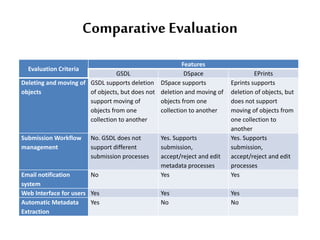
    Comparative Evaluation Evaluation Criteria Features GSDLDSpace EPrints Deleting and moving of objects GSDL supports deletion of objects, but does not support moving of objects from one collection to another DSpace supports deletion and moving of objects from one collection to another Eprints supports deletion of objects, but does not support moving of objects from one collection to another Submission Workflow management No. GSDL does not support different submission processes Yes. Supports submission, accept/reject and edit metadata processes Yes. Supports submission, accept/reject and edit processes Email notification system No Yes Yes Web Interface for users Yes Yes Yes Automatic Metadata Extraction Yes No No
  • 18.
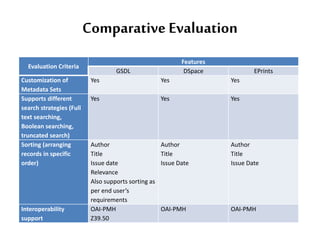
    Comparative Evaluation Evaluation Criteria Features GSDLDSpace EPrints Customization of Metadata Sets Yes Yes Yes Supports different search strategies (Full text searching, Boolean searching, truncated search) Yes Yes Yes Sorting (arranging records in specific order) Author Title Issue date Relevance Also supports sorting as per end user’s requirements Author Title Issue Date Author Title Issue Date Interoperability support OAI-PMH Z39.50 OAI-PMH OAI-PMH
  • 19.
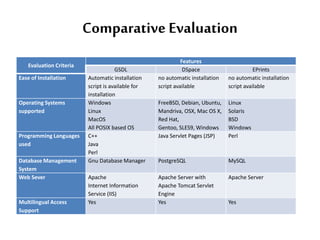
    Comparative Evaluation Evaluation Criteria Features GSDLDSpace EPrints Ease of Installation Automatic installation script is available for installation no automatic installation script available no automatic installation script available Operating Systems supported Windows Linux MacOS All POSIX based OS FreeBSD, Debian, Ubuntu, Mandriva, OSX, Mac OS X, Red Hat, Gentoo, SLES9, Windows Linux Solaris BSD Windows Programming Languages used C++ Java Perl Java Servlet Pages (JSP) Perl Database Management System Gnu Database Manager PostgreSQL MySQL Web Sever Apache Internet Information Service (IIS) Apache Server with Apache Tomcat Servlet Engine Apache Server Multilingual Access Support Yes Yes Yes