
Presentedby-
Rohit
lis
BBAU, LUCKNOW, UP
ANGLO AMERICAN CATALOUGUE
RULES 2
CONTENTS
OBJECTIVES
INTRODUCTION
HISTORY
STRUCTURE OF AACR 2
LEVELS OF DESCRIPTION
STYLE OF WRITING
TYPES OF ENTRIES
TITLES AND STATEMENT OF RESPONSIBILITY
AREA
PRACTICE WITH TITLE
OBJECTIVES
• TO DEFINE LIBRARY CATALOUGE
• TO DISCUSS FUNCTION OF LIBRARY CATALOUGE
• TO DISCUSS NEED AND PURPOSE OF LIBRARY
CATALOUGE
• TO DISCUSS IMPORTANT OF LIBRARY CATALOUGE
• TO DISCUSS DIFFERENT ENTERIES OF AACR 2 CODE
STANDARD.
• TO UNDERSTAND PROPER STRUCTURE OF AACR 2
CATALOUGE CARD.
LIBRARY CATALOUGE
The term library catalouge is derived from Greek
phrase “katalogos”.
Kata means = “According to”
Logos means= “Reason”
A library catalouge is a list of books and others
graphic material in a library arranged according to
recognized order for specific bibliogaphic
information.
Cont….
According to S. R. Rangnathan…….
Library catalouge involving three aspects-
a) The list
b) Documents
c) Libraries
According to H. A. Sharp…….
“list of books and other reading material in the
holding of a library or a group of libraries.”
HISTORY
1908= “Catalouging rules : author and title
entries”
1949= Anglo american enteries
1967= “AACR”
1978= “AACR 2”
1988= “ AACR 2 R”
2002= “AACR 2 R” Revise
2003= A schedule of annual updates began and
ceased with 2005.
2010= AACR 2 succeded by resource description
and access.
OBJECTIVES OF AACR 2
• Explain structure of AACR 2.
• Distinguish the area of description to be
included in the catalouge card according to
AACR 2.
• Describe the catalouge card and its parts.
• State the sequence of the descriptive elements
, punctuation used between area and elements.
• Develop an international catalouging code in
order to exchange of bibliographic data.
• Extension of catalogue process.
structure of Aacr 2
Anglo american cataloguing rules ,
edition 2 revision consists of two
parts –
Part I – Rules for standard description
of all kinds of material.
Part II- It deals with the determination
and establishment of headings or
access points in the catalogue.
Continue….
The area/items to be included in the description
are –
• Title and statement of responsibility
• Edition
• Material or type of publication specific details
• Publication , distribution etc.
• physical description
• Series
• Note
• Standards notes and terms of avilability.
LEVELS OF DESCRIPTION
• Catalogue entries vary from library to library on
the basis of description of items. The
description is categorised into levels on the
basis of amount of information to be included.
The inclusion of these descriptive elements is
categorised according to three levels-
First level of description
Second level of description
Third level of description
FIRST LEVEL OF DESCRIPTION
Title Proper /First Statement Of Responsibility –Edition
Statement –Material Specific Details –First Publisher Etc-
extent Of Item-note –Standard Number.
SECOND LEVEL OF DESCRIPTION
Title Proper- Parllel Title : Other Title Information /First
Statement Of Responsibility –Material Specific Details-
first Place Of Publicationetc:first Publisher, Date Of
Publication –Extent Of Item :Other Physical Details
;Dimensions-(title Proper Of Series ,ISSN Of Series,title
Of Subseries)-note –Standard Number.
THIRD LEVEL OF DESCRIPTION – involves full details
on the catalogue card.
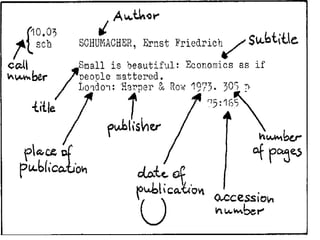
STYLE OF WRITING
7.5
cm
12.5 CM
TYPES OF ENTRIES
MAIN ENTRY
ADDED ENTRY
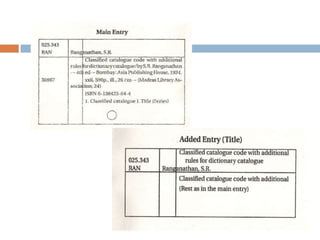
MAIN ENTRY :- The complete catalogue
record of an item , presented in form of
which is entity is to be uniformly
identified and cited. The main entry
include the tracings of all other headings
under which record to be represented in
catalogue.
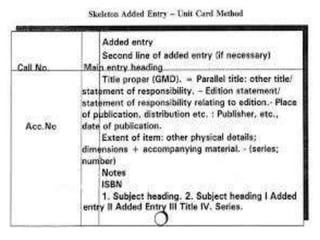
Added entry
An entry additional to main entry , by which an
item is represented in a catalogue is secondry
entry. Added entry prepare under the headings of
following-
Author , title , series, collaborators, subject etc
“basic catalogue card in the form of main entry
which when duplicated may be use as a unit for
all other enteries for that work in catalogue by
the addition of appropriate heading.
Items in catalogue entry
• Heading
• Descriptive elements
• Punctuation mark
• Call number
• Tracing
• Many objections and reservations were expressed before
AACR2 was adopted by the Library of Congress, the
major shared cataloging bibliographic utilities, and most
American and British libraries. This article recapitulates
the perceived advantages and disadvantages of the
Second Edition, insofar as this affects library public
services. The article then discusses alternatives to
implementation and shows how sometimes the
alternatives caused more problems for public service
librarians than did the new code itself. The conclusion is
drawn that most library users have not noticed AACR2's
effects or do not care enough about them to compliment
or complain
CONCLUSION
THANK
YOU
REFERENCES
• WWW.ALA.IN.COM
• WWW.SILDESHARE.COM
• IGNOU NOTES
• E-PG PATHSALA
• C.-LAL & K.KUMAR (AACR-2)

Anglo-American Cataloguing Rules AACR 2 ppt

  • 1.
  • 2.
    CONTENTS OBJECTIVES INTRODUCTION HISTORY STRUCTURE OF AACR2 LEVELS OF DESCRIPTION STYLE OF WRITING TYPES OF ENTRIES TITLES AND STATEMENT OF RESPONSIBILITY AREA PRACTICE WITH TITLE
  • 3.
    OBJECTIVES • TO DEFINELIBRARY CATALOUGE • TO DISCUSS FUNCTION OF LIBRARY CATALOUGE • TO DISCUSS NEED AND PURPOSE OF LIBRARY CATALOUGE • TO DISCUSS IMPORTANT OF LIBRARY CATALOUGE • TO DISCUSS DIFFERENT ENTERIES OF AACR 2 CODE STANDARD. • TO UNDERSTAND PROPER STRUCTURE OF AACR 2 CATALOUGE CARD.
  • 4.
    LIBRARY CATALOUGE The termlibrary catalouge is derived from Greek phrase “katalogos”. Kata means = “According to” Logos means= “Reason” A library catalouge is a list of books and others graphic material in a library arranged according to recognized order for specific bibliogaphic information.
  • 5.
    Cont…. According to S.R. Rangnathan……. Library catalouge involving three aspects- a) The list b) Documents c) Libraries According to H. A. Sharp……. “list of books and other reading material in the holding of a library or a group of libraries.”
  • 6.
    HISTORY 1908= “Catalouging rules: author and title entries” 1949= Anglo american enteries 1967= “AACR” 1978= “AACR 2” 1988= “ AACR 2 R” 2002= “AACR 2 R” Revise 2003= A schedule of annual updates began and ceased with 2005. 2010= AACR 2 succeded by resource description and access.
  • 7.
    OBJECTIVES OF AACR2 • Explain structure of AACR 2. • Distinguish the area of description to be included in the catalouge card according to AACR 2. • Describe the catalouge card and its parts. • State the sequence of the descriptive elements , punctuation used between area and elements. • Develop an international catalouging code in order to exchange of bibliographic data. • Extension of catalogue process.
  • 8.
    structure of Aacr2 Anglo american cataloguing rules , edition 2 revision consists of two parts – Part I – Rules for standard description of all kinds of material. Part II- It deals with the determination and establishment of headings or access points in the catalogue.
  • 9.
    Continue…. The area/items tobe included in the description are – • Title and statement of responsibility • Edition • Material or type of publication specific details • Publication , distribution etc. • physical description • Series • Note • Standards notes and terms of avilability.
  • 10.
    LEVELS OF DESCRIPTION •Catalogue entries vary from library to library on the basis of description of items. The description is categorised into levels on the basis of amount of information to be included. The inclusion of these descriptive elements is categorised according to three levels- First level of description Second level of description Third level of description
  • 11.
    FIRST LEVEL OFDESCRIPTION Title Proper /First Statement Of Responsibility –Edition Statement –Material Specific Details –First Publisher Etc- extent Of Item-note –Standard Number. SECOND LEVEL OF DESCRIPTION Title Proper- Parllel Title : Other Title Information /First Statement Of Responsibility –Material Specific Details- first Place Of Publicationetc:first Publisher, Date Of Publication –Extent Of Item :Other Physical Details ;Dimensions-(title Proper Of Series ,ISSN Of Series,title Of Subseries)-note –Standard Number. THIRD LEVEL OF DESCRIPTION – involves full details on the catalogue card.
  • 12.
  • 14.
    TYPES OF ENTRIES MAINENTRY ADDED ENTRY MAIN ENTRY :- The complete catalogue record of an item , presented in form of which is entity is to be uniformly identified and cited. The main entry include the tracings of all other headings under which record to be represented in catalogue.
  • 15.
    Added entry An entryadditional to main entry , by which an item is represented in a catalogue is secondry entry. Added entry prepare under the headings of following- Author , title , series, collaborators, subject etc “basic catalogue card in the form of main entry which when duplicated may be use as a unit for all other enteries for that work in catalogue by the addition of appropriate heading.
  • 17.
    Items in catalogueentry • Heading • Descriptive elements • Punctuation mark • Call number • Tracing
  • 19.
    • Many objectionsand reservations were expressed before AACR2 was adopted by the Library of Congress, the major shared cataloging bibliographic utilities, and most American and British libraries. This article recapitulates the perceived advantages and disadvantages of the Second Edition, insofar as this affects library public services. The article then discusses alternatives to implementation and shows how sometimes the alternatives caused more problems for public service librarians than did the new code itself. The conclusion is drawn that most library users have not noticed AACR2's effects or do not care enough about them to compliment or complain CONCLUSION
  • 20.
  • 21.
    REFERENCES • WWW.ALA.IN.COM • WWW.SILDESHARE.COM •IGNOU NOTES • E-PG PATHSALA • C.-LAL & K.KUMAR (AACR-2)