

The Library then and now:  it s  importance  and relevance to the  present-day generation by Fe Angela M. Verzosa
Overview   We live in an information society. Information is our basic resource & product. Information Technology has wrought significant changes for all information-handling professions.
Introduction Libraries are  user-centered  organizations focused on patron satisfaction. Libraries  value access to information  as fundamental to education and research. Up-to-date technology  provides one of the best means to reach their goals. Information Technology  has brought significant changes to libraries.
This presentation… Discusses  libraries then and now  as an important resource Presents the current or  recent developments  in library management  Explores the  ethical dilemmas  librarians face in relation to these current developments and discusses their ethical responsibilities  Recommends  measures towards   enhancing library resources  to meet the challenges and opportunities of today’s libraries as resource centers
Today’s situation Old ways : preoccupation with volumes, cards, materials, facilities, procedures, clerical work, statistical output, etc. traditional library functions: labelling, accessioning, sorting, typing, shelving, searching, & other manual activities concept of ownership, autonomy, and self-sufficiency in libraries
Technology   technologies are tools to make information- handling easier, more efficient, and less costly. Technologies must be looked into as means to an end --- not the end themselves. The technological concerns are: effectiveness efficiency economy
New Technologies   CD Rom technology Interactive Multimedia  Online catalogs Electronic publishing Electronic mails and file transfers Automation Networking  Digitization from librarian…..
Impact of New Technologies   to information    intermediary collection policies budgeting & funding acquisition methods bibliographic control cataloging processes reference services staffing physical facilities
Current institutional goals Support instructional, curricular, and research needs of the faculty Support informational, classroom, and general reading interests of the students Fast delivery of information resources Facilitate access into other library collections Support extension programs of the institution
Managing our collection    faces a crisis... * reduction in expenditures due to price increases *diminished resources  *aging of the collection  *digital formats are not  less expensive *resource-sharing may not  solve the problem
Collection Development:  recent developments     academic budgets pay increasing homage to serials to the neglect of book  purchases in spite of declining funds …
Collection Development:  recent developments traditional concept of ownership is challenged by the idea of  access  (whether  automated access to information or to information resources through document delivery or interlibrary lending) in lieu of  ownership …
Collection Development :    recent developments emphasis is on intellectual content , rather than the traditional format
Collection Development:    recent developments developing  core  collections rather than  comprehensive  holdings will dominate collection policies…
Collection Development :    recent developments electronic networks such as the  INTERNET  are now a reality.  Students and faculty are gaining access to a multitude of library catalogs worldwide.  More capital funds are being re-channelled to buy computer equipment, licenses and access fees…
Collection Development:     recent developments multimedia  (interactive videos) and  cd-rom  technology are becoming more and more attractive than prints, because they present a better alternative to reading…
Interest in resource-  sharing,  collaborative  purchasing, and    cooperative  collection   has replaced the   competitive   instinct of   librarians… Collection Development:     recent developments
Ethical dilemmas Inescapable because of these interrelated developments Librarians forced to make choices with limited resources Abuse fair use doctrine and ignore copyright restrictions
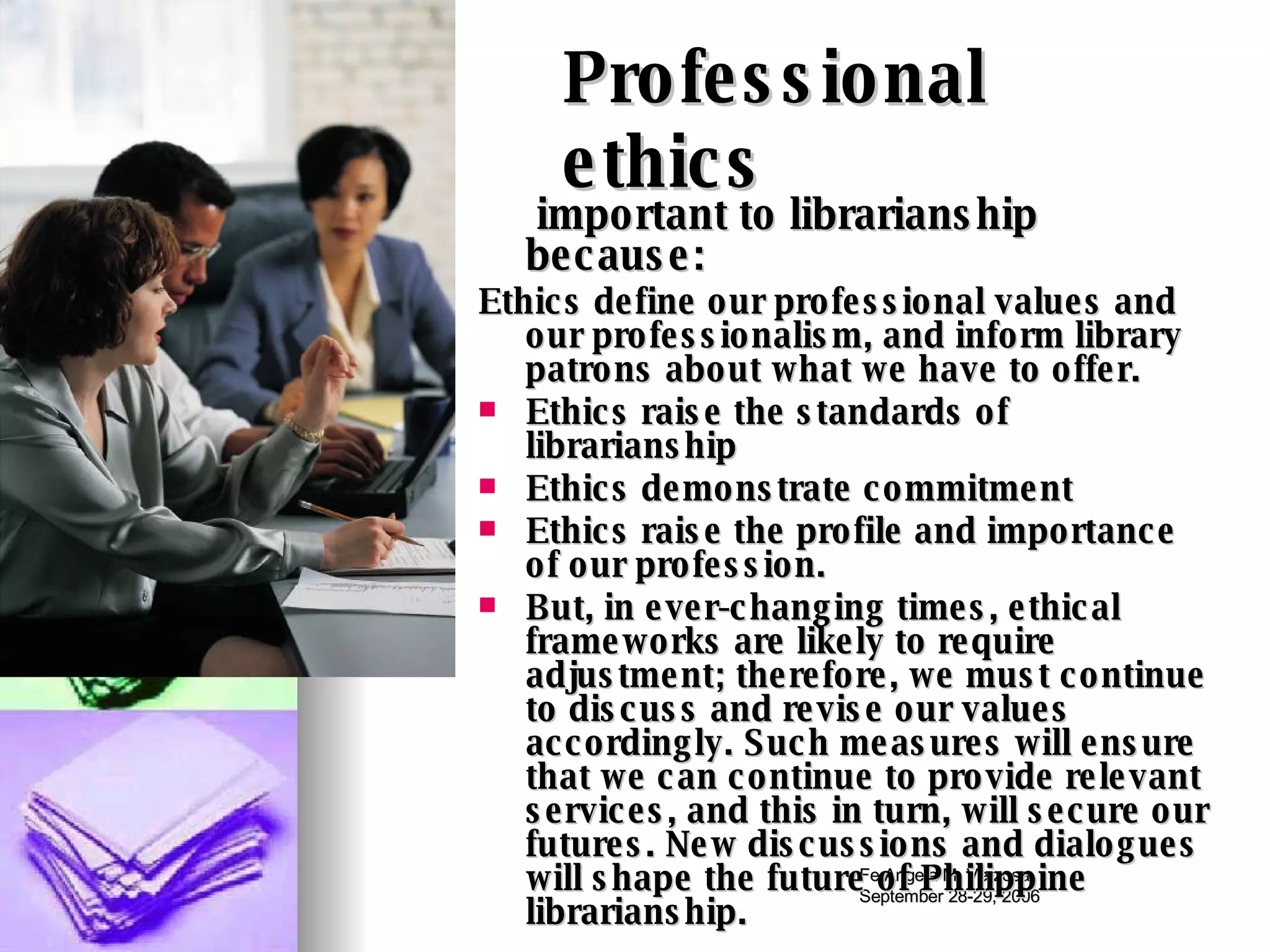
Professional ethics important to librarianship because:  Ethics define our professional values and our professionalism, and inform library patrons about what we have to offer.  Ethics raise the standards of librarianship Ethics demonstrate commitment  Ethics raise the profile and importance of our profession.  But, in ever-changing times, ethical frameworks are likely to require adjustment; therefore, we must continue to discuss and revise our values accordingly. Such measures will ensure that we can continue to provide relevant services, and this in turn, will secure our futures. New discussions and dialogues will shape the future of Philippine librarianship.
What are our ethical responsibilities? Be honest in giving available alternatives to gaining access to information Be wise consumers of information products Encourage technical innovations that benefit information users Promote awareness to the importance of open access to information Observe and implement judiciously laws and standards of professional practice
review present status of collection assess strengths and weaknesses identify unmet and emerging needs list priorities for acquisition Know what the library needs  …
Developing core collections rather than comprehensive holdings is a priority. Care should taken in updating. Emphasis is on intellectual content ,  rather than the traditional format Use shelf behavior and circulation usage to determine usefulness. Know how to keep collection current and useful…
Formulate short and long–term plans for collection development Information should be collected in the most appropriate format.  Usefulness, not format, is the deciding factor in acquisition.  Disseminate information on new materials for selection to clientele before acquisition match funds with needs set limits on spending Enhancing your  library resources
Identification/selection of materials  thru review sites and websites of vendors, publishers, traditional booksellers, libraries, academic institutions, etc. Web harvesting Archiving web resources Indexing archived documents Developing Online Collections
Resource-sharing,   collaborative  purchasing,   and cooperative  collection   present alternatives  to enhance  collections,    reduce not  only acquisition  costs.  Enhancing with shared  collections...
Resource-sharing the goal of many consortia is cooperative collection development. by knowing their strengths/weaknesses, libraries could take advantage of  the strengths and work together to cover the weaknesses.
Benefits from Shared Collections Enhance library resources and services Expand the breadth  and depth of collections Reduce unnecessary duplication Reduce costs and  space requirements Maximize their use
Acquiring gifts and donations Manuscript collections and rare books Local studies material Personal/family papers Periodical/serial titles of general interest Reference material of timeless value
An Action Agenda to Meet the Challenges of Technology Redefine the role (image) of librarians Upgrade librarians’ professionalism Improve recruiting Update curriculum of graduate education Restructure library management (from hierarchical to team structure) Redesign library work Reinvent the library
Image-building adopting the faculty-researcher model   knowledge-navigators   resource managers diversifying from collection  development to library  management systems  design,  and research and publications
Upgrade librarian’s  professionalism *delegating non-professional work to support staff increasing pay scale *continuing education  *self-renewal
Improve recruiting *HIRE PROFESSIONALS: systems managers, media specialists,  programmers, archivists,  documentalists *REQUIRE MLS as entry  point, and *  HIRE ONLY  LICENSED LIBRARIANS
UPDATE CURRICULUM Of GRADUATE EDUCATION ...to produce management-minded  librarians with special skills in computing, multimedia, and archival documentation work .
RESTRUCTURE   library management *developing participatory management style *evolving semi-autonomous workgroups *reducing the number/ level of supervisors
redesign library work * create semiautonomous depts *review job functions with emphasis on flexibility *adopt flexitime  schedules
reinvent the library wall-less hi-tech people- centered  proactive
Summary & Recommendations Collection Development should undergo review  to ensure  acquisition, weeding and retention policies are unbiased and customer-focused, so that library users have access to current, relevant and authoritative information in their preferred format.  Examine storage conditions of the existing book stock . Provisions must made to store rare materials in conditions that will ensure preservation and a longer shelf life, whilst maintaining ease of access for library users.  With regard to the general book collection,  cataloging and classification standards and procedures should be continuously reassessed  to ensure that classification is in line with twenty-first-century thinking, which, consequently, should facilitate browsing.
Conclusion Libraries are key partners in higher education, critical to the ability of academic institutions to succeed in teaching and learning.  Libraries will also continue to be important sources for the support and promotion of new developments in librarianship.  Changes in the library environment, such as technological innovations and legal limitations on the use of information, will continue to offer opportunities for librarians to gain and apply new knowledge.  At the same time, the expertise that librarians have developed in organizing, providing access to, and preserving information will become more important than ever.  The librarian of the future will have more opportunities to support learning, enhance teaching, and improve research, providing services to the users of today as well as anticipating the needs of the users of tomorrow.
Parting words… The ultimate test of a good library is whether the materials are available to those who need them, when and where they are needed  (effectiveness),  the manner in which they are  made available  (efficiency),  and at what cost  (economy).
 

The Library Then and Now: Its Importance and Relevance to the Present Generation

  • 1.
    The Library thenand now: it s importance and relevance to the present-day generation by Fe Angela M. Verzosa
  • 2.
    Overview We live in an information society. Information is our basic resource & product. Information Technology has wrought significant changes for all information-handling professions.
  • 3.
    Introduction Libraries are user-centered organizations focused on patron satisfaction. Libraries value access to information as fundamental to education and research. Up-to-date technology provides one of the best means to reach their goals. Information Technology has brought significant changes to libraries.
  • 4.
    This presentation… Discusses libraries then and now as an important resource Presents the current or recent developments in library management Explores the ethical dilemmas librarians face in relation to these current developments and discusses their ethical responsibilities Recommends measures towards enhancing library resources to meet the challenges and opportunities of today’s libraries as resource centers
  • 5.
    Today’s situation Oldways : preoccupation with volumes, cards, materials, facilities, procedures, clerical work, statistical output, etc. traditional library functions: labelling, accessioning, sorting, typing, shelving, searching, & other manual activities concept of ownership, autonomy, and self-sufficiency in libraries
  • 6.
    Technology technologies are tools to make information- handling easier, more efficient, and less costly. Technologies must be looked into as means to an end --- not the end themselves. The technological concerns are: effectiveness efficiency economy
  • 7.
    New Technologies CD Rom technology Interactive Multimedia Online catalogs Electronic publishing Electronic mails and file transfers Automation Networking Digitization from librarian…..
  • 8.
    Impact of NewTechnologies to information intermediary collection policies budgeting & funding acquisition methods bibliographic control cataloging processes reference services staffing physical facilities
  • 9.
    Current institutional goalsSupport instructional, curricular, and research needs of the faculty Support informational, classroom, and general reading interests of the students Fast delivery of information resources Facilitate access into other library collections Support extension programs of the institution
  • 10.
    Managing our collection faces a crisis... * reduction in expenditures due to price increases *diminished resources *aging of the collection *digital formats are not less expensive *resource-sharing may not solve the problem
  • 11.
    Collection Development: recent developments academic budgets pay increasing homage to serials to the neglect of book purchases in spite of declining funds …
  • 12.
    Collection Development: recent developments traditional concept of ownership is challenged by the idea of access (whether automated access to information or to information resources through document delivery or interlibrary lending) in lieu of ownership …
  • 13.
    Collection Development : recent developments emphasis is on intellectual content , rather than the traditional format
  • 14.
    Collection Development: recent developments developing core collections rather than comprehensive holdings will dominate collection policies…
  • 15.
    Collection Development : recent developments electronic networks such as the INTERNET are now a reality. Students and faculty are gaining access to a multitude of library catalogs worldwide. More capital funds are being re-channelled to buy computer equipment, licenses and access fees…
  • 16.
    Collection Development: recent developments multimedia (interactive videos) and cd-rom technology are becoming more and more attractive than prints, because they present a better alternative to reading…
  • 17.
    Interest in resource- sharing, collaborative purchasing, and cooperative collection has replaced the competitive instinct of librarians… Collection Development: recent developments
  • 18.
    Ethical dilemmas Inescapablebecause of these interrelated developments Librarians forced to make choices with limited resources Abuse fair use doctrine and ignore copyright restrictions
  • 19.
    Professional ethics importantto librarianship because: Ethics define our professional values and our professionalism, and inform library patrons about what we have to offer. Ethics raise the standards of librarianship Ethics demonstrate commitment Ethics raise the profile and importance of our profession. But, in ever-changing times, ethical frameworks are likely to require adjustment; therefore, we must continue to discuss and revise our values accordingly. Such measures will ensure that we can continue to provide relevant services, and this in turn, will secure our futures. New discussions and dialogues will shape the future of Philippine librarianship.
  • 20.
    What are ourethical responsibilities? Be honest in giving available alternatives to gaining access to information Be wise consumers of information products Encourage technical innovations that benefit information users Promote awareness to the importance of open access to information Observe and implement judiciously laws and standards of professional practice
  • 21.
    review present statusof collection assess strengths and weaknesses identify unmet and emerging needs list priorities for acquisition Know what the library needs …
  • 22.
    Developing core collectionsrather than comprehensive holdings is a priority. Care should taken in updating. Emphasis is on intellectual content , rather than the traditional format Use shelf behavior and circulation usage to determine usefulness. Know how to keep collection current and useful…
  • 23.
    Formulate short andlong–term plans for collection development Information should be collected in the most appropriate format. Usefulness, not format, is the deciding factor in acquisition. Disseminate information on new materials for selection to clientele before acquisition match funds with needs set limits on spending Enhancing your library resources
  • 24.
    Identification/selection of materials thru review sites and websites of vendors, publishers, traditional booksellers, libraries, academic institutions, etc. Web harvesting Archiving web resources Indexing archived documents Developing Online Collections
  • 25.
    Resource-sharing, collaborative purchasing, and cooperative collection present alternatives to enhance collections, reduce not only acquisition costs. Enhancing with shared collections...
  • 26.
    Resource-sharing the goalof many consortia is cooperative collection development. by knowing their strengths/weaknesses, libraries could take advantage of the strengths and work together to cover the weaknesses.
  • 27.
    Benefits from SharedCollections Enhance library resources and services Expand the breadth and depth of collections Reduce unnecessary duplication Reduce costs and space requirements Maximize their use
  • 28.
    Acquiring gifts anddonations Manuscript collections and rare books Local studies material Personal/family papers Periodical/serial titles of general interest Reference material of timeless value
  • 29.
    An Action Agendato Meet the Challenges of Technology Redefine the role (image) of librarians Upgrade librarians’ professionalism Improve recruiting Update curriculum of graduate education Restructure library management (from hierarchical to team structure) Redesign library work Reinvent the library
  • 30.
    Image-building adopting thefaculty-researcher model knowledge-navigators resource managers diversifying from collection development to library management systems design, and research and publications
  • 31.
    Upgrade librarian’s professionalism *delegating non-professional work to support staff increasing pay scale *continuing education *self-renewal
  • 32.
    Improve recruiting *HIREPROFESSIONALS: systems managers, media specialists, programmers, archivists, documentalists *REQUIRE MLS as entry point, and * HIRE ONLY LICENSED LIBRARIANS
  • 33.
    UPDATE CURRICULUM OfGRADUATE EDUCATION ...to produce management-minded librarians with special skills in computing, multimedia, and archival documentation work .
  • 34.
    RESTRUCTURE library management *developing participatory management style *evolving semi-autonomous workgroups *reducing the number/ level of supervisors
  • 35.
    redesign library work* create semiautonomous depts *review job functions with emphasis on flexibility *adopt flexitime schedules
  • 36.
    reinvent the librarywall-less hi-tech people- centered proactive
  • 37.
    Summary & RecommendationsCollection Development should undergo review to ensure acquisition, weeding and retention policies are unbiased and customer-focused, so that library users have access to current, relevant and authoritative information in their preferred format. Examine storage conditions of the existing book stock . Provisions must made to store rare materials in conditions that will ensure preservation and a longer shelf life, whilst maintaining ease of access for library users. With regard to the general book collection, cataloging and classification standards and procedures should be continuously reassessed to ensure that classification is in line with twenty-first-century thinking, which, consequently, should facilitate browsing.
  • 38.
    Conclusion Libraries arekey partners in higher education, critical to the ability of academic institutions to succeed in teaching and learning. Libraries will also continue to be important sources for the support and promotion of new developments in librarianship. Changes in the library environment, such as technological innovations and legal limitations on the use of information, will continue to offer opportunities for librarians to gain and apply new knowledge. At the same time, the expertise that librarians have developed in organizing, providing access to, and preserving information will become more important than ever. The librarian of the future will have more opportunities to support learning, enhance teaching, and improve research, providing services to the users of today as well as anticipating the needs of the users of tomorrow.
  • 39.
    Parting words… Theultimate test of a good library is whether the materials are available to those who need them, when and where they are needed (effectiveness), the manner in which they are made available (efficiency), and at what cost (economy).
  • 40.