Prashant Mahajan & Penelope Forbes
Agenda
 What is Digital Crime
 What is Forensics
 Conventional Crime vs Digital Crime
 Forensics at Fault
 Different Countries, Law Enforcement and
  Courts
 New Trends in Cyber Law and Law
  Enforcement
 Recommendations/Evaluation
What is Digital Crime?
Digital Crime is…
   Problematical
   Any crime where computer is a tool, target or
    both
   Offences against computer data or systems
   Unauthorised access, modification or
    impairment of a computer or digital system
   Offences against the confidentiality, integrity
    and availability of computer data and systems
Digital Crime is… Cntd.
“If getting rich were as simple
  as downloading and running
  software, wouldn’t more
  people do it?”
researchers Dinei Florêncio and Cormac Herley
   ask in their Times editorial, "The Cybercrime
   Wave That Wasn't.“
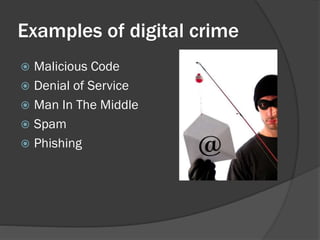
Examples of digital crime
 Malicious Code
 Denial of Service
 Man In The Middle
 Spam
 Phishing
Case Studies
   2007 Estonia attack
     Cyber attacks from an unknown source
     Most believe Russia was the attacker
     Key websites were subject to denial-of-service
      attacks which rendered their services
      inaccessible and unavailable
     Outcome?
Nigerian 4-1-9 Scams
 Scammers contact target by email or letter
 Offer target a share of a large sum of
  money
 Attacker states that they cannot access
  money
 Target ends up transferring money or fees
  to the attacker
What is Forensics?
Forensics is…
   The lawful and ethical seizure, acquisition,
    analysis, reporting and safeguarding of data and
    meta-data derived from digital devices which may
    contain information that is notable and perhaps
    of evidentiary value to the trier of fact in
    managerial, evidentiary value to the trier of fact
    in managerial, administrative, civil and criminal
    investigations.
                      - Larry Leibrock, PhD, 1998

   Forensic Science is science exercised on behalf
    of the law in the just resolution of conflict
    (Thornton 1997).
Computer Forensics
Computer Forensics involves:
 Identification
 Preservation
 Extraction
 Documentation
 Interpretation and
 Presentation
of computer data in such a way that it can be
legally admissible.
What forensics is not…
   Pro-Active (Security)
     But reactive to an event or request
   About finding the bad guy/criminal
     But finding evidence of value
   Something you do for fun
     Expertise is needed
   Quick
     2 TB drives are easily available
     OS X 10.4 supports 8 Exabyte or 8 million TB
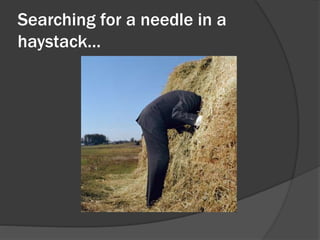
Searching for a needle in a
haystack…
Computer Forensics
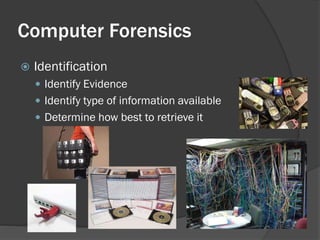
   Identification
     Identify Evidence
     Identify type of information available
     Determine how best to retrieve it
Computer Forensics
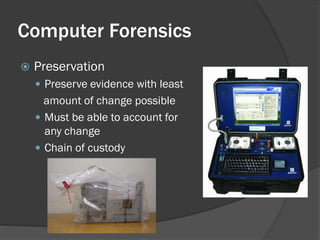
   Preservation
     Preserve evidence with least
      amount of change possible
     Must be able to account for
      any change
     Chain of custody
Computer Forensics
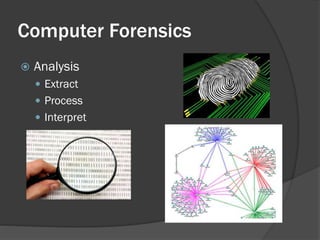
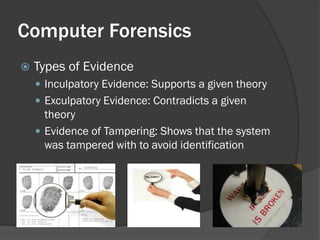
   Analysis
     Extract
     Process
     Interpret
Computer Forensics
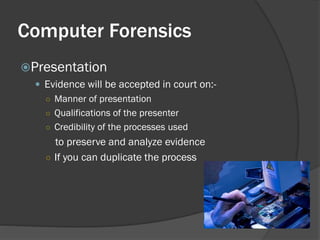
   Types of Evidence
     Inculpatory Evidence: Supports a given theory
     Exculpatory Evidence: Contradicts a given
      theory
     Evidence of Tampering: Shows that the system
      was tampered with to avoid identification
Computer Forensics
Presentation
   Evidence will be accepted in court on:-
    ○ Manner of presentation
    ○ Qualifications of the presenter
    ○ Credibility of the processes used
      to preserve and analyze evidence
    ○ If you can duplicate the process
Some Tools of the Trade
   Logicube Portable Forensic Lab (PFL)
   Forensic Talon, Forensic Dossier
   CyberCheck Suite (C-DAC)
   Encase, Forensic Toolkit (FTK), Sleuthkit
   X-Ways Forensics, X-Ways Trace
   Celldek-Tek, MOBILedit! Forensic, Oxygen
    Forensic Suite, Paraben
   CDR-Analyzer (Call Data Record)
   NetworkMiner, Wireshark
   SimCON
   Helix, DEFT, SANS Sift Kit, Matriux, Backtrack
Commercial vs Open-Source Tools
   Some advantages Commercial tools have
    over Open-Source tools:
     Better Documentation
     Commercial Level Support
     Slick GUI (Graphical User Interface), user-friendly
     In some cases, complete report generation which
      is accepted in court of law
   However, for anything a commercial forensics
    application can do, there are open-source
    applications which can do the same thing.
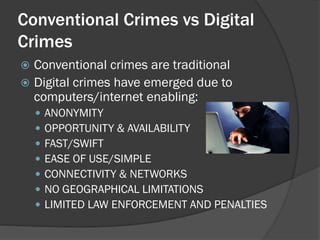
Conventional Crimes vs Digital
Crimes
 Conventional crimes are traditional
 Digital crimes have emerged due to
  computers/internet enabling:
       ANONYMITY
       OPPORTUNITY & AVAILABILITY
       FAST/SWIFT
       EASE OF USE/SIMPLE
       CONNECTIVITY & NETWORKS
       NO GEOGRAPHICAL LIMITATIONS
       LIMITED LAW ENFORCEMENT AND PENALTIES
Conventional Crimes vs Digital
Crimes (continued)
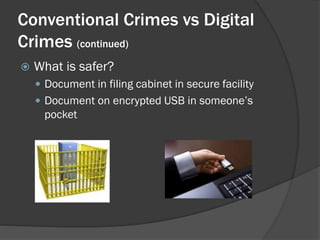
   What is safer?
     Document in filing cabinet in secure facility
     Document on encrypted USB in someone’s
      pocket
Conventional Crimes vs Digital
Crimes (continued)
 SUBJECTIVE
 However…
 Are conventional methods of crime more
  advanced and changed now, because of
  digital crime?
Conventional Crimes vs Digital
Crimes (continued)
 Yes
 Digital crime is an adaptation, as well as,
  an addition to conventional crime.
 Digital crime makes conventional crime
     Easier
     More complex
     Instantaneous
     Undetectable
     Sophisticated
Conventional Crimes vs Digital
Crimes (continued)
   Digital crimes make conventional crimes
    harder to investigate
     Who attacked who
     Legislation
     Prosecution
Conventional Crimes vs Digital
Crimes (continued)
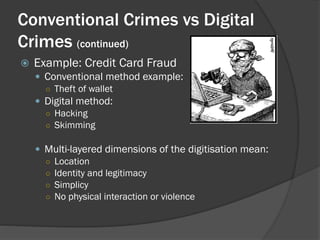
   Example: Credit Card Fraud
     Conventional method example:
      ○ Theft of wallet
     Digital method:
      ○ Hacking
      ○ Skimming

     Multi-layered dimensions of the digitisation mean:
      ○ Location
      ○ Identity and legitimacy
      ○ Simplicy
      ○ No physical interaction or violence
Conventional Crimes vs Digital
Crimes Summary
 We believe Digital Crime is an adaptation
  of Conventional Crimes
 Digital crime has made law enforcement a
  harder task
 Digital criminals are more likely to not be
  detected or prosecuted due to lack in
  international recognition and laws
Forensics at Fault
Forensics at Fault
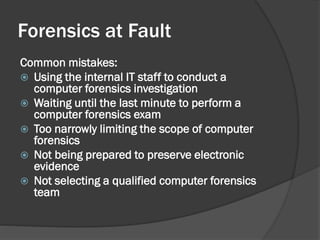
Common mistakes:
 Using the internal IT staff to conduct a
  computer forensics investigation
 Waiting until the last minute to perform a
  computer forensics exam
 Too narrowly limiting the scope of computer
  forensics
 Not being prepared to preserve electronic
  evidence
 Not selecting a qualified computer forensics
  team
Forensics is not cost effective
 Forensics is a post-event response – it is
  reactive, not proactive; the damage has
  already been done
 Investigation would reveal the culprit,
  maybe limit the damage and keep from
  occurring in the future
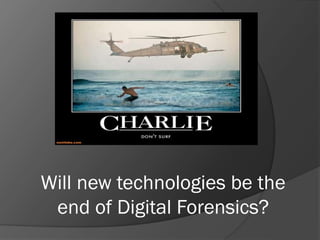
Will new technologies be the
 end of Digital Forensics?
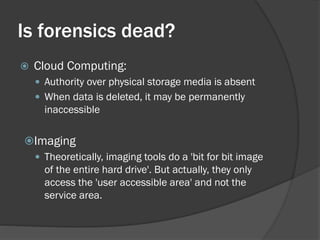
Is forensics dead?
   Cloud Computing:
     Authority over physical storage media is absent
     When data is deleted, it may be permanently
      inaccessible

Imaging
  Theoretically, imaging tools do a 'bit for bit image
   of the entire hard drive'. But actually, they only
   access the 'user accessible area' and not the
   service area.
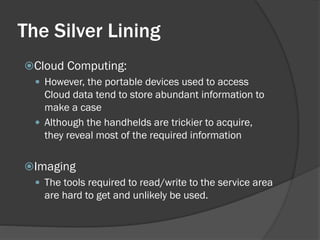
The Silver Lining
Cloud Computing:
  However, the portable devices used to access
   Cloud data tend to store abundant information to
   make a case
  Although the handhelds are trickier to acquire,
   they reveal most of the required information

Imaging
  The tools required to read/write to the service area
   are hard to get and unlikely be used.
Pitfalls with Forensics
 No International Definitions of Computer Crime
 No International Agreements on extraditions
 Multitude of OS platforms and filesystems
 Incredibly large storage space: 100+GB, TB, SANs
  (Storage Area Networks)
 Small footprint storage devices: compact flash,
  memory sticks, thumb drives,
 Networked Environments
 Cloud Computing
 Embedded Processors
 Encryption
 Anti-forensics: Wiping
Different Countries, Law
Enforcement and Courts
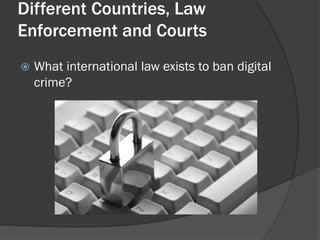
   What international law exists to ban digital
    crime?
Different Countries, Law
Enforcement and Courts (continued)
 Law - very difficult to define - controversial
 Currently, there is absence of
  law/agreement/regulation that is:
     Holistic
     Mutual
     World-wide
Different Countries, Law
Enforcement and Courts (continued)
   What have other countries done?
     Council of Europe
     United Nations
Different Countries, Law
Enforcement and Courts (continued)
 Courts and Law Enforcement
 Digital Data can be:
     Unreliable
     Volatile
     Susceptible to manipulation
Different Countries, Law
Enforcement and Courts (continued)
   Suggestions:
     International resolution
     Approaches from all levels – society,
      communities, local and federal government,
      law enforcement agencies, international
      bodies
     Publicised and enforced policy, procedures and
      views on digital crime
     Education, training and awareness
New Trends in Cyber Crime
 and Law Enforcement
New Trends
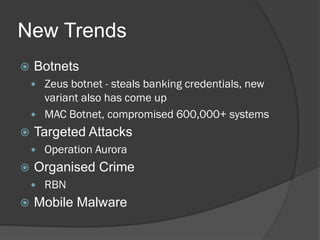
   Botnets
     Zeus botnet - steals banking credentials, new
      variant also has come up
     MAC Botnet, compromised 600,000+ systems
   Targeted Attacks
       Operation Aurora
   Organised Crime
       RBN
   Mobile Malware
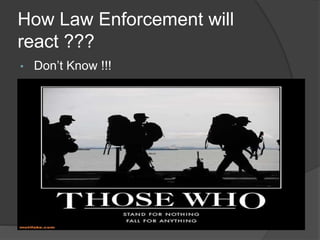
How Law Enforcement will
react ???
•   Don’t Know !!!
How Law Enforcement will
react ???
   Collaboration between law enforcement,
    government and industry
       Eg: Microsoft seizes Zeus Servers in Anti-Botnet
        Rampage

   Organised crime has the capability to resist
    and adapt to law enforcement efforts
       Law enforcement uses special tools including
        coercive powers, covert intelligence, surveillance
        and a range of specialised analytical and
        investigative techniques to overcome this
        resistance.
How Law Enforcement will
react ???
   Development
     DOD's 'Hardened' Android
     IOS may be on the way


   Information sharing between Law
    Enforcement Agencies
Conclusions
 As technology advances, so too does crime
 Digital crime is an emerging field, and as it
  develops and picks up speed, so too should
  the governing bodies
 Conventional crimes are becoming
  underpinned and improved by digital crime
   Collaboration between law enforcement,
    government and industry is vital
Conclusions
 International body for standards of policy,
  procedure and forensic investigation
 Training, education, awareness
 The criminal element is out in front all the
  time, so you have to use common sense.
 Everybody thinks technology solves a
  problem; technology doesn't do anything
  except compound common sense needs.
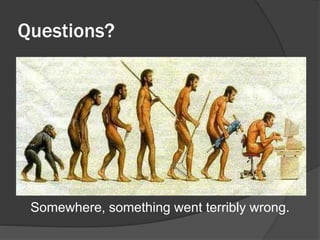
Questions?


 Somewhere, something went terribly wrong.
Questions?
References
   All References can be found in the report
    on Digital Crime and Forensics by
    Prashant Mahajan & Penelope Forbes
    http://prashantmahajan.wordpress.com/2
    012/11/27/digital-crime-forensics-report/

Digital Crime & Forensics - Presentation

  • 1.
    Prashant Mahajan &Penelope Forbes
  • 2.
    Agenda  What isDigital Crime  What is Forensics  Conventional Crime vs Digital Crime  Forensics at Fault  Different Countries, Law Enforcement and Courts  New Trends in Cyber Law and Law Enforcement  Recommendations/Evaluation
  • 3.
  • 4.
    Digital Crime is…  Problematical  Any crime where computer is a tool, target or both  Offences against computer data or systems  Unauthorised access, modification or impairment of a computer or digital system  Offences against the confidentiality, integrity and availability of computer data and systems
  • 5.
    Digital Crime is…Cntd. “If getting rich were as simple as downloading and running software, wouldn’t more people do it?” researchers Dinei Florêncio and Cormac Herley ask in their Times editorial, "The Cybercrime Wave That Wasn't.“
  • 6.
    Examples of digitalcrime  Malicious Code  Denial of Service  Man In The Middle  Spam  Phishing
  • 7.
    Case Studies  2007 Estonia attack  Cyber attacks from an unknown source  Most believe Russia was the attacker  Key websites were subject to denial-of-service attacks which rendered their services inaccessible and unavailable  Outcome?
  • 8.
    Nigerian 4-1-9 Scams Scammers contact target by email or letter  Offer target a share of a large sum of money  Attacker states that they cannot access money  Target ends up transferring money or fees to the attacker
  • 9.
  • 10.
    Forensics is…  The lawful and ethical seizure, acquisition, analysis, reporting and safeguarding of data and meta-data derived from digital devices which may contain information that is notable and perhaps of evidentiary value to the trier of fact in managerial, evidentiary value to the trier of fact in managerial, administrative, civil and criminal investigations. - Larry Leibrock, PhD, 1998  Forensic Science is science exercised on behalf of the law in the just resolution of conflict (Thornton 1997).
  • 11.
    Computer Forensics Computer Forensicsinvolves:  Identification  Preservation  Extraction  Documentation  Interpretation and  Presentation of computer data in such a way that it can be legally admissible.
  • 12.
    What forensics isnot…  Pro-Active (Security)  But reactive to an event or request  About finding the bad guy/criminal  But finding evidence of value  Something you do for fun  Expertise is needed  Quick  2 TB drives are easily available  OS X 10.4 supports 8 Exabyte or 8 million TB
  • 13.
    Searching for aneedle in a haystack…
  • 14.
    Computer Forensics  Identification  Identify Evidence  Identify type of information available  Determine how best to retrieve it
  • 15.
    Computer Forensics  Preservation  Preserve evidence with least amount of change possible  Must be able to account for any change  Chain of custody
  • 16.
    Computer Forensics  Analysis  Extract  Process  Interpret
  • 17.
    Computer Forensics  Types of Evidence  Inculpatory Evidence: Supports a given theory  Exculpatory Evidence: Contradicts a given theory  Evidence of Tampering: Shows that the system was tampered with to avoid identification
  • 18.
    Computer Forensics Presentation  Evidence will be accepted in court on:- ○ Manner of presentation ○ Qualifications of the presenter ○ Credibility of the processes used to preserve and analyze evidence ○ If you can duplicate the process
  • 19.
    Some Tools ofthe Trade  Logicube Portable Forensic Lab (PFL)  Forensic Talon, Forensic Dossier  CyberCheck Suite (C-DAC)  Encase, Forensic Toolkit (FTK), Sleuthkit  X-Ways Forensics, X-Ways Trace  Celldek-Tek, MOBILedit! Forensic, Oxygen Forensic Suite, Paraben  CDR-Analyzer (Call Data Record)  NetworkMiner, Wireshark  SimCON  Helix, DEFT, SANS Sift Kit, Matriux, Backtrack
  • 20.
    Commercial vs Open-SourceTools  Some advantages Commercial tools have over Open-Source tools:  Better Documentation  Commercial Level Support  Slick GUI (Graphical User Interface), user-friendly  In some cases, complete report generation which is accepted in court of law  However, for anything a commercial forensics application can do, there are open-source applications which can do the same thing.
  • 21.
    Conventional Crimes vsDigital Crimes  Conventional crimes are traditional  Digital crimes have emerged due to computers/internet enabling:  ANONYMITY  OPPORTUNITY & AVAILABILITY  FAST/SWIFT  EASE OF USE/SIMPLE  CONNECTIVITY & NETWORKS  NO GEOGRAPHICAL LIMITATIONS  LIMITED LAW ENFORCEMENT AND PENALTIES
  • 22.
    Conventional Crimes vsDigital Crimes (continued)  What is safer?  Document in filing cabinet in secure facility  Document on encrypted USB in someone’s pocket
  • 23.
    Conventional Crimes vsDigital Crimes (continued)  SUBJECTIVE  However…  Are conventional methods of crime more advanced and changed now, because of digital crime?
  • 24.
    Conventional Crimes vsDigital Crimes (continued)  Yes  Digital crime is an adaptation, as well as, an addition to conventional crime.  Digital crime makes conventional crime  Easier  More complex  Instantaneous  Undetectable  Sophisticated
  • 25.
    Conventional Crimes vsDigital Crimes (continued)  Digital crimes make conventional crimes harder to investigate  Who attacked who  Legislation  Prosecution
  • 26.
    Conventional Crimes vsDigital Crimes (continued)  Example: Credit Card Fraud  Conventional method example: ○ Theft of wallet  Digital method: ○ Hacking ○ Skimming  Multi-layered dimensions of the digitisation mean: ○ Location ○ Identity and legitimacy ○ Simplicy ○ No physical interaction or violence
  • 27.
    Conventional Crimes vsDigital Crimes Summary  We believe Digital Crime is an adaptation of Conventional Crimes  Digital crime has made law enforcement a harder task  Digital criminals are more likely to not be detected or prosecuted due to lack in international recognition and laws
  • 28.
  • 29.
    Forensics at Fault Commonmistakes:  Using the internal IT staff to conduct a computer forensics investigation  Waiting until the last minute to perform a computer forensics exam  Too narrowly limiting the scope of computer forensics  Not being prepared to preserve electronic evidence  Not selecting a qualified computer forensics team
  • 30.
    Forensics is notcost effective  Forensics is a post-event response – it is reactive, not proactive; the damage has already been done  Investigation would reveal the culprit, maybe limit the damage and keep from occurring in the future
  • 31.
    Will new technologiesbe the end of Digital Forensics?
  • 32.
    Is forensics dead?  Cloud Computing:  Authority over physical storage media is absent  When data is deleted, it may be permanently inaccessible Imaging  Theoretically, imaging tools do a 'bit for bit image of the entire hard drive'. But actually, they only access the 'user accessible area' and not the service area.
  • 33.
    The Silver Lining CloudComputing:  However, the portable devices used to access Cloud data tend to store abundant information to make a case  Although the handhelds are trickier to acquire, they reveal most of the required information Imaging  The tools required to read/write to the service area are hard to get and unlikely be used.
  • 34.
    Pitfalls with Forensics No International Definitions of Computer Crime  No International Agreements on extraditions  Multitude of OS platforms and filesystems  Incredibly large storage space: 100+GB, TB, SANs (Storage Area Networks)  Small footprint storage devices: compact flash, memory sticks, thumb drives,  Networked Environments  Cloud Computing  Embedded Processors  Encryption  Anti-forensics: Wiping
  • 35.
    Different Countries, Law Enforcementand Courts  What international law exists to ban digital crime?
  • 36.
    Different Countries, Law Enforcementand Courts (continued)  Law - very difficult to define - controversial  Currently, there is absence of law/agreement/regulation that is:  Holistic  Mutual  World-wide
  • 37.
    Different Countries, Law Enforcementand Courts (continued)  What have other countries done?  Council of Europe  United Nations
  • 38.
    Different Countries, Law Enforcementand Courts (continued)  Courts and Law Enforcement  Digital Data can be:  Unreliable  Volatile  Susceptible to manipulation
  • 39.
    Different Countries, Law Enforcementand Courts (continued)  Suggestions:  International resolution  Approaches from all levels – society, communities, local and federal government, law enforcement agencies, international bodies  Publicised and enforced policy, procedures and views on digital crime  Education, training and awareness
  • 40.
    New Trends inCyber Crime and Law Enforcement
  • 41.
    New Trends  Botnets  Zeus botnet - steals banking credentials, new variant also has come up  MAC Botnet, compromised 600,000+ systems  Targeted Attacks  Operation Aurora  Organised Crime  RBN  Mobile Malware
  • 42.
    How Law Enforcementwill react ??? • Don’t Know !!!
  • 43.
    How Law Enforcementwill react ???  Collaboration between law enforcement, government and industry  Eg: Microsoft seizes Zeus Servers in Anti-Botnet Rampage  Organised crime has the capability to resist and adapt to law enforcement efforts  Law enforcement uses special tools including coercive powers, covert intelligence, surveillance and a range of specialised analytical and investigative techniques to overcome this resistance.

  • 44.
    How Law Enforcementwill react ???  Development  DOD's 'Hardened' Android  IOS may be on the way  Information sharing between Law Enforcement Agencies
  • 45.
    Conclusions  As technologyadvances, so too does crime  Digital crime is an emerging field, and as it develops and picks up speed, so too should the governing bodies  Conventional crimes are becoming underpinned and improved by digital crime  Collaboration between law enforcement, government and industry is vital
  • 46.
    Conclusions  International bodyfor standards of policy, procedure and forensic investigation  Training, education, awareness  The criminal element is out in front all the time, so you have to use common sense.  Everybody thinks technology solves a problem; technology doesn't do anything except compound common sense needs.
  • 47.
    Questions? Somewhere, somethingwent terribly wrong.
  • 48.
  • 49.
    References  All References can be found in the report on Digital Crime and Forensics by Prashant Mahajan & Penelope Forbes http://prashantmahajan.wordpress.com/2 012/11/27/digital-crime-forensics-report/