Digital
forensics
Branch: BTI Computers
Semester/Year: X / 5th
Presented by:
C077- Mohammad Mubasshir
C176- Dhruvi Doshi
C177- Dipeesha Vartak
C186- Rushil Sheth
C195- Saanvi Misar
C196- Nitya Nivdunge
WhatisDigitalforensics?
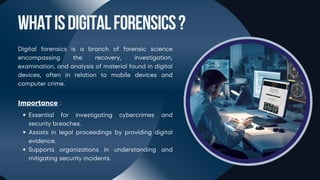
Digital forensics is a branch of forensic science
encompassing the recovery, investigation,
examination, and analysis of material found in digital
devices, often in relation to mobile devices and
computer crime.
Importance :
Essential for investigating cybercrimes and
security breaches.
Assists in legal proceedings by providing digital
evidence.
Supports organizations in understanding and
mitigating security incidents.
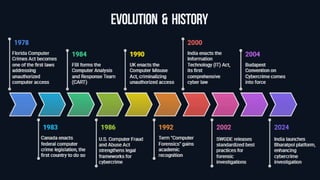
Evolution & History
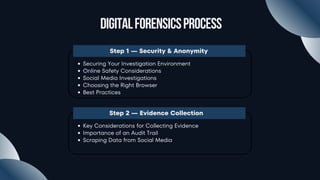
DigitalForensicsProcess
Step 1 — Security & Anonymity
Securing Your Investigation Environment
Online Safety Considerations
Social Media Investigations
Choosing the Right Browser
Best Practices
Step 2 — Evidence Collection
Key Considerations for Collecting Evidence
Importance of an Audit Trail
Scraping Data from Social Media
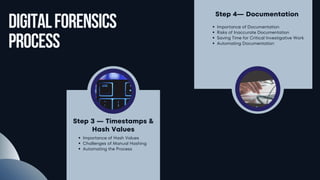
DigitalForensics
Process
Step 3 — Timestamps &
Hash Values Healthcare
Importance of Hash Values
Challenges of Manual Hashing
Automating the Process
Lorem ipsum dolor sit
amet, consectetur
adipiscing elit. Nunc
eu dapibus dolor,
tempor vulputate
ligula.
Business
Step 4— Documentation
Lorem ipsum dolor sit
amet, consectetur
adipiscing elit. Nunc
eu dapibus dolor,
tempor vulputate
ligula.
Importance of Documentation
Risks of Inaccurate Documentation
Saving Time for Critical Investigative Work
Automating Documentation
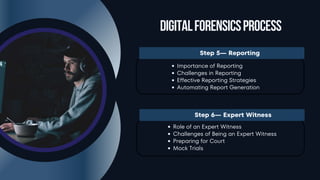
DigitalForensicsProcess
Step 5— Reporting
Importance of Reporting
Challenges in Reporting
Effective Reporting Strategies
Automating Report Generation
Step 6— Expert Witness
Role of an Expert Witness
Challenges of Being an Expert Witness
Preparing for Court
Mock Trials
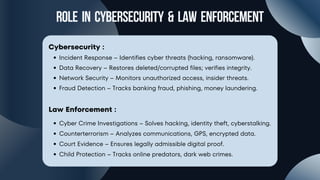
Role in cybersecurity & law enforcement
Cybersecurity :
Incident Response – Identifies cyber threats (hacking, ransomware).
Data Recovery – Restores deleted/corrupted files; verifies integrity.
Network Security – Monitors unauthorized access, insider threats.
Fraud Detection – Tracks banking fraud, phishing, money laundering.
Law Enforcement :
Cyber Crime Investigations – Solves hacking, identity theft, cyberstalking.
Counterterrorism – Analyzes communications, GPS, encrypted data.
Court Evidence – Ensures legally admissible digital proof.
Child Protection – Tracks online predators, dark web crimes.
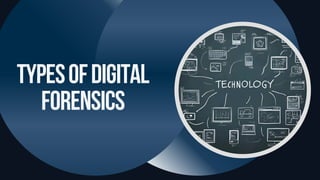
TypesofDigital
Forensics
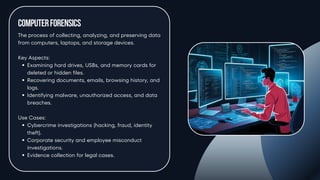
ComputerForensics
The process of collecting, analyzing, and preserving data
from computers, laptops, and storage devices.
Key Aspects:
Examining hard drives, USBs, and memory cards for
deleted or hidden files.
Recovering documents, emails, browsing history, and
logs.
Identifying malware, unauthorized access, and data
breaches.
Use Cases:
Cybercrime investigations (hacking, fraud, identity
theft).
Corporate security and employee misconduct
investigations.
Evidence collection for legal cases.
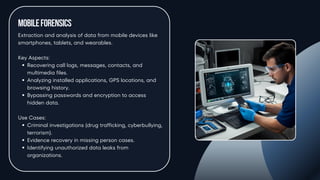
MobileForensics
Extraction and analysis of data from mobile devices like
smartphones, tablets, and wearables.
Key Aspects:
Recovering call logs, messages, contacts, and
multimedia files.
Analyzing installed applications, GPS locations, and
browsing history.
Bypassing passwords and encryption to access
hidden data.
Use Cases:
Criminal investigations (drug trafficking, cyberbullying,
terrorism).
Evidence recovery in missing person cases.
Identifying unauthorized data leaks from
organizations.
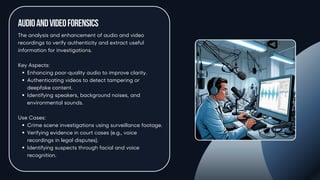
AudioandVideoForensics
The analysis and enhancement of audio and video
recordings to verify authenticity and extract useful
information for investigations.
Key Aspects:
Enhancing poor-quality audio to improve clarity.
Authenticating videos to detect tampering or
deepfake content.
Identifying speakers, background noises, and
environmental sounds.
Use Cases:
Crime scene investigations using surveillance footage.
Verifying evidence in court cases (e.g., voice
recordings in legal disputes).
Identifying suspects through facial and voice
recognition.
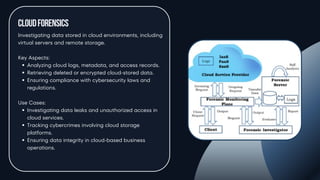
CloudForensics
Investigating data stored in cloud environments, including
virtual servers and remote storage.
Key Aspects:
Analyzing cloud logs, metadata, and access records.
Retrieving deleted or encrypted cloud-stored data.
Ensuring compliance with cybersecurity laws and
regulations.
Use Cases:
Investigating data leaks and unauthorized access in
cloud services.
Tracking cybercrimes involving cloud storage
platforms.
Ensuring data integrity in cloud-based business
operations.
DigitalForensics
UseCases
Using
professional
forensic software
like Email
Investigation
Tools for
accurate
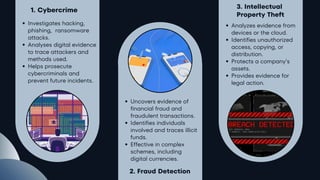
1. Cybercrime
2. Fraud Detection
3. Intellectual
Property Theft
Investigates hacking,
phishing, ransomware
attacks.
Analyses digital evidence
to trace attackers and
methods used.
Helps prosecute
cybercriminals and
prevent future incidents.
Uncovers evidence of
financial fraud and
fraudulent transactions.
Identifies individuals
involved and traces illicit
funds.
Effective in complex
schemes, including
digital currencies.
Analyzes evidence from
devices or the cloud.
Identifies unauthorized
access, copying, or
distribution.
Protects a company’s
assets.
Provides evidence for
legal action.
2. Fraud Detection
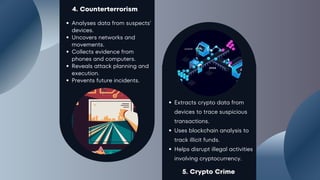
4. Counterterrorism
5. Crypto Crime
Extracts crypto data from
devices to trace suspicious
transactions.
Uses blockchain analysis to
track illicit funds.
Helps disrupt illegal activities
involving cryptocurrency.
Analyses data from suspects'
devices.
Uncovers networks and
movements.
Collects evidence from
phones and computers.
Reveals attack planning and
execution.
Prevents future incidents.
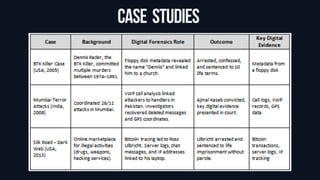
Case Studies
OverviewofDigitalForensicsInvestigation
Challenges
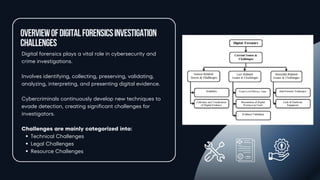
Digital forensics plays a vital role in cybersecurity and
crime investigations.
Involves identifying, collecting, preserving, validating,
analyzing, interpreting, and presenting digital evidence.
Cybercriminals continuously develop new techniques to
evade detection, creating significant challenges for
investigators.
Challenges are mainly categorized into:
Technical Challenges
Legal Challenges
Resource Challenges
TechnicalChallengesinDigitalForensics
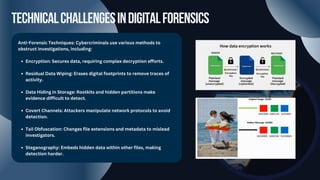
Anti-Forensic Techniques: Cybercriminals use various methods to
obstruct investigations, including:
Encryption: Secures data, requiring complex decryption efforts.
Residual Data Wiping: Erases digital footprints to remove traces of
activity.
Data Hiding in Storage: Rootkits and hidden partitions make
evidence difficult to detect.
Covert Channels: Attackers manipulate network protocols to avoid
detection.
Tail Obfuscation: Changes file extensions and metadata to mislead
investigators.
Steganography: Embeds hidden data within other files, making
detection harder.
LegalandResourceChallengesinDigitalForensics
Legal Challenges:
Privacy laws restrict access to crucial data
for investigations.
Legal limitations on how evidence is
collected and used in court.
Investigators may discover evidence but
be unable to use it due to privacy
concerns.
Resource Challenges:
High Data Volume: Large amounts of
data extend investigation time.
Time Constraints: Limited time to extract
evidence from volatile memory before it is
overwritten.
Data Integrity: Ensuring data remains
unchanged during the investigation.
Damaged Data Sources: Corrupted or
inaccessible files make evidence retrieval
difficult.
Education
Lorem ipsum dolor sit
amet, consectetur
adipiscing elit. Nunc
eu dapibus dolor,
tempor vulputate
ligula.
Obstacles:
Case Complexity:
Evidence is often scattered across
multiple devices, cloud storage, and
online platforms.
Requires automation and AI-based
forensic tools for efficiency.
Lack of Standardization:
Need for universally accepted forensic
methodologies and evidence-handling
standards.
Developing standardized formats and
schemas can improve forensic
investigations.
AdditionalObstaclesand
SolutionsinDigitalForensics
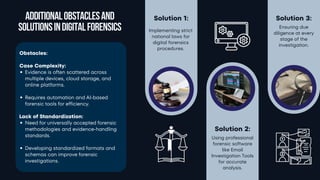
Solution 2:
Using professional
forensic software
like Email
Investigation Tools
for accurate
analysis.
Solution 1: Solution 3:
Implementing strict
national laws for
digital forensics
procedures.
Ensuring due
diligence at every
stage of the
investigation.
TOOLSOFDigital
Forensics
Business
Lorem
ipsum
dolor
sit
amet,
consectetur
adipiscing
elit.
Nunc
eu
dapibus
dolor,
tempor
vulputate
ligula.
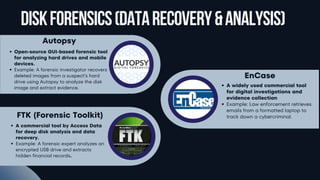
DiskForensics(DataRecovery&Analysis)
Autopsy
Open-source GUI-based forensic tool
for analyzing hard drives and mobile
devices.
Example: A forensic investigator recovers
deleted images from a suspect’s hard
drive using Autopsy to analyze the disk
image and extract evidence.
EnCase
A widely used commercial tool
for digital investigations and
evidence collection
Example: Law enforcement retrieves
emails from a formatted laptop to
track down a cybercriminal.
FTK (Forensic Toolkit)
A commercial tool by Access Data
for deep disk analysis and data
recovery.
Example: A forensic expert analyzes an
encrypted USB drive and extracts
hidden financial records.
Business
Lorem
ipsum
dolor
sit
amet,
consectetur
adipiscing
elit.
Nunc
eu
dapibus
dolor,
tempor
vulputate
ligula.
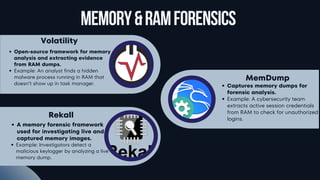
Memory&RAMForensics
Volatility
Open-source framework for memory
analysis and extracting evidence
from RAM dumps.
Example: An analyst finds a hidden
malware process running in RAM that
doesn’t show up in task manager.
MemDump
Captures memory dumps for
forensic analysis.
Example: A cybersecurity team
extracts active session credentials
from RAM to check for unauthorized
logins.
Rekall
A memory forensic framework
used for investigating live and
captured memory images.
Example: Investigators detect a
malicious keylogger by analyzing a live
memory dump.
Business
Lorem
ipsum
dolor
sit
amet,
consectetur
adipiscing
elit.
Nunc
eu
dapibus
dolor,
tempor
vulputate
ligula.
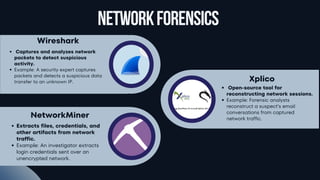
NetworkForensics
Wireshark
Captures and analyzes network
packets to detect suspicious
activity.
Example: A security expert captures
packets and detects a suspicious data
transfer to an unknown IP. Xplico
Open-source tool for
reconstructing network sessions.
Example: Forensic analysts
reconstruct a suspect’s email
conversations from captured
network traffic.
NetworkMiner
Extracts files, credentials, and
other artifacts from network
traffic.
Example: An investigator extracts
login credentials sent over an
unencrypted network.
Business
Lorem
ipsum
dolor
sit
amet,
consectetur
adipiscing
elit.
Nunc
eu
dapibus
dolor,
tempor
vulputate
ligula.
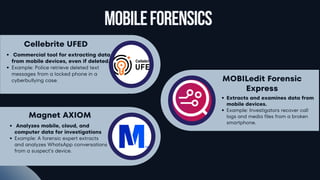
MobileForensics
Cellebrite UFED
Commercial tool for extracting data
from mobile devices, even if deleted.
Example: Police retrieve deleted text
messages from a locked phone in a
cyberbullying case. MOBILedit Forensic
Express
Extracts and examines data from
mobile devices.
Example: Investigators recover call
logs and media files from a broken
smartphone.
Magnet AXIOM
Analyzes mobile, cloud, and
computer data for investigations
Example: A forensic expert extracts
and analyzes WhatsApp conversations
from a suspect’s device.
Business
Lorem
ipsum
dolor
sit
amet,
consectetur
adipiscing
elit.
Nunc
eu
dapibus
dolor,
tempor
vulputate
ligula.
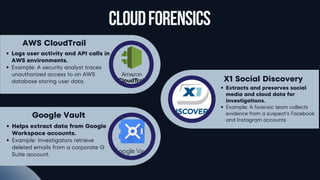
CloudForensics
AWS CloudTrail
Logs user activity and API calls in
AWS environments.
Example: A security analyst traces
unauthorized access to an AWS
database storing user data. X1 Social Discovery
Extracts and preserves social
media and cloud data for
investigations.
Example: A forensic team collects
evidence from a suspect’s Facebook
and Instagram accounts
Google Vault
Helps extract data from Google
Workspace accounts.
Example: Investigators retrieve
deleted emails from a corporate G
Suite account.
FUTUREOFDigital
Forensics
AIIntegration
Automates data sorting, keyword searches, and pattern
recognition.
Speeds up analysis of large data sets— terabytes in hours.
Identifies hidden connections and anomalies quickly.
Limitations: biases in training data, possible
misinterpretation of context.
Need for a balance between AI use and human judgment.
Emphasis on ethical considerations and accuracy in
analysis.
Traditional methods struggle with cloud-based evidence.
Difficulties in accessing data on distributed, remote servers.
Need to navigate international privacy and data protection
laws.
Adaptation of tools for live cloud environments.
Essential skills: virtual machine forensics, cloud data
analysis.
Ensuring compliance with complex regulations.
CloudandRemote
DataChallenges
IoTForensics
IoT devices as new evidence sources (smartwatches, home
assistants, vehicles).
Extracting data is challenging due to proprietary systems.
Limited storage on devices requires specific forensic techniques.
Importance of understanding the device’s operational context.
Growing demand for specialization in IoT forensics.
Potential to uncover critical insights through non-traditional
devices.
Encryption secures data but complicates forensic investigations.
End-to-end encryption increases legal access challenges.
Techniques: metadata analysis, lawful intercept
technologies.
Need for awareness of evolving cryptographic methods.
Balancing investigative needs with legal and ethical boundaries.
Staying updated with legislation impacting encrypted data
access.
AdvancementsinEncryption
Conclusion
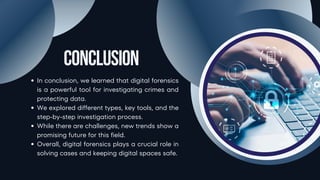
In conclusion, we learned that digital forensics
is a powerful tool for investigating crimes and
protecting data.
We explored different types, key tools, and the
step-by-step investigation process.
While there are challenges, new trends show a
promising future for this field.
Overall, digital forensics plays a crucial role in
solving cases and keeping digital spaces safe.
Contribution
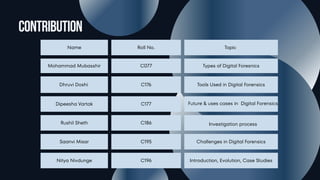
Name Roll No. Topic
Mohammad Mubasshir C077 Types of Digital Foresnics
Dhruvi Doshi C176 Tools Used in Digital Forensics
Dipeesha Vartak C177
Rushil Sheth C186
Saanvi Misar C195 Challenges in Digital Forensics
Nitya Nivdunge C196 Introduction, Evolution, Case Studies
Future & uses cases in Digital Forensics
Investigation process
references
https://www.linkedin.com/pulse/exploring-future-digital-forensics-challenges-eric-l-waldrep-ixkff/
https://www.cognyte.com/blog/digital-forensics-investigations/
https://www.psychologytoday.com/us/blog/wicked-deeds/202302/the-capture-of-serial-killer-dennis-
rader-btk
https://en.wikipedia.org/wiki/2008_Mumbai_attacks
https://en.wikipedia.org/wiki/Silk_Road_(marketplace)
https://www.jaroeducation.com/blog/digital-forensics-tools-and-techniques/
https://www.bluevoyant.com/knowledge-center/get-started-with-these-9-open-source-tools
https://www.geeksforgeeks.org/cyber-forensics-tools/
Thankyou

Introduction to Forensic Research Digital Forensics

  • 1.
    Digital forensics Branch: BTI Computers Semester/Year:X / 5th Presented by: C077- Mohammad Mubasshir C176- Dhruvi Doshi C177- Dipeesha Vartak C186- Rushil Sheth C195- Saanvi Misar C196- Nitya Nivdunge
  • 2.
    WhatisDigitalforensics? Digital forensics isa branch of forensic science encompassing the recovery, investigation, examination, and analysis of material found in digital devices, often in relation to mobile devices and computer crime. Importance : Essential for investigating cybercrimes and security breaches. Assists in legal proceedings by providing digital evidence. Supports organizations in understanding and mitigating security incidents.
  • 3.
  • 4.
    DigitalForensicsProcess Step 1 —Security & Anonymity Securing Your Investigation Environment Online Safety Considerations Social Media Investigations Choosing the Right Browser Best Practices Step 2 — Evidence Collection Key Considerations for Collecting Evidence Importance of an Audit Trail Scraping Data from Social Media
  • 5.
    DigitalForensics Process Step 3 —Timestamps & Hash Values Healthcare Importance of Hash Values Challenges of Manual Hashing Automating the Process Lorem ipsum dolor sit amet, consectetur adipiscing elit. Nunc eu dapibus dolor, tempor vulputate ligula. Business Step 4— Documentation Lorem ipsum dolor sit amet, consectetur adipiscing elit. Nunc eu dapibus dolor, tempor vulputate ligula. Importance of Documentation Risks of Inaccurate Documentation Saving Time for Critical Investigative Work Automating Documentation
  • 6.
    DigitalForensicsProcess Step 5— Reporting Importanceof Reporting Challenges in Reporting Effective Reporting Strategies Automating Report Generation Step 6— Expert Witness Role of an Expert Witness Challenges of Being an Expert Witness Preparing for Court Mock Trials
  • 7.
    Role in cybersecurity& law enforcement Cybersecurity : Incident Response – Identifies cyber threats (hacking, ransomware). Data Recovery – Restores deleted/corrupted files; verifies integrity. Network Security – Monitors unauthorized access, insider threats. Fraud Detection – Tracks banking fraud, phishing, money laundering. Law Enforcement : Cyber Crime Investigations – Solves hacking, identity theft, cyberstalking. Counterterrorism – Analyzes communications, GPS, encrypted data. Court Evidence – Ensures legally admissible digital proof. Child Protection – Tracks online predators, dark web crimes.
  • 8.
  • 9.
    ComputerForensics The process ofcollecting, analyzing, and preserving data from computers, laptops, and storage devices. Key Aspects: Examining hard drives, USBs, and memory cards for deleted or hidden files. Recovering documents, emails, browsing history, and logs. Identifying malware, unauthorized access, and data breaches. Use Cases: Cybercrime investigations (hacking, fraud, identity theft). Corporate security and employee misconduct investigations. Evidence collection for legal cases.

  • 10.
    MobileForensics Extraction and analysisof data from mobile devices like smartphones, tablets, and wearables. Key Aspects: Recovering call logs, messages, contacts, and multimedia files. Analyzing installed applications, GPS locations, and browsing history. Bypassing passwords and encryption to access hidden data. Use Cases: Criminal investigations (drug trafficking, cyberbullying, terrorism). Evidence recovery in missing person cases. Identifying unauthorized data leaks from organizations.
  • 11.
    AudioandVideoForensics The analysis andenhancement of audio and video recordings to verify authenticity and extract useful information for investigations. Key Aspects: Enhancing poor-quality audio to improve clarity. Authenticating videos to detect tampering or deepfake content. Identifying speakers, background noises, and environmental sounds. Use Cases: Crime scene investigations using surveillance footage. Verifying evidence in court cases (e.g., voice recordings in legal disputes). Identifying suspects through facial and voice recognition.
  • 12.
    CloudForensics Investigating data storedin cloud environments, including virtual servers and remote storage. Key Aspects: Analyzing cloud logs, metadata, and access records. Retrieving deleted or encrypted cloud-stored data. Ensuring compliance with cybersecurity laws and regulations. Use Cases: Investigating data leaks and unauthorized access in cloud services. Tracking cybercrimes involving cloud storage platforms. Ensuring data integrity in cloud-based business operations.
  • 13.
  • 14.
    Using professional forensic software like Email Investigation Toolsfor accurate 1. Cybercrime 2. Fraud Detection 3. Intellectual Property Theft Investigates hacking, phishing, ransomware attacks. Analyses digital evidence to trace attackers and methods used. Helps prosecute cybercriminals and prevent future incidents. Uncovers evidence of financial fraud and fraudulent transactions. Identifies individuals involved and traces illicit funds. Effective in complex schemes, including digital currencies. Analyzes evidence from devices or the cloud. Identifies unauthorized access, copying, or distribution. Protects a company’s assets. Provides evidence for legal action.
  • 15.
    2. Fraud Detection 4.Counterterrorism 5. Crypto Crime Extracts crypto data from devices to trace suspicious transactions. Uses blockchain analysis to track illicit funds. Helps disrupt illegal activities involving cryptocurrency. Analyses data from suspects' devices. Uncovers networks and movements. Collects evidence from phones and computers. Reveals attack planning and execution. Prevents future incidents.

  • 16.
  • 17.
    OverviewofDigitalForensicsInvestigation Challenges Digital forensics playsa vital role in cybersecurity and crime investigations. Involves identifying, collecting, preserving, validating, analyzing, interpreting, and presenting digital evidence. Cybercriminals continuously develop new techniques to evade detection, creating significant challenges for investigators. Challenges are mainly categorized into: Technical Challenges Legal Challenges Resource Challenges
  • 18.
    TechnicalChallengesinDigitalForensics Anti-Forensic Techniques: Cybercriminalsuse various methods to obstruct investigations, including: Encryption: Secures data, requiring complex decryption efforts. Residual Data Wiping: Erases digital footprints to remove traces of activity. Data Hiding in Storage: Rootkits and hidden partitions make evidence difficult to detect. Covert Channels: Attackers manipulate network protocols to avoid detection. Tail Obfuscation: Changes file extensions and metadata to mislead investigators. Steganography: Embeds hidden data within other files, making detection harder.
  • 19.
    LegalandResourceChallengesinDigitalForensics Legal Challenges: Privacy lawsrestrict access to crucial data for investigations. Legal limitations on how evidence is collected and used in court. Investigators may discover evidence but be unable to use it due to privacy concerns. Resource Challenges: High Data Volume: Large amounts of data extend investigation time. Time Constraints: Limited time to extract evidence from volatile memory before it is overwritten. Data Integrity: Ensuring data remains unchanged during the investigation. Damaged Data Sources: Corrupted or inaccessible files make evidence retrieval difficult.
  • 20.
    Education Lorem ipsum dolorsit amet, consectetur adipiscing elit. Nunc eu dapibus dolor, tempor vulputate ligula. Obstacles: Case Complexity: Evidence is often scattered across multiple devices, cloud storage, and online platforms. Requires automation and AI-based forensic tools for efficiency. Lack of Standardization: Need for universally accepted forensic methodologies and evidence-handling standards. Developing standardized formats and schemas can improve forensic investigations. AdditionalObstaclesand SolutionsinDigitalForensics Solution 2: Using professional forensic software like Email Investigation Tools for accurate analysis. Solution 1: Solution 3: Implementing strict national laws for digital forensics procedures. Ensuring due diligence at every stage of the investigation.
  • 21.
  • 22.
    Business Lorem ipsum dolor sit amet, consectetur adipiscing elit. Nunc eu dapibus dolor, tempor vulputate ligula. DiskForensics(DataRecovery&Analysis) Autopsy Open-source GUI-based forensictool for analyzing hard drives and mobile devices. Example: A forensic investigator recovers deleted images from a suspect’s hard drive using Autopsy to analyze the disk image and extract evidence. EnCase A widely used commercial tool for digital investigations and evidence collection Example: Law enforcement retrieves emails from a formatted laptop to track down a cybercriminal. FTK (Forensic Toolkit) A commercial tool by Access Data for deep disk analysis and data recovery. Example: A forensic expert analyzes an encrypted USB drive and extracts hidden financial records.
  • 23.
    Business Lorem ipsum dolor sit amet, consectetur adipiscing elit. Nunc eu dapibus dolor, tempor vulputate ligula. Memory&RAMForensics Volatility Open-source framework formemory analysis and extracting evidence from RAM dumps. Example: An analyst finds a hidden malware process running in RAM that doesn’t show up in task manager. MemDump Captures memory dumps for forensic analysis. Example: A cybersecurity team extracts active session credentials from RAM to check for unauthorized logins. Rekall A memory forensic framework used for investigating live and captured memory images. Example: Investigators detect a malicious keylogger by analyzing a live memory dump.
  • 24.
    Business Lorem ipsum dolor sit amet, consectetur adipiscing elit. Nunc eu dapibus dolor, tempor vulputate ligula. NetworkForensics Wireshark Captures and analyzesnetwork packets to detect suspicious activity. Example: A security expert captures packets and detects a suspicious data transfer to an unknown IP. Xplico Open-source tool for reconstructing network sessions. Example: Forensic analysts reconstruct a suspect’s email conversations from captured network traffic. NetworkMiner Extracts files, credentials, and other artifacts from network traffic. Example: An investigator extracts login credentials sent over an unencrypted network.
  • 25.
    Business Lorem ipsum dolor sit amet, consectetur adipiscing elit. Nunc eu dapibus dolor, tempor vulputate ligula. MobileForensics Cellebrite UFED Commercial toolfor extracting data from mobile devices, even if deleted. Example: Police retrieve deleted text messages from a locked phone in a cyberbullying case. MOBILedit Forensic Express Extracts and examines data from mobile devices. Example: Investigators recover call logs and media files from a broken smartphone. Magnet AXIOM Analyzes mobile, cloud, and computer data for investigations Example: A forensic expert extracts and analyzes WhatsApp conversations from a suspect’s device.
  • 26.
    Business Lorem ipsum dolor sit amet, consectetur adipiscing elit. Nunc eu dapibus dolor, tempor vulputate ligula. CloudForensics AWS CloudTrail Logs useractivity and API calls in AWS environments. Example: A security analyst traces unauthorized access to an AWS database storing user data. X1 Social Discovery Extracts and preserves social media and cloud data for investigations. Example: A forensic team collects evidence from a suspect’s Facebook and Instagram accounts Google Vault Helps extract data from Google Workspace accounts. Example: Investigators retrieve deleted emails from a corporate G Suite account.
  • 27.
  • 28.
    AIIntegration Automates data sorting,keyword searches, and pattern recognition. Speeds up analysis of large data sets— terabytes in hours. Identifies hidden connections and anomalies quickly. Limitations: biases in training data, possible misinterpretation of context. Need for a balance between AI use and human judgment. Emphasis on ethical considerations and accuracy in analysis.
  • 29.
    Traditional methods strugglewith cloud-based evidence. Difficulties in accessing data on distributed, remote servers. Need to navigate international privacy and data protection laws. Adaptation of tools for live cloud environments. Essential skills: virtual machine forensics, cloud data analysis. Ensuring compliance with complex regulations. CloudandRemote DataChallenges
  • 30.
    IoTForensics IoT devices asnew evidence sources (smartwatches, home assistants, vehicles). Extracting data is challenging due to proprietary systems. Limited storage on devices requires specific forensic techniques. Importance of understanding the device’s operational context. Growing demand for specialization in IoT forensics. Potential to uncover critical insights through non-traditional devices.
  • 31.
    Encryption secures databut complicates forensic investigations. End-to-end encryption increases legal access challenges. Techniques: metadata analysis, lawful intercept technologies. Need for awareness of evolving cryptographic methods. Balancing investigative needs with legal and ethical boundaries. Staying updated with legislation impacting encrypted data access. AdvancementsinEncryption
  • 32.
    Conclusion In conclusion, welearned that digital forensics is a powerful tool for investigating crimes and protecting data. We explored different types, key tools, and the step-by-step investigation process. While there are challenges, new trends show a promising future for this field. Overall, digital forensics plays a crucial role in solving cases and keeping digital spaces safe.
  • 33.
    Contribution Name Roll No.Topic Mohammad Mubasshir C077 Types of Digital Foresnics Dhruvi Doshi C176 Tools Used in Digital Forensics Dipeesha Vartak C177 Rushil Sheth C186 Saanvi Misar C195 Challenges in Digital Forensics Nitya Nivdunge C196 Introduction, Evolution, Case Studies Future & uses cases in Digital Forensics Investigation process
  • 34.
  • 35.