Presentation
on
Presented by
Mr .Amol V. Ghogare
Assistant Professor, Civil Engineering Dept.
SRES, SCOE, Kopargaon
.
 Stereoscopy
The use of binocular vision to achieve 3-
dimensional effects.
Enables you to view an object from 2 different
camera positions to obtain a 3-dimensional view.
Stereo pairs of photographs
Two adjacent, overlapping photographs in the same
flight line.
Stereo views can only be seen in the overlapping
portion
of the photos.
Stereoscope
The binocular optical instrument that help to view two
properly oriented photos to obtain a 3- dimensional model
Stereoscopic Fusion
Stereoscopic fusion is the fusion of two separate images
of an object in the brain together with a spatial impression,
is called as Stereoscopic Fusion
Types of Stereoscope:-
1. Lense Stereoscope
2. Mirror Stereoscope
3. Scanning Stereoscope
4. Zoom Stereoscope
Types of Stereoscopes
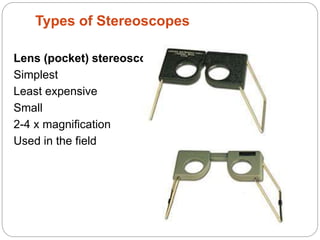
Lens (pocket) stereoscope
Simplest
Least expensive
Small
2-4 x magnification
Used in the field
Types of Stereoscopes:
[A] Mirror
stereoscope
 Photos can be placed
separately for viewing
 Used in the field?
• Consist of four mirror makes an angle 45 deg with plane of photo
• Two larger Wing mirror, two eyepiece mirror
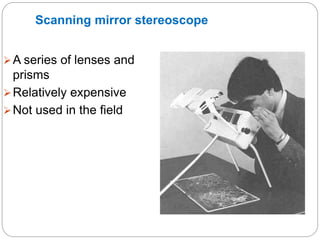
Scanning mirror stereoscope
A series of lenses and
prisms
Relatively expensive
Not used in the field
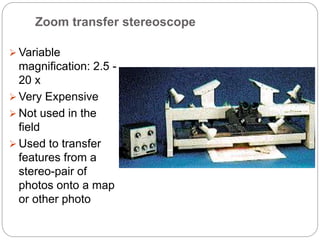
Zoom transfer stereoscope
 Variable
magnification: 2.5 -
20 x
 Very Expensive
 Not used in the
field
 Used to transfer
features from a
stereo-pair of
photos onto a map
or other photo
Stereo Photograph Geometry
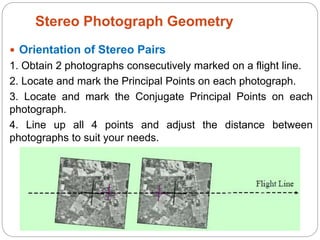
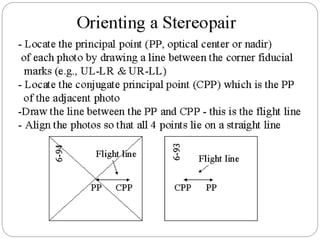
 Orientation of Stereo Pairs
1. Obtain 2 photographs consecutively marked on a flight line.
2. Locate and mark the Principal Points on each photograph.
3. Locate and mark the Conjugate Principal Points on each
photograph.
4. Line up all 4 points and adjust the distance between
photographs to suit your needs.
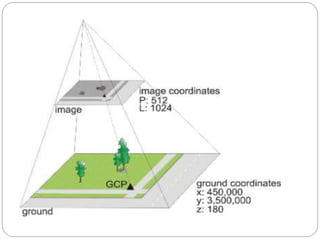
Ground Control Points (GCP)
 A ground control point (GCP) is feature that you can
clearly identify in the raw image for which you have a
known ground coordinate.
 Ground coordinates can come from a variety of sources
such as the Global Positioning System (GPS), ground
surveys, geocoded images, vectors, geographic
information systems (GIS), topographic maps, extend the
number of GCPs in your images.
 A GCP determines the relationship between the raw
image and the ground by associating the pixel (P) and
line (L) image coordinates to the x, y, and z coordinates
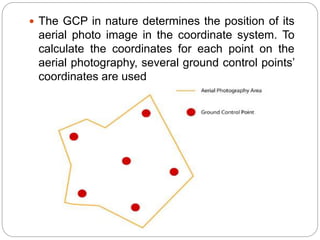
 The GCP in nature determines the position of its
aerial photo image in the coordinate system. To
calculate the coordinates for each point on the
aerial photography, several ground control points’
coordinates are used
Thank you

Types of stereoscope

  • 1.
    Presentation on Presented by Mr .AmolV. Ghogare Assistant Professor, Civil Engineering Dept. SRES, SCOE, Kopargaon .
  • 2.
     Stereoscopy The useof binocular vision to achieve 3- dimensional effects. Enables you to view an object from 2 different camera positions to obtain a 3-dimensional view. Stereo pairs of photographs Two adjacent, overlapping photographs in the same flight line. Stereo views can only be seen in the overlapping portion of the photos.
  • 3.
    Stereoscope The binocular opticalinstrument that help to view two properly oriented photos to obtain a 3- dimensional model Stereoscopic Fusion Stereoscopic fusion is the fusion of two separate images of an object in the brain together with a spatial impression, is called as Stereoscopic Fusion Types of Stereoscope:- 1. Lense Stereoscope 2. Mirror Stereoscope 3. Scanning Stereoscope 4. Zoom Stereoscope
  • 4.
    Types of Stereoscopes Lens(pocket) stereoscope Simplest Least expensive Small 2-4 x magnification Used in the field
  • 5.
    Types of Stereoscopes: [A]Mirror stereoscope  Photos can be placed separately for viewing  Used in the field? • Consist of four mirror makes an angle 45 deg with plane of photo • Two larger Wing mirror, two eyepiece mirror
  • 6.
    Scanning mirror stereoscope Aseries of lenses and prisms Relatively expensive Not used in the field
  • 7.
    Zoom transfer stereoscope Variable magnification: 2.5 - 20 x  Very Expensive  Not used in the field  Used to transfer features from a stereo-pair of photos onto a map or other photo
  • 8.
    Stereo Photograph Geometry Orientation of Stereo Pairs 1. Obtain 2 photographs consecutively marked on a flight line. 2. Locate and mark the Principal Points on each photograph. 3. Locate and mark the Conjugate Principal Points on each photograph. 4. Line up all 4 points and adjust the distance between photographs to suit your needs.
  • 10.
    Ground Control Points(GCP)  A ground control point (GCP) is feature that you can clearly identify in the raw image for which you have a known ground coordinate.  Ground coordinates can come from a variety of sources such as the Global Positioning System (GPS), ground surveys, geocoded images, vectors, geographic information systems (GIS), topographic maps, extend the number of GCPs in your images.  A GCP determines the relationship between the raw image and the ground by associating the pixel (P) and line (L) image coordinates to the x, y, and z coordinates
  • 12.
     The GCPin nature determines the position of its aerial photo image in the coordinate system. To calculate the coordinates for each point on the aerial photography, several ground control points’ coordinates are used
  • 13.