Diffusion Capacity
Indications and interpretation
Surinder K. Jindal
(Emeritus Professor, Pulm Med, PGIMER, Chandigarh)
Medical Director, Jindal Clinics, Chandigarh
www.jindalchest.com
Mechanisms of gas-exchange
from air to tissues
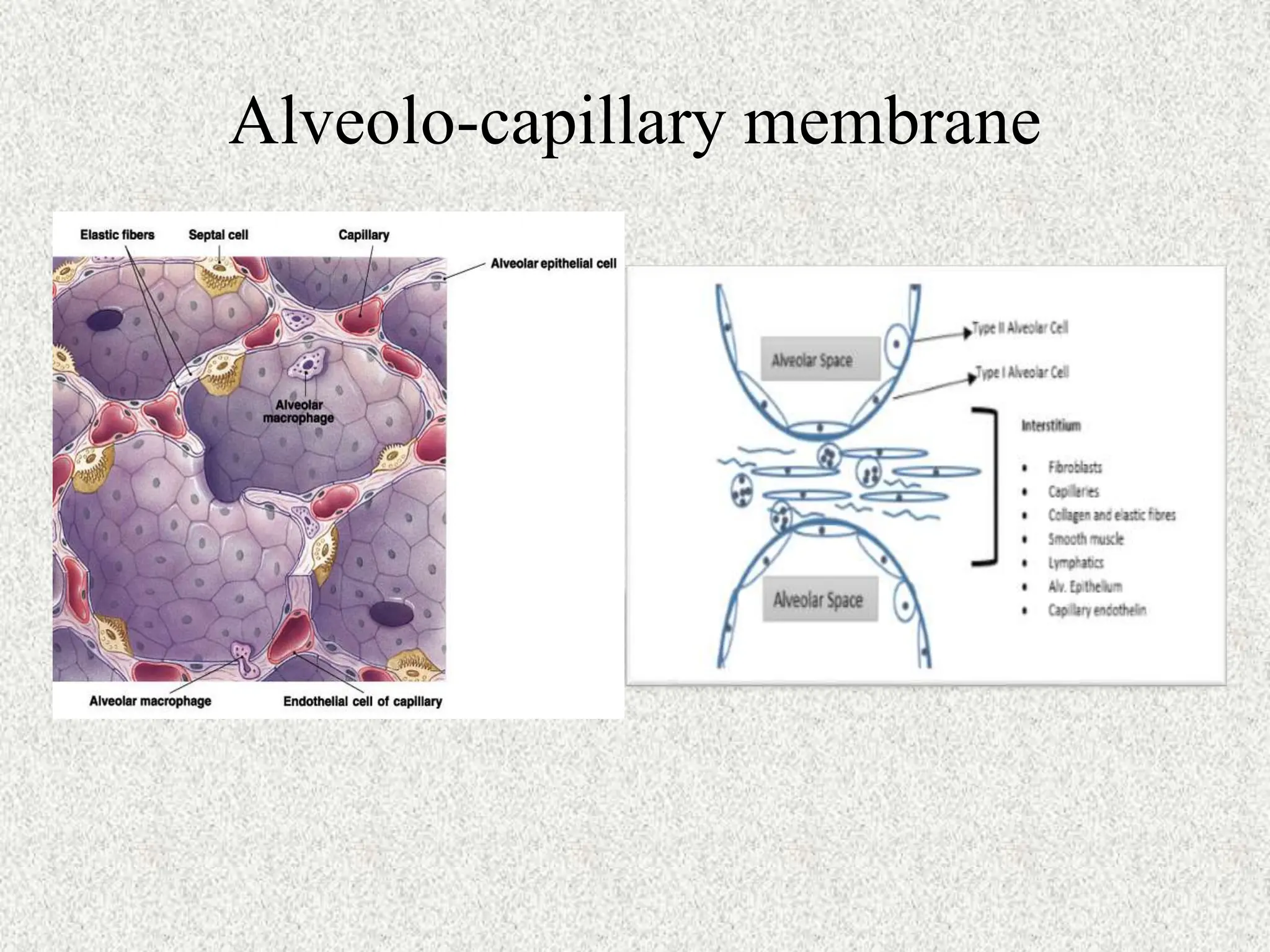
Alveolo-capillary membrane
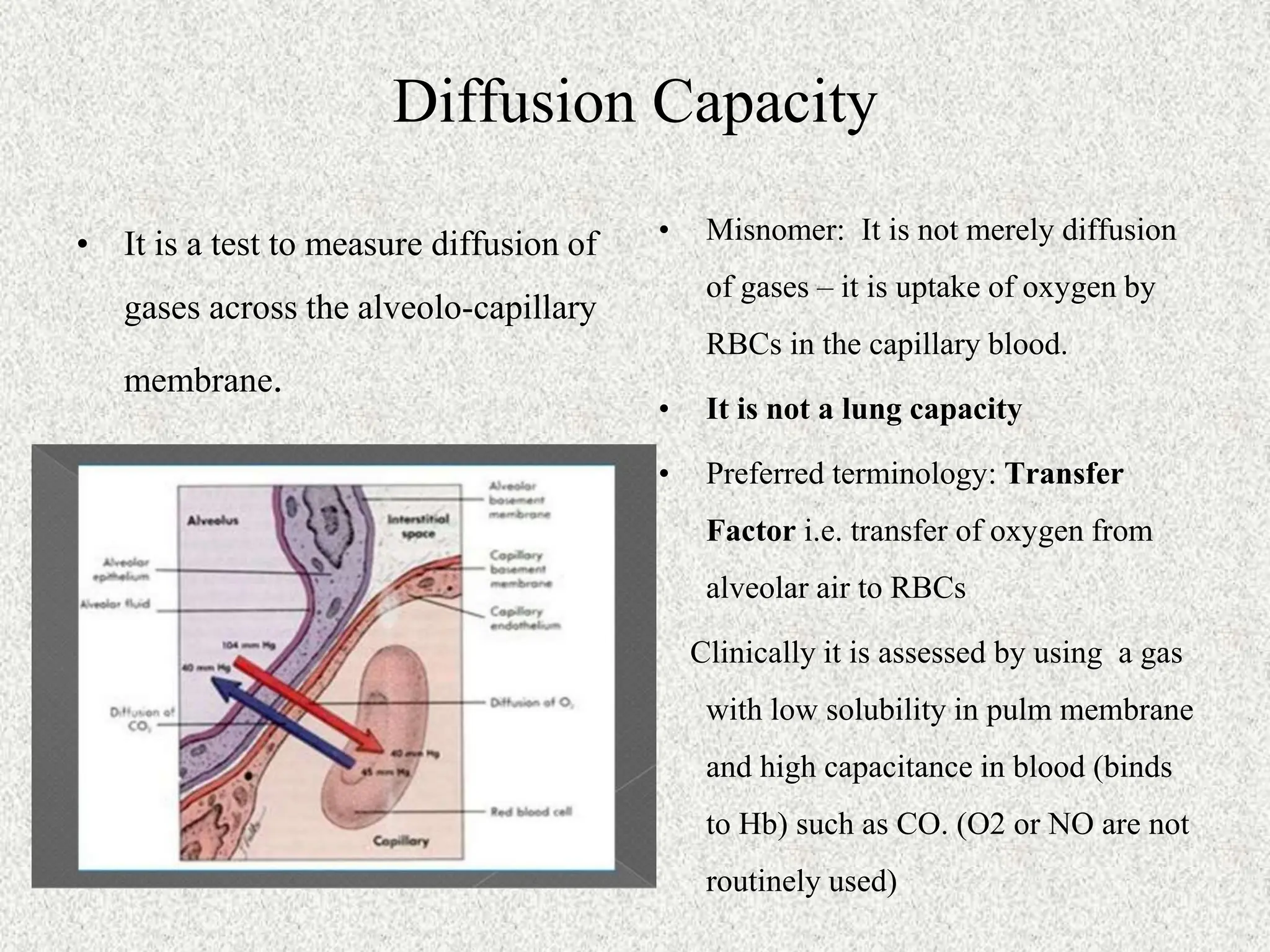
Diffusion Capacity
• It is a test to measure diffusion of
gases across the alveolo-capillary
membrane.
• Misnomer: It is not merely diffusion
of gases – it is uptake of oxygen by
RBCs in the capillary blood.
• It is not a lung capacity
• Preferred terminology: Transfer
Factor i.e. transfer of oxygen from
alveolar air to RBCs
Clinically it is assessed by using a gas
with low solubility in pulm membrane
and high capacitance in blood (binds
to Hb) such as CO. (O2 or NO are not
routinely used)
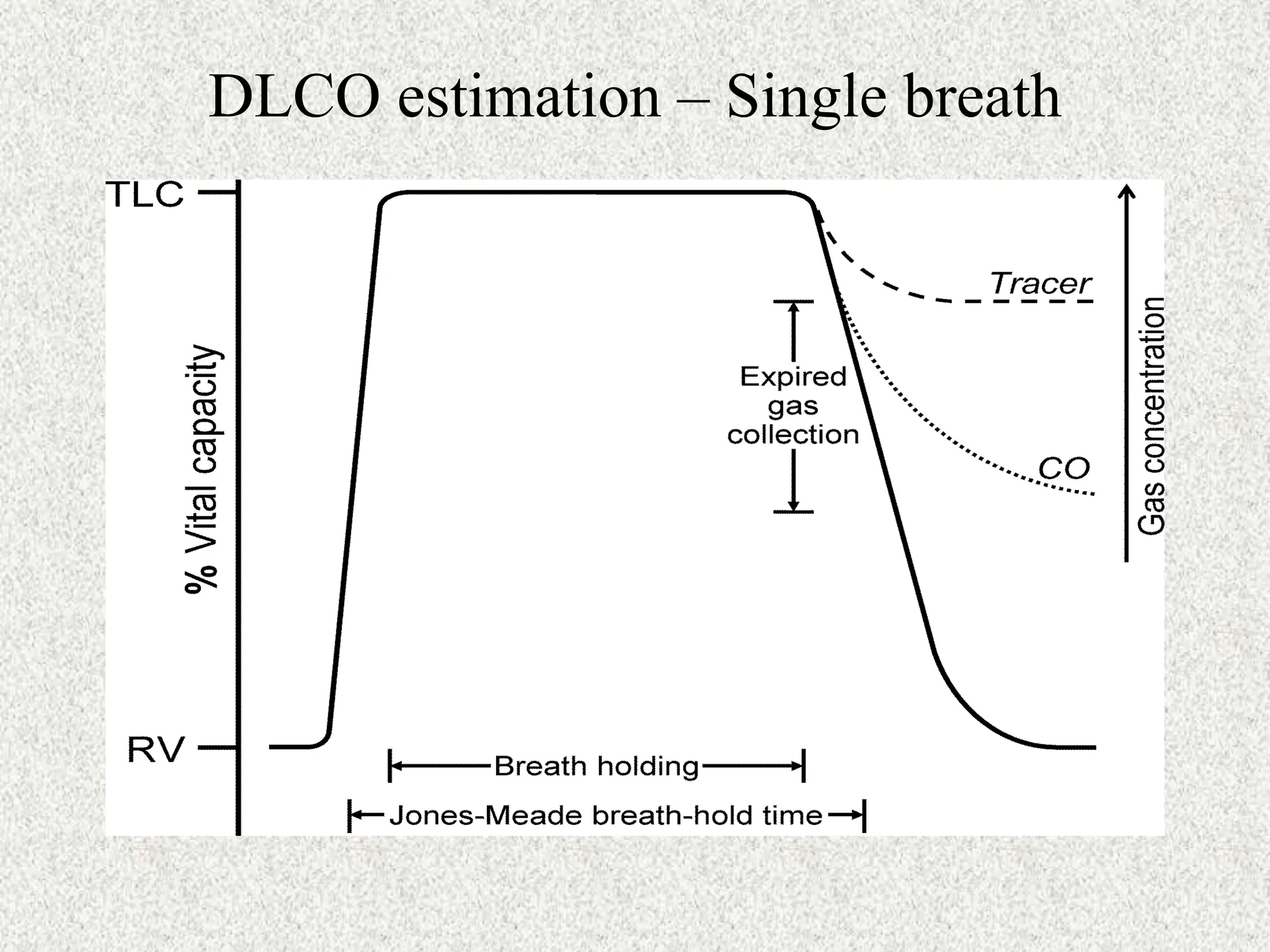
DLCO estimation – Single breath
Normal DLCO - Determinants
1. Area of the alveolo-capillary
membrane –
alveolar surface and capillary
blood
2. Thickness of the membrane
3. Driving pressure i.e. Difference
of oxygen tension between the
alveolar gas and venous blood
• Resting level: 20-30 mL/min/ mmHg
• Normal variations:
Age
Sex
Height, weight
Alveolar volume
Ethnicity
Smoking (decreases)
Exercise (increases)
Circadian rhythm
Menstrual cycle
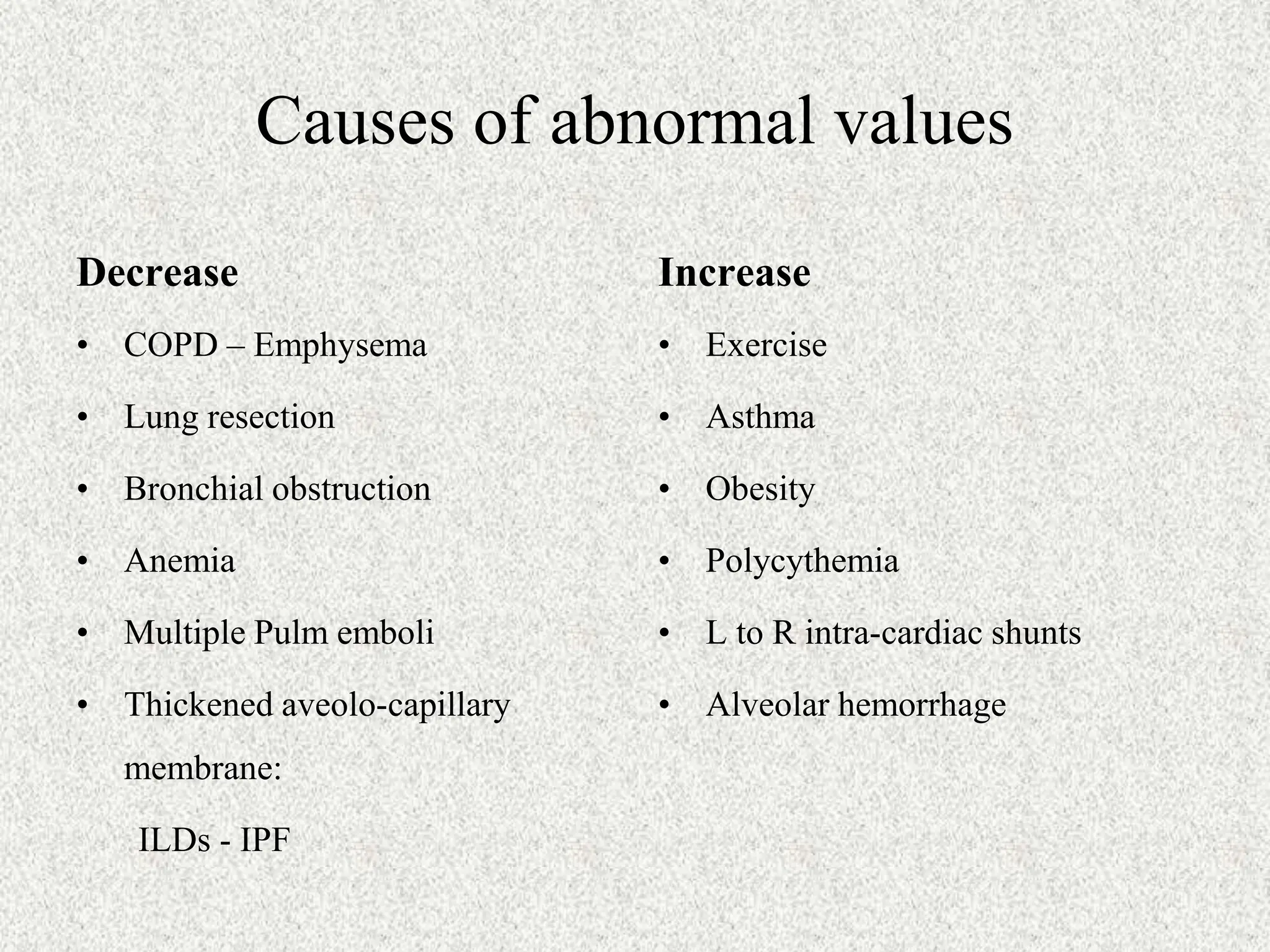
Causes of abnormal values
Decrease
• COPD – Emphysema
• Lung resection
• Bronchial obstruction
• Anemia
• Multiple Pulm emboli
• Thickened aveolo-capillary
membrane:
ILDs - IPF
Increase
• Exercise
• Asthma
• Obesity
• Polycythemia
• L to R intra-cardiac shunts
• Alveolar hemorrhage
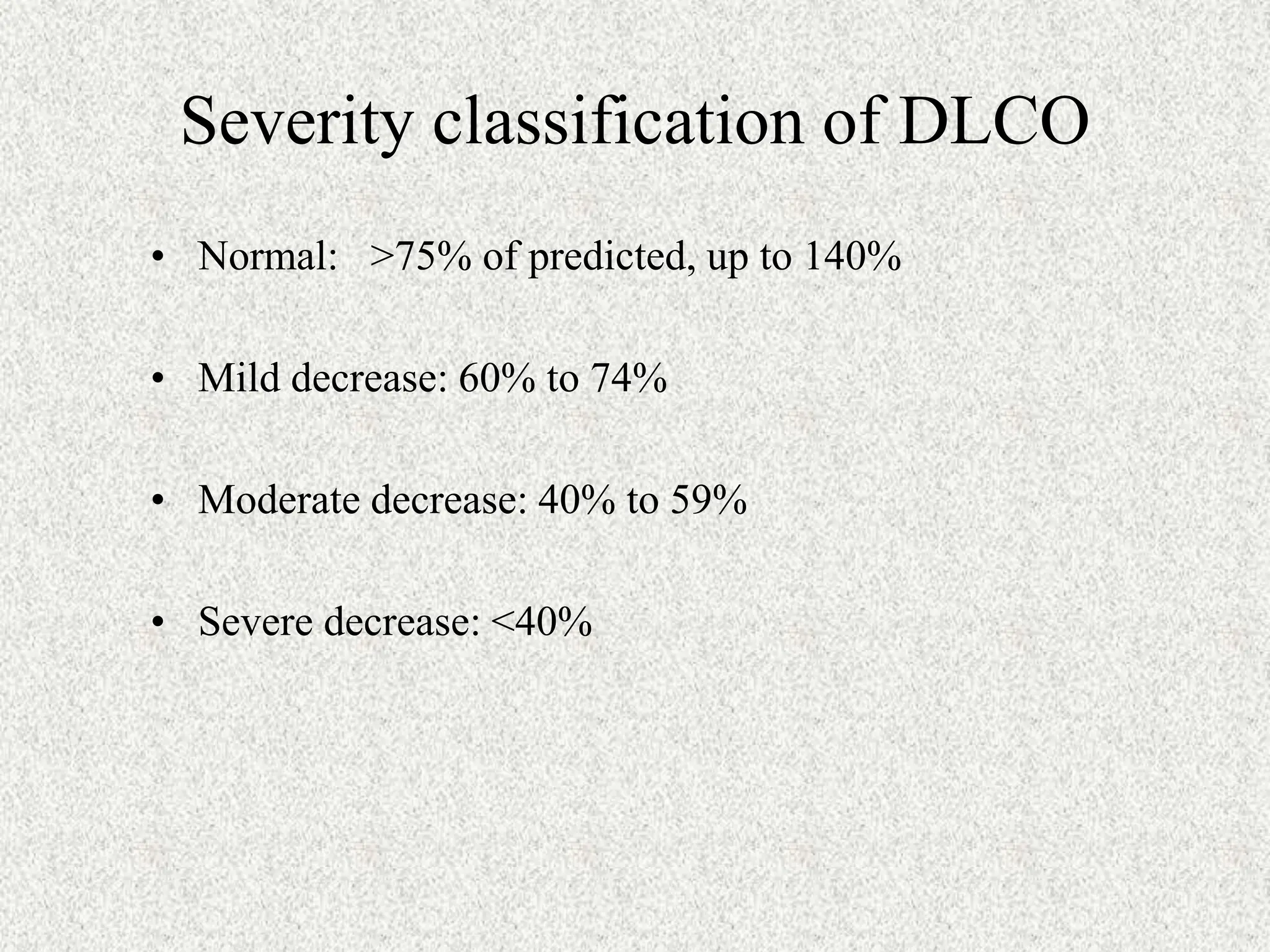
Severity classification of DLCO
• Normal: >75% of predicted, up to 140%
• Mild decrease: 60% to 74%
• Moderate decrease: 40% to 59%
• Severe decrease: <40%
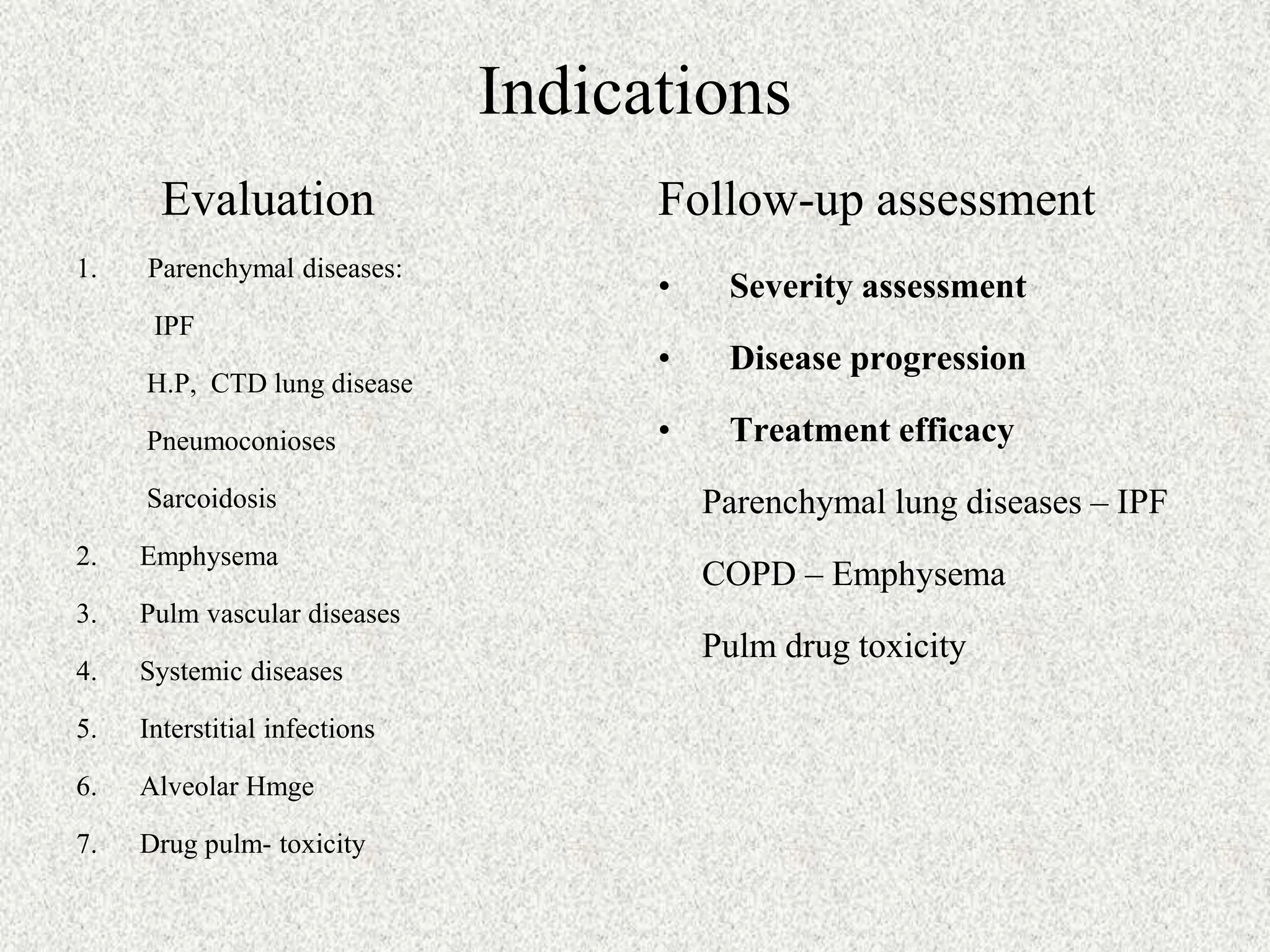
Indications
Evaluation
1. Parenchymal diseases:
IPF
H.P, CTD lung disease
Pneumoconioses
Sarcoidosis
2. Emphysema
3. Pulm vascular diseases
4. Systemic diseases
5. Interstitial infections
6. Alveolar Hmge
7. Drug pulm- toxicity
Follow-up assessment
• Severity assessment
• Disease progression
• Treatment efficacy
Parenchymal lung diseases – IPF
COPD – Emphysema
Pulm drug toxicity
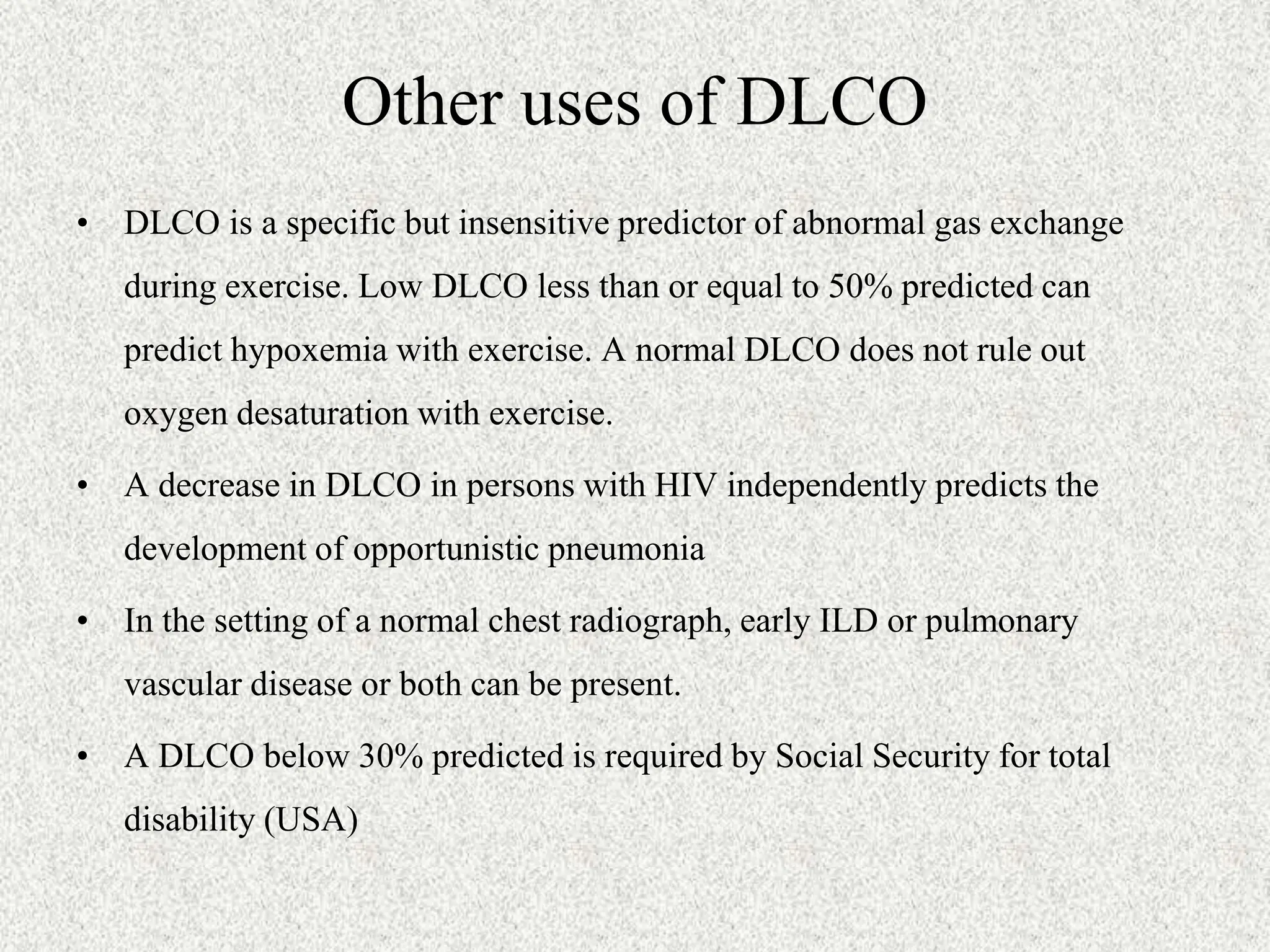
Other uses of DLCO
• DLCO is a specific but insensitive predictor of abnormal gas exchange
during exercise. Low DLCO less than or equal to 50% predicted can
predict hypoxemia with exercise. A normal DLCO does not rule out
oxygen desaturation with exercise.
• A decrease in DLCO in persons with HIV independently predicts the
development of opportunistic pneumonia
• In the setting of a normal chest radiograph, early ILD or pulmonary
vascular disease or both can be present.
• A DLCO below 30% predicted is required by Social Security for total
disability (USA)
Interpretation
DLCO is the product of two primary components:
i. Surface area of the lung available for gas exchange (VA)
ii. Rate of alveolar capillary blood CO uptake (KCO)
It is always important to determine whether the reduction in DLCO is due to
reduction in VA or KCO or both.
DLCO can be falsely reduced in patients with severe COPD or severe
restrictive lung disease when the inspired CO does not completely reach the
functioning alveolo-capillary units.
Interpretation is step-wise progress
Look at DLCO – reduced by either a decrease in VA
or KCO; we need to look for both
components
1. Remember: DLCO = VA X KCO and
KCO = DLCO / VA
2. Look at VA – within 5% of TLC; If not, suspect loss of lung volume (collapse,
resection, NM diseases, embolic disease); DLCO reduced proportionately.
3. Look at KCO (DLCO / VA) – reduced in anemia, ILD and pulm vascular
diseases
Clinical problem - 1
• 45 year old male
• No known lung disease
• On amiodarone for 6 mths for cardiac problem
• Now c/o non-productive cough, dyspnea, and weight loss
• Scattered crackles on physical examination
• Suspected to develop ‘drug-induced ILD’
• Lung function tests: Normal spirometry
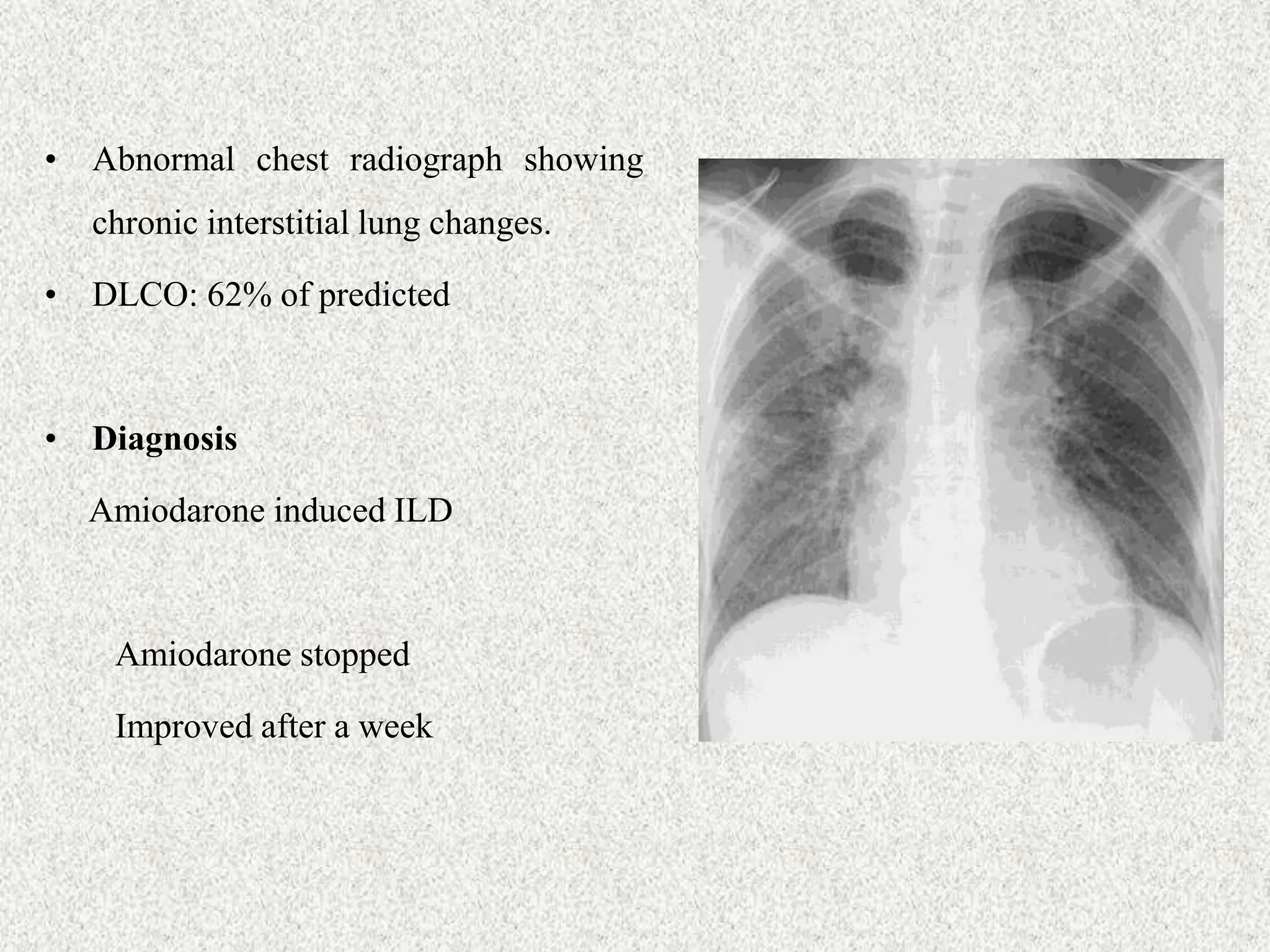
• Abnormal chest radiograph showing
chronic interstitial lung changes.
• DLCO: 62% of predicted
• Diagnosis
Amiodarone induced ILD
Amiodarone stopped
Improved after a week
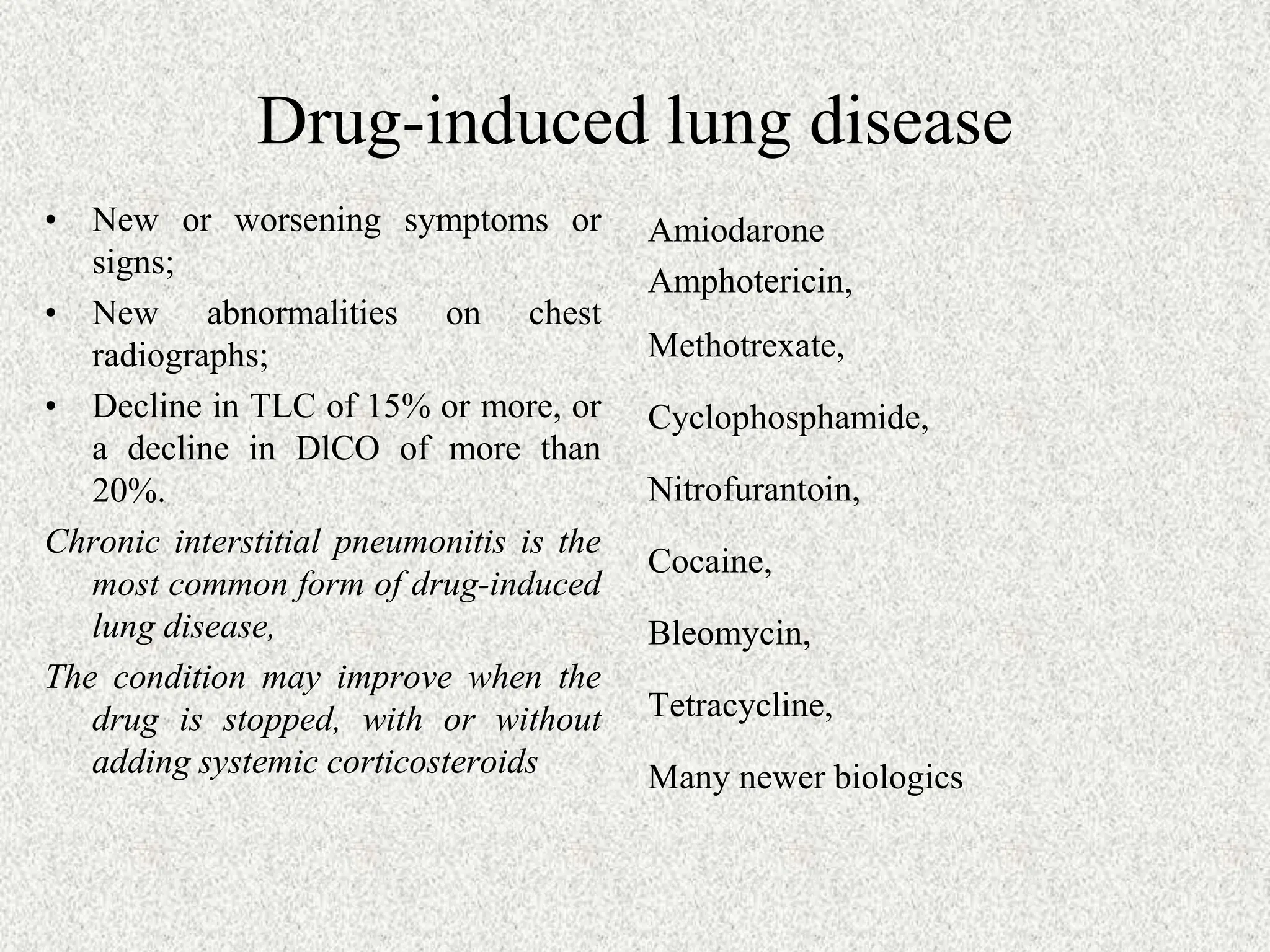
Drug-induced lung disease
• New or worsening symptoms or
signs;
• New abnormalities on chest
radiographs;
• Decline in TLC of 15% or more, or
a decline in DlCO of more than
20%.
Chronic interstitial pneumonitis is the
most common form of drug-induced
lung disease,
The condition may improve when the
drug is stopped, with or without
adding systemic corticosteroids
Amiodarone
Amphotericin,
Methotrexate,
Cyclophosphamide,
Nitrofurantoin,
Cocaine,
Bleomycin,
Tetracycline,
Many newer biologics
Clinical problem 2
• A 38 year old house-wife with history of asthma since childhood; multiple anti-
asthma therapies but poorly controlled
• Normal CXR, spirometry and lung function. ECHO revealed elevated PA pressure
• DLCO: unexpectedly reduced DLCO (35% predicted)
Diagnosis: difficult-to-control young adult asthmatic woman with PAH ? COPD x
?Drugs ?Secondary to CTD
• Detailed history revealed that she was on dieting pills, methamphetamines.
• The diagnosis was made after decreased DLCO prompted a search for the reasons.
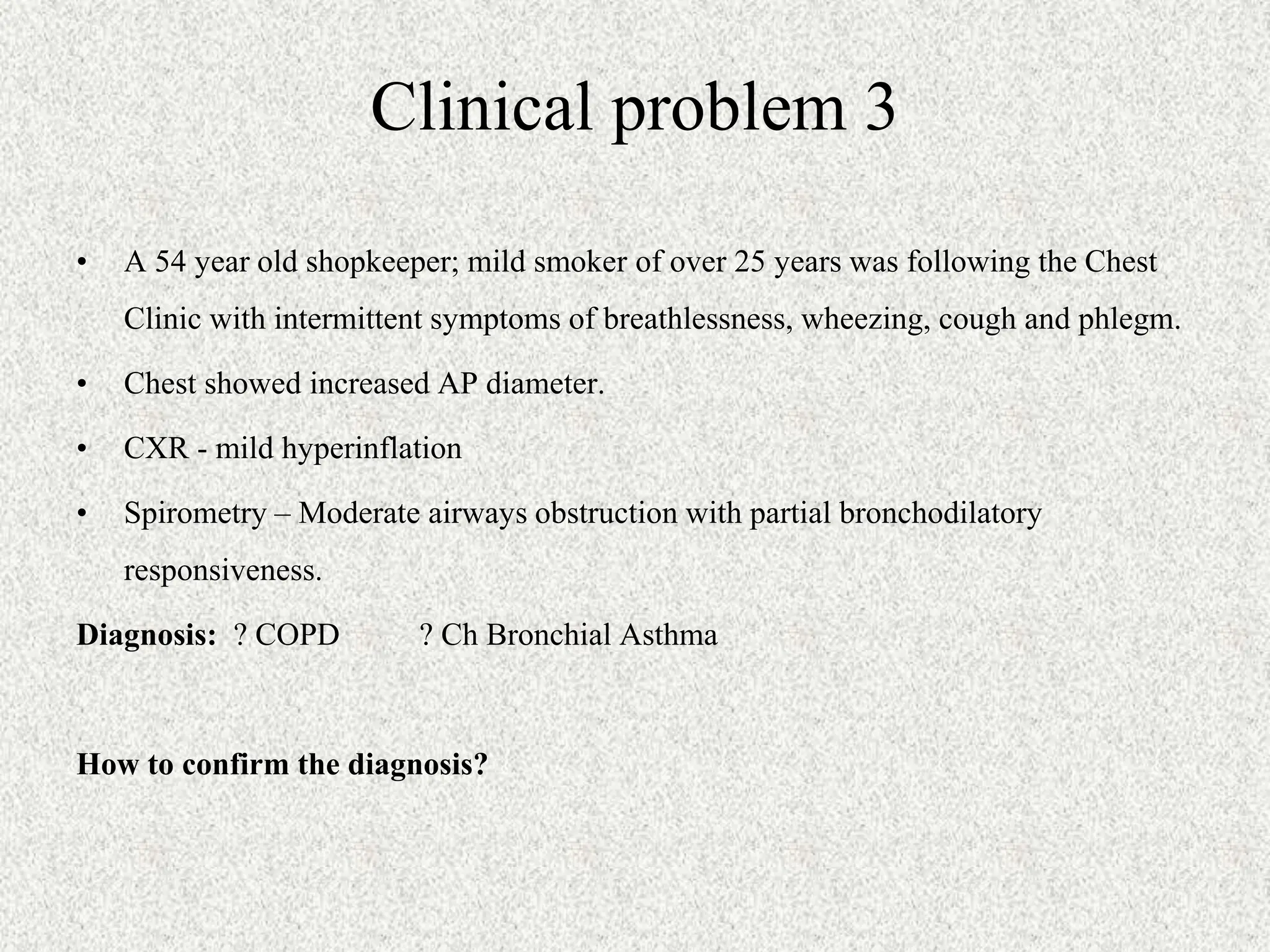
Clinical problem 3
• A 54 year old shopkeeper; mild smoker of over 25 years was following the Chest
Clinic with intermittent symptoms of breathlessness, wheezing, cough and phlegm.
• Chest showed increased AP diameter.
• CXR - mild hyperinflation
• Spirometry – Moderate airways obstruction with partial bronchodilatory
responsiveness.
Diagnosis: ? COPD ? Ch Bronchial Asthma
How to confirm the diagnosis?
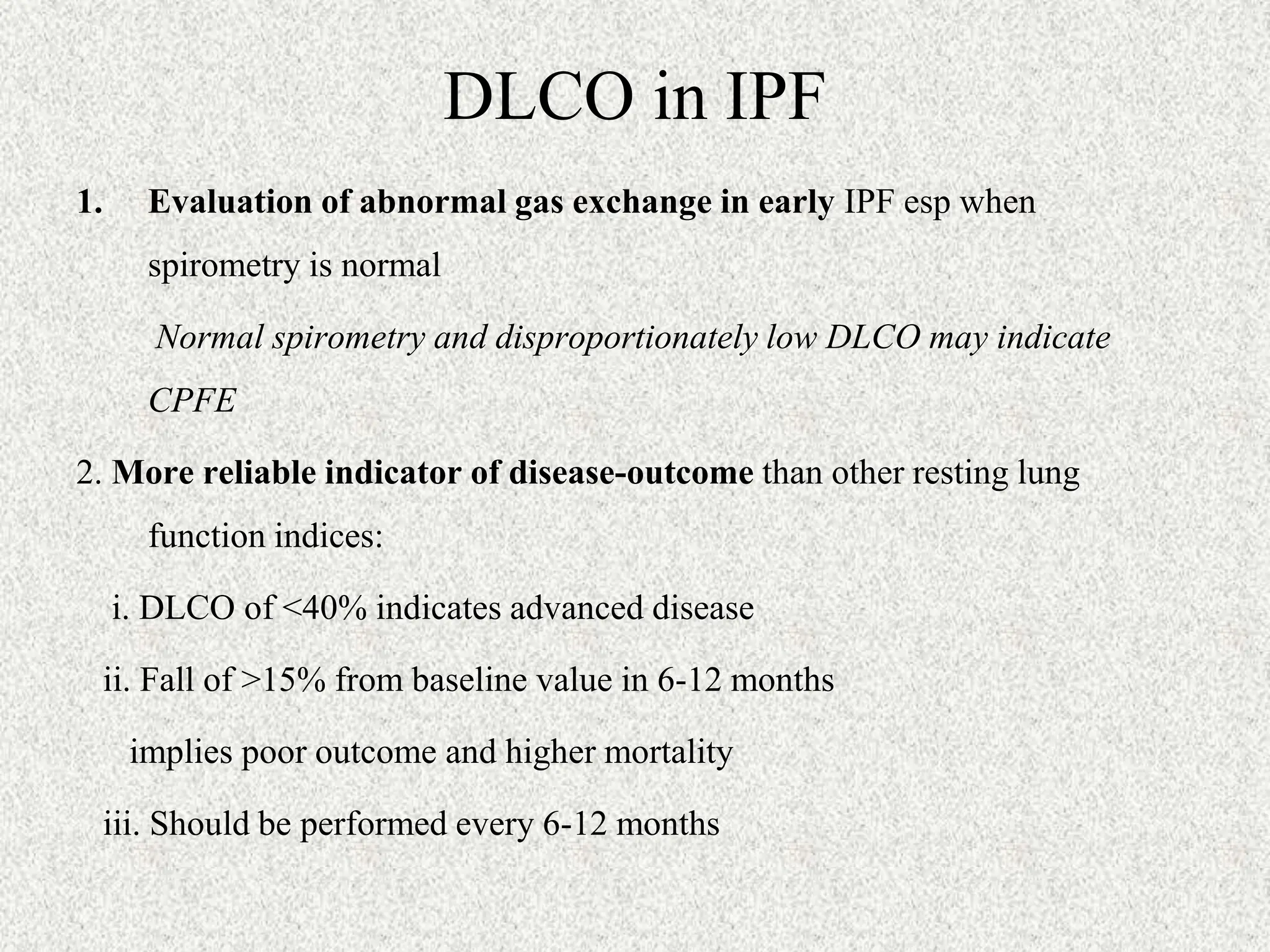
DLCO in IPF
1. Evaluation of abnormal gas exchange in early IPF esp when
spirometry is normal
Normal spirometry and disproportionately low DLCO may indicate
CPFE
2. More reliable indicator of disease-outcome than other resting lung
function indices:
i. DLCO of <40% indicates advanced disease
ii. Fall of >15% from baseline value in 6-12 months
implies poor outcome and higher mortality
iii. Should be performed every 6-12 months
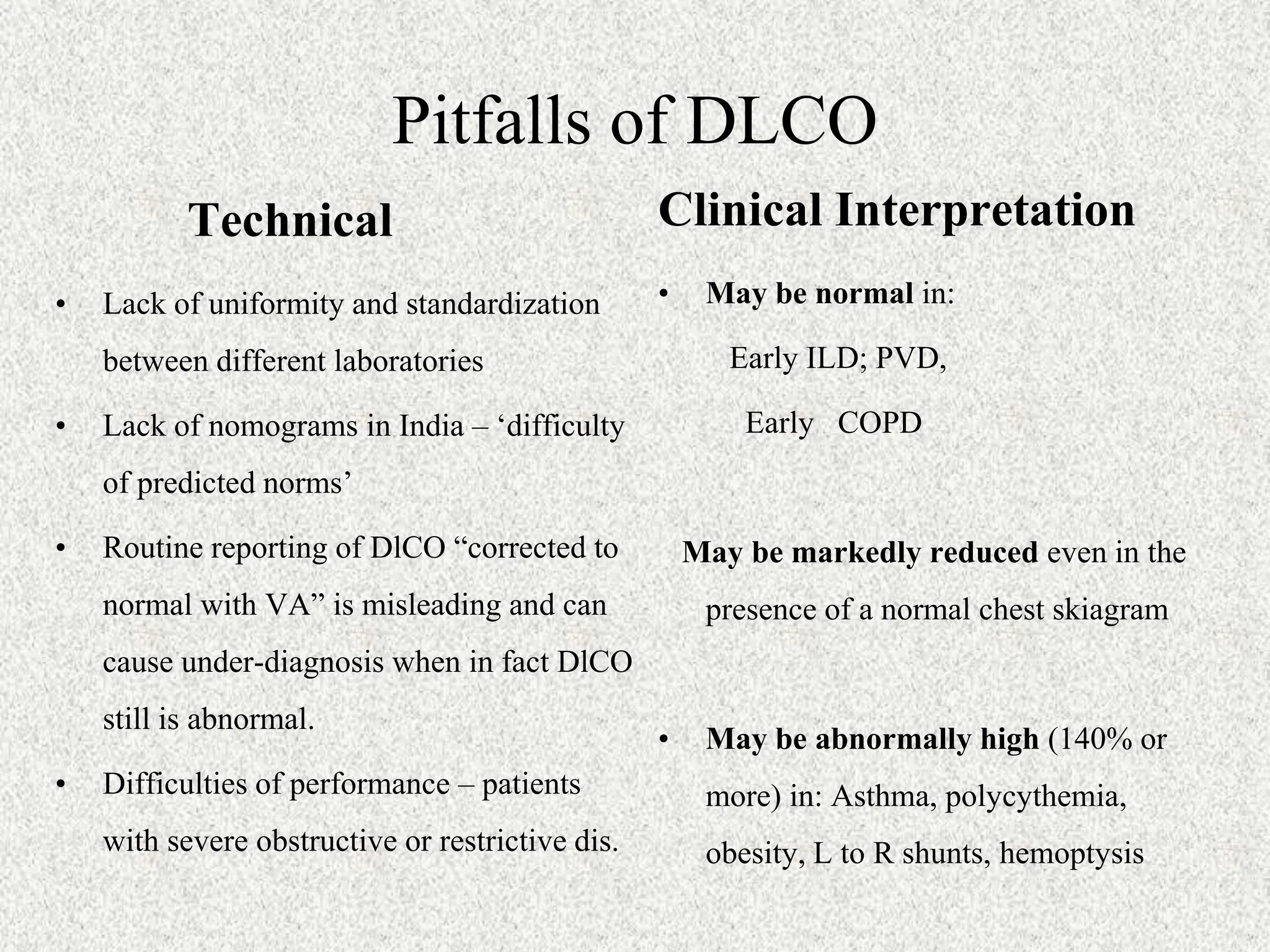
Pitfalls of DLCO
Technical
• Lack of uniformity and standardization
between different laboratories
• Lack of nomograms in India – ‘difficulty
of predicted norms’
• Routine reporting of DlCO “corrected to
normal with VA” is misleading and can
cause under-diagnosis when in fact DlCO
still is abnormal.
• Difficulties of performance – patients
with severe obstructive or restrictive dis.
Clinical Interpretation
• May be normal in:
Early ILD; PVD,
Early COPD
May be markedly reduced even in the
presence of a normal chest skiagram
• May be abnormally high (140% or
more) in: Asthma, polycythemia,
obesity, L to R shunts, hemoptysis
Conclusions
1. DLCO is an important PFT in the evaluation and follow-up
assessments of lung diseases; A decreasing DLCO is superior to
following changes in slow vital capacity (SVC) or TLC in ILDs.
2. Reduced DlCO in the context of normal spirometry, lung volumes, and
chest radiographs suggests underlying lung disease such as ILD,
emphysema, or PAH.
3. DLCO should always be interpreted in the context of clinical data of
the individual patient; decrease or increase in DLCO is not diagnostic
of a particular lung disease
THANK YOU

Diffusion Capacity: Indications and Interpretation | Jindal Chest Clinic

  • 1.
    Diffusion Capacity Indications andinterpretation Surinder K. Jindal (Emeritus Professor, Pulm Med, PGIMER, Chandigarh) Medical Director, Jindal Clinics, Chandigarh www.jindalchest.com
  • 2.
  • 3.
  • 4.
    Diffusion Capacity • Itis a test to measure diffusion of gases across the alveolo-capillary membrane. • Misnomer: It is not merely diffusion of gases – it is uptake of oxygen by RBCs in the capillary blood. • It is not a lung capacity • Preferred terminology: Transfer Factor i.e. transfer of oxygen from alveolar air to RBCs Clinically it is assessed by using a gas with low solubility in pulm membrane and high capacitance in blood (binds to Hb) such as CO. (O2 or NO are not routinely used)
  • 5.
    DLCO estimation –Single breath
  • 6.
    Normal DLCO -Determinants 1. Area of the alveolo-capillary membrane – alveolar surface and capillary blood 2. Thickness of the membrane 3. Driving pressure i.e. Difference of oxygen tension between the alveolar gas and venous blood • Resting level: 20-30 mL/min/ mmHg • Normal variations: Age Sex Height, weight Alveolar volume Ethnicity Smoking (decreases) Exercise (increases) Circadian rhythm Menstrual cycle
  • 7.
    Causes of abnormalvalues Decrease • COPD – Emphysema • Lung resection • Bronchial obstruction • Anemia • Multiple Pulm emboli • Thickened aveolo-capillary membrane: ILDs - IPF Increase • Exercise • Asthma • Obesity • Polycythemia • L to R intra-cardiac shunts • Alveolar hemorrhage
  • 8.
    Severity classification ofDLCO • Normal: >75% of predicted, up to 140% • Mild decrease: 60% to 74% • Moderate decrease: 40% to 59% • Severe decrease: <40%
  • 9.
    Indications Evaluation 1. Parenchymal diseases: IPF H.P,CTD lung disease Pneumoconioses Sarcoidosis 2. Emphysema 3. Pulm vascular diseases 4. Systemic diseases 5. Interstitial infections 6. Alveolar Hmge 7. Drug pulm- toxicity Follow-up assessment • Severity assessment • Disease progression • Treatment efficacy Parenchymal lung diseases – IPF COPD – Emphysema Pulm drug toxicity
  • 10.
    Other uses ofDLCO • DLCO is a specific but insensitive predictor of abnormal gas exchange during exercise. Low DLCO less than or equal to 50% predicted can predict hypoxemia with exercise. A normal DLCO does not rule out oxygen desaturation with exercise. • A decrease in DLCO in persons with HIV independently predicts the development of opportunistic pneumonia • In the setting of a normal chest radiograph, early ILD or pulmonary vascular disease or both can be present. • A DLCO below 30% predicted is required by Social Security for total disability (USA)
  • 11.
    Interpretation DLCO is theproduct of two primary components: i. Surface area of the lung available for gas exchange (VA) ii. Rate of alveolar capillary blood CO uptake (KCO) It is always important to determine whether the reduction in DLCO is due to reduction in VA or KCO or both. DLCO can be falsely reduced in patients with severe COPD or severe restrictive lung disease when the inspired CO does not completely reach the functioning alveolo-capillary units.
  • 12.
    Interpretation is step-wiseprogress Look at DLCO – reduced by either a decrease in VA or KCO; we need to look for both components 1. Remember: DLCO = VA X KCO and KCO = DLCO / VA 2. Look at VA – within 5% of TLC; If not, suspect loss of lung volume (collapse, resection, NM diseases, embolic disease); DLCO reduced proportionately. 3. Look at KCO (DLCO / VA) – reduced in anemia, ILD and pulm vascular diseases
  • 13.
    Clinical problem -1 • 45 year old male • No known lung disease • On amiodarone for 6 mths for cardiac problem • Now c/o non-productive cough, dyspnea, and weight loss • Scattered crackles on physical examination • Suspected to develop ‘drug-induced ILD’ • Lung function tests: Normal spirometry
  • 14.
    • Abnormal chestradiograph showing chronic interstitial lung changes. • DLCO: 62% of predicted • Diagnosis Amiodarone induced ILD Amiodarone stopped Improved after a week
  • 15.
    Drug-induced lung disease •New or worsening symptoms or signs; • New abnormalities on chest radiographs; • Decline in TLC of 15% or more, or a decline in DlCO of more than 20%. Chronic interstitial pneumonitis is the most common form of drug-induced lung disease, The condition may improve when the drug is stopped, with or without adding systemic corticosteroids Amiodarone Amphotericin, Methotrexate, Cyclophosphamide, Nitrofurantoin, Cocaine, Bleomycin, Tetracycline, Many newer biologics
  • 16.
    Clinical problem 2 •A 38 year old house-wife with history of asthma since childhood; multiple anti- asthma therapies but poorly controlled • Normal CXR, spirometry and lung function. ECHO revealed elevated PA pressure • DLCO: unexpectedly reduced DLCO (35% predicted) Diagnosis: difficult-to-control young adult asthmatic woman with PAH ? COPD x ?Drugs ?Secondary to CTD • Detailed history revealed that she was on dieting pills, methamphetamines. • The diagnosis was made after decreased DLCO prompted a search for the reasons.
  • 17.
    Clinical problem 3 •A 54 year old shopkeeper; mild smoker of over 25 years was following the Chest Clinic with intermittent symptoms of breathlessness, wheezing, cough and phlegm. • Chest showed increased AP diameter. • CXR - mild hyperinflation • Spirometry – Moderate airways obstruction with partial bronchodilatory responsiveness. Diagnosis: ? COPD ? Ch Bronchial Asthma How to confirm the diagnosis?
  • 18.
    DLCO in IPF 1.Evaluation of abnormal gas exchange in early IPF esp when spirometry is normal Normal spirometry and disproportionately low DLCO may indicate CPFE 2. More reliable indicator of disease-outcome than other resting lung function indices: i. DLCO of <40% indicates advanced disease ii. Fall of >15% from baseline value in 6-12 months implies poor outcome and higher mortality iii. Should be performed every 6-12 months
  • 19.
    Pitfalls of DLCO Technical •Lack of uniformity and standardization between different laboratories • Lack of nomograms in India – ‘difficulty of predicted norms’ • Routine reporting of DlCO “corrected to normal with VA” is misleading and can cause under-diagnosis when in fact DlCO still is abnormal. • Difficulties of performance – patients with severe obstructive or restrictive dis. Clinical Interpretation • May be normal in: Early ILD; PVD, Early COPD May be markedly reduced even in the presence of a normal chest skiagram • May be abnormally high (140% or more) in: Asthma, polycythemia, obesity, L to R shunts, hemoptysis
  • 20.
    Conclusions 1. DLCO isan important PFT in the evaluation and follow-up assessments of lung diseases; A decreasing DLCO is superior to following changes in slow vital capacity (SVC) or TLC in ILDs. 2. Reduced DlCO in the context of normal spirometry, lung volumes, and chest radiographs suggests underlying lung disease such as ILD, emphysema, or PAH. 3. DLCO should always be interpreted in the context of clinical data of the individual patient; decrease or increase in DLCO is not diagnostic of a particular lung disease
  • 21.