

INITIATE DIFFICULT CONVERSATIONS
Aspiring Principal’s Program
October 4, 2012
Thursday, October 4, 12
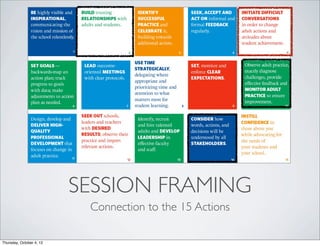
SESSION FRAMING
Connection to the 15 Actions
Thursday, October 4, 12
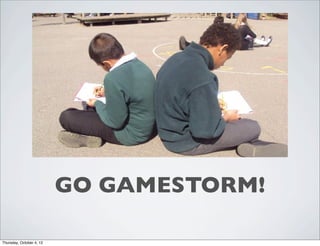
GO GAMESTORM!
Thursday, October 4, 12
BYTHE END OFTHIS SESSION
• Identify the elements of effective and ineffective difficult
conversations, as described in Difficult Conversations and their
own experience.
• Reflect on their emotional footprint and how they have been
handling difficult conversations related to changing adult
actions and attitudes about student achievement.
• Reconcile the principle of “not assuming rightness” with their
beliefs about efficacy.
Thursday, October 4, 12
AGENDA
Framing
• Alignment to the 15 Actions and Competencies
• Session Outcomes & Agenda
• Elements of ineffective difficult conversations
• Strategies for initiating and engaging in difficult conversations
• Self-assessment
Guided Practice
• Practice strategies for difficult conversations by engaging in role
plays based on a given scenario
• Self assess performance and give and receive feedback
Preparation
• Prepare for your own difficult conversation
Individual Practice
• Role play your own personal difficult conversation with a partner
• Fishbowl one role play
Wrap-Up
• Evaluation
Thursday, October 4, 12
CONFLICT GONE AWRY
Think of a difficult conversation you have had that did not go
well. What went wrong and why? What made it difficult?
Thursday, October 4, 12
BREAKING IT DOWN:
THE THREE CONVERSATIONS
• The “What happened?” Conversation
• The Feelings Conversation
• The Identity Conversation
Thursday, October 4, 12
JIGSAW
Jigsaw “TheThree Conversations” from Difficult Conversations
by deciding who will be the expert on which conversation.
✦ The “What Happened?” Conversation, p. 23-82
✦ The Feelings Conversation, p.83-108
✦ The Identity Conversation, p. 109-128
• Share your pre-work “Three Conversations” Notes for your assigned
conversation, identifying common pitfalls and productive behaviors and any
quotes or concepts that stood out to you personally. (10’)
• Discuss as a cohort which of the conversations you each find most difficult and
why. (5’)
Thursday, October 4, 12
PITFALLS &
PRODUCTIVE BEHAVIORS
What are common pitfalls and productive
behaviors for each conversation?
Thursday, October 4, 12
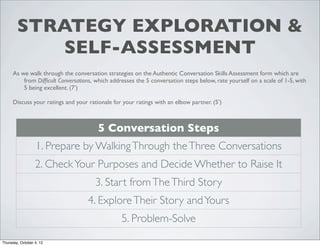
STRATEGY EXPLORATION &
SELF-ASSESSMENT
As we walk through the conversation strategies on the Authentic Conversation Skills Assessment form which are
from Difficult Conversations, which addresses the 5 conversation steps below, rate yourself on a scale of 1-5, with
5 being excellent. (7’)
Discuss your ratings and your rationale for your ratings with an elbow partner. (5’)
5 Conversation Steps
1. Prepare by WalkingThrough theThree Conversations
2. CheckYour Purposes and Decide Whether to Raise It
3. Start fromTheThird Story
4. ExploreTheir Story andYours
5. Problem-Solve
Thursday, October 4, 12
REFLECT
What did you learn from
completing the self-assessment?
What questions do you still
have about the conversation
strategies?
Thursday, October 4, 12
SKILL PRACTICE
Initiating Difficult Conversations
Thursday, October 4, 12
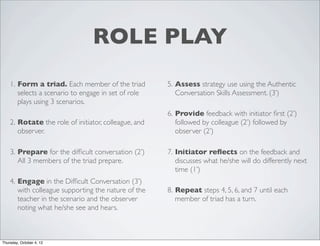
ROLE PLAY
1. Form a triad. Each member of the triad
selects a scenario to engage in set of role
plays using 3 scenarios.
2. Rotate the role of initiator, colleague, and
observer.
3. Prepare for the difficult conversation (2’)
All 3 members of the triad prepare.
4. Engage in the Difficult Conversation (3’)
with colleague supporting the nature of the
teacher in the scenario and the observer
noting what he/she see and hears.
5. Assess strategy use using the Authentic
Conversation Skills Assessment. (3’)
6. Provide feedback with initiator first (2’)
followed by colleague (2’) followed by
observer (2’)
7. Initiator reflects on the feedback and
discusses what he/she will do differently next
time (1’)
8. Repeat steps 4, 5, 6, and 7 until each
member of triad has a turn.
Thursday, October 4, 12
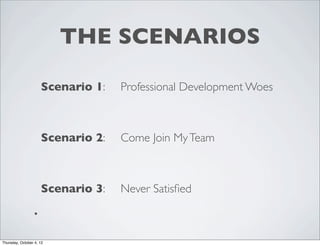
THE SCENARIOS
Scenario 1: Professional Development Woes
Scenario 2: Come Join MyTeam
Scenario 3: Never Satisfied
•
Thursday, October 4, 12
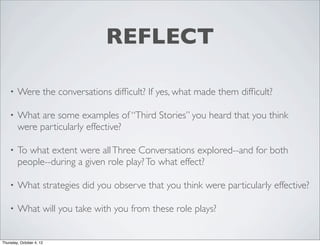
REFLECT
• Were the conversations difficult? If yes, what made them difficult?
• What are some examples of “Third Stories” you heard that you think
were particularly effective?
• To what extent were allThree Conversations explored--and for both
people--during a given role play?To what effect?
• What strategies did you observe that you think were particularly effective?
• What will you take with you from these role plays?
Thursday, October 4, 12
BREAK
10 minutes
Thursday, October 4, 12
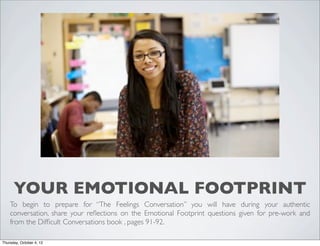
YOUR EMOTIONAL FOOTPRINT
To begin to prepare for “The Feelings Conversation” you will have during your authentic
conversation, share your reflections on the Emotional Footprint questions given for pre-work and
from the Difficult Conversations book , pages 91-92.
Thursday, October 4, 12
PREPARE
To prepare for the authentic conversation you selected as part of your pre-work and
that you plan to have this year and intend to role play today, complete the Authentic
Conversation Preparation Form.
Thursday, October 4, 12
INDEPENDENT PRACTICE
Connecting toYour Residency Experience
Thursday, October 4, 12
ROLE PLAY
1. Decide who will go first, with the author of
the scenario playing the initiator of the
conversation.
2. Exchange and read the authentic
scenarios you wrote for pre-work.Answer any
questions you have about each others’
scenarios. (2 min.)
3. Prepare for the conversation by determining
the purpose, the opening statement and
strategies for communication (initiator does this
on his/her own). (3 min.)
4. Engage in the difficult conversation. (3 min.
for each partner rotating roles of initiator and
colleague).
5. Assess strategy use using the Authentic
Conversation Skills Assessment form. (2 min)
6. Provide feedback with the initiator going first
followed by the colleague. (2 min. for initiator, 2
min. for colleague, and 2 minutes for observer.)
7. Reflect (initiator) on the feedback and on
what he/she will do differently during the real
conversation. (1 min.)
8. Role Play Repeat steps 2-7 for the other
scenarios.
•
Thursday, October 4, 12
REFLECT
• How did the practice in this session help you become more skillful with
engaging in difficult conversations? More confident?
• How did the practice of your own situation help you prepare for the time
when you have this conversation?
• What do you want to be sure to remember when preparing and
conducting this conversation later?
Thursday, October 4, 12
WRAP-UP
Next Steps & Preparing for Fall Foundations
Thursday, October 4, 12
EVALUATION
Please complete a brief evaluation of this session in Avatar by
clicking on:
https://nlns.avatarlms.com/login.html
• Action #5: Initiate Difficult Conversations
• Local Session
• End-of-Session Survey
• Your Name
• All evaluations will be kept confidential.
Thursday, October 4, 12

Difficult Conversations Workshop - Cohort 12

  • 1.
    INITIATE DIFFICULT CONVERSATIONS AspiringPrincipal’s Program October 4, 2012 Thursday, October 4, 12
  • 2.
    SESSION FRAMING Connection tothe 15 Actions Thursday, October 4, 12
  • 3.
  • 4.
    BYTHE END OFTHISSESSION • Identify the elements of effective and ineffective difficult conversations, as described in Difficult Conversations and their own experience. • Reflect on their emotional footprint and how they have been handling difficult conversations related to changing adult actions and attitudes about student achievement. • Reconcile the principle of “not assuming rightness” with their beliefs about efficacy. Thursday, October 4, 12
  • 5.
    AGENDA Framing • Alignment tothe 15 Actions and Competencies • Session Outcomes & Agenda • Elements of ineffective difficult conversations • Strategies for initiating and engaging in difficult conversations • Self-assessment Guided Practice • Practice strategies for difficult conversations by engaging in role plays based on a given scenario • Self assess performance and give and receive feedback Preparation • Prepare for your own difficult conversation Individual Practice • Role play your own personal difficult conversation with a partner • Fishbowl one role play Wrap-Up • Evaluation Thursday, October 4, 12
  • 6.
    CONFLICT GONE AWRY Thinkof a difficult conversation you have had that did not go well. What went wrong and why? What made it difficult? Thursday, October 4, 12
  • 7.
    BREAKING IT DOWN: THETHREE CONVERSATIONS • The “What happened?” Conversation • The Feelings Conversation • The Identity Conversation Thursday, October 4, 12
  • 8.
    JIGSAW Jigsaw “TheThree Conversations”from Difficult Conversations by deciding who will be the expert on which conversation. ✦ The “What Happened?” Conversation, p. 23-82 ✦ The Feelings Conversation, p.83-108 ✦ The Identity Conversation, p. 109-128 • Share your pre-work “Three Conversations” Notes for your assigned conversation, identifying common pitfalls and productive behaviors and any quotes or concepts that stood out to you personally. (10’) • Discuss as a cohort which of the conversations you each find most difficult and why. (5’) Thursday, October 4, 12
  • 9.
    PITFALLS & PRODUCTIVE BEHAVIORS Whatare common pitfalls and productive behaviors for each conversation? Thursday, October 4, 12
  • 10.
    STRATEGY EXPLORATION & SELF-ASSESSMENT Aswe walk through the conversation strategies on the Authentic Conversation Skills Assessment form which are from Difficult Conversations, which addresses the 5 conversation steps below, rate yourself on a scale of 1-5, with 5 being excellent. (7’) Discuss your ratings and your rationale for your ratings with an elbow partner. (5’) 5 Conversation Steps 1. Prepare by WalkingThrough theThree Conversations 2. CheckYour Purposes and Decide Whether to Raise It 3. Start fromTheThird Story 4. ExploreTheir Story andYours 5. Problem-Solve Thursday, October 4, 12
  • 11.
    REFLECT What did youlearn from completing the self-assessment? What questions do you still have about the conversation strategies? Thursday, October 4, 12
  • 12.
    SKILL PRACTICE Initiating DifficultConversations Thursday, October 4, 12
  • 13.
    ROLE PLAY 1. Forma triad. Each member of the triad selects a scenario to engage in set of role plays using 3 scenarios. 2. Rotate the role of initiator, colleague, and observer. 3. Prepare for the difficult conversation (2’) All 3 members of the triad prepare. 4. Engage in the Difficult Conversation (3’) with colleague supporting the nature of the teacher in the scenario and the observer noting what he/she see and hears. 5. Assess strategy use using the Authentic Conversation Skills Assessment. (3’) 6. Provide feedback with initiator first (2’) followed by colleague (2’) followed by observer (2’) 7. Initiator reflects on the feedback and discusses what he/she will do differently next time (1’) 8. Repeat steps 4, 5, 6, and 7 until each member of triad has a turn. Thursday, October 4, 12
  • 14.
    THE SCENARIOS Scenario 1:Professional Development Woes Scenario 2: Come Join MyTeam Scenario 3: Never Satisfied • Thursday, October 4, 12
  • 15.
    REFLECT • Were theconversations difficult? If yes, what made them difficult? • What are some examples of “Third Stories” you heard that you think were particularly effective? • To what extent were allThree Conversations explored--and for both people--during a given role play?To what effect? • What strategies did you observe that you think were particularly effective? • What will you take with you from these role plays? Thursday, October 4, 12
  • 16.
  • 17.
    YOUR EMOTIONAL FOOTPRINT Tobegin to prepare for “The Feelings Conversation” you will have during your authentic conversation, share your reflections on the Emotional Footprint questions given for pre-work and from the Difficult Conversations book , pages 91-92. Thursday, October 4, 12
  • 18.
    PREPARE To prepare forthe authentic conversation you selected as part of your pre-work and that you plan to have this year and intend to role play today, complete the Authentic Conversation Preparation Form. Thursday, October 4, 12
  • 19.
    INDEPENDENT PRACTICE Connecting toYourResidency Experience Thursday, October 4, 12
  • 20.
    ROLE PLAY 1. Decidewho will go first, with the author of the scenario playing the initiator of the conversation. 2. Exchange and read the authentic scenarios you wrote for pre-work.Answer any questions you have about each others’ scenarios. (2 min.) 3. Prepare for the conversation by determining the purpose, the opening statement and strategies for communication (initiator does this on his/her own). (3 min.) 4. Engage in the difficult conversation. (3 min. for each partner rotating roles of initiator and colleague). 5. Assess strategy use using the Authentic Conversation Skills Assessment form. (2 min) 6. Provide feedback with the initiator going first followed by the colleague. (2 min. for initiator, 2 min. for colleague, and 2 minutes for observer.) 7. Reflect (initiator) on the feedback and on what he/she will do differently during the real conversation. (1 min.) 8. Role Play Repeat steps 2-7 for the other scenarios. • Thursday, October 4, 12
  • 21.
    REFLECT • How didthe practice in this session help you become more skillful with engaging in difficult conversations? More confident? • How did the practice of your own situation help you prepare for the time when you have this conversation? • What do you want to be sure to remember when preparing and conducting this conversation later? Thursday, October 4, 12
  • 22.
    WRAP-UP Next Steps &Preparing for Fall Foundations Thursday, October 4, 12
  • 23.
    EVALUATION Please complete abrief evaluation of this session in Avatar by clicking on: https://nlns.avatarlms.com/login.html • Action #5: Initiate Difficult Conversations • Local Session • End-of-Session Survey • Your Name • All evaluations will be kept confidential. Thursday, October 4, 12