Introduction
Purpose: Understand the
importanceof having
difficult conversations and
learn strategies to manage
them effectively.
Importance: Difficult
conversations are critical for
addressing issues,
improving team dynamics,
and enhancing productivity.
3.
Understanding Difficult Conversations
Let’sstart by defining it: Conversations that
involve confronting uncomfortable topics,
providing critical feedback, or addressing
conflicts.
Examples: Performance reviews, addressing
inappropriate behavior, discussing sensitive
personal issues.
4.
Why Difficult Conversationsare Often Avoided
Fear of Negative
Outcome: Fear of the
conversation
deteriorating or
causing emotional
distress.
Anxiety: Worry about
damaging
relationships or
being perceived
negatively.
Lack of Skills:
Uncertainty about
how to approach the
conversation
constructively.
5.
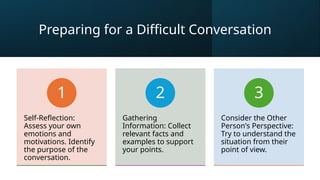
Preparing for aDifficult Conversation
Self-Reflection:
Assess your own
emotions and
motivations. Identify
the purpose of the
conversation.
1
Gathering
Information: Collect
relevant facts and
examples to support
your points.
2
Consider the Other
Person's Perspective:
Try to understand the
situation from their
point of view.
3
6.
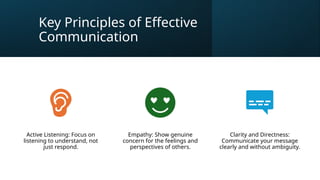
Key Principles ofEffective
Communication
Active Listening: Focus on
listening to understand, not
just respond.
Empathy: Show genuine
concern for the feelings and
perspectives of others.
Clarity and Directness:
Communicate your message
clearly and without ambiguity.
7.
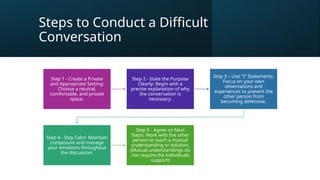
Steps to Conducta Difficult
Conversation
Step 1 - Create a Private
and Appropriate Setting:
Choose a neutral,
comfortable, and private
space.
Step 2 - State the Purpose
Clearly: Begin with a
precise explanation of why
the conversation is
necessary.
Step 3 – Use "I" Statements:
Focus on your own
observations and
experiences to prevent the
other person from
becoming defensive.
Step 4 - Stay Calm: Maintain
composure and manage
your emotions throughout
the discussion.
Step 5 - Agree on Next
Steps: Work with the other
person to reach a mutual
understanding or solution.
(Mutual understandings do
not require the individuals
support)
8.
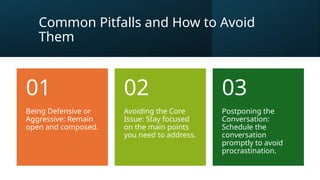
Common Pitfalls andHow to Avoid
Them
Being Defensive or
Aggressive: Remain
open and composed.
01
Avoiding the Core
Issue: Stay focused
on the main points
you need to address.
02
Postponing the
Conversation:
Schedule the
conversation
promptly to avoid
procrastination.
03
9.
Strategies for ManagingEmotions
Pause and Reflect:
Take a moment to
breathe and collect
your thoughts if
emotions rise.
Acknowledgement:
Validate emotions,
but guide the
conversation back
to objective facts
when necessary.
10.
Role-Playing Activity
Scenario 1– Irate &
Explosive Employee
01
Scenario 2 –
Leadership Failure
effects employee
02
Scenario 3 –
Employee tries but
their performance
remains below
standards
03
Scenario 4 -
Employee has gone
above and beyond
outside of their
scope but fails to
meet their
individual job
requirements
04
11.
Benefits of EffectivelyManaging Difficult Conversations
Improved Relationships: Builds deeper trust and
respect among colleagues.
Enhanced Communication: Develops clearer and
more open channels of communication.
Growth and Development: Encourages personal and
professional growth by resolving issues
constructively.
Conclusio
n
Highlights: The importanceof
preparation, effective
communication, and emotional
management.
Final Thoughts: Each one of us
has the ability to encourage an
environment where difficult
conversations are viewed as
opportunities for improvement.
14.
References and
Resources
Books andArticles:
Crucial Conversations: Tools for Talking When Stakes are
High, Third Edition by Joseph Grenny
Conversations Worth Having, Second Edition: Using
Appreciative Inquiry to Fuel Productive and Meaningful
Engagement by Jackie Stavros & Cheri Torres
Crucial Influence, Third Edition: Leadership Skills to Create
Lasting Behavior Change by Joseph Grenny & Kerry
Patterson
Difficult Leadership Conversations Matter: Stop Avoiding
Them
https://www.forbes.com/sites/curtsteinhorst/2024/12/09/di
fficult-leadership-conversations-matter-stop-avoiding-them/
Leaders Must Be Willing To Have Difficult Conversations.
https://leadyoufirst.com/leaders-must-be-willing-to-have-
difficult-conversations/