The tongue develops from three lingual buds that merge during development. The distal buds form the anterior two-thirds of the tongue, while the posterior third develops from the copula and hypopharyngeal eminence. Muscles are derived from migrating myoblasts and innervated by the hypoglossal nerve. Various papillae and taste buds develop in the fetus and establish reflex pathways. The nerve supply correlates to the embryonic origin, with the trigeminal, facial, glossopharyngeal, and vagus nerves innervating regions derived from different arches.
‘If there isgoodness in your heart,
it will come to your tongue’.
3.
Development of Tongue
•The three lingual buds result from the
proliferation of mesenchyme in
ventromedial parts of the first pair of
pharyngeal arches
• The distal tongue buds rapidly increase
in size, merge with each other, and
overgrow the median tongue bud
• The merged distal tongue buds form the
anterior two-thirds (oral part) of the
tongue
5.
Development of Tongue
•Fusion of the distal tongue buds is indicated by a middle
groove, the median sulcus of the tongue and internally by the
fibrous lingual septum
• Median tongue bud forms no recognizable part of the adult
tongue
6.
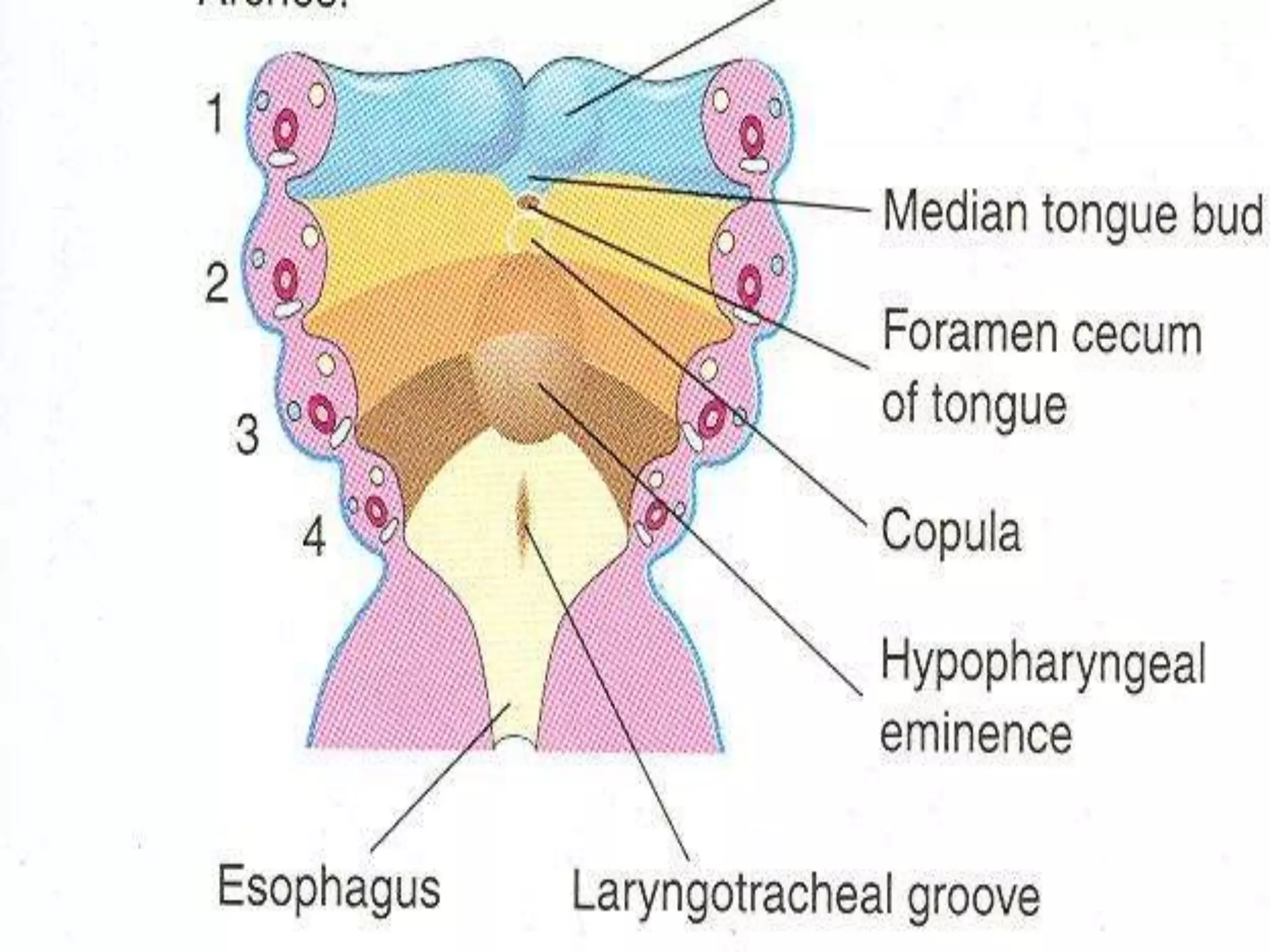
Formation of Posteriorthird of Tongue
• It is indicated by two elevations that develop
caudal to the foramen cecum
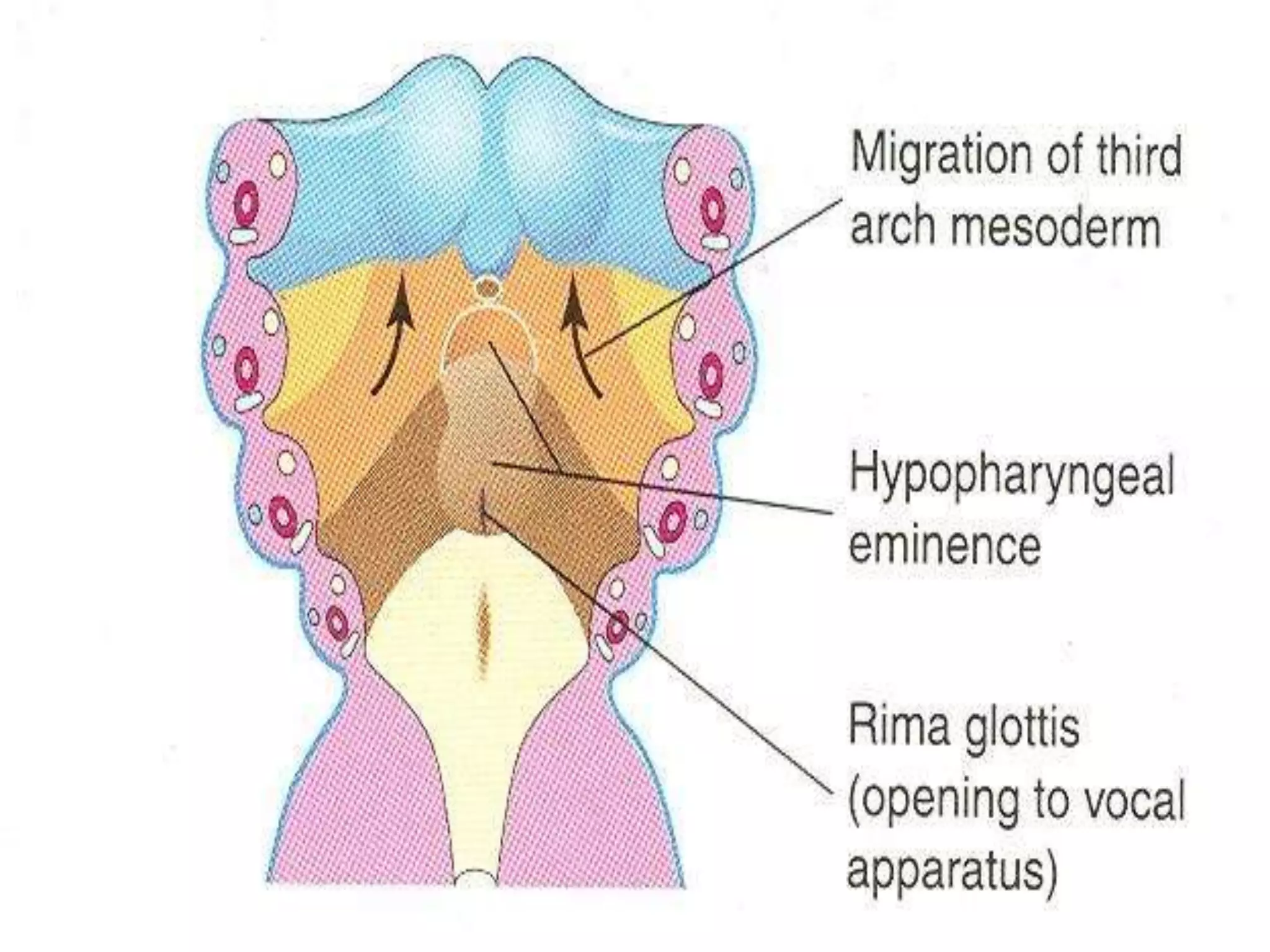
• Copula: Forms by fusion of the ventromedial
part of the second pair of pharyngeal arches
• The hypopharyngeal eminence: Develops
caudal to the copula from mesenchyme in the
ventromedial parts of the third and fourth
pairs of arches
8.
Formation of Posteriorthird of Tongue
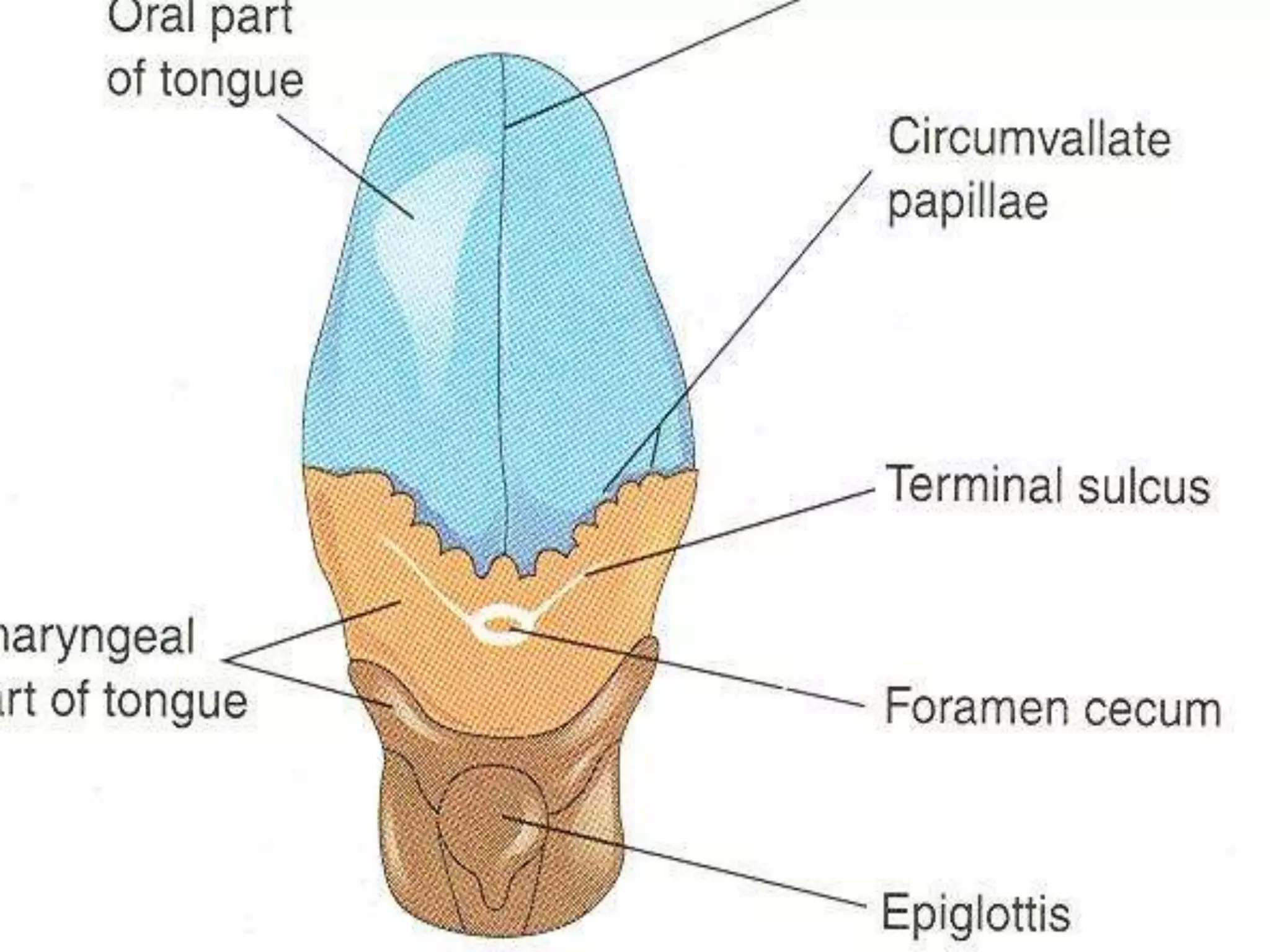
• As the tongue develops the copula is gradually overgrown by the
hypopharyngeal eminence and disappear
• As a result, the pharyngeal part of the tongue develops from the
rostral part of the hypopharyngeal eminence
• The line of fusion of the anterior and posterior parts of the tongue is
roughly indicated by a V-shaped groove called terminal sulcus
10.
Formation of Posteriorthird of Tongue
• Pharyngeal mesenchyme forms the connective tissue and
vasculature of the tongue
• Most of the tongue muscles are derived from myoblasts that
migrate from the occipital myotomes
• The hypoglossal nerve (CN Ⅻ) accompanies the myoblast
during their migration and innervates the tongue muscles as
they develop
• The entire tongue is within the mouth at birth, its posterior
third descends into the oropharynx by 4 years of age
11.
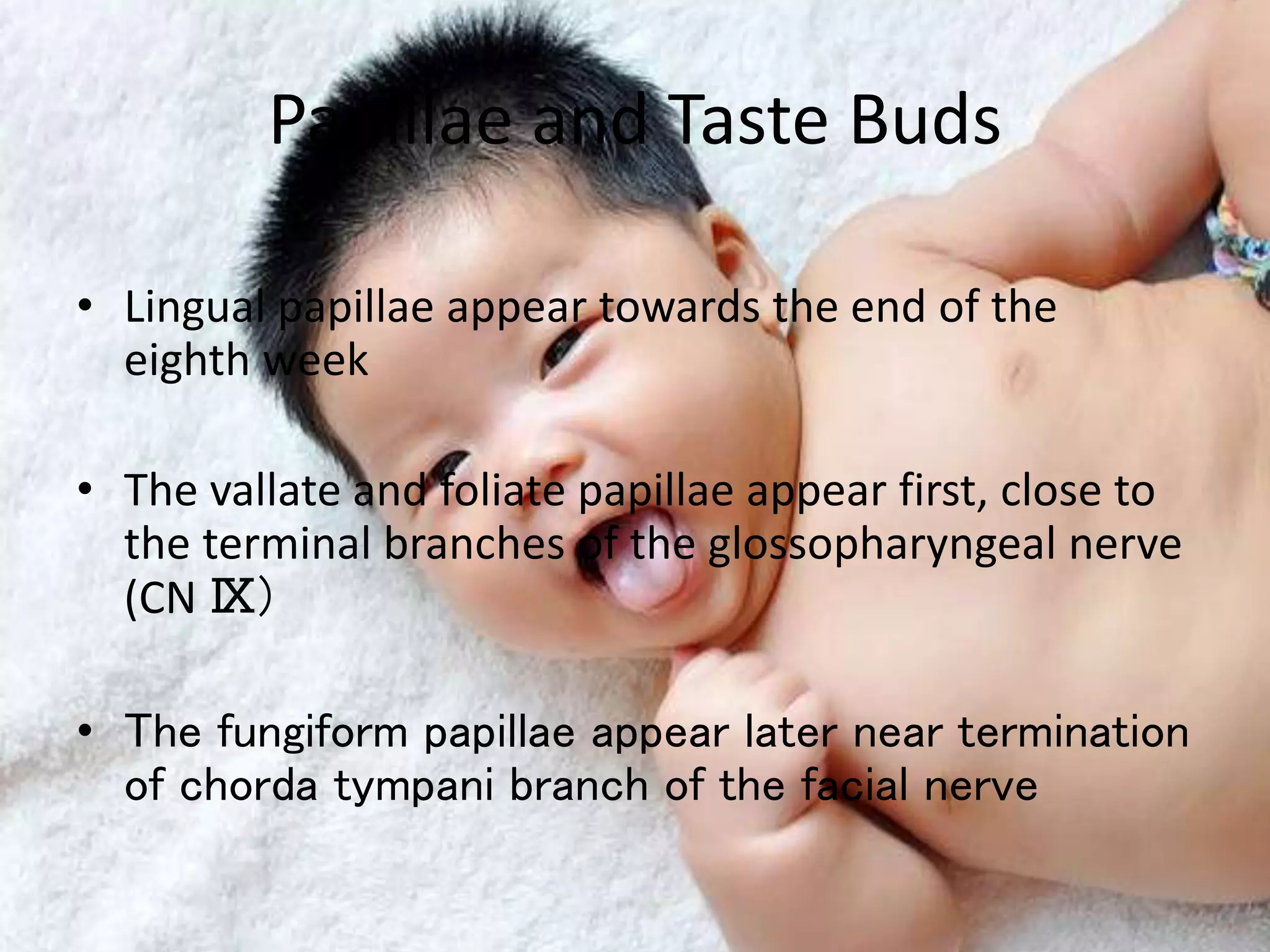
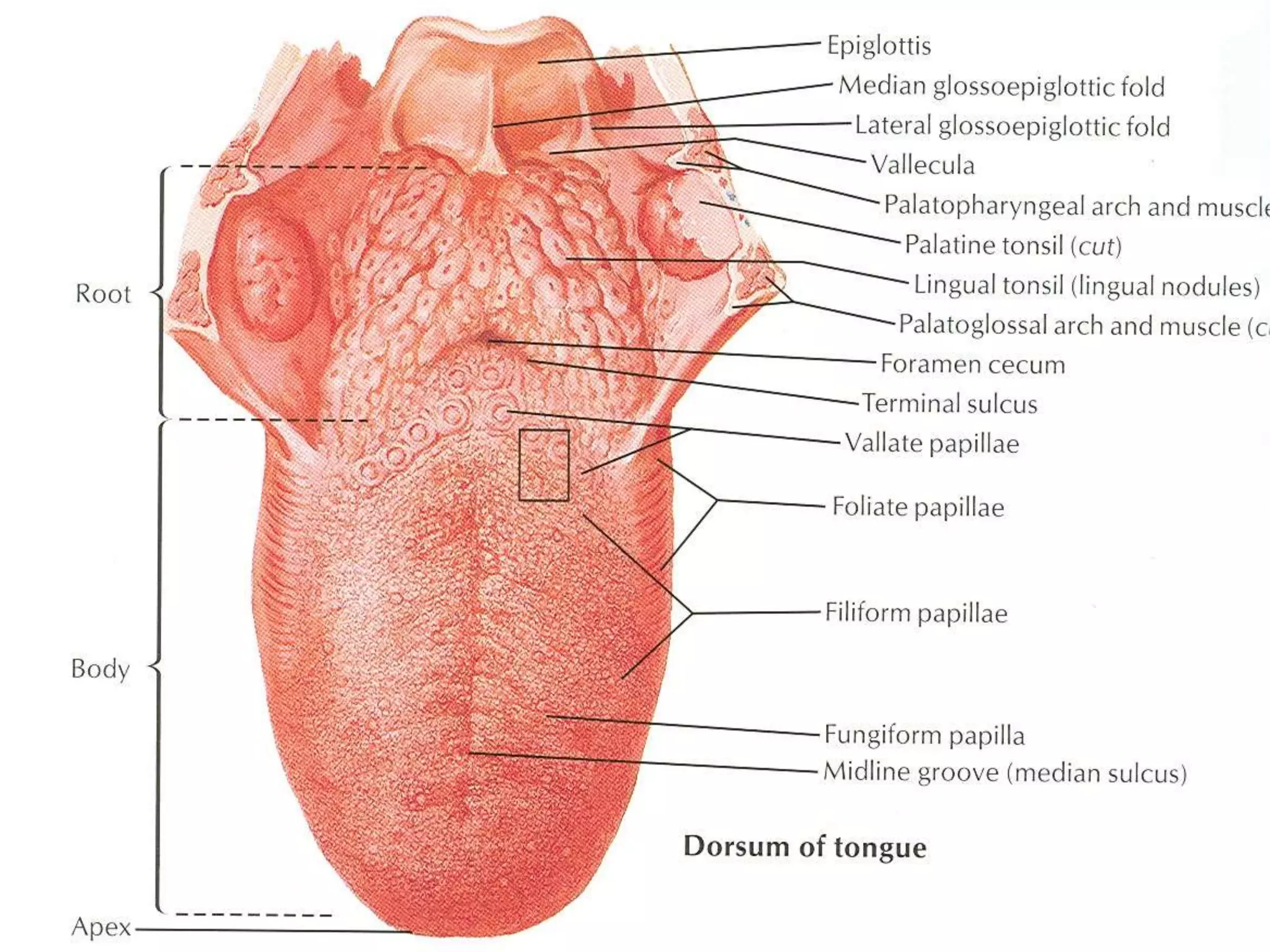
Papillae and TasteBuds
• Lingual papillae appear towards the end of the
eighth week
• The vallate and foliate papillae appear first, close to
the terminal branches of the glossopharyngeal nerve
(CN Ⅸ)
• The fungiform papillae appear later near termination
of chorda tympani branch of the facial nerve
13.
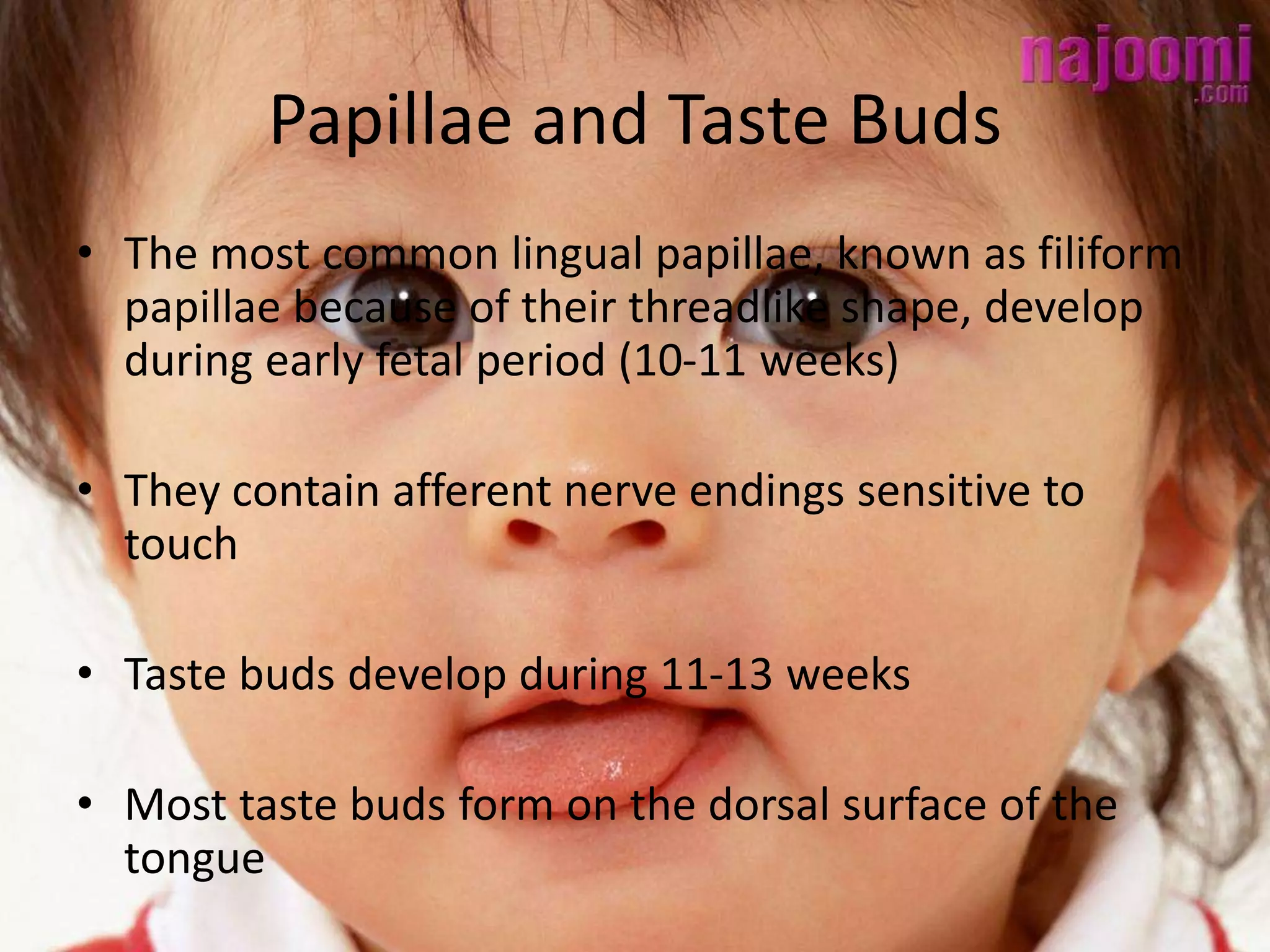
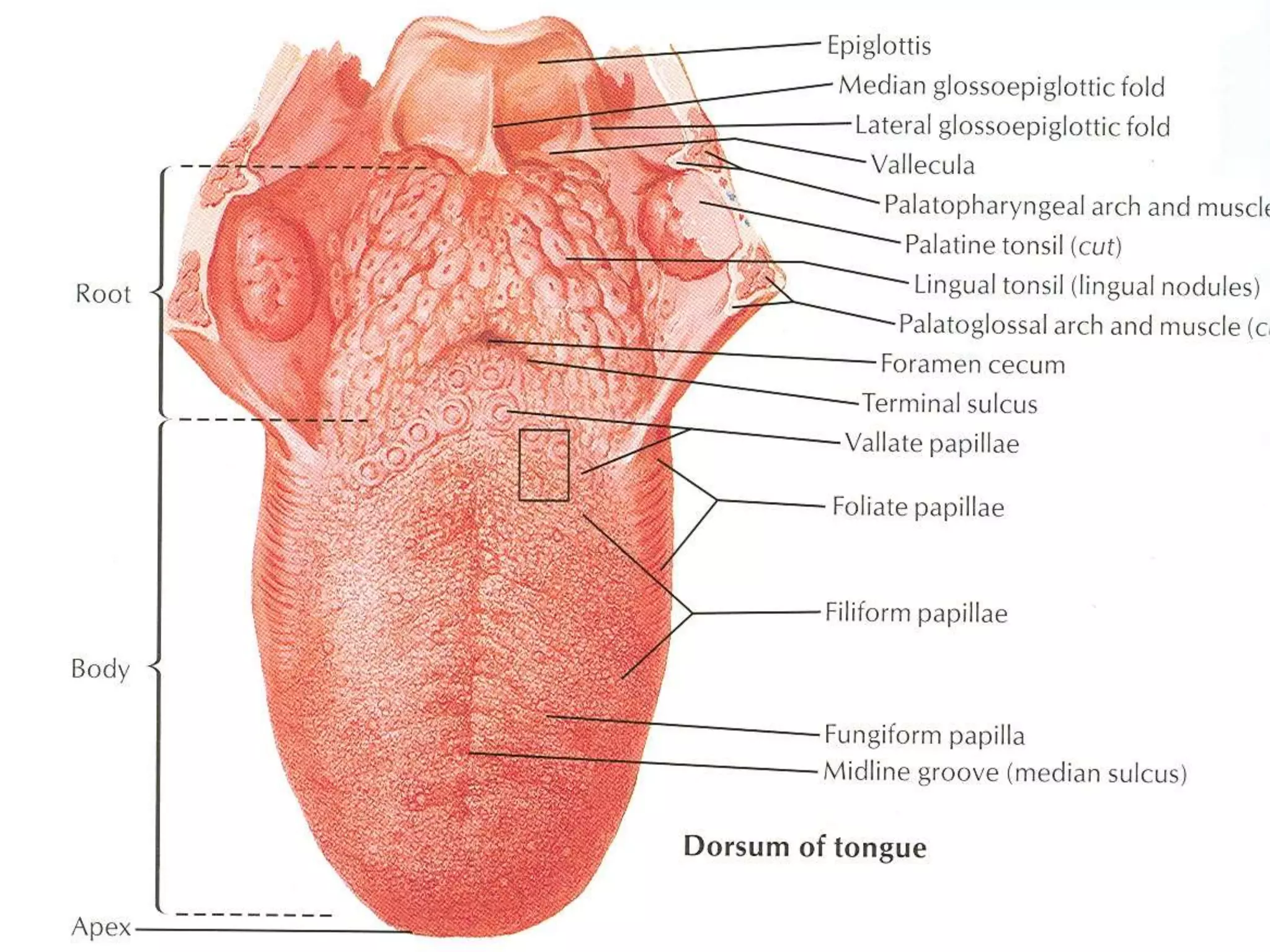
Papillae and TasteBuds
• The most common lingual papillae, known as filiform
papillae because of their threadlike shape, develop
during early fetal period (10-11 weeks)
• They contain afferent nerve endings sensitive to
touch
• Taste buds develop during 11-13 weeks
• Most taste buds form on the dorsal surface of the
tongue
15.
Papillae and TasteBuds
• Fetal responses in the face can be induced by
bitter tasting substances at 26-28 weeks,
indicating that the reflex pathways between
taste buds and facial muscles are established
by this age
16.
Nerve Supply ofthe Tongue
• The development of tongue explains its nerve supply
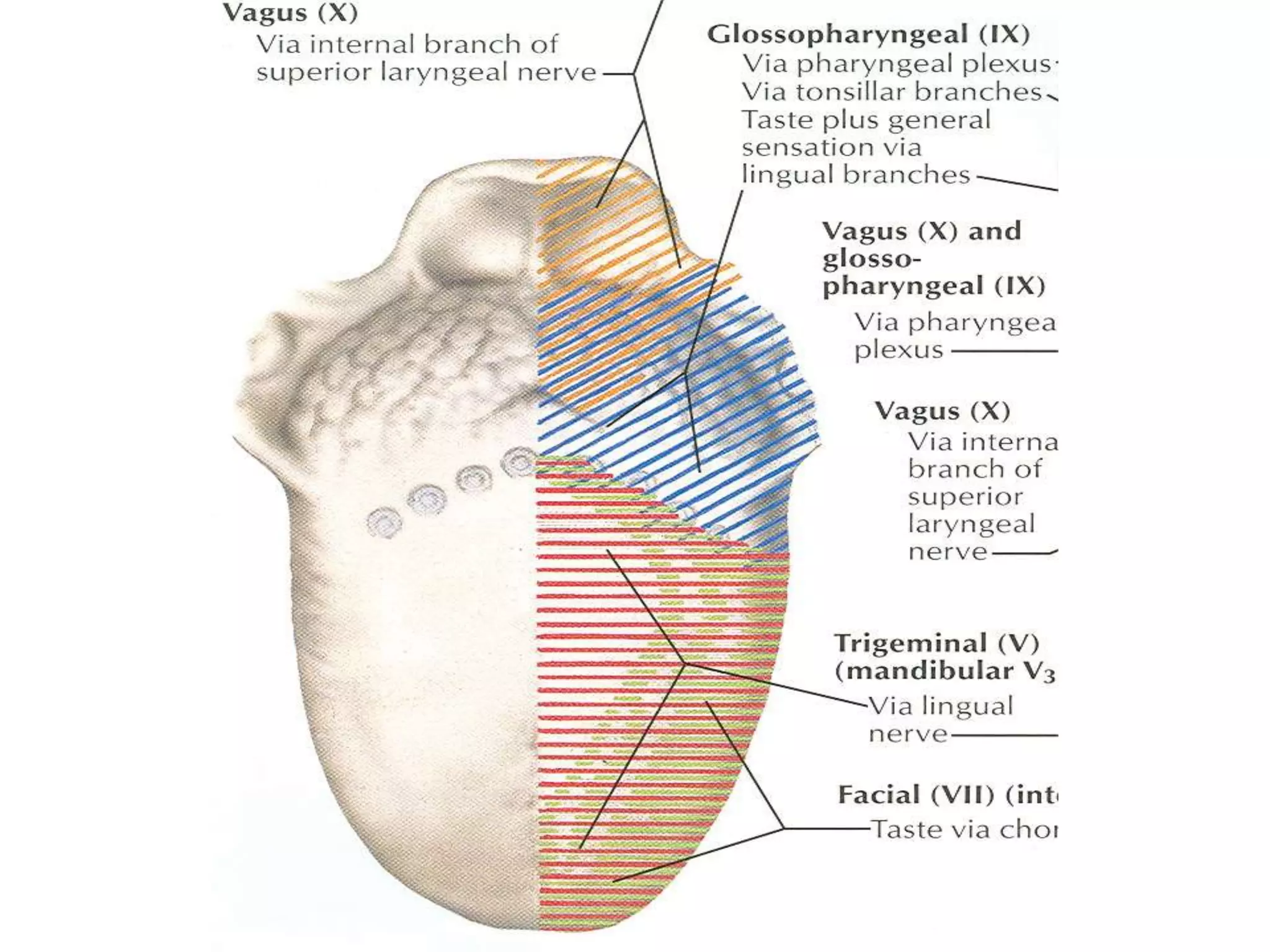
• The sensory supply to the mucosa of almost the
entire anterior two-thirds of the tongue is from the
lingual branch of the mandibular division of the
trigeminal nerve
• This nerve is the nerve of first pharyngeal arch and
this arch forms the median and distal tongue buds
17.
Nerve Supply ofthe Tongue
• Facial nerve is the nerve of second pharyngeal arch
• Its chorda tympani branch supplies the taste buds in
the anterior two-thirds of the tongue except the
vallate papillae
• The facial nerve does not supply any of the tongue
mucosa, except for taste buds in the oral part of the
tongue
19.
Nerve Supply ofthe Tongue
• The vallate papillae in the oral part of the tongue are
innervated by glossopharyngeal nerve (CN Ⅸ) of the
third pharyngeal arch
• This is due to the reason that mucosa of posterior
two third of the tongue is pulled slightly anteriorly as
the tongue develops
• The posterior third of the tongue is innervated
mainly by the glossopharyngeal nerve, which is a
nerve of third pharyngeal arch
20.
Nerve Supply ofthe Tongue
• The superior laryngeal branch of the vagus nerve (CN
Ⅹ) of the fourth arch supplies small area of the
tongue anterior to the epiglottis
• All muscles of the tongue are supplied by the
hypoglossal nerve (CN Ⅻ), except for palatoglossus,
which is supplied from pharyngeal plexus by fibers
arising from the vagus nerve
21.
Clinical Notes
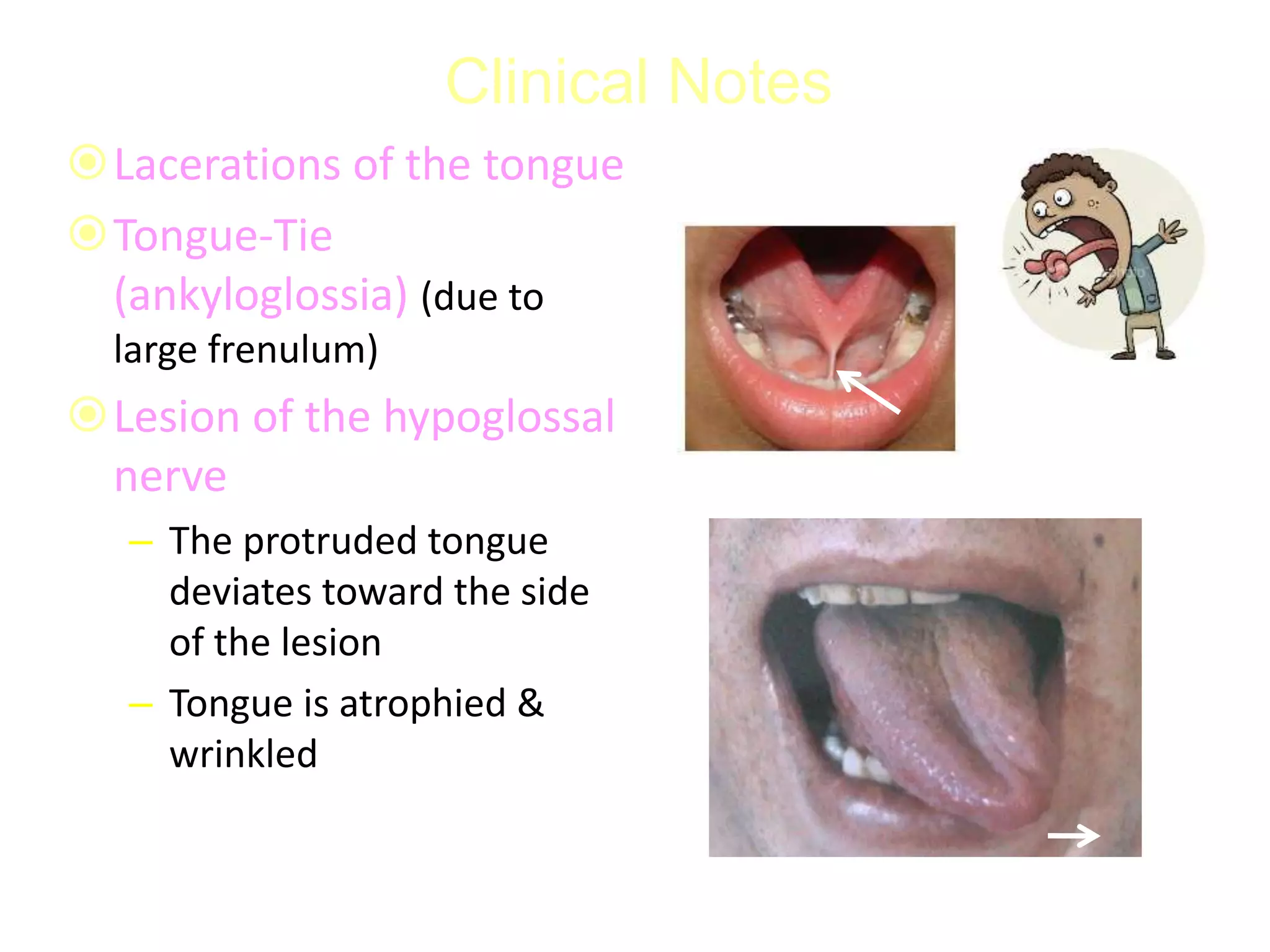
Lacerations ofthe tongue
Tongue-Tie
(ankyloglossia) (due to
large frenulum)
Lesion of the hypoglossal
nerve
– The protruded tongue
deviates toward the side
of the lesion
– Tongue is atrophied &
wrinkled