6th
International Disaster and Risk Conference IDRC 2016
‘Integrative Risk Management – Towards Resilient Cities‘ • 28 Aug – 1 Sept 2016 • Davos • Switzerland
www.grforum.org
Development of Disaster Profiling Technique
for Case-based Cause Analysis
Mi-Ran LEE·Chang-Geon YEO·Bo-Young SEO·Hyun-Ju KIM
National Disaster Management Research Institute, Korea
August 29, 2016
6th
International Disaster and Risk Conference IDRC 2016
‘Integrative Risk Management – Towards Resilient Cities‘ • 28 Aug – 1 Sept 2016 • Davos • Switzerland
www.grforum.org
Contents
1. Need for case-based Cause Analysis
2. What is DSI?
3. Disaster Profiling for Root Cause Analysis
4. Case Study
▷ Hydrofluoric Acid Leak in Gumi
▷ Collapse of the Resort’s Gymnasium in Gyeongju
5. Conclusion
1
2
3
4
5
6th
International Disaster and Risk Conference IDRC 2016
‘Integrative Risk Management – Towards Resilient Cities‘ • 28 Aug – 1 Sept 2016 • Davos • Switzerland
www.grforum.org
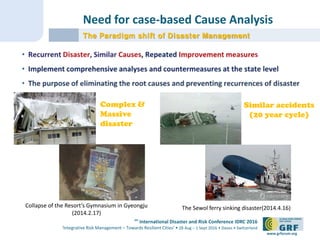
Need for case-based Cause Analysis
The Paradigm shift of Disaster Management
Collapse of the Resort’s Gymnasium in Gyeongju
(2014.2.17)
The Sewol ferry sinking disaster(2014.4.16)
Complex &
Massive
disaster
Similar accidents
(20 year cycle)
6th
International Disaster and Risk Conference IDRC 2016
‘Integrative Risk Management – Towards Resilient Cities‘ • 28 Aug – 1 Sept 2016 • Davos • Switzerland
www.grforum.org
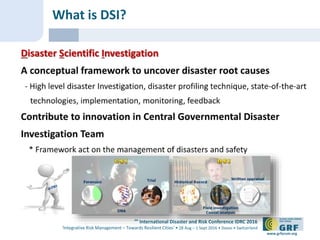
What is DSI?
6th
International Disaster and Risk Conference IDRC 2016
‘Integrative Risk Management – Towards Resilient Cities‘ • 28 Aug – 1 Sept 2016 • Davos • Switzerland
www.grforum.org
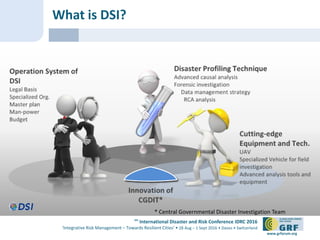
What is DSI?
* Central Governmental Disaster Investigation Team
6th
International Disaster and Risk Conference IDRC 2016
‘Integrative Risk Management – Towards Resilient Cities‘ • 28 Aug – 1 Sept 2016 • Davos • Switzerland
www.grforum.org
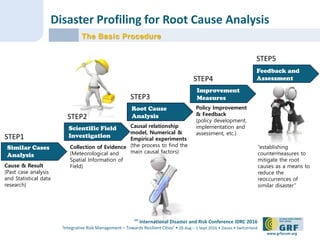
Disaster Profiling for Root Cause Analysis
The Basic Procedure
STEP1
STEP2
STEP3
STEP4
STEP5
Similar Cases
Analysis
Collection of Evidence
(Meteorological and
Spatial Information of
Field)
Scientific Field
Investigation
Root Cause
Analysis
Improvement
Measures
Feedback and
Assessment
Cause & Result
(Past case analysis
and Statistical data
research)
Causal relationship
model, Numerical &
Empirical experiments
(the process to find the
main causal factors)
Policy Improvement
& Feedback
(policy development,
implementation and
assessment, etc.)
“establishing
countermeasures to
mitigate the root
causes as a means to
reduce the
reoccurrences of
similar disaster”
6th
International Disaster and Risk Conference IDRC 2016
‘Integrative Risk Management – Towards Resilient Cities‘ • 28 Aug – 1 Sept 2016 • Davos • Switzerland
www.grforum.org
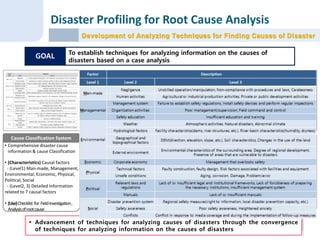
Disaster Profiling for Root Cause Analysis
Development of Analyzing Techniques for Finding Causes of Disaster
Cause Analysis Tree Diagram
• Treediagramofcausesofdisasters
• (Merits)Allows stakeholders to set
priorities for improvements based
on the type of disaster
• (Demerits)Cannotdeterminethe
relationshipbetweenthecausalfactors
• (Use)Priorityreviewchecklistduringfield
investigations
Cause Analysis Matrix
• Taxonomic analysis of an accident
• (Merits) Easy to see the principal
cause of each accident
• (Demerits) Cannot track the
development of the situation over
time or track the connection between
causes
• (Use) Derivation of the principal cause
of a disaster or accident
GOAL
To establish techniques for analyzing information on the causes of
disasters based on a case analysis
Cause Classification System
• Comprehensive disaster cause
information & cause Classification
• (Characteristics) Causal factors
- (Level1) Man-made, Management,
Environmental, Economic, Physical,
Political, Social
- (Level2, 3) Detailed Information
related to 7 causal factors
• (Use)Checklist for Fieldinvestigation,
Analysisofrootcause
Causal Loop Diagram
• Two-dimensionaldiagramforeachcausal
factor(explainthedynamicsofthecause-
effect relationships)
• (Characteristics)Understandtheinter-
connections betweenpoliciesand
decisionmakingprocessesandtheir
impactonthesystemgrowthand
stability
• (Use)eliminatethelinksinadvance
6th
International Disaster and Risk Conference IDRC 2016
‘Integrative Risk Management – Towards Resilient Cities‘ • 28 Aug – 1 Sept 2016 • Davos • Switzerland
www.grforum.org
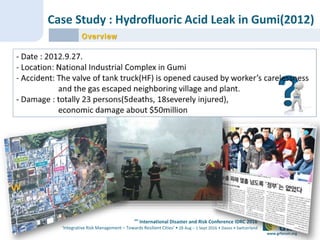
Case Study : Hydrofluoric Acid Leak in Gumi(2012)
Overview
6th
International Disaster and Risk Conference IDRC 2016
‘Integrative Risk Management – Towards Resilient Cities‘ • 28 Aug – 1 Sept 2016 • Davos • Switzerland
www.grforum.org
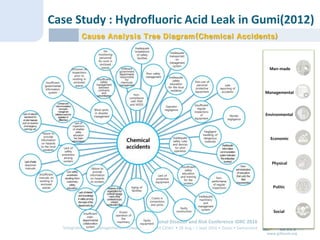
Case Study : Hydrofluoric Acid Leak in Gumi(2012)
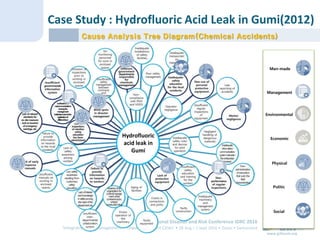
Cause Analysis Tree Diagram(Chemical Accidents)
Man-made
Managemental
Environmental
Economic
Physical
Politic
Social
6th
International Disaster and Risk Conference IDRC 2016
‘Integrative Risk Management – Towards Resilient Cities‘ • 28 Aug – 1 Sept 2016 • Davos • Switzerland
www.grforum.org
Case Study : Hydrofluoric Acid Leak in Gumi(2012)
Cause Analysis Tree Diagram(Chemical Accidents)
Man-made
Management
Environmental
Economic
Physical
Politic
Social
Hydrofluoric
acid leak in
Gumi
6th
International Disaster and Risk Conference IDRC 2016
‘Integrative Risk Management – Towards Resilient Cities‘ • 28 Aug – 1 Sept 2016 • Davos • Switzerland
www.grforum.org
Case Study : Hydrofluoric Acid Leak in Gumi(2012)
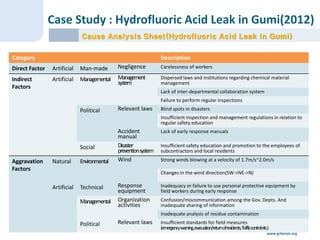
Cause Analysis Sheet(Hydrofluoric Acid Leak in Gumi)
Category Description
Direct Factor Artificial Man-made Negligence Carelessness of workers
Indirect
Factors
Artificial Managemental Management
system
Dispersed laws and institutions regarding chemical material
management
Lack of inter-departmental collaboration system
Failure to perform regular inspections
Political Relevant laws Blind spots in disasters
Insufficient inspection and management regulations in relation to
regular safety education
Accident
manual
Lack of early response manuals
Social Disaster
preventionsystem
Insufficient safety education and promotion to the employees of
subcontractors and local residents
Aggravation
Factors
Natural Environmental Wind Strong winds blowing at a velocity of 1.7m/s~2.0m/s
Changes in the wind direction(SW->NE->N)
Artificial Technical Response
equipment
Inadequacy or failure to use personal protective equipment by
field workers during early response
Managemental Organization
activities
Confusion/miscommunication among the Gov. Depts. And
inadequate sharing of information
Inadequate analysis of residue contamination
Political Relevant laws Insufficient standards for field measures
(emergencywarning,evacuation/returnofresidents,Trafficcontroletc.)
6th
International Disaster and Risk Conference IDRC 2016
‘Integrative Risk Management – Towards Resilient Cities‘ • 28 Aug – 1 Sept 2016 • Davos • Switzerland
www.grforum.org
Case Study : Hydrofluoric Acid Leak in Gumi(2012)
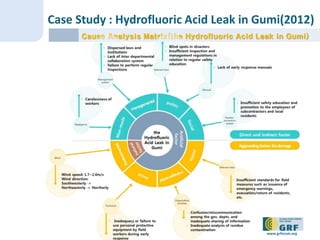
Cause Analysis Matrix(the Hydrofluoric Acid Leak in Gumi)
6th
International Disaster and Risk Conference IDRC 2016
‘Integrative Risk Management – Towards Resilient Cities‘ • 28 Aug – 1 Sept 2016 • Davos • Switzerland
www.grforum.org
Case Study : Hydrofluoric acid leak in Gumi(2012)
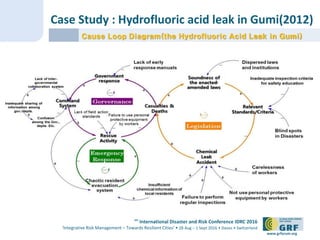
Cause Loop Diagram(the Hydrofluoric Acid Leak in Gumi)
6th
International Disaster and Risk Conference IDRC 2016
‘Integrative Risk Management – Towards Resilient Cities‘ • 28 Aug – 1 Sept 2016 • Davos • Switzerland
www.grforum.org
Case Study : Hydrofluoric acid leak in Gumi(2012)
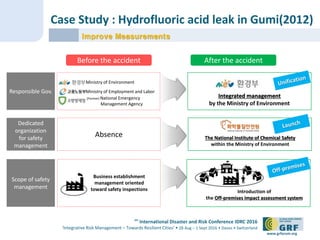
After the accidentBefore the accident
Responsible Gov.
Scope of safety
management
Dedicated
organization
for safety
management
Integrated management
by the Ministry of Environment
Absence
Ministry of Environment
The National Institute of Chemical Safety
within the Ministry of Environment
Business establishment
management oriented
toward safety inspections Introduction of
the Off-premises impact assessment system
(Former) National Emergency
Management Agency
Ministry of Employment and Labor
Improve Measurements
6th
International Disaster and Risk Conference IDRC 2016
‘Integrative Risk Management – Towards Resilient Cities‘ • 28 Aug – 1 Sept 2016 • Davos • Switzerland
www.grforum.org
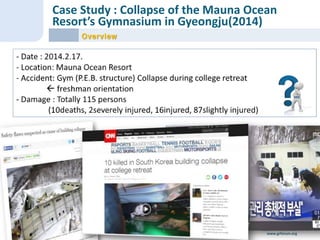
Overview
Case Study : Collapse of the Mauna Ocean
Resort’s Gymnasium in Gyeongju(2014)
6th
International Disaster and Risk Conference IDRC 2016
‘Integrative Risk Management – Towards Resilient Cities‘ • 28 Aug – 1 Sept 2016 • Davos • Switzerland
www.grforum.org
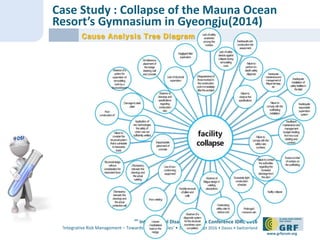
Case Study : Collapse of the Mauna Ocean
Resort’s Gymnasium in Gyeongju(2014)
Cause Analysis Tree Diagram
6th
International Disaster and Risk Conference IDRC 2016
‘Integrative Risk Management – Towards Resilient Cities‘ • 28 Aug – 1 Sept 2016 • Davos • Switzerland
www.grforum.org
Case Study : Collapse of the Mauna Ocean
Resort’s Gymnasium in Gyeongju(2014)
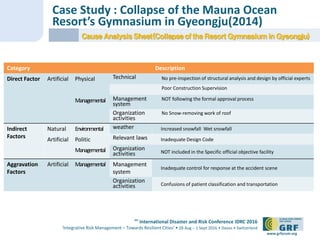
CauseAnalysisSheet(CollapseoftheResortGymnasiuminGyeongju)
Category Description
Direct Factor Artificial Physical Technical No pre-inspection of structural analysis and design by official experts
Poor Construction Supervision
Managemental Management
system
NOT following the formal approval process
Organization
activities
No Snow-removing work of roof
Indirect
Factors
Natural Environmental weather Increased snowfall Wet snowfall
Artificial Politic Relevant laws Inadequate Design Code
Managemental Organization
activities NOT included in the Specific official objective facility
Aggravation
Factors
Artificial Managemental Management
system
Inadequate control for response at the accident scene
Organization
activities Confusions of patient classification and transportation
6th
International Disaster and Risk Conference IDRC 2016
‘Integrative Risk Management – Towards Resilient Cities‘ • 28 Aug – 1 Sept 2016 • Davos • Switzerland
www.grforum.org
Case Study : Collapse of the Mauna Ocean
Resort’s Gymnasium in Gyeongju(2014)
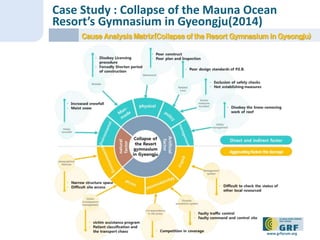
CauseAnalysisMatrix(CollapseoftheResortGymnasiuminGyeongju)
6th
International Disaster and Risk Conference IDRC 2016
‘Integrative Risk Management – Towards Resilient Cities‘ • 28 Aug – 1 Sept 2016 • Davos • Switzerland
www.grforum.org
Case Study : Collapse of the Mauna Ocean
Resort’s Gymnasium in Gyeongju(2014)
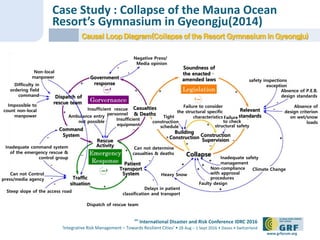
CausalLoopDiagram(CollapseoftheResortGymnasiuminGyeongju)
Difficulty in
ordering field
command
Impossible to
count non-local
manpower
Non-local
manpower
Inadequate command system
of the emergency rescue &
control group
Can not Control
press/media agency
Steep slope of the access road
Dispatch of rescue team
Dispatch of
rescue team
Command
System
Traffic
situation
Rescue
Activity
Patient
Transport
System
Casualties
& Deaths
Government
response
Relevant
standards
Soundness of
the enacted·
amended laws
Insufficient
equipment
Insufficient rescue
personnel
Ambulance entry
not possible
Tight
construction
schedule
Negative Press/
Media opinion
Failure to consider
the structural specific
characteristics Failure
to check
structural safety
Building
Construction Construction
Supervision
Collapse
Climate Change
Inadequate safety
management
Heavy Snow
Faulty design
Non-compliance
with approval
procedures
safety inspections
exception
Absence of P.E.B.
design standards
Absence of
design criterion
on wet/snow
loads
Can not determine
casualties & deaths
Delays in patient
classification and transport
6th
International Disaster and Risk Conference IDRC 2016
‘Integrative Risk Management – Towards Resilient Cities‘ • 28 Aug – 1 Sept 2016 • Davos • Switzerland
www.grforum.org
Case Study : Collapse of the Mauna Ocean
Resort’s Gymnasium in Gyeongju(2014)
Direct
Technique
No pre-inspection of structural analysis
and design by official experts
Poor Construction Supervision
[Revision] Framework Act on Building Article 67
[Revision] Framework Act on Building Article 25
Management
NOT following the formal approval
process
[Revision] Framework Act on Building Article 11
No Snow-removing work of roof [Revision] Countermeasures against Natural Disaster Act Article 26
Indirect
Meteorology Increased snowfall Wet snowfall [Revision] Korean Building Code Article 3
Policy Inadequate Design Code
[Enactment] Framework Act on Building Article/Korean Building
Code
Management
NOT included in the Specific official
objective facility
[Revision] Guideline for Designation and Management of the
Specific official objective facility Article 4
Aggravating Management
Inadequate control for response at the
accident scene
[Revision] Framework Act on the management for disasters and
safety Article 16
Confusions of patient classification and
transportation
[Revision] Guideline for Emergency Response Activities Article 20
Improvement measures
6th
International Disaster and Risk Conference IDRC 2016
‘Integrative Risk Management – Towards Resilient Cities‘ • 28 Aug – 1 Sept 2016 • Davos • Switzerland
www.grforum.org
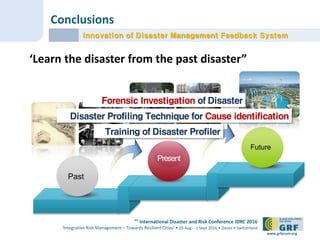
Conclusions
‘Learn the disaster from the past disaster”
Past
Present
Future
Forensic Investigation of Disaster
Disaster Profiling Technique for Cause identification
Training of Disaster Profiler
Innovation of Disaster Management Feedback System
6th
International Disaster and Risk Conference IDRC 2016
‘Integrative Risk Management – Towards Resilient Cities‘ • 28 Aug – 1 Sept 2016 • Davos • Switzerland
www.grforum.org
Questions? Comments?
Mi-Ran, LEE
Senior Researcher/Professional Engineer
National Disaster Management Research Institute
Ministry of Public Safety and Security
Homepage: www.ndmi.go.kr
E-mail: merang75@gmail.com, mrlee75@korea.kr

Development of Disaster Profiling Technique for Case-based Cause Analysis, Mi-Ran LEE

  • 1.
    6th International Disaster andRisk Conference IDRC 2016 ‘Integrative Risk Management – Towards Resilient Cities‘ • 28 Aug – 1 Sept 2016 • Davos • Switzerland www.grforum.org Development of Disaster Profiling Technique for Case-based Cause Analysis Mi-Ran LEE·Chang-Geon YEO·Bo-Young SEO·Hyun-Ju KIM National Disaster Management Research Institute, Korea August 29, 2016
  • 2.
    6th International Disaster andRisk Conference IDRC 2016 ‘Integrative Risk Management – Towards Resilient Cities‘ • 28 Aug – 1 Sept 2016 • Davos • Switzerland www.grforum.org Contents 1. Need for case-based Cause Analysis 2. What is DSI? 3. Disaster Profiling for Root Cause Analysis 4. Case Study ▷ Hydrofluoric Acid Leak in Gumi ▷ Collapse of the Resort’s Gymnasium in Gyeongju 5. Conclusion 1 2 3 4 5
  • 3.
    6th International Disaster andRisk Conference IDRC 2016 ‘Integrative Risk Management – Towards Resilient Cities‘ • 28 Aug – 1 Sept 2016 • Davos • Switzerland www.grforum.org Need for case-based Cause Analysis The Paradigm shift of Disaster Management Collapse of the Resort’s Gymnasium in Gyeongju (2014.2.17) The Sewol ferry sinking disaster(2014.4.16) Complex & Massive disaster Similar accidents (20 year cycle)
  • 4.
    6th International Disaster andRisk Conference IDRC 2016 ‘Integrative Risk Management – Towards Resilient Cities‘ • 28 Aug – 1 Sept 2016 • Davos • Switzerland www.grforum.org What is DSI?
  • 5.
    6th International Disaster andRisk Conference IDRC 2016 ‘Integrative Risk Management – Towards Resilient Cities‘ • 28 Aug – 1 Sept 2016 • Davos • Switzerland www.grforum.org What is DSI? * Central Governmental Disaster Investigation Team
  • 6.
    6th International Disaster andRisk Conference IDRC 2016 ‘Integrative Risk Management – Towards Resilient Cities‘ • 28 Aug – 1 Sept 2016 • Davos • Switzerland www.grforum.org Disaster Profiling for Root Cause Analysis The Basic Procedure STEP1 STEP2 STEP3 STEP4 STEP5 Similar Cases Analysis Collection of Evidence (Meteorological and Spatial Information of Field) Scientific Field Investigation Root Cause Analysis Improvement Measures Feedback and Assessment Cause & Result (Past case analysis and Statistical data research) Causal relationship model, Numerical & Empirical experiments (the process to find the main causal factors) Policy Improvement & Feedback (policy development, implementation and assessment, etc.) “establishing countermeasures to mitigate the root causes as a means to reduce the reoccurrences of similar disaster”
  • 7.
    6th International Disaster andRisk Conference IDRC 2016 ‘Integrative Risk Management – Towards Resilient Cities‘ • 28 Aug – 1 Sept 2016 • Davos • Switzerland www.grforum.org Disaster Profiling for Root Cause Analysis Development of Analyzing Techniques for Finding Causes of Disaster Cause Analysis Tree Diagram • Treediagramofcausesofdisasters • (Merits)Allows stakeholders to set priorities for improvements based on the type of disaster • (Demerits)Cannotdeterminethe relationshipbetweenthecausalfactors • (Use)Priorityreviewchecklistduringfield investigations Cause Analysis Matrix • Taxonomic analysis of an accident • (Merits) Easy to see the principal cause of each accident • (Demerits) Cannot track the development of the situation over time or track the connection between causes • (Use) Derivation of the principal cause of a disaster or accident GOAL To establish techniques for analyzing information on the causes of disasters based on a case analysis Cause Classification System • Comprehensive disaster cause information & cause Classification • (Characteristics) Causal factors - (Level1) Man-made, Management, Environmental, Economic, Physical, Political, Social - (Level2, 3) Detailed Information related to 7 causal factors • (Use)Checklist for Fieldinvestigation, Analysisofrootcause Causal Loop Diagram • Two-dimensionaldiagramforeachcausal factor(explainthedynamicsofthecause- effect relationships) • (Characteristics)Understandtheinter- connections betweenpoliciesand decisionmakingprocessesandtheir impactonthesystemgrowthand stability • (Use)eliminatethelinksinadvance
  • 8.
    6th International Disaster andRisk Conference IDRC 2016 ‘Integrative Risk Management – Towards Resilient Cities‘ • 28 Aug – 1 Sept 2016 • Davos • Switzerland www.grforum.org Case Study : Hydrofluoric Acid Leak in Gumi(2012) Overview
  • 9.
    6th International Disaster andRisk Conference IDRC 2016 ‘Integrative Risk Management – Towards Resilient Cities‘ • 28 Aug – 1 Sept 2016 • Davos • Switzerland www.grforum.org Case Study : Hydrofluoric Acid Leak in Gumi(2012) Cause Analysis Tree Diagram(Chemical Accidents) Man-made Managemental Environmental Economic Physical Politic Social
  • 10.
    6th International Disaster andRisk Conference IDRC 2016 ‘Integrative Risk Management – Towards Resilient Cities‘ • 28 Aug – 1 Sept 2016 • Davos • Switzerland www.grforum.org Case Study : Hydrofluoric Acid Leak in Gumi(2012) Cause Analysis Tree Diagram(Chemical Accidents) Man-made Management Environmental Economic Physical Politic Social Hydrofluoric acid leak in Gumi
  • 11.
    6th International Disaster andRisk Conference IDRC 2016 ‘Integrative Risk Management – Towards Resilient Cities‘ • 28 Aug – 1 Sept 2016 • Davos • Switzerland www.grforum.org Case Study : Hydrofluoric Acid Leak in Gumi(2012) Cause Analysis Sheet(Hydrofluoric Acid Leak in Gumi) Category Description Direct Factor Artificial Man-made Negligence Carelessness of workers Indirect Factors Artificial Managemental Management system Dispersed laws and institutions regarding chemical material management Lack of inter-departmental collaboration system Failure to perform regular inspections Political Relevant laws Blind spots in disasters Insufficient inspection and management regulations in relation to regular safety education Accident manual Lack of early response manuals Social Disaster preventionsystem Insufficient safety education and promotion to the employees of subcontractors and local residents Aggravation Factors Natural Environmental Wind Strong winds blowing at a velocity of 1.7m/s~2.0m/s Changes in the wind direction(SW->NE->N) Artificial Technical Response equipment Inadequacy or failure to use personal protective equipment by field workers during early response Managemental Organization activities Confusion/miscommunication among the Gov. Depts. And inadequate sharing of information Inadequate analysis of residue contamination Political Relevant laws Insufficient standards for field measures (emergencywarning,evacuation/returnofresidents,Trafficcontroletc.)
  • 12.
    6th International Disaster andRisk Conference IDRC 2016 ‘Integrative Risk Management – Towards Resilient Cities‘ • 28 Aug – 1 Sept 2016 • Davos • Switzerland www.grforum.org Case Study : Hydrofluoric Acid Leak in Gumi(2012) Cause Analysis Matrix(the Hydrofluoric Acid Leak in Gumi)
  • 13.
    6th International Disaster andRisk Conference IDRC 2016 ‘Integrative Risk Management – Towards Resilient Cities‘ • 28 Aug – 1 Sept 2016 • Davos • Switzerland www.grforum.org Case Study : Hydrofluoric acid leak in Gumi(2012) Cause Loop Diagram(the Hydrofluoric Acid Leak in Gumi)
  • 14.
    6th International Disaster andRisk Conference IDRC 2016 ‘Integrative Risk Management – Towards Resilient Cities‘ • 28 Aug – 1 Sept 2016 • Davos • Switzerland www.grforum.org Case Study : Hydrofluoric acid leak in Gumi(2012) After the accidentBefore the accident Responsible Gov. Scope of safety management Dedicated organization for safety management Integrated management by the Ministry of Environment Absence Ministry of Environment The National Institute of Chemical Safety within the Ministry of Environment Business establishment management oriented toward safety inspections Introduction of the Off-premises impact assessment system (Former) National Emergency Management Agency Ministry of Employment and Labor Improve Measurements
  • 15.
    6th International Disaster andRisk Conference IDRC 2016 ‘Integrative Risk Management – Towards Resilient Cities‘ • 28 Aug – 1 Sept 2016 • Davos • Switzerland www.grforum.org Overview Case Study : Collapse of the Mauna Ocean Resort’s Gymnasium in Gyeongju(2014)
  • 16.
    6th International Disaster andRisk Conference IDRC 2016 ‘Integrative Risk Management – Towards Resilient Cities‘ • 28 Aug – 1 Sept 2016 • Davos • Switzerland www.grforum.org Case Study : Collapse of the Mauna Ocean Resort’s Gymnasium in Gyeongju(2014) Cause Analysis Tree Diagram
  • 17.
    6th International Disaster andRisk Conference IDRC 2016 ‘Integrative Risk Management – Towards Resilient Cities‘ • 28 Aug – 1 Sept 2016 • Davos • Switzerland www.grforum.org Case Study : Collapse of the Mauna Ocean Resort’s Gymnasium in Gyeongju(2014) CauseAnalysisSheet(CollapseoftheResortGymnasiuminGyeongju) Category Description Direct Factor Artificial Physical Technical No pre-inspection of structural analysis and design by official experts Poor Construction Supervision Managemental Management system NOT following the formal approval process Organization activities No Snow-removing work of roof Indirect Factors Natural Environmental weather Increased snowfall Wet snowfall Artificial Politic Relevant laws Inadequate Design Code Managemental Organization activities NOT included in the Specific official objective facility Aggravation Factors Artificial Managemental Management system Inadequate control for response at the accident scene Organization activities Confusions of patient classification and transportation
  • 18.
    6th International Disaster andRisk Conference IDRC 2016 ‘Integrative Risk Management – Towards Resilient Cities‘ • 28 Aug – 1 Sept 2016 • Davos • Switzerland www.grforum.org Case Study : Collapse of the Mauna Ocean Resort’s Gymnasium in Gyeongju(2014) CauseAnalysisMatrix(CollapseoftheResortGymnasiuminGyeongju)
  • 19.
    6th International Disaster andRisk Conference IDRC 2016 ‘Integrative Risk Management – Towards Resilient Cities‘ • 28 Aug – 1 Sept 2016 • Davos • Switzerland www.grforum.org Case Study : Collapse of the Mauna Ocean Resort’s Gymnasium in Gyeongju(2014) CausalLoopDiagram(CollapseoftheResortGymnasiuminGyeongju) Difficulty in ordering field command Impossible to count non-local manpower Non-local manpower Inadequate command system of the emergency rescue & control group Can not Control press/media agency Steep slope of the access road Dispatch of rescue team Dispatch of rescue team Command System Traffic situation Rescue Activity Patient Transport System Casualties & Deaths Government response Relevant standards Soundness of the enacted· amended laws Insufficient equipment Insufficient rescue personnel Ambulance entry not possible Tight construction schedule Negative Press/ Media opinion Failure to consider the structural specific characteristics Failure to check structural safety Building Construction Construction Supervision Collapse Climate Change Inadequate safety management Heavy Snow Faulty design Non-compliance with approval procedures safety inspections exception Absence of P.E.B. design standards Absence of design criterion on wet/snow loads Can not determine casualties & deaths Delays in patient classification and transport
  • 20.
    6th International Disaster andRisk Conference IDRC 2016 ‘Integrative Risk Management – Towards Resilient Cities‘ • 28 Aug – 1 Sept 2016 • Davos • Switzerland www.grforum.org Case Study : Collapse of the Mauna Ocean Resort’s Gymnasium in Gyeongju(2014) Direct Technique No pre-inspection of structural analysis and design by official experts Poor Construction Supervision [Revision] Framework Act on Building Article 67 [Revision] Framework Act on Building Article 25 Management NOT following the formal approval process [Revision] Framework Act on Building Article 11 No Snow-removing work of roof [Revision] Countermeasures against Natural Disaster Act Article 26 Indirect Meteorology Increased snowfall Wet snowfall [Revision] Korean Building Code Article 3 Policy Inadequate Design Code [Enactment] Framework Act on Building Article/Korean Building Code Management NOT included in the Specific official objective facility [Revision] Guideline for Designation and Management of the Specific official objective facility Article 4 Aggravating Management Inadequate control for response at the accident scene [Revision] Framework Act on the management for disasters and safety Article 16 Confusions of patient classification and transportation [Revision] Guideline for Emergency Response Activities Article 20 Improvement measures
  • 21.
    6th International Disaster andRisk Conference IDRC 2016 ‘Integrative Risk Management – Towards Resilient Cities‘ • 28 Aug – 1 Sept 2016 • Davos • Switzerland www.grforum.org Conclusions ‘Learn the disaster from the past disaster” Past Present Future Forensic Investigation of Disaster Disaster Profiling Technique for Cause identification Training of Disaster Profiler Innovation of Disaster Management Feedback System
  • 22.
    6th International Disaster andRisk Conference IDRC 2016 ‘Integrative Risk Management – Towards Resilient Cities‘ • 28 Aug – 1 Sept 2016 • Davos • Switzerland www.grforum.org Questions? Comments? Mi-Ran, LEE Senior Researcher/Professional Engineer National Disaster Management Research Institute Ministry of Public Safety and Security Homepage: www.ndmi.go.kr E-mail: merang75@gmail.com, mrlee75@korea.kr

Editor's Notes

  • #7 Disaster Profiling entails modeling of the analysis process for an objective analysis of the root cause using the information collected on mass disaster cases.
  • #8 Advancement of Analysis Techniques Based on Case Analysis (goal) To establish techniques for analyzing information on the causes of disasters based on a case analysis
  • #22 Main concept of DSI is “Learning the disaster from the past disaster” We will expand the forensic investigation of disaster and also, improve the disaster profiling techniques for cause identification. Finally, we will use developed profiling technique in Education and Training program to foster Disaster Proiler.