DEVELOPING
YOUR IDENTITY
AS A LEADER
Stephanie Lancaster, MS, OTR/L,
ATP
UTHSC Dept. of Occupational
Therapy
OT 431 Leadership I
January 25, 2016
LEARNING
OBJECTIVES
 Through participation in this class, the learner will –
 Define the term leadership in individual terms.
 Identify four domains of leadership strength.
 Reflect on one’s own aptitudes and how they can
impact team performance as a leader and as a team
member.
 List at least three skills thought to contribute to effective
leadership.
WHAT MAKES A
LEADER?
“Leadership is not about experience,
education, or talent. It’s about choosing to
lead.” ~Michael Hyatt
“If your actions inspire other to dream more,
learn more, do more, and become more,
you are a leader.” ~John Quincy Adams
EMOTIONAL INTELLIGENCE
Self-awareness
Self-regulation
Motivation
Empathy
Social skills
Recommendation: https://www.youtube.com/watch?v=b9yRmpcXKjY
Video on “Focus: The Hidden Driver of Excellence”
Mayer & Salovey, 1995
AN EFFECTIVE LEADER …
Hyatt (2015)
Longs to make a difference
Feels discontented with the status quo
Has a vision that often precedes the resources
Has dreams so big they may seem impossible
Acknowledges what is - but asks what could be
Realizes that a person doesn’t have to be in charge to
have influence
Takes responsibility for finding solutions and fixing
problems
Fosters unity by encouraging communication and
collaboration
Quick to admit fault
Values relationships more than tasks
Leads by example, demonstrates authenticity
Lives as a lifelong learner
Authenticity
Character
Charisma
AN EFFECTIVE LEADER …
Rath & Conchie (2008)
Invests in strengths of others
Surrounds himself with the right
people and then maximizes his
team
Understands his followers’ needs
Bennis (2003)
Engages others by creating
shared meaning
Has a distinctive voice
Shows integrity
Demonstrates adaptive capacity
“Allows leaders to respond quickly
and intelligently, to act and then to
evaluate the results of their actions.
This capacity also involves the ability
to recognize and the guts to seize
opportunities.” ~Bennis
AN EFFECTIVE LEADER …
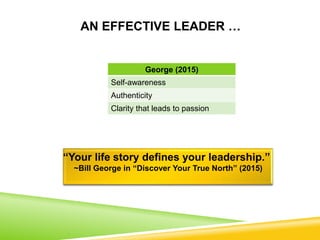
George (2015)
Self-awareness
Authenticity
Clarity that leads to passion
“Your life story defines your leadership.”
~Bill George in “Discover Your True North” (2015)
Image Source: LinkedIn
Resource:
http://coachingforleaders.com/podc
ast/four-stories-leaders-influence/
Image Source for bottom 2 photos: greenleaf.org
”Live in accordance with how one thinks. Be yourself and don't try to impose your
criteria on the rest. I don't expect others to live like me. I want to respect people's
freedom, but I defend my freedom. And that comes with the courage to say what
you think, even if sometimes others don't share those views” ~Jose Mujica
(Mascarenhas, 2014).
“While our society encourages us to be
well-rounded, this approach
inadvertently breeds mediocrity.
Perhaps the greatest misconception of
all is that of the well-rounded leader.”
~Rath & Conchie (2008)
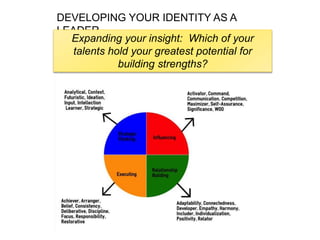
DEVELOPING YOUR IDENTITY AS A
LEADER
Expanding your insight: Which of your
talents hold your greatest potential for
building strengths?
DEVELOPING YOUR IDENTITY AS A LEADER
Building an effective team
DEVELOPING YOUR IDENTITY AS A LEADER
Building an effective team
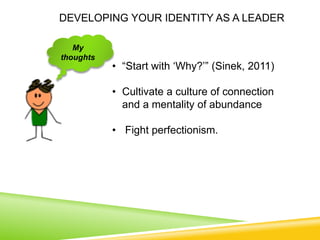
DEVELOPING YOUR IDENTITY AS A LEADER
My
thoughts
• “Start with ‘Why?’” (Sinek, 2011)
• Cultivate a culture of connection
and a mentality of abundance
• Fight perfectionism.
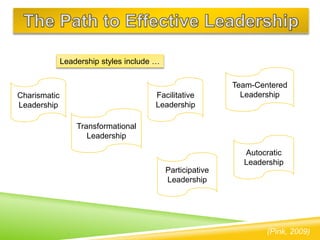
Leadership styles include …
Transformational
Leadership
Charismatic
Leadership
Facilitative
Leadership
Autocratic
Leadership
Participative
Leadership
Team-Centered
Leadership
(Pink, 2009)
TAKE-AWAY
MESSAGE
REFERENCES
Bennis, W. (2003). On becoming a leader. Cambridge, MA: Perseus Books Group.
Greenleaf, R.K. (2014). The servant leader. Atlanta, GA: Robert K. Greenleaf Center for
Servant
Leadership.
Kahnweiler, J. B. (2013). The Introverted leader: Building on your quiet strength. San
Francisco, CA: BK Publishers.
Loeb, P. R. (2010). Soul of a citizen: Living with conviction in challenging times. New York: St.
Martin’s Press.
Mayer, J. D., & Salovey, P. (1995). Emotional intelligence and the construction and regulation
of feelings. Applied and Preventative Psychology, 4, 197—208.
Pink, D. H. (2009). Drive: The surprising truth about what motivates us. New York: Penguin
Group.
Rath, R. (2007). Strengths Finder 2.0. New York: Gallup Press.
Rath. T., & Conchie, B. (2008). Strengths based leadership: Great leaders, teams, and why
people follow. New York: Gallup Press.
2015

Developing Your Identity as a Leader

  • 1.
    DEVELOPING YOUR IDENTITY AS ALEADER Stephanie Lancaster, MS, OTR/L, ATP UTHSC Dept. of Occupational Therapy OT 431 Leadership I January 25, 2016
  • 2.
    LEARNING OBJECTIVES  Through participationin this class, the learner will –  Define the term leadership in individual terms.  Identify four domains of leadership strength.  Reflect on one’s own aptitudes and how they can impact team performance as a leader and as a team member.  List at least three skills thought to contribute to effective leadership.
  • 4.
    WHAT MAKES A LEADER? “Leadershipis not about experience, education, or talent. It’s about choosing to lead.” ~Michael Hyatt “If your actions inspire other to dream more, learn more, do more, and become more, you are a leader.” ~John Quincy Adams
  • 6.
    EMOTIONAL INTELLIGENCE Self-awareness Self-regulation Motivation Empathy Social skills Recommendation:https://www.youtube.com/watch?v=b9yRmpcXKjY Video on “Focus: The Hidden Driver of Excellence” Mayer & Salovey, 1995
  • 7.
    AN EFFECTIVE LEADER… Hyatt (2015) Longs to make a difference Feels discontented with the status quo Has a vision that often precedes the resources Has dreams so big they may seem impossible Acknowledges what is - but asks what could be Realizes that a person doesn’t have to be in charge to have influence Takes responsibility for finding solutions and fixing problems Fosters unity by encouraging communication and collaboration Quick to admit fault Values relationships more than tasks Leads by example, demonstrates authenticity Lives as a lifelong learner
  • 8.
  • 9.
    AN EFFECTIVE LEADER… Rath & Conchie (2008) Invests in strengths of others Surrounds himself with the right people and then maximizes his team Understands his followers’ needs Bennis (2003) Engages others by creating shared meaning Has a distinctive voice Shows integrity Demonstrates adaptive capacity “Allows leaders to respond quickly and intelligently, to act and then to evaluate the results of their actions. This capacity also involves the ability to recognize and the guts to seize opportunities.” ~Bennis
  • 10.
    AN EFFECTIVE LEADER… George (2015) Self-awareness Authenticity Clarity that leads to passion “Your life story defines your leadership.” ~Bill George in “Discover Your True North” (2015)
  • 11.
  • 12.
    Image Source forbottom 2 photos: greenleaf.org ”Live in accordance with how one thinks. Be yourself and don't try to impose your criteria on the rest. I don't expect others to live like me. I want to respect people's freedom, but I defend my freedom. And that comes with the courage to say what you think, even if sometimes others don't share those views” ~Jose Mujica (Mascarenhas, 2014).
  • 13.
    “While our societyencourages us to be well-rounded, this approach inadvertently breeds mediocrity. Perhaps the greatest misconception of all is that of the well-rounded leader.” ~Rath & Conchie (2008)
  • 14.
    DEVELOPING YOUR IDENTITYAS A LEADER Expanding your insight: Which of your talents hold your greatest potential for building strengths?
  • 15.
    DEVELOPING YOUR IDENTITYAS A LEADER Building an effective team
  • 16.
    DEVELOPING YOUR IDENTITYAS A LEADER Building an effective team
  • 17.
    DEVELOPING YOUR IDENTITYAS A LEADER My thoughts • “Start with ‘Why?’” (Sinek, 2011) • Cultivate a culture of connection and a mentality of abundance • Fight perfectionism.
  • 18.
    Leadership styles include… Transformational Leadership Charismatic Leadership Facilitative Leadership Autocratic Leadership Participative Leadership Team-Centered Leadership (Pink, 2009)
  • 19.
  • 20.
    REFERENCES Bennis, W. (2003).On becoming a leader. Cambridge, MA: Perseus Books Group. Greenleaf, R.K. (2014). The servant leader. Atlanta, GA: Robert K. Greenleaf Center for Servant Leadership. Kahnweiler, J. B. (2013). The Introverted leader: Building on your quiet strength. San Francisco, CA: BK Publishers. Loeb, P. R. (2010). Soul of a citizen: Living with conviction in challenging times. New York: St. Martin’s Press. Mayer, J. D., & Salovey, P. (1995). Emotional intelligence and the construction and regulation of feelings. Applied and Preventative Psychology, 4, 197—208. Pink, D. H. (2009). Drive: The surprising truth about what motivates us. New York: Penguin Group. Rath, R. (2007). Strengths Finder 2.0. New York: Gallup Press. Rath. T., & Conchie, B. (2008). Strengths based leadership: Great leaders, teams, and why people follow. New York: Gallup Press. 2015