OT 537
Tony
Diagnosed with Amyotrophic Lateral Sclerosis (ALS) in January of 2009
Amyotrophic Lateral Sclerosis (ALS)
*Suggested reading (auto-biography) – “Until I Say Goodbye,” by Susan-Spencer-Wendel
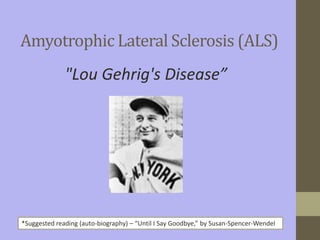
"Lou Gehrig's Disease”
What Causes ALS?
Environmental toxins
(slow-acting virus?)
Genetics (hormone
abnormality and/or
enzyme deficiency?)
Free-radical destruction
(toxic reaction to build-up
of glutamate in nerve
synapses?)
Immune system
(autoimmune disorder?)
Current
Research
Trends
Although the cause of ALS is not completely understood, recent years have brought a
wealth of new scientific understanding regarding the physiology of this disease.
Amyotrophic Lateral Sclerosis (ALS)
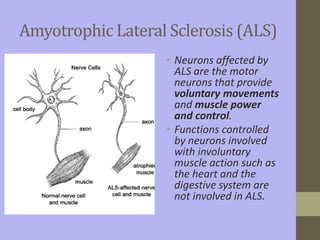
• Neurons affected by
ALS are the motor
neurons that provide
voluntary movements
and muscle power
and control.
• Functions controlled
by neurons involved
with involuntary
muscle action such as
the heart and the
digestive system are
not involved in ALS.
Clinical Presentation
• Can be very difficult to
diagnose
• A comprehensive diagnostic
workup including:
• Neurological examination
• Electomyography (EMG) and
nerve conduction velocity
(NCV) tests
• Blood and urine studies
including high resolution
serum protein electrophoresis,
thyroid and parathyroid
hormone levels and 24-hour
urine collection for heavy
metals
• Spinal tap
• MRI
• Myelogram of cervical spine
• Muscle and/or nerve biopsy
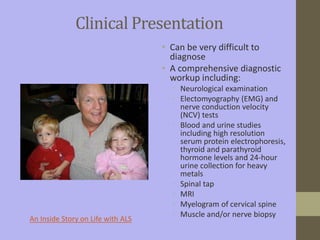
An Inside Story on Life with ALS
*brief, spontaneous contractions affecting a small number of muscle fibers, often causing a
flicker of movement under the skin. Can be a symptom of disease of the motor neurons.
Fasciculations*
Amyotrophic Lateral Sclerosis (ALS)
Upper Motor Neuron (UMN) – carries motor messages from the
motor cortex to the cranial nerve nuclei in the brainstem or
interneurons in the ventral horn
Lower Motor Neuron (LMN) – carries motor messages from motor
cells to the skeletal muscles in the periphery (part of the PNS)
Amyotrophic Lateral Sclerosis (ALS)
Two types of ALS:
• Spinal Progressive Muscular Atrophy
• LMN involvement
• Characterized by weakness, atrophy, loss of reflexes, presence of
fasciculations
• Progressive Bulbar Palsy
• UMN involvement
• Key feature - loss of use of muscles in the face innervated by cranial
nerves
• Often results in –
• dysphagia - difficulty swallowing
• dysarthria – difficulty with articulation of words in speech
• dysphonia – difficulty projecting one’s voice audibly
Classifications of ALS
• Sporadic (SALS) - the most common form of ALS in
the United States – 90-95% of all cases
• Familial (FALS) - occurring more than once in a family
lineage (genetic dominant inheritance), 5-10% of all
cases. In families with an inherited form, there is a
50% chance each child will inherit the gene mutation
and may develop the disease.
• Guamanian - an extremely high incidence of ALS was
observed in Guam and the Trust Territories of the
Pacific in the 1950’s.
Medical Intervention
• Medications to treat symptoms
• Riluzole - modestly slows the progression
• Muscle relaxers – Baclofen, etc.
• Anti-depressants
• Surgery
• Gastrostomy Tube (G-tube)
• Tracheotomy (“trach”)
Transfatty Lives – preview of the documentary film
Stages of ALS
Stage Clinical Features Recommendations to Maintain Motor
Function
I Ambulatory, independent in
ADLs, mild weakness
Normal activities, moderate exercise
in unaffected muscles, basic
strengthening
II Ambulatory, moderate weakness
in certain muscles,  fatigue
Modest exercise, remain as active as
possible, assisted/modified AROM ex.
III Ambulatory, severe weakness in
certain muscles, difficulty in
ADLs, marked fatigue
AAROM/PROM exercise, modified ADL
routine with min-mod assistance, joint
pain management
IV Can propel manual wheelchair for
mobility, severe weakness in LE
PROM ex., some strengthening ex. for
uninvolved muscles
V Power wheelchair for mobility,
severe weakness in LE/UE
PROM ex., pain management,
decubitus ulcer prevention
VI Dependent in all mobility, unable
to perform ADLs, maximal
assistance required
PROM ex., pain management,
prevention of decubitus ulcers and
deep venous thrombosis (DVT)
Multidisciplinary Approach
The ALS Functional Rating Scale (ALSFRS-R)
• Clinic visits every 3-4 months
• Multidisciplinary assessment of physical and psychosocial functioning
Imaged retrieved from http://webstl.alsa.org/site/PageServer?pagename=STL_8_Multidisciplinary_Clinics
OT Evaluation
 Initial Interview – include caregiver(s)
 Collect info about living situation
 Assess client’s understanding of the disease and the disease process
 D/C planning begins on Day 1
 Functional Status - challenges and barriers
 Client goals/priorities
 Occupational profile
 Analysis of Occupational Performance
 ROM and strength testing
 Functional mobility and transfers
 ADLs/self-care routines
 iADLs
 Leisure interests
 Home evaluation
COPM, Activity Card Sort, Occupational Self-Assessment (OSA), ALS Functional
Rating Scale (https://www.outcomes-umassmed.org/ALS/alsscale.aspx),
Purdue Pegboard, Multidimensional Fatigue Inventory (MFI), Kohlman
Evaluation of Living Skills (KELS), Occupational Performance History Interview
II (OPHI-II), Westmead Home Safety Assessment, In-Home Occupational
Performance Evaluation (I-HOPE), Berg Balance Scale
Deborah from Arlington, TN
OT Intervention
• Muscle strength
• Endurance
• Functional balance
• ROM
• Muscle tone
• ADL performance
• Safety
• Memory
• Signs of hand atrophy
• Gross and fine-motor skills
• Environmental access
• Occupational performance (including work and leisure activities)
Principles of Energy Conservation
• Prioritizing
• Planning
• Pacing
• Positioning
*Be sure to provide the patient and family with information
about WHY energy conservation strategies are important to
use as well as HOW the techniques can be done.
OT Intervention Planning & Treatment
 Anticipate functional changes – prepare via strategies and equipment
 The role of OT varies according to the stage of clinical presentation:
Early Stage End Stage
Disability
Stage
• National Institute of Neurological Disorders & Stroke –
www.nids.hih.gov/
• The ALS Association - www.alsa.org
• Tennessee Chapters -
http://webtn.alsa.org/site/PageServer?pagename=TN_homepage
• Muscular Dystrophy Association, ALS Division – www.mda.org
• Mayo Clinic info on ALS - http://www.mayoclinic.org/diseases-
conditions/amyotrophic-lateral-sclerosis/home/ovc-20247208
• MedLine Plus info on ALS -
https://medlineplus.gov/amyotrophiclateralsclerosis.html

OT 537 ALS

  • 1.
  • 2.
    Tony Diagnosed with AmyotrophicLateral Sclerosis (ALS) in January of 2009
  • 3.
    Amyotrophic Lateral Sclerosis(ALS) *Suggested reading (auto-biography) – “Until I Say Goodbye,” by Susan-Spencer-Wendel "Lou Gehrig's Disease”
  • 4.
    What Causes ALS? Environmentaltoxins (slow-acting virus?) Genetics (hormone abnormality and/or enzyme deficiency?) Free-radical destruction (toxic reaction to build-up of glutamate in nerve synapses?) Immune system (autoimmune disorder?) Current Research Trends Although the cause of ALS is not completely understood, recent years have brought a wealth of new scientific understanding regarding the physiology of this disease.
  • 5.
    Amyotrophic Lateral Sclerosis(ALS) • Neurons affected by ALS are the motor neurons that provide voluntary movements and muscle power and control. • Functions controlled by neurons involved with involuntary muscle action such as the heart and the digestive system are not involved in ALS.
  • 6.
    Clinical Presentation • Canbe very difficult to diagnose • A comprehensive diagnostic workup including: • Neurological examination • Electomyography (EMG) and nerve conduction velocity (NCV) tests • Blood and urine studies including high resolution serum protein electrophoresis, thyroid and parathyroid hormone levels and 24-hour urine collection for heavy metals • Spinal tap • MRI • Myelogram of cervical spine • Muscle and/or nerve biopsy An Inside Story on Life with ALS
  • 7.
    *brief, spontaneous contractionsaffecting a small number of muscle fibers, often causing a flicker of movement under the skin. Can be a symptom of disease of the motor neurons. Fasciculations* Amyotrophic Lateral Sclerosis (ALS) Upper Motor Neuron (UMN) – carries motor messages from the motor cortex to the cranial nerve nuclei in the brainstem or interneurons in the ventral horn Lower Motor Neuron (LMN) – carries motor messages from motor cells to the skeletal muscles in the periphery (part of the PNS)
  • 8.
    Amyotrophic Lateral Sclerosis(ALS) Two types of ALS: • Spinal Progressive Muscular Atrophy • LMN involvement • Characterized by weakness, atrophy, loss of reflexes, presence of fasciculations • Progressive Bulbar Palsy • UMN involvement • Key feature - loss of use of muscles in the face innervated by cranial nerves • Often results in – • dysphagia - difficulty swallowing • dysarthria – difficulty with articulation of words in speech • dysphonia – difficulty projecting one’s voice audibly
  • 9.
    Classifications of ALS •Sporadic (SALS) - the most common form of ALS in the United States – 90-95% of all cases • Familial (FALS) - occurring more than once in a family lineage (genetic dominant inheritance), 5-10% of all cases. In families with an inherited form, there is a 50% chance each child will inherit the gene mutation and may develop the disease. • Guamanian - an extremely high incidence of ALS was observed in Guam and the Trust Territories of the Pacific in the 1950’s.
  • 10.
    Medical Intervention • Medicationsto treat symptoms • Riluzole - modestly slows the progression • Muscle relaxers – Baclofen, etc. • Anti-depressants • Surgery • Gastrostomy Tube (G-tube) • Tracheotomy (“trach”) Transfatty Lives – preview of the documentary film
  • 11.
    Stages of ALS StageClinical Features Recommendations to Maintain Motor Function I Ambulatory, independent in ADLs, mild weakness Normal activities, moderate exercise in unaffected muscles, basic strengthening II Ambulatory, moderate weakness in certain muscles,  fatigue Modest exercise, remain as active as possible, assisted/modified AROM ex. III Ambulatory, severe weakness in certain muscles, difficulty in ADLs, marked fatigue AAROM/PROM exercise, modified ADL routine with min-mod assistance, joint pain management IV Can propel manual wheelchair for mobility, severe weakness in LE PROM ex., some strengthening ex. for uninvolved muscles V Power wheelchair for mobility, severe weakness in LE/UE PROM ex., pain management, decubitus ulcer prevention VI Dependent in all mobility, unable to perform ADLs, maximal assistance required PROM ex., pain management, prevention of decubitus ulcers and deep venous thrombosis (DVT)
  • 12.
    Multidisciplinary Approach The ALSFunctional Rating Scale (ALSFRS-R) • Clinic visits every 3-4 months • Multidisciplinary assessment of physical and psychosocial functioning Imaged retrieved from http://webstl.alsa.org/site/PageServer?pagename=STL_8_Multidisciplinary_Clinics
  • 13.
    OT Evaluation  InitialInterview – include caregiver(s)  Collect info about living situation  Assess client’s understanding of the disease and the disease process  D/C planning begins on Day 1  Functional Status - challenges and barriers  Client goals/priorities  Occupational profile  Analysis of Occupational Performance  ROM and strength testing  Functional mobility and transfers  ADLs/self-care routines  iADLs  Leisure interests  Home evaluation COPM, Activity Card Sort, Occupational Self-Assessment (OSA), ALS Functional Rating Scale (https://www.outcomes-umassmed.org/ALS/alsscale.aspx), Purdue Pegboard, Multidimensional Fatigue Inventory (MFI), Kohlman Evaluation of Living Skills (KELS), Occupational Performance History Interview II (OPHI-II), Westmead Home Safety Assessment, In-Home Occupational Performance Evaluation (I-HOPE), Berg Balance Scale
  • 14.
  • 15.
    OT Intervention • Musclestrength • Endurance • Functional balance • ROM • Muscle tone • ADL performance • Safety • Memory • Signs of hand atrophy • Gross and fine-motor skills • Environmental access • Occupational performance (including work and leisure activities)
  • 16.
    Principles of EnergyConservation • Prioritizing • Planning • Pacing • Positioning *Be sure to provide the patient and family with information about WHY energy conservation strategies are important to use as well as HOW the techniques can be done.
  • 17.
    OT Intervention Planning& Treatment  Anticipate functional changes – prepare via strategies and equipment  The role of OT varies according to the stage of clinical presentation: Early Stage End Stage Disability Stage
  • 18.
    • National Instituteof Neurological Disorders & Stroke – www.nids.hih.gov/ • The ALS Association - www.alsa.org • Tennessee Chapters - http://webtn.alsa.org/site/PageServer?pagename=TN_homepage • Muscular Dystrophy Association, ALS Division – www.mda.org • Mayo Clinic info on ALS - http://www.mayoclinic.org/diseases- conditions/amyotrophic-lateral-sclerosis/home/ovc-20247208 • MedLine Plus info on ALS - https://medlineplus.gov/amyotrophiclateralsclerosis.html

Editor's Notes

  • #3 http://www.npr.org/podcasts/414687918/living-while-dying - GREAT PODCAST SERIES ABOUT ALS http://www.alsa.org/news/media/quick-facts.html
  • #7 Video: In Inside Story - https://www.youtube.com/watch?v=8inVFUAqe1c (20:48)
  • #11 Video: Transfatty Lives - https://vimeo.com/ondemand/transfattylives/143808826 (2:00)
  • #13 Try out the new online ALS Functional Rating Scale
  • #15 Video clip – 2:42