Management Fundamentals:
Building A Team
Project Management Consulting
Yossi Barezer
May 2016
AGENDA
What is A Team
The 4 Stages of Team Building
 Forming
 Storming
 Norming
 Performing
The 4 Stages vs. Effort vs. Effectiveness
Steps to Develop an Effective Team
Team Structure
 Management Style
 Team Diversity
Part Two
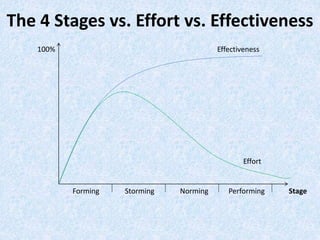
The 4 Stages vs. Effort vs. Effectiveness
100%
Forming Storming Norming Performing Stage
Effectiveness
Effort
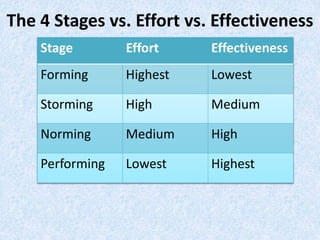
Stage Effort Effectiveness
Forming Highest Lowest
Storming High Medium
Norming Medium High
Performing Lowest Highest
The 4 Stages vs. Effort vs. Effectiveness
• At the beginning, there is a need to invest a lot
of effort while the team outcome is relatively
low.
• Once the team passes the storming stage, the
effort to build and stabilize the team is
reduced while the effectiveness continues to
grow
• When the team reaches the performing stage
(the highest performance phase of the team),
it is only required to lead and monitor the
team
The 4 Stages vs. Effort vs. Effectiveness
Steps to Develop an Effective Team
1. Clearly define the mission of the team
2. Define the specific R & R (role and
responsibility) of each member
3. Provide tasks to the individuals, direct
managers and team leaders
4. Set the expectation to each member in the
team
Steps to Develop an Effective Team
5. Provide short term goals – 1 week to 1
quarter
6. Provide long term goals – more than a
quarter
7. Elaborate the communication and tracking
methods
Steps to Develop an Effective Team
8. Share periodic guidelines and status
1. Weekly or Bi-weekly
• Preferred F2F with each member
2. Weekly report to/from the entire group
• Progress, major changes, obstacles, future event…
9. Create end to end infrastructure that will
support the team’s needs
10. Set joined activities such as group events,
team lunches
Steps to Develop an Effective Team
Team Structure
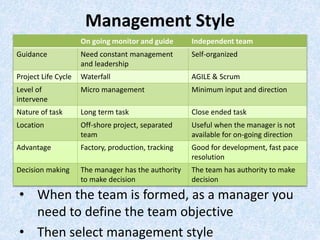
On going monitor and guide Independent team
Guidance Need constant management
and leadership
Self-organized
Project Life Cycle Waterfall AGILE & Scrum
Level of
intervene
Micro management Minimum input and direction
Nature of task Long term task Close ended task
Location Off-shore project, separated
team
Useful when the manager is not
available for on-going direction
Advantage Factory, production, tracking Good for development, fast pace
resolution
Decision making The manager has the authority
to make decision
The team has authority to make
decision
Management Style
• When the team is formed, as a manager you
need to define the team objective
• Then select management style
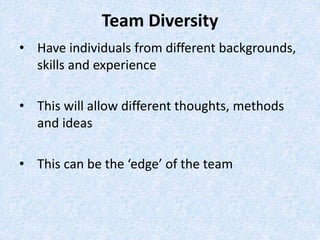
• Have individuals from different backgrounds,
skills and experience
• This will allow different thoughts, methods
and ideas
• This can be the ‘edge’ of the team
Team Diversity
Thank You
Links to Previous Lectures
 Management Fundamentals: Team - Lecture 4, Part 1
 Management Fundamentals: Communication - Lecture 3
 Management Fundamentals: The Iceberg Model - Lecture 2
 Managements Fundamentals: Introduction - Lecture 1

Management fundamentals building a team part two

  • 1.
    Management Fundamentals: Building ATeam Project Management Consulting Yossi Barezer May 2016
  • 2.
    AGENDA What is ATeam The 4 Stages of Team Building  Forming  Storming  Norming  Performing The 4 Stages vs. Effort vs. Effectiveness Steps to Develop an Effective Team Team Structure  Management Style  Team Diversity
  • 3.
  • 4.
    The 4 Stagesvs. Effort vs. Effectiveness 100% Forming Storming Norming Performing Stage Effectiveness Effort
  • 5.
    Stage Effort Effectiveness FormingHighest Lowest Storming High Medium Norming Medium High Performing Lowest Highest The 4 Stages vs. Effort vs. Effectiveness
  • 6.
    • At thebeginning, there is a need to invest a lot of effort while the team outcome is relatively low. • Once the team passes the storming stage, the effort to build and stabilize the team is reduced while the effectiveness continues to grow • When the team reaches the performing stage (the highest performance phase of the team), it is only required to lead and monitor the team The 4 Stages vs. Effort vs. Effectiveness
  • 7.
    Steps to Developan Effective Team
  • 8.
    1. Clearly definethe mission of the team 2. Define the specific R & R (role and responsibility) of each member 3. Provide tasks to the individuals, direct managers and team leaders 4. Set the expectation to each member in the team Steps to Develop an Effective Team
  • 9.
    5. Provide shortterm goals – 1 week to 1 quarter 6. Provide long term goals – more than a quarter 7. Elaborate the communication and tracking methods Steps to Develop an Effective Team
  • 10.
    8. Share periodicguidelines and status 1. Weekly or Bi-weekly • Preferred F2F with each member 2. Weekly report to/from the entire group • Progress, major changes, obstacles, future event… 9. Create end to end infrastructure that will support the team’s needs 10. Set joined activities such as group events, team lunches Steps to Develop an Effective Team
  • 11.
  • 12.
    On going monitorand guide Independent team Guidance Need constant management and leadership Self-organized Project Life Cycle Waterfall AGILE & Scrum Level of intervene Micro management Minimum input and direction Nature of task Long term task Close ended task Location Off-shore project, separated team Useful when the manager is not available for on-going direction Advantage Factory, production, tracking Good for development, fast pace resolution Decision making The manager has the authority to make decision The team has authority to make decision Management Style • When the team is formed, as a manager you need to define the team objective • Then select management style
  • 13.
    • Have individualsfrom different backgrounds, skills and experience • This will allow different thoughts, methods and ideas • This can be the ‘edge’ of the team Team Diversity
  • 14.
  • 15.
    Links to PreviousLectures  Management Fundamentals: Team - Lecture 4, Part 1  Management Fundamentals: Communication - Lecture 3  Management Fundamentals: The Iceberg Model - Lecture 2  Managements Fundamentals: Introduction - Lecture 1