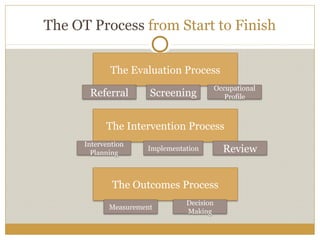
The OT Process from Start to Finish
The Evaluation Process
The Intervention Process
The Outcomes Process
Referral Screening
Occupational
Profile
Intervention
Planning
Implementation Review
Measurement
Decision
Making
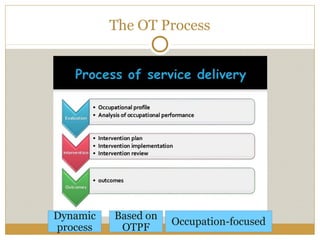
The OT Process
Dynamic
process
Based on
OTPF
Occupation-focused
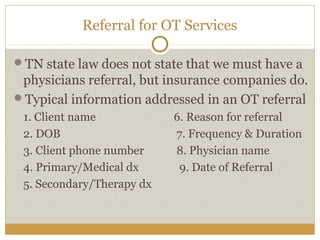
Referral for OT Services
TN state law does not state that we must have a
physicians referral, but insurance companies do.
Typical information addressed in an OT referral
1. Client name 6. Reason for referral
2. DOB 7. Frequency & Duration
3. Client phone number 8. Physician name
4. Primary/Medical dx 9. Date of Referral
5. Secondary/Therapy dx
OT Screening
Consists of quick observation and interview with
team member or family member
Request order for OT eval & tx or not
Typically ~5 minute long process
Can take place as part of the OT evaluation
OT Evaluation
May have limited information
Identify age, dx, and reason for referral to guide
approach
Collect and organize subjective data for the
occupational profile
Determine formatting requirements (if any)
Occupational profile includes occupational history,
occupational context, and occupational goals
Consider facility requirements of medical hx,
medications, pain scores, etc.
OT Evaluation Continued
Determine frequency/duration/intensity (if not
indicated on the referral form)
Determine if further evaluation is needed
Always end with signature - Betty Sue, MOTS or
MOT/S and date
Never leave anything blank
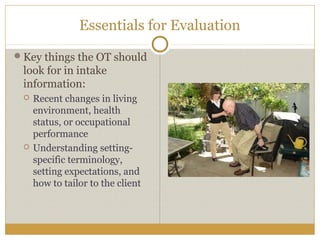
Essentials for Evaluation
Key things the OT should
look for in intake
information:
 Recent changes in living
environment, health
status, or occupational
performance
 Understanding setting-
specific terminology,
setting expectations, and
how to tailor to the client
Essentials for a Chart Review
• Procedure varies
by setting.
• Records review
may be in paper
charts, electronic
documents, etc.
Goal: to let the OT know
what to expect with regard to
potential adverse events that
might influence evaluation
and intervention.
Strategies for Successful Evaluations
Plan of Care
Consists of short- and long-term goals
Dependent on practice area
Measurable, functional, and occupation-centered
Client-centered
Time frame
Example: Sue will use an overhead method to don
and doff a t-shirt with minimal assistance in 2 of 3
trials over a one week period.
Intervention
PLAN
IMPLEMENT
MONITOR
Intervention Continued
Purposeful activities are specifically selected
activities that allow clients to develop skills that
enhance occupational performance.
Focus on collaboration for successful interventions
Start researching now! Keep a portfolio or folder full
of ideas.
Client-Centered
The Just Right Challenge
Grading - systematically
increasing the demands
of an occupation to
stimulate improved
function or reducing the
demands to respond to
the client’s difficulties in
performance.
Occupation as a Means and an End
Approaches for Intervention
Remediation or restoration
Occupational skill acquisition
Adaptation/compensation
Environmental modifications
Educational approach to improve occupational
performance
Prevention approach to “maintain”
Palliative approaches
Therapeutic use of self
Reevaluation
How has OT affected the client’s performance?
Re-analysis of occupational performance:
comparing initial evaluation results to new
reevaluation results; collecting data for
comparisons
Review of targeted outcomes: determine if changes
were made to occupational performance
Identify action: modify and determine needs
Outcomes
To continue or
discontinue … that is the
question.
Considerations: client’s
perspective, evidence,
your personal
experience, diagnostic
criteria, and intuition
Discharge Planning
Teamwork –
client/family input,
multi-disciplinary/trans-
disciplinary process
Consider all variables.
Anticipate, anticipate,
anticipate!
Write a discontinuation
(d/c) summary.
Documentation
Absolutely crucial for legal and ethical purposes
Audience: medical professionals, education
professionals, lawyers/judges/juries, accreditation
issues, payers, and the client.
Professional communication!
“If you didn’t document it, it didn’t happen!”
Legal and Ethical Considerations
Malpractice, fraud, negligence, and/or incompetence
Medicare and governmental payer sources
Legal documents that are part of the health records
for your client
Setting Requirements
Documentation is directly influenced and outlined
by the setting type
Typical elements required:
1. Date of service and/or date of completion of the
report
2. Full signature with credentials
3. Type of document (daily note, progress note, etc.)
4. Client name and case #
5. Acceptable abbreviations and terminology
6. Record storage and disposal complying with
federal/state law and facility procedures
Documentation
S – Subjective
O – Objective
A - Assessment: the clinicians’ interpretation of the
meaning of the “O” section
P - Plan description of what will happen next
(frequency, duration, location)
The SOAP Note
References
 Boyt Schell, B. A., Gillen, G., & Scaffa, M. E. (2013). Willard & Spackman’s
occupational therapy (12th ed). Baltimore, MD: Lippincott Williams & Wilkins.

OT 425 Session 9A

  • 2.
    The OT Processfrom Start to Finish The Evaluation Process The Intervention Process The Outcomes Process Referral Screening Occupational Profile Intervention Planning Implementation Review Measurement Decision Making
  • 3.
    The OT Process Dynamic process Basedon OTPF Occupation-focused
  • 4.
    Referral for OTServices TN state law does not state that we must have a physicians referral, but insurance companies do. Typical information addressed in an OT referral 1. Client name 6. Reason for referral 2. DOB 7. Frequency & Duration 3. Client phone number 8. Physician name 4. Primary/Medical dx 9. Date of Referral 5. Secondary/Therapy dx
  • 5.
    OT Screening Consists ofquick observation and interview with team member or family member Request order for OT eval & tx or not Typically ~5 minute long process Can take place as part of the OT evaluation
  • 6.
    OT Evaluation May havelimited information Identify age, dx, and reason for referral to guide approach Collect and organize subjective data for the occupational profile Determine formatting requirements (if any) Occupational profile includes occupational history, occupational context, and occupational goals Consider facility requirements of medical hx, medications, pain scores, etc.
  • 7.
    OT Evaluation Continued Determinefrequency/duration/intensity (if not indicated on the referral form) Determine if further evaluation is needed Always end with signature - Betty Sue, MOTS or MOT/S and date Never leave anything blank
  • 8.
    Essentials for Evaluation Keythings the OT should look for in intake information:  Recent changes in living environment, health status, or occupational performance  Understanding setting- specific terminology, setting expectations, and how to tailor to the client
  • 9.
    Essentials for aChart Review • Procedure varies by setting. • Records review may be in paper charts, electronic documents, etc. Goal: to let the OT know what to expect with regard to potential adverse events that might influence evaluation and intervention.
  • 10.
  • 11.
    Plan of Care Consistsof short- and long-term goals Dependent on practice area Measurable, functional, and occupation-centered Client-centered Time frame Example: Sue will use an overhead method to don and doff a t-shirt with minimal assistance in 2 of 3 trials over a one week period.
  • 12.
  • 13.
    Intervention Continued Purposeful activitiesare specifically selected activities that allow clients to develop skills that enhance occupational performance. Focus on collaboration for successful interventions Start researching now! Keep a portfolio or folder full of ideas.
  • 14.
  • 15.
    The Just RightChallenge Grading - systematically increasing the demands of an occupation to stimulate improved function or reducing the demands to respond to the client’s difficulties in performance.
  • 16.
    Occupation as aMeans and an End
  • 17.
    Approaches for Intervention Remediationor restoration Occupational skill acquisition Adaptation/compensation Environmental modifications Educational approach to improve occupational performance Prevention approach to “maintain” Palliative approaches Therapeutic use of self
  • 18.
    Reevaluation How has OTaffected the client’s performance? Re-analysis of occupational performance: comparing initial evaluation results to new reevaluation results; collecting data for comparisons Review of targeted outcomes: determine if changes were made to occupational performance Identify action: modify and determine needs
  • 19.
    Outcomes To continue or discontinue… that is the question. Considerations: client’s perspective, evidence, your personal experience, diagnostic criteria, and intuition
  • 20.
    Discharge Planning Teamwork – client/familyinput, multi-disciplinary/trans- disciplinary process Consider all variables. Anticipate, anticipate, anticipate! Write a discontinuation (d/c) summary.
  • 21.
    Documentation Absolutely crucial forlegal and ethical purposes Audience: medical professionals, education professionals, lawyers/judges/juries, accreditation issues, payers, and the client. Professional communication! “If you didn’t document it, it didn’t happen!”
  • 22.
    Legal and EthicalConsiderations Malpractice, fraud, negligence, and/or incompetence Medicare and governmental payer sources Legal documents that are part of the health records for your client
  • 23.
    Setting Requirements Documentation isdirectly influenced and outlined by the setting type Typical elements required: 1. Date of service and/or date of completion of the report 2. Full signature with credentials 3. Type of document (daily note, progress note, etc.) 4. Client name and case # 5. Acceptable abbreviations and terminology 6. Record storage and disposal complying with federal/state law and facility procedures
  • 24.
    Documentation S – Subjective O– Objective A - Assessment: the clinicians’ interpretation of the meaning of the “O” section P - Plan description of what will happen next (frequency, duration, location) The SOAP Note
  • 25.
    References  Boyt Schell,B. A., Gillen, G., & Scaffa, M. E. (2013). Willard & Spackman’s occupational therapy (12th ed). Baltimore, MD: Lippincott Williams & Wilkins.

Editor's Notes

  • #4 Meant to be a guideline or map Used in conjunction with the OTPF (3rd ed.) Directed by evidence, MoP, and FoR: evidence-based findings combined with practitioner experience Focus is on occupation and the client as an occupation-centered being
  • #17 https://thepracticaloccupationaltherapist.wordpress.com/2017/04/02/occupation-as-a-means-and-an-end/