Taking Ownership
How to Create a Culture of
Accountability in the Workplace
Definition of accountability : the
quality or state of being accountable;
especially:an obligation or willingness to
accept responsibility or to account for
one's actions
Merriam Webster Dictionary
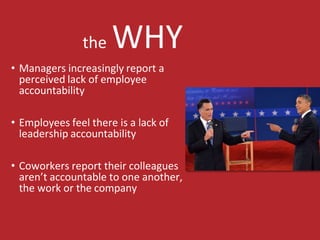
the WHY
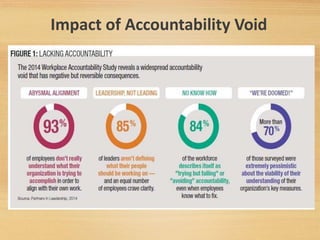
• Managers increasingly report a
perceived lack of employee
accountability
• Employees feel there is a lack of
leadership accountability
• Coworkers report their colleagues
aren’t accountable to one another,
the work or the company
Impact of Accountability Void
Accountable Cultures Have…
• improved performance
• greater employee participation and involvement
• increased feelings of job proficiency
• a heightened commitment to the work at hand
• added creativity and innovation
• leading to higher employee morale and job
satisfaction, and deeper employee engagement
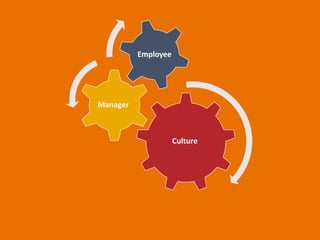
Culture
Manager
Employee
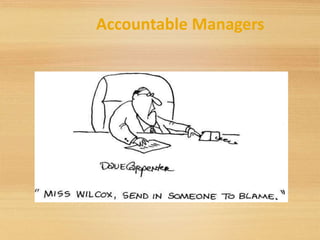
Accountable Managers
Leadership’s Role In Building Accountability
• Managers are responsible for accomplishing results through
others; often via relationship-building and their demonstration
of high trust and personal integrity
• Leaders have the greatest initial influence on company culture
• While held to the highest standard of accountability,
sometimes leaders abandon responsibilities in these areas;
the weight of leadership becomes an excuse
Accountable Managers Ask
Themselves
1. When did your performance expectations not
match the results?
2. What could you have you done differently to
attain your expectations?
3. Do you continue to enforce the missing
element(s) in your work?
“Great management can only be attained
by those who are able to manage
themselves before managing others...
Without accountability, the ability to
manage doesn’t exist. Great management
is holding yourself and those around you
accountable to deliver results.” - Greg
Llopis
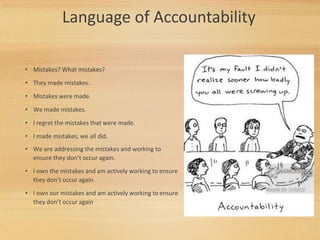
Language of Accountability
• Mistakes? What mistakes?
• They made mistakes.
• Mistakes were made.
• We made mistakes.
• I regret the mistakes that were made.
• I made mistakes; we all did.
• We are addressing the mistakes and working to
ensure they don’t occur again.
• I own the mistakes and am actively working to ensure
they don’t occur again.
• I own our mistakes and am actively working to ensure
they don’t occur again
Accountability to Goals
• Involve employees goal setting
• Coach, but encourage independence
• CONSISTENTLY monitor progress towards goals
• Provide needed training and resources
• Establish a framework for independent problem
solving (GROW model)
• Incentivize and recognize positive
performance, both formally and informally
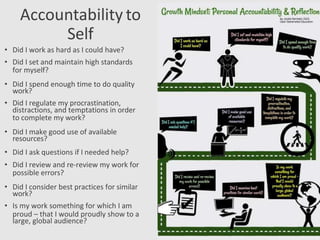
Accountability to
Self
• Did I work as hard as I could have?
• Did I set and maintain high standards
for myself?
• Did I spend enough time to do quality
work?
• Did I regulate my procrastination,
distractions, and temptations in order
to complete my work?
• Did I make good use of available
resources?
• Did I ask questions if I needed help?
• Did I review and re-review my work for
possible errors?
• Did I consider best practices for similar
work?
• Is my work something for which I am
proud – that I would proudly show to a
large, global audience?
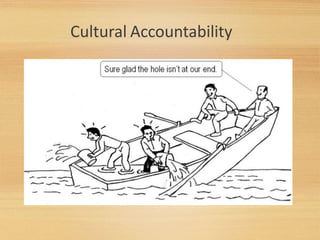
Cultural Accountability
“Accountability means people can count on
one another to keep performance
commitments and communication
agreements.”
- Mark Samuel,
The Accountability Revolution
Strategies: Build Accountable Teams
• Model accountability, collaboration & trust within your
leadership team
• Establish and clarify expectations(ex. values, agreements)
• Clearly defined roles and accountabilities
• Hire accountability values
• Provide ongoing communication skills training
• Practice recognition and improvement
Summary of Key Points
Hold leaders to the highest standards of
accountability, and support them in ongoing
efforts to maintain that standard
Create a culture that makes accountability as
easy as breathing
Hire, reinforce and reward individual
employee accountability
1
2
3
Thank you!

Taking Ownership & accountability.pptx

  • 1.
    Taking Ownership How toCreate a Culture of Accountability in the Workplace
  • 2.
    Definition of accountability: the quality or state of being accountable; especially:an obligation or willingness to accept responsibility or to account for one's actions Merriam Webster Dictionary
  • 3.
    the WHY • Managersincreasingly report a perceived lack of employee accountability • Employees feel there is a lack of leadership accountability • Coworkers report their colleagues aren’t accountable to one another, the work or the company
  • 4.
  • 5.
    Accountable Cultures Have… •improved performance • greater employee participation and involvement • increased feelings of job proficiency • a heightened commitment to the work at hand • added creativity and innovation • leading to higher employee morale and job satisfaction, and deeper employee engagement
  • 6.
  • 7.
  • 8.
    Leadership’s Role InBuilding Accountability • Managers are responsible for accomplishing results through others; often via relationship-building and their demonstration of high trust and personal integrity • Leaders have the greatest initial influence on company culture • While held to the highest standard of accountability, sometimes leaders abandon responsibilities in these areas; the weight of leadership becomes an excuse
  • 9.
    Accountable Managers Ask Themselves 1.When did your performance expectations not match the results? 2. What could you have you done differently to attain your expectations? 3. Do you continue to enforce the missing element(s) in your work?
  • 10.
    “Great management canonly be attained by those who are able to manage themselves before managing others... Without accountability, the ability to manage doesn’t exist. Great management is holding yourself and those around you accountable to deliver results.” - Greg Llopis
  • 11.
    Language of Accountability •Mistakes? What mistakes? • They made mistakes. • Mistakes were made. • We made mistakes. • I regret the mistakes that were made. • I made mistakes; we all did. • We are addressing the mistakes and working to ensure they don’t occur again. • I own the mistakes and am actively working to ensure they don’t occur again. • I own our mistakes and am actively working to ensure they don’t occur again
  • 13.
    Accountability to Goals •Involve employees goal setting • Coach, but encourage independence • CONSISTENTLY monitor progress towards goals • Provide needed training and resources • Establish a framework for independent problem solving (GROW model) • Incentivize and recognize positive performance, both formally and informally
  • 14.
    Accountability to Self • DidI work as hard as I could have? • Did I set and maintain high standards for myself? • Did I spend enough time to do quality work? • Did I regulate my procrastination, distractions, and temptations in order to complete my work? • Did I make good use of available resources? • Did I ask questions if I needed help? • Did I review and re-review my work for possible errors? • Did I consider best practices for similar work? • Is my work something for which I am proud – that I would proudly show to a large, global audience?
  • 15.
  • 16.
    “Accountability means peoplecan count on one another to keep performance commitments and communication agreements.” - Mark Samuel, The Accountability Revolution
  • 17.
    Strategies: Build AccountableTeams • Model accountability, collaboration & trust within your leadership team • Establish and clarify expectations(ex. values, agreements) • Clearly defined roles and accountabilities • Hire accountability values • Provide ongoing communication skills training • Practice recognition and improvement
  • 18.
    Summary of KeyPoints Hold leaders to the highest standards of accountability, and support them in ongoing efforts to maintain that standard Create a culture that makes accountability as easy as breathing Hire, reinforce and reward individual employee accountability 1 2 3
  • 20.