HUNTINGTON’S DISEASE
OT 537
What is HD?
• Neurodegenerative
–Progressive
• Inherited
–Autosomal
dominant
• Each child = 50/50
chance
–A family disease
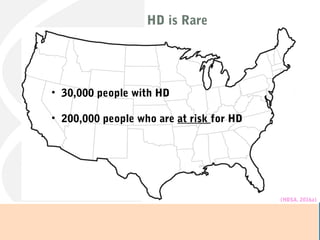
• 30,000 people with HD
• 200,000 people who are at risk for HD
HD is Rare
(HDSA, 2016a)
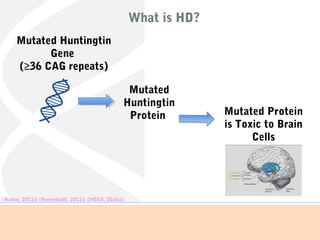
Mutated Huntingtin
Gene
(≥36 CAG repeats)
Mutated
Huntingtin
Protein Mutated Protein
is Toxic to Brain
Cells
(Nance, 2011); (Rosenblatt, 2011); (HDSA, 2016a)
What is HD?
When is it HD?
• Gene status determined before birth but diagnosed
clinically by symptoms
• # of CAG repeats explains ~60-70% of the variation
in age that symptoms begin
–  CAG repeats correlates to earlier symptoms
• Typical onset of HD symptoms: age ~35-55
– >90% do not have predictive testing
(Nance, 2011);
(Rosenblatt, 2011)
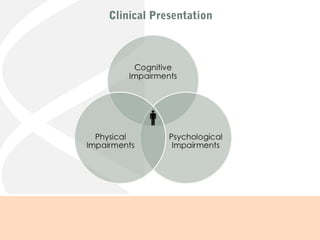
Clinical Presentation
Clinically Defining HD
2 Scales
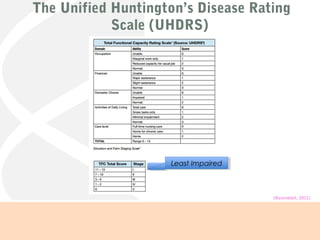
1.Unified Huntington’s Disease Rating Scale (UHDRS)
2.The 3 Clinical Stages: Early, Middle, Late
The Unified Huntington’s Disease Rating
Scale (UHDRS)
Least ImpairedLeast Impaired
(Rosenblatt, 2011)
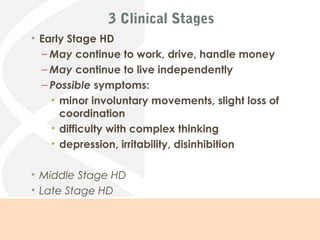
3 Clinical Stages
• Early Stage HD
– May continue to work, drive, handle money
– May continue to live independently
– Possible symptoms:
• minor involuntary movements, slight loss of
coordination
• difficulty with complex thinking
• depression, irritability, disinhibition
• Middle Stage HD
• Late Stage HD
Summarized from: (Rosenblatt, 2011, p.7)
HD Prodrome
• Or “premanifest”
• Time period for a person who is gene-positive for
HD before person is clinically-diagnosable
• Clinical and biological traits of HD can occur ~15
years before presenting the signs and symptoms
required for the clinical diagnosis of HD
(Paulsen et al., 2010)
The Care Team
Family, Caregivers
Neurologist
Genetic Counselor
Psychologist and/or
Psychiatrist
Social Worker
Therapists – OT, PT, SLP
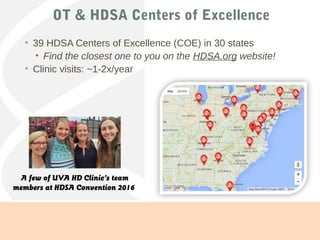
OT & HDSA Centers of Excellence
• 39 HDSA Centers of Excellence (COE) in 30 states
• Find the closest one to you on the HDSA.org website!
• Clinic visits: ~1-2x/year
A few of UVA HD Clinic’s team
members at HDSA Convention 2016
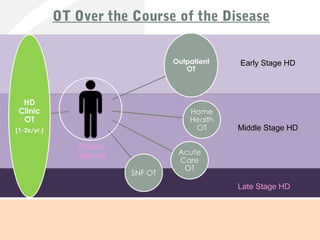
OT Over the Course of the Disease
Recommendation:
OT to OT Collaboration!
Person
with HD
Early Stage HD
Middle Stage HD
Late Stage HD
Evidence-Based practice:
Relevant Research
Paulsen et al. (2010) exposed decline in IADLs during prodrome
stage of HD.
• More likely to remain in typical job IF scored better on:
– cognitive assessment (SDMT)
– BDI-energy
– UHDRS total motor score
• 1st
areas of functional decline: work & financial capacity
• Functional decline in select IADLs can occur before the
clinical symptoms required for diagnosis of HD
Research for OTs
(Paulsen et al., 2010, p. 2599)
Cruickshank et al. (2015) studied the impact of multidisciplinary rehab for
15 persons with manifest HD
•Intervention: 9-month long multidisciplinary program including OT
– OT focused on cognition & executive function
•Participants demonstrated:
– improved verbal learning and memory
– increased grey matter volume
•Participants showed improvements while participating in multidisciplinary
intervention (including OT)
Research for OTs
(Cruickshank et al., 2015, p. 6).
OT practice:
For Persons & Families
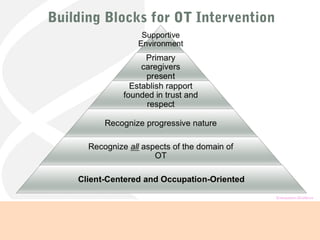
Building Blocks for OT Intervention
Knewstep-Watkins
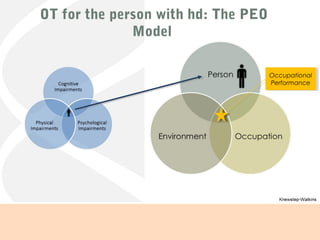
OT for the person with hd: The PEO
Model
Occupational
Performance
Occupational
Performance
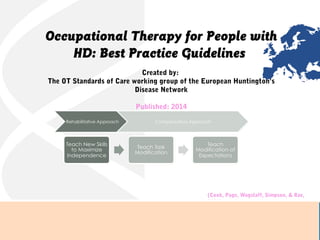
Occupational Therapy for People with
HD: Best Practice Guidelines
Created by:
The OT Standards of Care working group of the European Huntington’s
Disease Network
Published: 2014
(Cook, Page, Wagstaff, Simpson, & Rae,
2014)
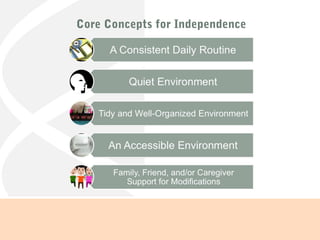
Core Concepts for Independence
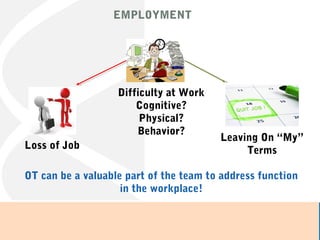
EMPLOYMENT
Loss of Job
Difficulty at Work
Cognitive?
Physical?
Behavior?
Leaving On “My”
Terms
OT can be a valuable part of the team to address function
in the workplace!
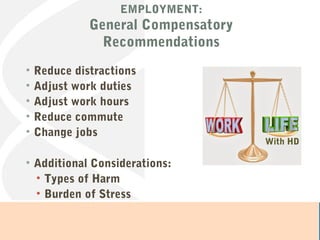
EMPLOYMENT:
General Compensatory
Recommendations
• Reduce distractions
• Adjust work duties
• Adjust work hours
• Reduce commute
• Change jobs
• Additional Considerations:
• Types of Harm
• Burden of Stress
With HD
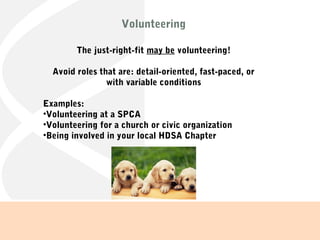
Volunteering
The just-right-fit may be volunteering!
Avoid roles that are: detail-oriented, fast-paced, or
with variable conditions
Examples:
•Volunteering at a SPCA
•Volunteering for a church or civic organization
•Being involved in your local HDSA Chapter
DRIVING
Safe driving:
• Complex task that requires reliable:
cognitive abilities
motor abilities
visual processing
control of one’s behavior
DRIVING
• Ask the person with HD and his/her family:
 any recent tickets or accidents
 any dents or scratches in the vehicle
 any concerns
• Eventually, person with HD will have to retire from driving
 Early dialog: “How do you want to make the decision to
retire from driving?”
 Best plan for this person with HD and family?
DRIVING: CDRS
An evaluation by CDRS removes the pressure
and blame from being on family members and
caregivers, and it allows a professional to
guide the difficult decision.
“We want to enable you to drive.”
Clay Huie, OTR/L, CDRS
Finding a CDRS: Search for provider on ADED website
LEISURE and SOCIAL PARTICIPATION
 1st: Get to know them! What do they enjoy?
 2nd
: Collaborative problem solving and sharing among OT,
person with HD, and their family/friends.
 3rd
: Encourage them to try and then CELEBRATE the
effort and success!
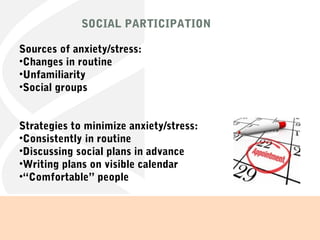
SOCIAL PARTICIPATION
Sources of anxiety/stress:
•Changes in routine
•Unfamiliarity
•Social groups
Strategies to minimize anxiety/stress:
•Consistently in routine
•Discussing social plans in advance
•Writing plans on visible calendar
•“Comfortable” people
LEISURE
• Leisure occupations:
• Socializing
• Relaxing
• The pursuit of interests or hobbies
• Role of the OT: “Ensure that the activity is adapted to fit
the person and not the other way around”
(Blacker, Broadhurst, & Teixeira, 2008)
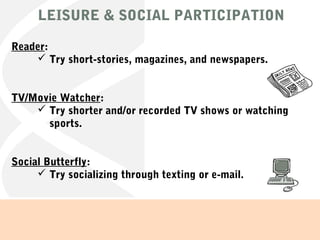
LEISURE & SOCIAL PARTICIPATION
Reader:
 Try short-stories, magazines, and newspapers.
TV/Movie Watcher:
 Try shorter and/or recorded TV shows or watching
sports.
Social Butterfly:
 Try socializing through texting or e-mail.
LEISURE
Outdoorsman
• Avoid high risk situations
(e.g. hunting, fishing on a boat, etc.)
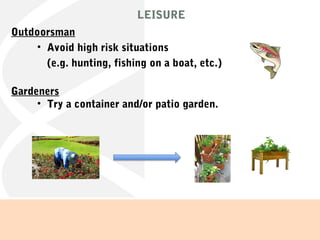
Gardeners
• Try a container and/or patio garden.
LEISURE: Exercise
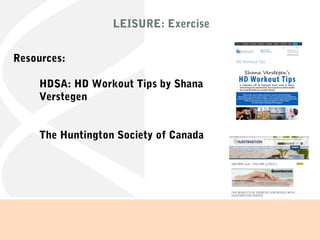
Resources:
HDSA: HD Workout Tips by Shana
Verstegen
The Huntington Society of Canada
Li (2013) article
•Tai Chi beneficial for people with movement disorders
Insights on Tai Chi for Persons with HD
•Encourages body control and body awareness
•Movements help keep strength and flexibility
•Focuses on breathing and syncing [breathing] with
movement
•Focus is on the fundamentals of Tai Chi, like weight shifting,
balance, and body control
(Li, 2013); (personal communication, April 25, 2016)
LEISURE: Exercise
Tai Chi
LEISURE and SOCIAL PARTICIPATION
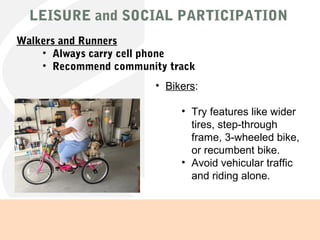
• Bikers:
• Try features like wider
tires, step-through
frame, 3-wheeled bike,
or recumbent bike.
• Avoid vehicular traffic
and riding alone.
Walkers and Runners
• Always carry cell phone
• Recommend community track
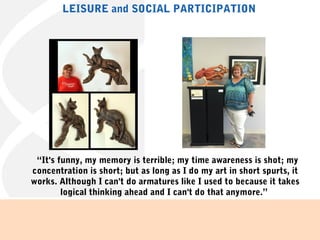
  “It's funny, my memory is terrible; my time awareness is shot; my
concentration is short; but as long as I do my art in short spurts, it
works. Although I can't do armatures like I used to because it takes
logical thinking ahead and I can't do that anymore.” 
LEISURE and SOCIAL PARTICIPATION
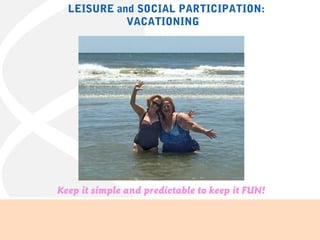
LEISURE and SOCIAL PARTICIPATION:
VACATIONING
Keep it simple and predictable to keep it FUN!
References
American Occupational Therapy Association. (2014). Occupational therapy practice framework: Domain and process (3rd
ed.).
American Journal of Occupational Therapy, 68(Suppl. 1) S1-S48. http://dx.doi.org/10.5014/ajot.2014.682006
Aubeeluck, A. (2009). A holistic and multidisciplinary approach to Huntington’s disease management. International Journal of
Therapy and Rehabilitation, 16(7), 360-361.
Blacker, D., Broadhurst, L., & Teixeira, L. (2008). The role of Occupational Therapy in leisure adaptation with complex neurological
disability: A discussion using two case study examples. NeuroRehabilitation, 23, 313-319.
Centers for Disease Control and Prevention. (2015). Stroke. Retrieved from http://www.cdc.gov/stroke/facts.htm
Cook, C., Page, K., Wagstaff, A. Simpson, S., & Rae, D.; with support from the European Huntington’s Disease Network Standards
of Care Occupational Therapists Working Group. (2014). Occupational Therapy for People with Huntington’s Disease: Best
Practice Guidelines. Retrieved from https://www.huntingtonswa.org.au/resources/OT-for-people-with-HD-best-practice-
guideline.pdf
Cruickshank, T. M., Thompson, J. A., Dominguez, J. F., Reyes, A. P., Bynevelt, M., Georgiou-Karistianis, N., . . . Ziman, M. R.
(2015). The effect of multidisciplinary rehabilitation on brain structure and cognition in Huntington’s disease: an exploratory
study. Brain and Behavior, 1-10.
Dubuque, S. (2015, July/August). Breaking the Silence: Huntington’s Disease. Our Health: The Resource for Healthy Living in the
Shenandoah Valley & Charlottesville, 46-53. Retrievable from: http://ourhealth.uberflip.com/h/i/271897071-ohm-julyaug2015
Huntington’s Disease Society of America. (2016a). What is Huntington’s Disease? Retrieved from http://hdsa.org/what-is-hd/
Huntington’s Disease Society of America. (2016b). Huntington’s Disease Society of America Announces Thirty-Nine 2016 HDSA
Centers of Excellence. Retrieved from http://hdsa.org/news/huntingtons-disease-society-of-america-announces-thirty-nine-
2016-hdsa-centers-of-excellence/
Huntington’s Disease Society of America. (2016c). HDSA Centers of Excellence. Retrieved from http://hdsa.org/about-hdsa/centers-
of-excellence/
Huntington Study Group. (1996). Unified Huntington’s Disease Rating Scale: reliability and consistency. Movement Disorders, II(2),
136-142.
K. M. “Shelley” Knewstep-Watkins (2016). Huntington’s Disease [webinar presentation]. University of Virginia.
Li, F. (2013). Tai Ji Quan Exercise for People with Parkinson’s Disease and Other Neurodegenerative Movement Disorders.
International Journal of Integrative Medicine, 1(4), 1-5.
.
References
McCabe, M. P., Roberts, C., & Firth, L. (2008). Work and recreational changes among people with neurological illness and their
caregivers. Disability and Rehabilitation, 30(8), 600-610
Nance, M. (2011). Genetic Counseling and Genetic Testing. A Physician’s Guide to the Management of Huntington’s Disease (3rd
Ed.) (5-14). New York, NY: Huntington’s Disease Society of America.
Paulsen, J. S., Long, J. D., Ross, C. A., Harrington, D. L., Erwin, C. J., Williams, J. K., . . . the PREDICT-HD Investigators and
Coordinators of the Huntington Study Group. (2014). Prediction of manifest Huntington’s disease with clinical and imaging
measures: a prospective observational study. The Lancet Neurology, 13, 1193-1201.
Paulsen, J. S., Wang, C., Duff, K., Barker, R., Nance, M., Beglinger, L., . . . the PREDICT-HD Investigators of the Huntington
Study Group. (2010). Challenges assessing clinical endpoints in early Huntington disease. Movement Disorders, 25(15),
2595-2603.
Rio 2016. (2016). Olympic Athletes. Retrieved from https://www.rio2016.com/en/athletes
Rosenblatt, A. (2011). Overview and Principles of Treatment. A Physician’s Guide to the Management of Huntington’s Disease (3rd
Ed.) (5-14). New York, NY: Huntington’s Disease Society of America.
Schultz-Krohn, W., & Pendleton, H.M. (2006). Application of the Occupational Therapy Practice Framework to Physical
Dysfunction. In Schultz-Krohn, W., & Pendleton, H.M. (Eds.), Pedretti’s Occupational Therapy: Practice Skills for Physical
Dysfunction (6th
Ed.) (pp. 28-52). St. Louis, MO: Mosby Elsevier.
Sitek, E. J., Soltan, W., Wieczorek, D., Schinwelski, M., Robowski, P., Reilmann, R., . . . Slawek, J. (2011). Self-awareness of
motor dysfunction in patients with Huntington’s disease in comparison to Parkinson’s disease and cervical dystonia. Journal
of the International Neuropsychological Society, 17, 788-795.
U.S. Census Bureau. (2016). U.S. and World Population Clock. Retrieved from http://www.census.gov/popclock/
Warby, S. C., Visscher, H., Collins, J. A., Doty, C. N., Carter, C., Butland, S. L., Hayden, A. R., . . . & Hayden, M. R. (2011). HTT
haplotypes contribute to differences in Huntington disease prevalence between Europe and East Asia. European Journal of
Human Genetics, 19, 561-566.
Interesting Correlation!
Persons with HD “with more passive lifestyles experienced
onset of the illness 4.6 years earlier than those people who
were more active”
(Cook et al., 2014, p. 10)

OT 537 Huntington's disease

  • 1.
  • 2.
    What is HD? •Neurodegenerative –Progressive • Inherited –Autosomal dominant • Each child = 50/50 chance –A family disease
  • 3.
    • 30,000 peoplewith HD • 200,000 people who are at risk for HD HD is Rare (HDSA, 2016a)
  • 4.
    Mutated Huntingtin Gene (≥36 CAGrepeats) Mutated Huntingtin Protein Mutated Protein is Toxic to Brain Cells (Nance, 2011); (Rosenblatt, 2011); (HDSA, 2016a) What is HD?
  • 5.
    When is itHD? • Gene status determined before birth but diagnosed clinically by symptoms • # of CAG repeats explains ~60-70% of the variation in age that symptoms begin –  CAG repeats correlates to earlier symptoms • Typical onset of HD symptoms: age ~35-55 – >90% do not have predictive testing (Nance, 2011); (Rosenblatt, 2011)
  • 6.
  • 7.
    Clinically Defining HD 2Scales 1.Unified Huntington’s Disease Rating Scale (UHDRS) 2.The 3 Clinical Stages: Early, Middle, Late
  • 8.
    The Unified Huntington’sDisease Rating Scale (UHDRS) Least ImpairedLeast Impaired (Rosenblatt, 2011)
  • 9.
    3 Clinical Stages •Early Stage HD – May continue to work, drive, handle money – May continue to live independently – Possible symptoms: • minor involuntary movements, slight loss of coordination • difficulty with complex thinking • depression, irritability, disinhibition • Middle Stage HD • Late Stage HD Summarized from: (Rosenblatt, 2011, p.7)
  • 10.
    HD Prodrome • Or“premanifest” • Time period for a person who is gene-positive for HD before person is clinically-diagnosable • Clinical and biological traits of HD can occur ~15 years before presenting the signs and symptoms required for the clinical diagnosis of HD (Paulsen et al., 2010)
  • 11.
    The Care Team Family,Caregivers Neurologist Genetic Counselor Psychologist and/or Psychiatrist Social Worker Therapists – OT, PT, SLP
  • 12.
    OT & HDSACenters of Excellence • 39 HDSA Centers of Excellence (COE) in 30 states • Find the closest one to you on the HDSA.org website! • Clinic visits: ~1-2x/year A few of UVA HD Clinic’s team members at HDSA Convention 2016
  • 13.
    OT Over theCourse of the Disease Recommendation: OT to OT Collaboration! Person with HD Early Stage HD Middle Stage HD Late Stage HD
  • 14.
  • 15.
    Paulsen et al.(2010) exposed decline in IADLs during prodrome stage of HD. • More likely to remain in typical job IF scored better on: – cognitive assessment (SDMT) – BDI-energy – UHDRS total motor score • 1st areas of functional decline: work & financial capacity • Functional decline in select IADLs can occur before the clinical symptoms required for diagnosis of HD Research for OTs (Paulsen et al., 2010, p. 2599)
  • 16.
    Cruickshank et al.(2015) studied the impact of multidisciplinary rehab for 15 persons with manifest HD •Intervention: 9-month long multidisciplinary program including OT – OT focused on cognition & executive function •Participants demonstrated: – improved verbal learning and memory – increased grey matter volume •Participants showed improvements while participating in multidisciplinary intervention (including OT) Research for OTs (Cruickshank et al., 2015, p. 6).
  • 17.
  • 18.
    Building Blocks forOT Intervention Knewstep-Watkins
  • 19.
    OT for theperson with hd: The PEO Model Occupational Performance Occupational Performance
  • 20.
    Occupational Therapy forPeople with HD: Best Practice Guidelines Created by: The OT Standards of Care working group of the European Huntington’s Disease Network Published: 2014 (Cook, Page, Wagstaff, Simpson, & Rae, 2014)
  • 21.
    Core Concepts forIndependence
  • 22.
    EMPLOYMENT Loss of Job Difficultyat Work Cognitive? Physical? Behavior? Leaving On “My” Terms OT can be a valuable part of the team to address function in the workplace!
  • 23.
    EMPLOYMENT: General Compensatory Recommendations • Reducedistractions • Adjust work duties • Adjust work hours • Reduce commute • Change jobs • Additional Considerations: • Types of Harm • Burden of Stress With HD
  • 24.
    Volunteering The just-right-fit maybe volunteering! Avoid roles that are: detail-oriented, fast-paced, or with variable conditions Examples: •Volunteering at a SPCA •Volunteering for a church or civic organization •Being involved in your local HDSA Chapter
  • 25.
    DRIVING Safe driving: • Complextask that requires reliable: cognitive abilities motor abilities visual processing control of one’s behavior
  • 26.
    DRIVING • Ask theperson with HD and his/her family:  any recent tickets or accidents  any dents or scratches in the vehicle  any concerns • Eventually, person with HD will have to retire from driving  Early dialog: “How do you want to make the decision to retire from driving?”  Best plan for this person with HD and family?
  • 27.
    DRIVING: CDRS An evaluationby CDRS removes the pressure and blame from being on family members and caregivers, and it allows a professional to guide the difficult decision. “We want to enable you to drive.” Clay Huie, OTR/L, CDRS Finding a CDRS: Search for provider on ADED website
  • 28.
    LEISURE and SOCIALPARTICIPATION  1st: Get to know them! What do they enjoy?  2nd : Collaborative problem solving and sharing among OT, person with HD, and their family/friends.  3rd : Encourage them to try and then CELEBRATE the effort and success!
  • 29.
    SOCIAL PARTICIPATION Sources ofanxiety/stress: •Changes in routine •Unfamiliarity •Social groups Strategies to minimize anxiety/stress: •Consistently in routine •Discussing social plans in advance •Writing plans on visible calendar •“Comfortable” people
  • 30.
    LEISURE • Leisure occupations: •Socializing • Relaxing • The pursuit of interests or hobbies • Role of the OT: “Ensure that the activity is adapted to fit the person and not the other way around” (Blacker, Broadhurst, & Teixeira, 2008)
  • 31.
    LEISURE & SOCIALPARTICIPATION Reader:  Try short-stories, magazines, and newspapers. TV/Movie Watcher:  Try shorter and/or recorded TV shows or watching sports. Social Butterfly:  Try socializing through texting or e-mail.
  • 32.
    LEISURE Outdoorsman • Avoid highrisk situations (e.g. hunting, fishing on a boat, etc.) Gardeners • Try a container and/or patio garden.
  • 33.
    LEISURE: Exercise Resources: HDSA: HDWorkout Tips by Shana Verstegen The Huntington Society of Canada
  • 34.
    Li (2013) article •TaiChi beneficial for people with movement disorders Insights on Tai Chi for Persons with HD •Encourages body control and body awareness •Movements help keep strength and flexibility •Focuses on breathing and syncing [breathing] with movement •Focus is on the fundamentals of Tai Chi, like weight shifting, balance, and body control (Li, 2013); (personal communication, April 25, 2016) LEISURE: Exercise Tai Chi
  • 35.
    LEISURE and SOCIALPARTICIPATION • Bikers: • Try features like wider tires, step-through frame, 3-wheeled bike, or recumbent bike. • Avoid vehicular traffic and riding alone. Walkers and Runners • Always carry cell phone • Recommend community track
  • 36.
      “It's funny, mymemory is terrible; my time awareness is shot; my concentration is short; but as long as I do my art in short spurts, it works. Although I can't do armatures like I used to because it takes logical thinking ahead and I can't do that anymore.”  LEISURE and SOCIAL PARTICIPATION
  • 37.
    LEISURE and SOCIALPARTICIPATION: VACATIONING Keep it simple and predictable to keep it FUN!
  • 38.
    References American Occupational TherapyAssociation. (2014). Occupational therapy practice framework: Domain and process (3rd ed.). American Journal of Occupational Therapy, 68(Suppl. 1) S1-S48. http://dx.doi.org/10.5014/ajot.2014.682006 Aubeeluck, A. (2009). A holistic and multidisciplinary approach to Huntington’s disease management. International Journal of Therapy and Rehabilitation, 16(7), 360-361. Blacker, D., Broadhurst, L., & Teixeira, L. (2008). The role of Occupational Therapy in leisure adaptation with complex neurological disability: A discussion using two case study examples. NeuroRehabilitation, 23, 313-319. Centers for Disease Control and Prevention. (2015). Stroke. Retrieved from http://www.cdc.gov/stroke/facts.htm Cook, C., Page, K., Wagstaff, A. Simpson, S., & Rae, D.; with support from the European Huntington’s Disease Network Standards of Care Occupational Therapists Working Group. (2014). Occupational Therapy for People with Huntington’s Disease: Best Practice Guidelines. Retrieved from https://www.huntingtonswa.org.au/resources/OT-for-people-with-HD-best-practice- guideline.pdf Cruickshank, T. M., Thompson, J. A., Dominguez, J. F., Reyes, A. P., Bynevelt, M., Georgiou-Karistianis, N., . . . Ziman, M. R. (2015). The effect of multidisciplinary rehabilitation on brain structure and cognition in Huntington’s disease: an exploratory study. Brain and Behavior, 1-10. Dubuque, S. (2015, July/August). Breaking the Silence: Huntington’s Disease. Our Health: The Resource for Healthy Living in the Shenandoah Valley & Charlottesville, 46-53. Retrievable from: http://ourhealth.uberflip.com/h/i/271897071-ohm-julyaug2015 Huntington’s Disease Society of America. (2016a). What is Huntington’s Disease? Retrieved from http://hdsa.org/what-is-hd/ Huntington’s Disease Society of America. (2016b). Huntington’s Disease Society of America Announces Thirty-Nine 2016 HDSA Centers of Excellence. Retrieved from http://hdsa.org/news/huntingtons-disease-society-of-america-announces-thirty-nine- 2016-hdsa-centers-of-excellence/ Huntington’s Disease Society of America. (2016c). HDSA Centers of Excellence. Retrieved from http://hdsa.org/about-hdsa/centers- of-excellence/ Huntington Study Group. (1996). Unified Huntington’s Disease Rating Scale: reliability and consistency. Movement Disorders, II(2), 136-142. K. M. “Shelley” Knewstep-Watkins (2016). Huntington’s Disease [webinar presentation]. University of Virginia. Li, F. (2013). Tai Ji Quan Exercise for People with Parkinson’s Disease and Other Neurodegenerative Movement Disorders. International Journal of Integrative Medicine, 1(4), 1-5. .
  • 39.
    References McCabe, M. P.,Roberts, C., & Firth, L. (2008). Work and recreational changes among people with neurological illness and their caregivers. Disability and Rehabilitation, 30(8), 600-610 Nance, M. (2011). Genetic Counseling and Genetic Testing. A Physician’s Guide to the Management of Huntington’s Disease (3rd Ed.) (5-14). New York, NY: Huntington’s Disease Society of America. Paulsen, J. S., Long, J. D., Ross, C. A., Harrington, D. L., Erwin, C. J., Williams, J. K., . . . the PREDICT-HD Investigators and Coordinators of the Huntington Study Group. (2014). Prediction of manifest Huntington’s disease with clinical and imaging measures: a prospective observational study. The Lancet Neurology, 13, 1193-1201. Paulsen, J. S., Wang, C., Duff, K., Barker, R., Nance, M., Beglinger, L., . . . the PREDICT-HD Investigators of the Huntington Study Group. (2010). Challenges assessing clinical endpoints in early Huntington disease. Movement Disorders, 25(15), 2595-2603. Rio 2016. (2016). Olympic Athletes. Retrieved from https://www.rio2016.com/en/athletes Rosenblatt, A. (2011). Overview and Principles of Treatment. A Physician’s Guide to the Management of Huntington’s Disease (3rd Ed.) (5-14). New York, NY: Huntington’s Disease Society of America. Schultz-Krohn, W., & Pendleton, H.M. (2006). Application of the Occupational Therapy Practice Framework to Physical Dysfunction. In Schultz-Krohn, W., & Pendleton, H.M. (Eds.), Pedretti’s Occupational Therapy: Practice Skills for Physical Dysfunction (6th Ed.) (pp. 28-52). St. Louis, MO: Mosby Elsevier. Sitek, E. J., Soltan, W., Wieczorek, D., Schinwelski, M., Robowski, P., Reilmann, R., . . . Slawek, J. (2011). Self-awareness of motor dysfunction in patients with Huntington’s disease in comparison to Parkinson’s disease and cervical dystonia. Journal of the International Neuropsychological Society, 17, 788-795. U.S. Census Bureau. (2016). U.S. and World Population Clock. Retrieved from http://www.census.gov/popclock/ Warby, S. C., Visscher, H., Collins, J. A., Doty, C. N., Carter, C., Butland, S. L., Hayden, A. R., . . . & Hayden, M. R. (2011). HTT haplotypes contribute to differences in Huntington disease prevalence between Europe and East Asia. European Journal of Human Genetics, 19, 561-566.
  • 40.
    Interesting Correlation! Persons withHD “with more passive lifestyles experienced onset of the illness 4.6 years earlier than those people who were more active” (Cook et al., 2014, p. 10)

Editor's Notes

  • #2  Describe the physical, psychological and cognitive symptoms of Huntington's Disease -     Describe how the symptoms of Huntington's Disease impact a person's engagement, enjoyment, and safety in community-based activities within the context of a family unit -     Identify appropriate compensatory strategies and modifications to maximize safety and function for persons and families with HD for participating in community-based activities, including working, driving, social participation, and leisure.
  • #3 Huntington’s disease is a genetic, chronic neurological condition. The common features of the condition are caused as a result of the gradual deterioration of the caudate nucleus and the putamen found within the basal ganglia.
  • #5 Picture: Huntington’s Disease Society of America. (2016a). What is Huntington’s Disease? Retrieved from http://hdsa.org/what-is-hd/
  • #9 Figure From: Rosenblatt, A. (2011). Overview and Principles of Treatment. A Physician’s Guide to the Management of Huntington’s Disease (3rd Ed.) (5-14). New York, NY: Huntington’s Disease Society of America.
  • #12 Ideally at an HD clinic
  • #13 Pic: UVA Speech Pathologist, Genetic Counselor, OT, and Social Worker (2016 HDSA Convention) Map: http://hdsa.org/about-hdsa/locate-resources/
  • #14 Role for telehealth – OT to OT collaboration
  • #15 Paulsen et al. (2014) investigated the predictors of clinically diagnosable HD Strongest predictors of diagnosis of HD: Change in motor score, imaging, & cognition score Measurable changes in brain structure, cognitive ability, and motor ability before the HD diagnosis “the diagnosis of [HD] is made fairly late in the disease course” Paulsen, J. S., Long, J. D., Ross, C. A., Harrington, D. L., Erwin, C. J., Williams, J. K., . . . the PREDICT-HD Investigators and Coordinators of the Huntington Study Group. (2014). Prediction of manifest Huntington’s disease with clinical and imaging measures: a prospective observational study. The Lancet Neurology, 13, 1193-1201.
  • #16 Paulsen, J. S., Wang, C., Duff, K., Barker, R., Nance, M., Beglinger, L., . . . the PREDICT-HD Investigators of the Huntington Study Group. (2010). Challenges assessing clinical endpoints in early Huntington disease. Movement Disorders, 25(15), 2595-2603.
  • #17 McCabe, Roberts, & Firth (2008) qualitatively studied impact of progressive neurological illness on work and leisure (mostly negative feelings) WORK: >80% of patients: full-time work  unemployment >51% of caregivers moved to part-time work ~1/3 of patients indicate work changes negatively impacted social lives: social isolation, limited funds to socialize, reduced self-confidence LEISURE: Patients’ recreational activities deteriorate due to illness McCabe, M. P., Roberts, C., & Firth, L. (2008). Work and recreational changes among people with neurological illness and their caregivers. Disability and Rehabilitation, 30(8), 600-610. Cruickshank, T. M., Thompson, J. A., Dominguez, J. F., Reyes, A. P., Bynevelt, M., Georgiou-Karistianis, N., . . . Ziman, M. R. (2015). The effect of multidisciplinary rehabilitation on brain structure and cognition in Huntington’s disease: an exploratory study. Brain and Behavior, 1-10.
  • #23 1st: Collaborate with patient, family, and social worker 2nd: Determine Rehabilitative vs. Compensatory
  • #28 Resources: Free Home & Care Safety Guides by The Hartford “We Need to Talk: Family Conversations with Older Drivers” Maintain extra space around the vehicle Minimize distractions Do not speed Avoid higher speed roads Avoid congested traffic Avoid cruise-control Help vs. Harm: GPS Handicap-accessible parking
  • #29 Do the activities that can be enjoyed now, NOW!
  • #35 Li, F. (2013). Tai Ji Quan Exercise for People with Parkinson’s Disease and Other Neurodegenerative Movement Disorders. International Journal of Integrative Medicine, 1(4), 1-5. Evan CameronConsulting HypnotistRichmond Complementary & Integrative Health(804) 517-0915www.RCIHealth.com