

Dementia
S. Lancaster, OT 537
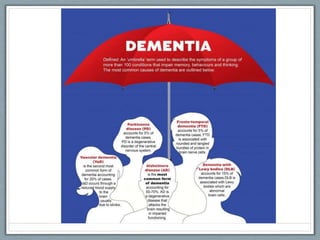
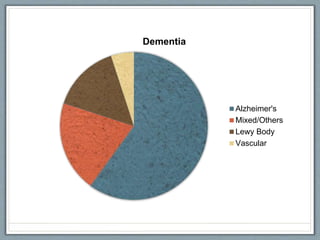
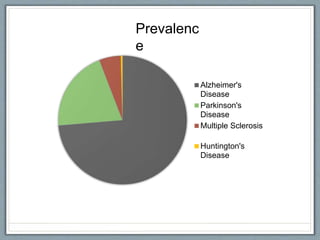
Dementia
Alzheimer's
Mixed/Others
Lewy Body
Vascular
AD vs. Dementia
• The Alzheimer’s Association defines 13 different types of
dementia. Accounting for about 2/3 of all cases, Alzheimer’s
Disease, which for most people is synonymous with dementia,
is the most common type.
• Dementia is a general term for a decline in mental ability
severe enough to interfere with daily life.
• Other common types of dementia include:
• Vascular dementia – occurs after a CVA (2nd most common)
• Dementia with Lewy Bodies (DLB) - abnormal aggregations (or
clumps) of the protein alpha-synuclein develop in the cortex.
• Mixed dementia - abnormal protein deposits associated with AD
coexist with blood vessel problems linked to vascular dementia …
or AD brain changes coexist with Lewy bodies.
Alzheimer’s Disease (AD)
• The most common form of dementia
• Occurs most frequently in people >60
• 5.3 million Americans with AD
• More common in women than in men
• Three main pathological hallmarks:
• Excessive amounts of the protein β-amyloid
• Neurofibrillary tangles within neurons
• Loss of neuronal connections
Alzheimer’s Disease Fact Sheet, NIH, Sept. 2012
Alzheimer's
Disease
Parkinson's
Disease
Multiple Sclerosis
Huntington's
Disease
Prevalenc
e
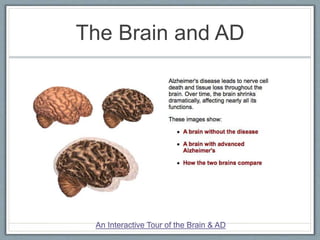
The Brain and AD
An Interactive Tour of the Brain & AD
Myths About Alzheimer’s
Disease
• Memory loss that impairs function is a natural part of aging.
• Alzheimer’s Disease is not fatal.
• Only older people get Alzheimer’s Disease (“Old Timer’s
Disease”)
• Drinking out of aluminum cans or cooking in aluminum pots and
pans can lead to AD.
• Aspartame (Equal) causes memory loss.
• Flu shots increase risk of AD.
• Silver (amalgam) dental fillings contribute to AD.
• There are treatments to stop the progression of AD (some slow
the worsening of symptoms temporarily but not the progression
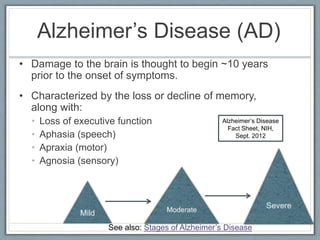
Alzheimer’s Disease (AD)
• Damage to the brain is thought to begin ~10 years
prior to the onset of symptoms.
• Characterized by the loss or decline of memory,
along with:
• Loss of executive function
• Aphasia (speech)
• Apraxia (motor)
• Agnosia (sensory)
Alzheimer’s Disease
Fact Sheet, NIH,
Sept. 2012
See also: Stages of Alzheimer’s Disease
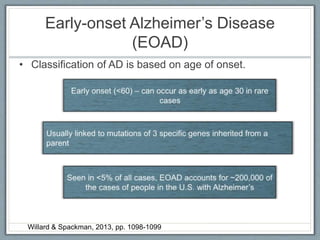
Early-onset Alzheimer’s Disease
(EOAD)
• Classification of AD is based on age of onset.
Willard & Spackman, 2013, pp. 1098-1099
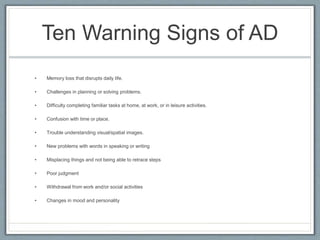
Ten Warning Signs of AD
• Memory loss that disrupts daily life.
• Challenges in planning or solving problems.
• Difficulty completing familiar tasks at home, at work, or in leisure activities.
• Confusion with time or place.
• Trouble understanding visual/spatial images.
• New problems with words in speaking or writing
• Misplacing things and not being able to retrace steps
• Poor judgment
• Withdrawal from work and/or social activities
• Changes in mood and personality
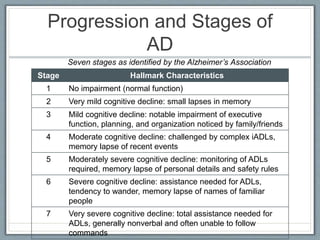
Progression and Stages of
AD
Stage Hallmark Characteristics
1 No impairment (normal function)
2 Very mild cognitive decline: small lapses in memory
3 Mild cognitive decline: notable impairment of executive
function, planning, and organization noticed by family/friends
4 Moderate cognitive decline: challenged by complex iADLs,
memory lapse of recent events
5 Moderately severe cognitive decline: monitoring of ADLs
required, memory lapse of personal details and safety rules
6 Severe cognitive decline: assistance needed for ADLs,
tendency to wander, memory lapse of names of familiar
people
7 Very severe cognitive decline: total assistance needed for
ADLs, generally nonverbal and often unable to follow
commands
Seven stages as identified by the Alzheimer’s Association
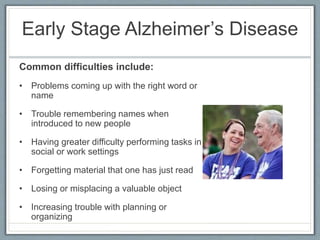
Early Stage Alzheimer’s Disease
Common difficulties include:
• Problems coming up with the right word or
name
• Trouble remembering names when
introduced to new people
• Having greater difficulty performing tasks in
social or work settings
• Forgetting material that one has just read
• Losing or misplacing a valuable object
• Increasing trouble with planning or
organizing
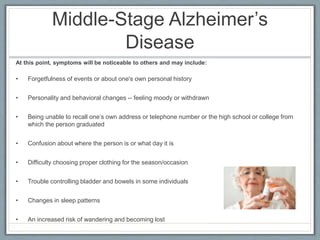
Middle-Stage Alzheimer’s
Disease
At this point, symptoms will be noticeable to others and may include:
• Forgetfulness of events or about one's own personal history
• Personality and behavioral changes -- feeling moody or withdrawn
• Being unable to recall one’s own address or telephone number or the high school or college from
which the person graduated
• Confusion about where the person is or what day it is
• Difficulty choosing proper clothing for the season/occasion
• Trouble controlling bladder and bowels in some individuals
• Changes in sleep patterns
• An increased risk of wandering and becoming lost
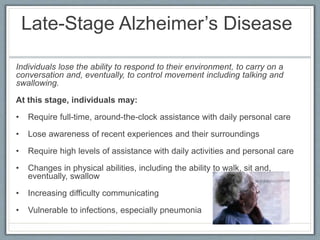
Late-Stage Alzheimer’s Disease
Individuals lose the ability to respond to their environment, to carry on a
conversation and, eventually, to control movement including talking and
swallowing.
At this stage, individuals may:
• Require full-time, around-the-clock assistance with daily personal care
• Lose awareness of recent experiences and their surroundings
• Require high levels of assistance with daily activities and personal care
• Changes in physical abilities, including the ability to walk, sit and,
eventually, swallow
• Increasing difficulty communicating
• Vulnerable to infections, especially pneumonia
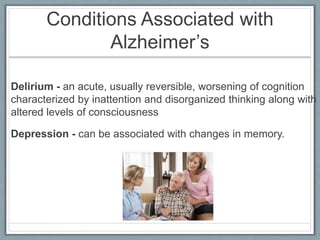
Conditions Associated with
Alzheimer’s
Delirium - an acute, usually reversible, worsening of cognition
characterized by inattention and disorganized thinking along with
altered levels of consciousness
Depression - can be associated with changes in memory.
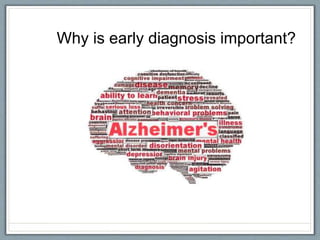
Why is early diagnosis important?
Sundowning
Factors that may contribute to sundowning and sleep
disturbances include:
• End-of-day exhaustion
• An upset in the "internal body clock”
• Less need for sleep, which is common among older adults
• Reduced lighting and increased shadows causing individual
to misinterpret what they see, and become confused and
afraid
• Reactions to nonverbal cues of frustration from caregivers
who are exhausted from their day
• Disorientation due to the inability to separate dreams from
reality when sleeping
Executive Function
Executive Functions (EF) – a set of cognitive skills that help people to connect past
experiences with present actions, including planning, organizing, and problem-solving
Four primary components –
*volition
*planning
*purposeful action
*self-awareness/self-monitoring
Executive Function
1. Analyze a task
2. Plan how to address the task
3. Organize the steps needed to carry out the task
4. Develop timelines for completing the task
5. Adjust or shift the steps, if needed, to complete the task
6. Complete the task in a timely way
Executive Function
Normally, features of executive function are seen in our ability to do
things like -
• making plans
• keeping track of time
• meaningfully including past knowledge in discussions
• engaging in group dynamics
• reflecting on our work
• changing our minds and making corrections while thinking or
writing
• keeping track of more than one thing at once
• waiting to speak until we're called on
• seeking more information or help when we need it
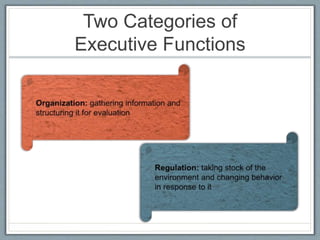
Two Categories of
Executive Functions
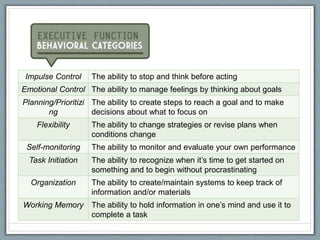
Impulse Control The ability to stop and think before acting
Emotional Control The ability to manage feelings by thinking about goals
Planning/Prioritizi
ng
The ability to create steps to reach a goal and to make
decisions about what to focus on
Flexibility The ability to change strategies or revise plans when
conditions change
Self-monitoring The ability to monitor and evaluate your own performance
Task Initiation The ability to recognize when it’s time to get started on
something and to begin without procrastinating
Organization The ability to create/maintain systems to keep track of
information and/or materials
Working Memory The ability to hold information in one’s mind and use it to
complete a task
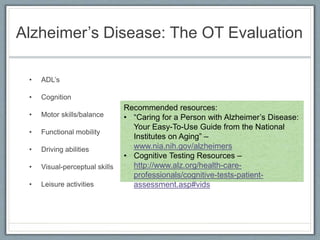
Alzheimer’s Disease: The OT Evaluation
• ADL’s
• Cognition
• Motor skills/balance
• Functional mobility
• Driving abilities
• Visual-perceptual skills
• Leisure activities
Recommended resources:
• “Caring for a Person with Alzheimer’s Disease:
Your Easy-To-Use Guide from the National
Institutes on Aging” –
www.nia.nih.gov/alzheimers
• Cognitive Testing Resources –
http://www.alz.org/health-care-
professionals/cognitive-tests-patient-
assessment.asp#vids
Alzheimer’s Disease: The OT Evaluation
Key Questions & Considerations
• What is a typical day like for the client/family/caregiver(s)?
 Home set-up?
 Safety concerns?
 Best/most challenging times of day for client?
• What is seen by the client/caregiver(s) as the primary
barrier(s) to participation for the client in the current
stage?
 Need for outside referrals and/or resources?
 Coping strategies in place?
• What is the impact of the cognitive impairment on
occupational performance?
 Assessment information will guide intervention
 Establish baseline
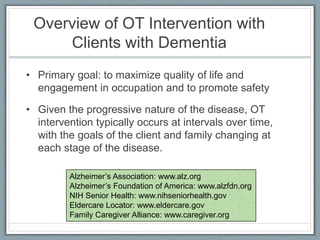
Overview of OT Intervention with
Clients with Dementia
• Primary goal: to maximize quality of life and
engagement in occupation and to promote safety
• Given the progressive nature of the disease, OT
intervention typically occurs at intervals over time,
with the goals of the client and family changing at
each stage of the disease.
Alzheimer’s Association: www.alz.org
Alzheimer’s Foundation of America: www.alzfdn.org
NIH Senior Health: www.nihseniorhealth.gov
Eldercare Locator: www.eldercare.gov
Family Caregiver Alliance: www.caregiver.org
Overview of OT Intervention with
Clients with Dementia
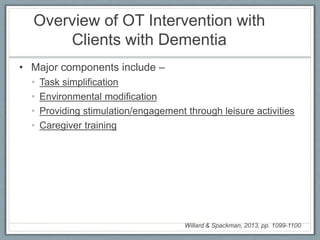
• Major components include –
• Task simplification
• Environmental modification
• Providing stimulation/engagement through leisure activities
• Caregiver training
Willard & Spackman, 2013, pp. 1099-1100
Intervention Approaches:
Early-Stage Dementia
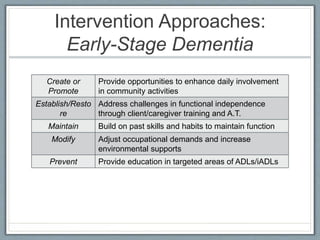
Create or
Promote
Provide opportunities to enhance daily involvement
in community activities
Establish/Resto
re
Address challenges in functional independence
through client/caregiver training and A.T.
Maintain Build on past skills and habits to maintain function
Modify Adjust occupational demands and increase
environmental supports
Prevent Provide education in targeted areas of ADLs/iADLs
Intervention Approaches:
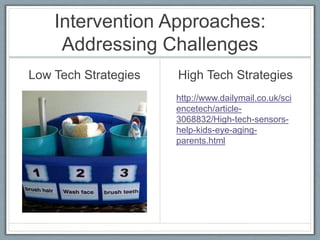
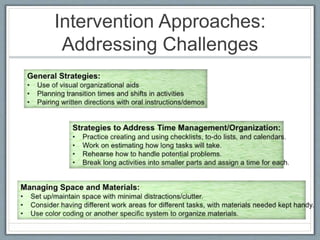
Addressing Challenges
Low Tech Strategies High Tech Strategies
http://www.dailymail.co.uk/sci
encetech/article-
3068832/High-tech-sensors-
help-kids-eye-aging-
parents.html
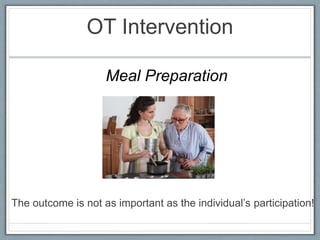
OT Intervention
The outcome is not as important as the individual’s participation!
Meal Preparation
Intervention Approaches:
Addressing Challenges
Intervention Approaches:
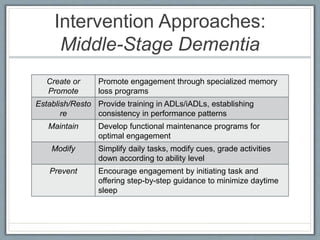
Middle-Stage Dementia
Create or
Promote
Promote engagement through specialized memory
loss programs
Establish/Resto
re
Provide training in ADLs/iADLs, establishing
consistency in performance patterns
Maintain Develop functional maintenance programs for
optimal engagement
Modify Simplify daily tasks, modify cues, grade activities
down according to ability level
Prevent Encourage engagement by initiating task and
offering step-by-step guidance to minimize daytime
sleep
Intervention Approaches:
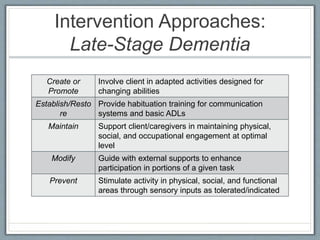
Late-Stage Dementia
Create or
Promote
Involve client in adapted activities designed for
changing abilities
Establish/Resto
re
Provide habituation training for communication
systems and basic ADLs
Maintain Support client/caregivers in maintaining physical,
social, and occupational engagement at optimal
level
Modify Guide with external supports to enhance
participation in portions of a given task
Prevent Stimulate activity in physical, social, and functional
areas through sensory inputs as tolerated/indicated
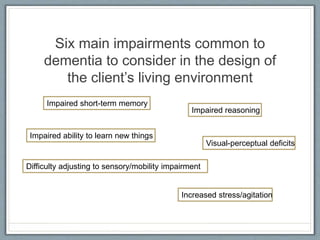
Six main impairments common to
dementia to consider in the design of
the client’s living environment
Impaired short-term memory
Impaired ability to learn new things
Visual-perceptual deficits
Difficulty adjusting to sensory/mobility impairment
Increased stress/agitation
Impaired reasoning
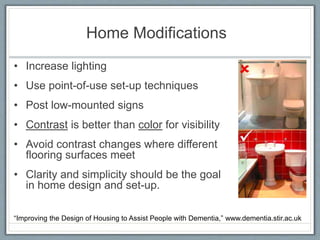
Home Modifications
• Increase lighting
• Use point-of-use set-up techniques
• Post low-mounted signs
• Contrast is better than color for visibility
• Avoid contrast changes where different
flooring surfaces meet
• Clarity and simplicity should be the goal
in home design and set-up.
“Improving the Design of Housing to Assist People with Dementia,” www.dementia.stir.ac.uk
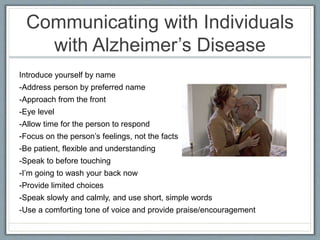
Communicating with Individuals
with Alzheimer’s Disease
Introduce yourself by name
-Address person by preferred name
-Approach from the front
-Eye level
-Allow time for the person to respond
-Focus on the person’s feelings, not the facts
-Be patient, flexible and understanding
-Speak to before touching
-I’m going to wash your back now
-Provide limited choices
-Speak slowly and calmly, and use short, simple words
-Use a comforting tone of voice and provide praise/encouragement
Communication Techniques
-Avoid interrupting
-Allow them to interrupt you, or they may forget what they want to say
-Limit distractions during communication
-Increase the use of gestures and other non-verbal communication techniques
-Observe the individual to recognize non-verbal communication
-Visual cues or pictures may help them understand what he or she is hearing.
-Limit medical jargon
-Have patient or caregiver repeat instructions
-Avoid rushing
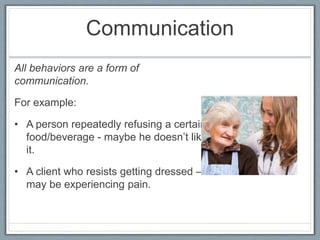
Communication
All behaviors are a form of
communication.
For example:
• A person repeatedly refusing a certain
food/beverage - maybe he doesn’t like
it.
• A client who resists getting dressed –
may be experiencing pain.
Evidence-based Practice
 Positive long-term impact on functional decline in older adults seen from
OT intervention focusing on compensatory strategies, environmental
modification, fall prevention, and balance/strength (Gitlin et al., 2009).
 Strong evidence that the use of visual cues and low-tech strategies such
as labeling increases participation and safety in clients with AD
(Dooley & Hinojosa, 2004).
 OT interventions using task simplification have been found to be effective
for people with early and mid-stage AD (Graff et. al., 2006).
 Engagement in everyday occupation contributes to well-being of both the
client and the caregiver (Hasselkus & Murray, 2007).
Other Suggested
Resources
• Activities_for_People_with_Dementia.pdf (posted
to Bb)
• Emerging screening tools to detect early-stage AD
through smell or eye exams --Changes in Smell or
Vision May Indicate Early AD
• The Forgetting by David Shenk
• Schaber, P. (2010). Occupational therapy practice
guidelines for adults with Alzheimer’s disease and
related disorders. Bethesda, MD: AOTA.
Practice Question
At what stage of Alzheimer’s disease (AD) does nerve
cell damage cause significant motor impairments that
limit the ability to complete life tasks?
a) Mild cognitive impairment
b) Early stage
c) Middle stage
d) Late stage
Practice Question
A client with dementia is having difficulty locating the bathroom in
the home, which is creating strain for the caregiver. What is the
BEST recommendation the OTR can give the caregiver to assist
the client with this task?
a) Use arrows on the walls to indicate the location of the
bathroom.
b) Paint the walls near the bathroom bright red to create
contrast.
c) Use low lighting in the hallway leading to the bathroom to
reduce distraction.
d) Place the names of commonly used bathroom items on the
door of the bathroom.
References
Alzheimer’s Association (2009). Campaign for quality care: Dementia care practice
recommendations for professionals working in a home setting
Alzheimer’s Disease Fact Sheet, NIH, Sept. 2012, Chicago, IL: Alzheimer’s Association.
Crepeau, E., Cohn, E., & Schell, B. (2013). Willard & Spackman’s occupational therapy (12th
ed.). Baltimore: Lippincott, Williams & Wilkins
http://www.alz.org/alzheimers_disease_stages_of_alzheimers.asp
Randomski, M. V., Trombly-Latham, C. A. (2013). Occupational Therapy for Physical
Dysfunction (7th ed.), Wolters Kluwer – Lippincott Williams & Wilkins.
Zachry, A. (2015). Powerpoint presentation: Alzheimer’s Disease.
Images from Wikipedia, Google.

OT 537 dementia

  • 1.
  • 3.
  • 4.
    AD vs. Dementia •The Alzheimer’s Association defines 13 different types of dementia. Accounting for about 2/3 of all cases, Alzheimer’s Disease, which for most people is synonymous with dementia, is the most common type. • Dementia is a general term for a decline in mental ability severe enough to interfere with daily life. • Other common types of dementia include: • Vascular dementia – occurs after a CVA (2nd most common) • Dementia with Lewy Bodies (DLB) - abnormal aggregations (or clumps) of the protein alpha-synuclein develop in the cortex. • Mixed dementia - abnormal protein deposits associated with AD coexist with blood vessel problems linked to vascular dementia … or AD brain changes coexist with Lewy bodies.
  • 6.
    Alzheimer’s Disease (AD) •The most common form of dementia • Occurs most frequently in people >60 • 5.3 million Americans with AD • More common in women than in men • Three main pathological hallmarks: • Excessive amounts of the protein β-amyloid • Neurofibrillary tangles within neurons • Loss of neuronal connections Alzheimer’s Disease Fact Sheet, NIH, Sept. 2012
  • 7.
  • 8.
    The Brain andAD An Interactive Tour of the Brain & AD
  • 9.
    Myths About Alzheimer’s Disease •Memory loss that impairs function is a natural part of aging. • Alzheimer’s Disease is not fatal. • Only older people get Alzheimer’s Disease (“Old Timer’s Disease”) • Drinking out of aluminum cans or cooking in aluminum pots and pans can lead to AD. • Aspartame (Equal) causes memory loss. • Flu shots increase risk of AD. • Silver (amalgam) dental fillings contribute to AD. • There are treatments to stop the progression of AD (some slow the worsening of symptoms temporarily but not the progression
  • 10.
    Alzheimer’s Disease (AD) •Damage to the brain is thought to begin ~10 years prior to the onset of symptoms. • Characterized by the loss or decline of memory, along with: • Loss of executive function • Aphasia (speech) • Apraxia (motor) • Agnosia (sensory) Alzheimer’s Disease Fact Sheet, NIH, Sept. 2012 See also: Stages of Alzheimer’s Disease
  • 11.
    Early-onset Alzheimer’s Disease (EOAD) •Classification of AD is based on age of onset. Willard & Spackman, 2013, pp. 1098-1099
  • 12.
    Ten Warning Signsof AD • Memory loss that disrupts daily life. • Challenges in planning or solving problems. • Difficulty completing familiar tasks at home, at work, or in leisure activities. • Confusion with time or place. • Trouble understanding visual/spatial images. • New problems with words in speaking or writing • Misplacing things and not being able to retrace steps • Poor judgment • Withdrawal from work and/or social activities • Changes in mood and personality
  • 13.
    Progression and Stagesof AD Stage Hallmark Characteristics 1 No impairment (normal function) 2 Very mild cognitive decline: small lapses in memory 3 Mild cognitive decline: notable impairment of executive function, planning, and organization noticed by family/friends 4 Moderate cognitive decline: challenged by complex iADLs, memory lapse of recent events 5 Moderately severe cognitive decline: monitoring of ADLs required, memory lapse of personal details and safety rules 6 Severe cognitive decline: assistance needed for ADLs, tendency to wander, memory lapse of names of familiar people 7 Very severe cognitive decline: total assistance needed for ADLs, generally nonverbal and often unable to follow commands Seven stages as identified by the Alzheimer’s Association
  • 14.
    Early Stage Alzheimer’sDisease Common difficulties include: • Problems coming up with the right word or name • Trouble remembering names when introduced to new people • Having greater difficulty performing tasks in social or work settings • Forgetting material that one has just read • Losing or misplacing a valuable object • Increasing trouble with planning or organizing
  • 15.
    Middle-Stage Alzheimer’s Disease At thispoint, symptoms will be noticeable to others and may include: • Forgetfulness of events or about one's own personal history • Personality and behavioral changes -- feeling moody or withdrawn • Being unable to recall one’s own address or telephone number or the high school or college from which the person graduated • Confusion about where the person is or what day it is • Difficulty choosing proper clothing for the season/occasion • Trouble controlling bladder and bowels in some individuals • Changes in sleep patterns • An increased risk of wandering and becoming lost
  • 16.
    Late-Stage Alzheimer’s Disease Individualslose the ability to respond to their environment, to carry on a conversation and, eventually, to control movement including talking and swallowing. At this stage, individuals may: • Require full-time, around-the-clock assistance with daily personal care • Lose awareness of recent experiences and their surroundings • Require high levels of assistance with daily activities and personal care • Changes in physical abilities, including the ability to walk, sit and, eventually, swallow • Increasing difficulty communicating • Vulnerable to infections, especially pneumonia
  • 17.
    Conditions Associated with Alzheimer’s Delirium- an acute, usually reversible, worsening of cognition characterized by inattention and disorganized thinking along with altered levels of consciousness Depression - can be associated with changes in memory.
  • 18.
    Why is earlydiagnosis important?
  • 19.
  • 20.
    Factors that maycontribute to sundowning and sleep disturbances include: • End-of-day exhaustion • An upset in the "internal body clock” • Less need for sleep, which is common among older adults • Reduced lighting and increased shadows causing individual to misinterpret what they see, and become confused and afraid • Reactions to nonverbal cues of frustration from caregivers who are exhausted from their day • Disorientation due to the inability to separate dreams from reality when sleeping
  • 21.
    Executive Function Executive Functions(EF) – a set of cognitive skills that help people to connect past experiences with present actions, including planning, organizing, and problem-solving Four primary components – *volition *planning *purposeful action *self-awareness/self-monitoring
  • 22.
    Executive Function 1. Analyzea task 2. Plan how to address the task 3. Organize the steps needed to carry out the task 4. Develop timelines for completing the task 5. Adjust or shift the steps, if needed, to complete the task 6. Complete the task in a timely way
  • 23.
    Executive Function Normally, featuresof executive function are seen in our ability to do things like - • making plans • keeping track of time • meaningfully including past knowledge in discussions • engaging in group dynamics • reflecting on our work • changing our minds and making corrections while thinking or writing • keeping track of more than one thing at once • waiting to speak until we're called on • seeking more information or help when we need it
  • 24.
  • 25.
    Impulse Control Theability to stop and think before acting Emotional Control The ability to manage feelings by thinking about goals Planning/Prioritizi ng The ability to create steps to reach a goal and to make decisions about what to focus on Flexibility The ability to change strategies or revise plans when conditions change Self-monitoring The ability to monitor and evaluate your own performance Task Initiation The ability to recognize when it’s time to get started on something and to begin without procrastinating Organization The ability to create/maintain systems to keep track of information and/or materials Working Memory The ability to hold information in one’s mind and use it to complete a task
  • 26.
    Alzheimer’s Disease: TheOT Evaluation • ADL’s • Cognition • Motor skills/balance • Functional mobility • Driving abilities • Visual-perceptual skills • Leisure activities Recommended resources: • “Caring for a Person with Alzheimer’s Disease: Your Easy-To-Use Guide from the National Institutes on Aging” – www.nia.nih.gov/alzheimers • Cognitive Testing Resources – http://www.alz.org/health-care- professionals/cognitive-tests-patient- assessment.asp#vids
  • 27.
    Alzheimer’s Disease: TheOT Evaluation Key Questions & Considerations • What is a typical day like for the client/family/caregiver(s)?  Home set-up?  Safety concerns?  Best/most challenging times of day for client? • What is seen by the client/caregiver(s) as the primary barrier(s) to participation for the client in the current stage?  Need for outside referrals and/or resources?  Coping strategies in place? • What is the impact of the cognitive impairment on occupational performance?  Assessment information will guide intervention  Establish baseline
  • 28.
    Overview of OTIntervention with Clients with Dementia • Primary goal: to maximize quality of life and engagement in occupation and to promote safety • Given the progressive nature of the disease, OT intervention typically occurs at intervals over time, with the goals of the client and family changing at each stage of the disease. Alzheimer’s Association: www.alz.org Alzheimer’s Foundation of America: www.alzfdn.org NIH Senior Health: www.nihseniorhealth.gov Eldercare Locator: www.eldercare.gov Family Caregiver Alliance: www.caregiver.org
  • 29.
    Overview of OTIntervention with Clients with Dementia • Major components include – • Task simplification • Environmental modification • Providing stimulation/engagement through leisure activities • Caregiver training Willard & Spackman, 2013, pp. 1099-1100
  • 30.
    Intervention Approaches: Early-Stage Dementia Createor Promote Provide opportunities to enhance daily involvement in community activities Establish/Resto re Address challenges in functional independence through client/caregiver training and A.T. Maintain Build on past skills and habits to maintain function Modify Adjust occupational demands and increase environmental supports Prevent Provide education in targeted areas of ADLs/iADLs
  • 31.
    Intervention Approaches: Addressing Challenges LowTech Strategies High Tech Strategies http://www.dailymail.co.uk/sci encetech/article- 3068832/High-tech-sensors- help-kids-eye-aging- parents.html
  • 32.
    OT Intervention The outcomeis not as important as the individual’s participation! Meal Preparation
  • 33.
  • 34.
    Intervention Approaches: Middle-Stage Dementia Createor Promote Promote engagement through specialized memory loss programs Establish/Resto re Provide training in ADLs/iADLs, establishing consistency in performance patterns Maintain Develop functional maintenance programs for optimal engagement Modify Simplify daily tasks, modify cues, grade activities down according to ability level Prevent Encourage engagement by initiating task and offering step-by-step guidance to minimize daytime sleep
  • 35.
    Intervention Approaches: Late-Stage Dementia Createor Promote Involve client in adapted activities designed for changing abilities Establish/Resto re Provide habituation training for communication systems and basic ADLs Maintain Support client/caregivers in maintaining physical, social, and occupational engagement at optimal level Modify Guide with external supports to enhance participation in portions of a given task Prevent Stimulate activity in physical, social, and functional areas through sensory inputs as tolerated/indicated
  • 36.
    Six main impairmentscommon to dementia to consider in the design of the client’s living environment Impaired short-term memory Impaired ability to learn new things Visual-perceptual deficits Difficulty adjusting to sensory/mobility impairment Increased stress/agitation Impaired reasoning
  • 37.
    Home Modifications • Increaselighting • Use point-of-use set-up techniques • Post low-mounted signs • Contrast is better than color for visibility • Avoid contrast changes where different flooring surfaces meet • Clarity and simplicity should be the goal in home design and set-up. “Improving the Design of Housing to Assist People with Dementia,” www.dementia.stir.ac.uk
  • 38.
    Communicating with Individuals withAlzheimer’s Disease Introduce yourself by name -Address person by preferred name -Approach from the front -Eye level -Allow time for the person to respond -Focus on the person’s feelings, not the facts -Be patient, flexible and understanding -Speak to before touching -I’m going to wash your back now -Provide limited choices -Speak slowly and calmly, and use short, simple words -Use a comforting tone of voice and provide praise/encouragement
  • 39.
    Communication Techniques -Avoid interrupting -Allowthem to interrupt you, or they may forget what they want to say -Limit distractions during communication -Increase the use of gestures and other non-verbal communication techniques -Observe the individual to recognize non-verbal communication -Visual cues or pictures may help them understand what he or she is hearing. -Limit medical jargon -Have patient or caregiver repeat instructions -Avoid rushing
  • 40.
    Communication All behaviors area form of communication. For example: • A person repeatedly refusing a certain food/beverage - maybe he doesn’t like it. • A client who resists getting dressed – may be experiencing pain.
  • 41.
    Evidence-based Practice  Positivelong-term impact on functional decline in older adults seen from OT intervention focusing on compensatory strategies, environmental modification, fall prevention, and balance/strength (Gitlin et al., 2009).  Strong evidence that the use of visual cues and low-tech strategies such as labeling increases participation and safety in clients with AD (Dooley & Hinojosa, 2004).  OT interventions using task simplification have been found to be effective for people with early and mid-stage AD (Graff et. al., 2006).  Engagement in everyday occupation contributes to well-being of both the client and the caregiver (Hasselkus & Murray, 2007).
  • 42.
    Other Suggested Resources • Activities_for_People_with_Dementia.pdf(posted to Bb) • Emerging screening tools to detect early-stage AD through smell or eye exams --Changes in Smell or Vision May Indicate Early AD • The Forgetting by David Shenk • Schaber, P. (2010). Occupational therapy practice guidelines for adults with Alzheimer’s disease and related disorders. Bethesda, MD: AOTA.
  • 43.
    Practice Question At whatstage of Alzheimer’s disease (AD) does nerve cell damage cause significant motor impairments that limit the ability to complete life tasks? a) Mild cognitive impairment b) Early stage c) Middle stage d) Late stage
  • 44.
    Practice Question A clientwith dementia is having difficulty locating the bathroom in the home, which is creating strain for the caregiver. What is the BEST recommendation the OTR can give the caregiver to assist the client with this task? a) Use arrows on the walls to indicate the location of the bathroom. b) Paint the walls near the bathroom bright red to create contrast. c) Use low lighting in the hallway leading to the bathroom to reduce distraction. d) Place the names of commonly used bathroom items on the door of the bathroom.
  • 45.
    References Alzheimer’s Association (2009).Campaign for quality care: Dementia care practice recommendations for professionals working in a home setting Alzheimer’s Disease Fact Sheet, NIH, Sept. 2012, Chicago, IL: Alzheimer’s Association. Crepeau, E., Cohn, E., & Schell, B. (2013). Willard & Spackman’s occupational therapy (12th ed.). Baltimore: Lippincott, Williams & Wilkins http://www.alz.org/alzheimers_disease_stages_of_alzheimers.asp Randomski, M. V., Trombly-Latham, C. A. (2013). Occupational Therapy for Physical Dysfunction (7th ed.), Wolters Kluwer – Lippincott Williams & Wilkins. Zachry, A. (2015). Powerpoint presentation: Alzheimer’s Disease. Images from Wikipedia, Google.

Editor's Notes

  • #6 Generalize to dementia – discuss other types like FTD: https://www.youtube.com/watch?v=DzeprVgNcFI&index=32&list=PLYNSC2T2aPD5_gO756U7yBla7wEpHC_jD (5:00 video)
  • #9 http://www.alz.org/alzheimers_disease_4719.asp
  • #10 Reference: http://www.alz.org/alzheimers_disease_myths_about_alzheimers.asp
  • #26 How does each impact occupational engagement?
  • #27 ADL’s – with regard to living situation and including caregiver needs and safety issues Cognition (Allen Cognitive Level Screen-5, KTA, Mini-Mental State Exam) – assess orientation, attention, memory, problem-solving, ability to follow directions, and overall cognitive processing and performance abilities Motor skills/balance Functional mobility (including bed mobility) Driving abilities Visual-perceptual skills Leisure activities Need for home modifications, mobility and communication aids, and patient/caregiver
  • #28 Cognitive Functional Assessments – Assessment Round-up – developers, time to administer, purpose/what is being measured, content areas/how test is conducted, materials needed, rating scale/scoring system Kitchen task Assessment - KTA Cognitive Performance Test - CPT Executive Function Performance Test Mini-Mental Status Exam (MMSE) Lowenstein Occupational Therapy Cognitive Assessment Short Blessed Test (SBT)/Blessed Orientation-Memory-Concentration (BOMC) Test Home Environment Assessment Protocol (HEAP) - http://www.tandfonline.com/doi/abs/10.1080/09638280110066325 http://www.slideshare.net/cpeirce/ltc-insurance-ot-study
  • #37 See Improving the design of housing to assist people with dementia pdf
  • #43 *News report: http://www.nbcnews.com/health/aging/worried-you-may-be-developing-alzheimers-check-your-eyes-n153226