Effective Leadership for Teaching and Learning Superintendent Certification Program  WSU  Vancouver March 14, 2009 Mickey Venn Lahmann Senior Associate [email_address]
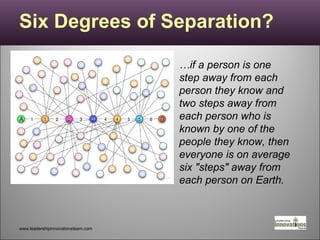
Six Degrees of Separation? www.leadershipinnovationsteam.com … if a person is one step away from each person they know and two steps away from each person who is known by one of the people they know, then everyone is on average six "steps" away from each person on Earth.
Learning targets for today Review the  Characteristics of Improved School Districts Explore your own  leadership strengths Learn what the  research  says about leadership Learn about the  power of feedback www.leadershipinnovationsteam.com
Four Characteristics of  Research on Improved Districts Effective Leadership Quality Teaching and Learning Support for System-wide Improvement Clear and Collaborative Relationships
Which Areas are Strengths for You? Review the Characteristics of Improved School Districts From the 4 Categories, identify  2 themes  you consider to be your strengths Share your strengths with your neighbor… What are your  strengths and why? www.leadershipinnovationsteam.com
All Characteristics are Important Which ones are most important? Certainly the heart of our business is  learning,  while there is … NO SILVER BULLET… Your investment in making sure every student has a  highly effective teacher every day is where the  rubber hits the road! www.leadershipinnovationsteam.com
Leadership for Teaching & Learning? How can you ensure this for ALL students? Be the BEST leader you can be…. www.leadershipinnovationsteam.com
No lack of advice on leadership  To name but a few.. Bolman and Deal Fullan Elmore Covey Schletchy Peters Senge Collins www.leadershipinnovationsteam.com
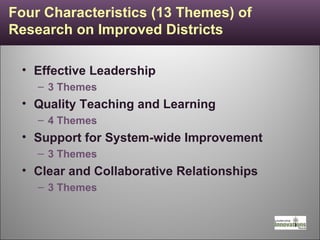
Four Characteristics (13 Themes) of  Research on Improved Districts Effective Leadership 3 Themes Quality Teaching and Learning 4 Themes Support for System-wide Improvement 3 Themes Clear and Collaborative Relationships 3 Themes
Common Threads (9)  of Highly Successful  Schools,  DuFour Clarity of focus Collaborative culture Collective Inquiry into Best Practices & Current Reality Action orientation Commitment to continuous improvement Focus on Results Strong principals who empower teachers Commitment to face adversity, conflict, and anxiety Use of the same guiding phrase
McREL Balanced Leadership Profile The purpose of the Balanced Leadership Profile™ Survey is to provide building principals with multiple perspectives on the their fulfillment of the 21 leadership responsibilities  identified  i n McREL's leadership research, and to furnish feedback on principals' change leadership. www.leadershipinnovationsteam.com
Leadership Practices Inventory: LPI By Jim Kouzes and Barry Posner   360 Degree Inventory It allows us continuously to test our initial findings that  The Five Practices Model with 31 practices is a valid view of the world of leadership, and it provides a tool that helps leaders assess the extent to which they actually use those practices so that they can make plans or improvement .
Now, Discover Your Strengths  by Marcus Buckingham Strengths Finder Profile  (34 Themes) Based on Gallup Study, over 2 million people Globally only 20% of employees working in large organization surveyed felt their strengths were used each day. “ The keystone of high achievement and happiness is exercising your strengths,  not correcting your weaknesses” “ That excellent performers must be well rounded is one of the most pervasive myths we hope to dispel in this book.”
Extraordinary Leaders?  Think about an extraordinary leader… Think of at least  3 characteristics this person was extremely good and  write those down. www.leadershipinnovationsteam.com
The Zenger/Folkman Research Two years researching the impact of leadership performance and the key behaviors that great leaders demonstrate Data set of 200,000 evaluations on 20,000 people Contrasted the  highest-performing 10%  to the  lowest-performing 10%  The approach:  Lead with the data! The result:  New insights  that  fundamentally change the way we think about leadership development
Insight Good does not equal great—and your organization needs you to be great.
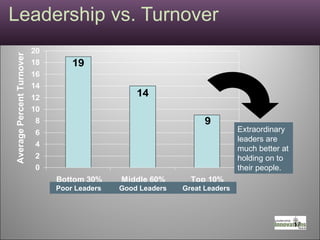
Leadership vs. Turnover Average Percent Turnover Poor Leaders  Good Leaders  Great Leaders Extraordinary leaders are much better at holding on to their people.
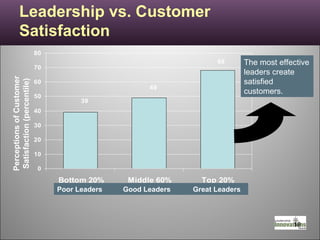
Leadership vs. Customer Satisfaction Perceptions of Customer Satisfaction (percentile) Poor Leaders   Good Leaders    Great Leaders The most effective leaders create satisfied customers.
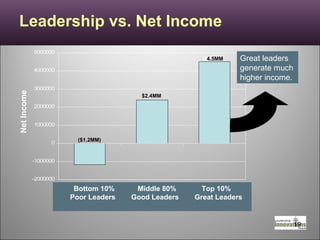
Leadership vs. Net Income Net Income ($1.2MM) $2.4MM $ 4.5MM Bottom 10% Middle 80% Top 10%   Poor Leaders  Good Leaders  Great Leaders Great leaders generate much higher income.
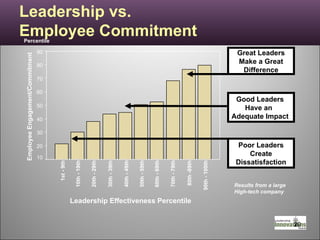
Leadership vs.  Employee Commitment Results from a large High-tech company 90 80 70 60 50 40 30 20 10 90th - 100th 80th -89th 70th - 79th 60th - 69th 50th - 59th 40th - 49th 30th - 39th 20th - 29th 10th - 19th 1st - 9th Leadership Effectiveness Percentile Employee Engagement/Commitment Percentile Poor Leaders Create Dissatisfaction Good Leaders  Have an  Adequate Impact  Great Leaders Make a Great Difference
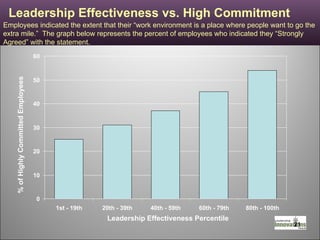
Leadership Effectiveness vs. High Commitment  % of Highly Committed Employees Leadership Effectiveness Percentile Employees indicated the extent that their “work environment is a place where people want to go the extra mile.”  The graph below represents the percent of employees who indicated they “Strongly Agreed” with the statement.
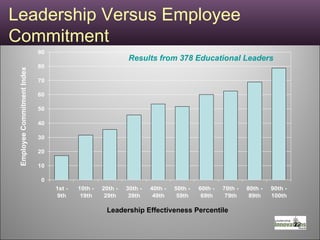
Leadership Versus Employee Commitment  Employee Commitment Index Leadership Effectiveness Percentile Results from 378 Educational Leaders
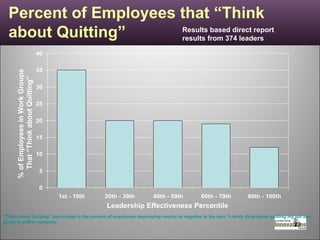
Percent of Employees that “Think about Quitting”  % of Employees in Work Groups  That “Think about Quitting” Leadership Effectiveness Percentile “ Think about Quitting” percentage is the percent of employees responding neutral or negative to the item “I rarely think about quitting my job and going to anther company. Results based direct report results from 374 leaders
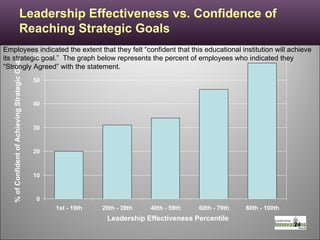
Leadership Effectiveness vs. Confidence of Reaching Strategic Goals % of Confident of Achieving Strategic Goal Leadership Effectiveness Percentile Employees indicated the extent that they felt “confident that this educational institution will achieve its strategic goal.”  The graph below represents the percent of employees who indicated they “Strongly Agreed” with the statement.
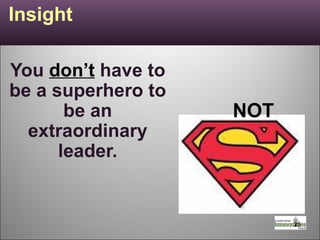
Insight You  don’t   have to be a superhero to be an extraordinary leader. NOT
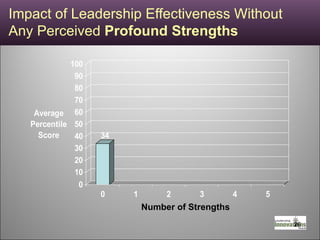
Impact of Leadership Effectiveness Without Any Perceived  Profound Strengths  Number of Strengths
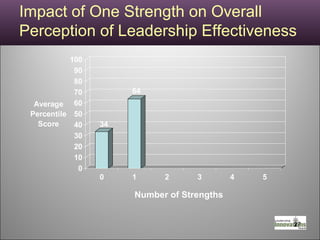
Impact of One Strength on Overall Perception of Leadership Effectiveness  Number of Strengths
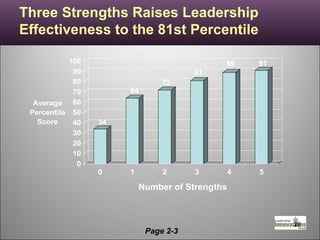
Three Strengths Raises Leadership Effectiveness to the 81st Percentile  Number of Strengths Page 2-3
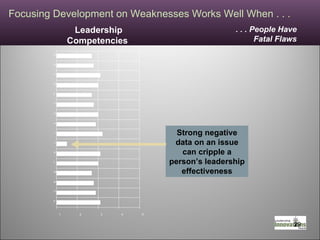
Focusing Development on Weaknesses Works Well When . . . Leadership Competencies  1 2 3 4 5 P O N M L K J I H G F E D C B A Strong negative data on an issue can cripple a person’s leadership effectiveness . . . People Have Fatal Flaws
Insight To get where you want to go, you need to know where you are.
Power of Feedback “ Pity the leader caught between unloving critics and uncritical lover .” John Gardner Getting regular feedback is the only way to know if you are having the desired impact. www.leadershipinnovationsteam.com
Other Leadership Observations True North: Discover your Authentic Leadership  by  Bill George CEO of Medtronic 75 members of the Stanford Graduate School Business Advisory Council Asked to recommend the  most important capability   for leaders to develop  Answer nearly unanimous…  Self awareness !
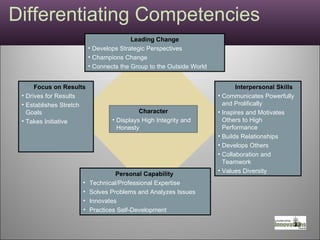
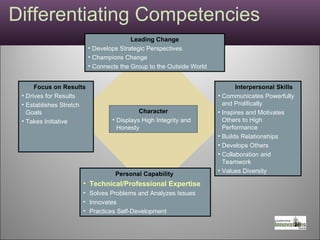
Differentiating Competencies Leading Change Develops Strategic Perspectives  Champions Change  Connects the Group to the Outside World Character Displays High Integrity and Honesty Interpersonal Skills Communicates Powerfully and Prolifically Inspires and Motivates Others to High Performance  Builds Relationships Develops Others Collaboration and Teamwork  Values Diversity Focus on Results Drives for Results  Establishes Stretch Goals Takes Initiative Personal Capability  Technical/Professional Expertise Solves Problems and Analyzes Issues Innovates Practices Self-Development
Insight  When choosing which strengths to develop, play to your passions!
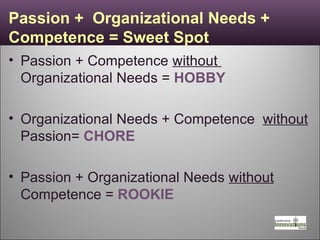
Passion +  Organizational Needs + Competence = Sweet Spot Passion + Competence  without  Organizational Needs =  HOBBY Organizational Needs + Competence  without  Passion=  CHORE Passion + Organizational Needs  without  Competence =  ROOKIE
What Does Performance Improvement Mean to Most People? Fixing Weaknesses!
Insight  When building on your strengths, often the best approach is to build around them.
Differentiating Competencies Leading Change Develops Strategic Perspectives  Champions Change  Connects the Group to the Outside World Character Displays High Integrity and Honesty Interpersonal Skills Communicates Powerfully and Prolifically Inspires and Motivates Others to High Performance  Builds Relationships Develops Others Collaboration and Teamwork  Values Diversity Focus on Results Drives for Results  Establishes Stretch Goals Takes Initiative Personal Capability  Technical/Professional Expertise Solves Problems and Analyzes Issues Innovates Practices Self-Development
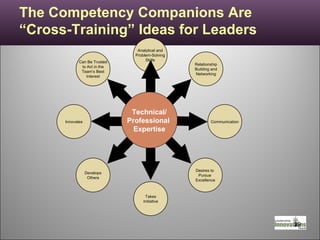
The Competency Companions Are “Cross-Training” Ideas for Leaders Analytical and Problem-Solving Skills Innovates Can Be Trusted to Act in the Team’s Best Interest Relationship Building and Networking Communication Takes Initiative Develops Others Technical/ Professional  Expertise Desires to  Pursue  Excellence
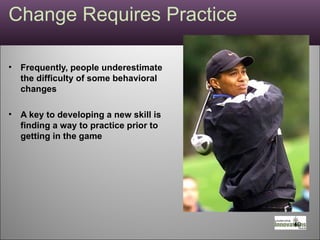
Change Requires Practice Frequently, people underestimate the difficulty of some behavioral changes A key to developing a new skill is finding a way to practice prior to getting in the game
Playing or Practicing Leadership? Set Goals based on Strengths Which is our tendency? Practice, practice, practice Enlist the support of a  coach.
Potential of Extraordinary Leadership Development for you? What  IF  your leadership development leads to… Increased commitment to overall district goals Lower turn-over More satisfied customers (staff, students, parents) Increased job satisfaction & professional advancement Achievement of strategic goals Student Achievement !!!
The Power of Feedback “ Turning Feedback from Others into Personal and Professional Change” By Joseph Folkman www.leadershipinnovationsteam.com
Leadership for Teaching and Learning… What  difference  do you think leadership makes in a school district?  YOU are the difference.
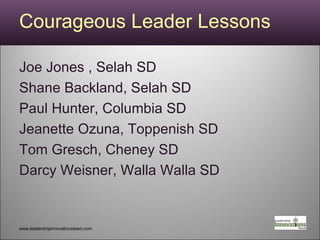
Courageous Leader Lessons Joe Jones , Selah SD Shane Backland, Selah SD Paul Hunter, Columbia SD Jeanette Ozuna, Toppenish SD Tom Gresch, Cheney SD                Darcy Weisner, Walla Walla SD www.leadershipinnovationsteam.com
Summary Leadership matters! Great leaders have great impact. If you have a fatal flaw, fix it.  Cultivate a few outstanding strengths. Use your feedback as a starting point in your development. Play to your passions! Cross-train to build on strengths. Practice, practice, practice!

Mickey Lahmann

  • 1.
    Effective Leadership forTeaching and Learning Superintendent Certification Program WSU Vancouver March 14, 2009 Mickey Venn Lahmann Senior Associate [email_address]
  • 2.
    Six Degrees ofSeparation? www.leadershipinnovationsteam.com … if a person is one step away from each person they know and two steps away from each person who is known by one of the people they know, then everyone is on average six "steps" away from each person on Earth.
  • 3.
    Learning targets fortoday Review the Characteristics of Improved School Districts Explore your own leadership strengths Learn what the research says about leadership Learn about the power of feedback www.leadershipinnovationsteam.com
  • 4.
    Four Characteristics of Research on Improved Districts Effective Leadership Quality Teaching and Learning Support for System-wide Improvement Clear and Collaborative Relationships
  • 5.
    Which Areas areStrengths for You? Review the Characteristics of Improved School Districts From the 4 Categories, identify 2 themes you consider to be your strengths Share your strengths with your neighbor… What are your strengths and why? www.leadershipinnovationsteam.com
  • 6.
    All Characteristics areImportant Which ones are most important? Certainly the heart of our business is learning, while there is … NO SILVER BULLET… Your investment in making sure every student has a highly effective teacher every day is where the rubber hits the road! www.leadershipinnovationsteam.com
  • 7.
    Leadership for Teaching& Learning? How can you ensure this for ALL students? Be the BEST leader you can be…. www.leadershipinnovationsteam.com
  • 8.
    No lack ofadvice on leadership To name but a few.. Bolman and Deal Fullan Elmore Covey Schletchy Peters Senge Collins www.leadershipinnovationsteam.com
  • 9.
    Four Characteristics (13Themes) of Research on Improved Districts Effective Leadership 3 Themes Quality Teaching and Learning 4 Themes Support for System-wide Improvement 3 Themes Clear and Collaborative Relationships 3 Themes
  • 10.
    Common Threads (9) of Highly Successful Schools, DuFour Clarity of focus Collaborative culture Collective Inquiry into Best Practices & Current Reality Action orientation Commitment to continuous improvement Focus on Results Strong principals who empower teachers Commitment to face adversity, conflict, and anxiety Use of the same guiding phrase
  • 11.
    McREL Balanced LeadershipProfile The purpose of the Balanced Leadership Profile™ Survey is to provide building principals with multiple perspectives on the their fulfillment of the 21 leadership responsibilities identified i n McREL's leadership research, and to furnish feedback on principals' change leadership. www.leadershipinnovationsteam.com
  • 12.
    Leadership Practices Inventory:LPI By Jim Kouzes and Barry Posner 360 Degree Inventory It allows us continuously to test our initial findings that The Five Practices Model with 31 practices is a valid view of the world of leadership, and it provides a tool that helps leaders assess the extent to which they actually use those practices so that they can make plans or improvement .
  • 13.
    Now, Discover YourStrengths by Marcus Buckingham Strengths Finder Profile (34 Themes) Based on Gallup Study, over 2 million people Globally only 20% of employees working in large organization surveyed felt their strengths were used each day. “ The keystone of high achievement and happiness is exercising your strengths, not correcting your weaknesses” “ That excellent performers must be well rounded is one of the most pervasive myths we hope to dispel in this book.”
  • 14.
    Extraordinary Leaders? Think about an extraordinary leader… Think of at least 3 characteristics this person was extremely good and write those down. www.leadershipinnovationsteam.com
  • 15.
    The Zenger/Folkman ResearchTwo years researching the impact of leadership performance and the key behaviors that great leaders demonstrate Data set of 200,000 evaluations on 20,000 people Contrasted the highest-performing 10% to the lowest-performing 10% The approach: Lead with the data! The result: New insights that fundamentally change the way we think about leadership development
  • 16.
    Insight Good doesnot equal great—and your organization needs you to be great.
  • 17.
    Leadership vs. TurnoverAverage Percent Turnover Poor Leaders Good Leaders Great Leaders Extraordinary leaders are much better at holding on to their people.
  • 18.
    Leadership vs. CustomerSatisfaction Perceptions of Customer Satisfaction (percentile) Poor Leaders Good Leaders Great Leaders The most effective leaders create satisfied customers.
  • 19.
    Leadership vs. NetIncome Net Income ($1.2MM) $2.4MM $ 4.5MM Bottom 10% Middle 80% Top 10% Poor Leaders Good Leaders Great Leaders Great leaders generate much higher income.
  • 20.
    Leadership vs. Employee Commitment Results from a large High-tech company 90 80 70 60 50 40 30 20 10 90th - 100th 80th -89th 70th - 79th 60th - 69th 50th - 59th 40th - 49th 30th - 39th 20th - 29th 10th - 19th 1st - 9th Leadership Effectiveness Percentile Employee Engagement/Commitment Percentile Poor Leaders Create Dissatisfaction Good Leaders Have an Adequate Impact Great Leaders Make a Great Difference
  • 21.
    Leadership Effectiveness vs.High Commitment % of Highly Committed Employees Leadership Effectiveness Percentile Employees indicated the extent that their “work environment is a place where people want to go the extra mile.” The graph below represents the percent of employees who indicated they “Strongly Agreed” with the statement.
  • 22.
    Leadership Versus EmployeeCommitment Employee Commitment Index Leadership Effectiveness Percentile Results from 378 Educational Leaders
  • 23.
    Percent of Employeesthat “Think about Quitting” % of Employees in Work Groups That “Think about Quitting” Leadership Effectiveness Percentile “ Think about Quitting” percentage is the percent of employees responding neutral or negative to the item “I rarely think about quitting my job and going to anther company. Results based direct report results from 374 leaders
  • 24.
    Leadership Effectiveness vs.Confidence of Reaching Strategic Goals % of Confident of Achieving Strategic Goal Leadership Effectiveness Percentile Employees indicated the extent that they felt “confident that this educational institution will achieve its strategic goal.” The graph below represents the percent of employees who indicated they “Strongly Agreed” with the statement.
  • 25.
    Insight You don’t have to be a superhero to be an extraordinary leader. NOT
  • 26.
    Impact of LeadershipEffectiveness Without Any Perceived Profound Strengths Number of Strengths
  • 27.
    Impact of OneStrength on Overall Perception of Leadership Effectiveness Number of Strengths
  • 28.
    Three Strengths RaisesLeadership Effectiveness to the 81st Percentile Number of Strengths Page 2-3
  • 29.
    Focusing Development onWeaknesses Works Well When . . . Leadership Competencies 1 2 3 4 5 P O N M L K J I H G F E D C B A Strong negative data on an issue can cripple a person’s leadership effectiveness . . . People Have Fatal Flaws
  • 30.
    Insight To getwhere you want to go, you need to know where you are.
  • 31.
    Power of Feedback“ Pity the leader caught between unloving critics and uncritical lover .” John Gardner Getting regular feedback is the only way to know if you are having the desired impact. www.leadershipinnovationsteam.com
  • 32.
    Other Leadership ObservationsTrue North: Discover your Authentic Leadership by Bill George CEO of Medtronic 75 members of the Stanford Graduate School Business Advisory Council Asked to recommend the most important capability for leaders to develop Answer nearly unanimous… Self awareness !
  • 33.
    Differentiating Competencies LeadingChange Develops Strategic Perspectives Champions Change Connects the Group to the Outside World Character Displays High Integrity and Honesty Interpersonal Skills Communicates Powerfully and Prolifically Inspires and Motivates Others to High Performance Builds Relationships Develops Others Collaboration and Teamwork Values Diversity Focus on Results Drives for Results Establishes Stretch Goals Takes Initiative Personal Capability Technical/Professional Expertise Solves Problems and Analyzes Issues Innovates Practices Self-Development
  • 34.
    Insight Whenchoosing which strengths to develop, play to your passions!
  • 35.
    Passion + Organizational Needs + Competence = Sweet Spot Passion + Competence without Organizational Needs = HOBBY Organizational Needs + Competence without Passion= CHORE Passion + Organizational Needs without Competence = ROOKIE
  • 36.
    What Does PerformanceImprovement Mean to Most People? Fixing Weaknesses!
  • 37.
    Insight Whenbuilding on your strengths, often the best approach is to build around them.
  • 38.
    Differentiating Competencies LeadingChange Develops Strategic Perspectives Champions Change Connects the Group to the Outside World Character Displays High Integrity and Honesty Interpersonal Skills Communicates Powerfully and Prolifically Inspires and Motivates Others to High Performance Builds Relationships Develops Others Collaboration and Teamwork Values Diversity Focus on Results Drives for Results Establishes Stretch Goals Takes Initiative Personal Capability Technical/Professional Expertise Solves Problems and Analyzes Issues Innovates Practices Self-Development
  • 39.
    The Competency CompanionsAre “Cross-Training” Ideas for Leaders Analytical and Problem-Solving Skills Innovates Can Be Trusted to Act in the Team’s Best Interest Relationship Building and Networking Communication Takes Initiative Develops Others Technical/ Professional Expertise Desires to Pursue Excellence
  • 40.
    Change Requires PracticeFrequently, people underestimate the difficulty of some behavioral changes A key to developing a new skill is finding a way to practice prior to getting in the game
  • 41.
    Playing or PracticingLeadership? Set Goals based on Strengths Which is our tendency? Practice, practice, practice Enlist the support of a coach.
  • 42.
    Potential of ExtraordinaryLeadership Development for you? What IF your leadership development leads to… Increased commitment to overall district goals Lower turn-over More satisfied customers (staff, students, parents) Increased job satisfaction & professional advancement Achievement of strategic goals Student Achievement !!!
  • 43.
    The Power ofFeedback “ Turning Feedback from Others into Personal and Professional Change” By Joseph Folkman www.leadershipinnovationsteam.com
  • 44.
    Leadership for Teachingand Learning… What difference do you think leadership makes in a school district? YOU are the difference.
  • 45.
    Courageous Leader LessonsJoe Jones , Selah SD Shane Backland, Selah SD Paul Hunter, Columbia SD Jeanette Ozuna, Toppenish SD Tom Gresch, Cheney SD                Darcy Weisner, Walla Walla SD www.leadershipinnovationsteam.com
  • 46.
    Summary Leadership matters!Great leaders have great impact. If you have a fatal flaw, fix it. Cultivate a few outstanding strengths. Use your feedback as a starting point in your development. Play to your passions! Cross-train to build on strengths. Practice, practice, practice!

Editor's Notes

  • #2 Welcome – Introductions introduce myself and Alison Share my own experience with PTL and Coaching that brings me here, somehting personal and real why it gets me so fired up Have them share name, school role and why they are here (their PTL story that brings you here today or other motivating factor) How many of you as part of your role support others in finding ways to improve teaching and learning so that all students are achieving at high levels? We have a community fo people who serve in many capacities, but our common link is that work of supporting others to improve student achievement. This is a unique opportunity for those in instructional leadership. And I am very excited to have you here today. Logistics: Clock hours and credit are available Restroom locations Breaks Phones Lunch Depart at 4:00 Refreshments