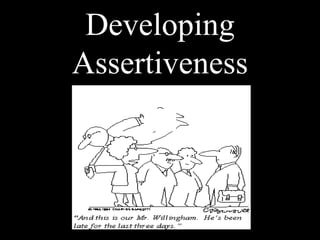
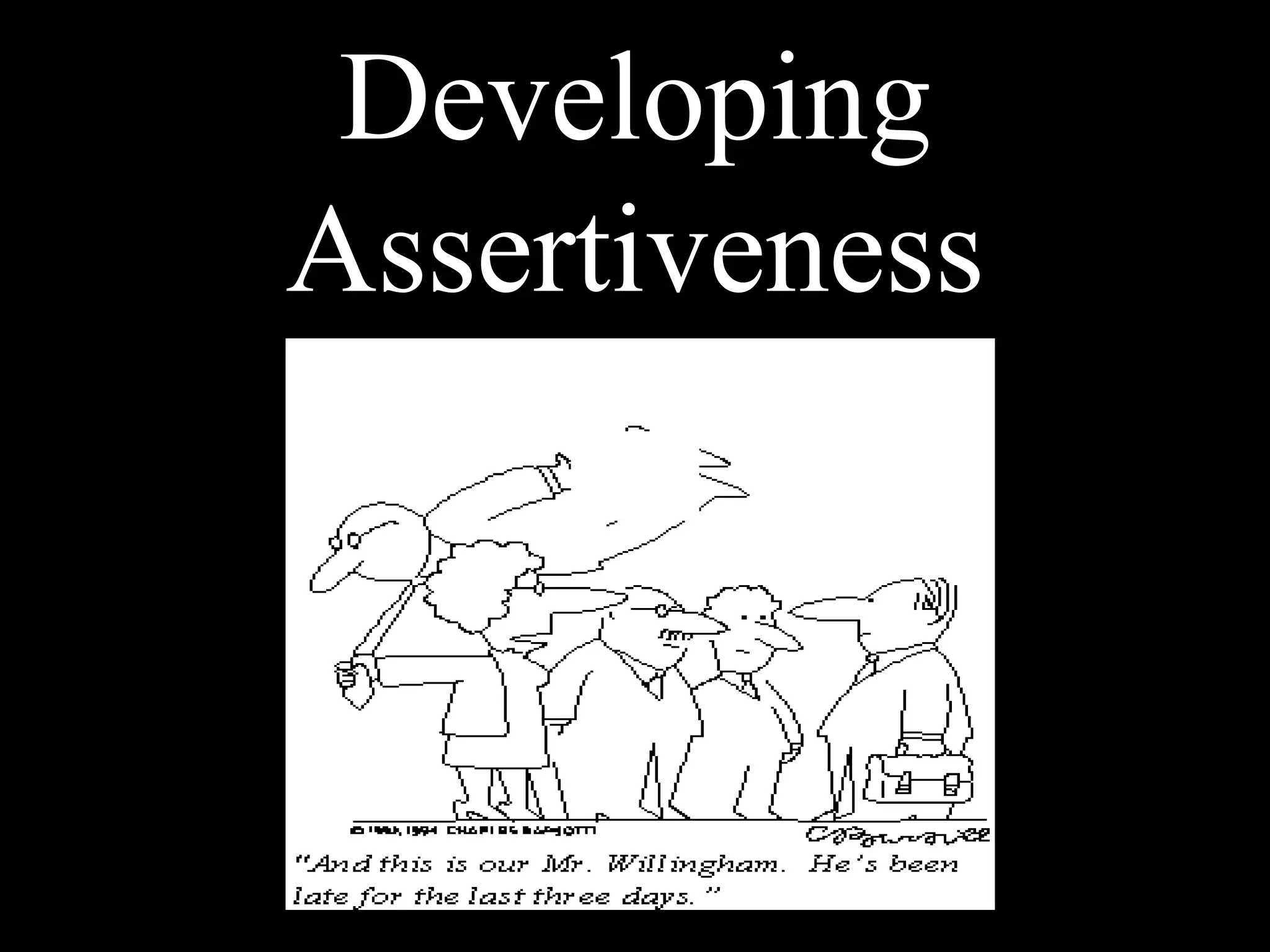
Developing
Assertiveness


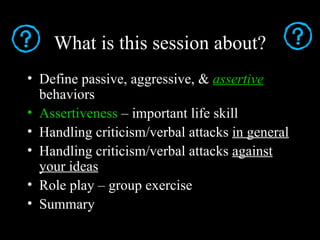
What is this session about?
• Define passive, aggressive, & assertive
  behaviors
• Assertiveness – important life skill
• Handling criticism/verbal attacks in general
• Handling criticism/verbal attacks against
  your ideas
• Role play – group exercise
• Summary
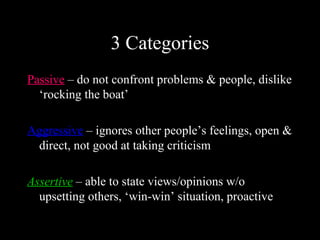
3 Categories
Passive – do not confront problems & people, dislike
  ‘rocking the boat’

Aggressive – ignores other people’s feelings, open &
 direct, not good at taking criticism

Assertive – able to state views/opinions w/o
  upsetting others, ‘win-win’ situation, proactive
So what exactly does
     assertiveness mean?


It is getting your thoughts across and
dealing with a situation in a straightforward
manner without harming others.
Why is this important?
• Because it is an essential workplace skill.

• Because genuinely assertive people are
  better to work with. They establish more
  effective relationships.

• Technical and professional skills are
  highlighted by excellent interpersonal
  skills
Traits of an assertive person
• Confident in a relaxed way
• Able to openly state views/opinions w/o upsetting
  others
• Do not ignore problems – looks for ‘win-win
  situations’
• Proactive – looks for solutions instead of blaming
  others
• Able to admit mistakes w/o excessive apologizing
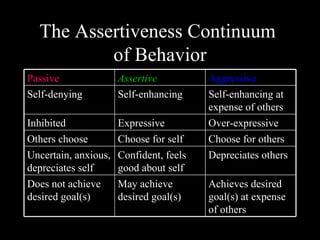
The Assertiveness Continuum
          of Behavior
Passive               Assertive          Aggressive
Self-denying          Self-enhancing     Self-enhancing at
                                         expense of others
Inhibited             Expressive         Over-expressive
Others choose         Choose for self    Choose for others
Uncertain, anxious,   Confident, feels   Depreciates others
depreciates self      good about self
Does not achieve      May achieve        Achieves desired
desired goal(s)       desired goal(s)    goal(s) at expense
                                         of others
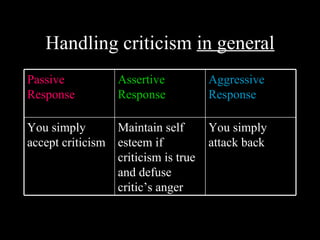
Handling criticism in general
Passive           Assertive          Aggressive
Response          Response           Response

You simply       Maintain self       You simply
accept criticism esteem if           attack back
                 criticism is true
                 and defuse
                 critic’s anger
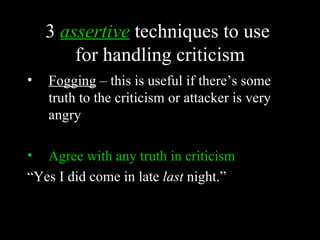
3 assertive techniques to use
        for handling criticism
•   Fogging – this is useful if there’s some
    truth to the criticism or attacker is very
    angry

•  Agree with any truth in criticism
“Yes I did come in late last night.”
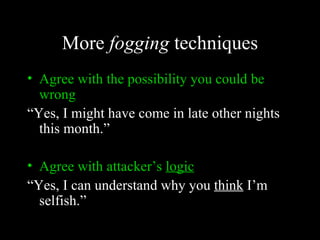
More fogging techniques
• Agree with the possibility you could be
  wrong
“Yes, I might have come in late other nights
  this month.”

• Agree with attacker’s logic
“Yes, I can understand why you think I’m
  selfish.”
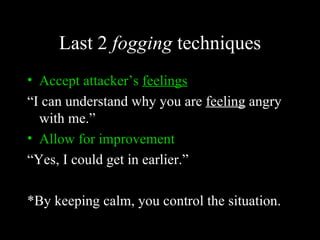
Last 2 fogging techniques
• Accept attacker’s feelings
“I can understand why you are feeling angry
  with me.”
• Allow for improvement
“Yes, I could get in earlier.”

*By keeping calm, you control the situation.
2 assertive technique to use
     nd

     for handling criticism
2. Negative assertion – use this if you know
  for sure you have done something wrong.

  If you calmly admit mistake w/o excessive
  apologizing, both you and attacker can
  maintain dignity and anger of attacker is
  defused.
Negative assertion techniques
• Agree with criticism
“Yes, I do talk too much in class.”
“Yes, I am moody sometimes.”

• Agree with the critic’s values
“Yes, I should have worked harder.”
“Yes, what I said last night was stupid.”
Should I say I’m sorry?
Yes but only if you really are.

An insincere apology can just
 make the situation worse.
3 assertive technique
         rd

    to use for handling criticism
3. Negative Inquiry – best to use if:

c) You are not sure why you are being
   criticized
d) You suspect that the criticism is not based
   on factual evidence
e) You have a strong hunch that critic is
   trying to manipulate you.
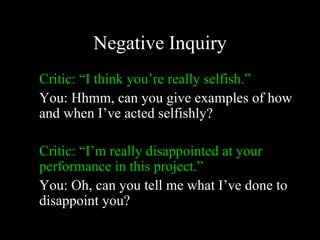
Negative Inquiry
Critic: “I think you’re really selfish.”
You: Hhmm, can you give examples of how
and when I’ve acted selfishly?

Critic: “I’m really disappointed at your
performance in this project.”
You: Oh, can you tell me what I’ve done to
disappoint you?
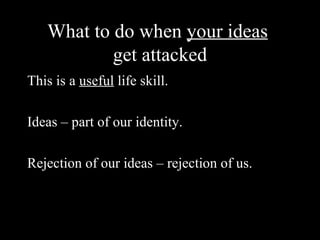
What to do when your ideas
           get attacked
This is a useful life skill.

Ideas – part of our identity.

Rejection of our ideas – rejection of us.
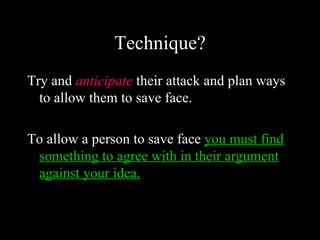
Technique?
Try and anticipate their attack and plan ways
  to allow them to save face.

To allow a person to save face you must find
 something to agree with in their argument
 against your idea.
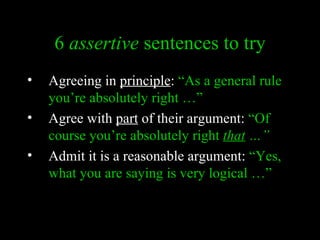
6 assertive sentences to try
•   Agreeing in principle: “As a general rule
    you’re absolutely right …”
•   Agree with part of their argument: “Of
    course you’re absolutely right that …”
•   Admit it is a reasonable argument: “Yes,
    what you are saying is very logical …”
6 assertive sentences to try
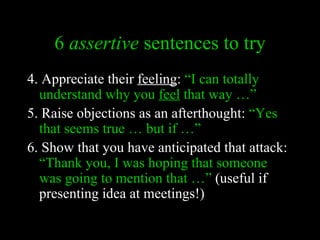
4. Appreciate their feeling: “I can totally
  understand why you feel that way …”
5. Raise objections as an afterthought: “Yes
  that seems true … but if …”
6. Show that you have anticipated that attack:
  “Thank you, I was hoping that someone
  was going to mention that …” (useful if
  presenting idea at meetings!)
Sentence to watch out for
“I don’t want to be rude but …”

- simple warning that person saying it is about
   to be very rude/aggressive
Let’s do a quick
           reflection exercise
Write down a circumstance when you have been
    criticized recently:

•   How did you react? Which approach did you
    use?
•   What was the effect on both you & your critic
    when you used that approach?
•   Which assertive strategies could you have used
    instead?
Role play
exercise
20 minutes
So we’ve gone over:
• Assertiveness test & interpretation of results
• Define passive, aggressive, & assertive
  behaviors
• Assertiveness – important life skill
• Handling criticism/verbal attacks in general
• Handling criticism/verbal attacks against
  your ideas
• Role play – group exercise
To conclude: What happens
    when you behave assertively?

•   You feel more comfortable with yourself
•   Your self-esteem improves
•   You become more valued and respected
•   Your technical & professional abilities are
    highlighted by excellent interpersonal skills
Last note
In most situations we have the choice to be
     passive, assertive, or aggressive.


 Being assertive is often the best choice.
Thanks for
 your time

Developing Assertiveness

  • 1.
    Developing Assertiveness                                         
  • 2.
    What is thissession about? • Define passive, aggressive, & assertive behaviors • Assertiveness – important life skill • Handling criticism/verbal attacks in general • Handling criticism/verbal attacks against your ideas • Role play – group exercise • Summary
  • 3.
    3 Categories Passive –do not confront problems & people, dislike ‘rocking the boat’ Aggressive – ignores other people’s feelings, open & direct, not good at taking criticism Assertive – able to state views/opinions w/o upsetting others, ‘win-win’ situation, proactive
  • 4.
    So what exactlydoes assertiveness mean? It is getting your thoughts across and dealing with a situation in a straightforward manner without harming others.
  • 5.
    Why is thisimportant? • Because it is an essential workplace skill. • Because genuinely assertive people are better to work with. They establish more effective relationships. • Technical and professional skills are highlighted by excellent interpersonal skills
  • 6.
    Traits of anassertive person • Confident in a relaxed way • Able to openly state views/opinions w/o upsetting others • Do not ignore problems – looks for ‘win-win situations’ • Proactive – looks for solutions instead of blaming others • Able to admit mistakes w/o excessive apologizing
  • 7.
    The Assertiveness Continuum of Behavior Passive Assertive Aggressive Self-denying Self-enhancing Self-enhancing at expense of others Inhibited Expressive Over-expressive Others choose Choose for self Choose for others Uncertain, anxious, Confident, feels Depreciates others depreciates self good about self Does not achieve May achieve Achieves desired desired goal(s) desired goal(s) goal(s) at expense of others
  • 8.
    Handling criticism ingeneral Passive Assertive Aggressive Response Response Response You simply Maintain self You simply accept criticism esteem if attack back criticism is true and defuse critic’s anger
  • 9.
    3 assertive techniquesto use for handling criticism • Fogging – this is useful if there’s some truth to the criticism or attacker is very angry • Agree with any truth in criticism “Yes I did come in late last night.”
  • 10.
    More fogging techniques •Agree with the possibility you could be wrong “Yes, I might have come in late other nights this month.” • Agree with attacker’s logic “Yes, I can understand why you think I’m selfish.”
  • 11.
    Last 2 foggingtechniques • Accept attacker’s feelings “I can understand why you are feeling angry with me.” • Allow for improvement “Yes, I could get in earlier.” *By keeping calm, you control the situation.
  • 12.
    2 assertive techniqueto use nd for handling criticism 2. Negative assertion – use this if you know for sure you have done something wrong. If you calmly admit mistake w/o excessive apologizing, both you and attacker can maintain dignity and anger of attacker is defused.
  • 13.
    Negative assertion techniques •Agree with criticism “Yes, I do talk too much in class.” “Yes, I am moody sometimes.” • Agree with the critic’s values “Yes, I should have worked harder.” “Yes, what I said last night was stupid.”
  • 14.
    Should I sayI’m sorry? Yes but only if you really are. An insincere apology can just make the situation worse.
  • 15.
    3 assertive technique rd to use for handling criticism 3. Negative Inquiry – best to use if: c) You are not sure why you are being criticized d) You suspect that the criticism is not based on factual evidence e) You have a strong hunch that critic is trying to manipulate you.
  • 16.
    Negative Inquiry Critic: “Ithink you’re really selfish.” You: Hhmm, can you give examples of how and when I’ve acted selfishly? Critic: “I’m really disappointed at your performance in this project.” You: Oh, can you tell me what I’ve done to disappoint you?
  • 17.
    What to dowhen your ideas get attacked This is a useful life skill. Ideas – part of our identity. Rejection of our ideas – rejection of us.
  • 18.
    Technique? Try and anticipatetheir attack and plan ways to allow them to save face. To allow a person to save face you must find something to agree with in their argument against your idea.
  • 19.
    6 assertive sentencesto try • Agreeing in principle: “As a general rule you’re absolutely right …” • Agree with part of their argument: “Of course you’re absolutely right that …” • Admit it is a reasonable argument: “Yes, what you are saying is very logical …”
  • 20.
    6 assertive sentencesto try 4. Appreciate their feeling: “I can totally understand why you feel that way …” 5. Raise objections as an afterthought: “Yes that seems true … but if …” 6. Show that you have anticipated that attack: “Thank you, I was hoping that someone was going to mention that …” (useful if presenting idea at meetings!)
  • 21.
    Sentence to watchout for “I don’t want to be rude but …” - simple warning that person saying it is about to be very rude/aggressive
  • 22.
    Let’s do aquick reflection exercise Write down a circumstance when you have been criticized recently: • How did you react? Which approach did you use? • What was the effect on both you & your critic when you used that approach? • Which assertive strategies could you have used instead?
  • 23.
  • 24.
    So we’ve goneover: • Assertiveness test & interpretation of results • Define passive, aggressive, & assertive behaviors • Assertiveness – important life skill • Handling criticism/verbal attacks in general • Handling criticism/verbal attacks against your ideas • Role play – group exercise
  • 25.
    To conclude: Whathappens when you behave assertively? • You feel more comfortable with yourself • Your self-esteem improves • You become more valued and respected • Your technical & professional abilities are highlighted by excellent interpersonal skills
  • 26.
    Last note In mostsituations we have the choice to be passive, assertive, or aggressive. Being assertive is often the best choice.
  • 27.