Assertiveness Training
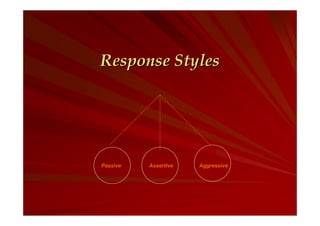
Response Styles

Passive

Assertive

Aggressive
Submissive Response
Submissive Response is usually made by people, who attempt
to gain the approval of others and avoid upsetting others.

People who demonstrate this behavior •Don’t stand up for themselves.
•Find it difficult to say NO.
•May express opinions in a cautious or mild manner, or they may not
express it at all.
•Allow others to dominate them.
•Allow others to take credit for work they have completed.
•Feel taken for granted in many situations.
•Feel ineffective in social situations.
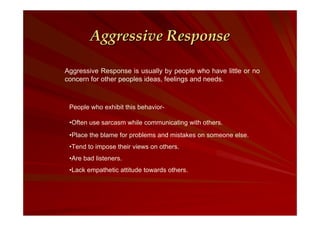
Aggressive Response
Aggressive Response is usually by people who have little or no
concern for other peoples ideas, feelings and needs.

People who exhibit this behavior•Often use sarcasm while communicating with others.
•Place the blame for problems and mistakes on someone else.
•Tend to impose their views on others.
•Are bad listeners.
•Lack empathetic attitude towards others.
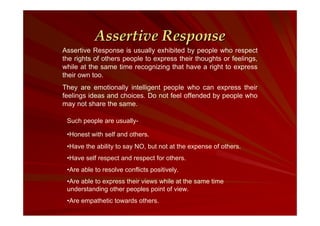
Assertive Response
Assertive Response is usually exhibited by people who respect
the rights of others people to express their thoughts or feelings,
while at the same time recognizing that have a right to express
their own too.
They are emotionally intelligent people who can express their
feelings ideas and choices. Do not feel offended by people who
may not share the same.
Such people are usually•Honest with self and others.
•Have the ability to say NO, but not at the expense of others.
•Have self respect and respect for others.
•Are able to resolve conflicts positively.
•Are able to express their views while at the same time
understanding other peoples point of view.
•Are empathetic towards others.
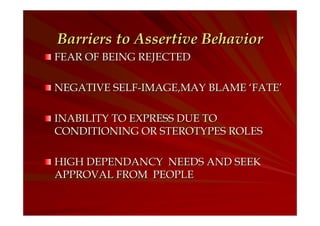
Barriers to Assertive Behavior
FEAR OF BEING REJECTED
NEGATIVE SELF-IMAGE,MAY BLAME ‘FATE’
INABILITY TO EXPRESS DUE TO
CONDITIONING OR STEROTYPES ROLES
HIGH DEPENDANCY NEEDS AND SEEK
APPROVAL FROM PEOPLE
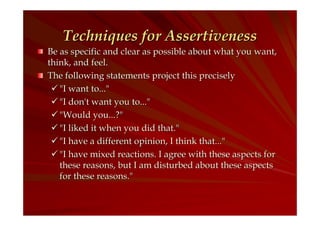
Techniques for Assertiveness
Be as specific and clear as possible about what you want,
think, and feel.
The following statements project this precisely
 "I want to..."
 "I don't want you to..."
 "Would you...?"
 "I liked it when you did that."
 "I have a different opinion, I think that..."
 "I have mixed reactions. I agree with these aspects for
these reasons, but I am disturbed about these aspects
for these reasons."
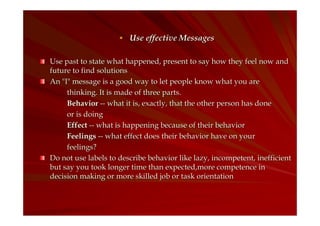
 Use effective Messages
Use past to state what happened, present to say how they feel now and
future to find solutions
An "I" message is a good way to let people know what you are
thinking. It is made of three parts.
Behavior -- what it is, exactly, that the other person has done
or is doing
Effect -- what is happening because of their behavior
Feelings -- what effect does their behavior have on your
feelings?
Do not use labels to describe behavior like lazy, incompetent, inefficient
but say you took longer time than expected,more competence in
decision making or more skilled job or task orientation
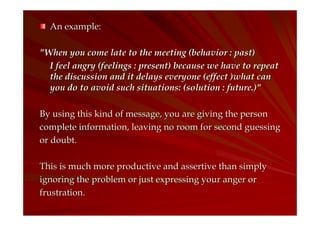
An example:
"When you come late to the meeting (behavior : past)
I feel angry (feelings : present) because we have to repeat
the discussion and it delays everyone (effect )what can
you do to avoid such situations: (solution : future.)"
By using this kind of message, you are giving the person
complete information, leaving no room for second guessing
or doubt.
This is much more productive and assertive than simply
ignoring the problem or just expressing your anger or
frustration.
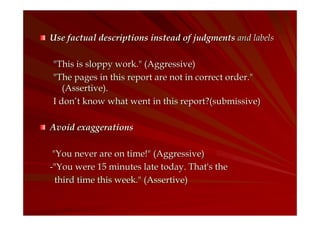
Use factual descriptions instead of judgments and labels
"This is sloppy work." (Aggressive)
"The pages in this report are not in correct order."
(Assertive).
I don’t know what went in this report?(submissive)
Avoid exaggerations
"You never are on time!" (Aggressive)
-"You were 15 minutes late today. That's the
third time this week." (Assertive)
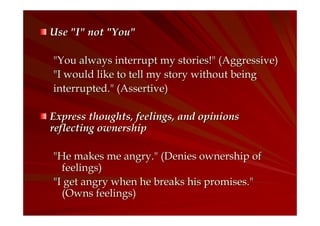
Use "I" not "You"
"You always interrupt my stories!" (Aggressive)
"I would like to tell my story without being
interrupted." (Assertive)
Express thoughts, feelings, and opinions
reflecting ownership
"He makes me angry." (Denies ownership of
feelings)
"I get angry when he breaks his promises."
(Owns feelings)
Positive Body Language
Maintain Eye-Contact.
Facial expressions, the ultimate give away!
Posture and gestures.
Listen...and let people know you have heard what they
said.
Be polite, clear and firm.
When we loose temper we stop controlling situations
Build consensus not agreement, build commitment not
compliance.
Don’t command seek cooperation.

Assertiveness

  • 1.
  • 2.
  • 3.
    Submissive Response Submissive Responseis usually made by people, who attempt to gain the approval of others and avoid upsetting others. People who demonstrate this behavior •Don’t stand up for themselves. •Find it difficult to say NO. •May express opinions in a cautious or mild manner, or they may not express it at all. •Allow others to dominate them. •Allow others to take credit for work they have completed. •Feel taken for granted in many situations. •Feel ineffective in social situations.
  • 4.
    Aggressive Response Aggressive Responseis usually by people who have little or no concern for other peoples ideas, feelings and needs. People who exhibit this behavior•Often use sarcasm while communicating with others. •Place the blame for problems and mistakes on someone else. •Tend to impose their views on others. •Are bad listeners. •Lack empathetic attitude towards others.
  • 5.
    Assertive Response Assertive Responseis usually exhibited by people who respect the rights of others people to express their thoughts or feelings, while at the same time recognizing that have a right to express their own too. They are emotionally intelligent people who can express their feelings ideas and choices. Do not feel offended by people who may not share the same. Such people are usually•Honest with self and others. •Have the ability to say NO, but not at the expense of others. •Have self respect and respect for others. •Are able to resolve conflicts positively. •Are able to express their views while at the same time understanding other peoples point of view. •Are empathetic towards others.
  • 6.
    Barriers to AssertiveBehavior FEAR OF BEING REJECTED NEGATIVE SELF-IMAGE,MAY BLAME ‘FATE’ INABILITY TO EXPRESS DUE TO CONDITIONING OR STEROTYPES ROLES HIGH DEPENDANCY NEEDS AND SEEK APPROVAL FROM PEOPLE
  • 7.
    Techniques for Assertiveness Beas specific and clear as possible about what you want, think, and feel. The following statements project this precisely  "I want to..."  "I don't want you to..."  "Would you...?"  "I liked it when you did that."  "I have a different opinion, I think that..."  "I have mixed reactions. I agree with these aspects for these reasons, but I am disturbed about these aspects for these reasons."
  • 8.
     Use effectiveMessages Use past to state what happened, present to say how they feel now and future to find solutions An "I" message is a good way to let people know what you are thinking. It is made of three parts. Behavior -- what it is, exactly, that the other person has done or is doing Effect -- what is happening because of their behavior Feelings -- what effect does their behavior have on your feelings? Do not use labels to describe behavior like lazy, incompetent, inefficient but say you took longer time than expected,more competence in decision making or more skilled job or task orientation
  • 9.
    An example: "When youcome late to the meeting (behavior : past) I feel angry (feelings : present) because we have to repeat the discussion and it delays everyone (effect )what can you do to avoid such situations: (solution : future.)" By using this kind of message, you are giving the person complete information, leaving no room for second guessing or doubt. This is much more productive and assertive than simply ignoring the problem or just expressing your anger or frustration.
  • 10.
    Use factual descriptionsinstead of judgments and labels "This is sloppy work." (Aggressive) "The pages in this report are not in correct order." (Assertive). I don’t know what went in this report?(submissive) Avoid exaggerations "You never are on time!" (Aggressive) -"You were 15 minutes late today. That's the third time this week." (Assertive)
  • 11.
    Use "I" not"You" "You always interrupt my stories!" (Aggressive) "I would like to tell my story without being interrupted." (Assertive) Express thoughts, feelings, and opinions reflecting ownership "He makes me angry." (Denies ownership of feelings) "I get angry when he breaks his promises." (Owns feelings)
  • 12.
    Positive Body Language MaintainEye-Contact. Facial expressions, the ultimate give away! Posture and gestures. Listen...and let people know you have heard what they said. Be polite, clear and firm. When we loose temper we stop controlling situations Build consensus not agreement, build commitment not compliance. Don’t command seek cooperation.