Time Management
Inspirational quotes on time management
• Michael Altshuler
The bad news is time flies. The good news is
you're the pilot.
• Richard H. Nelson
Never let yesterday use up today.
• H. Jackson Brown
Don't say you don't have enough time. You
have exactly the same number of hours per
day that were given to Helen Keller, Pasteur,
Michelangelo, Mother Teresa, Leonardo da
Vinci, Thomas Jefferson, and Albert Einstein.
Inspirational quotes on time management
• M. Scott Peck
Until you value yourself, you will not value
your time. Until you value your time, you
will not do anything with it
• Samuel Smiles
Lost wealth may be replaced by industry,
lost knowledge by study, lost health by
temperance or medicine, but lost time is
gone forever.
What is Time Management?
• Time management is the development of processes and
tools that increase an individual’s time-efficiency.
– The ability to manage and control time.
– The use of planners, calendars, and the like as effective tools in
managing time.
– Implementing a routine as a method of scheduling actions
which enforce a regiment to fit with a person's flow of work and
activities.
• Time Management teaches a number of techniques that aim
to increase the effectiveness of a person in getting the
things done that need to be done
Why Is Time Management
Important?
• Time is limited
• Time is scarce
• You need time to get what you want out of
life
• You can accomplish more with less effort
• Too many choices
Let’s now do a small time audit to see how
much time we spend every day on various
activities….
Time Audit
• A time Audit is nothing but the exaination of time spent on various
activities.
• Make a note of all your activities for a routine day.
• Some examples of activites can be as under:
– Classes
• College
• Tuitions
• Extra curricular activities (dance, music, cricket,etc)
– Studying
– Sports/exercise
– Work (if working)
– Family Commitments
– Personal care / grooming
– Meal preparation/eating/cleaning up
– Travel (to college, office, etc)
– Relaxing alone (TV, Games, hobbies, etc)
– Socializing with friends/colleagues
– Sleeping
• Visit the following link to check how much time you spend on the above
activities:
http://www.studygs.net/schedule/
A sample Time Audit Sheet
(fill your activities in the grid)
Mon Tues Wed Thur Fri Sat Sun
6:00 AM
6:30
7:00
7:30
8:00
8:30
9:00
9:30
10:00
10:30
11:00
11:30
NOON Mon Tues Wed Thur Fri Sat Sun
12:30
1:00
1:30
2:00
2:30
3:00
3:30
4:00
4:30
5:00
5:30
Mon Tues Wed Thur Fri Sat Sun
6:30
7:00
7:30
8:00
8:30
9:00
9:30
10:00
10:30
11:00
11:30
Midnight Mon Tues Wed Thur Fri Sat Sun
12:30
1:00
1:30
2:00
2:30
3:00
3:30
4:00
4:30
5:00
5:30
Analysis of the Time Audit Sheet
• Fill the Time Audit Sheet religiously for a week.
• At the end of the week examine the sheet to see
how productive each day has been.
• If you are honest with yourself you may find
activities that are just time-wasters which
probably can be abandoned.
Time Management Matrix
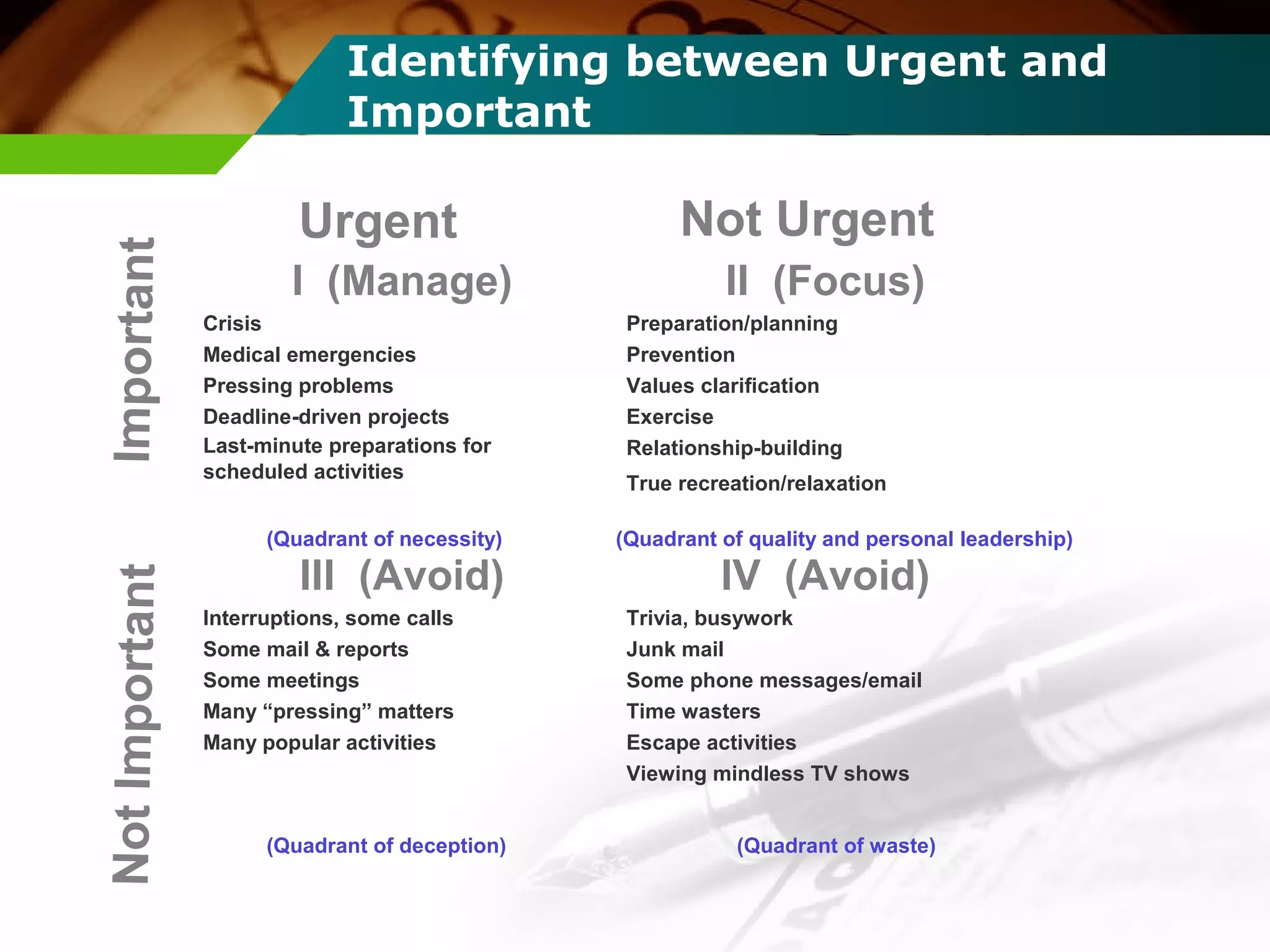
Schematically, this concept is shown below:
Importance-urgency
syndrome
Identifying between Urgent and
Important
I (Manage)
Crisis
Medical emergencies
Pressing problems
Deadline-driven projects
Last-minute preparations for
scheduled activities
II (Focus)
Preparation/planning
Prevention
Values clarification
Exercise
Relationship-building
True recreation/relaxation
III (Avoid)
Interruptions, some calls
Some mail & reports
Some meetings
Many “pressing” matters
Many popular activities
IV (Avoid)
Trivia, busywork
Junk mail
Some phone messages/email
Time wasters
Escape activities
Viewing mindless TV shows
Urgent Not Urgent
ImportantNotImportant
(Quadrant of deception)
(Quadrant of necessity) (Quadrant of quality and personal leadership)
(Quadrant of waste)
Quadrant I
• Quadrant I is both urgent and important.
• It deals with situations that require immediate
attention.
• They are generally termed as ‘crises’ or
‘problems’.
• Result of spending too long a time in Quadrant I
is stress and burnout.
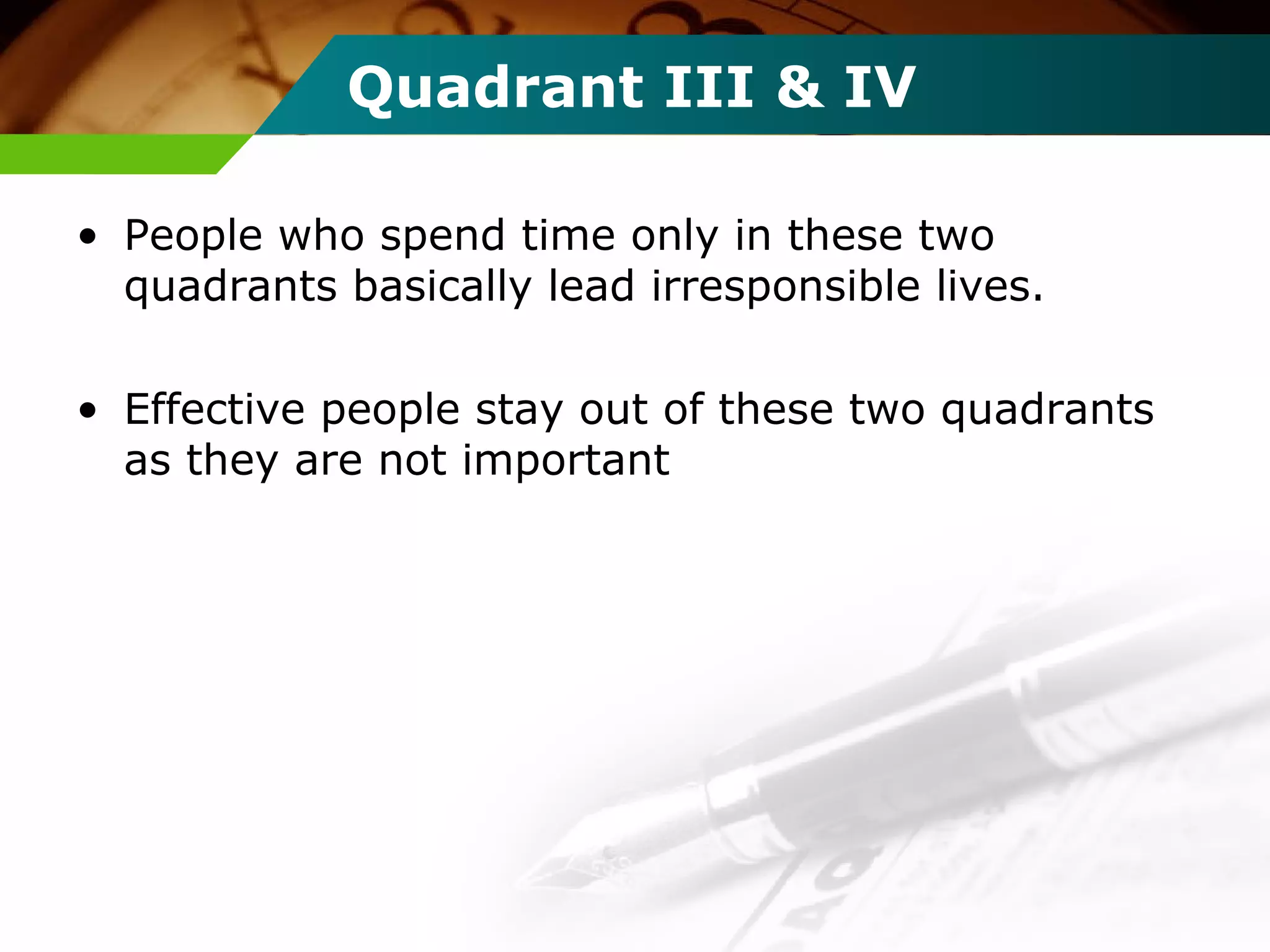
Quadrant III & IV
• People who spend time only in these two
quadrants basically lead irresponsible lives.
• Effective people stay out of these two quadrants
as they are not important
Quadrant II
• Deals with activities that are not urgent, but are
important.
• This quadrant is the pivot of effective time management.
• Deals with activities like relationship building, long term
planning, preventive maintenance.
• If you focus on quadrant 2 activities, you will have
enhanced your vision, perspective, balance, discipline,
control, and have fewer crises.
• Try to set aside time each day to work on something that
is important but not necessarily urgent as a way of getting
ahead. In doing so, you buy extra time later to handle the
unexpected events that invariably happen to everyone.
Tips for Time Management
• Spend time planning and organizing
– Maintain a calendar/diary
– List down important activities that need to be done
• Set SMART Goals
– Goals must be Specific, Measurable, Attainable,
Relevant and Time bound.
• Prioritize
– 80:20 Rule (80% of the output should be produced by
putting in 20% of your time)
Contd…
Tips for Time Management
• Use a To Do List
– Constantly add/delete as the status maybe
• Be Flexible
– Plan for 50% of your time, the balance for
unplanned interruptions/ emergencies
• Consider your biological prime time
– When are you most productive ?
• Do the right thing right
– Effectiveness or Efficiency?
• Eliminate the urgent
– Short term consequences Vs. Long- term goal related
implications
• Learn to say ‘No’
– Staying focused
• Reward yourself
– Celebrate Achievement to keep motivated
Tips for Time Management
Advantages of Time Management
• gain time
• motivates and initiates
• reduces avoidance
• promotes review
• reduces anxiety
Aids in Time Management
• ‘To do’ list
• Daily/weekly planner
• Long term planner
‘To do’ List
• A To Do list is a list of activities that have
to be done by you.
• Once the list is made, then decide
– what to do at the moment/for the day
– what to schedule for later
– what to get someone else to do
– and what to put off for a later time
period
• Use the A-B-C Value rating system in your
To Do list (will be discussed shortly)
Making a ‘To Do’ list
• Assign high (A), medium (B), and low priority (C), to your
activities in the To Do list – called A-B-C rating.
• Ask yourself questions like: "What is important?" versus
"What is urgent?" versus "What is both urgent and
important?" If you have too many "A" tasks, you need to
decide which is more important.
• Keep important tasks at the top of your to-do list; write
them in red ink; or keep the important task list on top of
the less important task list.
• Break important tasks into manageable chunks. You may
be able to accomplish something on one or another
important task without having to do it all at once.
Making a ‘To Do’ list
• Understand that doing less important tasks may be easier
or more familiar or seem like you are getting things done,
BUT may not count for much (a clean room won't get you
an A in chemistry!).
• Important tasks are often difficult and anxiety provoking
simply because of their importance. Once again, break
them into manageable chunks, build your tolerance and
skill, and reward yourself for staying on target.
Tips to remember while making a To
Do list
• get into the habit of making your list every
morning or every evening.
• be specific - define exactly what you have to do
• break your tasks into small steps - it leads to
greater success
• ask yourself if it is feasible for you to complete all
your A's during the day
• ask yourself if you will feel good about yourself if
you complete all your A's for the day
Advantages of a To Do list
• A to-do-list is more dependable than our memory. It helps
us know the different things that have to be done so that
we do not miss anything.
• A to-do-list enables us to cross out the finished tasks which
gives us a sense of accomplishment and satisfaction. It also
has the effect of shocking us if nothing has been done and
crossed out.
• Balance or incomplete tasks can be carried over to te next
day’s To Do list. It is an excellent way of maintaining
continuity till finished.
• Once we have a written list of the things that we have to
do, we can prioritize and decide which jobs should be done
first.
A Sample ‘To Do’ List
1. Pay tuition fees. Last day today (A)
2. Pick up sister from the dance class (A)
3. Buy a present for mom’s birthday
4. Finish revising final accounts
5. Pick up clothes from the dry cleaners
6. Prepare for tomorrow’s aptitude test (A)
7. Recharge the cell phone currency (A)
To Do – 04/09/06
Time Management is all about
efficient Multi-tasking!
Thank You!

Time management

  • 1.
  • 2.
    Inspirational quotes ontime management • Michael Altshuler The bad news is time flies. The good news is you're the pilot. • Richard H. Nelson Never let yesterday use up today. • H. Jackson Brown Don't say you don't have enough time. You have exactly the same number of hours per day that were given to Helen Keller, Pasteur, Michelangelo, Mother Teresa, Leonardo da Vinci, Thomas Jefferson, and Albert Einstein.
  • 3.
    Inspirational quotes ontime management • M. Scott Peck Until you value yourself, you will not value your time. Until you value your time, you will not do anything with it • Samuel Smiles Lost wealth may be replaced by industry, lost knowledge by study, lost health by temperance or medicine, but lost time is gone forever.
  • 4.
    What is TimeManagement? • Time management is the development of processes and tools that increase an individual’s time-efficiency. – The ability to manage and control time. – The use of planners, calendars, and the like as effective tools in managing time. – Implementing a routine as a method of scheduling actions which enforce a regiment to fit with a person's flow of work and activities. • Time Management teaches a number of techniques that aim to increase the effectiveness of a person in getting the things done that need to be done
  • 5.
    Why Is TimeManagement Important? • Time is limited • Time is scarce • You need time to get what you want out of life • You can accomplish more with less effort • Too many choices
  • 6.
    Let’s now doa small time audit to see how much time we spend every day on various activities….
  • 7.
    Time Audit • Atime Audit is nothing but the exaination of time spent on various activities. • Make a note of all your activities for a routine day. • Some examples of activites can be as under: – Classes • College • Tuitions • Extra curricular activities (dance, music, cricket,etc) – Studying – Sports/exercise – Work (if working) – Family Commitments – Personal care / grooming – Meal preparation/eating/cleaning up – Travel (to college, office, etc) – Relaxing alone (TV, Games, hobbies, etc) – Socializing with friends/colleagues – Sleeping • Visit the following link to check how much time you spend on the above activities: http://www.studygs.net/schedule/
  • 8.
    A sample TimeAudit Sheet (fill your activities in the grid) Mon Tues Wed Thur Fri Sat Sun 6:00 AM 6:30 7:00 7:30 8:00 8:30 9:00 9:30 10:00 10:30 11:00 11:30 NOON Mon Tues Wed Thur Fri Sat Sun 12:30 1:00 1:30 2:00 2:30 3:00 3:30 4:00 4:30 5:00 5:30 Mon Tues Wed Thur Fri Sat Sun 6:30 7:00 7:30 8:00 8:30 9:00 9:30 10:00 10:30 11:00 11:30 Midnight Mon Tues Wed Thur Fri Sat Sun 12:30 1:00 1:30 2:00 2:30 3:00 3:30 4:00 4:30 5:00 5:30
  • 9.
    Analysis of theTime Audit Sheet • Fill the Time Audit Sheet religiously for a week. • At the end of the week examine the sheet to see how productive each day has been. • If you are honest with yourself you may find activities that are just time-wasters which probably can be abandoned.
  • 10.
  • 11.
    Schematically, this conceptis shown below: Importance-urgency syndrome
  • 12.
    Identifying between Urgentand Important I (Manage) Crisis Medical emergencies Pressing problems Deadline-driven projects Last-minute preparations for scheduled activities II (Focus) Preparation/planning Prevention Values clarification Exercise Relationship-building True recreation/relaxation III (Avoid) Interruptions, some calls Some mail & reports Some meetings Many “pressing” matters Many popular activities IV (Avoid) Trivia, busywork Junk mail Some phone messages/email Time wasters Escape activities Viewing mindless TV shows Urgent Not Urgent ImportantNotImportant (Quadrant of deception) (Quadrant of necessity) (Quadrant of quality and personal leadership) (Quadrant of waste)
  • 13.
    Quadrant I • QuadrantI is both urgent and important. • It deals with situations that require immediate attention. • They are generally termed as ‘crises’ or ‘problems’. • Result of spending too long a time in Quadrant I is stress and burnout.
  • 14.
    Quadrant III &IV • People who spend time only in these two quadrants basically lead irresponsible lives. • Effective people stay out of these two quadrants as they are not important
  • 15.
    Quadrant II • Dealswith activities that are not urgent, but are important. • This quadrant is the pivot of effective time management. • Deals with activities like relationship building, long term planning, preventive maintenance. • If you focus on quadrant 2 activities, you will have enhanced your vision, perspective, balance, discipline, control, and have fewer crises. • Try to set aside time each day to work on something that is important but not necessarily urgent as a way of getting ahead. In doing so, you buy extra time later to handle the unexpected events that invariably happen to everyone.
  • 16.
    Tips for TimeManagement
  • 17.
    Tips for TimeManagement • Spend time planning and organizing – Maintain a calendar/diary – List down important activities that need to be done • Set SMART Goals – Goals must be Specific, Measurable, Attainable, Relevant and Time bound. • Prioritize – 80:20 Rule (80% of the output should be produced by putting in 20% of your time) Contd…
  • 18.
    Tips for TimeManagement • Use a To Do List – Constantly add/delete as the status maybe • Be Flexible – Plan for 50% of your time, the balance for unplanned interruptions/ emergencies • Consider your biological prime time – When are you most productive ? • Do the right thing right – Effectiveness or Efficiency?
  • 19.
    • Eliminate theurgent – Short term consequences Vs. Long- term goal related implications • Learn to say ‘No’ – Staying focused • Reward yourself – Celebrate Achievement to keep motivated Tips for Time Management
  • 20.
    Advantages of TimeManagement • gain time • motivates and initiates • reduces avoidance • promotes review • reduces anxiety
  • 21.
    Aids in TimeManagement • ‘To do’ list • Daily/weekly planner • Long term planner
  • 22.
    ‘To do’ List •A To Do list is a list of activities that have to be done by you. • Once the list is made, then decide – what to do at the moment/for the day – what to schedule for later – what to get someone else to do – and what to put off for a later time period • Use the A-B-C Value rating system in your To Do list (will be discussed shortly)
  • 23.
    Making a ‘ToDo’ list • Assign high (A), medium (B), and low priority (C), to your activities in the To Do list – called A-B-C rating. • Ask yourself questions like: "What is important?" versus "What is urgent?" versus "What is both urgent and important?" If you have too many "A" tasks, you need to decide which is more important. • Keep important tasks at the top of your to-do list; write them in red ink; or keep the important task list on top of the less important task list. • Break important tasks into manageable chunks. You may be able to accomplish something on one or another important task without having to do it all at once.
  • 24.
    Making a ‘ToDo’ list • Understand that doing less important tasks may be easier or more familiar or seem like you are getting things done, BUT may not count for much (a clean room won't get you an A in chemistry!). • Important tasks are often difficult and anxiety provoking simply because of their importance. Once again, break them into manageable chunks, build your tolerance and skill, and reward yourself for staying on target.
  • 25.
    Tips to rememberwhile making a To Do list • get into the habit of making your list every morning or every evening. • be specific - define exactly what you have to do • break your tasks into small steps - it leads to greater success • ask yourself if it is feasible for you to complete all your A's during the day • ask yourself if you will feel good about yourself if you complete all your A's for the day
  • 26.
    Advantages of aTo Do list • A to-do-list is more dependable than our memory. It helps us know the different things that have to be done so that we do not miss anything. • A to-do-list enables us to cross out the finished tasks which gives us a sense of accomplishment and satisfaction. It also has the effect of shocking us if nothing has been done and crossed out. • Balance or incomplete tasks can be carried over to te next day’s To Do list. It is an excellent way of maintaining continuity till finished. • Once we have a written list of the things that we have to do, we can prioritize and decide which jobs should be done first.
  • 27.
    A Sample ‘ToDo’ List 1. Pay tuition fees. Last day today (A) 2. Pick up sister from the dance class (A) 3. Buy a present for mom’s birthday 4. Finish revising final accounts 5. Pick up clothes from the dry cleaners 6. Prepare for tomorrow’s aptitude test (A) 7. Recharge the cell phone currency (A) To Do – 04/09/06
  • 28.
    Time Management isall about efficient Multi-tasking!
  • 29.

Editor's Notes

  • #12 FACULTY TO EXPLAIN: As given in the book ‘SEVEN HABITS OF EFFECTIVE EXECUTIVES’ by Dr. Stephen Covey, these can be seen on 2 different scales.
  • #18 Using time to think and plan is time well-spent. In fact, if you fail to take time for planning, you are, in effect, planning to fail. Organize in a way that makes sense to you. If you need color and pictures, use a lot on your calendar or planning book. Some people need to have papers filed away; others get their creative energy from their piles. So forget the "should" and organize your way. Goals give your life, and the way you spend your time, direction. Set goals which are specific, measurable, realistic and achievable. Your optimum goals are those which cause you to "stretch" but not "break" as you strive for achievement. Goals can give creative people a much-needed sense of direction.
  • #20 That's the time of day when you are at your best. Are you a "morning person," a "night owl," or a late afternoon "whiz?" Knowing when your best time is and planning to use that time of day for your priorities (if possible) is effective time management. Noted management expert, Peter Drucker, says "doing the right thing is more important than doing things right." Doing the right thing is effectiveness; doing things right is efficiency. Focus first on effectiveness (identifying what is the right thing to do), then concentrate on efficiency (doing it right). Urgent tasks have short-term consequences while important tasks are those with long-term, goal-related implications. Work towards reducing the urgent things you must do so you'll have time for your important priorities. Flagging or highlighting items on your To Do list or attaching a deadline to each item may help keep important items from becoming urgent emergencies. Such a small word — and so hard to say. Focusing on your goals may help. Blocking time for important, but often not scheduled, priorities such as family and friends can also help. But first you must be convinced that you and your priorities are important — that seems to be the hardest part in learning to say "no." Once convinced of their importance, saying "no" to the unimportant in life gets easier. Even for small successes, celebrate achievement of goals. Promise yourself a reward for completing each task, or finishing the total job. Then keep your promise to yourself and indulge in your reward. Doing so will help you maintain the necessary balance in life between work and play.
  • #21 Needless to say if you manage time, you will also reap rich benefits for eg: You will have time to do more meaningful things… Since every activity is planned and accomplished as per schedule, it motivates you to take added challenges and new initiatives It allows time to evaluate and examine Most importantly by managing time sensibly and productively , it reduces anxiety . So you can see, how a little bit of planning & prioritization can save time and money…