
THE  ART OF BEING ASSERTIVE
Assertiveness is not about   trying to Dominate others
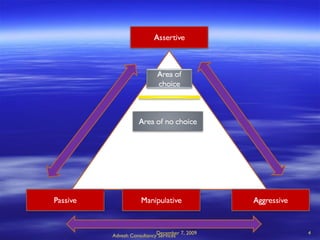
FOUR BEHAVIOURS
June 7, 2009 Advesh Consultancy Services
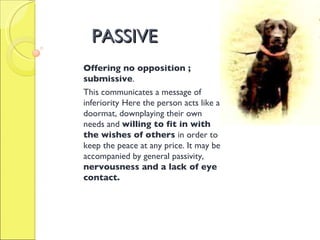
PASSIVE Offering no opposition ; submissive . This communicates a message of inferiority   Here the person acts like a doormat, downplaying their own needs and  willing to fit in with the wishes of others  in order to keep the peace at any price. It may be accompanied by general passivity,  nervousness and a lack of eye contact.
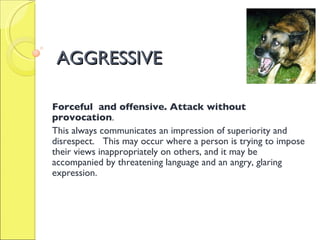
AGGRESSIVE Forceful  and offensive. Attack without provocation .  This always communicates an impression of superiority and disrespect.     This may occur where a person is trying to impose their views inappropriately on others, and it may be accompanied by threatening language and an angry, glaring expression.
MANIPULATIVE This typically occurs where a person seeks to ingratiate themself with another through flattery and other forms of deceit. It may be accompanied by cloying over-attention and a simpering, smarmy voice June 7, 2009 Advesh Consultancy Services
ASSERTIVENESS State clearly and forthright . Is the ability to express yourself  and  your rights in an open, non-confrontational way.
The key to assertiveness is  clear, open and honest  discussion that does not  blame, ridicule  or  put other people down .
June 7, 2009 Advesh Consultancy Services
WORK SITUATION Your boss finds an error in your work and scolds you in front of your colleagues. Your boss criticizes you unjustly in private. You know your standard of work to be very high possibly better than most in your section- but your boss is critical of you. Your boss by-passes you and admonishes one of your staff for errors committed. You feel your colleague is possessive of information which you need to complete your job. You are asked to take on additional work, although you are working to full capacity now. A customer/client is rude and abusive to you on the telephone. June 7, 2009 Advesh Consultancy Services
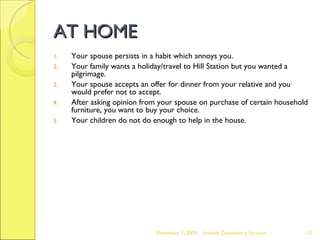
AT HOME Your spouse persists in a habit which annoys you. Your family wants a holiday/travel to Hill Station but you wanted a pilgrimage. Your spouse accepts an offer for dinner from your relative and you would prefer not to accept. After asking opinion from your spouse on purchase of certain household furniture, you want to buy your choice. Your children do not do enough to help in the house. June 7, 2009 Advesh Consultancy Services
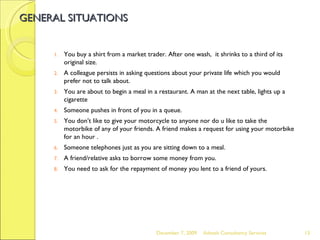
GENERAL SITUATIONS You buy a shirt from a market trader. After one wash,  it shrinks to a third of its original size. A colleague persists in asking questions about your private life which you would prefer not to talk about. You are about to begin a meal in a restaurant. A man at the next table, lights up a cigarette Someone pushes in front of you in a queue. You don’t like to give your motorcycle to anyone nor do u like to take the motorbike of any of your friends. A friend makes a request for using your motorbike for an hour . Someone telephones just as you are sitting down to a meal. A friend/relative asks to borrow some money from you. You need to ask for the repayment of money you lent to a friend of yours. June 7, 2009 Advesh Consultancy Services
ASSERTIVENESS TECHNIQUE OVERVIEW
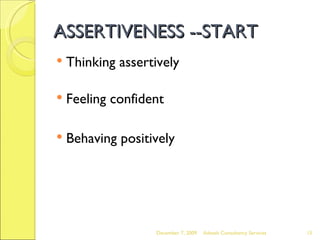
ASSERTIVENESS --START Thinking assertively Feeling confident Behaving positively June 7, 2009 Advesh Consultancy Services
MOST IMPORTANT EYE CONTACT June 7, 2009 Advesh Consultancy Services
ASSERTIVENESS TECHNIQUE Creating self esteem  Communication - Your voice and language  Communication - Body language  Persistency - Broken record and workable compromise Handling Criticism – Fogging and Negative assertion June 7, 2009 Advesh Consultancy Services
CREATING SELF ESTEEM WHAT IS SELF ESTEEM?
SELF ESTEEM Look at your personalities Be conscious of your abilities Feel proud of your achievements June 7, 2009 Advesh Consultancy Services
CREATING SELF ESTEEM Complete the following with a positive statement about a personal quality, attribute or achievement Examples I am knowledgeable about  Local market I can identify potential customers I think I am good in communication I believe in my judgment about people June 7, 2009 Advesh Consultancy Services
CREATING SELF ESTEEM I am I can I think I believe June 7, 2009 Advesh Consultancy Services
COMMUNICATION VOICE AND LANGUAGE
ASSERTIVE WORD CHOICE Use “I” statements rather than “You” statements. Use factual descriptions instead of judgments or exaggerations. Express thoughts , feelings , and opinions reflecting ownership Use clear , direct requests or directives when you want others to do something , rather than hinting , being indirect , or presuming June 7, 2009 Advesh Consultancy Services
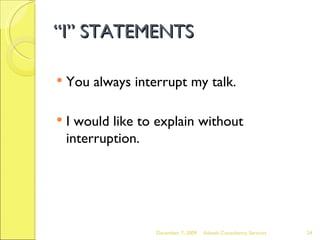
“ I” STATEMENTS You always interrupt my talk. I would like to explain without interruption. June 7, 2009 Advesh Consultancy Services
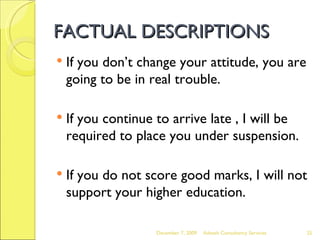
FACTUAL DESCRIPTIONS If you don’t change your attitude, you are going to be in real trouble. If you continue to arrive late , I will be required to place you under suspension. If you do not score good marks, I will not support your higher education. June 7, 2009 Advesh Consultancy Services
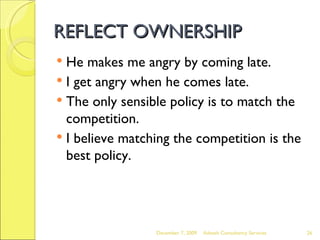
REFLECT OWNERSHIP He makes me angry by coming late. I get angry when he comes late. The only sensible policy is to match the competition. I believe matching the competition is the best policy. June 7, 2009 Advesh Consultancy Services
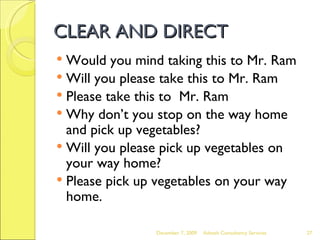
CLEAR AND DIRECT Would you mind taking this to Mr. Ram Will you please take this to Mr. Ram Please take this to  Mr. Ram Why don’t you stop on the way home and pick up vegetables? Will you please pick up vegetables on your way home? Please pick up vegetables on your way home. June 7, 2009 Advesh Consultancy Services
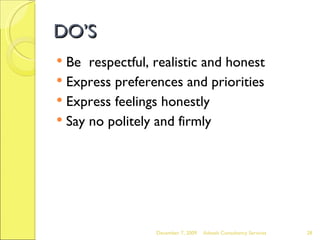
DO’S Be  respectful, realistic and honest Express preferences and priorities Express feelings honestly Say no politely and firmly June 7, 2009 Advesh Consultancy Services
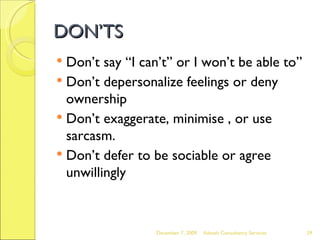
DON’TS Don’t say “I can’t” or I won’t be able to” Don’t depersonalize feelings or deny ownership Don’t exaggerate, minimise , or use sarcasm. Don’t defer to be sociable or agree unwillingly June 7, 2009 Advesh Consultancy Services
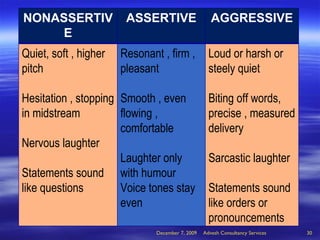
June 7, 2009 Advesh Consultancy Services NONASSERTIVE ASSERTIVE AGGRESSIVE Quiet, soft , higher pitch Hesitation , stopping in midstream Nervous laughter Statements sound like questions Resonant , firm , pleasant Smooth , even flowing , comfortable Laughter only with humour Voice tones stay even Loud or harsh or steely quiet Biting off words, precise , measured delivery Sarcastic laughter Statements sound like orders or pronouncements
COMMUNICATION BODY LANGUAGE
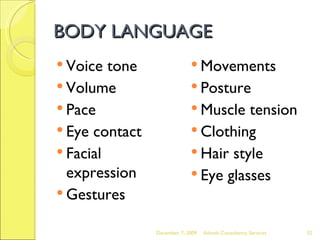
BODY LANGUAGE Voice tone Volume Pace Eye contact Facial expression Gestures Movements Posture Muscle tension Clothing Hair style Eye glasses June 7, 2009 Advesh Consultancy Services
BODY LANGUAGE P0STURES
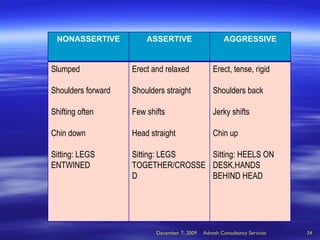
June 7, 2009 Advesh Consultancy Services NONASSERTIVE ASSERTIVE AGGRESSIVE Slumped Shoulders forward Shifting often Chin down Sitting: LEGS ENTWINED Erect and relaxed Shoulders straight Few shifts Head straight Sitting: LEGS TOGETHER/CROSSED Erect, tense, rigid Shoulders back Jerky shifts Chin up Sitting: HEELS ON DESK,HANDS BEHIND HEAD
BODY LANGUAGE GESTURES
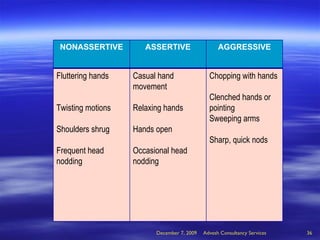
June 7, 2009 Advesh Consultancy Services NONASSERTIVE ASSERTIVE AGGRESSIVE Fluttering hands Twisting motions Shoulders shrug Frequent head nodding Casual hand movement Relaxing hands Hands open Occasional head nodding Chopping with hands Clenched hands or pointing Sweeping arms Sharp, quick nods
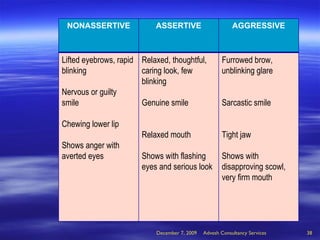
BODY LANGUAGE FACIAL EXPRESSION
June 7, 2009 Advesh Consultancy Services NONASSERTIVE ASSERTIVE AGGRESSIVE Lifted eyebrows, rapid blinking Nervous or guilty smile Chewing lower lip Shows anger with averted eyes Relaxed, thoughtful, caring look, few blinking Genuine smile Relaxed mouth Shows with flashing eyes and serious look Furrowed brow, unblinking glare Sarcastic smile Tight jaw Shows with disapproving scowl, very firm mouth
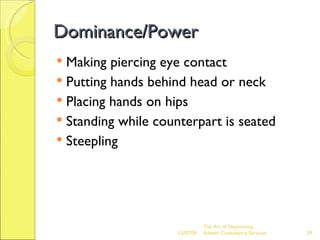
Dominance/Power Making piercing eye contact Putting hands behind head or neck Placing hands on hips Standing while counterpart is seated Steepling 06/07/09 The Art of Negotiating  Advesh Consultancy Services
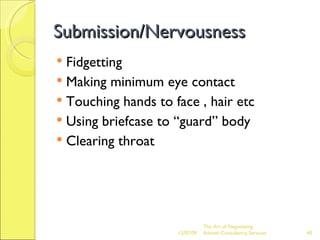
Submission/Nervousness Fidgetting Making minimum eye contact Touching hands to face , hair etc Using briefcase to “guard” body Clearing throat 06/07/09 The Art of Negotiating  Advesh Consultancy Services
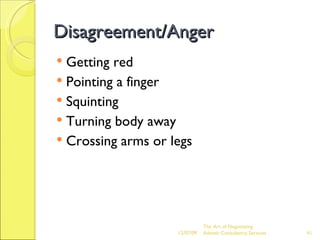
Disagreement/Anger Getting red Pointing a finger Squinting Turning body away Crossing arms or legs 06/07/09 The Art of Negotiating  Advesh Consultancy Services
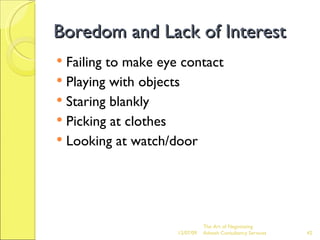
Boredom and Lack of Interest Failing to make eye contact Playing with objects Staring blankly Picking at clothes Looking at watch/door 06/07/09 The Art of Negotiating  Advesh Consultancy Services
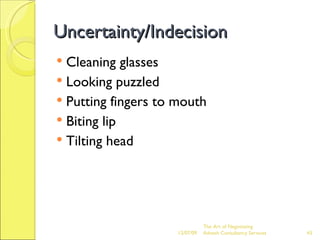
Uncertainty/Indecision Cleaning glasses Looking puzzled Putting fingers to mouth Biting lip Tilting head 06/07/09 The Art of Negotiating  Advesh Consultancy Services
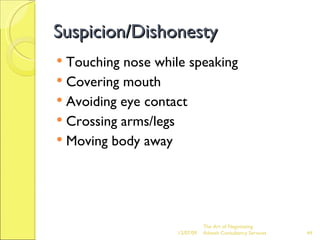
Suspicion/Dishonesty Touching nose while speaking Covering mouth Avoiding eye contact Crossing arms/legs Moving body away 06/07/09 The Art of Negotiating  Advesh Consultancy Services
Confidence, Cooperation and Honesty Leaning forward Keeping arms and palms open Maintaining great eye contact Placing feet flat on floor Sitting with legs uncrossed Smiling 06/07/09 The Art of Negotiating  Advesh Consultancy Services
PERSISTENCY BROKEN RECORD  AND  WORKABLE COMPROMISE
BROKEN RECORD A SKILL THAT BY CALM REPETITION- SAYING WHAT YOU WANT OVER AND OVER AGAIN- TEACHES PERSISTENCE WITHOUT YOU HAVING TO REHEARSE ARGUMENTS OR ANGRY FEELINGS.
WORKABLE COMPROMISE WHENEVER YOU FEEL THAT  YOUR  SELF RESPECT IS NOT IN QUESTION,  OFFER A WORKABLE COMPROMISE  TO THE OTHER PERSON.
SAY “NO” On a Sunday morning, your brother in law comes home and asks for your motorbike for his use for a day. You don’t want to give. One of your friends asks for a loan of Rs 1000. You have cash with you and your friend is aware of it. You need to refuse. June 7, 2009 Advesh Consultancy Services
HANDLING CRITICISM FOGGING NEGATIVE ASSERTION
CRITICISM Usually people react to criticism  by  avoiding it,  taking it to heart  or  reacting aggressively to it.  June 7, 2009 Advesh Consultancy Services
TIPS TO HANDLE CRITICISM Face and listen to criticism rather than avoid it.  Don't take it to heart.  React calmly and respect others rights, there is no point attacking the person. Be prepared for constructive criticism. This does not include blaming, put-downs or attempting to hurt someone to get what you want.  June 7, 2009 Advesh Consultancy Services
FOGGING A SKILL THAT TEACHES ACCEPTANCE  OF MANIPULATIVE CRITICISM  BY CALMLY ACKNOWLEDGING  TO YOUR CRITIC  THE PROBABILITY THAT THERE MAY BE SOME TRUTH IN WHAT HE SAYS,  YET ALLOWS YOU TO REMAIN  YOUR  OWN JUDGE OF  WHAT YOU DO. June 7, 2009 Advesh Consultancy Services
FOGGING Requires some self-control Stay calm in the face of criticism, and agreeing with whatever may be fair and useful in it.  By refusing to be provoked and upset by criticism, you remove its destructive power.  June 7, 2009 Advesh Consultancy Services
NEGATIVE ASSERTION A SKILL THAT TEACHES  ACCEPTANCE OF  YOUR ERRORS AND FAULTS  WITHOUT HAVING TO APOLOGISE BY STRONGLY AGREEING WITH CRITICISM OF  YOUR  NEGATIVE QUALITIES. June 7, 2009 Advesh Consultancy Services
Your  boss criticises you for something that you know without a doubt you didn’t do
A new member of your Team is critical of your Department and always tell “we in Company X would do like this”
Your neighbour keeps TV volume very high and it irritates you.
You have to send your monthly sales report and you were waiting for some information from Accounts for you to complete. There is delay in getting the information and the person is attending to some other unimportant work
assert •  Listen -  understand, put yourself in others' shoes and ask for clarification. • Keep calm - deep breaths, take your time, and allow others to express their feelings.  • Be prepared - stick to facts.  • Compromise - try and find a  "win-win"  solution. June 7, 2009 Advesh Consultancy Services
assert Remember that just because someone says something you don't have to believe it.  Put a stop to the put-down as soon as possible.  Choose to leave the situation. This might take persistence, being open to negotiation or compromise and having the ability to ask for and accept constructive criticism.  June 7, 2009 Advesh Consultancy Services

ASSERTIVENESS

  • 1.
    THE ARTOF BEING ASSERTIVE
  • 2.
    Assertiveness is notabout trying to Dominate others
  • 3.
  • 4.
    June 7, 2009Advesh Consultancy Services
  • 5.
    PASSIVE Offering noopposition ; submissive . This communicates a message of inferiority Here the person acts like a doormat, downplaying their own needs and willing to fit in with the wishes of others in order to keep the peace at any price. It may be accompanied by general passivity, nervousness and a lack of eye contact.
  • 6.
    AGGRESSIVE Forceful and offensive. Attack without provocation . This always communicates an impression of superiority and disrespect.   This may occur where a person is trying to impose their views inappropriately on others, and it may be accompanied by threatening language and an angry, glaring expression.
  • 7.
    MANIPULATIVE This typicallyoccurs where a person seeks to ingratiate themself with another through flattery and other forms of deceit. It may be accompanied by cloying over-attention and a simpering, smarmy voice June 7, 2009 Advesh Consultancy Services
  • 8.
    ASSERTIVENESS State clearlyand forthright . Is the ability to express yourself and your rights in an open, non-confrontational way.
  • 9.
    The key toassertiveness is clear, open and honest discussion that does not blame, ridicule or put other people down .
  • 10.
    June 7, 2009Advesh Consultancy Services
  • 11.
    WORK SITUATION Yourboss finds an error in your work and scolds you in front of your colleagues. Your boss criticizes you unjustly in private. You know your standard of work to be very high possibly better than most in your section- but your boss is critical of you. Your boss by-passes you and admonishes one of your staff for errors committed. You feel your colleague is possessive of information which you need to complete your job. You are asked to take on additional work, although you are working to full capacity now. A customer/client is rude and abusive to you on the telephone. June 7, 2009 Advesh Consultancy Services
  • 12.
    AT HOME Yourspouse persists in a habit which annoys you. Your family wants a holiday/travel to Hill Station but you wanted a pilgrimage. Your spouse accepts an offer for dinner from your relative and you would prefer not to accept. After asking opinion from your spouse on purchase of certain household furniture, you want to buy your choice. Your children do not do enough to help in the house. June 7, 2009 Advesh Consultancy Services
  • 13.
    GENERAL SITUATIONS Youbuy a shirt from a market trader. After one wash, it shrinks to a third of its original size. A colleague persists in asking questions about your private life which you would prefer not to talk about. You are about to begin a meal in a restaurant. A man at the next table, lights up a cigarette Someone pushes in front of you in a queue. You don’t like to give your motorcycle to anyone nor do u like to take the motorbike of any of your friends. A friend makes a request for using your motorbike for an hour . Someone telephones just as you are sitting down to a meal. A friend/relative asks to borrow some money from you. You need to ask for the repayment of money you lent to a friend of yours. June 7, 2009 Advesh Consultancy Services
  • 14.
  • 15.
    ASSERTIVENESS --START Thinkingassertively Feeling confident Behaving positively June 7, 2009 Advesh Consultancy Services
  • 16.
    MOST IMPORTANT EYECONTACT June 7, 2009 Advesh Consultancy Services
  • 17.
    ASSERTIVENESS TECHNIQUE Creatingself esteem Communication - Your voice and language Communication - Body language Persistency - Broken record and workable compromise Handling Criticism – Fogging and Negative assertion June 7, 2009 Advesh Consultancy Services
  • 18.
    CREATING SELF ESTEEMWHAT IS SELF ESTEEM?
  • 19.
    SELF ESTEEM Lookat your personalities Be conscious of your abilities Feel proud of your achievements June 7, 2009 Advesh Consultancy Services
  • 20.
    CREATING SELF ESTEEMComplete the following with a positive statement about a personal quality, attribute or achievement Examples I am knowledgeable about Local market I can identify potential customers I think I am good in communication I believe in my judgment about people June 7, 2009 Advesh Consultancy Services
  • 21.
    CREATING SELF ESTEEMI am I can I think I believe June 7, 2009 Advesh Consultancy Services
  • 22.
  • 23.
    ASSERTIVE WORD CHOICEUse “I” statements rather than “You” statements. Use factual descriptions instead of judgments or exaggerations. Express thoughts , feelings , and opinions reflecting ownership Use clear , direct requests or directives when you want others to do something , rather than hinting , being indirect , or presuming June 7, 2009 Advesh Consultancy Services
  • 24.
    “ I” STATEMENTSYou always interrupt my talk. I would like to explain without interruption. June 7, 2009 Advesh Consultancy Services
  • 25.
    FACTUAL DESCRIPTIONS Ifyou don’t change your attitude, you are going to be in real trouble. If you continue to arrive late , I will be required to place you under suspension. If you do not score good marks, I will not support your higher education. June 7, 2009 Advesh Consultancy Services
  • 26.
    REFLECT OWNERSHIP Hemakes me angry by coming late. I get angry when he comes late. The only sensible policy is to match the competition. I believe matching the competition is the best policy. June 7, 2009 Advesh Consultancy Services
  • 27.
    CLEAR AND DIRECTWould you mind taking this to Mr. Ram Will you please take this to Mr. Ram Please take this to Mr. Ram Why don’t you stop on the way home and pick up vegetables? Will you please pick up vegetables on your way home? Please pick up vegetables on your way home. June 7, 2009 Advesh Consultancy Services
  • 28.
    DO’S Be respectful, realistic and honest Express preferences and priorities Express feelings honestly Say no politely and firmly June 7, 2009 Advesh Consultancy Services
  • 29.
    DON’TS Don’t say“I can’t” or I won’t be able to” Don’t depersonalize feelings or deny ownership Don’t exaggerate, minimise , or use sarcasm. Don’t defer to be sociable or agree unwillingly June 7, 2009 Advesh Consultancy Services
  • 30.
    June 7, 2009Advesh Consultancy Services NONASSERTIVE ASSERTIVE AGGRESSIVE Quiet, soft , higher pitch Hesitation , stopping in midstream Nervous laughter Statements sound like questions Resonant , firm , pleasant Smooth , even flowing , comfortable Laughter only with humour Voice tones stay even Loud or harsh or steely quiet Biting off words, precise , measured delivery Sarcastic laughter Statements sound like orders or pronouncements
  • 31.
  • 32.
    BODY LANGUAGE Voicetone Volume Pace Eye contact Facial expression Gestures Movements Posture Muscle tension Clothing Hair style Eye glasses June 7, 2009 Advesh Consultancy Services
  • 33.
  • 34.
    June 7, 2009Advesh Consultancy Services NONASSERTIVE ASSERTIVE AGGRESSIVE Slumped Shoulders forward Shifting often Chin down Sitting: LEGS ENTWINED Erect and relaxed Shoulders straight Few shifts Head straight Sitting: LEGS TOGETHER/CROSSED Erect, tense, rigid Shoulders back Jerky shifts Chin up Sitting: HEELS ON DESK,HANDS BEHIND HEAD
  • 35.
  • 36.
    June 7, 2009Advesh Consultancy Services NONASSERTIVE ASSERTIVE AGGRESSIVE Fluttering hands Twisting motions Shoulders shrug Frequent head nodding Casual hand movement Relaxing hands Hands open Occasional head nodding Chopping with hands Clenched hands or pointing Sweeping arms Sharp, quick nods
  • 37.
  • 38.
    June 7, 2009Advesh Consultancy Services NONASSERTIVE ASSERTIVE AGGRESSIVE Lifted eyebrows, rapid blinking Nervous or guilty smile Chewing lower lip Shows anger with averted eyes Relaxed, thoughtful, caring look, few blinking Genuine smile Relaxed mouth Shows with flashing eyes and serious look Furrowed brow, unblinking glare Sarcastic smile Tight jaw Shows with disapproving scowl, very firm mouth
  • 39.
    Dominance/Power Making piercingeye contact Putting hands behind head or neck Placing hands on hips Standing while counterpart is seated Steepling 06/07/09 The Art of Negotiating Advesh Consultancy Services
  • 40.
    Submission/Nervousness Fidgetting Makingminimum eye contact Touching hands to face , hair etc Using briefcase to “guard” body Clearing throat 06/07/09 The Art of Negotiating Advesh Consultancy Services
  • 41.
    Disagreement/Anger Getting redPointing a finger Squinting Turning body away Crossing arms or legs 06/07/09 The Art of Negotiating Advesh Consultancy Services
  • 42.
    Boredom and Lackof Interest Failing to make eye contact Playing with objects Staring blankly Picking at clothes Looking at watch/door 06/07/09 The Art of Negotiating Advesh Consultancy Services
  • 43.
    Uncertainty/Indecision Cleaning glassesLooking puzzled Putting fingers to mouth Biting lip Tilting head 06/07/09 The Art of Negotiating Advesh Consultancy Services
  • 44.
    Suspicion/Dishonesty Touching nosewhile speaking Covering mouth Avoiding eye contact Crossing arms/legs Moving body away 06/07/09 The Art of Negotiating Advesh Consultancy Services
  • 45.
    Confidence, Cooperation andHonesty Leaning forward Keeping arms and palms open Maintaining great eye contact Placing feet flat on floor Sitting with legs uncrossed Smiling 06/07/09 The Art of Negotiating Advesh Consultancy Services
  • 46.
    PERSISTENCY BROKEN RECORD AND WORKABLE COMPROMISE
  • 47.
    BROKEN RECORD ASKILL THAT BY CALM REPETITION- SAYING WHAT YOU WANT OVER AND OVER AGAIN- TEACHES PERSISTENCE WITHOUT YOU HAVING TO REHEARSE ARGUMENTS OR ANGRY FEELINGS.
  • 48.
    WORKABLE COMPROMISE WHENEVERYOU FEEL THAT YOUR SELF RESPECT IS NOT IN QUESTION, OFFER A WORKABLE COMPROMISE TO THE OTHER PERSON.
  • 49.
    SAY “NO” Ona Sunday morning, your brother in law comes home and asks for your motorbike for his use for a day. You don’t want to give. One of your friends asks for a loan of Rs 1000. You have cash with you and your friend is aware of it. You need to refuse. June 7, 2009 Advesh Consultancy Services
  • 50.
    HANDLING CRITICISM FOGGINGNEGATIVE ASSERTION
  • 51.
    CRITICISM Usually peoplereact to criticism by avoiding it, taking it to heart or reacting aggressively to it. June 7, 2009 Advesh Consultancy Services
  • 52.
    TIPS TO HANDLECRITICISM Face and listen to criticism rather than avoid it. Don't take it to heart. React calmly and respect others rights, there is no point attacking the person. Be prepared for constructive criticism. This does not include blaming, put-downs or attempting to hurt someone to get what you want. June 7, 2009 Advesh Consultancy Services
  • 53.
    FOGGING A SKILLTHAT TEACHES ACCEPTANCE OF MANIPULATIVE CRITICISM BY CALMLY ACKNOWLEDGING TO YOUR CRITIC THE PROBABILITY THAT THERE MAY BE SOME TRUTH IN WHAT HE SAYS, YET ALLOWS YOU TO REMAIN YOUR OWN JUDGE OF WHAT YOU DO. June 7, 2009 Advesh Consultancy Services
  • 54.
    FOGGING Requires someself-control Stay calm in the face of criticism, and agreeing with whatever may be fair and useful in it. By refusing to be provoked and upset by criticism, you remove its destructive power. June 7, 2009 Advesh Consultancy Services
  • 55.
    NEGATIVE ASSERTION ASKILL THAT TEACHES ACCEPTANCE OF YOUR ERRORS AND FAULTS WITHOUT HAVING TO APOLOGISE BY STRONGLY AGREEING WITH CRITICISM OF YOUR NEGATIVE QUALITIES. June 7, 2009 Advesh Consultancy Services
  • 56.
    Your bosscriticises you for something that you know without a doubt you didn’t do
  • 57.
    A new memberof your Team is critical of your Department and always tell “we in Company X would do like this”
  • 58.
    Your neighbour keepsTV volume very high and it irritates you.
  • 59.
    You have tosend your monthly sales report and you were waiting for some information from Accounts for you to complete. There is delay in getting the information and the person is attending to some other unimportant work
  • 60.
    assert • Listen - understand, put yourself in others' shoes and ask for clarification. • Keep calm - deep breaths, take your time, and allow others to express their feelings. • Be prepared - stick to facts. • Compromise - try and find a "win-win" solution. June 7, 2009 Advesh Consultancy Services
  • 61.
    assert Remember thatjust because someone says something you don't have to believe it. Put a stop to the put-down as soon as possible. Choose to leave the situation. This might take persistence, being open to negotiation or compromise and having the ability to ask for and accept constructive criticism. June 7, 2009 Advesh Consultancy Services