TRANSACTIONAL ANALYSIS
MS CHRISTINE
MN FINAL
RAKCON
DEFINITION
• Transactional analysis is a method of
understanding people’s behavior by analyzing
the transactions or interactions which
transpire between people.
• Transactional analysis is a social psychology
and a method to improve communication.
THEORY OF TRANSACTIONAL
ANALYSIS
GOALS OF TRANSACTIONAL ANALYSIS
• Make yourself aware of your triadic
personality structure.
• Increase awareness of your own ego state
and the ego states of others.
• Be aware of both social and psychological
messages
which
exist
within
communication transactions.
• Increase the chance for complementary
transaction.
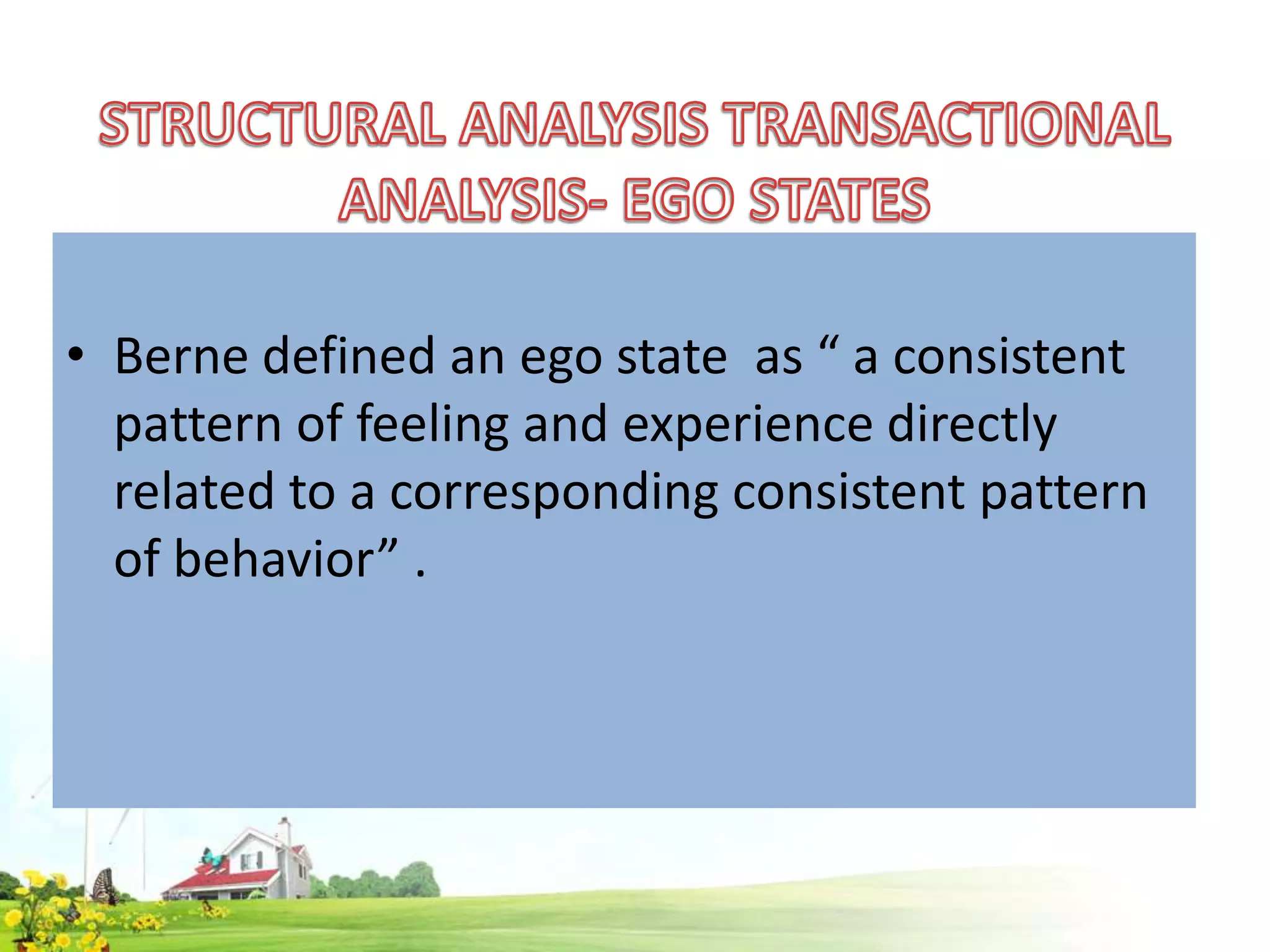
• Berne defined an ego state as “ a consistent
pattern of feeling and experience directly
related to a corresponding consistent pattern
of behavior” .
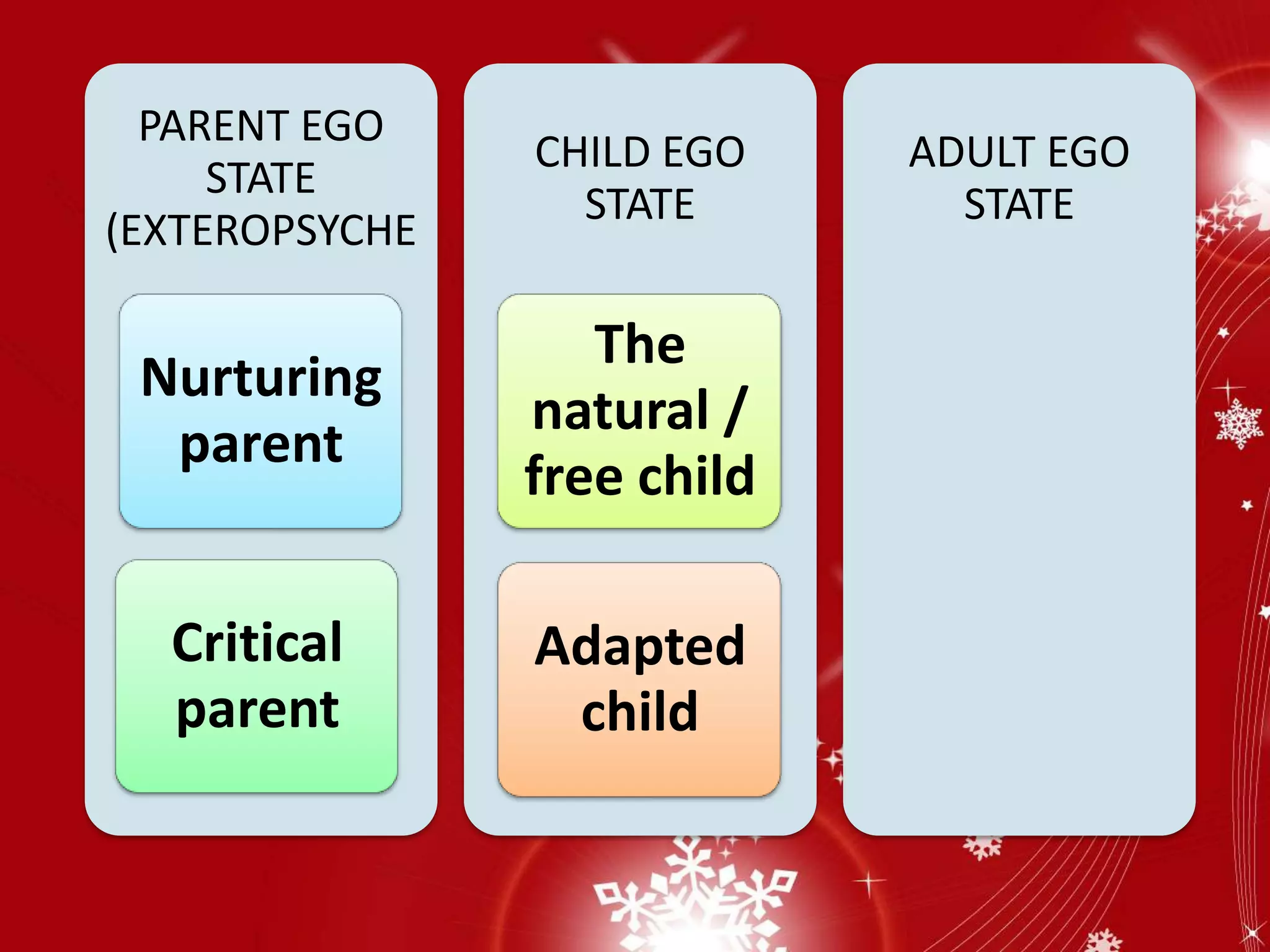
PARENT EGO
STATE
(EXTEROPSYCHE

CHILD EGO
STATE

Nurturing
parent

The
natural /
free child

Critical
parent

Adapted
child

ADULT EGO
STATE
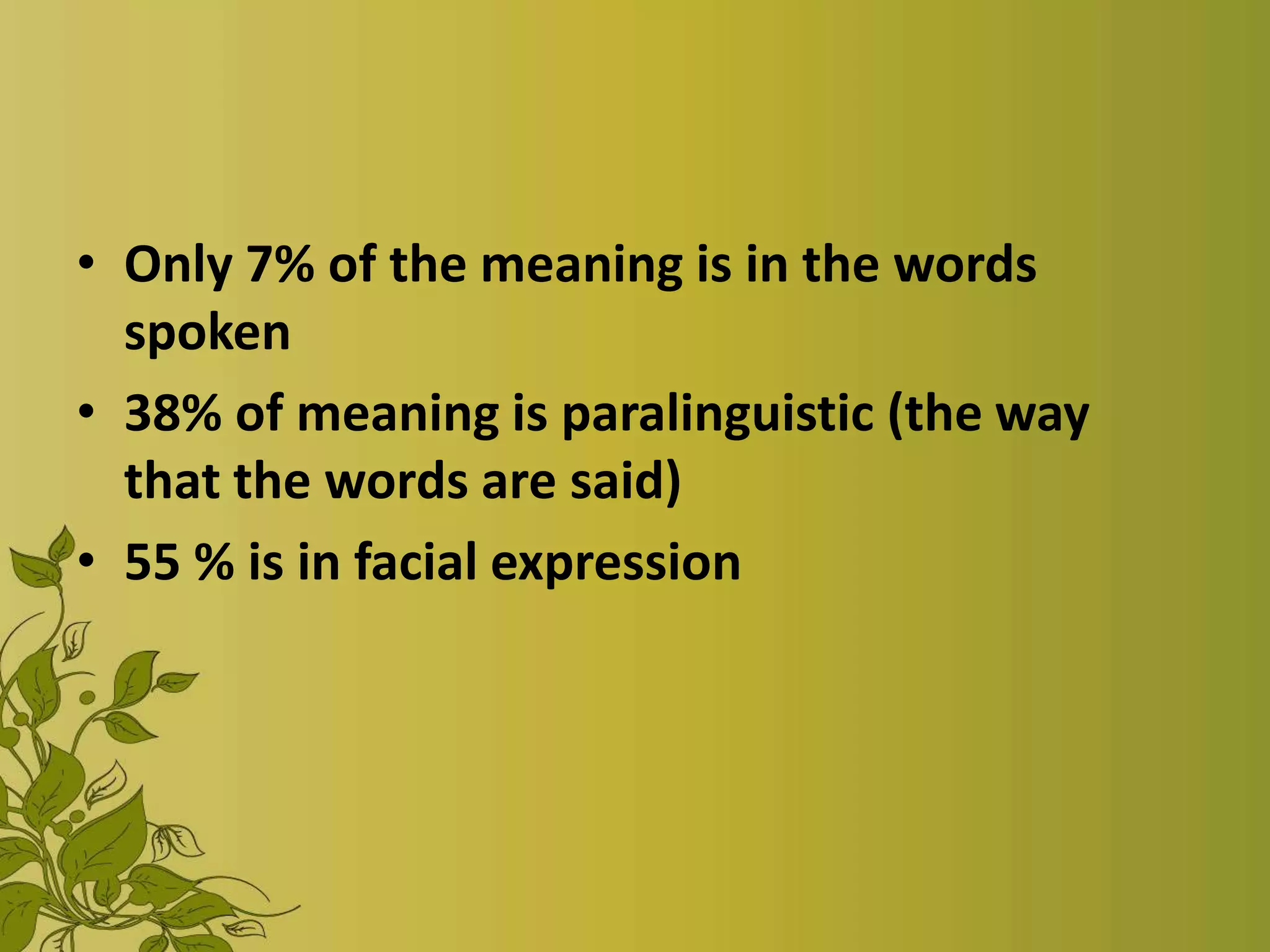
• Only 7% of the meaning is in the words
spoken
• 38% of meaning is paralinguistic (the way
that the words are said)
• 55 % is in facial expression
INTER PERSONAL TRANSACTIONS
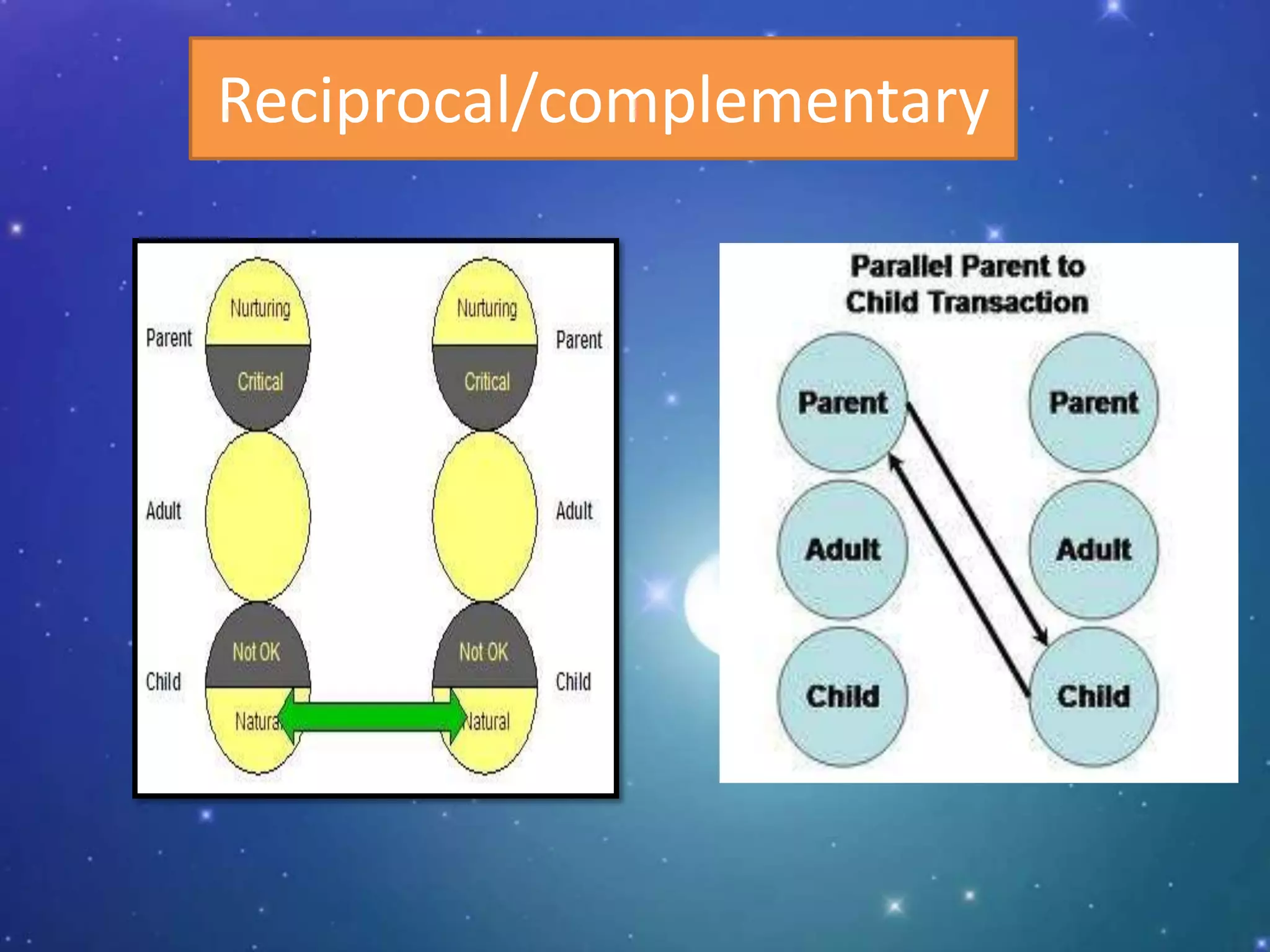
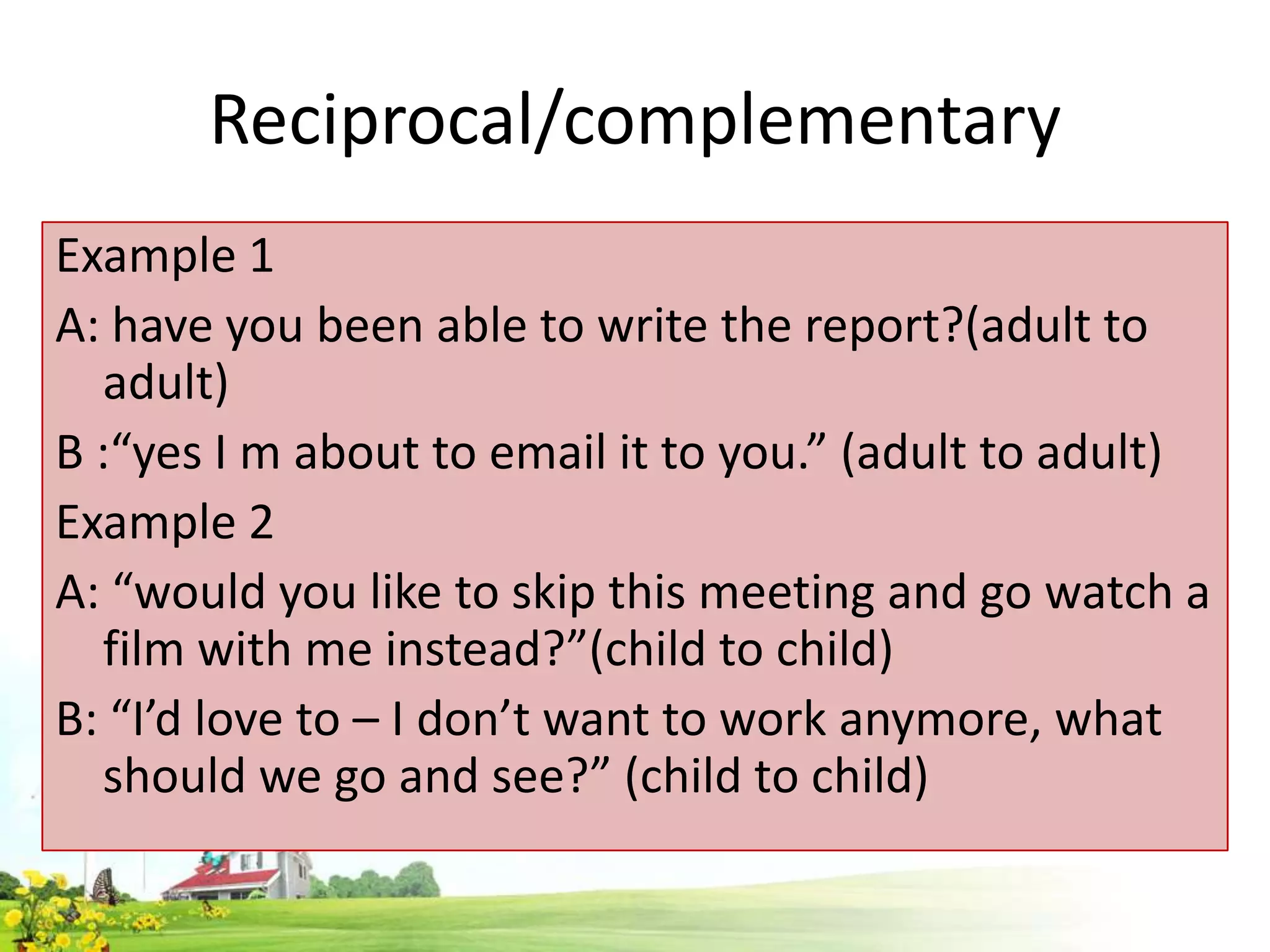
Reciprocal/complementary
Example 1
A: have you been able to write the report?(adult to
adult)
B :“yes I m about to email it to you.” (adult to adult)
Example 2
A: “would you like to skip this meeting and go watch a
film with me instead?”(child to child)
B: “I’d love to – I don’t want to work anymore, what
should we go and see?” (child to child)
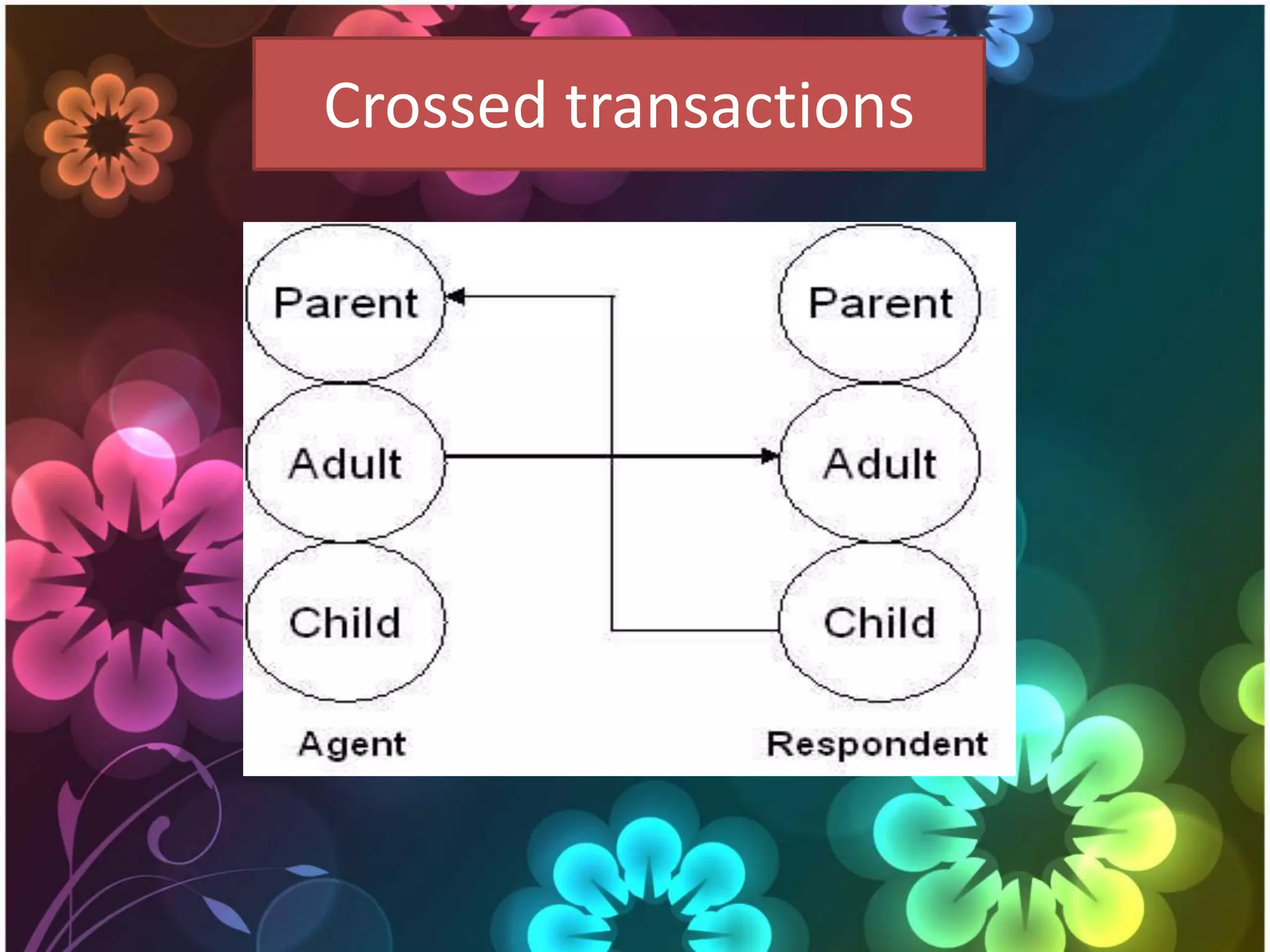
Crossed transactions
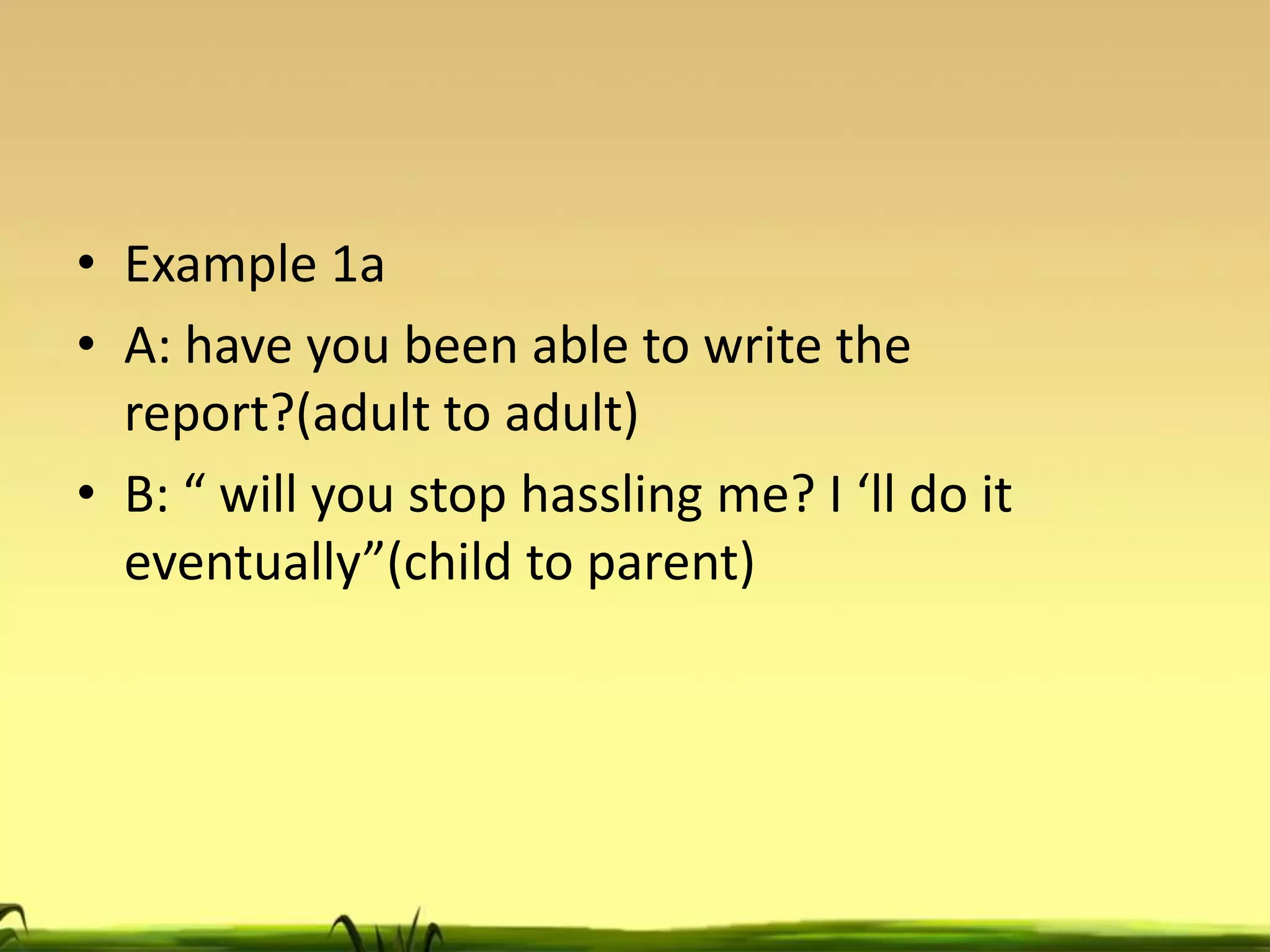
• Example 1a
• A: have you been able to write the
report?(adult to adult)
• B: “ will you stop hassling me? I ‘ll do it
eventually”(child to parent)
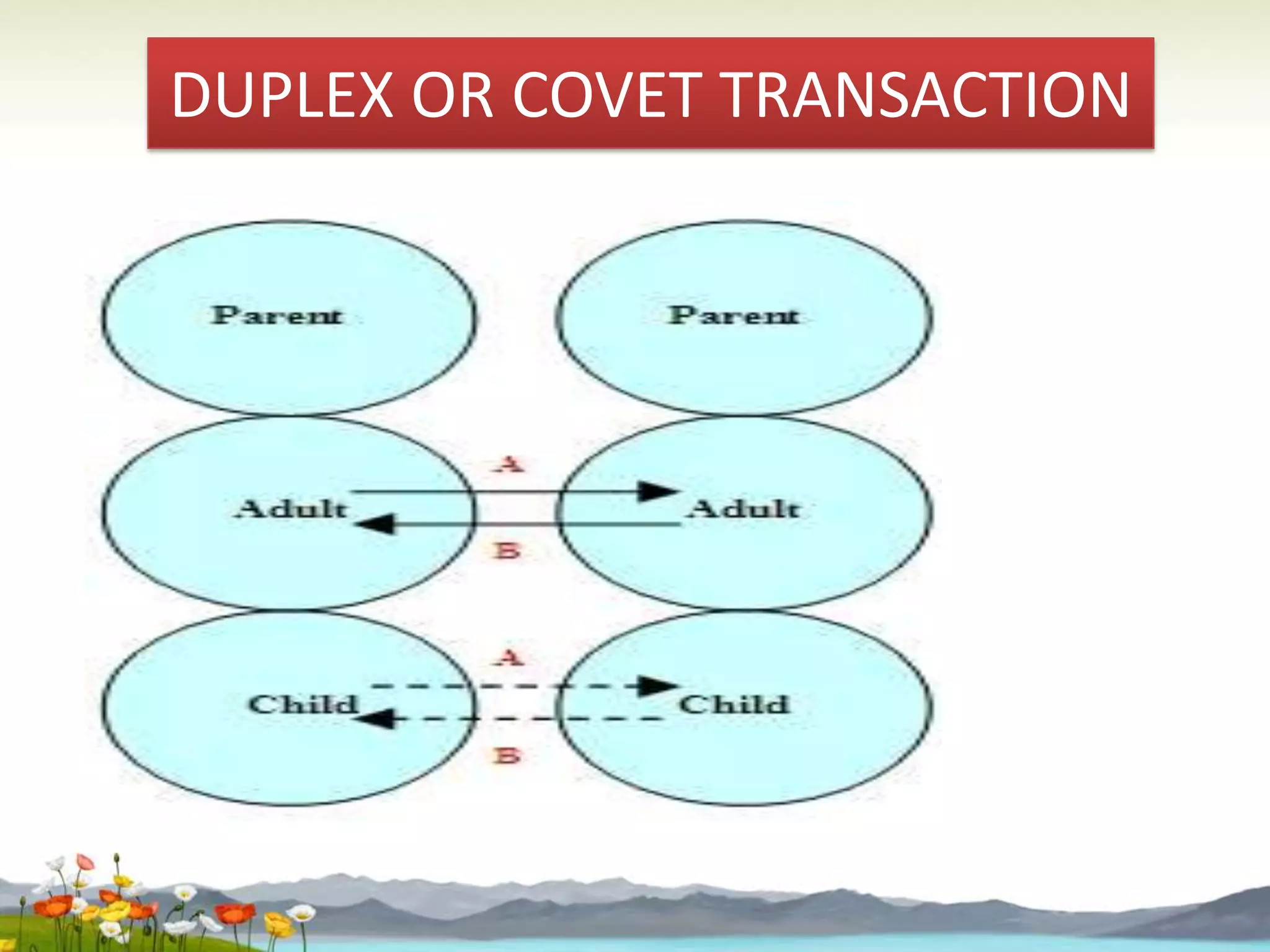
DUPLEX OR COVET TRANSACTION
• There are two different levels in transaction.
One of them is a surface level or social level
and the second one is a hidden level or a
psychological level.
In a class room the teacher played some video clips
to give a presentation on Marxist ideology.
Two of the students started discussing topics related
to Marxist ideology which were not discussed in the
class before. Now apparently, or on surface, the two
students were having an adult-to-adult transaction.
But covertly, that transaction was a child-to-child
transaction as the two were trying to tell the rest of
the class, ‘Look! We’ve more knowledge about the
topic”.
THE FOUR LIFE POSITIONS
1. I AM NOT O.K YOU ARE O.K
• Lack of self respect and self confidence
• Feeling of inferiority and negative approval.
• Lack motivation and strive to progress.
• Dominated by situations and lack initiative.
2. I AM NOT O.K YOU ARE NOT O.K
• Low opinion and lack of self
confidence.
• No trust in others, rather always
suspicious.
• Negative feeling of thought of self
and others.
• Not straight forward.
•
•
•
•

Lack of trust and confidence in colleagues.
Feeling of superiority and power
Blaming his colleagues for any failure.
No interest in feedback.
4. I AM O.K YOU ARE O.K
• Respect for self and others- high self esteem.
• Interested to provide democratic leadership.
• Honest and sincere in both his work and with
colleagues.
POSITIVE STROKES
• A positive stroke is any recognition that is
direct, appropriate, and relevant .Positive
strokes leaves the other person feeling
alive, alert, and significant
• Positive strokes may be . . .
• Complimentary
• Affectionate
Positive Unconditional Strokes
• Example
• “I really liked the way you handled the
meeting.”
• “You really know how to close a sale.”
Positive Conditional Strokes
• Examples . . .
• “If you keep that up, you will get a big bonus.”
• “When you work like that you really
contribute to the team.”
NEGATIVE STROKES
•
•
•
•

Strokes can also be negative
A put down
An insult
Laughing at someone
• Knowing and trusting each other is
essential, self disclosure, self awareness
and self- trust are also very important.
• Communicating with each other accurately
and inclear words and actions.
• Accepting and supporting each other’s
positive and negative strokes. Accept the
person as he is and then change him once
the rapport is established.
• Resolving conflicts and relationship
problem constructively.
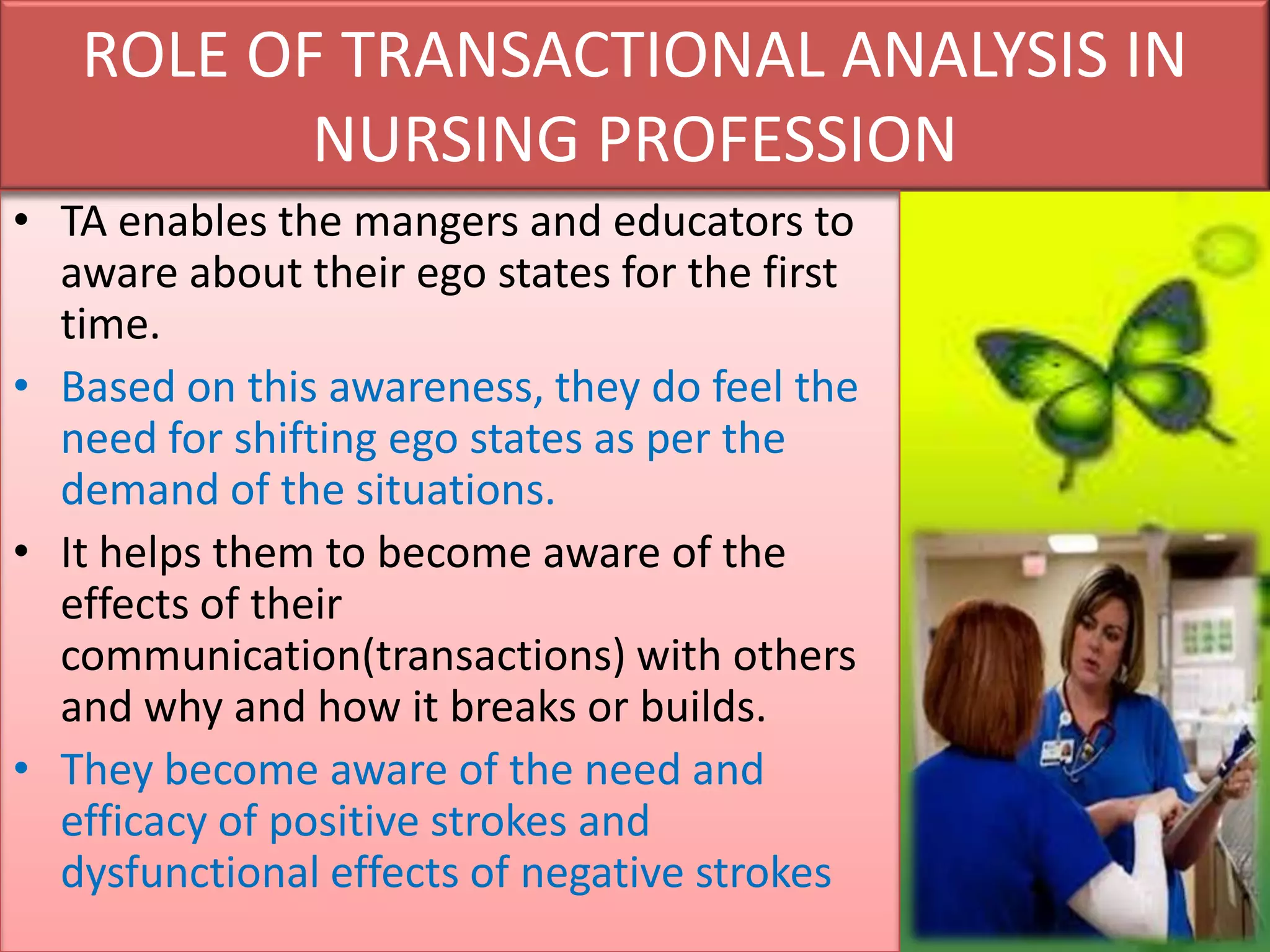
ROLE OF TRANSACTIONAL ANALYSIS IN
NURSING PROFESSION
• TA enables the mangers and educators to
aware about their ego states for the first
time.
• Based on this awareness, they do feel the
need for shifting ego states as per the
demand of the situations.
• It helps them to become aware of the
effects of their
communication(transactions) with others
and why and how it breaks or builds.
• They become aware of the need and
efficacy of positive strokes and
dysfunctional effects of negative strokes
contiiiii
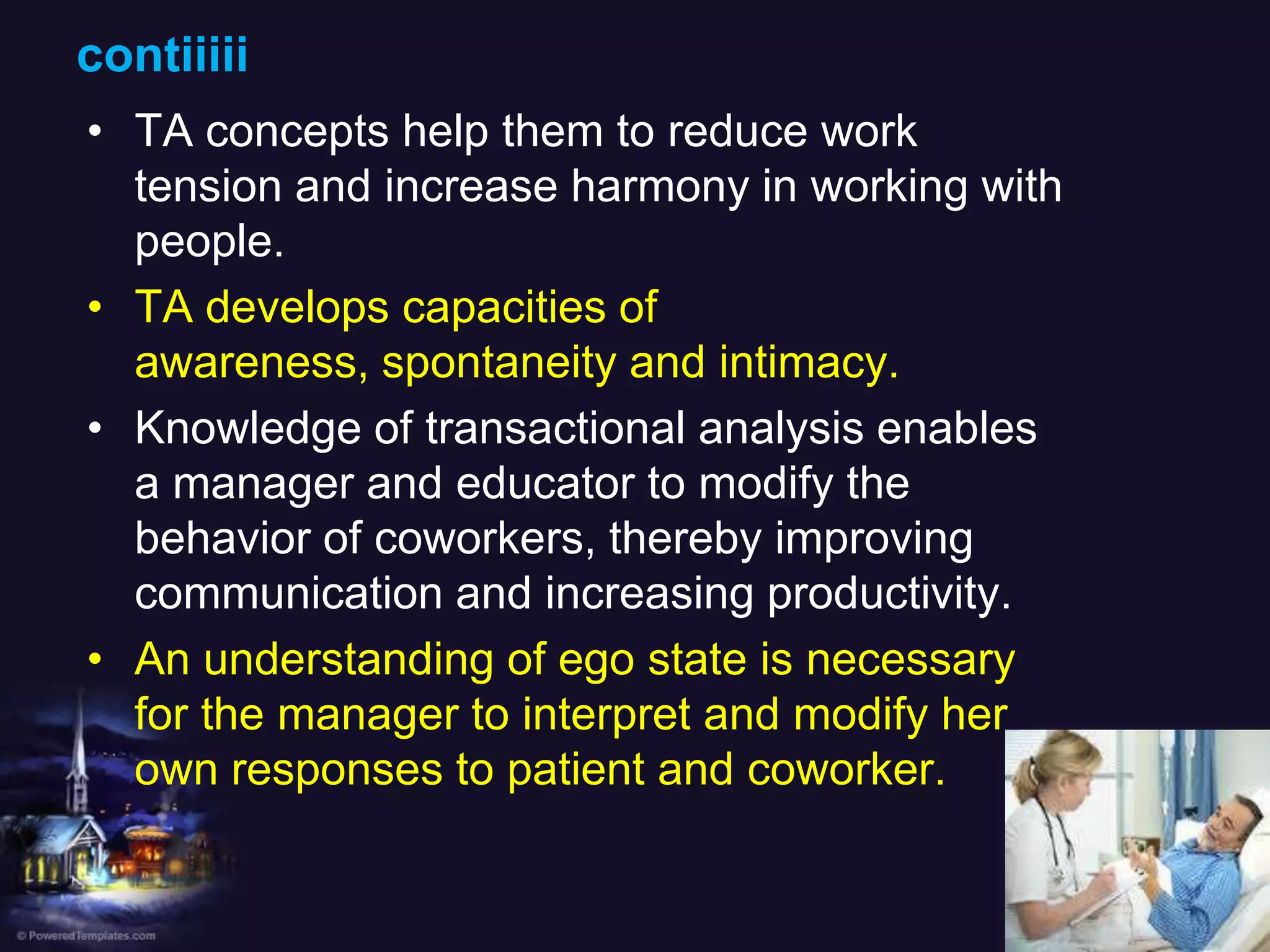
• TA concepts help them to reduce work
tension and increase harmony in working with
people.
• TA develops capacities of
awareness, spontaneity and intimacy.
• Knowledge of transactional analysis enables
a manager and educator to modify the
behavior of coworkers, thereby improving
communication and increasing productivity.
• An understanding of ego state is necessary
for the manager to interpret and modify her
own responses to patient and coworker.
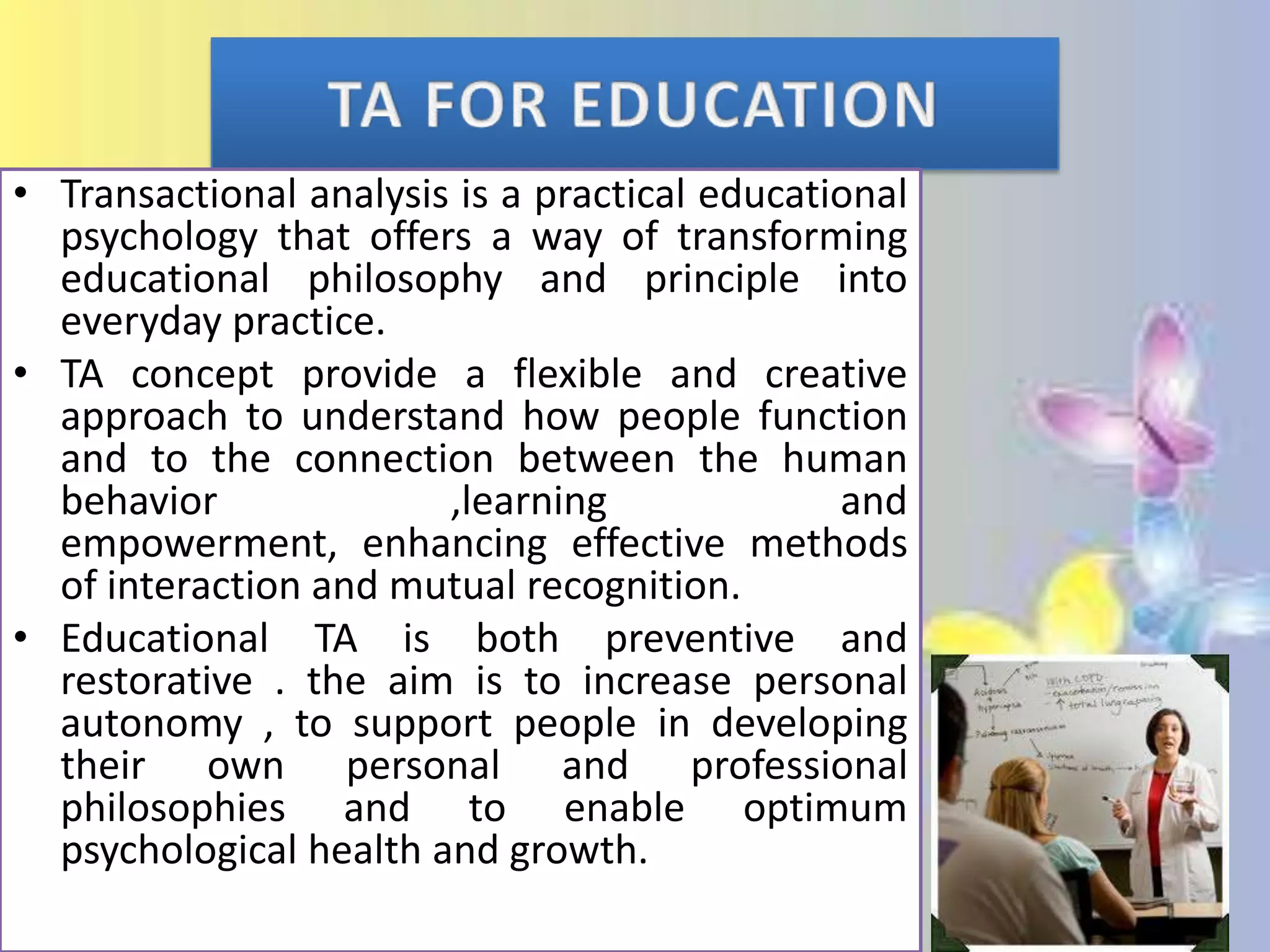
• Transactional analysis is a practical educational
psychology that offers a way of transforming
educational philosophy and principle into
everyday practice.
• TA concept provide a flexible and creative
approach to understand how people function
and to the connection between the human
behavior
,learning
and
empowerment, enhancing effective methods
of interaction and mutual recognition.
• Educational TA is both preventive and
restorative . the aim is to increase personal
autonomy , to support people in developing
their own personal and professional
philosophies and to enable optimum
psychological health and growth.
FOR ORGANISATIONAL CHANGE
• TA to enhance job performance
develop
more
effective
management, leadership skills, and
greater organizational teamwork. TA
support organizational goals and
helps to solve managementemployee problems or conflicts in
order to promote healthier and
more
productive
business, government and social
organization.
FOR PERSONAL CHANGE
• TA to help achieve your personal goals. You
can use it to break free of negative life script
and become more autonomous.
• TA has significant role in resolving conflicts
and building interpersonal relationship. It can
bridge the difference and cement
interpersonal relationship by knowing and
trusting each other by self disclosure, self
awareness and self trust
• Communicating each other accurately
• Accepting and supporting each other’s
positive and negative strokes
• TA can be used to promote healthy and
productive social institutions. It can raise
awareness of social inequities and promote
ok- ok relations between diverse cultural
group. TA can be used by both informal and
formal social leaders and their followers to
support basic human rights in line with the
goal of creating more harmony in society.
•
SUMMARY
MEANING
DEFINITION
THEORY
GOALS
STRUCTURAL ANALYSIS
FUNCTIONAL ANALYSIS
POSITIVE STROKES
FUNCTION OF TA
Transactional analysis

Transactional analysis

  • 1.
  • 2.
    DEFINITION • Transactional analysisis a method of understanding people’s behavior by analyzing the transactions or interactions which transpire between people. • Transactional analysis is a social psychology and a method to improve communication.
  • 3.
  • 4.
    GOALS OF TRANSACTIONALANALYSIS • Make yourself aware of your triadic personality structure. • Increase awareness of your own ego state and the ego states of others. • Be aware of both social and psychological messages which exist within communication transactions. • Increase the chance for complementary transaction.
  • 5.
    • Berne definedan ego state as “ a consistent pattern of feeling and experience directly related to a corresponding consistent pattern of behavior” .
  • 6.
    PARENT EGO STATE (EXTEROPSYCHE CHILD EGO STATE Nurturing parent The natural/ free child Critical parent Adapted child ADULT EGO STATE
  • 7.
    • Only 7%of the meaning is in the words spoken • 38% of meaning is paralinguistic (the way that the words are said) • 55 % is in facial expression
  • 8.
  • 9.
  • 10.
    Reciprocal/complementary Example 1 A: haveyou been able to write the report?(adult to adult) B :“yes I m about to email it to you.” (adult to adult) Example 2 A: “would you like to skip this meeting and go watch a film with me instead?”(child to child) B: “I’d love to – I don’t want to work anymore, what should we go and see?” (child to child)
  • 11.
  • 12.
    • Example 1a •A: have you been able to write the report?(adult to adult) • B: “ will you stop hassling me? I ‘ll do it eventually”(child to parent)
  • 13.
    DUPLEX OR COVETTRANSACTION
  • 14.
    • There aretwo different levels in transaction. One of them is a surface level or social level and the second one is a hidden level or a psychological level.
  • 15.
    In a classroom the teacher played some video clips to give a presentation on Marxist ideology. Two of the students started discussing topics related to Marxist ideology which were not discussed in the class before. Now apparently, or on surface, the two students were having an adult-to-adult transaction. But covertly, that transaction was a child-to-child transaction as the two were trying to tell the rest of the class, ‘Look! We’ve more knowledge about the topic”.
  • 16.
    THE FOUR LIFEPOSITIONS 1. I AM NOT O.K YOU ARE O.K • Lack of self respect and self confidence • Feeling of inferiority and negative approval. • Lack motivation and strive to progress. • Dominated by situations and lack initiative.
  • 17.
    2. I AMNOT O.K YOU ARE NOT O.K • Low opinion and lack of self confidence. • No trust in others, rather always suspicious. • Negative feeling of thought of self and others. • Not straight forward.
  • 18.
    • • • • Lack of trustand confidence in colleagues. Feeling of superiority and power Blaming his colleagues for any failure. No interest in feedback.
  • 19.
    4. I AMO.K YOU ARE O.K • Respect for self and others- high self esteem. • Interested to provide democratic leadership. • Honest and sincere in both his work and with colleagues.
  • 20.
    POSITIVE STROKES • Apositive stroke is any recognition that is direct, appropriate, and relevant .Positive strokes leaves the other person feeling alive, alert, and significant • Positive strokes may be . . . • Complimentary • Affectionate
  • 21.
    Positive Unconditional Strokes •Example • “I really liked the way you handled the meeting.” • “You really know how to close a sale.”
  • 22.
    Positive Conditional Strokes •Examples . . . • “If you keep that up, you will get a big bonus.” • “When you work like that you really contribute to the team.”
  • 23.
    NEGATIVE STROKES • • • • Strokes canalso be negative A put down An insult Laughing at someone
  • 24.
    • Knowing andtrusting each other is essential, self disclosure, self awareness and self- trust are also very important. • Communicating with each other accurately and inclear words and actions. • Accepting and supporting each other’s positive and negative strokes. Accept the person as he is and then change him once the rapport is established. • Resolving conflicts and relationship problem constructively.
  • 25.
    ROLE OF TRANSACTIONALANALYSIS IN NURSING PROFESSION • TA enables the mangers and educators to aware about their ego states for the first time. • Based on this awareness, they do feel the need for shifting ego states as per the demand of the situations. • It helps them to become aware of the effects of their communication(transactions) with others and why and how it breaks or builds. • They become aware of the need and efficacy of positive strokes and dysfunctional effects of negative strokes
  • 26.
    contiiiii • TA conceptshelp them to reduce work tension and increase harmony in working with people. • TA develops capacities of awareness, spontaneity and intimacy. • Knowledge of transactional analysis enables a manager and educator to modify the behavior of coworkers, thereby improving communication and increasing productivity. • An understanding of ego state is necessary for the manager to interpret and modify her own responses to patient and coworker.
  • 27.
    • Transactional analysisis a practical educational psychology that offers a way of transforming educational philosophy and principle into everyday practice. • TA concept provide a flexible and creative approach to understand how people function and to the connection between the human behavior ,learning and empowerment, enhancing effective methods of interaction and mutual recognition. • Educational TA is both preventive and restorative . the aim is to increase personal autonomy , to support people in developing their own personal and professional philosophies and to enable optimum psychological health and growth.
  • 28.
    FOR ORGANISATIONAL CHANGE •TA to enhance job performance develop more effective management, leadership skills, and greater organizational teamwork. TA support organizational goals and helps to solve managementemployee problems or conflicts in order to promote healthier and more productive business, government and social organization.
  • 29.
    FOR PERSONAL CHANGE •TA to help achieve your personal goals. You can use it to break free of negative life script and become more autonomous. • TA has significant role in resolving conflicts and building interpersonal relationship. It can bridge the difference and cement interpersonal relationship by knowing and trusting each other by self disclosure, self awareness and self trust • Communicating each other accurately • Accepting and supporting each other’s positive and negative strokes
  • 30.
    • TA canbe used to promote healthy and productive social institutions. It can raise awareness of social inequities and promote ok- ok relations between diverse cultural group. TA can be used by both informal and formal social leaders and their followers to support basic human rights in line with the goal of creating more harmony in society. •
  • 31.