Objection Handling

               Eric Ravina
         22nd August 2011
What is an objection?
Objection - opportunity to
expose and explore reasons
to book on to the event.
Buying signal

usually a question asked based on your
information
if the prospect asks for the price at the end or
in the middle of the conversation it is usually a
good sign of interest
if the prospect asks in the beginning it is usually
a means of getting you off the phone
Objection handling
- the skill to deal with
any given objection and
to turn it from NO into a
YES
An objection can be either TRUE
or FALSE.
A false objection comes up any
time prior to you giving out the
price and asking for business. We
know this because it means the
prospect is objecting when in fact
they do not know enough about
the opportunity, details, features,
benefits, etc. That is why it is a
false objection.
Examples:

Prospect not listening
Speak to marketing
I am going into a meeting so
send me some information
What’s the price?
We have been contacted
before about this
A true objection comes up
after you have quoted the
price and asked for the
business after the full pitch.
True objections help us
understand the prospect’s
concerns and allow us to
address them in a confident
way
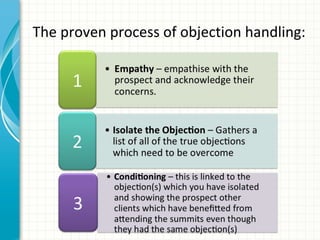
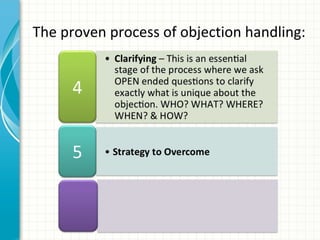
The proven process of objection handling:
Dealing with a “MR.
GURU” objection
“I only speak at
conferences”
• Empathise: Massage the ego.

• Clarify – So to understand you, you
  only get involved in speaking at
  events. Is that correct? Is it a
  corporate or a personal policy?

• Isolate/Validate – Putting that
  issue aside, I take it you liked the
  programme? What specifically
  caught your interest?
• Overcome
• Branding and exclusivity:
• (Name), have you ever attended an
  ME event? We limit these types of
  event to 40 delegates, of which a
  large majority are former speakers
  and so the level & quality of the
  audience is never an issue. We also
  make a point of not inviting
  vendors as delegates, to ensure
  that you won’t be bombarded with
  sales pitches at the event.
• Interactiviy:
• (Name), I want to picture the
  auditorium. Now what we
  encourage at the event is a forum-
  like atmosphere. It’s not a group of
  people lecturing on a stand; it’s
  very interactive, almost like a
  debate with microphones in the
  audience. Most of the true value is
  not in the program but in the
  intense discussions that follow
  each presentation.
• Speaking ops:
• (Name), all the speakers you see on
  the program have attended as
  delegates at previous events. Now
  what I suggest is the following: If
  you’re committed to speaking, why
  not come down as a delegate to this
  event and I will introduce you to the
  producer, you can see how we
  operate, we can see how you can add
  value to our future programs because
  we don’t want you to come to just this
  event. We want (company name) to be
  involved in a series of events.
• I really want your present at this event
  considering all of your peers are there.
  Why don’t we do that?
Important Notes
•   the more you do it the better
    you get, so don’t fear
    objections! There is always,
    always an objection – you
    need to find out what it is.
•   when you are practiced
    enough in the art, you will
    actually change your
    perspective, instead of fearing
    the objection and pitching in
    such a way as to hopefully
    avoid any coming up you will
    welcome them and pitch in
    such a way as to encourage
    objections.
Questions?

Objection handling

  • 1.
    Objection Handling Eric Ravina 22nd August 2011
  • 2.
    What is anobjection?
  • 3.
    Objection - opportunityto expose and explore reasons to book on to the event.
  • 4.
    Buying signal usually aquestion asked based on your information if the prospect asks for the price at the end or in the middle of the conversation it is usually a good sign of interest if the prospect asks in the beginning it is usually a means of getting you off the phone
  • 5.
    Objection handling - theskill to deal with any given objection and to turn it from NO into a YES
  • 6.
    An objection canbe either TRUE or FALSE. A false objection comes up any time prior to you giving out the price and asking for business. We know this because it means the prospect is objecting when in fact they do not know enough about the opportunity, details, features, benefits, etc. That is why it is a false objection.
  • 7.
    Examples: Prospect not listening Speakto marketing I am going into a meeting so send me some information What’s the price? We have been contacted before about this
  • 8.
    A true objectioncomes up after you have quoted the price and asked for the business after the full pitch. True objections help us understand the prospect’s concerns and allow us to address them in a confident way
  • 9.
    The proven processof objection handling:
  • 10.
    The proven processof objection handling:
  • 11.
    Dealing with a“MR. GURU” objection
  • 12.
    “I only speakat conferences” • Empathise: Massage the ego. • Clarify – So to understand you, you only get involved in speaking at events. Is that correct? Is it a corporate or a personal policy? • Isolate/Validate – Putting that issue aside, I take it you liked the programme? What specifically caught your interest?
  • 13.
    • Overcome • Brandingand exclusivity: • (Name), have you ever attended an ME event? We limit these types of event to 40 delegates, of which a large majority are former speakers and so the level & quality of the audience is never an issue. We also make a point of not inviting vendors as delegates, to ensure that you won’t be bombarded with sales pitches at the event.
  • 14.
    • Interactiviy: • (Name),I want to picture the auditorium. Now what we encourage at the event is a forum- like atmosphere. It’s not a group of people lecturing on a stand; it’s very interactive, almost like a debate with microphones in the audience. Most of the true value is not in the program but in the intense discussions that follow each presentation.
  • 15.
    • Speaking ops: •(Name), all the speakers you see on the program have attended as delegates at previous events. Now what I suggest is the following: If you’re committed to speaking, why not come down as a delegate to this event and I will introduce you to the producer, you can see how we operate, we can see how you can add value to our future programs because we don’t want you to come to just this event. We want (company name) to be involved in a series of events. • I really want your present at this event considering all of your peers are there. Why don’t we do that?
  • 16.
    Important Notes • the more you do it the better you get, so don’t fear objections! There is always, always an objection – you need to find out what it is. • when you are practiced enough in the art, you will actually change your perspective, instead of fearing the objection and pitching in such a way as to hopefully avoid any coming up you will welcome them and pitch in such a way as to encourage objections.
  • 17.

Editor's Notes

  • #2 This template can be used as a starter file for presenting training materials in a group setting. Sections Sections can help to organize your slides or facilitate collaboration between multiple authors. On the Home tab under Slides , click Section , and then click Add Section . Notes Use the Notes pane for delivery notes or to provide additional details for the audience. You can see these notes in Presenter View during your presentation. Keep in mind the font size (important for accessibility, visibility, videotaping, and online production) Coordinated colors Pay particular attention to the graphs, charts, and text boxes. Consider that attendees will print in black and white or grayscale. Run a test print to make sure your colors work when printed in pure black and white and grayscale. Graphics, tables, and graphs Keep it simple: If possible, use consistent, non-distracting styles and colors. Label all graphs and tables.
  • #3 Give a brief overview of the presentation. Describe the major focus of the presentation and why it is important. Introduce each of the major topics. To provide a road map for the audience, you can repeat this Overview slide throughout the presentation, highlighting the particular topic you will discuss next.
  • #4 This is another option for an overview using transitions to advance through several slides.
  • #5 This is another option for an overview using transitions to advance through several slides.
  • #10 This is another option for an overview slide.
  • #11 This is another option for an overview slide.
  • #12 Use a section header for each of the topics, so there is a clear transition to the audience.
  • #13 Add slides to each topic section as necessary, including slides with tables, graphs, and images. See next section for sample table, graph, image, and video layouts.
  • #14 Add slides to each topic section as necessary, including slides with tables, graphs, and images. See next section for sample table, graph, image, and video layouts.
  • #15 Add slides to each topic section as necessary, including slides with tables, graphs, and images. See next section for sample table, graph, image, and video layouts.
  • #16 Add slides to each topic section as necessary, including slides with tables, graphs, and images. See next section for sample table, graph, image, and video layouts.
  • #17 What will the audience be able to do after this training is complete? Briefly describe each objective and how the audience will benefit from this presentation.
  • #18 Microsoft Engineering Excellence Microsoft Confidential