The Art of Assertiveness Washoe Tribe  of Nevada & California Don Johnson, Trainer
Objectives: Managing change Assertive vs. Aggressive Communication techniques Avoiding the Drama Triangle 4 Step Process (DESC) Benefits
3 Benefits of Assertive Communication Set boundaries with aggressive types Speak-up confidently for yourself Expressing your ideas so you are perceived as a valuable asset
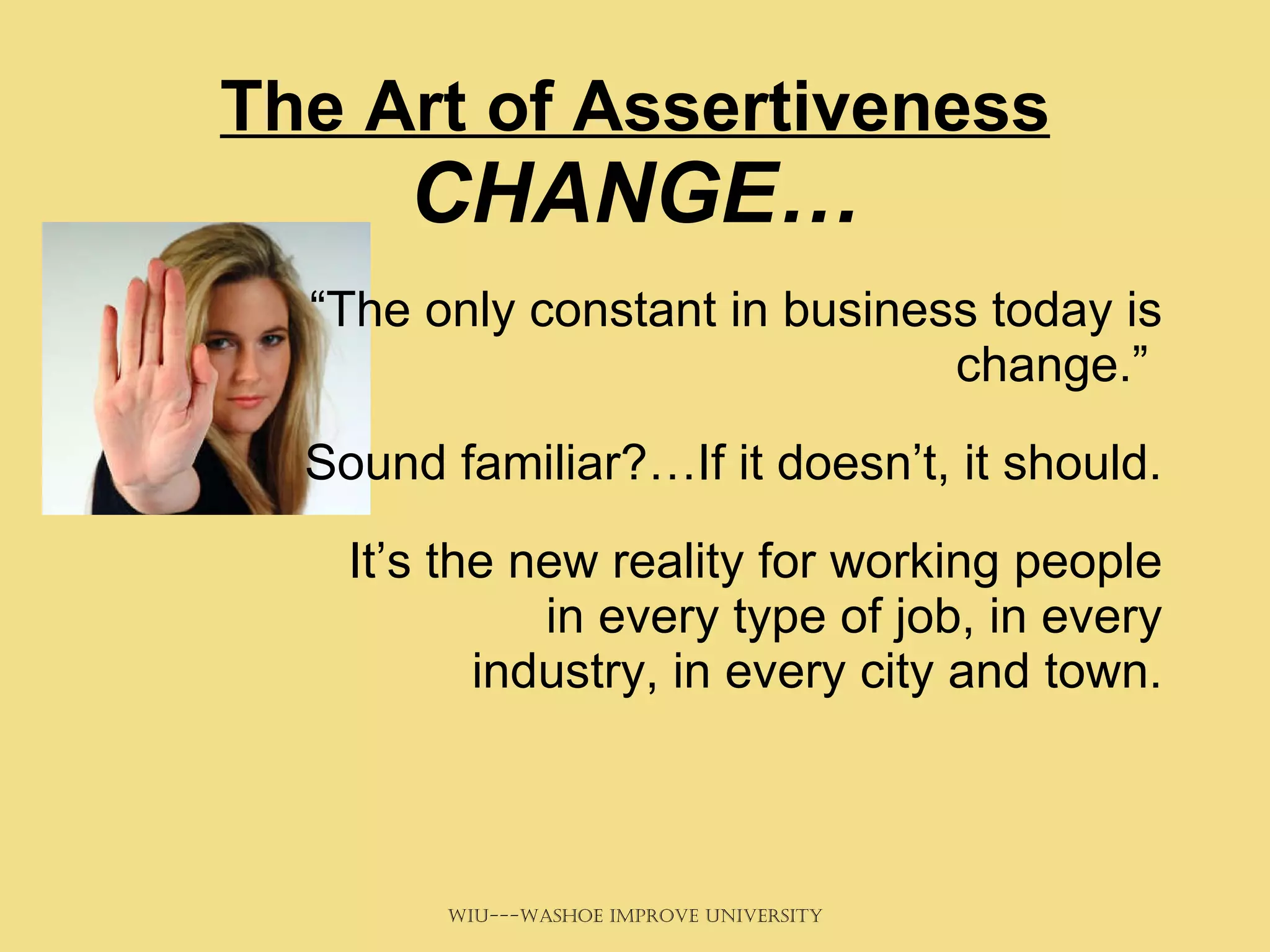
The Art of Assertiveness  CHANGE… “ The only constant in business today is change.”  Sound familiar?…If it doesn’t, it should. It’s the new reality for working people in every type of job, in every industry, in every city and town.
The Art of Assertiveness  CHANGE… To survive and, more importantly, thrive in the business world of today and tomorrow, working people must accept and adapt to changes like these: New technology constantly requires new skills.  Downsizing means each person assumes more work and more responsibility.  Mergers and realignments bring changes in job duties, career paths, compensation, retirements and benefits.
Dealing with change isn’t easy.   Some people seem to enjoy the challenges of change, believing they can handle anything that comes their way. When they face obstacles, they find solutions.  And although they may experience moments of uncertainty or indecisiveness, they quickly get back on track, hang in there and eventually make good things happen.
Dealing with Change Because these people are constantly learning and growing  with  their changing work environment, they can be labeled as both  optimistic  and  assertive .  Optimism  – shows in a person’s outlook on life and their personality.  Assertiveness  - While it’s difficult, if not impossible, to change your basic personality, it’s certainly possible to learn to be more assertive — to go after and get what you want.
What is Assertive? Assertive vs. Aggressive  In the business world, you often hear the word “aggressive.”   Companies talk about their “aggressive” growth plans.  Sales managers tell their people to be “aggressive” when calling on clients. Customer service reps are instructed to “aggressively” solve customer problems. Children are told to be aggressive in sports.
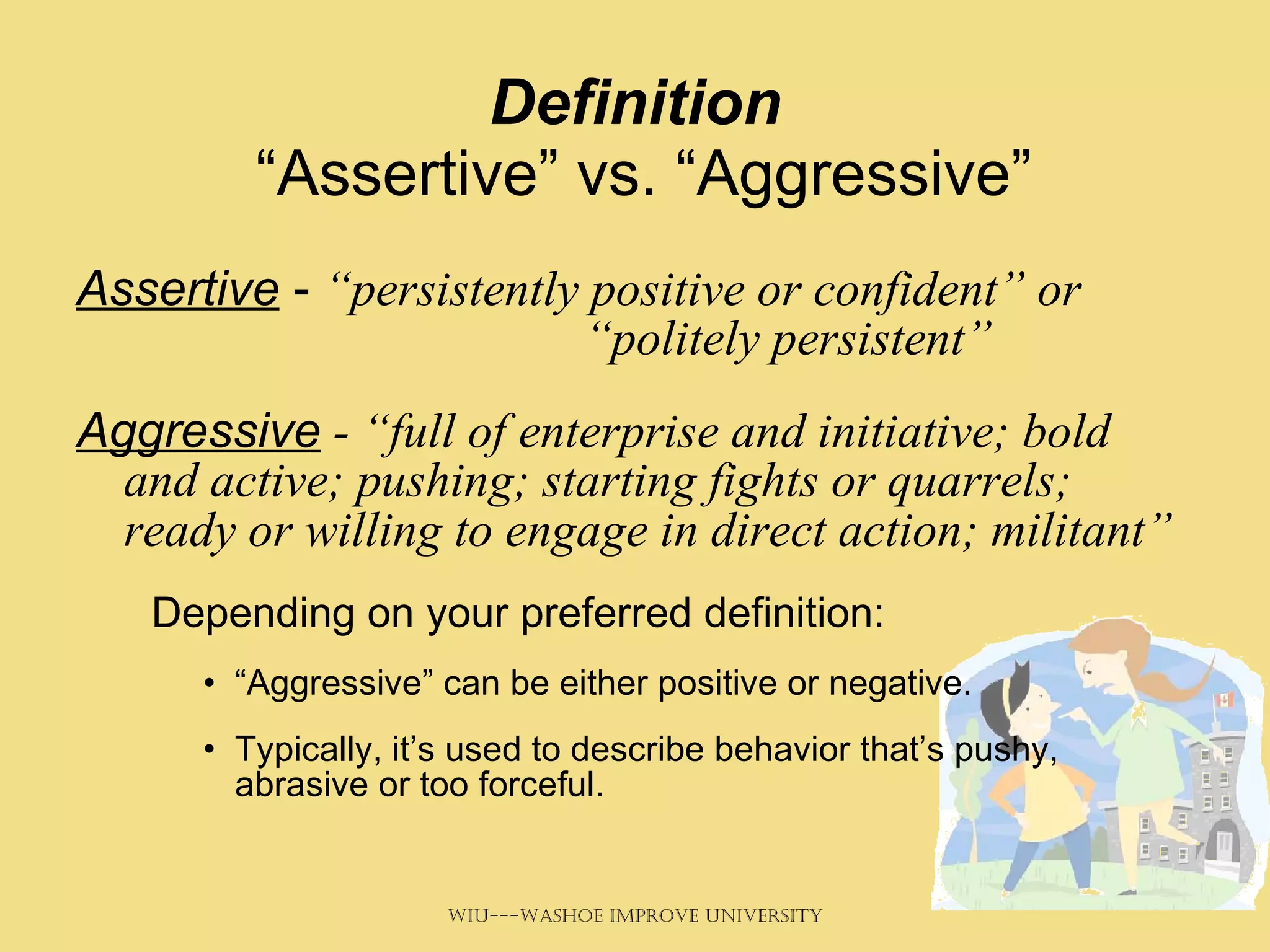
Definition  “Assertive” vs. “Aggressive” Assertive  -  “persistently positive or confident” or  “politely persistent” Aggressive  - “full of enterprise and initiative; bold and active; pushing; starting fights or quarrels; ready or willing to engage in direct action; militant”     Depending on your preferred definition: “ Aggressive” can be either positive or negative. Typically, it’s used to describe behavior that’s pushy, abrasive or too forceful.
Difference between being  assertive  and  aggressive How our words and behavior affect the rights and well-being of other people.   Assertive communication  champions our own rights and well-being without violating those of others take feelings and needs into consideration shows respect
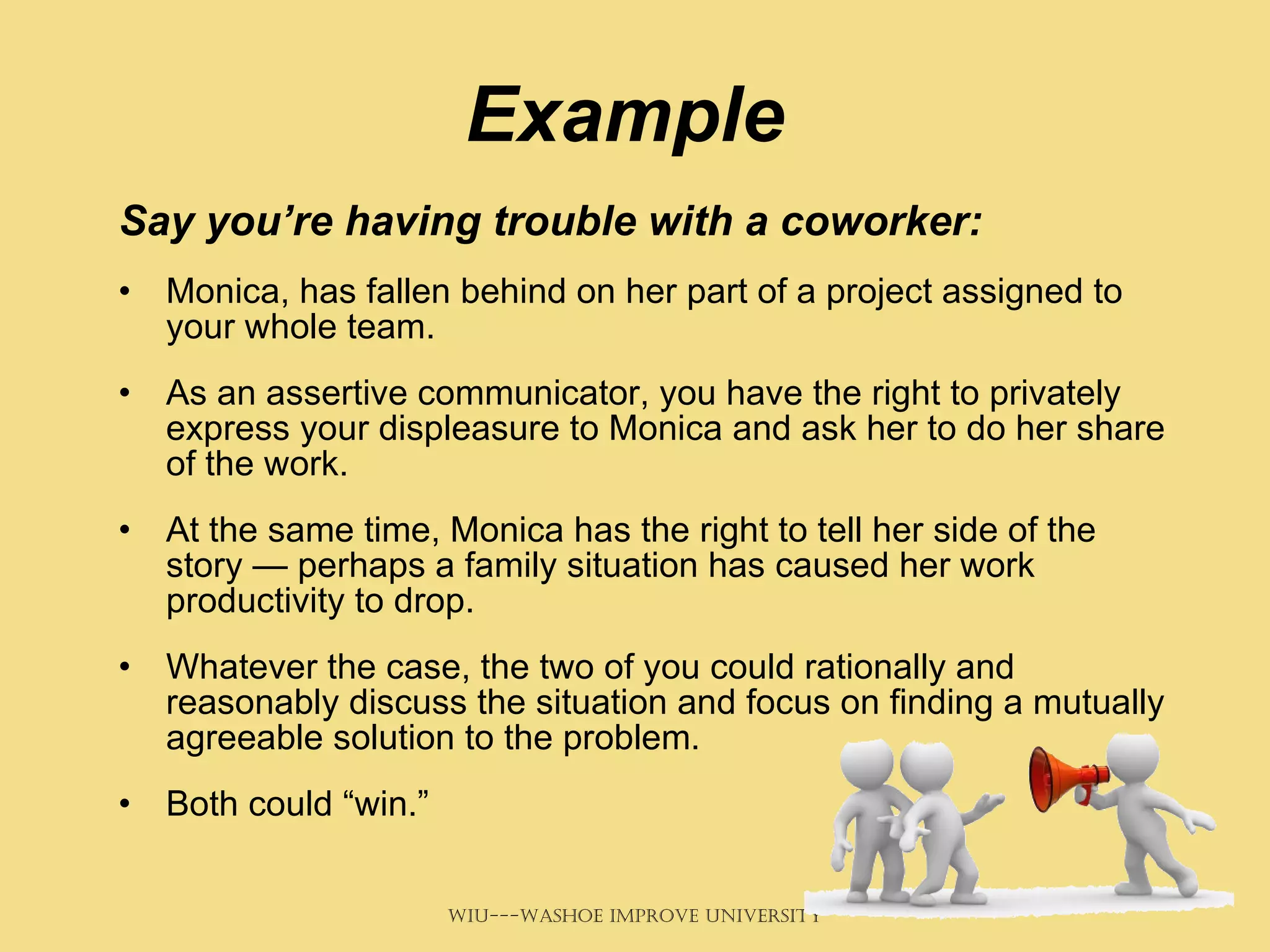
Example Say you’re having trouble with a coworker: Monica, has fallen behind on her part of a project assigned to your whole team.  As an assertive communicator, you have the right to privately express your displeasure to Monica and ask her to do her share of the work.  At the same time, Monica has the right to tell her side of the story — perhaps a family situation has caused her work productivity to drop.  Whatever the case, the two of you could rationally and reasonably discuss the situation and focus on finding a mutually agreeable solution to the problem.  Both could “win.”
3  Crucial  Elements of Assertive Persuasion Credibility  – people believe you know what you’re talking about Emotional Connection  – people oriented / task oriented Logic  – based on situation / audience
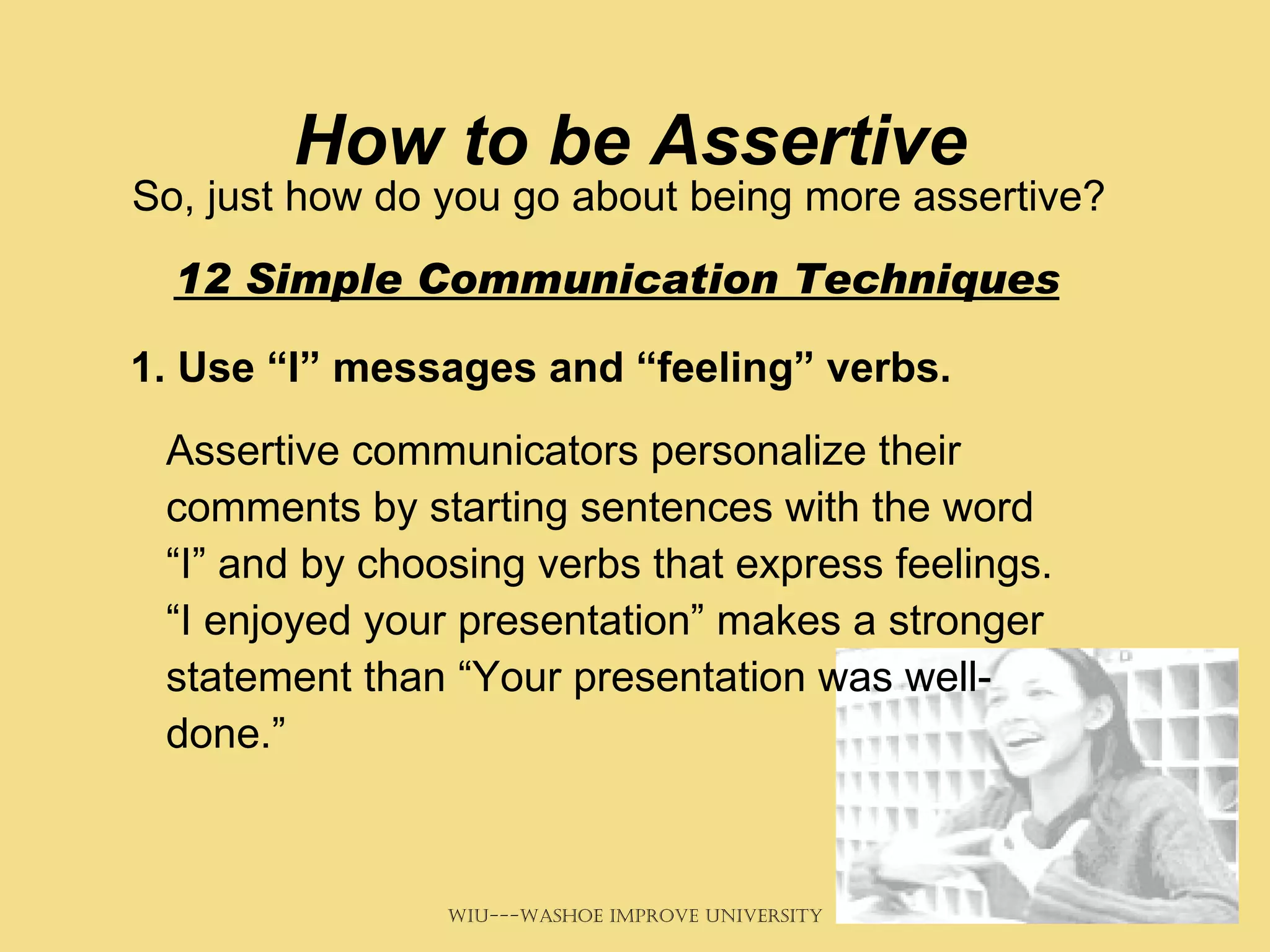
How to be Assertive So, just how do you go about being more assertive?   12 Simple Communication Techniques   1. Use “I” messages and “feeling” verbs.   Assertive communicators personalize their comments by starting sentences with the word “I” and by choosing verbs that express feelings. “I enjoyed your presentation” makes a stronger statement than “Your presentation was well-done.”
How to Be Assertive  12 Simple Communication Techniques 2. Discuss your goals and accomplishments.   Don’t be afraid to tell coworkers:  “I plan to improve my performance this month”  or  “I’m proud that I won the employee of the month award for last month.”  
How to Be Assertive  12 Simple Communication Techniques 3. Show an interest in others.  An assertive communicator can read another person’s body language, or tone of voice and react appropriately with phrases like “I’m glad you got that promotion” or “I see you’re relieved that project’s over.”
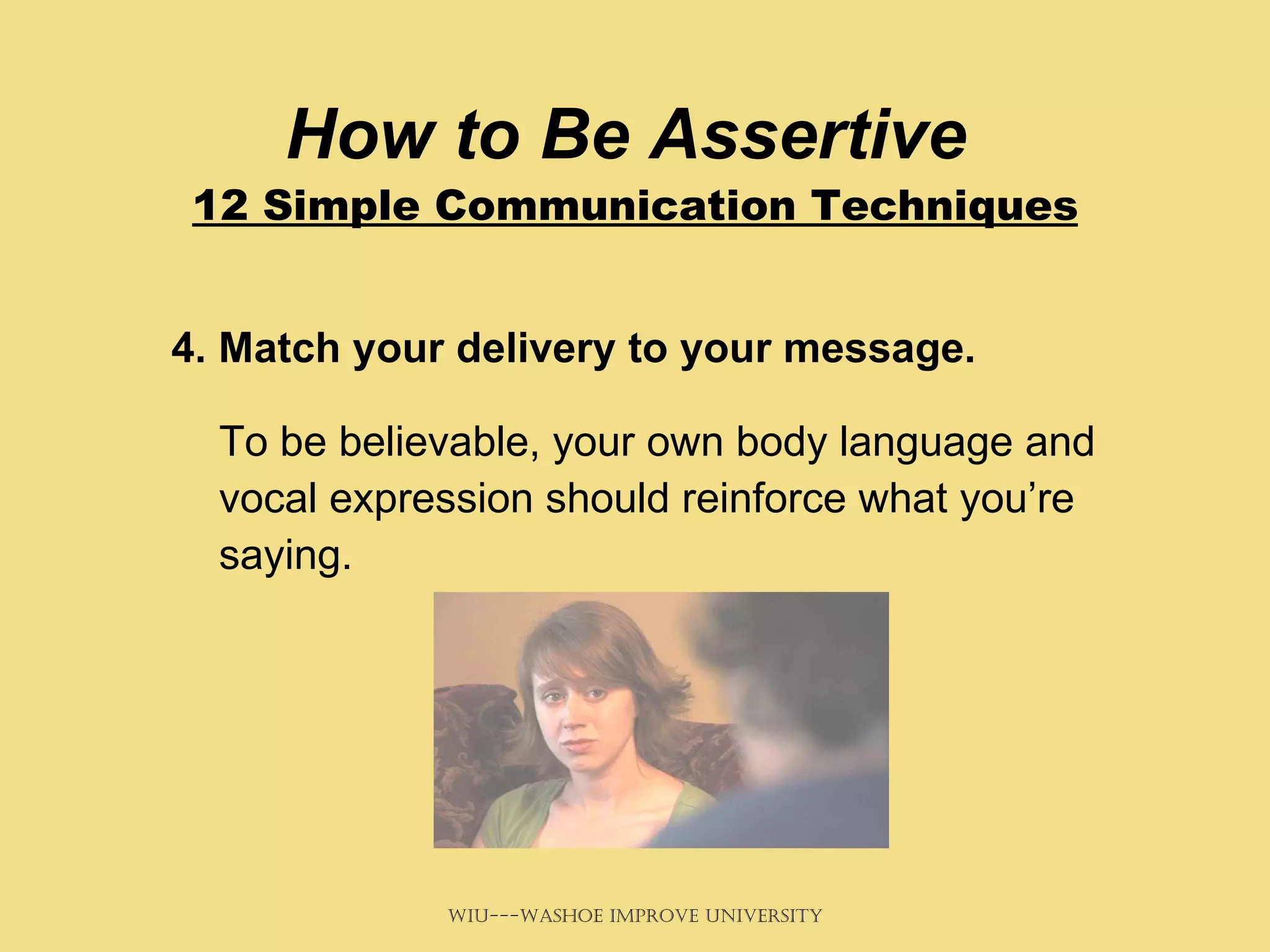
How to Be Assertive  12 Simple Communication Techniques 4. Match your delivery to your message.   To be believable, your own body language and vocal expression should reinforce what you’re saying.
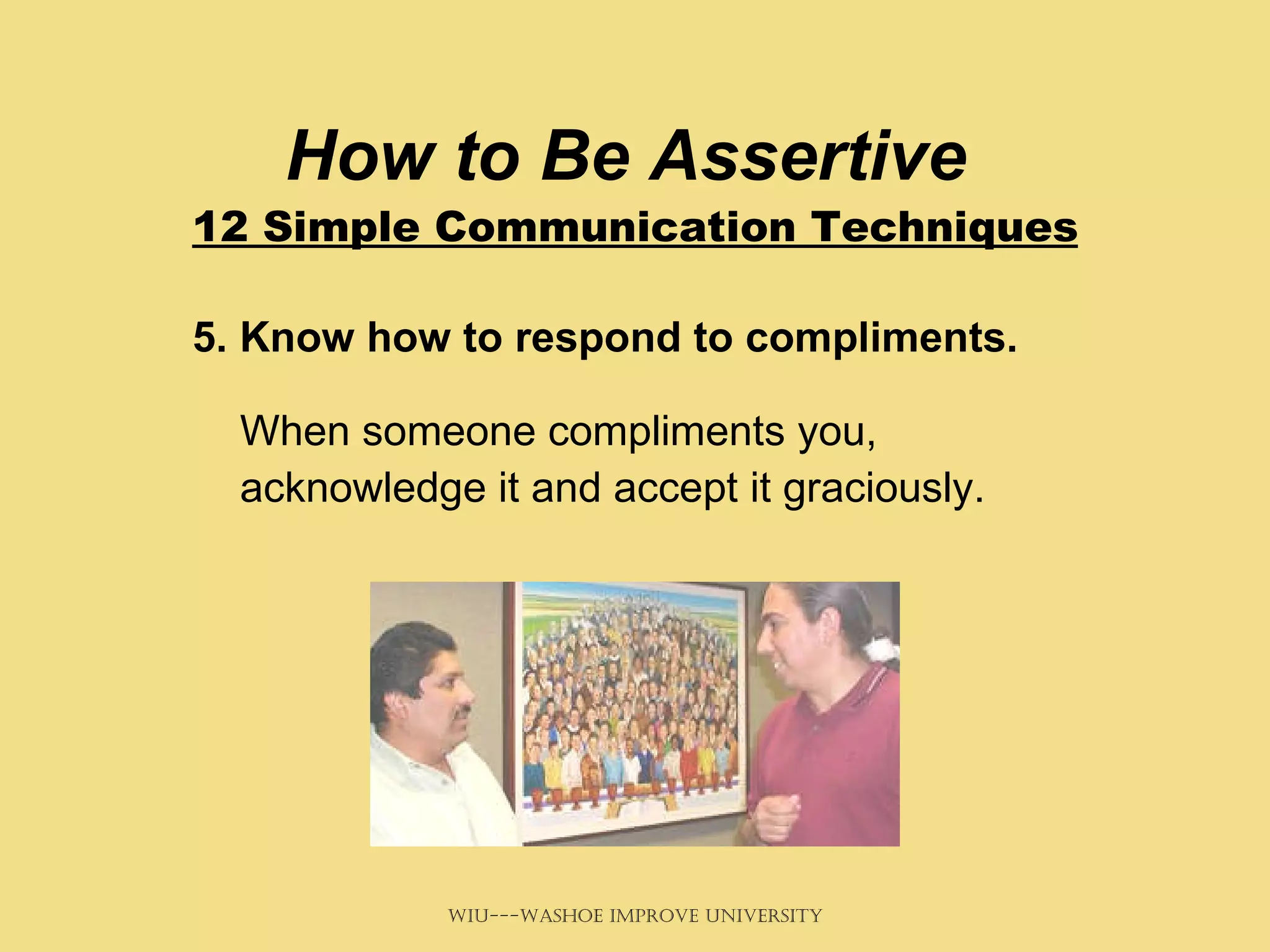
How to Be Assertive  12 Simple Communication Techniques 5. Know how to respond to compliments.   When someone compliments you, acknowledge it and accept it graciously.
How to Be Assertive 12 Simple Communication Techniques 6. Disagree mildly.   If you’re unsure of another person’s thoughts or feelings, state your position firmly, quietly and in a non-demanding, uncritical way.
How to Be Assertive  12 Simple Communication Techniques 7. Disagree more emphatically when it’s necessary to get your point across .  If you’re sure someone’s idea isn’t going to work and they’re being stubborn about it, make your message stronger.
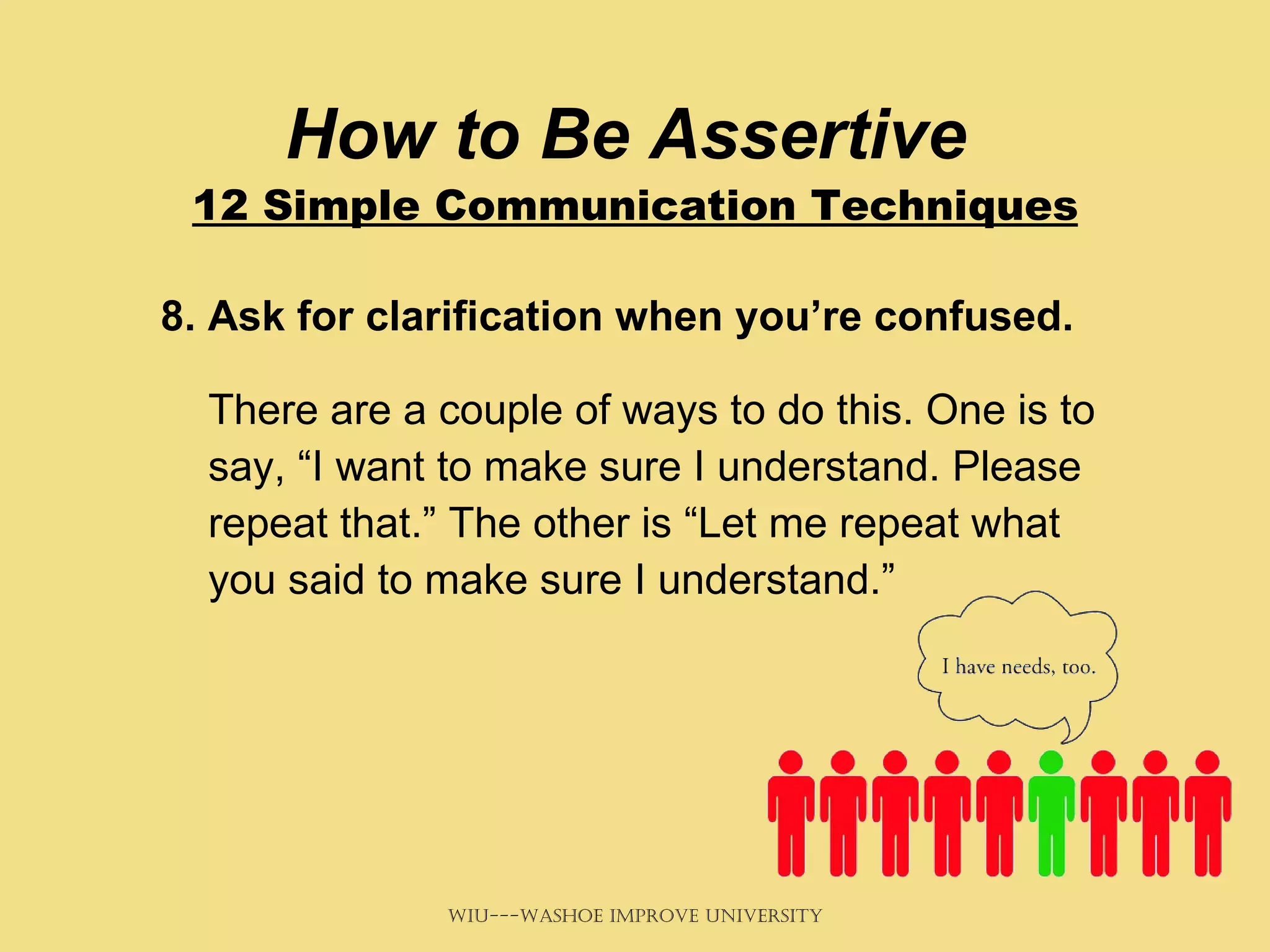
How to Be Assertive  12 Simple Communication Techniques 8. Ask for clarification when you’re confused.   There are a couple of ways to do this. One is to say, “I want to make sure I understand. Please repeat that.” The other is “Let me repeat what you said to make sure I understand.”  
How to Be Assertive 12 Simple Communication Techniques 9. Don’t be afraid to ask “Why?”   This applies to requests that seem unreasonable, silly or wasteful. Begin with a positive statement, then express your opinion and finally ask a direct question.
How to Be Assertive 12 Simple Communication Techniques 10. Speak up for yourself.   Assertive people don’t let others take advantage of them. If a request is unreasonable or poorly timed, say “no,” give a brief explanation and don’t feel guilty about it.
How to Be Assertive 12 Simple Communication Techniques 11. Be persistent.   If you have a reasonable or legitimate request, don’t give up until it’s been fulfilled.
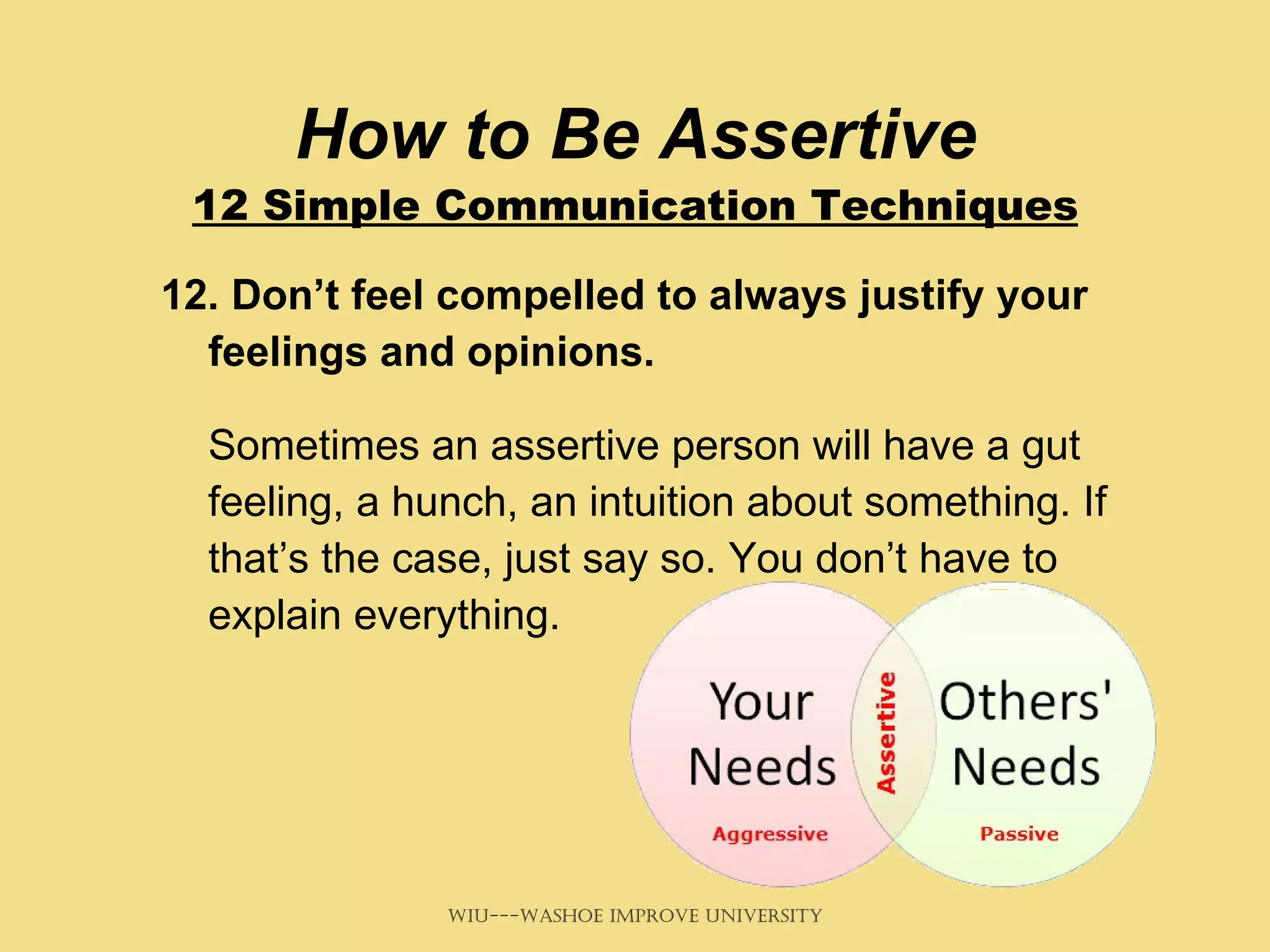
How to Be Assertive 12 Simple Communication Techniques 12. Don’t feel compelled to always justify your feelings and opinions. Sometimes an assertive person will have a gut feeling, a hunch, an intuition about something. If that’s the case, just say so. You don’t have to explain everything.
Exposure Therapy Practicing assertiveness in real-life seems daunting Best way to build confidence, improve assertiveness Overcome anxiety by forcing yourself to participate when you usually have difficulty
Visualization Imagine yourself handling a difficult scenario assertively Helps you relax and react more effectively Rehearsing can help you be more effective, confident and assertive
Making Your Messages Assertive When conflict or poor communication is causing problems at work people typically react passively by doing nothing  or aggressively by doing and saying too much others may react in a passive-aggressive manner
Making Your Messages Assertive
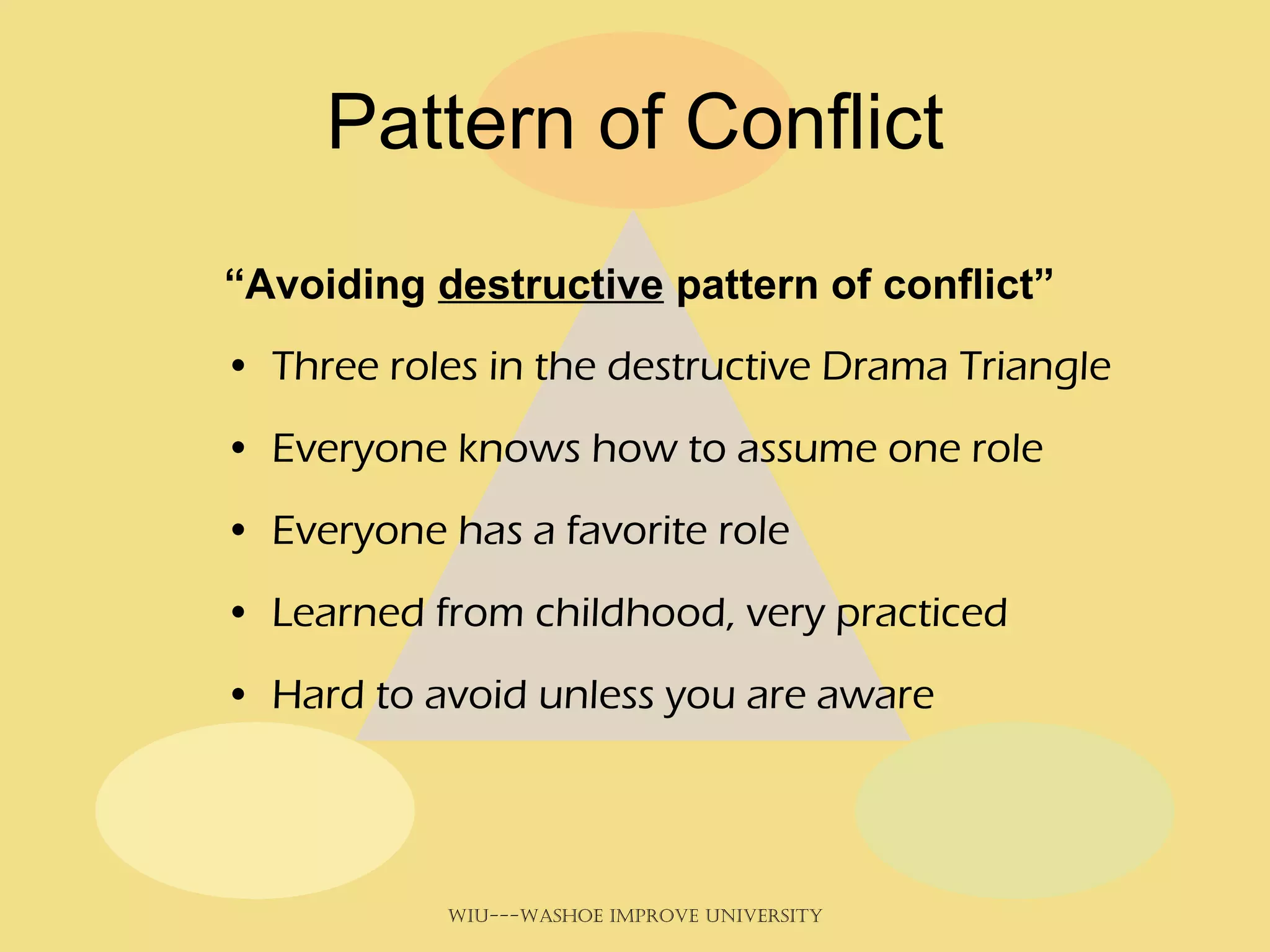
Pattern of Conflict “ Avoiding  destructive  pattern of conflict” Three roles in the destructive Drama Triangle Everyone knows how to assume one role Everyone has a favorite role Learned from childhood, very practiced Hard to avoid unless you are aware
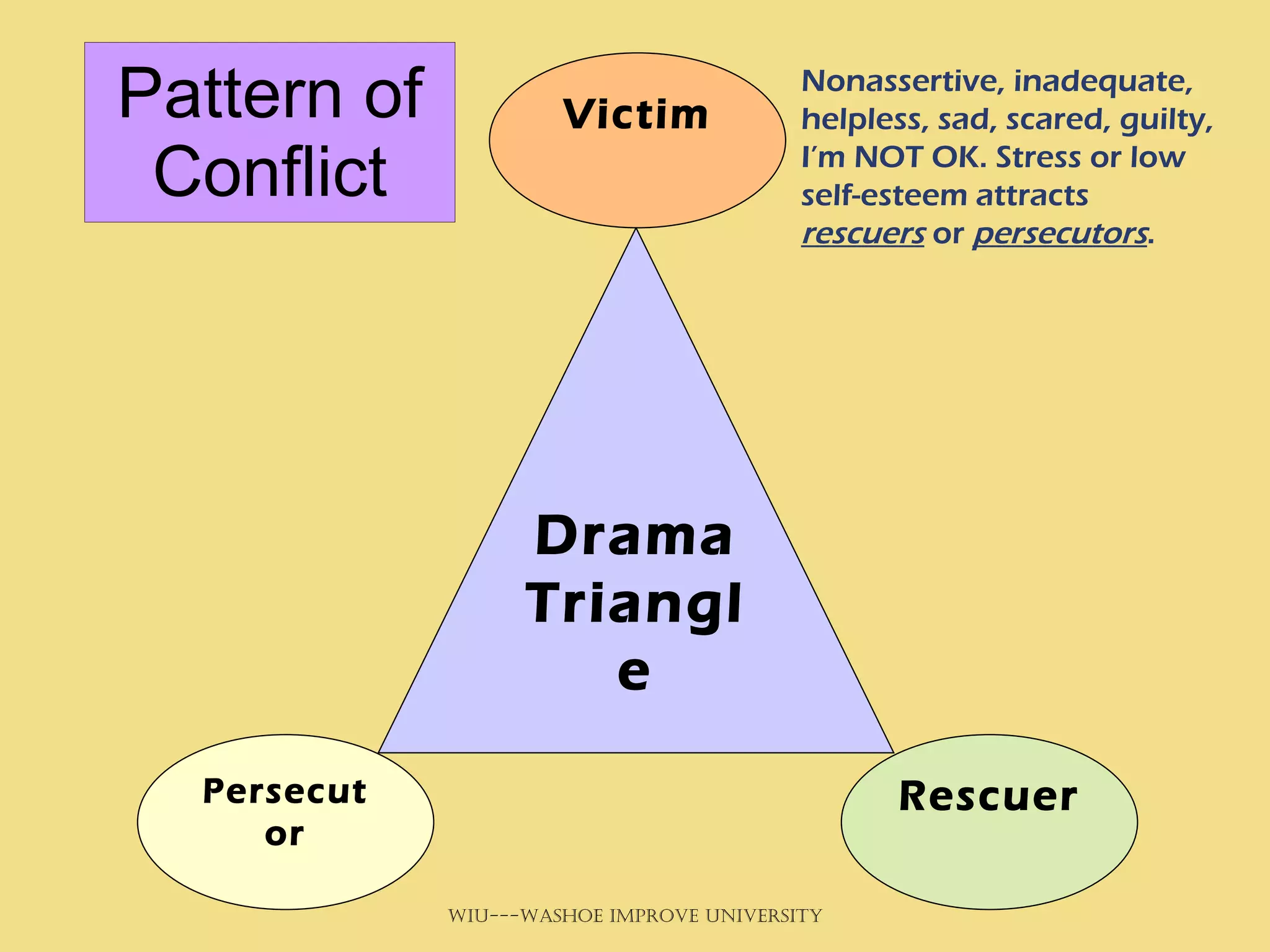
Pattern of Conflict Nonassertive, inadequate, helpless, sad, scared, guilty, I’m NOT OK. Stress or low self-esteem attracts  rescuers  or  persecutors . Drama Triangle Persecutor Victim Rescuer
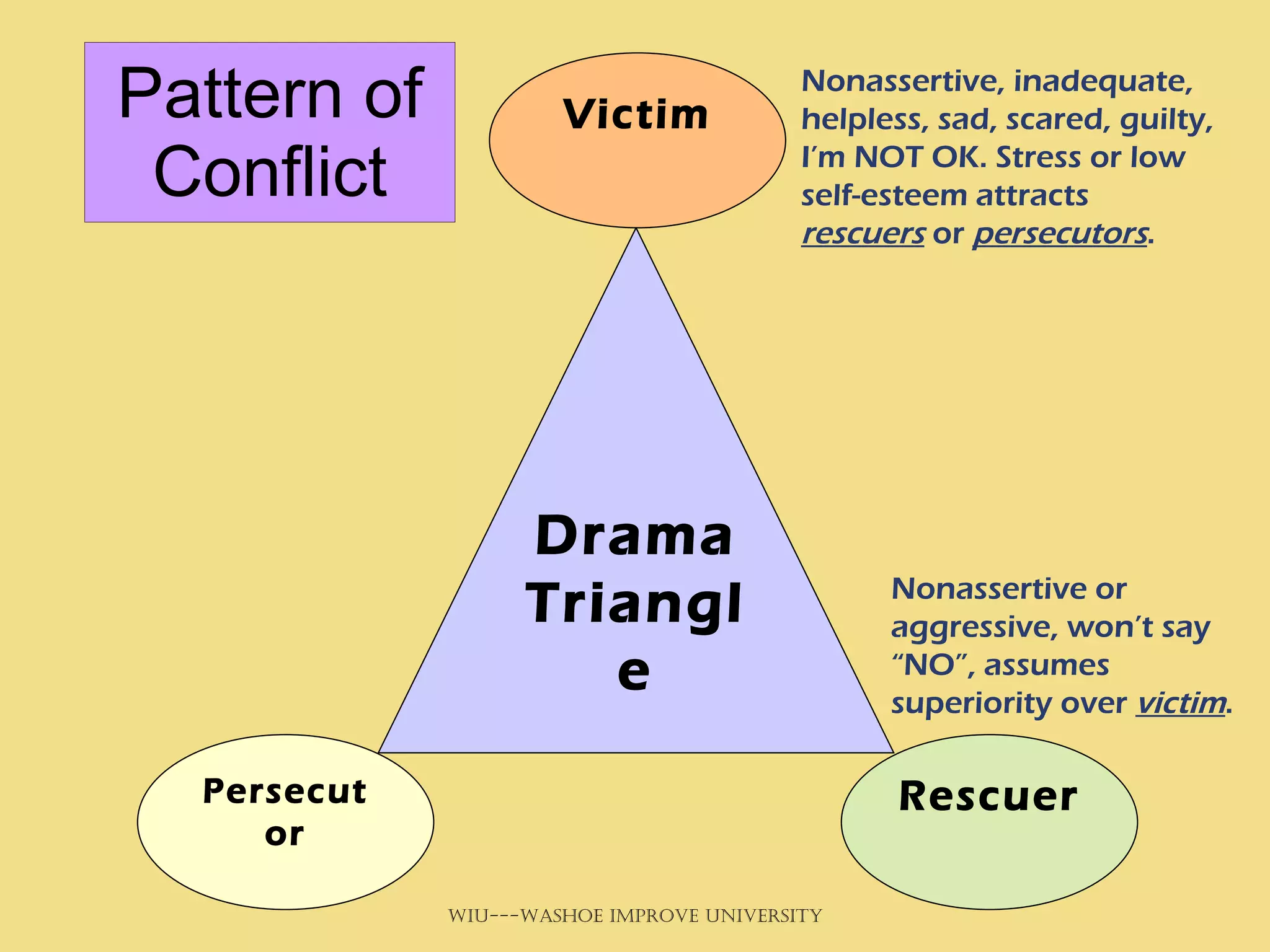
Pattern of Conflict Nonassertive, inadequate, helpless, sad, scared, guilty, I’m NOT OK. Stress or low self-esteem attracts  rescuers  or  persecutors . Nonassertive or aggressive, won’t say “NO”, assumes superiority over  victim . Drama Triangle Persecutor Victim Rescuer
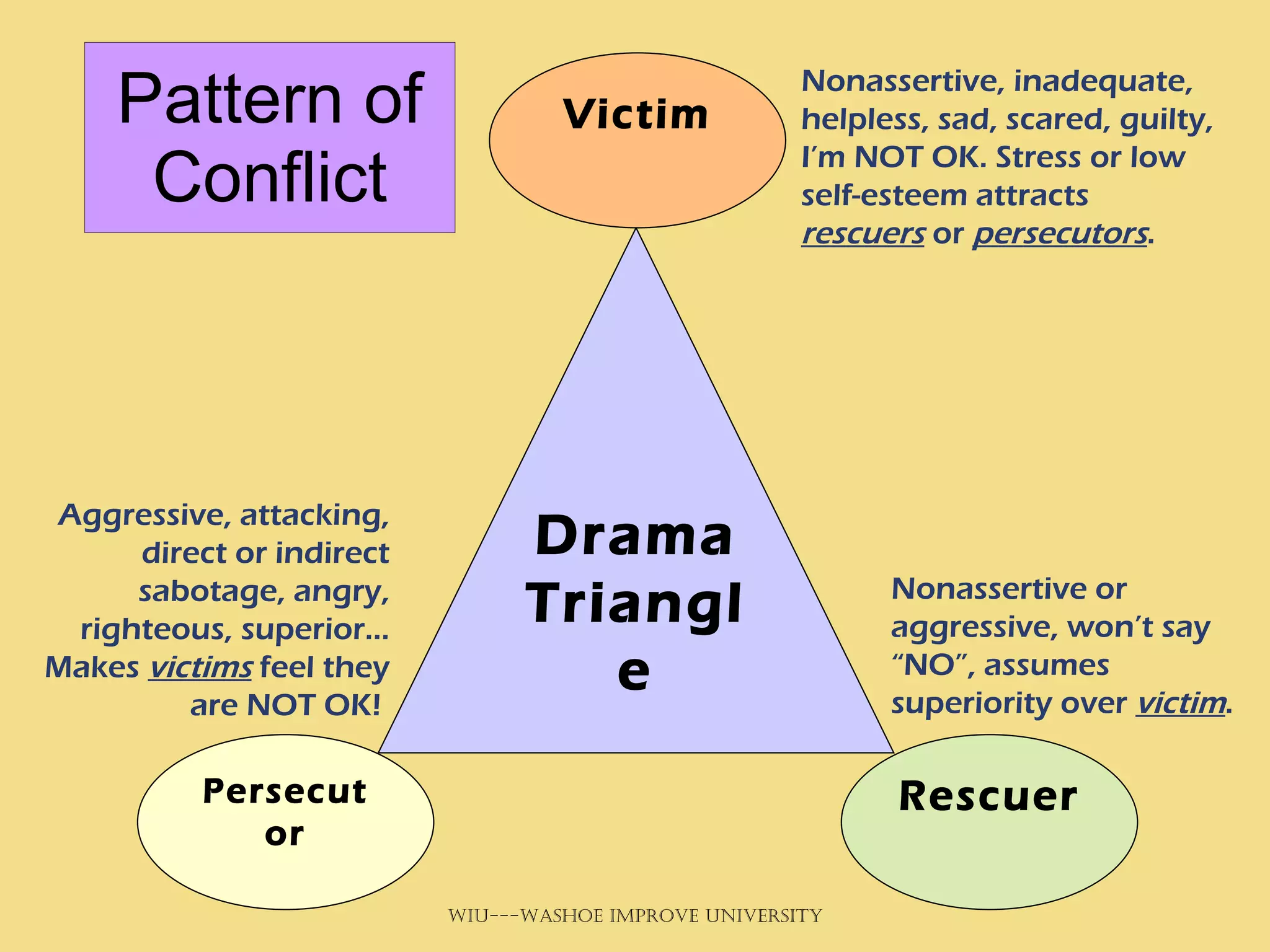
Pattern of Conflict Nonassertive, inadequate, helpless, sad, scared, guilty, I’m NOT OK. Stress or low self-esteem attracts  rescuers  or  persecutors . Aggressive, attacking, direct or indirect sabotage, angry, righteous, superior…Makes  victims  feel they are NOT OK!  Nonassertive or aggressive, won’t say “NO”, assumes superiority over  victim . Drama Triangle Persecutor Victim Rescuer
Pattern of Conflict PRACTICE, PRACTICE! Improving skills requires practice Daily practice for at least 21 days is  recommended to change old behavior patterns and develop new skills
Assertive communication… Gets to the heart of problems and finds solutions   The most effective way to communicate assertively is to prepare a script of what you want to say.  Plan it, write it out, fine-tune it, memorize it, and practice it — then present it.  4 Step Process   “ Acronym DESC” Helps you prepare and deliver successful assertive scripts   D = Describe E = Express  S = Specify  C = Consequences
4 Step Process   “ Acronym DESC” “ Each step addresses a certain goal”   Describe :  Objectively describe the problem to the target person, the one who can do something to help resolve it. Be very specific, stating when, where and why the problem occurs. The technique was first formulated in a 1976 book, Asserting Yourself: A Practical Guide to Positive Change, (Addison-Wesley Publishing Company, Inc.), and updated in 1991 by Sharon Anthony Bower and Gordon H. Bower.
4 Step Process   “ Acronym DESC” Express :  Using restraint, calmly express how you feel. Remember to focus on the problem, not the person who’s causing or contributing to it.
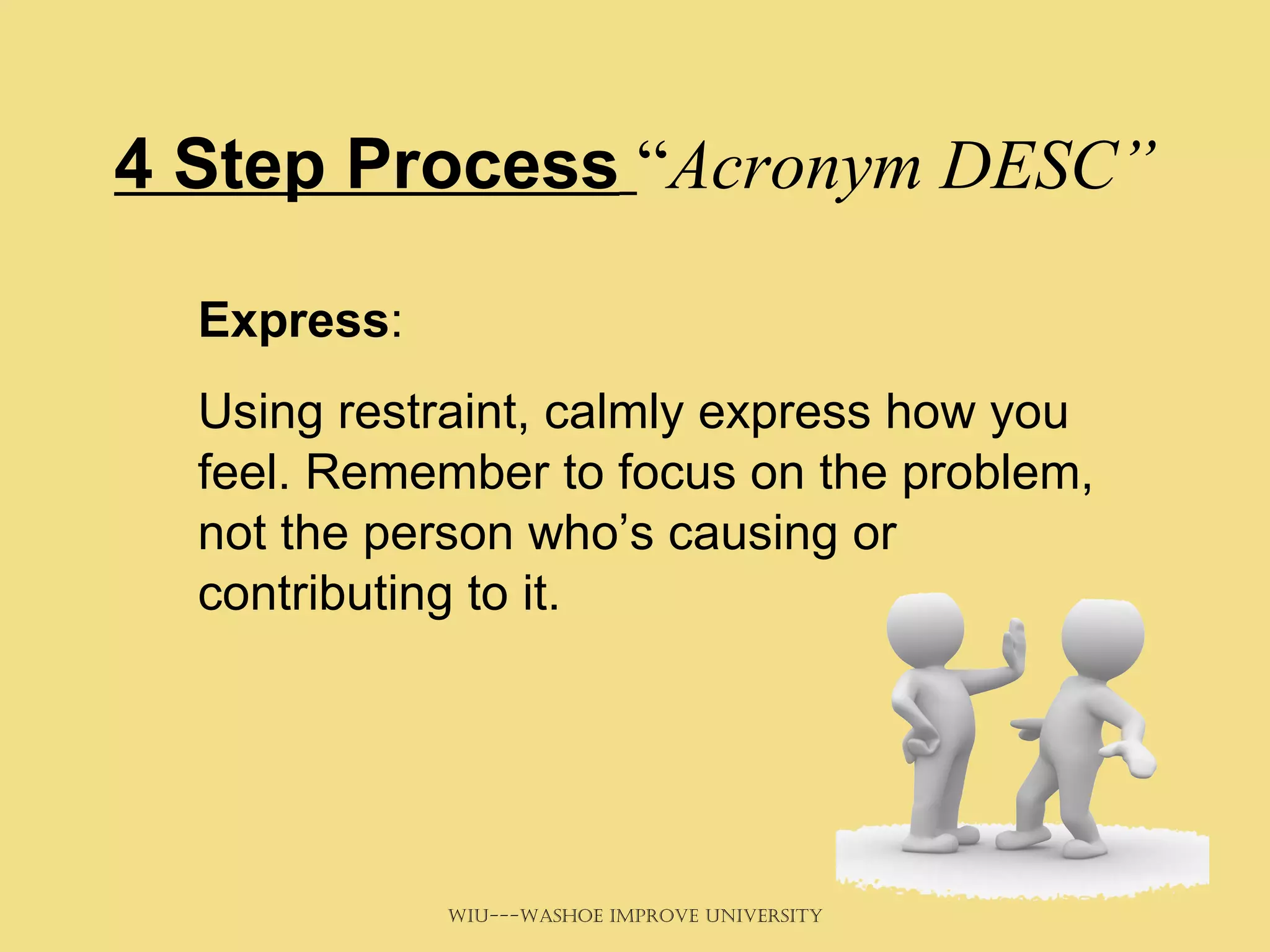
4 Step Process   “ Acronym DESC” Specify:   Carefully explain how you would like the problem to be solved and be willing to compromise a bit to reach a solution. Remember, you’re making a request, not a demand.
4 Step Process   “ Acronym DESC” Consequences:   Lay your cards on the table. Tell the target person about the positive consequences or “rewards” that will result if she helps solve the problem. If the target person isn’t willing to help, outline the negative consequences or “punishments” that will result. Then be prepared to follow through.
4 Step Process   “ Acronym DESC” Example ...  Here’s how you might handle the problem with your coworker, Monica, who’s fallen behind on her part of a project that’s been assigned to your whole team. Describe : “Monica, I haven’t received your part of the research our team’s supposed to gather for the new strategic plan. It was due to the department director yesterday, and he’s called me twice already to ask about it.”
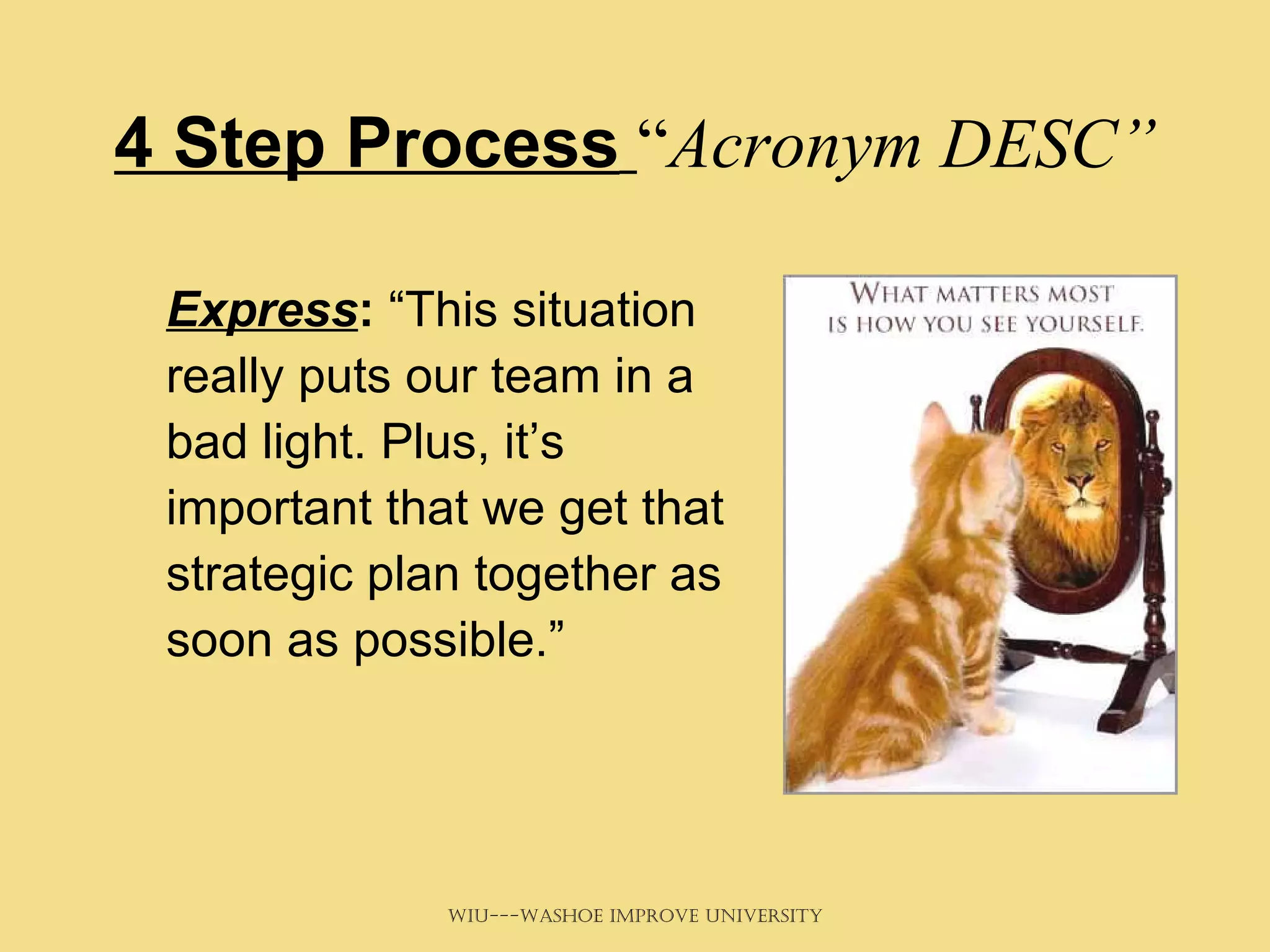
4 Step Process   “ Acronym DESC” Express :  “This situation really puts our team in a bad light. Plus, it’s important that we get that strategic plan together as soon as possible.”  
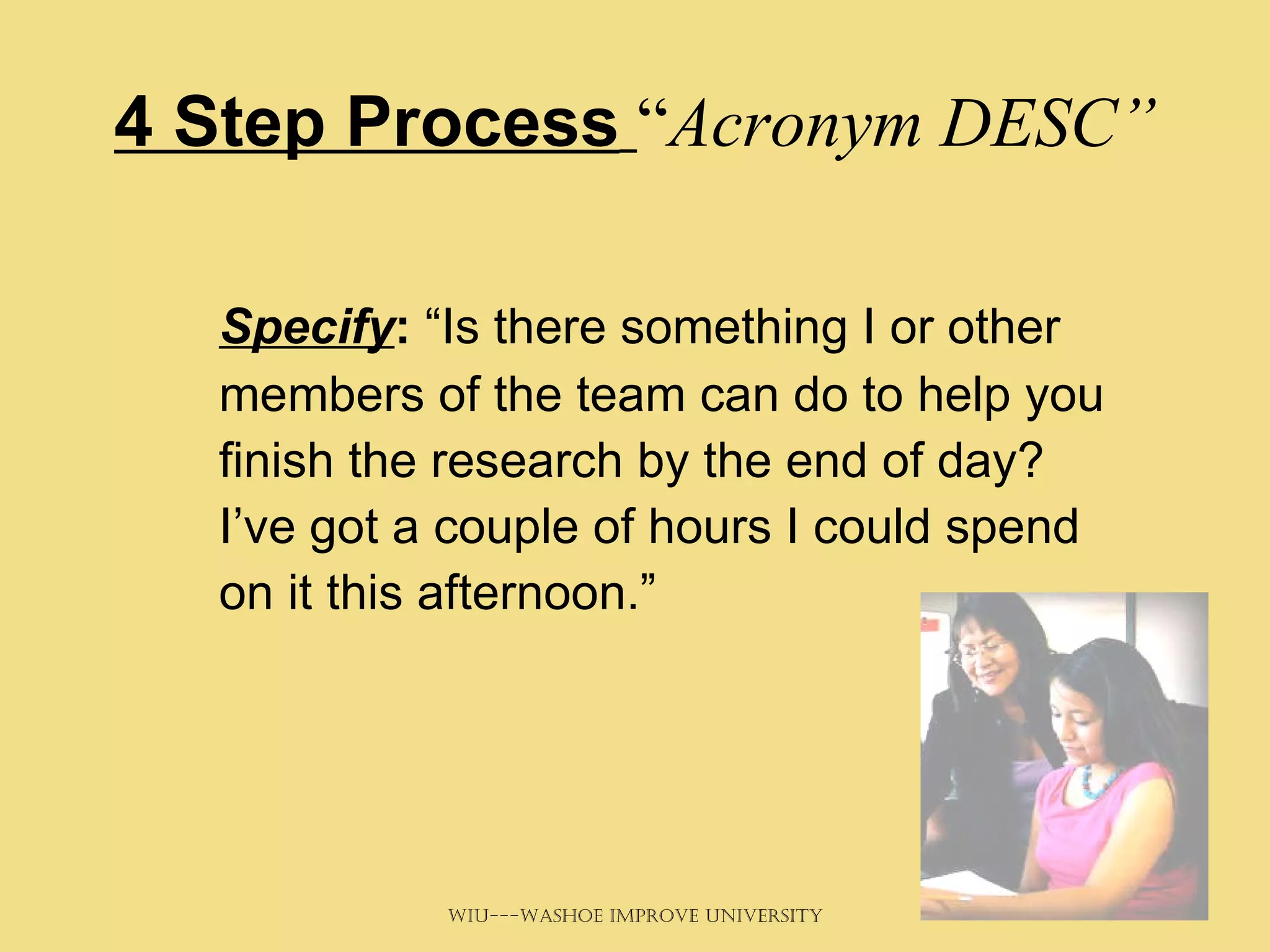
4 Step Process   “ Acronym DESC” Specify :  “Is there something I or other members of the team can do to help you finish the research by the end of day? I’ve got a couple of hours I could spend on it this afternoon.”
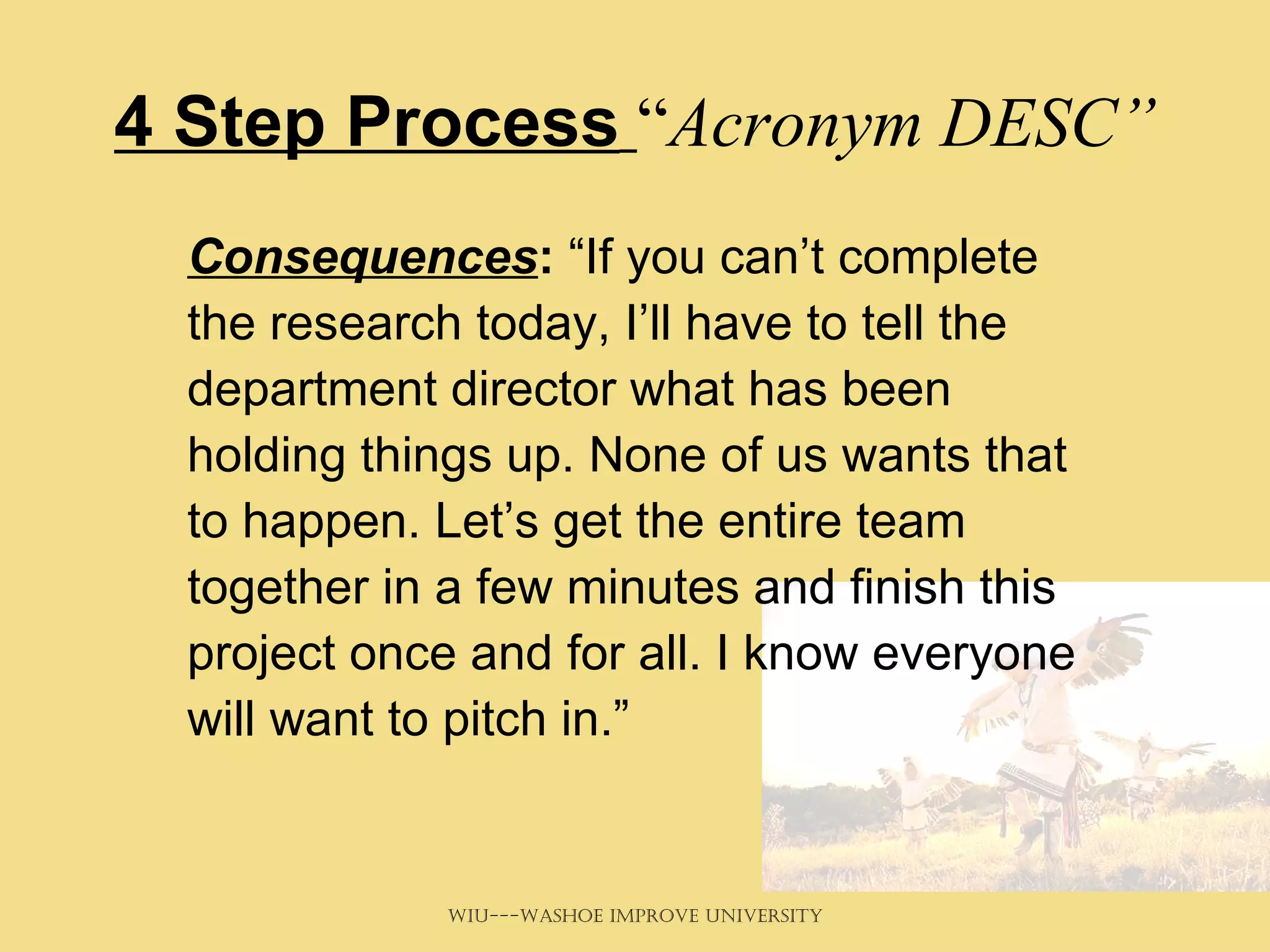
4 Step Process   “ Acronym DESC” Consequences :  “If you can’t complete the research today, I’ll have to tell the department director what has been holding things up. None of us wants that to happen. Let’s get the entire team together in a few minutes and finish this project once and for all. I know everyone will want to pitch in.”
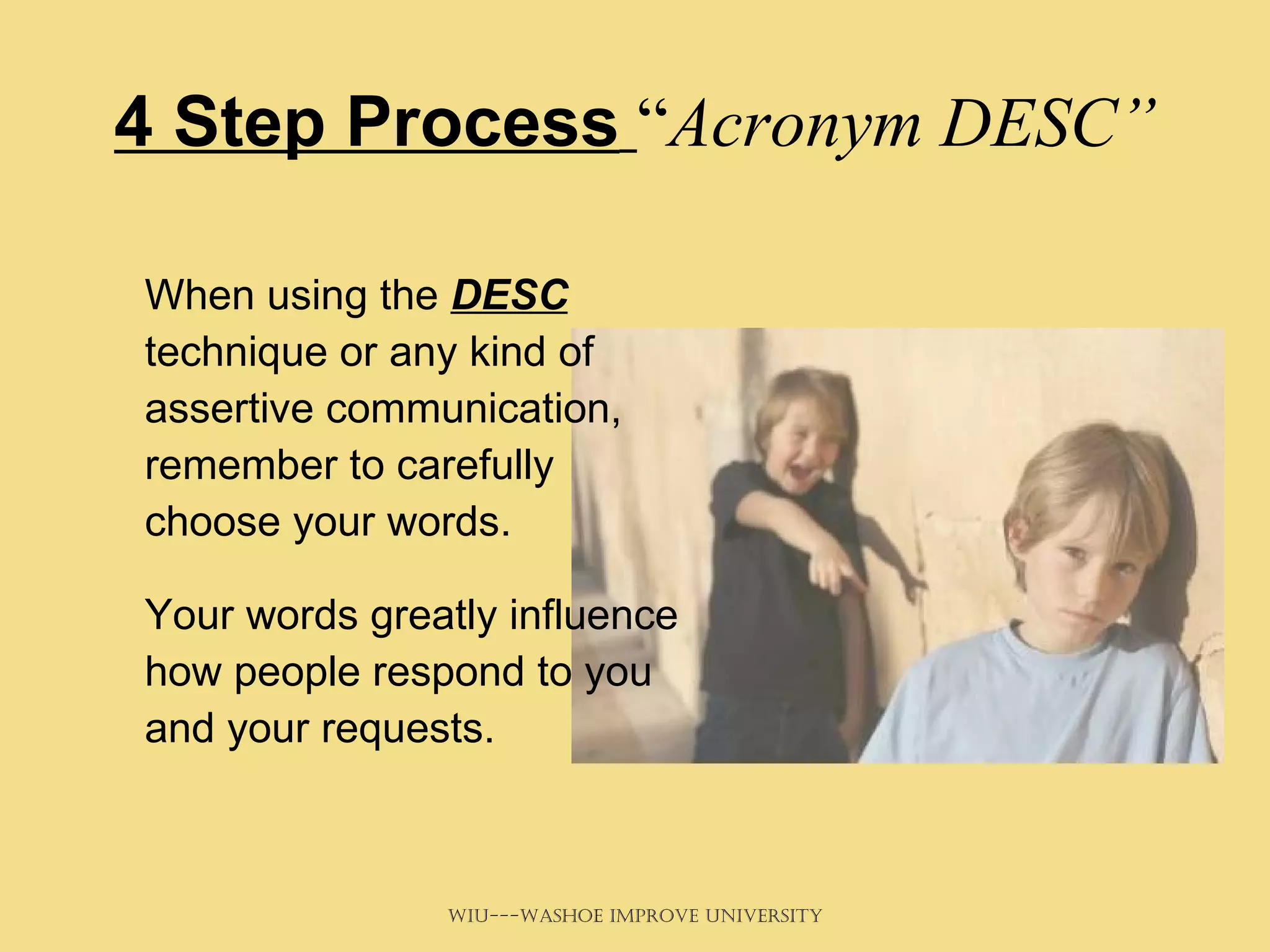
4 Step Process   “ Acronym DESC” When using the  DESC  technique or any kind of assertive communication, remember to carefully choose your words.  Your words greatly influence how people respond to you and your requests.
4 Step Process   “ Acronym DESC” The Benefits of Being Assertive   Each year, companies spend billions of dollars upgrading their employees’ technical, people and customer-service skills.  What many don’t realize is that assertiveness training can also affect things like customer satisfaction, productivity and profitability.  By offering this kind of training, companies can teach their employees to solve problems through cooperation and negotiation.  But that’s just one of the many benefits of an assertive workplace.
A few other benefits… Every problem seems to have a “win-win” solution. Assertive communicators first ask what the other person wants, then quickly negotiate a solution all can live with.  Because problems are solved quickly, resentment, frustration and other tensions that block peak performance are minimized.  Helps employees become problem-solvers rather than victims of a system they believe they can’t control.  While  victims  feel paralyzed, assertive people feel empowered to find the best solutions.
A few other benefits… Assertive behavior can actually reduce physical and mental stress because people feel less like victims and more like influencers.  Employees stop procrastinating and start acting.  They form an action plan for success by asking, “What will it take to make my wish (or goal) a reality?”  Communication becomes clearer and more concise, which reduces misunderstandings and clarifies expectations.  Phrases like “I thought you meant ... ” virtually disappear. People speak up and say what’s on their minds.  They aren’t afraid their ideas will be shunned, ridiculed or ignored.
A few other benefits… Employees concentrate on what’s within their control, rather than what’s beyond their control.  Example : you can always control how you react to a situation, but you can’t control how others react.  Instead of wasting time by gossiping and complaining — which accomplish nothing — employees focus on the positive, productive steps they can take to solve problems.
As you can see, it pays to be assertive in the workplace, especially when change and uncertainty are the only constants in today’s business world. Being assertive gives you the confidence and communication skills to go after and get what you really want.  After all, if you don’t stand up for yourself, no one else will.
Please be sure to complete and leave the evaluation sheet you received with your handouts.  Thank you for your attention and interest!
Recommended Reading : Asserting Yourself:  A Practical Guide to Positive Change ,  by Sharon Anthony Bower and Gordon H. Bower (the DESC technique was first formulated in this 1976 book) When I Say No, I Feel Guilty by Manuel J. Smith,  #1 Best Seller on Assertiveness Training Your Perfect Right:  Assertiveness and Equality in Your Life and Relationships by Robert E. Alberti and Michael L. Emmons

The Art Of Assertiveness

  • 1.
    The Art ofAssertiveness Washoe Tribe of Nevada & California Don Johnson, Trainer
  • 2.
    Objectives: Managing changeAssertive vs. Aggressive Communication techniques Avoiding the Drama Triangle 4 Step Process (DESC) Benefits
  • 3.
    3 Benefits ofAssertive Communication Set boundaries with aggressive types Speak-up confidently for yourself Expressing your ideas so you are perceived as a valuable asset
  • 4.
    The Art ofAssertiveness CHANGE… “ The only constant in business today is change.” Sound familiar?…If it doesn’t, it should. It’s the new reality for working people in every type of job, in every industry, in every city and town.
  • 5.
    The Art ofAssertiveness CHANGE… To survive and, more importantly, thrive in the business world of today and tomorrow, working people must accept and adapt to changes like these: New technology constantly requires new skills. Downsizing means each person assumes more work and more responsibility. Mergers and realignments bring changes in job duties, career paths, compensation, retirements and benefits.
  • 6.
    Dealing with changeisn’t easy. Some people seem to enjoy the challenges of change, believing they can handle anything that comes their way. When they face obstacles, they find solutions. And although they may experience moments of uncertainty or indecisiveness, they quickly get back on track, hang in there and eventually make good things happen.
  • 7.
    Dealing with ChangeBecause these people are constantly learning and growing with their changing work environment, they can be labeled as both optimistic and assertive . Optimism – shows in a person’s outlook on life and their personality. Assertiveness - While it’s difficult, if not impossible, to change your basic personality, it’s certainly possible to learn to be more assertive — to go after and get what you want.
  • 8.
    What is Assertive?Assertive vs. Aggressive In the business world, you often hear the word “aggressive.” Companies talk about their “aggressive” growth plans. Sales managers tell their people to be “aggressive” when calling on clients. Customer service reps are instructed to “aggressively” solve customer problems. Children are told to be aggressive in sports.
  • 9.
    Definition “Assertive”vs. “Aggressive” Assertive - “persistently positive or confident” or “politely persistent” Aggressive - “full of enterprise and initiative; bold and active; pushing; starting fights or quarrels; ready or willing to engage in direct action; militant”   Depending on your preferred definition: “ Aggressive” can be either positive or negative. Typically, it’s used to describe behavior that’s pushy, abrasive or too forceful.
  • 10.
    Difference between being assertive and aggressive How our words and behavior affect the rights and well-being of other people. Assertive communication champions our own rights and well-being without violating those of others take feelings and needs into consideration shows respect
  • 11.
    Example Say you’rehaving trouble with a coworker: Monica, has fallen behind on her part of a project assigned to your whole team. As an assertive communicator, you have the right to privately express your displeasure to Monica and ask her to do her share of the work. At the same time, Monica has the right to tell her side of the story — perhaps a family situation has caused her work productivity to drop. Whatever the case, the two of you could rationally and reasonably discuss the situation and focus on finding a mutually agreeable solution to the problem. Both could “win.”
  • 12.
    3 Crucial Elements of Assertive Persuasion Credibility – people believe you know what you’re talking about Emotional Connection – people oriented / task oriented Logic – based on situation / audience
  • 13.
    How to beAssertive So, just how do you go about being more assertive? 12 Simple Communication Techniques   1. Use “I” messages and “feeling” verbs. Assertive communicators personalize their comments by starting sentences with the word “I” and by choosing verbs that express feelings. “I enjoyed your presentation” makes a stronger statement than “Your presentation was well-done.”
  • 14.
    How to BeAssertive 12 Simple Communication Techniques 2. Discuss your goals and accomplishments. Don’t be afraid to tell coworkers: “I plan to improve my performance this month” or “I’m proud that I won the employee of the month award for last month.”  
  • 15.
    How to BeAssertive 12 Simple Communication Techniques 3. Show an interest in others. An assertive communicator can read another person’s body language, or tone of voice and react appropriately with phrases like “I’m glad you got that promotion” or “I see you’re relieved that project’s over.”
  • 16.
    How to BeAssertive 12 Simple Communication Techniques 4. Match your delivery to your message. To be believable, your own body language and vocal expression should reinforce what you’re saying.
  • 17.
    How to BeAssertive 12 Simple Communication Techniques 5. Know how to respond to compliments. When someone compliments you, acknowledge it and accept it graciously.
  • 18.
    How to BeAssertive 12 Simple Communication Techniques 6. Disagree mildly. If you’re unsure of another person’s thoughts or feelings, state your position firmly, quietly and in a non-demanding, uncritical way.
  • 19.
    How to BeAssertive 12 Simple Communication Techniques 7. Disagree more emphatically when it’s necessary to get your point across . If you’re sure someone’s idea isn’t going to work and they’re being stubborn about it, make your message stronger.
  • 20.
    How to BeAssertive 12 Simple Communication Techniques 8. Ask for clarification when you’re confused. There are a couple of ways to do this. One is to say, “I want to make sure I understand. Please repeat that.” The other is “Let me repeat what you said to make sure I understand.”  
  • 21.
    How to BeAssertive 12 Simple Communication Techniques 9. Don’t be afraid to ask “Why?” This applies to requests that seem unreasonable, silly or wasteful. Begin with a positive statement, then express your opinion and finally ask a direct question.
  • 22.
    How to BeAssertive 12 Simple Communication Techniques 10. Speak up for yourself. Assertive people don’t let others take advantage of them. If a request is unreasonable or poorly timed, say “no,” give a brief explanation and don’t feel guilty about it.
  • 23.
    How to BeAssertive 12 Simple Communication Techniques 11. Be persistent. If you have a reasonable or legitimate request, don’t give up until it’s been fulfilled.
  • 24.
    How to BeAssertive 12 Simple Communication Techniques 12. Don’t feel compelled to always justify your feelings and opinions. Sometimes an assertive person will have a gut feeling, a hunch, an intuition about something. If that’s the case, just say so. You don’t have to explain everything.
  • 25.
    Exposure Therapy Practicingassertiveness in real-life seems daunting Best way to build confidence, improve assertiveness Overcome anxiety by forcing yourself to participate when you usually have difficulty
  • 26.
    Visualization Imagine yourselfhandling a difficult scenario assertively Helps you relax and react more effectively Rehearsing can help you be more effective, confident and assertive
  • 27.
    Making Your MessagesAssertive When conflict or poor communication is causing problems at work people typically react passively by doing nothing or aggressively by doing and saying too much others may react in a passive-aggressive manner
  • 28.
  • 29.
    Pattern of Conflict“ Avoiding destructive pattern of conflict” Three roles in the destructive Drama Triangle Everyone knows how to assume one role Everyone has a favorite role Learned from childhood, very practiced Hard to avoid unless you are aware
  • 30.
    Pattern of ConflictNonassertive, inadequate, helpless, sad, scared, guilty, I’m NOT OK. Stress or low self-esteem attracts rescuers or persecutors . Drama Triangle Persecutor Victim Rescuer
  • 31.
    Pattern of ConflictNonassertive, inadequate, helpless, sad, scared, guilty, I’m NOT OK. Stress or low self-esteem attracts rescuers or persecutors . Nonassertive or aggressive, won’t say “NO”, assumes superiority over victim . Drama Triangle Persecutor Victim Rescuer
  • 32.
    Pattern of ConflictNonassertive, inadequate, helpless, sad, scared, guilty, I’m NOT OK. Stress or low self-esteem attracts rescuers or persecutors . Aggressive, attacking, direct or indirect sabotage, angry, righteous, superior…Makes victims feel they are NOT OK! Nonassertive or aggressive, won’t say “NO”, assumes superiority over victim . Drama Triangle Persecutor Victim Rescuer
  • 33.
    Pattern of ConflictPRACTICE, PRACTICE! Improving skills requires practice Daily practice for at least 21 days is recommended to change old behavior patterns and develop new skills
  • 34.
    Assertive communication… Getsto the heart of problems and finds solutions The most effective way to communicate assertively is to prepare a script of what you want to say. Plan it, write it out, fine-tune it, memorize it, and practice it — then present it. 4 Step Process “ Acronym DESC” Helps you prepare and deliver successful assertive scripts   D = Describe E = Express S = Specify C = Consequences
  • 35.
    4 Step Process “ Acronym DESC” “ Each step addresses a certain goal”   Describe : Objectively describe the problem to the target person, the one who can do something to help resolve it. Be very specific, stating when, where and why the problem occurs. The technique was first formulated in a 1976 book, Asserting Yourself: A Practical Guide to Positive Change, (Addison-Wesley Publishing Company, Inc.), and updated in 1991 by Sharon Anthony Bower and Gordon H. Bower.
  • 36.
    4 Step Process “ Acronym DESC” Express : Using restraint, calmly express how you feel. Remember to focus on the problem, not the person who’s causing or contributing to it.
  • 37.
    4 Step Process “ Acronym DESC” Specify: Carefully explain how you would like the problem to be solved and be willing to compromise a bit to reach a solution. Remember, you’re making a request, not a demand.
  • 38.
    4 Step Process “ Acronym DESC” Consequences: Lay your cards on the table. Tell the target person about the positive consequences or “rewards” that will result if she helps solve the problem. If the target person isn’t willing to help, outline the negative consequences or “punishments” that will result. Then be prepared to follow through.
  • 39.
    4 Step Process “ Acronym DESC” Example ... Here’s how you might handle the problem with your coworker, Monica, who’s fallen behind on her part of a project that’s been assigned to your whole team. Describe : “Monica, I haven’t received your part of the research our team’s supposed to gather for the new strategic plan. It was due to the department director yesterday, and he’s called me twice already to ask about it.”
  • 40.
    4 Step Process “ Acronym DESC” Express : “This situation really puts our team in a bad light. Plus, it’s important that we get that strategic plan together as soon as possible.”  
  • 41.
    4 Step Process “ Acronym DESC” Specify : “Is there something I or other members of the team can do to help you finish the research by the end of day? I’ve got a couple of hours I could spend on it this afternoon.”
  • 42.
    4 Step Process “ Acronym DESC” Consequences : “If you can’t complete the research today, I’ll have to tell the department director what has been holding things up. None of us wants that to happen. Let’s get the entire team together in a few minutes and finish this project once and for all. I know everyone will want to pitch in.”
  • 43.
    4 Step Process “ Acronym DESC” When using the DESC technique or any kind of assertive communication, remember to carefully choose your words. Your words greatly influence how people respond to you and your requests.
  • 44.
    4 Step Process “ Acronym DESC” The Benefits of Being Assertive Each year, companies spend billions of dollars upgrading their employees’ technical, people and customer-service skills. What many don’t realize is that assertiveness training can also affect things like customer satisfaction, productivity and profitability. By offering this kind of training, companies can teach their employees to solve problems through cooperation and negotiation. But that’s just one of the many benefits of an assertive workplace.
  • 45.
    A few otherbenefits… Every problem seems to have a “win-win” solution. Assertive communicators first ask what the other person wants, then quickly negotiate a solution all can live with. Because problems are solved quickly, resentment, frustration and other tensions that block peak performance are minimized. Helps employees become problem-solvers rather than victims of a system they believe they can’t control. While victims feel paralyzed, assertive people feel empowered to find the best solutions.
  • 46.
    A few otherbenefits… Assertive behavior can actually reduce physical and mental stress because people feel less like victims and more like influencers. Employees stop procrastinating and start acting. They form an action plan for success by asking, “What will it take to make my wish (or goal) a reality?” Communication becomes clearer and more concise, which reduces misunderstandings and clarifies expectations. Phrases like “I thought you meant ... ” virtually disappear. People speak up and say what’s on their minds. They aren’t afraid their ideas will be shunned, ridiculed or ignored.
  • 47.
    A few otherbenefits… Employees concentrate on what’s within their control, rather than what’s beyond their control. Example : you can always control how you react to a situation, but you can’t control how others react. Instead of wasting time by gossiping and complaining — which accomplish nothing — employees focus on the positive, productive steps they can take to solve problems.
  • 48.
    As you cansee, it pays to be assertive in the workplace, especially when change and uncertainty are the only constants in today’s business world. Being assertive gives you the confidence and communication skills to go after and get what you really want. After all, if you don’t stand up for yourself, no one else will.
  • 49.
    Please be sureto complete and leave the evaluation sheet you received with your handouts. Thank you for your attention and interest!
  • 50.
    Recommended Reading :Asserting Yourself: A Practical Guide to Positive Change , by Sharon Anthony Bower and Gordon H. Bower (the DESC technique was first formulated in this 1976 book) When I Say No, I Feel Guilty by Manuel J. Smith, #1 Best Seller on Assertiveness Training Your Perfect Right: Assertiveness and Equality in Your Life and Relationships by Robert E. Alberti and Michael L. Emmons

Editor's Notes

  • #2 Who is familiar with what assertiveness is? Look up the Definition of Art: they use words like “skill” and “creativity” We all have the ability to be skillful and creative. Learning curve!? Not overnight…takes practice.
  • #3 Objectives of this course are to learn how to Manage change for assertiveness Know the differences of Assertiveness vs. Aggressiveness Learn assertive (tactical) Communication techniques Learn how to Avoid the Drama Triangle to be more assertive Learn the 4 Step Process of assertiveness (DESC) …from the book Asserting Yourself: A practical guide to positive change, by Sharon Anthony-Bower And to learn the Benefits of being more assertive
  • #4 Your Assertiveness is determined by the opinion of others. 3 Benefits of Assertive Communication Set boundaries with aggressive types Speak-up confidently for yourself Expressing your ideas so you are perceived as a valuable asset
  • #5 “The only constant in business today is change.” We should all be familiar with this concept. Change is constant and inevitable, therefore we must embrace it. If we don’t we’ll get left behind. It’s the new reality for working people Tasks are changing, jobs are changing, businesses are changing, technology is changing.
  • #6 To survive and thrive in today’s world and in the future, we must accept and adapt to these types of changes: New technology constantly requires new skills. Economic cutbacks means each one of us has to do more. Changes in organizational structure may bring about many other changes…like job descriptions, compensation, benefits.
  • #7 Change is not easy… 1. Some enjoy the challenge…they like to problem solve and overcome those obstacles we throw their way. Others get caught up in the change and resist it. Which only makes it difficult on themselves. 2. The ones who are up to the challenge may get off track but they figure it out and find new ways to do things to become successful.
  • #8 People that deal well w/ change constantly learn and grow with the changing environment These people are both optimistic and assertive . Optimism – shows in a person’s outlook on life and their personality. Assertiveness means changing your basic personality, to go after and get what you want…especially when it is not like you to do so.
  • #9 What is Assertiveness?...let’s define it! Confrontation is not an assertive act…It is an aggressive act! Assertive vs. Aggressive In the business world, you often hear the word “aggressive.” Companies talk about their “aggressive” growth plans. Sales managers tell their people to be “aggressive” when calling on clients. Customer service reps are instructed to “aggressively” solve customer problems. Children are told to be aggressive in sports.
  • #10 Let’s look at the definitions of Assertive and Aggressive Assertive - “persistently positive or confident” or “politely persistent” Aggressive - “full of enterprise and initiative; bold and active; pushing; starting fights or quarrels; ready or willing to engage in direct action; militant”   Depending on your preferred definition: “ Aggressive” can be either positive or negative. Usually, “aggressive” is used to describe pushy, abrasive or forceful actions. SPEAKER NOTES : Group Exercise “Differences between Aggressive and Assertive
  • #11 How do our words and behavior affect the rights and well-being of other people? Through Assertive communication While we are in control of own our rights and our own well-being at the same time we are not violating the rights of others. We also take feelings and needs of others into consideration And we show respect for them while standing up for our own rights
  • #12 Say you’re having trouble with a coworker: Monica, has fallen behind on her part of a project assigned to your whole team. As an assertive communicator, you have the right to privately express your displeasure to Monica and ask her to do her share of the work. At the same time, Monica has the right to tell her side of the story — perhaps a family situation has caused her work productivity to drop. Whatever the case, the two of you could rationally and reasonably discuss the situation and focus on finding a mutually agreeable solution to the problem. Both could “win.” What would an aggressive response to Monica look like? How would that affect your work relationship with her? What would a passive or submissive response look like? Builds frustration…leads to passive >> aggressive (a disorder – an explosion) How is work relationship affected? SPEAKER NOTES : Group Exercise “Decide if the scenario is Passive, Aggressive or Assertive”
  • #13 To persuade someone on your point of view you need these… Credibility – other people believe you know what you’re talking about Emotional Connection – you are people oriented or task oriented, you have the people skills and you have a direct or an indirect Emotional Connection to them. Focused on feelings. Could be emotional about the task at hand. Logic – Your audience or your situation determines your approach Your reputation is based on brief snapshots in time, taken out of context.
  • #14 12 Simple Communication Techniques   1. During conversations with others use “I” messages and “feeling” verbs. Assertive communicators personalize their comments by starting sentences with the word “I” and by choosing verbs that express feelings. “I enjoyed your presentation” makes a stronger statement than “Your presentation was well-done.”
  • #15 2. Discuss your goals and accomplishments with others Don’t be afraid to tell coworkers something like: “I plan to improve my performance this month” or “I’m proud that I won the employee of the month award for last month.”
  • #16 3. Show a true interest in others and have compassion for people An assertive communicator can read another person’s body language, or tone of voice and react appropriately with phrases like “I’m glad you got that promotion” or “I see you’re relieved that project’s over.”
  • #17 4. Match your delivery to the message you’re delivering. To be believable, your own body language and vocal expression should reinforce what you’re saying. In other words, if you look sullen and sound serious when you tell someone you’re happy about her promotion, you’ll probably come across as insincere. Instead, put a smile on your face and in your voice.
  • #18 5. Know how to respond to compliments. When someone compliments you, acknowledge it and accept it graciously. For instance, if a coworker says she likes your suit, say “Thanks for noticing my suit. It’s my favorite.” Don’t say, “Gee, I’ve had this old thing for almost five years.” Comments like that can make the other person feel uncomfortable.
  • #19 6. Disagree mildly. If you’re unsure of another person’s thoughts or feelings, state your position firmly, quietly and in a non-demanding, uncritical way. Say something like, “It’s hard for me to see how your solution will work.” Gently shaking your head “no” will support your verbal message.  
  • #20 7. Disagree more emphatically when it’s necessary to get your point across . If you’re sure someone’s idea isn’t going to work and they’re being stubborn about it, make your message stronger. Say “Your solution won’t solve this problem” or “That’s not how I see it.” Reinforce your words by leaning forward, speaking a little louder and engaging in direct eye contact.
  • #21 8. Ask for clarification when you’re confused. There are a couple of ways to do this. One is to say, “I want to make sure I understand. Please repeat that.” The other is “Let me repeat what you said to make sure I understand.” Use “I” statements to keep people off the defensive.
  • #22 9. Don’t be afraid to ask “Why?” This applies to requests that seem unreasonable, silly or wasteful. Begin with a positive statement, then express your opinion and finally ask a direct question. For example, “I’d like to help you, but I’m certain Charmaine’s already been given that assignment. Should I still do it?’
  • #23 10. Speak up for yourself. Assertive people don’t let others take advantage of them. If a request is unreasonable or poorly timed, say “no,” give a brief explanation and don’t feel guilty about it.  
  • #24 11. Be persistent. If you have a reasonable or legitimate request, don’t give up until it’s been fulfilled. Example : you’ve asked your employee Charmaine to complete a report by 3 p.m. and it’s not done on time. Keep checking her progress every few minutes and send a clear message: “It’s important that I get those figures by mid-afternoon in order to authorize the payroll. From now on, please make sure you get them to me on time.”
  • #25 12. Don’t feel compelled to always justify your feelings and opinions. Sometimes an assertive person will have a gut feeling, a hunch, an intuition about something. If that’s the case, just say so. You don’t have to explain everything.
  • #26 While practicing assertiveness in real-life situations may seem daunting, it is probably the best and Most effective way to build your confidence and improve your ability to be assertive Useful for combating symptoms of social anxiety or social phobia by gradually forcing yourself to participate in settings where you usually have difficulty being assertive
  • #27 Imagining yourself handling a difficult scenario in an assertive manner can help you relax and react more effectively when confronted by the actual situation. Rehearsing what you want to say or imagining how you want to handle a specific situation can help you to become more effective, confident and assertive.
  • #28 Here are some reasons to get your message across more assertively You may have conflict or poor communication which causes problems at work - Typically people will react passively by doing nothing or aggressively by doing and saying too much. - Occasionally others may react in a passive-aggressive manner They may not say anything to your face, but they’ll talk about you behind your back and try to sabotage your efforts. When these situations occur, no one “wins” and no problems are ever solved.
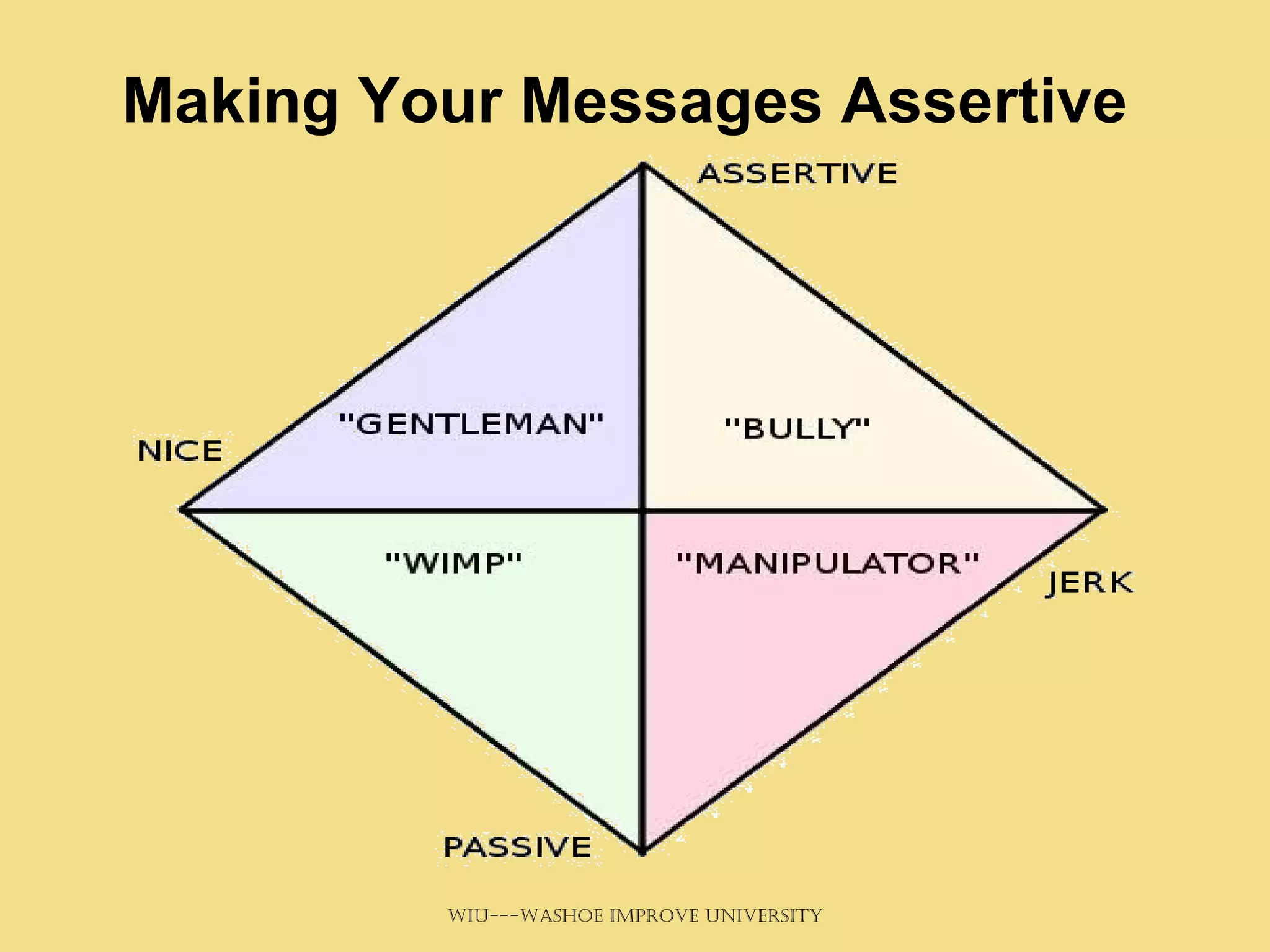
  • #29 In this matrix you can see how there are basically four categories you can fall into at anytime, depending on how you react to a situation. Anywhere along the bottom vertical line would be passive aggressive…a wimp on the verge of manipulator/bully. The other end or tip top would be the assertive. We need to be careful not to go over the line to Bully.
  • #30 We also want to Avoid destructive patterns of conflict - Let’s learn a bit more about this pattern so we can avoid it. There are three (3) roles in the drama triangle that cause a pattern of conflict Everyone knows how to assume one of the three roles Everyone has a favorite role Learned from childhood it is very practiced
  • #31 The Pattern of Conflict begins with the Victim Role Nonassertive, inadequate, helpless, sad, scared, guilty, I’m NOT OK. Stress or low self-esteem attracts rescuers or persecutors .
  • #32 The Rescuer is Nonassertive or aggressive, won’t say “NO”, assumes superiority over victim . SPEAKER NOTES: Read three roles then read this example EXAMPLE: Rescuer - A woman was preparing to drive a nail for hanging a picture on the wall of her home, she felt the hammer being removed from her hand and heard her husband say, “Here, dear, let me do that so you won’t hurt yourself.” He probably wasn’t aware of how condescending his uninvited rescue was to his wife who was quite capable of driving the nail all by herself! Either form of Rescue will communicate the same message to the Victim player: ‘You are Not OK’ and the person is reinforced for seeing themselves as inadequate. The three roles involve either perceiving yourself as ‘Not OK’ or someone else as ‘Not OK’. The only behaviors involved (nonassertive and aggressive) are ones that lead to win-lose outcomes. As long as people stay in the roles there is no possibility of a win-win resolution!
  • #33 The persecutor is Aggressive, attacking, direct or indirect sabotage, angry, righteous, superior…Makes victims feel they are NOT OK! How do we avoid this getting caught in the middle of this triangle??? Only assertiveness all the time will avoid falling into the triangle, especially when you’re tempted to be aggressive or nonassertive. (honest, appropriate, respectful and direct…very hard to do all the time) It’s a behavior style that communicates “I’m Okay, You’re Okay”! Eliminate words and phrases such as ‘you know’, ‘maybe’, ‘kind of’, ‘sort of’, ‘only’, ‘just’, ‘I guess’, etc. Compare the following: “ You know, maybe we could sort of change our approach and get a little better result.” VICTIM “ I suggest we change our approach to see if we can get a better result.” “ Oh, that’s okay. It was only a suggestion.” “ Oh, that’s okay. I thought it was an idea worth considering.” Avoid exaggerations and negative judgments. Compare the following: “ Those idiots never do it right the first time!” PERSECUTOR “ These inaccuracies are happening too often !” Use polite commands or a direct request when you want someone to do something for you. Compare: “ Would you mind doing this so I can get to my meeting on time?” (only asks the person to consider doing it – does not ask them to do it) “ Will you please do this so I can get to my meeting on time?” “ Can you prepare a summary of what we discussed?” (asks if the person is capable of doing it) “ Will you prepare a summary of what we discussed?” “ Why don’t you use some visuals to make the presentation more appealing?” (asks the person to think about reasons not to do it) “ Please add some visuals to make the presentation more appealing.”
  • #34 Just as we’ve practiced our destructive roles since childhood, so must we practice our new roles.
  • #35 There is a 4 step process for communicating more assertively. We start by preparing a script, of what you might want to say in a certain situation, then practicing it over and over to make sure we are comfortable with it. A tool for preparing your script is the 4 step DESC process. It h elps you prepare and deliver successful assertive scripts D = Describe E = Express S = Specify C = Consequences Let’s take a closer look at each step…
  • #36 “ Each step addresses a certain goal”   Describe : Objectively describe the problem to the target person, the one who can do something to help resolve it. Be very specific, stating when, where and why the problem occurs. This 4 step technique was originally formulated for the book “Asserting Yourself” – recommended reading!
  • #37 The E is for Express : Using restraint, calmly express how you feel. Remember to focus on the problem, not the person who’s causing or contributing to it.
  • #38 Specify: Carefully explain how you would like the problem to be solved and be willing to compromise a bit to reach a solution. Remember, you’re making a request , not a demand . If the compromise feels like a sacrifice, reconsider what they are asking you for. Don’t be afraid to turn down the offer or re-negotiate.
  • #39 Consequences: Lay your cards on the table. Tell the target person about the positive consequences or “rewards” that will result if she helps solve the problem. If the target person isn’t willing to help, outline the negative consequences or “punishments” that will result. Then be prepared to follow through. SPEAKER NOTES : Group Exercise… Let’s look at an example (next slide)
  • #44 When using this 4 step process (or any kind of assertive communication), remember to carefully choose your words to emit the proper response. Your words can tremendously affect how people respond to you and your requests. And that is important for us to feel good about what we can accomplish. Write your plan down and practice until you know you can pull it off without a hitch.
  • #45 The Benefits of Being Assertive Each year, companies spend billion$ upgrading employee skills. What many of them don’t realize is that assertiveness training can also affect things like customer satisfaction , productivity and profitability . By offering assertiveness training, companies can teach their employees to solve problems through cooperation and negotiation. That is just one of many benefits.
  • #46 Every problem seems to have a “win-win” solution. Assertive communicators first ask what the other person wants, then quickly negotiate a solution all can live with. Resentment and frustration that typically block peak performance are minimized because problems are solved quickly. Employees become problem-solvers instead of victims. Teamwork becomes commonplace. While victims typically feel paralyzed by the system they can’t control, assertive people feel empowered to find solutions.
  • #47 Assertive behavior reduces stress because people feel less like victims and more like they can influence decisions. Employees stop procrastinating and start acting. They ask, “What will it take to make my wish (or goal) a reality?” Communication becomes clearer, which reduces misunderstandings and clarifies expectations. Phrases like “I thought you meant ... ” virtually disappear. People have a voice to say what’s on their minds. They aren’t afraid their ideas will be shot down and ignored.
  • #48 Employees concentrate on what’s within their control, rather than what’s beyond their control. Example : you can always control how you react to a situation, but you can’t control how others react. Instead of wasting time by gossiping and complaining — which accomplish nothing — employees focus on the positive, productive steps they can take to solve problems.
  • #49 As you can see, it pays to be assertive in the workplace, especially when change and uncertainty are the only constants in today’s business world. Being assertive gives you the confidence and communication skills to go after and get what you really want. After all, if you don’t stand up for yourself, no one else will.
  • #50 Next Slide – recommended reading.