The document discusses visual communication and its importance in business. It defines visual communication as the expression of ideas using visible forms like photographs, charts and diagrams. Visual communication is more memorable than verbal communication alone. The document provides examples showing people remember visual information better and are twice as likely to achieve objectives when visual aids are used. It discusses selecting the right type of visual for the audience and topic, and producing and integrating visuals for effective communication through understanding the subject, audience and developing a theme.
ContentsContents
1. Introduction toVisual Communication
2. Importance of Visual Communication in Business
3. A Few Examples to Illustrate
4. Selecting the Right Type of Visuals
5. Producing and Integrating Visuals for Effective
Communication
6. Conclusions
12/21/16 2Designing Visual Communication
3.
1. Introduction toVisual Communication1. Introduction to Visual Communication
The expression of ideas and information using
visible forms or aids is referred to as visual
communication.
In fact, it is a pictorial form of communication.
Body language including gestures are part of such
communication in business.
Presentations may also include photographs,
charts, graphs, and diagrams to enforce or
demonstrate ideas or data.
Visual communication also includes traffic signals,
hoarding boards and paintings too.12/21/16 3Designing Visual Communication
4.
2. Importance ofVisual Communication in Business2. Importance of Visual Communication in Business
1.1. People rememberPeople remember what they seewhat they see so much moreso much more
than what they hear.than what they hear.
2.2. Visual thingsVisual things have direct route tohave direct route to long-termlong-term
memorymemory of the audience.of the audience.
3.3. Research supports that visual communication canResearch supports that visual communication can
be more powerful than verbal communication.be more powerful than verbal communication.
4.4. The more visual content in a presentation, theThe more visual content in a presentation, the
more memorable will the information be.more memorable will the information be.
5.5. People not only communicate visually more thanPeople not only communicate visually more than
ever, they also communicate better when theyever, they also communicate better when they
communicate visually.communicate visually. Let’s talk about a few
examples in business12/21/16 4Designing Visual Communication
5.
3. A FewExamples to Illustrate3. A Few Examples to Illustrate
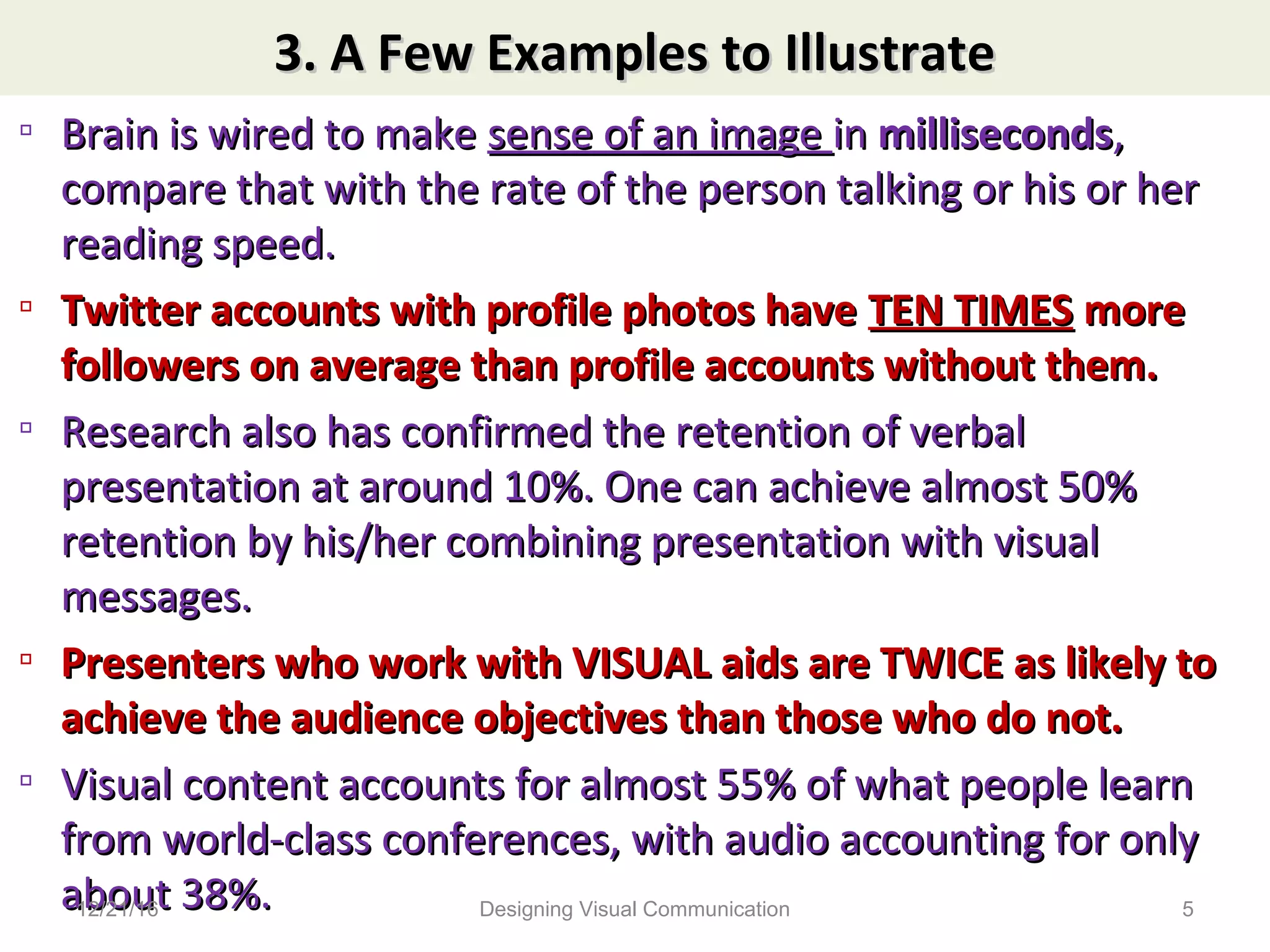
▫ Brain is wired to makeBrain is wired to make sense of an imagesense of an image inin millisecondsmilliseconds,,
compare that with the rate of the person talking or his or hercompare that with the rate of the person talking or his or her
reading speed.reading speed.
▫ Twitter accounts with profile photos haveTwitter accounts with profile photos have TEN TIMESTEN TIMES moremore
followers on average than profile accounts without them.followers on average than profile accounts without them.
▫ Research also has confirmed the retention of verbalResearch also has confirmed the retention of verbal
presentation at around 10%. One can achieve almost 50%presentation at around 10%. One can achieve almost 50%
retention by his/her combining presentation with visualretention by his/her combining presentation with visual
messages.messages.
▫ Presenters who work with VISUAL aids are TWICE as likely toPresenters who work with VISUAL aids are TWICE as likely to
achieve the audience objectives than those who do not.achieve the audience objectives than those who do not.
▫ Visual content accounts for almost 55% of what people learnVisual content accounts for almost 55% of what people learn
from world-class conferences, with audio accounting for onlyfrom world-class conferences, with audio accounting for only
about 38%.about 38%.12/21/16 5Designing Visual Communication
6.
4. Selecting theRight Type of Visuals4. Selecting the Right Type of Visuals
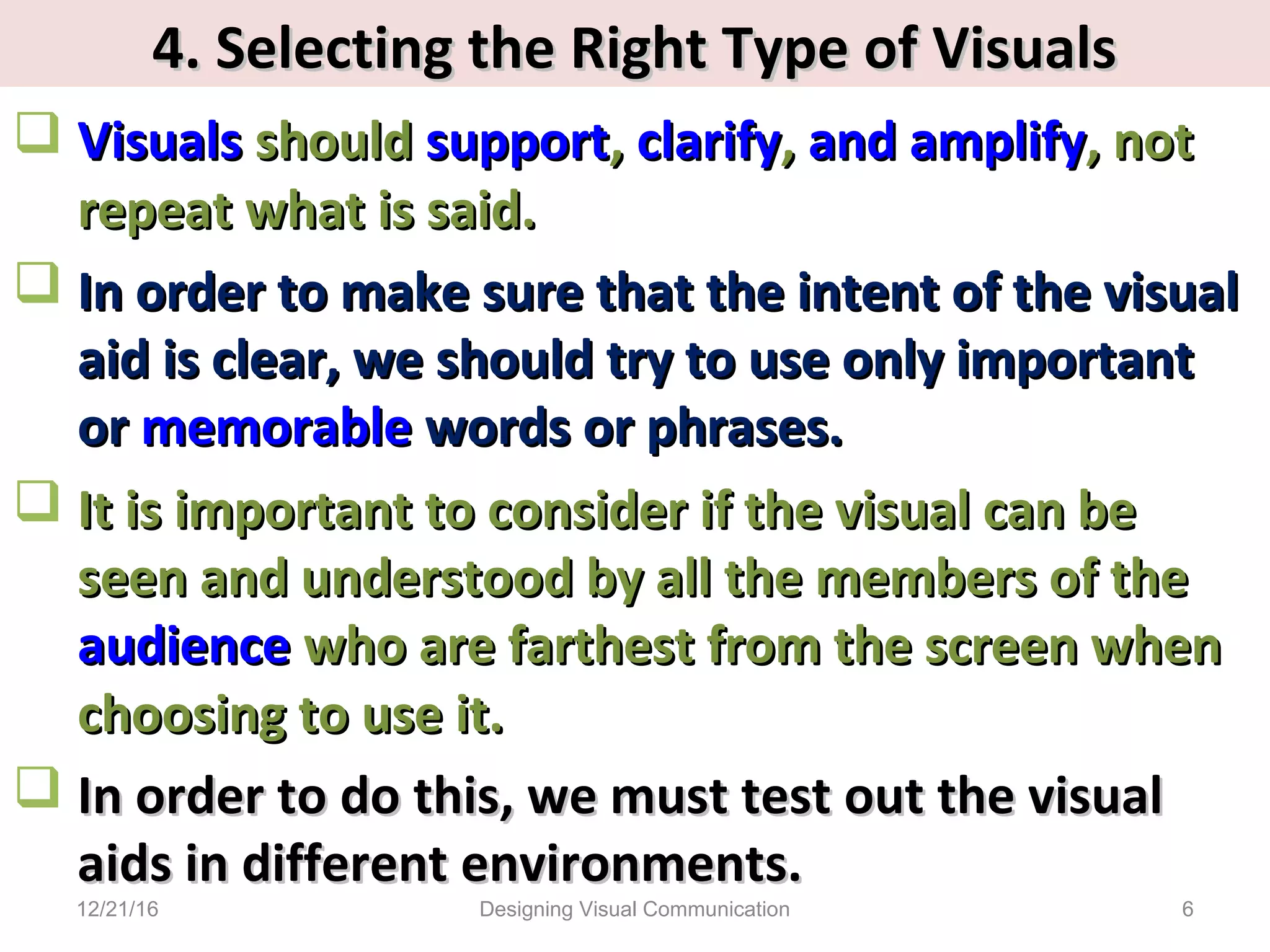
VisualsVisuals shouldshould supportsupport,, clarifyclarify,, andand amplifyamplify, not, not
repeat what is said.repeat what is said.
In order to make sure that the intent of the visualIn order to make sure that the intent of the visual
aid is clear, we should try to use only importantaid is clear, we should try to use only important
oror memorablememorable words or phrases.words or phrases.
It is important to consider if the visual can beIt is important to consider if the visual can be
seen and understood by all the members of theseen and understood by all the members of the
audienceaudience who are farthest from the screen whenwho are farthest from the screen when
choosing to use it.choosing to use it.
In order to do this, we must test out the visualIn order to do this, we must test out the visual
aids in different environments.aids in different environments.
12/21/16 6Designing Visual Communication
7.
4. Selecting theRight Type of Visuals…4. Selecting the Right Type of Visuals…
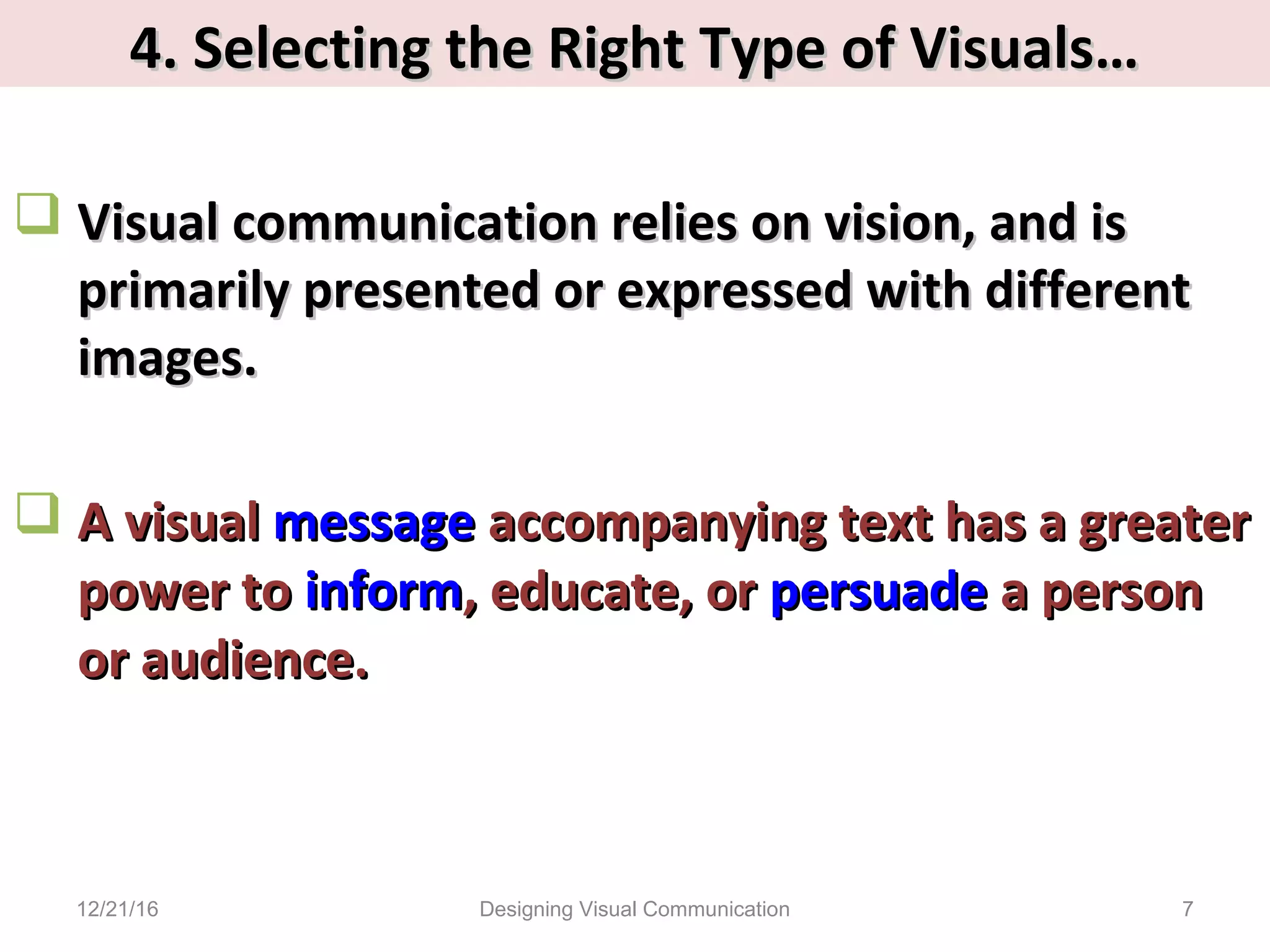
Visual communication relies on vision, and isVisual communication relies on vision, and is
primarily presented or expressed with differentprimarily presented or expressed with different
images.images.
A visualA visual messagemessage accompanying text has a greateraccompanying text has a greater
power topower to informinform, educate, or, educate, or persuadepersuade a persona person
or audience.or audience.
12/21/16 7Designing Visual Communication
8.
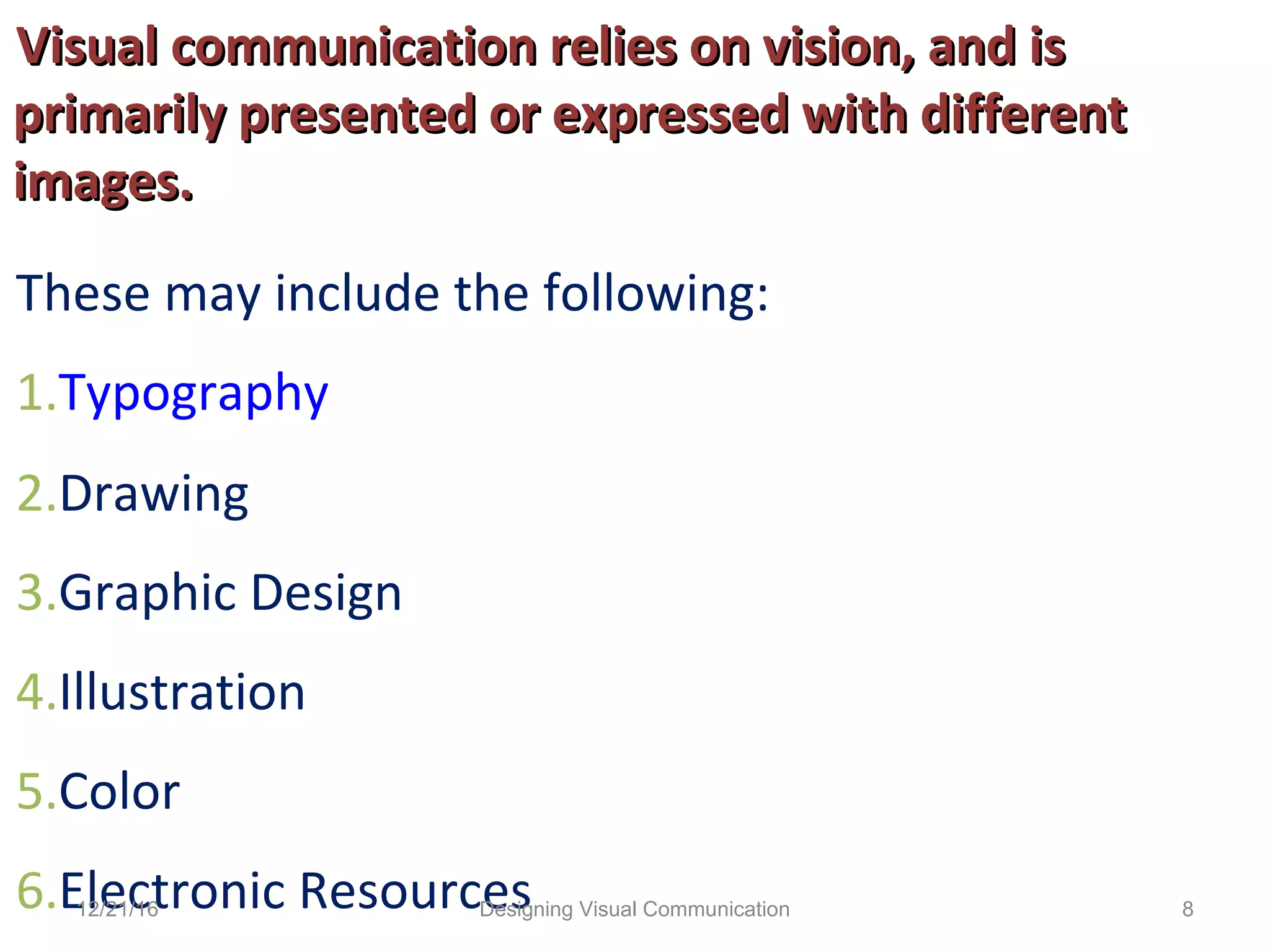
Visual communication relieson vision, and isVisual communication relies on vision, and is
primarily presented or expressed with differentprimarily presented or expressed with different
images.images.
These may include the following:
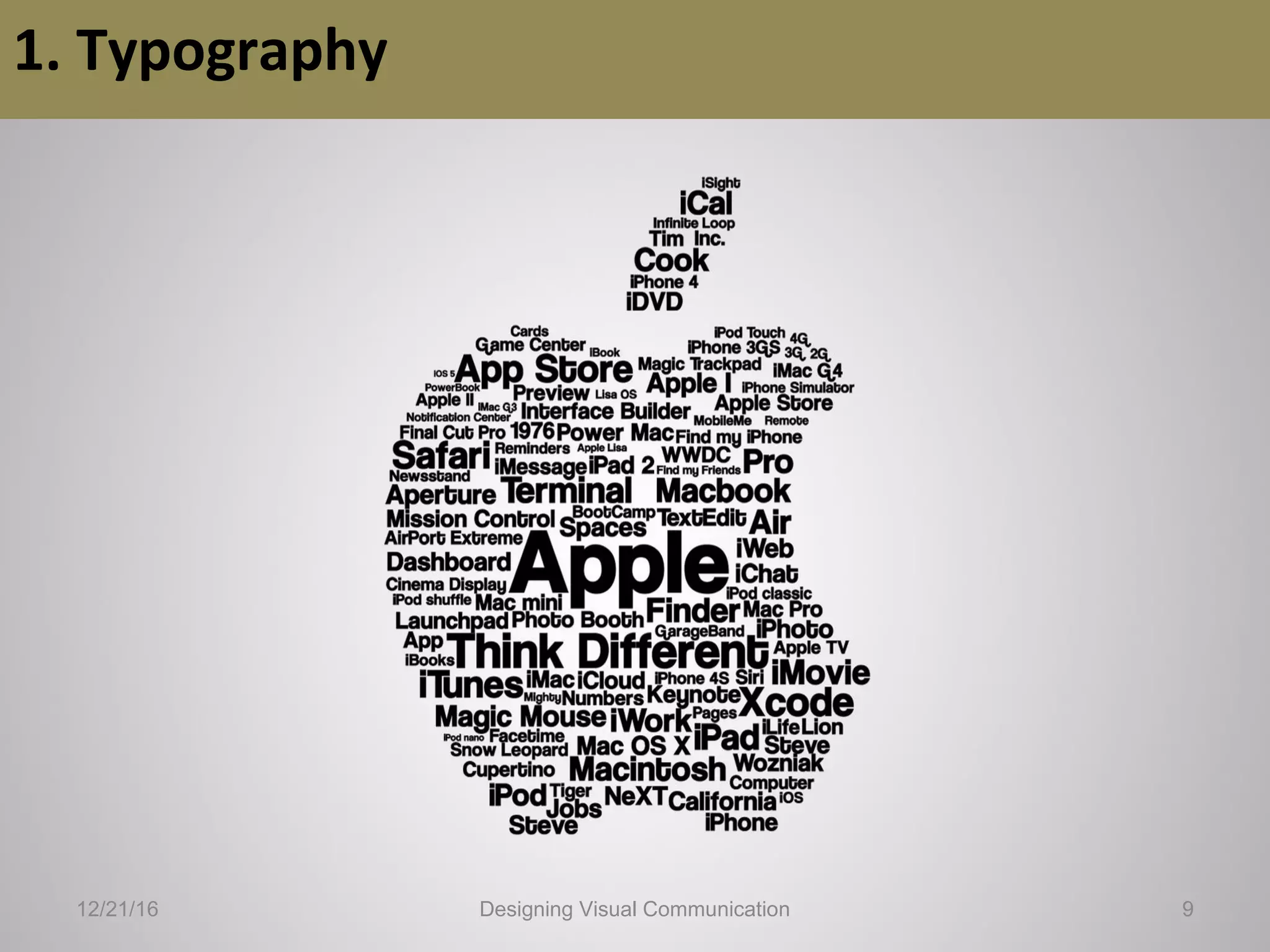
1.Typography
2.Drawing
3.Graphic Design
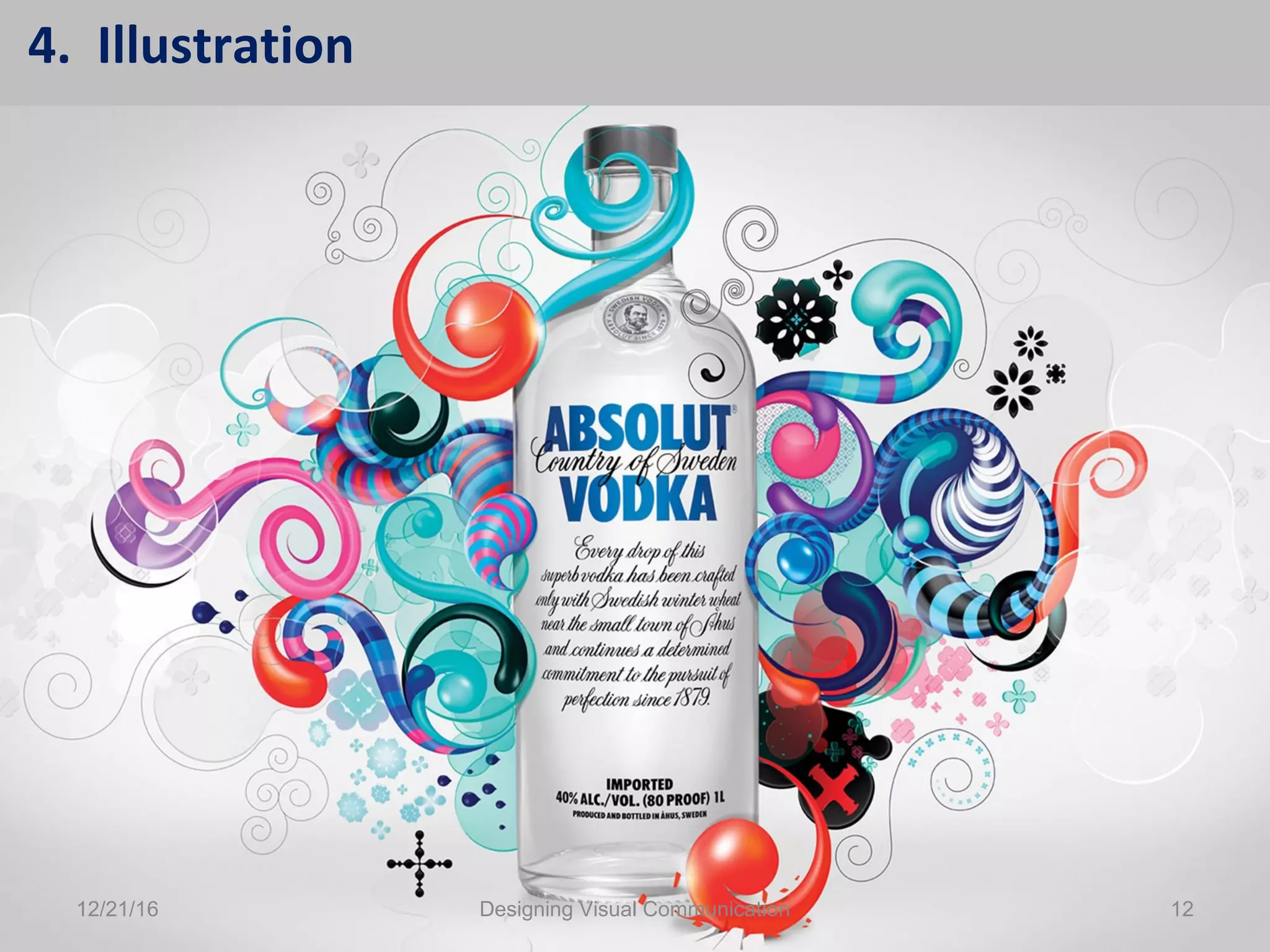
4.Illustration
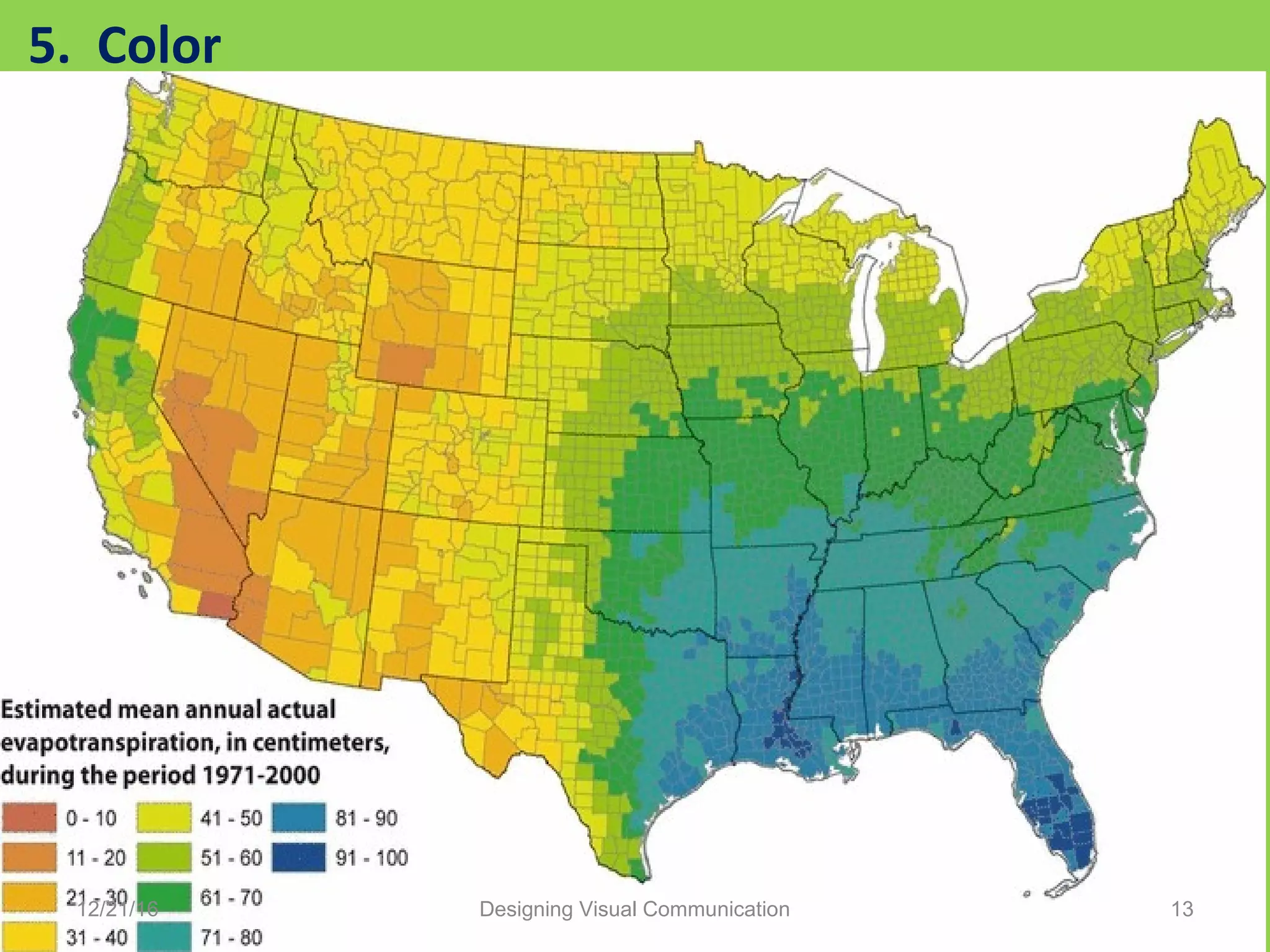
5.Color
6.Electronic Resources12/21/16 8Designing Visual Communication
5. Producing andIntegrating Visuals for5. Producing and Integrating Visuals for
Effective CommunicationEffective Communication
1.1. Know the subject matterKnow the subject matter: The ability to present a: The ability to present a
subject with confidence directly affects the audiencesubject with confidence directly affects the audience
impression and will help keep their attention.impression and will help keep their attention.
2.2. Know the audienceKnow the audience: A: A small amount of researchsmall amount of research
into the makeup of audience will reap large benefitsinto the makeup of audience will reap large benefits
on the presentation day.on the presentation day.
3.3. Know yourselfKnow yourself: We all must push our limits and: We all must push our limits and
willingly bite off more than we may be comfortablewillingly bite off more than we may be comfortable
swallowing on occasion -- this is how we learn andswallowing on occasion -- this is how we learn and
grow.grow.
12/21/16 15Designing Visual Communication
16.
4. Develop atheme4. Develop a theme: All presentations, regardless of: All presentations, regardless of
their complexity, are designed with a single purposetheir complexity, are designed with a single purpose
-- whether it is to sell, educate, or for pure-- whether it is to sell, educate, or for pure
entertainment – and the theme must be builtentertainment – and the theme must be built
around the purpose of communication.around the purpose of communication.
5. Prepare a script5. Prepare a script: The script does not necessarily: The script does not necessarily
have to be a work of literary excellence, anyhave to be a work of literary excellence, any
presentation scripts shares four basic parts: opening,presentation scripts shares four basic parts: opening,
body , summary and closing.body , summary and closing.
6. Select the proper visual ads6. Select the proper visual ads: Good presentation: Good presentation
visuals, regardless of the display medium, do notvisuals, regardless of the display medium, do not
have to be expensive. When properly planned andhave to be expensive. When properly planned and
produced, simple, well designed graphics addproduced, simple, well designed graphics add12/21/16 16Designing Visual Communication
17.
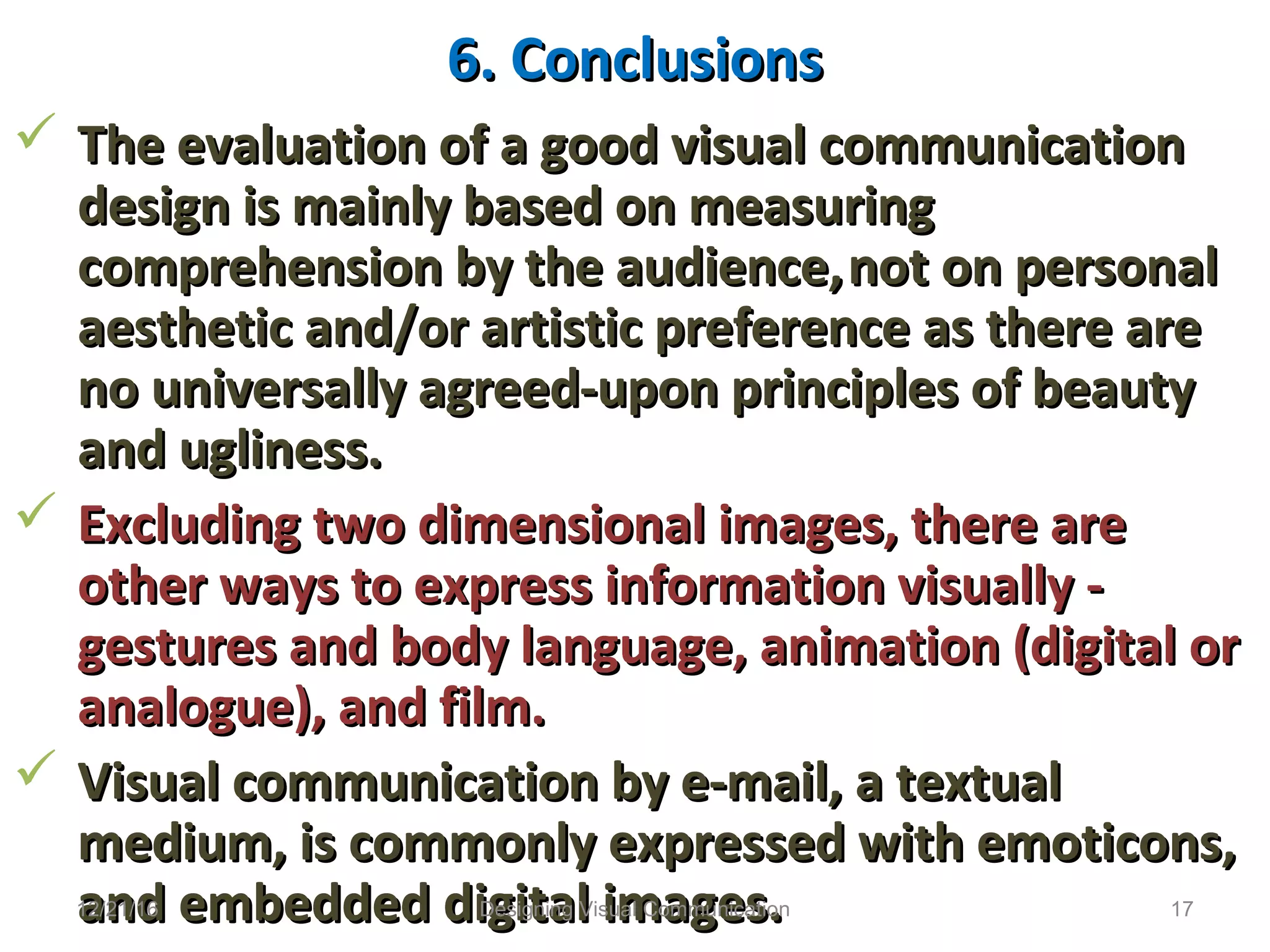
6. Conclusions6. Conclusions
The evaluation of a good visual communicationThe evaluation of a good visual communication
design is mainly based on measuringdesign is mainly based on measuring
comprehension by the audience,comprehension by the audience,not on personalnot on personal
aesthetic and/or artistic preference as there areaesthetic and/or artistic preference as there are
no universally agreed-upon principles of beautyno universally agreed-upon principles of beauty
and ugliness.and ugliness.
Excluding two dimensional images, there areExcluding two dimensional images, there are
other ways to express information visually -other ways to express information visually -
gestures and body language, animation (digital orgestures and body language, animation (digital or
analogue), and film.analogue), and film.
Visual communication by e-mail, a textualVisual communication by e-mail, a textual
medium, is commonly expressed with emoticons,medium, is commonly expressed with emoticons,
and embedded digital images.and embedded digital images.12/21/16 17Designing Visual Communication