Presented By:
Suman Subedi
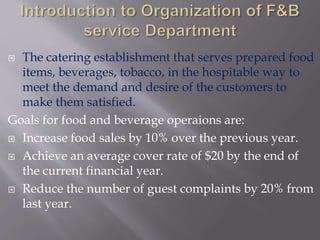
 The catering establishment that serves prepared food
items, beverages, tobacco, in the hospitable way to
meet the demand and desire of the customers to
make them satisfied.
Goals for food and beverage operaions are:
 Increase food sales by 10% over the previous year.
 Achieve an average cover rate of $20 by the end of
the current financial year.
 Reduce the number of guest complaints by 20% from
last year.
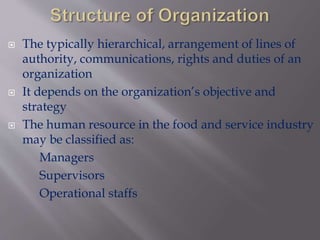
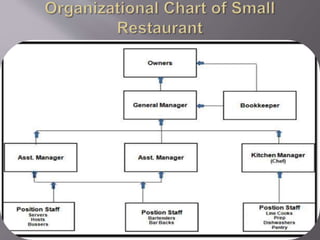
 The typically hierarchical, arrangement of lines of
authority, communications, rights and duties of an
organization
 It depends on the organization’s objective and
strategy
 The human resource in the food and service industry
may be classified as:
Managers
Supervisors
Operational staffs
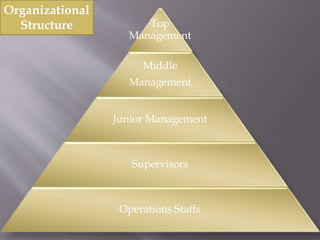
Top
Management
Middle
Management
Junior Management
Supervisors
Operations Staffs
Organizational
Structure
It is a documented profile of a Job. It has several
benefits to the individual and organizations such
as :
 It helps both a superior and subordinate to have
a common perspective of the job.
 It is a legal document in the case of any litigation
between the employer and employee.
 It acts as the basis of training an employee.
 It acts as the basis of evaluating an employee’s
performance.
Now, lets study the brief
Job descriptions of some
restaurant positions
 Reports to: F&B Manager and General Manager
 Job summary: To recommend and meet budgets
and goals by leading a service team that ensures
quality service standards with personalized guest
attention.
 Supervises: Senior captain, captains, hostess,
servers, busboys and apprentices
 Limits of authority: Evaluate performance of staff,
discipline of staff, can void checks
 Reports to: Restaurant manager and F&B Manager
 Job Summary: Organize, supervise and train all
service personnel in the restaurant with a view to
providing quick and personalized food and
beverage service to guests.
 Supervises: Restaurant captains, hostess, servers
and apprentices.
 Limits of authority: Recommending authority but
initiates the performance appraisals of staff for the
final approval of the manager.
 Reports to: Senior Captain and Restaurant Manager
 Job Summary: To organize and supervise an
assigned restaurant station with a view to providing
fast and efficient food and beverage service.
 Supervises: Servers, busboy and apprentices in
his/her charge
 Limits of authority: Only advisory to the Captain
 Reports to: Captain and Senior Captain
 Job Summary: To provide quick and personalized
food and beverage service to guests at allotted
tables as per standards of service laid down and to
guest satisfaction
 Supervises: Assistant waiters, busboys and trainees.
 Limits of Authority: None
 Reports to: Senior Captain and Restaurant Manager
 Job Summary: To receive and record table
reservations requested for the restaurant. To extend
warm and courteous welcome and hospitality to
guests visiting the restaurant and allot them a table.
 Supervises: None
 Limits of authority: Can allocate tables
independently
 Reports to: Station Captain and Senior Captain.
 Job Summary: To provide supportive help to
stewards in mis-en-place, clearance of soiled
dishes, table set-ups, replenishing guest water and
drinks, and ultimate food and beverage service to
guests.
 Supervises: None
 Limits of Authority: None
 Reports to: Senior Captain and Restaurant
Manager
 Job Summary: To present and serve wine and
spirits to guests as per the standards of the
establishment
 Supervises: None
 Limits of authority: May dialogue with guest
directly to procure business
 Food and Beverage is very lucrative as it
satisfies a basic physiological need of all
human being to survive.
 No matter how basic or elaborate the
operation is, food and beverage is a safe
business because people must eat and drink.
 The basic objective of food and beverage is to
provide food and beverage to identified
market segments.
The responsibilities of food and
beverage operations are as follows:
 Plan menus that are compatible to the expectation of the
market segment.
 Set standards of raw materials required to fulfill the
menu.
 Reconcile actual performance with budgeted
performance.
 Train and motivate staff to provide the perfect dining
experience.
 Evaluate performance and taking corrective measures.
 Procure, receive and store the raw materials so
that there is minimum spoilage.
 Use correct procedures for food preparation to
attain consistency.
 Control the flow of material and services as to
ensure cost effective operation.
 Macro Environment:
o It is the larger external surroundings that
influence and operation.
o It is largely unpredictable and uncontrollable.
o Such influence have to be respected to survive in
the community.
Now, lets talk about
different macro
Environments
1. Political Environment:
o Labor that includes minimum wages, working hours
etc.
o Taxes to provide infrastructure.
o Environmental issues such as pollution, garbage
disposal.
2. Economic Environment:
o Influences the success of business.
o Interest rate on borrowed capital.
o Regional development.
3. Social Environment:
o Ethics in doing business.
o Food habits of target markets.
o Religious restriction like no beef for Indians and no pork
for Muslim.
4. Technological Environment:
o Information technology has influenced how information
is proceed.
o Mechanism of work method has greatly influenced food
preparation.
5. Media:
o Food promotions.
o Provide employment to the local people.
o Having a system of receiving guest comment and
acting upon them.
Micro Environment
1 .Customers:
o The satisfaction of their needs and wants.
o Life style and habits.
o Getting value of money.
2. Employees:
o Availability of skilled workers.
o Providing career advancement.
o Motivating their staff.
3. Suppliers
o Availability of raw materials round the years.
o Increasing transportation cost.
4. Service Agencies:
o Providing license to do the business.
o Giving license to operate a bar.
o Internal revenue that governs sales tax and income
tax.
Food and beverage service department

Food and beverage service department

  • 1.
  • 2.
     The cateringestablishment that serves prepared food items, beverages, tobacco, in the hospitable way to meet the demand and desire of the customers to make them satisfied. Goals for food and beverage operaions are:  Increase food sales by 10% over the previous year.  Achieve an average cover rate of $20 by the end of the current financial year.  Reduce the number of guest complaints by 20% from last year.
  • 3.
     The typicallyhierarchical, arrangement of lines of authority, communications, rights and duties of an organization  It depends on the organization’s objective and strategy  The human resource in the food and service industry may be classified as: Managers Supervisors Operational staffs
  • 6.
  • 7.
    It is adocumented profile of a Job. It has several benefits to the individual and organizations such as :  It helps both a superior and subordinate to have a common perspective of the job.  It is a legal document in the case of any litigation between the employer and employee.  It acts as the basis of training an employee.  It acts as the basis of evaluating an employee’s performance. Now, lets study the brief Job descriptions of some restaurant positions
  • 8.
     Reports to:F&B Manager and General Manager  Job summary: To recommend and meet budgets and goals by leading a service team that ensures quality service standards with personalized guest attention.  Supervises: Senior captain, captains, hostess, servers, busboys and apprentices  Limits of authority: Evaluate performance of staff, discipline of staff, can void checks
  • 9.
     Reports to:Restaurant manager and F&B Manager  Job Summary: Organize, supervise and train all service personnel in the restaurant with a view to providing quick and personalized food and beverage service to guests.  Supervises: Restaurant captains, hostess, servers and apprentices.  Limits of authority: Recommending authority but initiates the performance appraisals of staff for the final approval of the manager.
  • 10.
     Reports to:Senior Captain and Restaurant Manager  Job Summary: To organize and supervise an assigned restaurant station with a view to providing fast and efficient food and beverage service.  Supervises: Servers, busboy and apprentices in his/her charge  Limits of authority: Only advisory to the Captain
  • 11.
     Reports to:Captain and Senior Captain  Job Summary: To provide quick and personalized food and beverage service to guests at allotted tables as per standards of service laid down and to guest satisfaction  Supervises: Assistant waiters, busboys and trainees.  Limits of Authority: None
  • 12.
     Reports to:Senior Captain and Restaurant Manager  Job Summary: To receive and record table reservations requested for the restaurant. To extend warm and courteous welcome and hospitality to guests visiting the restaurant and allot them a table.  Supervises: None  Limits of authority: Can allocate tables independently
  • 13.
     Reports to:Station Captain and Senior Captain.  Job Summary: To provide supportive help to stewards in mis-en-place, clearance of soiled dishes, table set-ups, replenishing guest water and drinks, and ultimate food and beverage service to guests.  Supervises: None  Limits of Authority: None
  • 14.
     Reports to:Senior Captain and Restaurant Manager  Job Summary: To present and serve wine and spirits to guests as per the standards of the establishment  Supervises: None  Limits of authority: May dialogue with guest directly to procure business
  • 15.
     Food andBeverage is very lucrative as it satisfies a basic physiological need of all human being to survive.  No matter how basic or elaborate the operation is, food and beverage is a safe business because people must eat and drink.  The basic objective of food and beverage is to provide food and beverage to identified market segments.
  • 16.
    The responsibilities offood and beverage operations are as follows:  Plan menus that are compatible to the expectation of the market segment.  Set standards of raw materials required to fulfill the menu.  Reconcile actual performance with budgeted performance.  Train and motivate staff to provide the perfect dining experience.  Evaluate performance and taking corrective measures.
  • 17.
     Procure, receiveand store the raw materials so that there is minimum spoilage.  Use correct procedures for food preparation to attain consistency.  Control the flow of material and services as to ensure cost effective operation.
  • 18.
     Macro Environment: oIt is the larger external surroundings that influence and operation. o It is largely unpredictable and uncontrollable. o Such influence have to be respected to survive in the community. Now, lets talk about different macro Environments
  • 19.
    1. Political Environment: oLabor that includes minimum wages, working hours etc. o Taxes to provide infrastructure. o Environmental issues such as pollution, garbage disposal. 2. Economic Environment: o Influences the success of business. o Interest rate on borrowed capital. o Regional development.
  • 20.
    3. Social Environment: oEthics in doing business. o Food habits of target markets. o Religious restriction like no beef for Indians and no pork for Muslim. 4. Technological Environment: o Information technology has influenced how information is proceed. o Mechanism of work method has greatly influenced food preparation.
  • 21.
    5. Media: o Foodpromotions. o Provide employment to the local people. o Having a system of receiving guest comment and acting upon them.
  • 22.
    Micro Environment 1 .Customers: oThe satisfaction of their needs and wants. o Life style and habits. o Getting value of money. 2. Employees: o Availability of skilled workers. o Providing career advancement. o Motivating their staff.
  • 23.
    3. Suppliers o Availabilityof raw materials round the years. o Increasing transportation cost. 4. Service Agencies: o Providing license to do the business. o Giving license to operate a bar. o Internal revenue that governs sales tax and income tax.