DEVELOPING A BRAND
EQUITY MEASUREMENT
AND
MANAGEMENT SYSTEM
New Accountability
“Return of marketing investment” (ROMI)
Increase in Accountability forced marketers to address
tough challenges and develop new measurement
approach
Brand as a asset- ability to generate future cash flow
Create value by changing customer behavior not
changing attitude
The Brand Value Chain
Broader perspective than just the CBBE model
The brand value chain is a structured approach to
assessing the sources and outcomes of brand equity
and the manner by which marketing activities create
brand value.
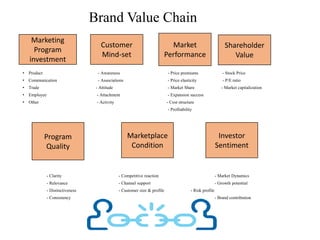
• Product - Awareness - Price premiums - Stock Price
• Communication - Associations - Price elasticity - P/E ratio
• Trade - Attitude - Market Share - Market capitalization
• Employee - Attachment - Expansion success
• Other - Activity - Cost structure
- Profitability
- Clarity - Competitive reaction - Market Dynamics
- Relevance - Channel support - Growth potential
- Distinctiveness - Customer size & profile - Risk profile
- Consistency - Brand contribution
Customer
Mind-set
Marketing
Program
investment
Market
Performance
Shareholder
Value
Program
Quality
Marketplace
Condition
Investor
Sentiment
Brand Value Chain
Value Stages
Marketing program investment- Any marketing program that
can be attributed to brand value development
• Customer mind-set: In what way have customers been
changed as a result of the marketing program?
Five dimension came out from CBBE model-
Brand awareness
Brand association
Brand attitude
Brand attachment
Brand activity
Value Stages
Market Performance- How do customers respond
in the marketplace?
Shareholder value
Multipliers
Program Quality Multiplier- ability of marketing program to
affect customer mind-set depend on its quality
Clarity
Relevance
Distinctiveness
Consistency
Marketplace Conditions Multiplier- The extent to which
value created in the minds of customers affects market
performance depends on
Competitive reaction
Channel support
Customer size & profile
Multipliers
Investor Sentiment Multiplier: The extent to which
the value generated through brand market
performance is manifested in shareholder value It
depends on
Dynamics
Growth potential
Risk profile and
Brand contribution
Brand Equity Measurement System
A set of research procedures that is designed to
provide timely, accurate, and actionable information
for marketers so that they can make the best possible
tactical decisions in the short run and strategic
decisions in the long run
Brand Equity Measurement System
Conducting brand audits
Developing tracking procedures
Designing a brand equity management system
Designing Brand Tracking Studies
Tracking studies involve information collected from
consumers on a routine basis over time
Often done on a “continuous” basis
Provide descriptive and diagnostic information
What To Track
Customize tracking surveys to address the specific
issues faced by the brand
Product-brand tracking
Corporate or family brand tracking
Global tracking
How to Conduct Tracking Studies
Who to track (target market)
When and where to track (how frequently)
How to interpret brand tracking

Chapter 8 (developing a brand equity measurement and management system)

  • 1.
    DEVELOPING A BRAND EQUITYMEASUREMENT AND MANAGEMENT SYSTEM
  • 2.
    New Accountability “Return ofmarketing investment” (ROMI) Increase in Accountability forced marketers to address tough challenges and develop new measurement approach Brand as a asset- ability to generate future cash flow Create value by changing customer behavior not changing attitude
  • 3.
    The Brand ValueChain Broader perspective than just the CBBE model The brand value chain is a structured approach to assessing the sources and outcomes of brand equity and the manner by which marketing activities create brand value.
  • 4.
    • Product -Awareness - Price premiums - Stock Price • Communication - Associations - Price elasticity - P/E ratio • Trade - Attitude - Market Share - Market capitalization • Employee - Attachment - Expansion success • Other - Activity - Cost structure - Profitability - Clarity - Competitive reaction - Market Dynamics - Relevance - Channel support - Growth potential - Distinctiveness - Customer size & profile - Risk profile - Consistency - Brand contribution Customer Mind-set Marketing Program investment Market Performance Shareholder Value Program Quality Marketplace Condition Investor Sentiment Brand Value Chain
  • 5.
    Value Stages Marketing programinvestment- Any marketing program that can be attributed to brand value development • Customer mind-set: In what way have customers been changed as a result of the marketing program? Five dimension came out from CBBE model- Brand awareness Brand association Brand attitude Brand attachment Brand activity
  • 6.
    Value Stages Market Performance-How do customers respond in the marketplace? Shareholder value
  • 7.
    Multipliers Program Quality Multiplier-ability of marketing program to affect customer mind-set depend on its quality Clarity Relevance Distinctiveness Consistency Marketplace Conditions Multiplier- The extent to which value created in the minds of customers affects market performance depends on Competitive reaction Channel support Customer size & profile
  • 8.
    Multipliers Investor Sentiment Multiplier:The extent to which the value generated through brand market performance is manifested in shareholder value It depends on Dynamics Growth potential Risk profile and Brand contribution
  • 9.
    Brand Equity MeasurementSystem A set of research procedures that is designed to provide timely, accurate, and actionable information for marketers so that they can make the best possible tactical decisions in the short run and strategic decisions in the long run Brand Equity Measurement System Conducting brand audits Developing tracking procedures Designing a brand equity management system
  • 10.
    Designing Brand TrackingStudies Tracking studies involve information collected from consumers on a routine basis over time Often done on a “continuous” basis Provide descriptive and diagnostic information
  • 11.
    What To Track Customizetracking surveys to address the specific issues faced by the brand Product-brand tracking Corporate or family brand tracking Global tracking
  • 12.
    How to ConductTracking Studies Who to track (target market) When and where to track (how frequently) How to interpret brand tracking